My 11-year-old son, Ari, is now a Hebrew-school dropout.
I am aware that that’s the name of a comedy act and a line of T-shirts. But, for me, the phrase is not a punch line, but a punch in the gut.
I imagine my response was just like parents whose kids drop out of high school: disbelief, sadness and helplessness followed quickly by a healthy dose of Jewish guilt. “Where did I go wrong?” “What did I do to cause him to reject my contribution to his heritage?”
I realize the situations aren’t exactly comparable. My son, Ari, won’t face difficulties getting into college or landing a good job—at least as a result of this decision. He won’t be walking the streets of New York stopping strangers and saying, “Dude, can you spare a kippah so I can cover my head in synagogue?” On the flip side, there’s no GED equivalent for the bar mitzvah (though an adult bar mitzvah is an option).
My goals for the after-school Hebrew-school program were modest: I knew he wouldn’t become a Judaic scholar, conversant in Jewish history or fluent in Hebrew. I just hoped he’d have fun being Jewish, make a couple of friends in the tribe, and possibly gain enough of a sense of Judaism that he could accept it—or reject it—with some knowledge base.
I suppose I could force Ari to go to Hebrew school. But I worry that it would backfire, that he would end up resenting his Jewish heritage.
When I was growing up, my household changed when my mother married her second husband. My mother was agnostic, her new hubby Orthodox, which made for an interesting combination. The family that had been only loosely affiliated with Judaism started to keep kosher and attend synagogue weekly. And my sister and I ended up at a Jewish high school. I felt like I was being force-fed Judaism as a result of my mother’s second marriage—and it gave me heartburn.
Of course, the effort backfired the minute I moved out of my mother’s house. While I retained a strong sense of Jewish identity, you would never know it if you watched my behavior when I was in college and my early 20s. I avoided synagogue and any Jewish event where my grandparents weren’t in attendance. I ate on Yom Kippur, a traditional fast day, and enjoyed sandwiches during Passover, the week when most Jews eschew leavening. In my late 20s, I married a non-Jew and did not ask him to even consider converting. Although I did warn him that any kids I might have—purely theoretical, mind you—would be Jewish.
My sister has stayed away from all things Jewish. To the best of my knowledge, she hasn’t set foot in a synagogue in the past decade, aside from my daughter’s bat mitzvah. This year, when I invited her to our very low-key seder, she told me it was “too Jewish” for her and her non-Jewish husband.
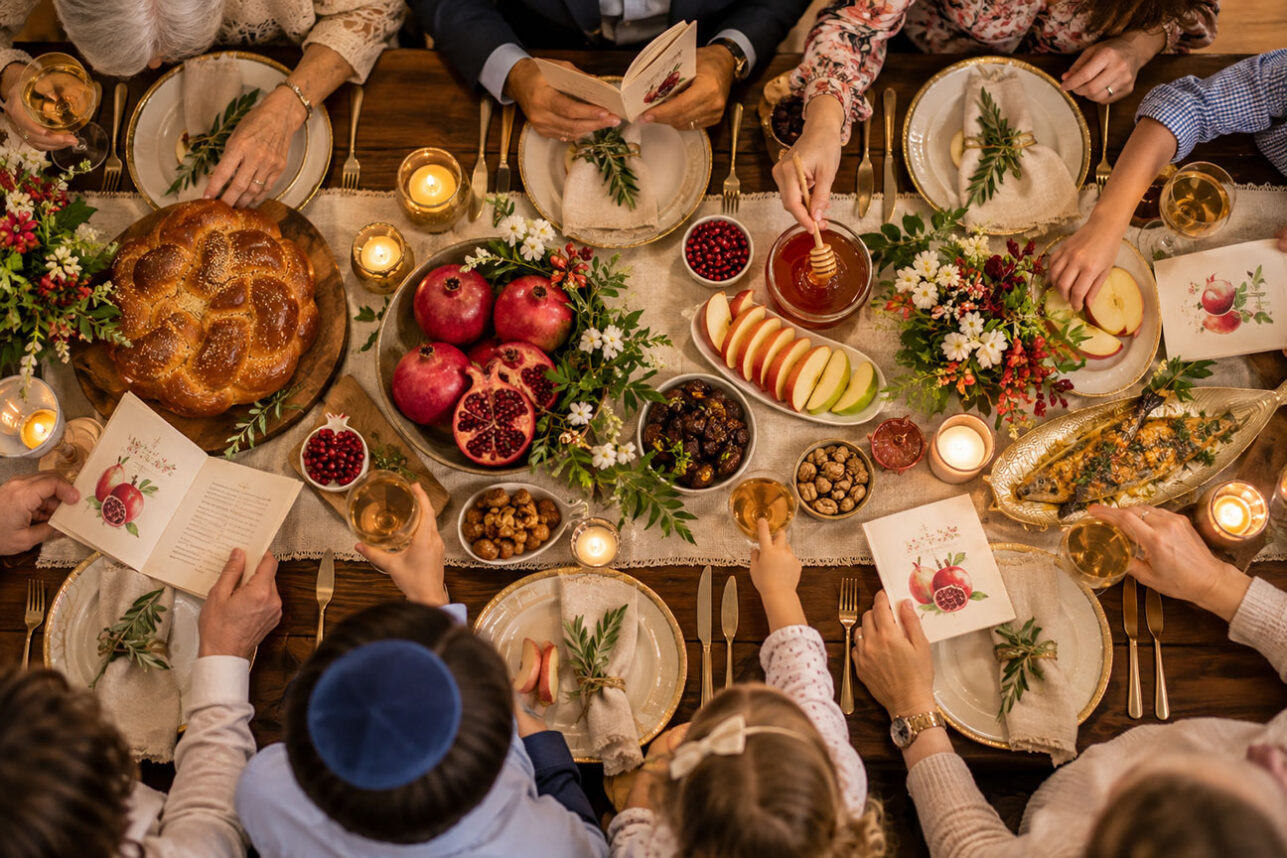
Eventually, in my 30s, I came back to the fold, drop by drop. I added elements as the whim struck, taking a deli-line approach; I picked what was fun or meaningful. I ventured back to synagogue on the High Holy Days, then branched into very occasional Friday night services. My then-husband and I took a trip to Israel and upon our return, he began—of his own accord—the process of converting to Judaism. And once we had children, the process accelerated. The kids thought challah was yummy, so we started to eat it every Friday night. I liked the notion of celebrating freedom, so we had seders at Passover. Of course, we did it in our own style, sitting on the living room floor with bowls of leavening-free chili in our laps.
Then my daughter, who has always identified herself strongly as Jewish, learned the Sabbath prayers at Tot Shabbat and asked that we say them—and provide grape juice—every Friday night. She’s still at it—and now lights the candles for Ari and me every Friday night.
Do I worry too much about Ari and Hebrew school? My daughter says yes; it is his life, she avers. I don’t disagree. It is his life—but I am his mom.
I want to send him into the world with a well-stocked box of life tools. That includes certain skills, such as the ability to tie shoes, use a pair of scissors, design and prepare an assortment of nutritious meals, balance a checkbook and, these days, safely traverse the Internet. It includes some basic habits, such as twice-daily tooth brushing, regular use of “please” and “thank you,” and proper tipping. I also want my children, my son, to have certain psychological tools, such as confidence, hobbies, a sense of humor, an ability to find joy in life—and a sense of who he is and where he comes from. I worry that Ari won’t have a clear sense of who he is and where he comes from as a Jew. It’s as though he’s missing the Phillips-head screwdriver in his toolbox.
What we do, the little steps that we take—or don’t take—every day contribute to our identity. Is Ari denying who he is? After all, renouncing religions is much simpler than “passing” for a different race; it is eminently doable and sadly common.
I’m not giving up on Ari. He will continue to have challah and grape juice every Friday night—and to watch his older sister light the candles. He will continue to celebrate freedom on Passover, throw sponges at the rabbi at the Purim carnival and seek forgiveness around the High Holy Days.
I know my kids are getting mixed messages about being Jewish since their father and I divorced. In my home, we celebrate the holidays, march in the Israel Day parade and generally identify ourselves as Hebes.
My kids say that they are often asked, “Are you half-Jewish?” I know that choosing Judaism means, at least to some extent, picking Mom over Dad—a position neither child (nor I, on most days) relishes.
Judaism is a journey, and everyone takes an individual path. My daughter is taking what seems like a pretty straight line thus far, sticking to the major highways. I took my own spiral approach to identifying as a Jew, pulling away and then cycling back. And Ari will take his own path, though I do worry that he’s wandered off into a field for a nap.
The good news is that he asked to attend the synagogue’s Purim carnival this year—and then put in a plug for a chocolate seder, negotiating the details with his acne-phobic older sister. I am hopeful that this means Ari will wake up from his Hebrew-school nap, grab his well-stocked toolbox, and make a life for himself that includes the joy and pride of being Jewish.
Beth Leibson is a New York-based writer and editor, and author of the book “I’m Too Young to Have Breast Cancer” (Lifeline, 2004).