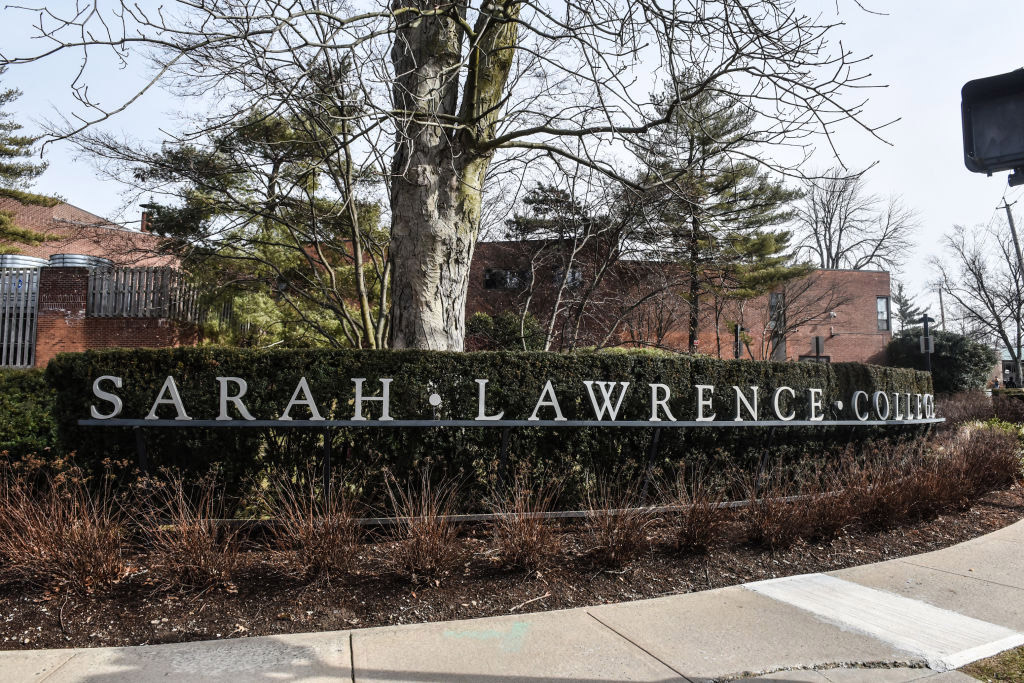
When the House Committee on Education and the Workforce released its report on campus antisemitism in March, naming Sarah Lawrence College among the institutions whose responses it found wanting, the question was how the College would answer. We now have two answers—one from the president, one from a faculty member writing in The Forward. Read together, and set against the documentary record the Committee assembled, they reveal more than either does alone.
President Cristle Collins Judd’s response arrived first, in a Mar. 18 email to faculty and staff. It acknowledges that the Committee issued a report. It notes that the College “engaged with the Committee in good faith and in accordance with the law.” It emphasizes FERPA compliance. It then pivots: “The last two and a half years have been a challenging time for campuses across the country, including our own.” The College, Judd writes, does “not agree with aspects of the report” and believes it “did not capture the full context and broad range of efforts undertaken by the College to support our community.” She closes with an inventory of values—diversity, inclusion, free expression, academic freedom—and a commitment to “continuing to evaluate how to best meet the needs of our students and community.”
What the email does not do, across hundreds of words, is name antisemitism. It does not name a single Jewish student. It does not acknowledge that any of the specific incidents the Committee documented occurred. The institutional response to a federal finding that Jewish students were harmed is to talk about something else and make no public statement outside of the Sarah Lawrence community.
A month later, the second response arrived: a Forward op-ed by a Sarah Lawrence professor of religion and Jewish studies, dismissing the House report as detached from “actual Jews at actual universities.”
The Forward op-ed is not without its honest moments. Its author acknowledges that antisemitism on campus is real, that it takes forms both blunt and subtle, that students have brought such concerns to him, and that institutions have not yet found effective strategies to address them. He is right about all of this. What is harder to defend is the move that follows. Having acknowledged the problem, the piece pivots to dismissing the report that documents it.
The argument is straightforward: Because the writer was not personally consulted (“I never encountered anyone involved with this investigation”), the investigation lacks legitimacy. But this confuses proximity with evidence. It also elides a basic chronology. Hillels of Westchester filed the Title VI complaint against Sarah Lawrence in March 2024. The college’s Students for Justice in Palestine (SJP) chapter received a Student Leadership Award that same spring. Administrators adopted the Jerusalem Declaration in the summer. The Forward writer joined the faculty that fall of 2024. The Department of Education’s Office for Civil Rights opened a formal Title VI investigation in December, during his first semester. He is, in effect, speaking on behalf of an institution he had only recently joined and dismissing the premises of a federal civil rights investigation that was already in the works before he arrived.
Congressional investigations are not seminars. They rely on documented incidents, institutional responses, and formal complaints. Teaching Jewish studies does not make one the arbiter of campus climate, student safety, or institutional accountability. Scholarly expertise in francophone Jewish philosophy or modern Jewish intellectual history—however distinguished—is not expertise in Title VI enforcement, institutional response to harassment, or the sociology of contemporary campus antisemitism. Those are administrative and legal questions, not matters of disciplinary preference.
The record at Sarah Lawrence is not thin. Much of it is documented in the college’s own internal emails, obtained by the Committee through its investigation. In the weeks after Oct. 7, 2023, the director of the local Hillel wrote to President Judd asking her to speak out for Jewish students on campus. Vice President and Dean of Students Dave Stanfield wrote internally to Judd describing the Hillel director’s messages as “exaggerated and alarmist.” Judd replied: “agreed on her alarmism.” When the Hillels of Westchester Board of Directors followed up with a formal letter demanding the college act against antisemitism, Stanfield wrote back to Judd: “I suppose she will recommend … that we disband SJP. Yeah, not gonna happen.”
The record at Sarah Lawrence is not thin.
The record beyond the emails is equally clear. In a March 2025 letter, the Congressional Committee described the November 2024 takeover and occupation of Westlands, the college’s main administrative building. It documented posters inside declaring “Long live the Intifada,” and pamphlets featuring Hamas leader Yahya Sinwar alongside an assault rifle. In a follow-up letter that June, the Committee recorded that a Jewish student had received text messages from members of SJP telling him he “should have been killed in Israel.” He left Sarah Lawrence. Others have left or considered leaving. More recently, an event featuring Ezra Klein—himself a critic of Israel—was disrupted by masked protesters, after graffiti on campus labeled him a “Zionist pig.”
You can argue about interpretation. You cannot argue these events did not happen.
The Hillel complaint that triggered the federal investigation included a line, attributed to a Jewish student who had transferred out of Sarah Lawrence, that reads now like a prediction: “it is safe to be Jewish as long as you are openly anti-Israel.” The Forward op-ed, two years later, presents exactly those Jews—the ones comfortable on campus, the ones whose politics align with the campus majority—as representative of Jewish student experience. The Jewish students who filed complaints, who felt targeted, who made the difficult decision to transfer or withdraw do not appear. The president of Hillel International described the environment for Jewish students at Sarah Lawrence as “among the worst we’ve seen.” Neither the Judd email nor the Forward op-ed engages this assessment.
The faculty op-ed is striking in what it does not contain. Across more than seventeen-hundred words defending the institution, it engages not one of the specific incidents the Committee documented at Sarah Lawrence. Not the building occupation. Not the death-wish message that drove a Jewish student to leave. Not the disruption of Ezra Klein. Not the graffiti calling him a “Zionist pig.” Not a single internal email. A faculty member writing about his own institution’s appearance in a federal report somehow finds room for definitional debates and IHRA’s lead drafter, but no room to address what was actually found.
There is also a familiar bait-and-switch in the Forward piece: a debate over definitions—whether universities should adopt the IHRA definition of antisemitism or prefer the Jerusalem Declaration. That is a useful academic discussion. It is not the central issue.
Critics sometimes invoke Kenneth Stern, IHRA’s lead drafter, who has warned that the definition was never intended as a campus speech code. Stern’s concern deserves engagement. So do the related concerns about hypothetical chilling effects on classroom material—whether faculty could still teach Yeshayahu Leibowitz, or Moshe Ya’alon, or other Israeli figures who have used Nazi analogies in their own moral reckoning with their country. These are real questions. But they are not the questions the House report is asking. The report is not about what is taught in seminars. It is about whether administrative buildings should be occupied, whether students should receive messages wishing them dead, or whether presidents should sit silently as speakers are shouted down. You can agree with every word Stern has written, and grant every concern about classroom freedom, and still not absolve Sarah Lawrence of a single failure on that list.
The Forward op-ed presents Sarah Lawrence’s preference for the Jerusalem Declaration over IHRA as a matter of scholarly judgment. The House report tells a different story. According to internal college emails the Committee obtained, in July 2024 the faculty FSJP chapter wrote to administrators claiming that IHRA “is being used all over the country to fire faculty and staff, censure and expel students, and shut down classroom and community discussion.” One week later, the vice president and dean of students wrote back “praising FSJP”—per the House report—for “raising the problematic nature of the IHRA definition of antisemitism” and explained: “we have decided to use the Jerusalem Declaration definition moving forward […] [it] seems more in-line with our community values.” The definition the Forward op-ed defends on scholarly grounds was adopted on political ones, by the same administrator who had already characterized Jewish community concerns shared by Hillel as “exaggerated and alarmist.”
This is what the intellectual shield looks like in practice. The definitional debate, the procedural compliance, the values inventory, the faculty op-ed pointing to friendly students—each does the same work. They allow the institution to signal seriousness while avoiding the harder question of whether its own standards were enforced when they were challenged. A college can host panels, issue statements, cite preferred frameworks, and produce sympathetic faculty commentary—all while failing to act when the lines are crossed.
That is the pattern the House report identifies. And it is the pattern the internal record now confirms.
Critics often respond by arguing that concerns about campus antisemitism are being “weaponized” by the political right, and that Jewish students are being made instruments of an ideological battle. Political actors do seize on cultural flashpoints. But protection is not measured by who claims to be doing the protecting. It is measured by what happens to the students allegedly being protected. The Jewish student who left Sarah Lawrence after receiving a message wishing him dead was not protected by anyone invoking his name in defense of the institution. He was failed by the institution that did not act.
This is where many universities are failing. Not because they lack the right definitions, and not because they lack awareness, but because they lack the will to apply their own standards consistently. Higher education has created a campus culture extraordinarily sensitive to some forms of harm and strikingly hesitant to confront others. Students notice. They understand which concerns are taken seriously and which are treated as politically inconvenient. Once that perception takes hold, trust erodes quickly.
Higher education has created a campus culture extraordinarily sensitive to some forms of harm and strikingly hesitant to confront others.
The deeper issue is not simply antisemitism, though that is serious enough. It is whether universities can still uphold clear norms under pressure; whether they can distinguish between protest and intimidation, and protect students without calibrating every decision through the lens of ideological alignment.
Those are institutional questions, not partisan ones.
The House report is not perfect. No such document is. But responding to it with administrative deflection and faculty op-eds, rather than with substantive engagement, does not strengthen the case for academic judgment. It weakens it. Because when a college cannot even acknowledge what is happening on its own campus, it is not protecting its students. It is protecting its narrative. A president who cannot name antisemitism and a faculty member who cannot name a single incident are not defending Sarah Lawrence. They are defining its failure.
Samuel J. Abrams is a professor of politics at Sarah Lawrence College, a senior fellow at the American Enterprise Institute and a scholar with the Sutherland Institute.