fbpx

January 13, 2026

On Giving Happiness: How I Remember Scott Adams

Most people seek happiness for themselves. Life would be weird if it was any other way.

Scott Adams, the prolific cartoonist, author and political commentator who died Tuesday at the age of 68, was weird in that way.

He was a chronic, obsessive giver of happiness.

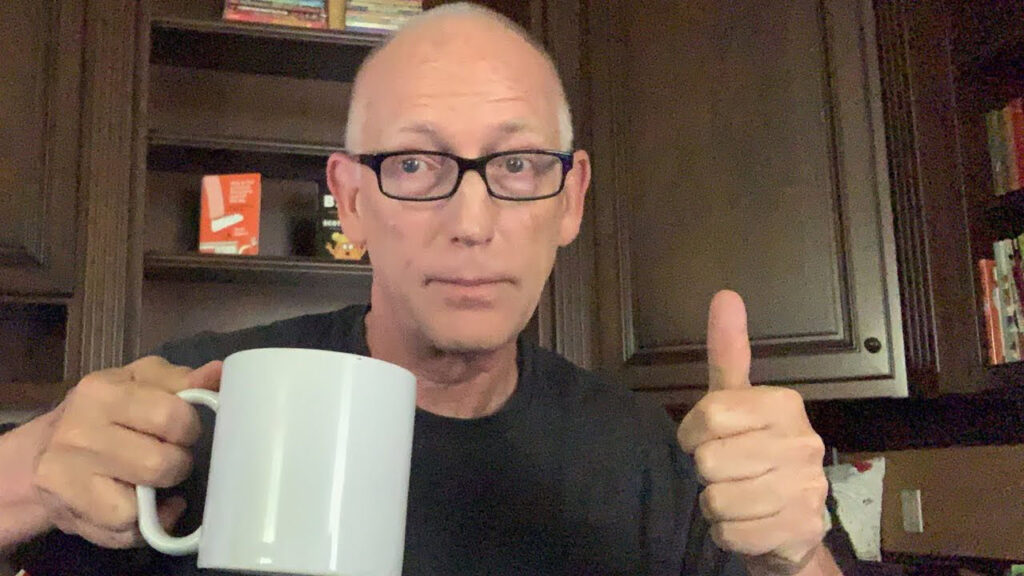
Year after year, 365 days a year, his legions of fans would tune in every morning for “Coffee with Scott Adams,” which included the famous “simultaneous sip.”

For an hour or two, Adams would comment on whatever was happening in the world. He was smart and witty, yes. But for me, what stood out was that despite the ugliness of the news, he was always cheerful.

I know that doesn’t sound very dramatic, but it was everything.

He was cheerful and understated and measured in a medium where those who stand out are usually loud, blustery and outrageous.

There were no sexy titles to announce his episodes, with hyperbole in all caps like “BEST EVER” or “WORST EVER” that you feel compelled to check out.

With Adams, it was always the same title: “Coffee with Scott Adams.”

His fans, and I was one of them, knew very well the Adams formula: show up every day and deliver. He never missed a day. He’d wake up at 4am and prepare his notes, which consisted of news items and his original, offbeat observations.

It didn’t matter whether you agreed with him or not. Just as with friendships, it was his style and personality that mattered. He loved to laugh. Sometimes he’d crack up uncontrollably.

No matter how strongly he felt about an issue—and he had strong opinions—it was never enough to rile him up.

Maybe he knew that if he’d lose his cool, he’d become like everyone else. His fans tuned in for something else—for his positive vibe. In an angry time where everyone seems to be at each other’s throat, we could count on Scott’s vibe.

We needed that vibe every morning, and he knew we did.

There’s plenty of talk in his obituaries about his support for President Trump; how he predicted Trump’s victory in 2015; his expertise in hypnosis and persuasion; his Dilbert comic strip that made fun of office culture and delighted millions; his many books that offered life advice, like the bestseller, “How to Fail at Almost Everything and Still Win Big,” and on and on. He was a man of accomplishment, a man who loved to debunk hoaxes, dissect human nature, and simply loved being useful.

My favorite Adams book was “Reframe Your Brain: The User Interface for Happiness and Success.” When you read it you understand why his show was so beloved: He reframed everything to give life itself a positive vibe.

Indeed with all of his accomplishments, nothing compared to the daily delight of “Coffee with Scott Adams,” which he delivered every morning wherever he was in the world, including on Thanksgiving, Christmas, and, of course, weekends.

He rarely talked about himself. He was fascinated by the world, by people, by science, by his listeners, by the folly of life.

His career took a major hit in 2023 when he was accused of racism after commenting on a Rasmussen poll in which 53% of black respondents agreed with the statement: “It’s OK to be white.” As Joel Pollak writes in JPost, “Adams quipped that it would be good to move away from people who felt that degree of hostility. He immediately found himself ‘canceled’ — his comic strip dropped, his publishing contracts terminated.”

But that didn’t stop Adams. He didn’t get defensive or bitter. True to his principles, he reframed his setback as a challenge and came back stronger and more independent.

Adams wasn’t the sentimental type. He loved his fans and he loved making them happy, but he didn’t need to say it. You felt it.

The more you tuned in to his show, the more you got used to his familiar face and gentle manner, the more you appreciated his casual delivery and back and forth with viewers, the less you wanted the show to end. But when it did, you had the consolation of knowing he’d be right back tomorrow.

In his last week, as his condition grew worse, he kept on showing up every morning for the simultaneous sip. It was obvious from his frail voice that he was dying, but he didn’t stop.

In his last week, as his condition grew worse, he kept on showing up every morning for the simultaneous sip. It was obvious from his frail voice that he was dying, but he didn’t stop. He knew and we knew that any of these shows could have been his last.

From what I hear, on the morning he died, he was getting ready for another show.

A giver of happiness until the end.

On Giving Happiness: How I Remember Scott Adams Read More »
U-Haul Truck Drives Through Free Iran March in Westwood; Driver Charged with Misdemeanor and Released

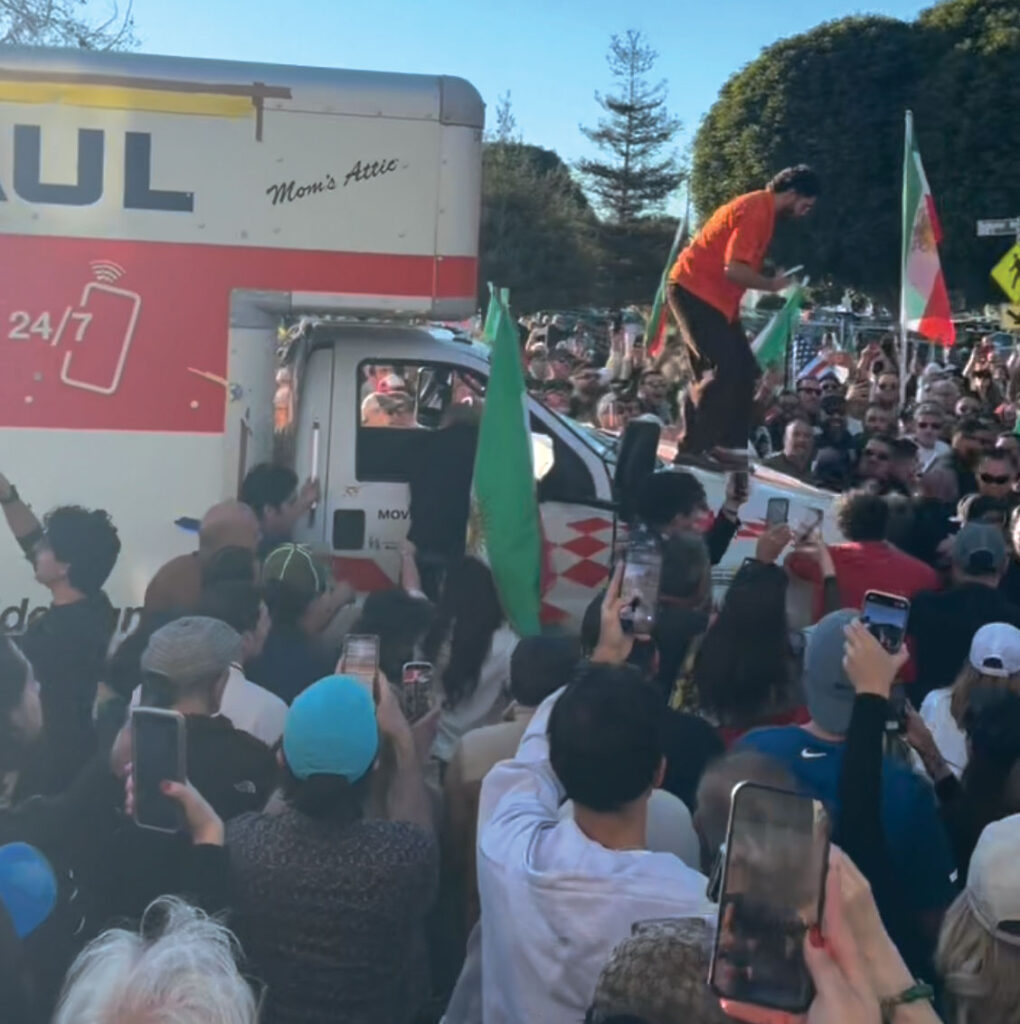
A 26-foot U-Haul moving truck drove into a crowd of demonstrators advocating for the dismantling of Iran’s current regime during a rally in Westwood on Sunday, Jan. 11. Authorities said no serious injuries were reported.

Police identified the driver as Calor Madanescht, 48. He was taken into custody and booked on suspicion of reckless driving. He was charged with a misdemeanor and released on his own recognizance on Monday. His next court date is scheduled for Feb. 2. Authorities allege Madanescht deliberately drove the truck into the protest area. Investigators said they do not view the incident as terrorism or politically driven, and said the driver does not have a known criminal record. The FBI was present and working alongside LAPD as investigators assess motive.

The Sunday afternoon rally drew an estimated 3,000 people and included Persian Jews, Christians, Muslims and atheists. The march moved south down Veteran Avenue toward Wilshire Boulevard, one block from the Wilshire Federal Building.

The truck entered the crowd by turning left onto northbound Veteran Avenue from Ohio Avenue. The truck came to a stop at the corner as it was turning, with its hazard lights flashing. There was no police obstruction stationed at Ohio and Veteran. Messages visible on paper and fabric signs bolted to the truck included: “No Shah,” “No Regime,” “USA: Don’t Repeat 1953” and “No Mullah.”

With the truck stopped at the corner, people shouted and pounded on the vehicle with their hands and flagpoles. Several of the signs attached to the truck were torn down by members of the crowd. After about one minute, someone smashed the passenger-side window. A man climbed onto the hood and then the roof and tried to rip a yellow sign written in Farsi from the right side. Rally attendees approached the window and shouted at the driver, who appeared frustrated.

Witnesses said some people believed the truck had stopped and did not expect it to move again. Others began shouting warnings as the vehicle advanced.

As the crowd continued southbound, the truck, now northbound on Veteran Avenue, appeared slowed or stopped, then began revving its engine and moving forward into the street occupied by marchers. People shouted warnings and moved toward the west sidewalk as the truck accelerated through the crowd.

Photo by Brian Fishbach

About two minutes after the passenger-side window was smashed, the truck drove forward in four short bursts — about 10 feet at a time — north on Veteran Avenue. The crowd screamed. Those bursts alerted people farther up the truck’s path, who parted before the vehicle accelerated. 

Witnesses said some people stumbled or fell as others pulled children and older adults toward the sidewalk. The crowd included children, older adults and people with disabilities.

The truck was honking as it accelerated past a building at 1441 Veteran Avenue. At that location, a man in a dark red plaid shirt jumped onto the running board below the driver’s-side door and began pounding on the window with his left fist. He continued for 53 seconds as the truck traveled roughly 1,000 feet north past Westwoof Dog Park. A crowd of at least 50 people, mostly men, chased the vehicle. The truck came to a stop near the intersection of Veteran Avenue and Rochester Avenue, angled northeast.

A 38-year-old man who fled Iran two years ago and asked that his name not be published said he was walking south on Veteran Avenue when he saw the truck approaching. “I saw a huge U-Haul truck coming towards us,” the man told The Journal. “First, he was driving kind of slowly, but then he pushed the gas. We ran after him with the other people to stop him. I saw people grabbing the steering wheel.”

Video reviewed by The Journal did not conclusively show whether the truck stopped due to protesters encroaching on the cab. It remains unclear when the driver-side window was broken.

After the truck stopped, people punched and prodded the driver with flagpoles that appeared to be made of PVC pipe. Bystanders partially removed the driver from the cab before police intervened to arrest him and form a barrier. At least two people appeared to shove LAPD officers during the arrest.

“They took him out of the car,” the man said. “They opened the door, but the seatbelt was still fastened.”

In the minutes after the stop, some witnesses believed marchers near Ohio Avenue had been struck or killed. Police initially reported that one person had been hit by the truck but did not report any injury. LAPD later said no one came forward reporting they had been struck by the vehicle.

The Los Angeles Fire Department said two individuals were checked by responders at the scene and declined medical care. Authorities said no ambulances were requested or dispatched.

There did not appear to be blood on the front of the truck. Blood observed by The Journal was limited to the passenger-side door near the shattered window, which appeared consistent with people cutting their hands on broken glass. There was no indication that anyone had been trapped beneath the vehicle.

Police said the driver sustained injuries during the confrontation after the truck stopped.

Afrouz Demeri, who came to the rally from Orange County, filmed the truck driving toward her and captured the moment it stopped and the crowd began attacking the driver. The video has been viewed nearly 1 million times on Instagram.

Demeri attended both the Los Angeles rally and a similar protest in Orange County days earlier. “Orange County was very different than this one, it was much more chanting, there was music and it was very, very peaceful,” Demeri told The Journal.

She said she was standing in the middle of the street facing the truck as it approached. “I was literally facing the truck,” Demeri said. She said she did not initially believe the driver would hit anyone. “For some reason I wasn’t scared,” Demeri said. “I didn’t even think that he was going to hit somebody.” 

Demeri said she observed police officers nearby and did not see them intervene while the driver was being beaten. “They didn’t do anything when the guy was being beaten up,” Demeri said. She said she left the immediate area after the violence escalated. “When this guy grabbed the end of a pole and started stabbing him, that’s when I got very emotional and I just thought, ‘Oh my God, they’re going to kill this guy.’ I thought the driver died because of the way the flagpole was being stabbed in his chest.”

After police handcuffed the driver and led him away, members of the crowd continued trying to strike him. One man in a green hoodie hit the driver from behind with a flagpole as police escorted him toward a squad car on Rochester Avenue. Officers drew batons and warned people to stay back.

The driver appeared cooperative while in custody. Blood was visible on the back of his head. Police placed him in a patrol vehicle as some in the crowd struck the police car before officers cleared the area.

Broken glass littered the street and the step of the truck’s cab. Small blood smudges remained on the passenger-side door. The cargo area and cab appeared empty, with no visible weapons or materials.

In the minutes after the driver was arrested, many witnesses ran south towards Ohio Avenue and Rochester Avenue thinking there would be dozens of severely injured people. Groups gathered in the street were often watching video footage or consoling one another. Reports included frightened children and possible minor injuries such as twisted ankles, but no serious injuries were identified.

Witnesses said early claims circulated in the crowd before accounts and video were compared. Demeri said she did not believe anyone had been run over based on what she observed. “It never crossed my mind,” Demeri said. “And I 100% thought that everyone is going to go to jail because they’re beating up the driver,” Demeri said.

Traffic control remained limited after the arrest. Nearly an hour later, northbound traffic on Veteran Avenue remained open at Ohio Avenue, with one civilian waving cars away. Police dispersed the crowd and secured the scene about 90 minutes later.

The investigation remains ongoing. 

U-Haul Truck Drives Through Free Iran March in Westwood; Driver Charged with Misdemeanor and Released Read More »

Why We Shouldn’t Separate Zionism from Judaism

My closest friend in Israel, Lior, is a law school dean. My first communication with him following the Hamas massacre was Oct. 8, 2023, when he was already volunteering at an army base with his young son. He shared with me his terse take on the situation facing his country: “Israel needs a strong American Jewish Diaspora.”  

Just last week, news broke of a Ruderman Family Foundation survey showing that although 78% of Israeli Jews believe the relationship with American Jewry is important and essential, 43% believe that the nation’s management of the fighting in Gaza has weakened the support of American Jews for Israel. In the United States, it is easy to find daily evidence of this weakened support, among American Jews and others, in the form of articles, television broadcasts and, of course, social media. 

But what I find most disturbing about this situation is the burgeoning sense, particularly among academics and other intellectual elites, that American Judaism will be just fine without Israel.  Although for years the Jewish media has been featuring articles about Jewish communities that reject Zionism as a core element of Jewish identity, this trend has been intensifying over the last few years. This shift should be cause for great concern not only for Israelis, but also for American Jews.

As an academic whose current research concentrates on the intersection between Jewish law and culture, particularly among American Jews, I have waded through countless sources analyzing the current state of American Judaism. It gives me no pleasure to say that I have concluded that without Zionism, most religiously liberal American Jewish communities do not have sufficient Jewish content to sustain a thriving, long-term future in this country. 

This conclusion is bolstered by substantial anecdotal experience. Over the past five years, I have given scores of talks at synagogues and other Jewish institutions about specific steps parents and grandparents can take to strengthen the Jewish identify of their children and grandchildren.  I heard many stories about how and why adult children were not currently making Jewish choices despite being raised with stronger norms of observance.  None of this came as a surprise to me given the data of the two most recent Pew surveys of the American Jewish population in the 2010s, and the struggles non-Orthodox synagogues and seminaries have been encountering during this decade and beyond.

American Jews are just over 2% of our nation’s population. With burgeoning antisemitism threatening the safety of Jews everywhere, including in America, it takes even more effort than ever to sustain our Jewish identity and transmit it to our children and grandchildren. Many of us who are entrenched in the organized Jewish community very much want to paint a rosy picture of the progress we are making when it comes to transmission of Jewish tradition. But we know in our hearts what we are up against even as we do our best to continue to encourage “doing more Jewish” in a world that is simply not Jewish, and even worse, is increasingly hostile to the only Jewish country in the world.

In contrast, although distinct challenges abound in Israel, a thriving Jewish culture there is assumed regardless of individual religiosity. Israel is the one nation where Jewish holidays take center stage; where you can ask any vendor if the food is kosher and even if the answer is “no,” all understand what and why you are asking; where Jewish cab drivers who are not religious still do not work on Saturdays because that is culturally understood as family time; and where life is marked by Jewish time rather than by the secular clock that governs human existence everywhere else.  

Taken together, the United States and Israel make up over 85% of the world’s Jewish population, with the numbers roughly split between these two countries. Those of us who believe in the miracle of Israel need to push back hard against the escalating number of Jewish non-Zionists and antizionists in our midst.  Israel bolsters us as much as we bolster Israel. Failing to maintain this bond will be catastrophic for Jewish peoplehood and the continuity of Judaism everywhere.


Roberta Rosenthal Kwall is law professor, author and Jewish educator with a focus on American Judaism. Her latest book is “Polarized: Why American Jews are Divided and What to do About It” (forthcoming 2026, Bloomsbury Press).

Why We Shouldn’t Separate Zionism from Judaism Read More »

Chabad Secures Major New Campus on Pico Boulevard

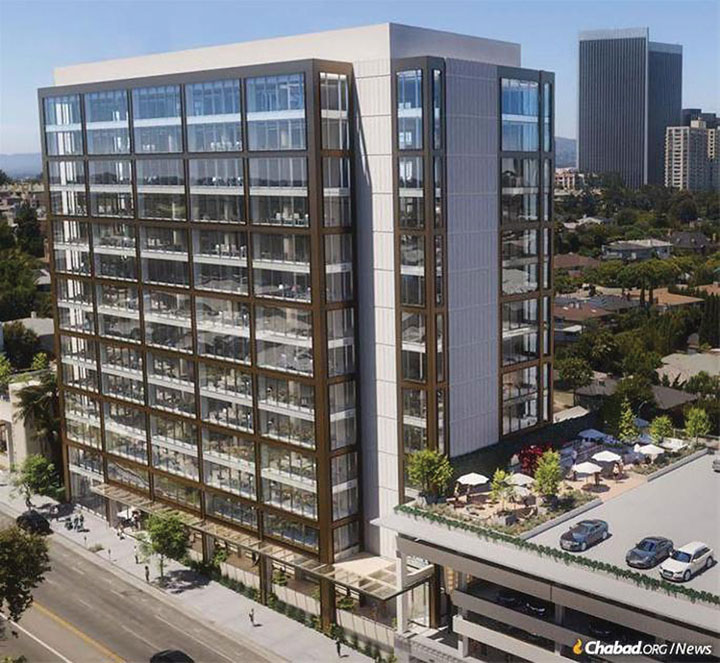
West Coast Chabad announced on Tuesday the acquisition of a 300,000-square-foot, 16-story campus in Los Angeles that it claims will become “the largest Jewish center in North America.”

The $100 million Chabad Campus for Jewish Life was donated by the Abady family, making it one of the largest contributions in Chabad’s history. The gift, from real estate professional Alon Abady and his wife, Monique, was made in honor of Alon’s mother, Liora Abady, and will house the “Abady Family Center” in her honor.

Located at 9911 West Pico Boulevard, the campus sits at the gateway to Century City and Beverly Hills. It is directly across from the Hillcrest Country Club and next door to the Fox Studios lot and the Simon Wiesenthal Center.

The plan for the campus is to house a range of communal functions: a synagogue; educational facilities for students of varying ages; Jewish life-cycle venues; youth and senior programming; mental health and social services; support for Jewish students on college campuses; and a convention and banquet hall for communal gatherings and international events.

It plans to offer specialized programming for children with special needs, comprehensive services for California’s growing aging population, and a state-of-the-art museum that will use multimedia and virtual reality to engage the broader community with Jewish history, heritage, and the story of the Land of Israel.

In addition to its immediate use as a center for worship, service, education, and community engagement, the property benefits from newly granted by-right residential conversion entitlements, providing flexibility for future housing initiatives, including the potential conversion of the existing structure to residential use.

When the Abady family immigrated to the United States in the 1970s, they arrived with little means. Within two years, facing financial hardship and with no support network, they met Chabad and Rabbi Baruch Shlomo Cunin, the West Coast Director of Chabad-Lubavitch. Then a young emissary of the Rebbe, Rabbi Menachem M. Schneerson, of righteous memory, sent to grow Chabad-Lubavitch across the West Coast, Rabbi Cunin and Chabad helped the Abady family navigate their hardship and helped provide them with the foundation to rebuild their lives.

Alon Abady went on to build a real estate empire, and Rabbi Cunin continued the Rebbe’s work of transforming Jewish life on the West Coast. But the Abadys never forgot.

When Chabad approached Abady about the campus he had recently acquired, the response was immediate. He shared that the family had never forgotten the kindness Rabbi Cunin and Chabad had shown them in their time of need, and that it was time to repay that kindness.

“This gift reflects our deep commitment to the Los Angeles community of all faiths and backgrounds, and our desire to leave a lasting impact that will endure for future generations,” said Alon Abady. “The Abady Family Center, owned and operated by the Chabad Campus for Jewish Life, is intended not only as a physical home for the Los Angeles community, but also as a platform for growth, adaptability, and long-term community benefit. This is a lifelong dream that also allows me to honor my parents and my children. When my family immigrated to Los Angeles in the 1970s, Chabad was there for us. That was never forgotten.”

The closing took place on the afternoon of Friday, Jan. 9. As Shabbat approached, leaders and friends of Chabad hurried to join Rabbi Cunin at the property to celebrate and affix a mezuzah to the front door of the campus.

The Jewish date of the closing coincided with 20 Tevet, the yahrtzeit of the Rambam, also known as Maimonides. In 1984, the Rebbe established a daily study cycle of the Rambam’s monumental work, Mishneh Torah, explaining that this would unify the Jewish people regardless of background. Rabbi Cunin felt it was a particularly auspicious date, as the new center will likewise be a point of unity for people from all walks of life.

The announcement comes during a period marked by rising antisemitism and harrowing events—most recently, the Bondi Chanukah Massacre in Australia, which claimed the lives of 15 people, including Chabad Rabbi Eli Schlanger and Rabbi Yaakov Levitan, chief operating officer at Chabad of Bondi.

Chabad views the launch of the center as a direct response to the darkness and a concrete way to channel the Rebbe’s teachings to double down on good works in the face of difficulties.

“This extraordinary gift reflects the Rebbe’s mission to illuminate the world through goodness and kindness,” says Rabbi Baruch Shlomo Cunin. “The Chabad Campus for Jewish Life will serve as a beacon of light, strengthening Jewish life while uplifting and serving the entire Los Angeles and global community for generations to come.”

Chabad Secures Major New Campus on Pico Boulevard Read More »