
fbpx

December 26, 2025

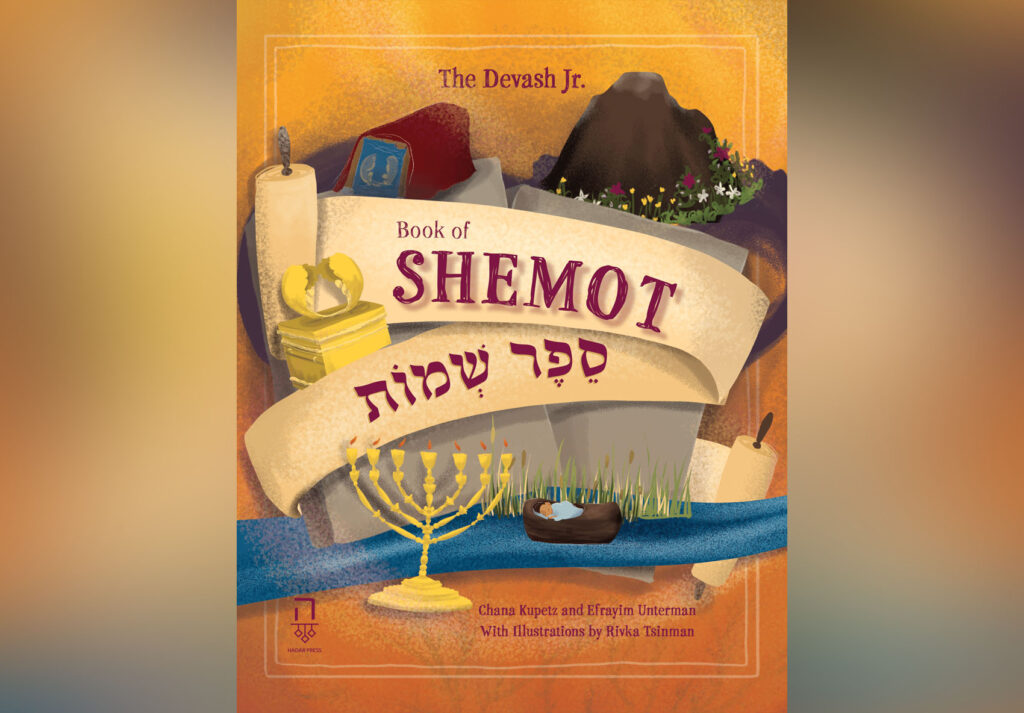
Hadar’s New “Book of Shemot” Makes Torah Accessible to Young Children

When my children were born, I assumed teaching them Torah would be easy. After all, I have a PhD in Talmud and am married to a rabbi. I worried about plenty of things—sleep schedules, tantrums, and other typical toddler woes—but Jewish education? That seemed simple.

How wrong I was.

As my children entered preschool, I began searching for resources to help my kids engage with Jewish texts and traditions. But while the bookstores shelves were filled with options for Christian children’s Bibles, the choices for Jewish families were limited. For my preschool aged children, the main options seemed to be retellings of Noah’s ark and a handful of other isolated stories. There was little that reflected the breadth and depth of Torah in a way that young children could truly access.

That’s why “The Devash Jr. Book of Shemot” feels so important. Rather than covering a single story, it introduces children to an entire book of the Torah. The text is divided into weekly parshiyot (Torah portions), mirroring the annual Torah reading cycle. This structure makes it easy for families with young children to read the weekly parasha together.  The book is designed for ages three to seven, retelling each portion in clear, kid-friendly language paired with vivid illustrations. At the end of each section, there are also suggestions for how to connect the story to children’s everyday experiences.

Like many children’s Bibles, “The Devash Jr. Book of Shemot” summarizes the events, main ideas, or teachings of each parasha rather than providing a direct translation. (For families who want engagement with the literal words of the Torah, each section also highlights specific verses, providing them in both Hebrew and English.) The retellings emphasize connections to kids’ own experiences, presenting ideas in ways they can easily understand. For example, the book explains the commandment to return lost property as follows: “If you find a lost object, you have to return it, even if you’re not friends with the owner.” This framing speaks to the realities of a child’s world and the considerations that might be most relevant to them, such as themes of friendship or fairness.

The retellings emphasize connections to kids’ own experiences, presenting ideas in ways they can easily understand.

Of course, the ultimate test of any children’s resource is how kids respond. My children, ages four and six, are always excited when any new book arrives, and they eagerly dove into the first few parshiyot, which tell the story of baby Moses and his later call to lead the Israelites out of Egypt. They were already familiar with this story from our Passover celebrations, and the illustrations helped bring it to life. It was harder to hold their attention in some of the later portions, like those detailing the priestly garments or the construction of the Mishkan (Tabernacle), but the artwork helped sustain their curiosity even when the text was less narrative.

Interestingly, neither child has asked to reread the book, which is unusual in our home. They clearly experience it differently from the other stories we read, including picture books that tell a single story from the Torah, like Noah’s ark. I think this is partly due to the book’s presentation. It is physically large and lengthy. Children who are used to reading short stories may find its scale a bit overwhelming and be unsure where to begin or exactly how to engage with it. Furthermore, even in its most narrative sections, the text doesn’t follow the familiar arc of a storybook with a clear beginning, narrative arc, and resolution. That makes sense, since it mimics the structure and organization of the Torah itself, but it means parents need to be intentional about how they use it.

For that reason, I see “The Devash Jr. Book of Shemot” as a resource for parent-led learning rather than independent reading. It works best when integrated into family rituals or used as the foundation to create new practices, such as a Shabbat afternoon story time. And it comes out at the perfect time, since Jewish communities around the world will begin reading Shemot in just a few weeks.

It is worth noting that “Devash Jr.” makes specific choices about language and interpretation. It uses Hebrew names throughout (e.g., Benei Yisrael instead of the Israelites) and often provides Hebrew transliterations alongside English terms. It also incorporates elements of traditional interpretation and observance; for example, when introducing the commandment not to cook a kid in its mother’s milk (Ex. 23:19), it explains that meat and milk cannot be cooked or eaten together—a detail not explicit in the Torah text, but which becomes a normative part of keeping kosher. These choices reflect Hadar’s halakhic, egalitarian approach, but may not align with every family’s practice, goals, or orientation.

Overall, I was impressed by “The Devash Jr. Book of Shemot,” and hope that the series will continue with all five books. It succeeds in making Torah accessible to young children while honoring the text and its structure. For families with an existing Shabbat rhythm—or those looking to create one—it offers a meaningful way to bring Torah into the lives of our youngest learners. Most importantly, it sends a powerful message: Our children are full members of this tradition, and their engagement matters. The Torah is their heritage, and “The Devash Jr. Book of Shemot” makes that clear by creating a version of the text just for them.


Deborah Barer is Senior Faculty at the Shalom Hartman Institute of North America. 

Hadar’s New “Book of Shemot” Makes Torah Accessible to Young Children Read More »

Antizionism is Anti-America, Anti-World and Anti-Truth

Jew-haters must have felt some ambivalence after 6 million Jews perished in the Holocaust. How are we going to demonize these guys now?

I thought about those Jew-haters as I watched scenes of mangled Jewish bodies in the must-see film “Nuremberg.” The Holocaust was so horrific some argue that the Jews got an unofficial “reprieve” from the scourge of antisemitism, as evidenced by the UN partition vote that endorsed the state of Israel.

Ironically, that very Jewish state became the source of a most sinister form of Jew-hatred we now call antizionism.

Antizionism may be flying high these days, but its venom is rooted in history. As Jonathan Eric Lewis writes on his Substack, “Contemporary antizionists, like the Nazis in the 1930s and 1940s and the Soviets in the 1970s and 1980s, traffic in conspiratorial tropes about Jews and draw upon a legacy of classical antisemitism.”

For the garden variety Jew-hater, the state of Israel was like hitting the jackpot. Imagine: Instead of going after Jews directly and being called an antisemite, they could now go after a Jewish country and still bash the Jews.

Slowly and inexorably, the Jewish state became the big bad Western oppressor and the Palestinians the poor and oppressed victims longing for their own home.

That antizionist narrative hasn’t changed much through the years; it just got more lethal and intersectional. “Rather than a critique of Zionism,” Lewis writes, “[antizionism] is an all-encompassing ideology of hate that posits that not only is Israel ontologically evil, but that anyone who supports the very existence of Jews living safely in the Land of Israel is guilty of enabling ‘genocide.’”

As if things couldn’t get worse, they did after the massacre of 1200 Jews by Hamas on Oct. 7, 2023. Suddenly, the mighty Jews looked vulnerable like never before.

Unlike 1945, when the Jews did not have a state, this time there was no guilty reprieve after the massacre of Jews. Quite the opposite: Jew-haters and antizionists came out in full fury. This may have been shocking but it wasn’t surprising. Remember that by 2023, Israel was already the target of a global BDS campaign; libelous accusations like genocide and apartheid had become routine; and the Palestinian cause had infiltrated virtually every social justice heart on the planet.

The stage was set, then, for Jew-haters and antizionists to go all in, and they did. The long and ugly war in Gaza, combined with the popularity of the Palestinian cause and the support of a gullible media, triggered an unrelenting aggression on the Jews that flourishes to this day.

Jews are left with a conundrum: Zionism is as hard as ever to defend, but antizionism is as crucial as ever to combat, especially as it encourages more and more animosity toward Jews.

Besides the obvious point that Jews must fight like hell to prevent the kind of violence we saw at Bondi Beach– including demanding repercussions, better intelligence and tighter security– I don’t have any magical solutions.

I do, however, have a starting point: With Jew-hatred becoming so global, we must begin to think globally. The Jewish community must get into the habit of asking two simple questions: What is good for the world and what is bad for the world?

So far, we’ve been focusing on what is good and bad for the Jews and Israel, but with Israel becoming a pariah state, much of the world has shrugged and said: Who cares?

With our backs to the wall, we must raise the stakes and focus more on what is good for the world. Yes, antizionism is a singular sin and a uniquely evil expression of Jew-hatred that targets Jews as Zionists, but it’s much worse than that. It’s also a poison for humanity.

Antizionism is anti-West, anti-America, anti-truth, anti-peace, anti-justice and anti-world. Being a hate movement, antizionism is an affront to the common good. With Zionism now under siege, antizionism has become a hater’s paradise where all haters and liars of the world are welcome. That is terrible for the world, and it behooves us to make that case.

Yes, as improbable as it sounds, the world, or at least the part of the world that can reason, needs to see that it is in the world’s interest to join the fight on the side of the Jews. If we believe the truth is on our side, we must act like it.

If antizionism is bad for humanity, the corollary, as I argued in a recent op-ed, is also true: Zionism is great for humanity, especially the West. As Joshua Hoffman writes on his Substack: “The West is losing something essential that Israelis do best. While many people in the West feel embarrassed by their own countries, Israelis carry deep-seated pride rooted in history, responsibility, and a clear-eyed understanding of reality.”

Zionism’s contributions to the planet have become so ubiquitous we have a tendency to take them for granted. We shouldn’t. We should own them and use them to our advantage.

The same goes for Judaism. If Zionism is good for the world, so is Judaism and the values intrinsic to our tradition. The two are inseparable. Just as antizionism is rooted in Jew-hatred, Zionism is rooted in Judaism. By keeping these two pillars of Jewish identity tightly bonded, we can craft a bold and unapologetic message for the next century: Zionism and Judaism are a blessing for the world.

All this said, it’s important not to downplay the grim reality that Jews are living in. We’re  under assault and there are no easy fixes. But the ultimate Jewish question was never “How bad is it?” but “What should we do?” We know we must fight the evil forces we’re up against. Let’s fight that evil not just for our sake but for the sake of a broken world that still needs us. 

We owe it to those decimated Jewish souls I saw in “Nuremberg.”

Antizionism is Anti-America, Anti-World and Anti-Truth Read More »