fbpx

December 6, 2025

Paul Simon Sides with a Killer—Again

Does Paul Simon have a soft spot for killers?

The iconic singer-songwriter this week signed a petition demanding freedom for the Palestinian Arab terrorist Marwan Barghouti, a convicted multiple-murderer.

Barghouti is currently in an Israeli prison for his role in five murders. In 2001, he sent terrorists to ambush motorists on the outskirts of Jerusalem; they killed a young Greek Orthodox priest named Father Germanos. The following year, Barghouti masterminded an attack on a Tel Aviv restaurant that left three dead and 35 wounded.

But Barghouti is not the first killer to enjoy Paul Simon’s friendly attention. That distinction belongs to Salvador Agron.

Agron was a member of a Brooklyn street gang called The Vampires. In 1959, he stabbed two boys to death on a New York City playground. The victims, Anthony Krzesinski and Robert Young, Jr., were just 16. The press called Agron “The Capeman” based on eyewitness descriptions of his clothing.

In 1998, Simon created a Broadway play called “The Capeman,” which portrayed Agron as a victim of society. Members of the Krzesinski and Young families, together with a group called Parents of Murdered Children, picketed the opening night performance.

The protesters charged that Simon was glorifying the killer, and objected that the deaths of their loved ones were being exploited for entertainment and profit. Robert Young’s cousin Kim carried a sign that read “Our Loss is $imon’s Gain.”

Simon said in an interview at the time that he was moved to bring Agron’s story to Broadway because I was drawn to the environment that shaped him—the street culture, the poverty, the sense of being outsiders.”

It’s a shame that Simon has never taken an interest in the environment that has shaped young Palestinian Arabs, including Marwan Barghouti. Growing up, Barghouti was immersed in the virulent hatred of Jews and glorification of terrorism that permeates the Palestinian Authority’s school curricula, summer camps, news media, sermons in mosques, and speeches by political leaders.

Here’s what then-U.S. Senator Hillary Clinton had to say about the antisemitism in the Palestinian Authority’s schools:

“Their textbooks are still preaching such hatred…Young minds are being infected with this anti-Semitism…These messages of hatred and these enticements for martyrdom in these textbooks and on the media, take young minds and twist and pervert them and create a new generation of terrorists and insurgents…Using children as pawns in a political process is tantamount to child abuse, and we must say it has to end now!”

That’s the environment which inspired Barghouti to join the Fatah terrorist group when he was 15 years old. He wasn’t protesting “Netanyahu’s policies” or “settlements.” Yitzhak Rabin was prime minister at the time, and only a handful of settlements existed. Fatah’s goal was the destruction of Israel. That’s the path that led Barghouti to become a mastermind of the suicide bombings and machine-gun massacres of the Second Intifada. Wouldn’t that make for an interesting play?

Or how about a play about Barghouti’s victims? Each of them has a compelling back story.

Salim Barakat, 33,  was a policeman who heard the shooting at the Tel Aviv restaurant and ran towards the gunfire, not away from it. He left behind a wife, a four year-old daughter, and seven siblings.

Yosef Haybi, 52, died while using his body to shield his wife from the terrorist’s bullets. A friend described him as “a magnificent soul,” a brilliant businessman, and a generous philanthropist. He left behind two children.

Eli Dahan, 53, came to Israel as a child when his family fled persecution in the Arab world.  Yet he had many Arab friends and ran a cafe that was popular with Jews and Arabs alike. His co-owner called him “the symbol for existence.” He had four children and three grandchildren.

Father Germanos was raised in a deeply impoverished family in rural northern Greece. He left school at age 12 to earn money for his family by working in a fabric factory. When he turned to a religious lifestyle, he gave away his possessions and moved to the Holy Land to join St. Georges Monastery, near Jerusalem.

A play, or even just a song, about the victims of Palestinian Arab terrorism might not be popular among today’s political and cultural elites. But it would be the right thing to do.


Dr. Medoff is founding director of The David S. Wyman Institute for Holocaust Studies and author of more than 20 books about Jewish history and the Holocaust. His latest is The Road to October 7: Hamas, the Holocaust, and the Eternal War Against the Jews, published by the Jewish Publication Society & University of Nebraska Press.

Paul Simon Sides with a Killer—Again Read More »

Getting Hannah Senesh the Respect She Deserves

In 1944, in her final act of defiance, Hannah Senesh refused to be blindfolded. She wanted the men who executed her to look her in the eyes.

Before that, she could have likely saved her life had she asked for a pardon or been apologetic, yet she brazenly criticized the Hungarian judges presiding over her trial, telling them they’d soon face the consequences of their actions, as Hungary collaborated with the Nazis, who she knew would lose the war.

Douglas Century’s mesmerizing new book on Senesh, “Crash of The Heavens: The Remarkable Story of Hannah Senesh and the Only Military Mission to Rescue Europe’s Jews During World War II” which gets its title from one of her most famous poems, is meticulously researched, written with cinematic flair and one of the best books of 2025.

Century, a Princeton graduate who has written about El Chapo and the Mafia, recalled learning about Senesh in Calgary, when he was eight years old.

“I understood she was captured and tortured and would not inform on her people and was willing to die,” Century said. “The story we always heard is that she jumped and was quickly captured. That’s not true. From March to June, she was involved in shootouts. I think the story was mis-told to make her into a martyr where there was this doomed mission. It wasn’t some lunatic mission.”

From Folding Socks To Dodging Bullets

Born Anne Szenes in Budapest in 1921, her father Bela was a well-known writer and playwright. Century said had he not died before turning 44, the family might have moved to California and he might have been a successful Hollywood screenwriter. She left her mother and went to Kibbutz Sdot Yam, and became disillusioned with washing and folding socks, when she could speak six languages, was physically fit and highly intelligent. She completed a training of five day-jumps and one night-jump and when she finally jumped as part of her mission, she got suck in a tree but cut herself out. At that time Hungary was not yet overtaken by the Nazis, but Century writes that Senesh cried a few days later when she became aware of the Nazi progression.

For a few months before Oct. 7, 2023, Century was in Israel doing research and in speaking to Israelis, some of them knew little about Senesh or had the facts wrong.

“It astounded me that people don’t really know her anymore,” Century said.

While Anne Frank is known by nearly every Jew, few know about Senesh. “Hannah Senesh,” a play by David Schechter, was performed last month in Manhattan starring Jennifer Apple as Senesh; Century praised her performance. There hasn’t been a biopic about Senesh and her story has not received the attention or reverence of Anne Frank.

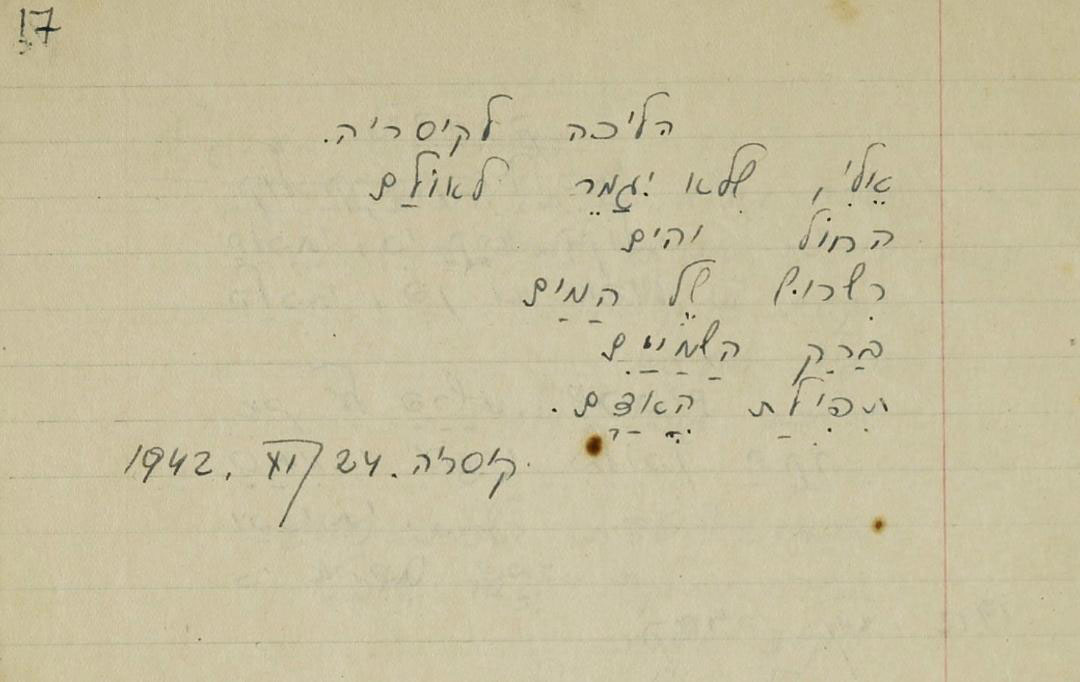
“New heroes are created so often in Israel, “ Century said. “Hannah was a foundational hero. But you had numerous wars since then. The trauma in Israel is so consistent, she got pushed out of the public consciousness. But not her poetry. ‘Eli, Eli,’ (‘My God, My God”) is like the second national anthem.”

“Eli,Eli” is one of Senesh’s best known poems.

Set to music, Senesh’s short poem (originally titled “A Walk to Caesarea”)  reads “My God, may it never end/The sand and the sea,/ plash of the water,/ the crash of the heavens/ the prayer of man. ”

Senesh parachuted into Hungary in March 1944, one of 32 Jewish volunteers from Mandatory Palestine who parachuted into occupied Europe.  She was captured on June 8, 1944 in Murska Sabota Hungary.

Century writes that Senesh was stripped naked, had a tooth knocked out and was kicked, punched and flogged.

Though she was not given a cyanide pill, she tried to run up the stairs to possibly jump from the top of the building, but tripped and was tied to a chair. Even with a threat made that her mother would be killed, she did not give up military secrets.

Century quotes Senesh’s unbowed statement to the judges who held her fate in their hands.

“I stand before you as a captured British servicewoman. I’m not guilty of espionage or treason. I’m not traitor to Hungary. The traitors are those among you who brought this calamity upon the Jewish people and upon Hungary itself. I implore you now – don’t add to your crimes. You surely realize that your own day of reckoning is soon coming …”

That would be an unbelievably brazen thing out of the mouth of a hardened soldier, let alone a 23-year-old who had not seen significant combat time.

Century said Senesh was a person of great conviction but may have given too much credit to a legal system that was not following the letter of the law (a huge understatement).

“The prosecutor, (Col. Julian) Simon came on his own initiative to execute her,” Century said. “Like all the rats, he was found in Argentina. He gave in interview years later and he said he didn’t have any regrets. He said ‘she made us so God damn angry with her Jewish pride’ Hannah asked how she could be guilty of treason when they took away her citizenship. It was a brilliant defense. She would have been a great lawyer. She was playing with fire. I don’t think she wanted to die. She had incredible moral clarity and thought it was right to tell the judges the truth.”

Century writes about a bizarre offer from Adolf Eichmann, who offered to save the lives of 1 million Jews of Hungary in exchange for 10,000 winterized trucks and other supplies. This never took place; in a different deal, Eichmann allowed 1,686 Hungarian Jews to go on what would be called the Kastner train as the deal was made by Rudolf Kastner, Jewish lawyer and journalist who was criticized for saving some of his friends and relatives. The train also took the Satmar Rebbe, Joel Teitelbaum.

“Crash of the Heavens” hits home even more so now, when opponents of Israel have attempted to give Zionism a negative connotation. The book demonstrates how Senesh went from not speaking Hebrew, to coming to a realization that when Hungary was turning its back on Jews, it was her duty not only to go to Israel but to build up the country. He cites her writing that her obligations were ‘leami vleimi” or “to my nation and to my mother.”

Her mother, Katherine Senesh, on a death march, was able to escape as artillery flew in the air and she was able to be hidden by a righteous gentile. There is also an intriguing character named Enzo Sereni, a proud Jew and a proud Italian.  A force of nature, he insisted on parachuting into Europe as well, even though Golda Meir told him it was a bad idea. More than decade earlier, in 1932, the Jewish Agency sent him to Berlin and he was able to convince Jews to make Aliyah and was was able to facilitate smuggling $25 million of Jewish money out of the country. Sereni was murdered at Dachau in November of 1944.

It is impossible to read this book at not marvel on how unselfish Senesh was and how she must have felt a sense of purpose that few share. “Crash of the Heavens” is a page turner. Century is able to transmit pride and pain on the page, like few can.

Senesh is a Hero For Many Reasons

Century said during that period most 22-year-olds thought about who they might marry. Senesh, despite having a number of suitors, brushed them off as she had incredibly high standards. She knew the mission to go into Hungary was extremely dangerous.

“They don’t make people like her anymore,” Century said. “How many of us our willing to die for a principle? She represents a universal story of a strong female foll of courage and bravery. Man, was she a badass!”

Getting Hannah Senesh the Respect She Deserves Read More »

When Did Terrorists Become Untouchable?

We are living through an extraordinary time of moral reversion. Perversion, actually, is more like it.

The way far too many valorize evil and demonize the good is truly breathtaking.

Evidence of shattered moral clarity is everywhere. Terrorists are transformed into freedom fighters. We judge them not harshly; we judge not at all. Bloodthirsty enablers and cheerleaders of terrorism are infantilized as “innocent civilians.”

Meanwhile, actually innocent teenage girls attending a music concert are fair game for gang rape. In Europe, Muslims raping white women are chalked up to “cultural differences.” In Israel, babies too young for kindergarten are deemed perfect for kindling. No head in the Middle East and Persian Gulf—other than that belonging to a mullah—is safe from beheading.

Those who insist on severing body parts are merely adhering to the pieties of fundamentalist Islam.

Closer to home, this week we learned that narco-terrorists are merely nautical-loving seafarers. Their cargo might as well be mangos and bananas.

Our children are indoctrinated into glorifying villainy. Our mass media trivializes barbarism or ignores it altogether. People shamelessly speak within polite company that any Israeli—or Jew, for that matter—should be killed “by any means necessary.” The evil of Hamas is re-characterized as the benign actions of misunderstood teenagers from rough neighborhoods.

The evil of Hamas is re-characterized as the benign actions of misunderstood teenagers from rough neighborhoods.

We recently reached a new low. The never-ending parade of celebrities whose only reading is confined to scripts they are paid to read, was at it again. Some 200, including Benedict Cumberbatch, Mark Ruffalo, Cynthia Nixon, Sir Ian McKellen, Paul Simon, Tilda Swinton, Stephen Fry, Margaret Atwood, Sting and Brian Eno, signed a petition demanding that Israel release from its prisons the notorious Palestinian terrorist, Marwan Barghouti.

Why? Well, Palestinians are deprived of responsible leadership, and polls show that most of them would like to see Barghouti as president of the Palestinian Authority. This statesman-in-waiting is presently serving five life sentences for mass murder.

Hollywood sure knows how to pick them.

Barghouti is one of the masterminds of the terror that accompanied the Second Intifada. Well over 1,000 Israelis were killed by suicide bombers—with Barghouti’s blood-soaked fingerprints left at every crime scene.

Two teenagers at a Tel Aviv disco. Suicide bombers killing hundreds of Jews: at a hotel celebrating Passover in Natanya, cafes and buses in Jerusalem, pizza shops in Tel Aviv. Barghouti personally killed five Israelis, including a Greek monk and a man having dinner in a restaurant.

The petition calling for his immediate release describes this monster as “a husband and a father” and a “nation-builder, . . . a powerful symbol of unity [who has been] illegally held by Israel” for more than two decades.

None of his crimes seem to matter. All he did was kill Jews. No “bridge over troubled water” for Paul Simon, who proudly lent his name. Barghouti is, after all, a political prisoner of an illegitimate regime. The petition even compares him to Nelson Mandela, a Nobel Peace Prize recipient who never detonated bombs in South Africa.

Unfortunately for these pampered buffoons whose only daily challenge is keeping their beleaguered assistants nearby, Israel knows their terrain much better than these actors know the backlot at MGM.

The mastermind of October 7, 2023, Yahyah Sinwar, was released from an Israeli prison in 2011, along with 1,000 of his fellow terrorists. Every single one of them went right back into the family business of murdering Jews. Not even one chose a different line of work.

Let’s face it: The hard left has always romanticized revolutionary violence—whether Stalin, Che Guevara, Fidel Castro, Pol Pot, the IRA in Ireland, the Baader-Meinhof Gang in Germany, and, of course, Arab terrorists calling themselves Palestinians fighting for liberation.

Violence against Jews isn’t deemed violence at all—but self-righteous expressions of human rights and social justice. Who wouldn’t want to root for that?

Violence against Jews isn’t deemed violence at all—but self-righteous expressions of human rights and social justice. Who wouldn’t want to root for that?

This moral dementia has even found its way into the American political scene—wholly apart from the anti-Israel factions of the far left and, most recently, the far right. We seem to be getting sentimental about the lives and general welfare of avowed terrorists who mean to do us harm. Does the Democratic Party still believe that its hero, Barack Obama, was correct in ordering the assassination of Osama bin Laden? Are SEAL Team Six still heroes, or assassins?

How about the 2011 drone strike Obama ordered that killed American citizen and Islamist radicalizer Anwar al-Wiaki in Yemen? Bin Laden was a Saudi, but Obama killed an American citizen without due process or authorization from Congress.

Anyone losing any sleep over his death in today’s more humanitarian climate of untouchable terrorists? The Council on Foreign Relations credits the Obama administration with launching 540 drone strikes in Pakistan, Somalia and Yemen that killed over 1,000 people, many being civilians.

Was President Trump wrong in taking out ISIS kingpin Abu Bakr al-Baghdadi in 2019? It’s a fair question given the tumult caused by the U.S. military’s recent aggressive attacks against drug-running boats off the coastal waters of Latin America. This past Thursday, four narco-terrorists were killed.

President Trump and the Pentagon have been busy in the Caribbean these days. Since early September, they have launched 22 strikes on vessels without providing evidence that they were trafficking drugs. Then again, Obama never produced the bodies of bin Laden and al-Wiaki.

Estimates are that 87 people have been killed in these drug boat operations. President Trump is treating drug cartels who are poisoning Americans with illicit drugs as the work of foreign terror organizations.

One congressman, Jim Himes from Connecticut, who sits on the House Intelligence Committee, called a second drone strike that sunk the cargo and killed the terrorists who survived the first strike as “one of the most troubling things I’ve seen in my time in public service.”

Seriously? More troubling than 9/11? Worse than 10/7? Congressman Himes must be treating opioids like Milk Duds.

Maybe he has evidence that these ships aren’t commandeered by drug cartels at all. Perhaps they are merely carrying drunken fraternity brothers out on a fishing trip? A boatload of marine science students tagging whales in the Caribbean, perhaps?

President Trump claims that for every drug boat the United States sinks, the lives of 25,000 Americans are saved. I am surprised PETA isn’t protesting the drug addictions we are imposing on unsuspecting fish nibbling on fentanyl.

Just wait—that, too, is coming.


Thane Rosenbaum is a novelist, essayist, law professor and Distinguished University Professor at Touro University, where he directs the Forum on Life, Culture & Society. He is the legal analyst for CBS News Radio. His most recent book is titled, “Beyond Proportionality: Israel’s Just War in Gaza.

When Did Terrorists Become Untouchable? Read More »