103 Year Old Holocaust Survivor Joseph Alexander Celebrates Birthday Alongside Rescued Hostage
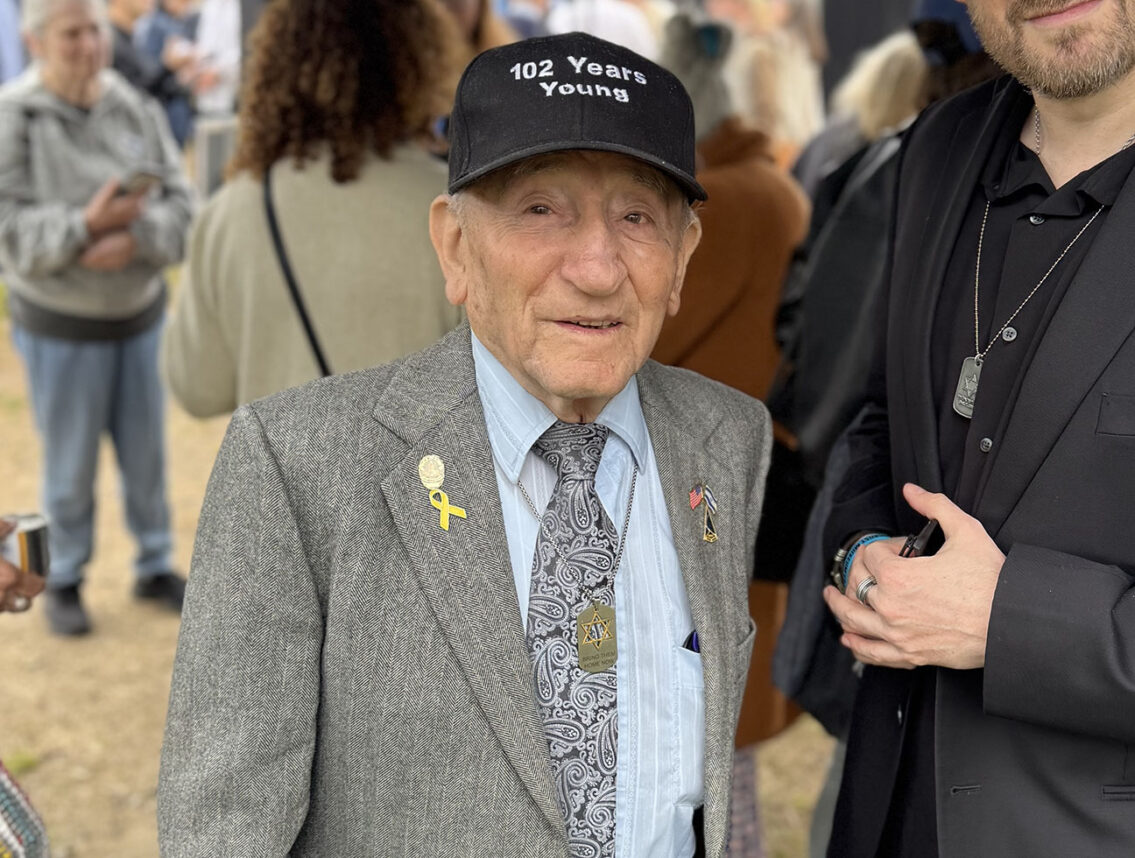
Throughout 2025 at Jewish community events across Los Angeles, a short elderly man wearing a baseball cap reading “102 Years Young” was often spotted moving with the vigor of someone half his age, greeting all comers with a firm handshake. Meet Joseph Alexander, a Los Angeles-based survivor of 12 concentration camps who just celebrated his 103rd birthday on Nov. 20. Even at his age, he still spends most of his time sharing his story at synagogues, schools, and as many non-Jewish crowds as possible.
Alexander spoke to The Journal two days before his 103rd birthday. At the time, he said he planned to keep things “low key” and stay home to be with Reeva, his partner of more than 25 years.
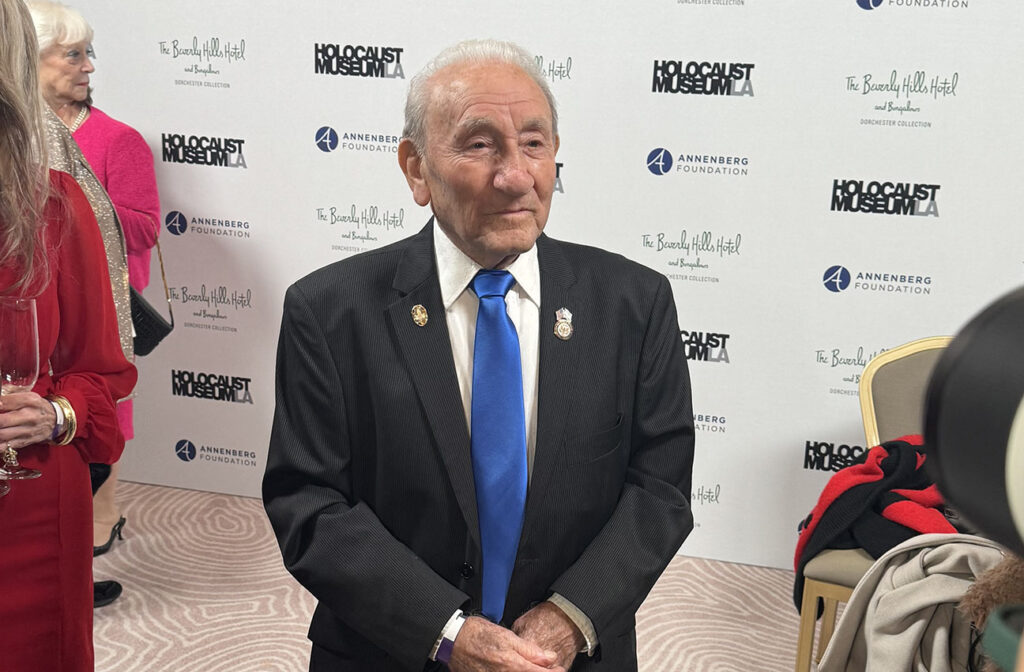
But two days after his 103rd birthday, Alexander was on the dance floor at The Beverly Hilton for the 50th birthday party of influencer and pro-Israel activist, Naz Hashem. Guests were asked to dress in “‘The Great Gatsby’-themed attire.” Alexander is three years older than F. Scott Fitzgerald’s book, which was published in 1925.
At Hashem’s party, a live band played pop hits and Persian dance standards. The band played a klezmer–techno mix that had the party bouncing. When Alexander got on the dance floor, he wasn’t just doing a slow waltz, he moved and grooved with brisk but jovial footwork and a big smile—all while wearing his brand new “103 Years Young” hat.
“Joe’s mindset, having gone through what he has gone through, always tells me ‘the key to life is to always enjoy your life and never stop, always keep going,’” Hashem told The Journal. “That’s something that will never leave me. He loves the younger generation to sit around him and listen to him, it means the world to him and it literally lights him up see it in his face.
At one point, Alexander sat in conversation with Israeli Almog Meir Jan, 80 years his junior, who was rescued after spending 246 days in Hamas captivity. The sight of a 103-year-old survivor of Auschwitz and a 23-year-old man who had lived through an ordeal eight decades later stood out to anyone who happened to see them chatting together.
Hashem said that the mere sight of Alexander and Jan together gave her “shivers and vibrations” all over her body. She threw a Shabbat dinner birthday party for Alexander’s 102nd birthday last year.
Other guests of the party shared with The Journal what went through their minds to see such a moment.
“Joe probably took a horse and buggy to a birthday party in Poland almost a century ago, but tonight he could have taken Waymo to the Beverly Hilton,” comedian Elon Gold told The Journal after attending the party. “He’s not just alive, he’s living his best life, he’s got a girlfriend, and is going to parties. And seeing him with a hostage survivor—It was like the greatest thing to see two generations of survivors.”
“Joe probably took a horse and buggy to a birthday party in Poland almost a century ago, but tonight he could have taken Waymo to the Beverly Hilton,” comedian Elon Gold told The Journal after attending the party. “He’s not just alive, he’s living his best life, he’s got a girlfriend, and is going to parties. And seeing him with a hostage survivor—It was like the greatest thing to see two generations of survivors.”
Attorney Sam Yebri, who has known Alexander for years, called him “a grandfather for every Jewish Angelino who cares deeply about Jewish history and Jewish continuity.”
“People were mobbing Joe on the dance floor and it was incredible,” Yebri told The Journal. “The dance floor was crowded and the evening was late on a Saturday, yet the star of someone else’s party was a 103 year-old Holocaust survivor.” Alexander even lit the first candle at Yebri’s daughter Elizabeth’s Bat Mitzvah at Sephardic Temple Tifereth Israel earlier in November.
Later in the night, another dance circle formed while Alexander kept moving. Filmmaker Rotem Alima joined in.
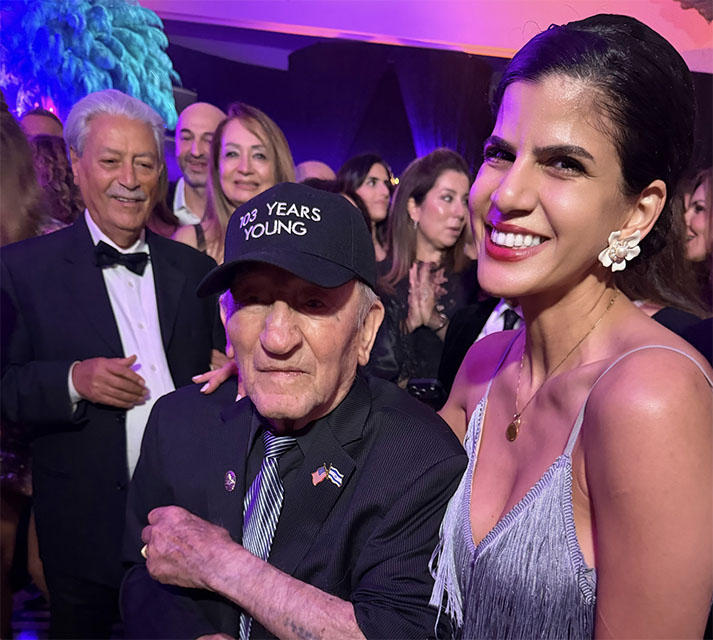
“Last night, I danced with a 103-year-young Holocaust survivor and a Gaza hostage — both made it home, and both were at the same party,” Alima told The Journal. “To anyone who doubts the Jewish peoples’ light — sorry, we’re too busy shining and we are dancing again” Like anyone else who’s met Alexander, she’s in awe that he’s still “so communicative and full of life” despite all he suffered and lost in the Holocaust.
Alexander’s path to that birthday bash in Beverly Hills began in Kowal, Poland, where he was born on Nov. 20, 1922 in a Modern Orthodox family. His father sold men’s work clothes out of the home. Joe played soccer in the street, and was active in local Zionist youth groups, where he was often chosen to lead the meetings. In 1939, when the Germans entered Kowal, his family fled toward Warsaw. They were forced into the Warsaw Ghetto in 1940. In March 1941, he escaped with two siblings and returned to Kowal. He never saw his parents and three other siblings again.
For the next four years he endured a sequence of camps: six in the Posen labor system, where he worked in trenches and sewers; Auschwitz, where he received a tattoo; a return to the ruins of Warsaw after the uprising; Dachau and its satellite camps; and the work sites where Germany’s V-1 and V-2 rockets were launched. He survived beatings, starvation and typhus. He crossed a bridge moments before it was blown up during an evacuation. He was liberated when American tanks entered Königsdorf.
He was the only member of his immediate family who survived.
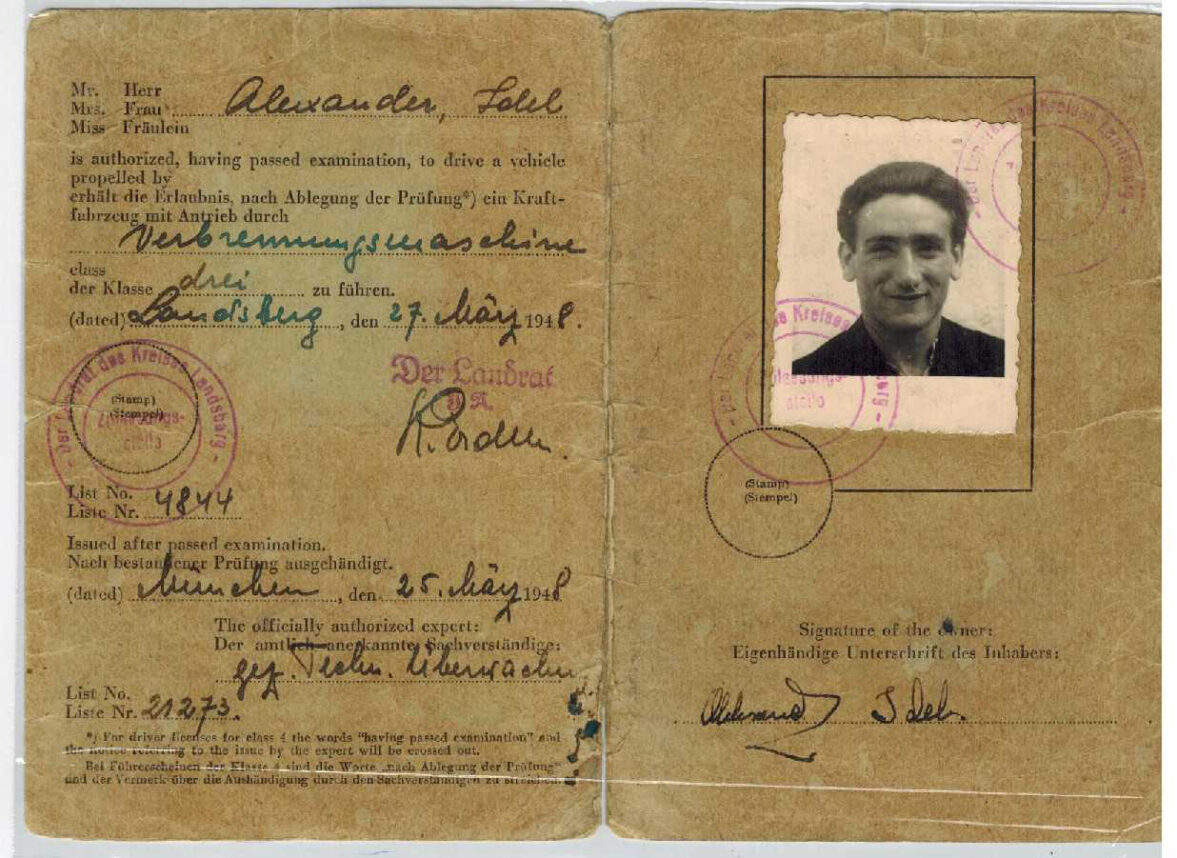
Alexander spent four years in Germany after the war. He met a surviving cousin. He lived in the Landsberg area, worked on a farm in Epfenhausen, and traded what he had to survive. His German driver’s license was issued in Landsberg on March 27, 1948 and recorded in Munich two days earlier—it is somehow still valid. The original German license, along with his Auschwitz identity card and Dachau papers, has been displayed in museum exhibitions. He still drives around town with his California drivers license.
He immigrated to the United States in 1949, first living in Harrisburg, Pennsylvania, with a sponsor. A relative in Los Angeles helped him return to tailoring. He worked near Vandenberg Air Force Base and opened the L.A. Uniform Exchange on Melrose. The shop made military uniforms for soldiers and for Hollywood productions. Jimmy Stewart once stopped by and spoke with him for hours. The Dominican dictator Rafael Trujillo came by with guards and ordered a uniform. Alexander made it, and eventually retired in 1994.
Alexander’s speaking career began by chance in 1997, when a friend invited him to a lunch club in Culver City and asked him to talk about his life. Alexander told his story. Listeners asked him to come back. He has been speaking ever since.
Today, when people run into Alexander, he answers their question of “how are you doing” by rattling off the schools and groups he most recently spoke to. He most recently spoke at Concordia University Irvine.
“Most of the people I speak to, more than a half are not Jewish,” Alexander told The Journal. These are the audiences he thinks about the most — the classrooms where students are hearing the story for the first time and often show up not knowing anything about the Holocaust. He rolls up his sleeve and showed them the tattoo: 14284.
“That was now my name, 1-4-2-8-4,” Alexander said before adding how he looked at the sadistic Dr. Josef Mengele in the eyes.
Over the past 25 years, Alexander’s audiences have grown. He has spoken in cities across the United States, often in places far from the major Jewish centers. His event in Spokane, Washington drew 2,000 people. In California, a speech in Bakersfield was attended by 4,500; one in San Luis Obispo was heard by hundreds. Schools in South Dakota and Tennessee have requested him. He has spoken in Italy, Scotland and Ireland. He has appeared on countless Zoom screens and is as fluid with signing in as anyone who grew up with iPhones.
His first visit back to Germany came in 2015, when he met Chancellor Angela Merkel. He saw how Germany teaches students about the Holocaust and contrasts that with the lack of awareness he sees in American high schools. Students tell him he’s the first Holocaust survivor they have ever met. Alexander keeps the thousands of their letters of gratitude he received over the years.
He told the Journal that, “It felt good that I could go as a free man. How did I go to a place where before I was a prisoner, a slave? And now I am there as a free man.”
When people ask him how he has lived so long, he gives the same answer. “People say, what’s the secret? I said there’s no secret. Just keep busy.” Even in the age of TikTok, he is still telling his story and spreading the truth in a world full of disinformation. It keeps him going. And now, last year’s hat that read “102 Years Young” — replaced yet again.