fbpx

July 25, 2025

Leading with Strength and Heart: Mayor Sharona Nazarian’s Vision for Beverly Hills

Since being appointed Mayor of Beverly Hills on April 1, Sharona Nazarian has been very busy. There’s hardly a day that goes by without her attending at least one community event — often several in a single day. Since taking office, she participated in dozens of events and spoke at most of them.

But none was as personal or meaningful as the speech she gave on the day she took office.

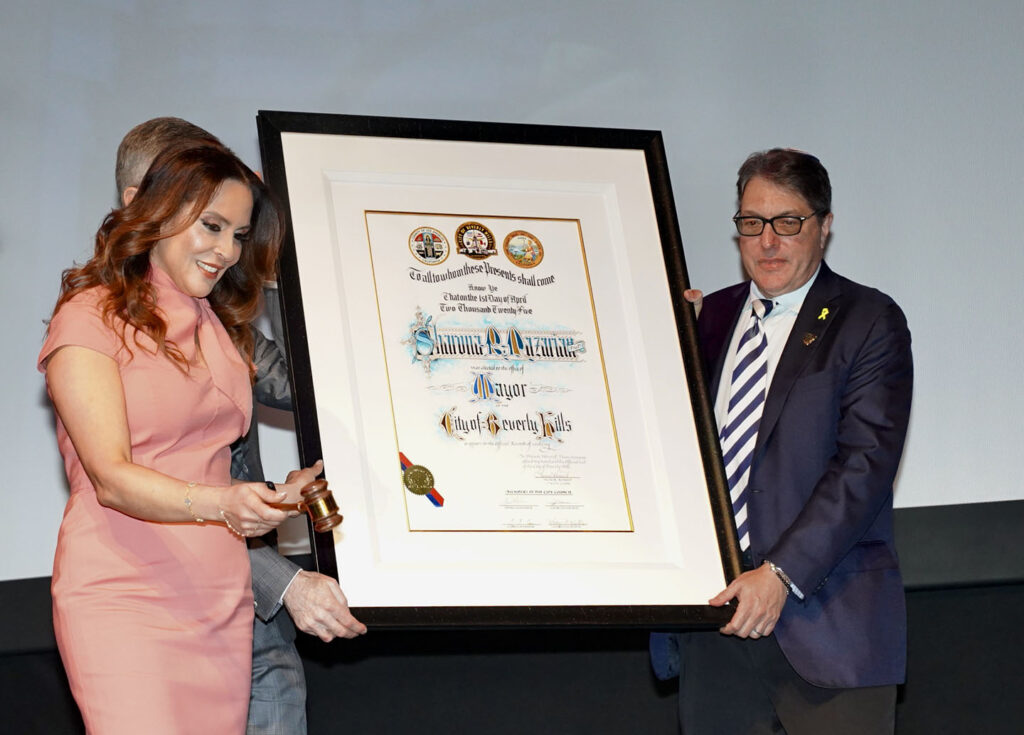
At the inauguration ceremony held at the Wallis Annenberg Center in Beverly Hills, Nazarian said, “I am an immigrant. English is my third language. I came to this wonderful nation because of religious persecution. There was no one there to be my voice, and things didn’t always come easily, but I refused to have a victim mentality. You see, I believe that hard work and dedication are the keys to achieving things, and I promise to work hard for you.”

In her speech, Nazarian also spoke about her commitment to social justice, peace, tolerance and fighting antisemitism. “We’re committed to continuing to serve as a voice against hate, discrimination and antisemitism, with my initiative, ‘Never Again is Now’,” Nazarian said.

Nazarian was preceded by Jimmy Delshad, who held the position in 2007 and again in 2010. In her first interview as mayor, the day after the ceremony, she told The Journal what it meant to her to become the first Jewish-Iranian female mayor in the country.

“Where else could an immigrant accomplish so much? It’s a humbling moment for me and my family and I don’t take it for granted,” she said. “I’m truly excited and honored to serve our country and this beautiful community, as we work alongside so many great leaders to build a safer, stronger and more united Beverly Hills.”

Before joining the Beverly Hills City Council, Nazarian worked as a clinical psychologist and served as Vice President of Beit Halochem USA. As mayor, she will serve a one-year term, before being succeeded by another council member. Each of the five City Council members serves a four-year term.

In many ways, Nazarian’s journey is the ultimate success story — fleeing oppression in one country and rising to prominence in another.

Nazarian, 51, fled Iran with her family after the 1979 revolution and the fall of the Shah. “I came here together with my mother and younger brother. We moved to Israel, which was our safe haven, and after living there for some time, my father joined us and we immigrated to the U.S.,” she said.

Beverly Hills has long been known for its clean, well-maintained streets and quick police response. Now, as mayor, Nazarian aimed to continue that tradition of safety and vigilance.

“We have close to 3,000 cameras monitored 24/7, which helps us protect our houses of worship and synagogues and ensures the safety of our communities,” she said. “If someone is thinking about committing a crime in Beverly Hills, they should think twice.”

While public safety remained a top priority, Nazarian’s goals extended far beyond crime prevention.

“We will work to support our local businesses, expand access to mental health services, protect human rights, empower women, strengthen international relations, and promote the city. It’s a cycle. When our businesses succeed, that provides the revenue to support services and infrastructure, which in turn protects our quality of life.”

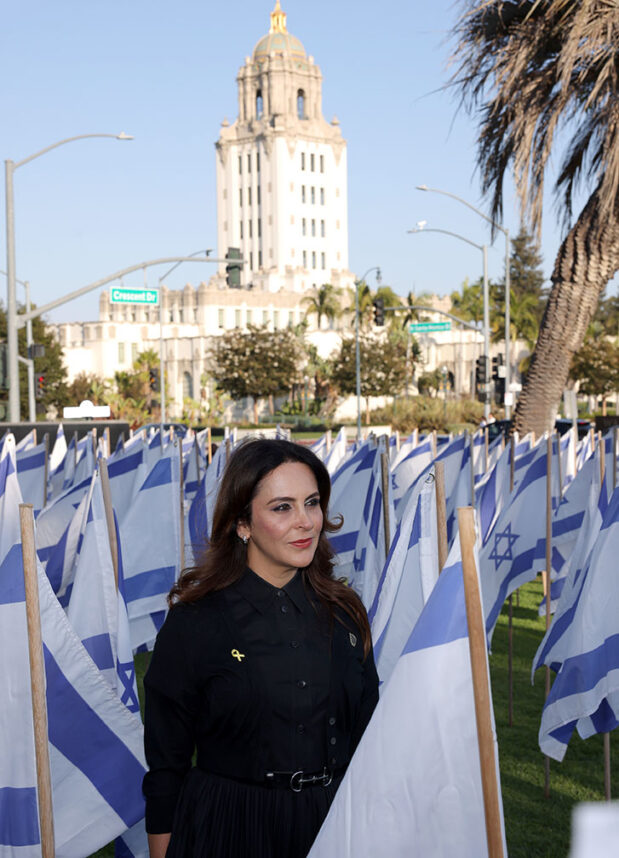
Nazarian also highlighted Beverly Hills’ strong support for Israel. In the days following the Oct. 7 massacre of Israelis, she helped pass a resolution — unanimously supported by the City Council — expressing Beverly Hills’ support for Israel and its right to defend itself, and condemning the actions of Hamas. It was the first statement of its kind in the United States.

“Since the day the hostages were taken, we’ve been projecting the words ‘Bring Them Home Now!’ along with a yellow ribbon on our City Hall building,” said Nazarian. “We partnered with the Israeli Consulate and brought in 1,200 flags from 30 different nations to symbolize the lives lost on Oct. 7. We held a hostage forum with the families of those who were kidnapped, set up a Shabbat table with empty chairs representing the hostages. There’s so much tension and divide in the world today. Israel is important to our community and they want peace and light.”

Nazarian said she was shocked by the silence of women’s organizations in response to the rape and abuse of women on Oct. 7. “We witnessed one of the most tragic massacres of the Jewish people since the Holocaust, and I was deeply shaken by the silence of women’s groups. They claim to stand for women’s rights — but where were they? I want to encourage women to remain brave, strong, kind and to lead with strength but also with heart, because that’s what makes women so influential and impactful. We need more women leaders who are involved and committed to uniting people.”

Courtesy of Sharona Nazarian

One of Nazarian’s key initiatives during her term is to establish a permanent memorial for the victims of Oct. 7, located across the garden from the city’s 9/11 memorial. The monument will be placed near the fire station and the public library. She brought the idea to the Council, which quickly supported it.

“I believe this will be one of the first sites in the world — or at least in the U.S. — to honor the Oct. 7 victims. We’re currently looking for a design. We plan to hold the official groundbreaking ceremony ahead of Oct. 7. I think it’s a beautiful gesture that these two memorials will stand across from each other — America’s memorial and that of our greatest ally.”

In 2019, Beverly Hills and Herzliya formalized a sister-city relationship on Israel’s 70th Independence Day. The partnership was made official in a ceremony attended by representatives from both cities. Nazarian, who co-chaired the sister cities program, said she planned to build on that foundation by organizing more collaborations between the two cities — festivals, symposiums, tourism exchanges, and more.

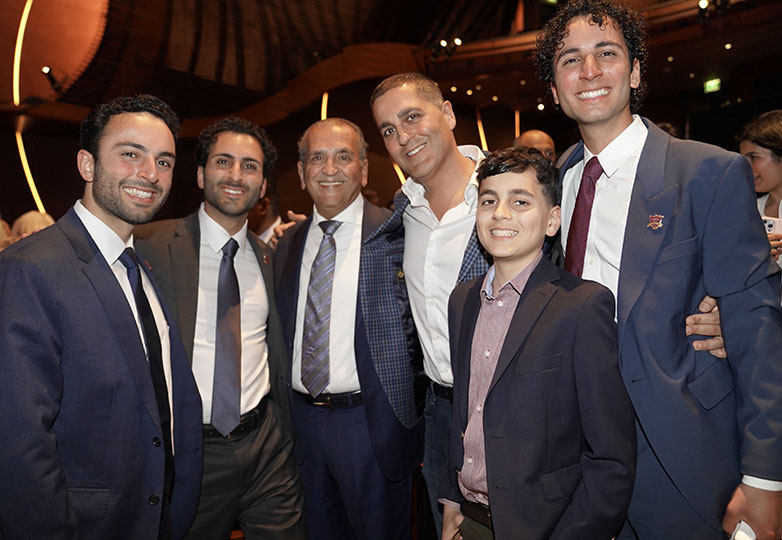
Nazarian’s inauguration ceremony was attended by public officials, community leaders, and her family — her husband Daniel Nazarian, their three sons, and her proud father, Jacob Rashti. Her mother passed away 20 years ago, only 52 years old.

Nazarian’s family at the inauguration ceremony (Photo by Orly Halevy)

“Sadly, she didn’t get to see me become mayor, but she’s always in my heart. She helped guide me on this path. She always supported me and told me, ‘You can achieve anything.’ She was a strong Jewish mother, incredibly caring, and supported all of us. I hope to follow in her footsteps. We celebrate Shabbat at home every week. I cook, my in-laws come over, my father and my kids if they’re in town, it’s something I learned from her.”

For her father, she said, seeing her become mayor was an especially emotional moment. “I’m truly excited and honored to serve this country and this beautiful community, and to collaborate with so many great leaders to build a safer, stronger, and more united Beverly Hills.”

Leading with Strength and Heart: Mayor Sharona Nazarian’s Vision for Beverly Hills Read More »

Rabbis of LA | Rabbi Denise Eger: Retired … Only More Active

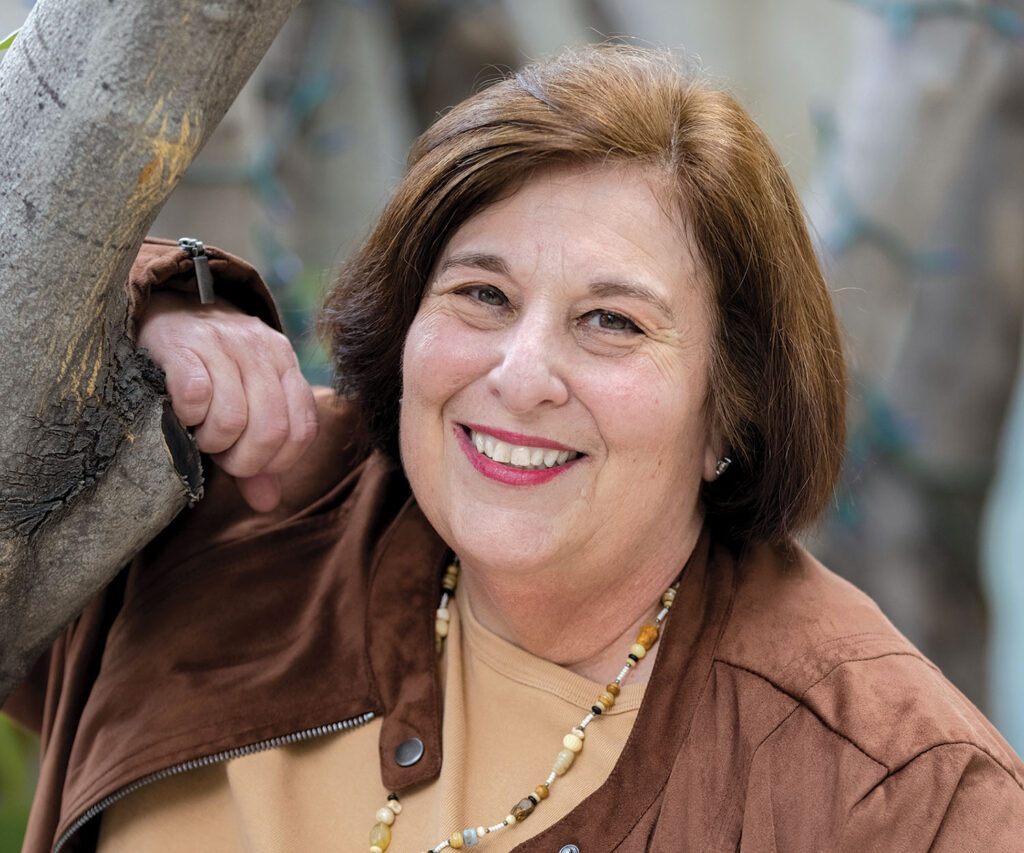
Rabbi Dr. Denise Eger retired two years ago … and her life has been even busier than ever. After 37 years in Los Angeles one of the country’s most prominent and successful lesbian and gay leaders, Rabbi Eger stepped away. She moved to Austin, Texas, with her wife, Rabbi Eleanor Steinman, a native Angeleno who is senior rabbi of Temple Beth Shalom on a sprawling campus housing Orthodox, Conservative and Reform synagogues. There are three shuls “on this beautiful, huge campus,” Eger said, plus the Jewish Community Center, Jewish Family Service, the Jewish Federation and a day school. In addition to writing, Eger’s focus has been her executive coaching practice: tutoring rabbis, ministers and non-profit executives – on Zoom – all over the U.S. and Canada. Since March, she has also been the interim executive director for A Wider Bridge, an LGBTQ Jewish Zionist organization that brings LGBTQ people to Israel, supports the Israel LGBTQ community and fights antisemitism in the LGBTQ community.And she travels. When she spoke to The Journal earlier this month, Rabbi Eger was in New York for the quarterly meeting of the Reform movement’s Pension Board. Then she was off to Los Angeles for a huge celebratory weekend at Kol Ami Congregation on La Brea Avenue in West Hollywood, which she founded in 1993. Kol Ami is defined as a welcoming space for LGBTQ+ Jews and their allies. As the speaker at Kol Ami’s Shabbat Friday night services, Rabbi Eger urged the community “to live by Jewish values, to love each other, to have chessed for one another, to keep learning Torah with one another.” The next day, she participated in the formal installation of her successor, Rabbi Lindy Reznick. A Memphis native and USC graduate, Rabbi Eger has been an activist throughout her career. She was the first openly gay or lesbian rabbi to serve as president of the Reform movement’s Central Conference of American Rabbis and the first woman president of the Southern California Board of Rabbis. “I have been very busy these last few months,” Rabbi Eger said. Throughout Pride Month, “there has been ugliness around the country for Jews and those of us who love and adore Israel. In particular, San Francisco was really bad. A singer there called for the killing of Jews and Zionists.”

Rabbi Eger was in New York City when Zohran Mamdani won the Democratic mayoral election. The singer in San Francisco, she said, “was worse than Mamdani” and was removed as Grand Marshal of the Pride parade. “We also have a terrible problem in San Diego, …The Pride organization there invited the same singer to be their Grand Marshal. Despite pressure from the Jewish community, they did not back down. So the San Diego Jewish community pulled out of Pride. They are doing their own Pride weekend. It has gotten too horrific, not safe for Jews.”

“To parse it out,” she continued, “the Jewish community in San Francisco always has been a part of Pride. It’s the home of Harvey Milk.” But the LGBTQ community – and the larger San Francisco community – “has not been a place of support for Israel either.”

As leader of A Wider Bridge “where we deal with this,” she thinks about this. As a national activist, she said “we live in the age of disinformation. We Jews are a small people, and gay Jews are even smaller. We live in a TikTok Age. Mamdani, the fellow who won in New York, he’s the TikTok candidate. He’s all over. He has a huge following.”

San Diego troubles Rabbi Eger’s soul. It’s a city where she has a personal connection; her son, daughter-in-law and their first child live there. “It’s typically a more conservative town, way more conservative with the Navy bases there and a lot of military retirees,” she said. “It’s been shocking. The Jewish community is shocked about what’s happened … As a Jewish LGBT person from Southern California, I have to say I am heartened by the larger Jewish community’s response of support for the LGBT community. We have all stood together.” 

In almost every city in America, she said, “if there is a Pride parade or festival, it’s on public property. Cities have to underwrite it in some way. They don’t give the money. But they have police and security.” In San Diego, “the city does give the money. Why are they endorsing hate? Very troublesome.”

Rabbi Eger said the wide hatred of Jews and gays is “more coordinated than you might think – Qatari money, Chinese money are going to fund [Jewish] Voice for Peace, which isn’t Jewish or a voice for peace or justice. Women for Peace in Palestine, a group funded by Code Pink – very socialist, far left, not even progressive.”

The rabbi feels betrayed by her party. “Democrats have internal challenges here [in New York]as they allow these voices to take hold. As a mainstream Democrat, it is getting uncomfortable. Never would I have believed this could happen.”

Reflecting on the birth of her career, Rabbi Eger said she “was mentored by some of the greats of our town who took me under their wings in the late ‘80s. There were only two women solo rabbis in Los Angeles then: myself and the late Carole Meyers, the rabbi at Temple Sinai, Glendale. Reform rabbis of that era –– Allen Freehling, Bob Gan, Steve Jacobs, Harvey Fields – were all generous with me. If I had a question or needed guidance, they were all good mentors.”

Fast Takes with Rabbi Eger

Jewish Journal: What is your proudest achievement?

Rabbi Eger: That my son Benjamin still loves me and talks to me.

J.J.: What is your favorite childhood memory?

RE: This shaped my life: My father’s family is from Pittsburgh. I was about three. On Sundays, my father the jeweler used to take repair jobs to Pittsburgh. One very cold Sunday, a man outside a restaurant was huddling, freezing. The man asked for change. My father had a better idea, sat the man at the counter, ordered a meal, then ordered something to go for later. That incident shaped my life about our obligation for tzedakah. 

J.J.: What is in your future?

RE: I hope for more grandchildren, that I can continue to write, contribute to the Jewish community and support my family.

Rabbis of LA | Rabbi Denise Eger: Retired … Only More Active Read More »

“Oh Just Vote For Us”: How the Democratic Party Fell Down to Earth

Because we have a loud, impulsive, attention-grabbing, power-hungry president named Donald Trump who sucks up all the oxygen wherever he goes, one of the epic political stories of our time has flown under the radar:

The stunning fall of the Democratic party.

Just 28% of Americans view the party favorably, according to a CNN poll conducted July 10-13 and released last week. That’s the lowest mark for Democrats in the entire history of CNN polling, going back over 30 years.

Of course, this hasn’t gone totally unnoticed. The party did get routed last November, which triggered endless handwringing and analyses from Democratic insiders desperate for a comeback. Most of those analyses, however, tiptoe on “what went wrong” and go full-throated on “what to do.”

And who can blame them? If the answer to “what went wrong?” challenges the very soul of your party, that can get pretty demoralizing, especially if the “fixes” are equally challenging.

So it came as a pleasant surprise this week when I came across a long essay in The New York Times that gave a smart and candid take on the historic fall of a historic party. The essay zeroes in on one crucial aspect of the fall– the loss of the Democrats’ multiracial coalition.

“It seemed that the multiracial coalition that elected Barack Obama would secure a Democratic future for this country for decades,” began the essay by Dr. Daniel Martinez HoSang, professor of American studies and political science at Yale University. “But instead, as America grows more diverse, it has become more conservative. Why?”

The question itself is stunning.

Imagine if you’re a diehard Democrat who thinks Trump is Hitler and you read that more and more Americans are becoming conservative and voting for him. What do you do with that information, besides put an ice pack on your forehead?

Slowly and deliberately, Dr. HoSang dissects what happened through the eyes of people who made it happen.

He opens with Joey Gibson, a Japanese American leader of a right-wing group in the Pacific Northwest that rallied for Donald Trump. But Mr. Gibson, HoSang writes, “also disavowed white supremacy and spoke candidly about harms against the Black community, building a movement that was at once multiracial and conservative. “

When HoSang and his colleague Joseph Lowndes began studying the movement of nonwhite voters to the right 15 years ago, people like Mr. Gibson “were often disdained by liberals as dupes of the right voting against their own interests, votes they would regret once they saw their conservative beliefs in action.”

He adds: “For decades, the dominant assumption has been that people of color in the United States would find their natural political home within the Democratic Party, with its commitment to racial liberalism.”

How times and assumptions have changed.

To show the shift, HoSang notes that from 2020 to 2024, Trump nearly doubled his support among Black voters, won some 40 percent of the Asian American vote, and took almost half of the Latino vote.

What’s noteworthy is that many of the people HoSang talked to — students, lawyers, mechanics, pastors and others — “sounded strikingly similar to Mr. Gibson. Angry at a system they contend is indifferent to their lives, they express ideas that were once seen only on the far-right fringe.”

HoSang notes that the rightward drift of minority voters is “a phenomenon years in the making, one that is reshaping the American political landscape. And to understand this movement, you must understand the transformations in the places they are happening.”

To capture that transformation, HoSang enters the worlds of three minority groups traditionally associated with Democrats— Blacks, Asians and Latinos.

What makes his essay come alive is its humanity. The voters he meets who have moved to the right are real people with real sentiments and real grievances. They’re neither wackos nor ideologues. They exhibit common sense, a motif that runs through the essay.

“I joined the Democratic party because I’m Black,” Orlando Owens of Milwaukee says. “When you get your food stamp review, you have to go give shot records, school records, blood type. You almost have to get absolutely naked to get a $50 increase. But you have people coming to this country who have no documentation who are staying in hotels for two years, for free? How is that right?”

Owens, HoSang notes, isn’t the only voter in Milwaukee who believes the Democratic Party is “indifferent to his needs.”

“A lot of Black people are not MAGA,” radio host and community advocate Tory Lowe says. “They’re rejecting the Democrat leadership because of how they’re running our communities. They need to take accountability for how they have mismanaged the Black communities.”

Lowe voted for Obama because, he says, “the energy was, let’s see if we can get a brother in. So we had eight years of Obama, and the communities didn’t change. Our communities probably got worse…They’re trying to continue to move forward fearmongering against the Trump administration, instead of saying, ‘OK, let’s redo and make it right.’”

From retired property manager Cindy Werner: “My dad passed when I was much younger and my mother raised us. It was the responsibility of those of us who were older than our younger siblings to take care of them. So the policies that the Republican Party supports —pulling yourself up by your bootstraps — were in our household already.

“My mom being a single mom, there were times when we got the government cheese, we got the government milk. But I could see the change within the Black community where there was more dependency on the government and that became just like voting Democrat became. It just became a habit.”

I’m being generous with quotes because HoSang’s essay is full of lively statements from people that cut through the political jargon and illustrate his academic research.

From Erik Ngutse, a community engagement director and an immigrant from Rwanda: “I worked on Obama’s campaign, knocked on a few doors for him and organized students. It was something about when Hillary Clinton ran for office that I think I started realizing that a lot of the values that I truly believed in were more on the conservative side. I absolutely despised her idea that she already owned the Black vote, that she didn’t really have to do anything.

“I’ve always been fairly patriotic. When we were coming here, America was a far-fetched dream. I feel like I owe America quite a bit. I care very little for the social aspect of things. I am not particularly anti-gay marriage or anything. It just isn’t what I see bringing down my community.”

From café owner Shana Gray: “For many, many years we have voted Democratic, but we have nothing to show for that other than the continued fight for civil rights. I am tired of fighting. At this point, individuals like myself and others in my community were like, what do we have to lose? Because we feel like we’re losing, and we have nothing to lose to try something different.”

“‘Oh, just give us your vote.’ That’s all we heard,” Gray added. “There was no action behind that. Maybe they were speaking the language of reform for themselves, but the people who had mattered were not feeling that.”

HoSang notes that “In many ways, the story of Milwaukee’s disillusioned Black voters encapsulates the tectonic shifts in American society that voters of color have faced in recent years. Like many other distressed cities, Milwaukee continues to reel from the foreclosure crisis, the opioid epidemic and chronic funding shortfalls. Together, these problems have created cracks in the bedrock of Democratic support in these communities.”

What I found remarkable about HoSang’s observations of the three groups is how unremarkable their concerns were, how common and obvious they came across.

In California, he notes, “the Asian American community stands as a microcosm of the collapsing support for Democrats…In the Bay Area, Asian American voters are moving rightward out of anger with state and local Democratic policies. Frustrated with homelessness and crime, Nancy Yu Law asked if Democrats were making San Francisco less safe.”

Homelessness. Crime. Concern for safety. Those issues kept coming up.

“My opinion started turning when I used to work for 7-Eleven,” California business manager Tammi Li says. “I became a franchisee, and that’s when I started to feel there’s something going on. In 2014, there was a law passed called Proposition 47: If people steal less than $950, you can’t really prosecute them as felons. We got impacted almost right away. The crime goes up; we got shoplifted left and right. When we try to call the police, a lot of times we’re told, ‘Well, there’s not much to do.’”

A key theme of HoSang’s analyses is that America changed, but the Democrats did not change with it.

“The Democratic-championed civil rights protections and social welfare programs that have defined the party’s appeal to nonwhite voters have proven inadequate in the face of the interconnected crises that define America now,” he writes. “Policies to address residential segregation some 70 years ago can do little to ease the housing shortages plaguing many communities today. The 1965 Immigration Act was not designed to manage the migration driven by economic downturns, military strife and climate catastrophes unfolding around the globe.”

The shift to the right among minority voters may have been a long-term trend, but the unique appeal and charisma of President Obama masked the underlying problems and made it more difficult to notice.

“On the heels of Mr. Obama’s sweeping victory in 2008, the Democratic Party saw the multiracial coalition that elected him as a virtual electoral guarantee,” HoSang writes. “Indeed, an estimated 80 percent of voters of color cast their ballots for Mr. Obama in 2012, as the share of white eligible voters declined in all 50 states from 2000 to 2018.”

But behind the grand pronouncements and the faith in “demography as destiny,” HoSang and his colleague were seeing a different reality coming into view.

They were researching “the ways the 2008 financial meltdown and the myriad housing and other crises it caused were sowing discontent in the Democrats’ multiracial coalition. Already in our research we noticed how conservatives were directing the frustrations of those suffering these crises at institutions and public workers instead of corporations and Wall Street.”

This is a crucial point, because an essential part of the Democrats’ downfall is that they represented government and public institutions at a time when trust in those institutions was tanking. As HoSang notes, “the Democratic message that hope and possibility were limitless and the country’s best days were ahead was crashing on the shoals of grim economic conditions and a growing sense of isolation, loneliness and despair. A rift was forming, one that only grew wider as the years wore on.”

If the Democrats represented government and all the baggage that came with it, Trump, for all his blowhard and vulgar ways, represented America and all the possibilities that came with it. In the battle between a sclerotic and bloated government people didn’t trust and the America of the American Dream people aspired to, it was no contest.

At a time of collapsing trust among its multiethnic voter base, HoSang writes, “the [Democratic] party’s commitment to progressive causes like L.G.B.T. rights and racial equality have become the target of attacks from the right. Voters like Tammy Li in San Francisco, whose frustrations with the Democrats stem from the break-ins and shopliftings at the 7-Eleven franchise she owned there, began engaging with the right-wing social critique once she found herself in Republican circles.”

“I’m a minority myself,” she said, “but just because you’re L.G.B.T.Q., you have more rights over my rights?”

The Latino community’s experience speaks to the shift on social views. In 1960, HoSang writes, “there were an estimated six million Latinos in the United States… but by 2022, the Latino population had exceeded 63 million. Latinos had built longstanding communities in most states, and a large majority had been born in this country. Under 45 percent identified as Catholic, while 15 percent described themselves as evangelical Protestants, in churches that make conservative views on abortion, same-sex marriage and other social issues central to their beliefs. How they vote could change the trajectory of America’s political landscape.”

In the Rio Grande Valley, HoSang notes that “years of rightward shift in the Latino community culminated in the region flipping Republican in 2024.”

From restaurant owner Yolanda Gonzalez“I was brought up as a Democrat. My mother was a strong Democrat. A lot of us have relatives across the border. But those that are here have come in legally. It’s cost them. They saw all the benefits they were giving those who had come illegally. I have employees where they do get benefits, and they were getting cut because of the illegals that were coming in. That was hurting everybody. I was not a big Trump supporter back in 2020. The man grew on me. He talks to us like he’s talking to us directly.”

HoSang quotes Sam Gonzales, a gay and Latino, who, like many in South Texas, has “grown tired of identity politics.”

“They always told us the Democrats are for the people, for the little guy, for the Mexicans, for Blacks, for poor people,” Gonzales says. “They were going to take care of us, they were going to make things better for us. Then it was the constant support of abortion, the constant need to talk about race, the need to identify yourself as a gay Hispanic or gay Mexican American. No, I am an American. I happen to be gay. I happened to believe in God. I don’t fit the norm.

“And when I finally realized that I’m not a cookie-cutter type person, I let my freak flag fly. I just turned my back towards them because I felt the Democrats turned their back towards me.”

In the soul searching that the Democratic party has begun, that is perhaps the point that stings the most: a sense that they “turned their back” on their multiracial base and took them for granted, not to mention turning their back on the white working class who shared many of the same grievances.

Turning your back on voters is not something that‘s easy to admit, especially for a political party. It’s a spear to the soul. How does a party come back from that?

HoSang’s essay, by following the truth wherever it leads, is a good start. It forces the party to look in the mirror and confront an uncomfortable reality. As tempting as it is for Democrats to settle for “bashing Trump” as a strategy, that won’t deal with those uncomfortable truths.

As Kimberley Strassel writes in The Wall Street Journal, Democrats cannot afford to avoid “the voters who last year decisively rejected the progressive agenda that defines today’s Democratic Party. A real autopsy would focus almost entirely on the unpopularity of the ideas that animate the political left… It would note not just the polls showing this rejection, but the proof in the form of recent, extraordinary demographic shifts that show a left losing its grip on whole categories of once reliable voter groups.”

Strassel doesn’t believe this will happen, for a simple reason: “The progressive left remains a minority in the liberal movement, but its true believers nonetheless occupy all the positions of power, including the leadership of the DNC (and most Beltway press jobs). They won’t criticize their basic world view. If change is to come to the Democratic Party—and it will—expect it to come in the form of a charismatic outsider who shows a new way, not via a pro forma autopsy by an insular claque that has no real regrets over the course that actually lost them an election.”

How ironic that the only thing that can revitalize the Democratic party is a “charismatic outsider who shows a new way.” That sounds awfully familiar.

“Oh Just Vote For Us”: How the Democratic Party Fell Down to Earth Read More »

She’s 13. She’s Jewish. And This Is What Found Her

I was very prepared.

Not just professionally—as Executive Director of an organisation dedicated to fighting antisemitism and supporting Israel—but personally. This work is not a job; it’s my story. My family history, my identity, my tradition. It’s why I get up every morning. I’ve lived it. I’ve taught it. And I’ve spent years preparing young people—students, parents, educators—for the reality of antisemitism in our world.

But when my 13-year-old daughter forwarded me a number of posts she’d seen on Instagram—accusing Israel of genocide, twisting history into propaganda, and riddled with the same tired antisemitic tropes—I was shaken.

Not because I didn’t know what I was looking at. I did. I’ve seen worse. I’ve dismantled these lies a thousand times. But this time, it didn’t come from a student in one of our programmes. It wasn’t shared by a parent in the community. It was my daughter.

And while it didn’t change everything—I’ve always known why I do this work—it reminded me, in the strongest and most personal way, just how close this fight truly is.

Hate didn’t arrive with noise or warning. It slipped into her world—quietly, casually—through a post, a share, a few words posing as activism. Not in a dramatic moment, but in the normal rhythm of her day. And there it was: something vile, something heavy, suddenly sitting in front of her.

And it hurt. Because I’ve spent years preparing others for this exact moment. But when it reached someone I love more than anything in the world—my own young daughter—I felt, just for a moment, helpless. Because I had no way of stopping the flow of hate from reaching her

This wasn’t new for me. I grew up with antisemitism. At the same age my daughter is now, I remember being called maudit Juif—“damned Jew”—as a child in Canada. I remember coins thrown at me, muttered slurs in corridors or on the baseball field. It was cruel. But it was visible. You knew where the hate was coming from. You could name it, confront it—you could literally fight it. There was pain, but there was also clarity. You saw the line, and you knew which side you were on.

Today, it’s different. More slippery. More insidious. It comes disguised as virtue. It wraps itself in hashtags and soundbites, then uses them to bludgeon Jewish identity. It spreads not with raised fists, but with reposts and retweets. And our kids—our bright, kind, curious kids—are right in the blast zone.

The shared experience of young Jews today isn’t just being Jewish. It’s being made to justify it. To defend it. To wonder whether showing pride will cost them socially, academically, emotionally. They carry this burden quietly—many too tired, too afraid, or too confused to even talk about it.

And that’s what struck me most. Not just the posts, but how normal she found them. There was no panic in her voice—just calm curiosity, as if this kind of hatred was simply part of the background noise of being a Jewish teenager today. I was shocked because she wasn’t. And in that moment, I realised how far this poison has spread—how routine, how expected, it’s become for our kids to see themselves and their people vilified in their feeds.

So how do we respond, when even preparation doesn’t feel like enough?

First, we don’t retreat. We move through that sense of futility, and we meet our children where they are. Not just with policies or programmes—but with presence. With strength. With truth. With love.

We must teach them not only how to recognise lies—but how to hold their heads high despite them. That their Jewish identity isn’t something to explain away, but something to live with pride.

We need to give them more than facts. We need to give them spiritual resilience—a deep sense of who they are, where they come from, and what they belong to. We need to surround them with stories of strength and survival, not just suffering. We need to light candles with them, sing the songs, say the blessings, share the legacy. That, too, is resistance.

And we need to show them that being part of this people—this ancient, enduring, beautifully stubborn people—is a privilege, not a problem.

That’s where the power is. Not in shouting louder—but in building something unshakable inside them.

My daughter is strong. She asked questions. She wanted to understand. She didn’t turn away. But I carry that moment with me—not as defeat, but as fuel. Because if it reached her, it’s reaching others.

And we have a responsibility—to her and to every Jewish child—not just to protect them, but to empower them.

Hate may travel faster now. But so can we.

And with courage, clarity, and pride—we will.


Michael Gencher is Executive Director, StandWithUs Australia

She’s 13. She’s Jewish. And This Is What Found Her Read More »