fbpx

May 5, 2025

Is It Time to Rejuvenate Jewish Education?

The two most popular words in the Jewish communal world must surely be “Jewish education.” Walk into any board meeting of any Jewish organization and if you want the room to kvell, just talk about “the importance of Jewish education.”

With the high rate of assimilation and the growing irrelevancy of organized religion to the new generation, it’s not surprising that Jewish leaders are constantly looking for an elixir that will keep more Jews in the fold. After all, what is more important for the future of the Jews than to continue its remarkable story by raising generations who will be motivated to do so?

But how do we motivate Jews to want to stay Jewish?

Traditionally, the number one answer has been to “give them a Jewish education.” What’s missing from that answer, however, is that we’ve never really defined what kind of Jewish education will motivate Jews to strengthen their Jewish connection.

One reason is that the high cost of Jewish education has sucked up most of the attention. For years, our community has been struggling with the vexing problem of how to make Jewish education more affordable to more families.

But as serious as it is, the affordability issue should not preclude candid discussions about the very nature of Jewish education and how we might maximize its impact.

In that spirit, I thought I’d share a few thoughts from the lens of a community paper, including one concrete idea I believe can make a big difference.

A good place to start would be to broaden the definition of Jewish education to include whatever can accentuate one’s Jewish identity and encourage more Jews to stay Jewish. From that vantage point, are we missing opportunities to take full advantage of everything Judaism and the Jewish world have to offer?

For example, if learning about Jewish contributions to humanity throughout history can build Jewish pride, why not consider it part of Jewish education?

If learning about Jewish cinema, Jewish art and Jewish comedy can strengthen one’s Jewish identity, even in an indirect way, why not consider that part of Jewish education?

If learning about the fascinating history of the nomadic Jewish Diaspora can deepen the feeling of Jewish peoplehood, why shouldn’t it be part of Jewish education?

Even current events can reinforce Jewish identity, if we expose students to prominent Jewish thinkers who are making a difference to the national conversation.

Jews are the people of stories. Every Jewish community bubbles over with human stories. We see it at The Journal every day — countless stories of survivors, volunteers, innovators, rabbis and communal leaders doing their share for a better world.  If hearing those stories can encourage Jewish kids to do their share, shouldn’t that also be part of Jewish education?

Torah will always be at the heart of Jewish education, but in terms of building Jewish identity, let’s recognize that Torah is part of an extraordinary kaleidoscope we might call the “Jewish buffet.”

Indeed, the breadth of this buffet might be one of the most attractive aspects of Judaism. Offerings like Jewish poetry, Jewish literature and Jewish philosophy, among many others, hold treasure troves of brilliance and wisdom that can only deepen one’s Jewish identity.

Israel has become a hot and charged topic in the Jewish world. How should we teach it to strengthen Jewish identity? One way is to focus on the miraculous story of how it came to be. No story has more resonance than that of our ancestors who yearned for 1,900 years to come home to Zion. This is where you can generate emotional goosebumps.

The word “goosebumps” rarely come ups in conferences on Jewish education, but it’s critical to building identity. Goosebumps is another way of saying that some Jewish stories can reach deep into the heart and create lasting impressions. Having goosebumps for the miraculous Jewish story, for example, can serve as a kind of insurance policy against the forces of assimilation and animosity that will inevitably confront Jewish students when they enter college.

The reality is that the great majority of Jewish kids don’t go to Jewish day schools. Their primary contact with Jewish education is preparing for their bar and bat mitzvahs, which is necessary but not sufficient to build a lasting Jewish identity.

They need more.

Exposure to the exceptional breadth of the Jewish buffet would be a good first step as a way into their Judaism. It might even trigger their Jewish curiosity, which would benefit all Jewish students, whether in Jewish day schools or not.

The irony is that everything looks better when you look at the whole Jewish menu. When the central item of Torah is surrounded by culture and storytelling and other offerings, it feels more human, more approachable, like an integral part of the expansive Jewish family of knowledge.

Another modern reality is that people have different tastes and moods and, especially now, unbridled freedom of choice. Unlike the days of my forefathers, when everyone followed the same Jewish way, Jews today can choose a million other ways. The more entry points we can offer to their Judaism and the more diverse the menu, the more we increase the odds of both attracting Jews and keeping them in the fold.

In general, Jewish schools do a solid job of marrying Jewish and secular studies. But there are only so many hours in a school day, which makes the time available for Jewish studies precious and limited. It’s unrealistic to expect too much beyond the basics of Torah, prayer, Hebrew, Israel and Jewish values.

Even if we agreed that introducing Jewish students to the full Jewish buffet is a great idea, how would we even dream of incorporating it in such a tight schedule? Does a simple and convenient way exist to help make this happen?

Of course I’m biased, but I believe a good way to introduce that Jewish buffet is the print edition of The Jewish Journal.

If you go through our pages with that diversity in mind, you’ll notice quite a Jewish menu. From Torah to culture to history to rabbinic profiles to Jewish contributions to humanity to Sephardic Torah to poetry, communal stories, food, arts, Israel and much more, it’s the whole buffet in one convenient package.

As an educator told me recently, “The Journal is more than journalism, it’s really Jewish education.” That thought resonated so much I decided to write this cover story expanding on it.

Indeed, it’s refreshing to think of a weekly communal paper as a component of Jewish education. When I brought it up with Rabbi David Wolpe, he observed in an email that “adult universal adult-ed is long past due,” and that a vehicle like the Jewish Journal would be a good “starting point.”

For students, it’s exciting to imagine what would happen if, every week, Jewish students of all stripes would spend one hour in class being introduced to the Jewish buffet through their communal paper. I’ve kicked this idea around with Rabbi Yoshi Zweiback of Stephen Wise Temple, and he agrees the paper could serve as a useful weekly class. “It’s all there,” he wrote in an email. “Torah, current events, commentary, culture, community stories, history, Israel. Everything you’d want for a rich conversation around a Shabbat dinner table or in a thoughtful classroom discussion.”
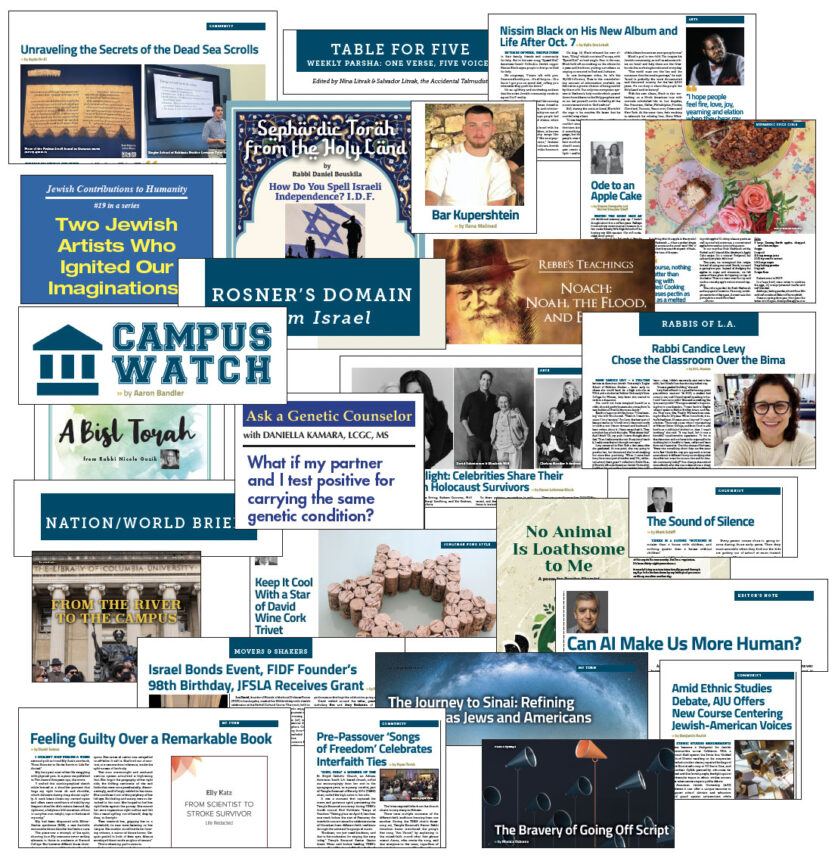
If the paper is seen as a “book” of Jewish education, it changes the very experience of flipping through the pages. Political analyses and commentaries teach different Jewish views on the world; the “Table for Five” Torah page teaches different takes on the weekly Torah portion; the column “Jewish Contributions to Humanity” teaches the long history of how Jews have given back to their societies; the food sections teach the diversity of Jewish ethnicity; the Sephardic Torah column exposes readers to Jewish scholars from Arab and Muslim lands; the Community section reinforces the value of storytelling to the Jewish tradition; the poetry page teaches the value of using words in a different context; the Israel page and analyses deepens the connection with Israel; the Arts section reinforces the many ways Jews express their Jewish identity, and on and on.

The point is this: If used well, The Journal can educate Jews in a unique way by exposing them to the tremendous variety of their Judaism. That variety is both a source of Jewish learning and a spark for meaningful conversations.

There’s no quick fix to the long-term problems of the high cost of Jewish education or the perennial threat of assimilation. But while we work on those, it’s good to know there exists a simple and efficient way to boost Jewish identity and trigger Jewish curiosity.

In short, a one-hour “Jewish Journal class” every week that would give Jews young and old a taste of everything their Judaism has to offer might well rejuvenate Jewish education.

That would surely be something to kvell about.

Is It Time to Rejuvenate Jewish Education? Read More »

AJU President Jeff Herbst Resigns; Jay Sanderson to Become Interim President

American Jewish University President Jeffrey Herbst, a globally respected political scientist who has navigated the institution through a period of great transition, has decided to resign his position, AJU announced today.

Jay Sanderson, a household name in the Jewish world with a reputation for disruption and innovation in his previous roles heading the Jewish Federation of Greater Los Angeles and Jewish Television Network Productions, will become AJU’s Interim President.

The news was made public in a letter written by Harold Masor, AJU board chair, and Dr. Larry Platt, the incoming board chair, which was shared via email to the university’s community this afternoon.

Dr. Jeffrey Herbst’s resignation will mark the end of a seven-year tenure. He will remain affiliated with the institution as President Emeritus. Before joining AJU, Dr. Herbst served as president of Colgate University, as the president and CEO of the Newseum and the Newseum Institute in Washington, D.C. and as a professor of politics and international affairs at Princeton.

“Our board of directors is grateful to Dr. Herbst, who has effectively led AJU – with wisdom, professionalism, and grace – to navigate a critical time of great transition for the institution,” wrote Masor and Platt.

In recent years, AJU navigated the sale of its Familian Campus in Bel Air, a restructuring of the Ziegler School of Rabbinic Studies, a transition to increased online learning, and the launch of new programs to reach local and global Jewish audiences.

Earlier this year, Sanderson joined the leadership team at AJU to launch the 2050 Institute, an initiative that brings together influential leaders, thinkers, creators and philanthropists to develop action-oriented strategies that have the potential to reshape Jewish life in North America and address the Jewish community’s most pressing issues.

Sanderson will now step into the lead role at AJU, as the institution looks to write its next chapter.

“This is a moment ripe with opportunity for AJU. We are confident that together – our board, staff, students and supporters – will seize the opportunities ahead of us and bring our unique capabilities, talent and resources to advance Jewish wisdom, strengthen our community in Los Angeles and uplift our global Jewish family in the decades to come,” Masor and Platt wrote.

AJU President Jeff Herbst Resigns; Jay Sanderson to Become Interim President Read More »

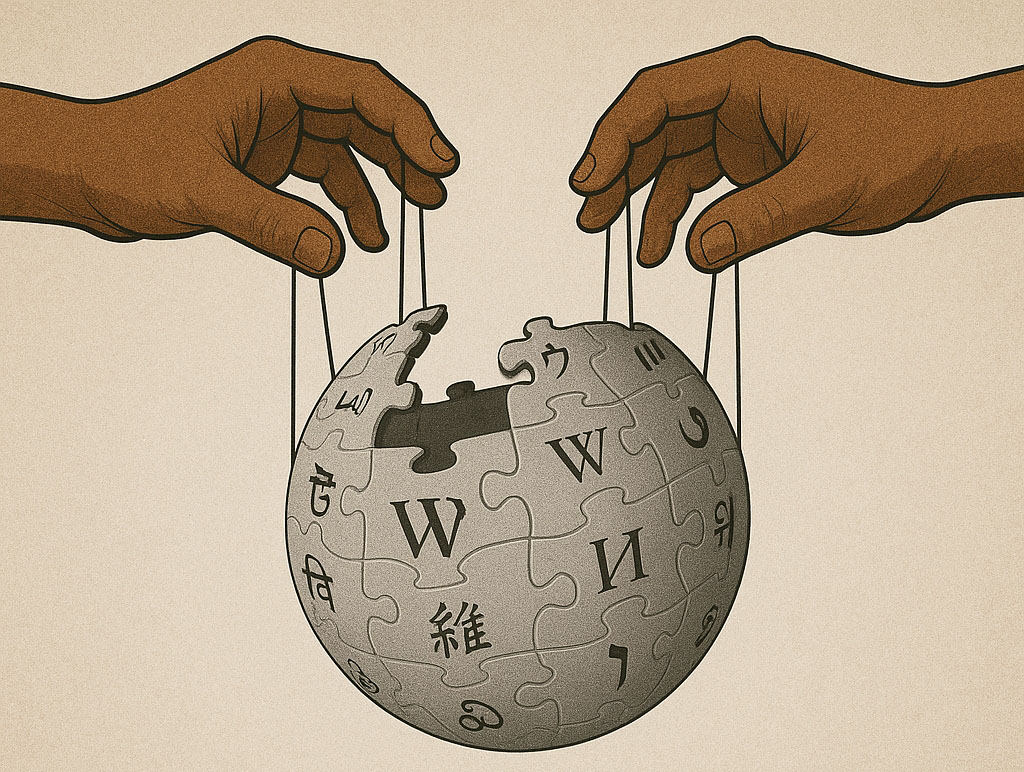
Wikipedia’s Supreme Court Bans Two Editors for Offsite Misconduct in Israel-Palestine Topic Area

Wikipedia’s Arbitration Committee (ArbCom), the site’s version of a Supreme Court, announced on April 25 that two editors have been banned from the site entirely for “off-wiki misconduct” in the Palestine-Israel articles (PIA) topic area.

In their announcement, the committee said it had reviewed a 244-page dossier that The Journal published in the “Gaming the Wiki System” cover story chronicling the purported activities of the Wikipedia channel in the Tech for Palestine Discord server.

“The Arbitration Committee has reviewed a dossier of ‘Tech4Palestine’ Discord server related evidence and has determined that, as of this time, the concerns raised have been adequately addressed,” the committee wrote. “The evidence has been retained by the Committee to be used, if necessary, to corroborate additional evidence received.”

It then listed all of the editors mentioned in the dossier. Several of them only made a handful of edits and haven’t been active in a while; thus the committee concluded that there’s “no action necessary, can be addressed if they return.” But the committee did site-ban one editor mentioned in the report, “Isoceles-sai,” which the committee said was the result of obtaining “additional evidence of off-wiki coordination independent of the Tech4Palestine Discord server.” The committee concluded that Isoceles-sai had violated Wikipedia policies on offsite coordination and canvassing, which is defined as notifying editors “with the intention of influencing the outcome of a discussion in a particular way.”

Another editor, “GeoColdWater,” was also site-banned for violating those policies based on the “additional evidence of off-wiki coordination independent of the Tech4Palestine Discord server” that ArbCom received. GeoColdWater is not mentioned in the dossier and there is no established link between the editor and the Discord channel as of publication time.

A sockpuppet investigation (Wikipedia defines sockpuppetry as misusing multiple accounts) was filed on April 11 against GeoColdWater, Isoceles-sai and two other editors. The editor who filed the report, “Chess,” alleged that the four editors were meatpuppets of each other, which Wikipedia defines as individuals promoting “their causes by bringing like-minded editors into the dispute, including enlisting assistance off-wiki.” Ultimately the case was closed with no action.

As for the rest of the editors mentioned in the dossier, the original sanctions on three editors in December remain the same; those three editors were “Ïvana” (site-banned), “Samisawtak” (indefinitely topic banned from the Israel-Palestine topic area) and “Tashmetu” (extended confirmed protection privileges revoked, meaning they can no longer edit areas like Israel-Palestine that require at least 30 days editing and 500 edits to begin editing there). There were two other editors listed in the dossier, one of whom edits in the French Wikipedia (and thus outside of the committee’s jurisdiction) and the other was not found to have engaged in any wrongdoing.

“Better late than never,” one editor told me about the result. “ArbCom can definitely take their time sometimes and be rather slow and bureaucratic much like a real court.”

Better late than never. … ArbCom can definitely take their time sometimes and be rather slow and bureaucratic much like a real court.”

The longtime editor behind “The Wikipedia Flood” blog, who has written about the Discord server, told me that it’s hard for them to comment on ArbCom’s latest actions since “I haven’t seen the evidence, but all those ‘sleeper’ accounts that stopped contributing months ago could start again at any time. Besides, no matter how many accounts they penalize, there will always be more. That’s why Wikipedia needs to be stripped of its tax-exempt status.”

A different editor called ArbCom’s actions a “toothless, distractionary gesture,” telling me that “nothing has changed here” and that “ArbCom still cannot find a way to apply more than a topic ban for people for conducting six-month canvassing operations” despite other editors being site-banned for lesser offenses in the past month. The editor was specifically referencing Samisawtak, believed to be Samer, one of the ringleaders of the Tech for Palestine Discord channel. In response to a question at “Arbitration/Requests/Clarification and Amendment” (ARCA) page (the wiki-equivalent of a Supreme Court hearing, where ArbCom hears arguments on if it should take a case) on why Samisawtak was only topic banned, ArbCom member “Captain Eek” replied: “Whether ArbCom imposes a particular remedy over another includes a wide range of factors, and is ultimately a vote where each Arb may have a different reason.”

Chess accused Samisawtak on his talk page of violating his topic ban in March when he made an edit to the Wikipedia page for Antoinette Lattouf. Lattouf is a journalist who was let go from ABC’s (Australian Broadcasting Corporation) local radio program after the outlet claimed she had violated company policy in a social media post about the ongoing Israel-Hamas war, prompting Lattouf to file an unlawful termination lawsuit against the outlet. Samisawtak told Chess that the edit was simply about “Freedom of Speech in Australia.” Chess countered that “someone who was fired for pro-Palestinian activism may be about freedom of speech in Australia, but it is related to the Israel-Palestine conflict and is encompassed in the topic-ban.” Samisawtak asked if he had to undo his edit, to which Chess warned him not to do it again. One editor told me that typically those that violate topic bans receive warnings first, and any further violations would result in escalating sanctions enforced by the admins. Another editor told me, however, that Samisawtak made it clear that he’s not there to build an encyclopedia, “and made it super clear the moment they returned and broke the rules again. Are the settings stuck on ‘warn’? When will the transgressions be sufficient?”

The latter editor further criticized ArbCom for “telling us ‘we won’t ban people caught canvassing because they’ve been off site for a while but if and when they come back on the site maybe we’ll address this then?’ and thinking we will find more safety in their leadership.”

Proceedings at ARCA have shed some more light on the processes behind ArbCom’s actions against members of the Tech for Palestine Discord server. In response to queries on ARCA asking why ArbCom never received the 244-page dossier published by The Journal, CaptainEek said that the committee received a download link from an anonymous individual — the purported WeTransfer link containing the dossier — “which years of email safety taught me not to click.” “They then keep sending attachments,” CaptainEek said of the anonymous individual who sent them the dossier. “I assumed that the attachments were the same as the download link, and that it wasn’t necessary to potentially download a tracker from a questionable individual. Nothing that our source said made it clear that this download link was five times larger than the other evidence.” CaptainEek did provide a “mea culpa” and pledged to be “more exacting in the future.” CaptainEek said that “our first investigation was based primarily on information sent from a different confidential source than this one, so we actually had another source of info which allowed us to handle the other editors.”

When an editor pointed out that follow-up emails indicated that more evidence was forthcoming and asked if it was communicated to the individual submitting evidence that there were security concerns with opening the download link and if the individual explained why they were anonymous, CaptainEek replied that she was not at liberty to disclose such information.

In response to questioning about the French Wikipedia editor, CaptainEek said that “the French effectively lack an ArbCom at the moment.”

ArbCom member “ScottishFinnishRadish” wrote in ARCA that the dossier “had a great deal of focus on editors with a handful of edits, or that were already blocked, and didn’t really add anything above what we’d already received. By the time I reviewed it almost everything actionable was done, and based on additional private evidence unrelated to the dossier we took some other actions. It sucks that we don’t have a better system of tracking the enormous amount of issues that come to us. It also sucks that someone forgot a couple emails out of literally thousands from six months earlier, but that happens.”

“Aoidh,” another member of committee, noted in ARCA that in January, ArbCom passed a motion to appoint a coordinating arbitrator whose responsibilities include “acknowledging the receipt of correspondence and assigning tracking identifiers to pending requests and other matters” and “tracking the status of pending matters and providing regular updates and reminders on the status of the Committee’s off-wiki work to arbitrators.” Aoidh contended that this change “has so far been very effective in its implementation.”

One editor told me that “ArbCom might be starting to wake up to the fact that they can’t just delay and drag feet with procedural bureaucratic slowness if it helps Hamas or when it comes to antisemitism.” Another editor, however, questioned “the substance” of the motion referenced by Aoidh “if there doesn’t seem to have been any retroactive application to submitted evidence … We also have in one ArbCom member openly boasting they had never received evidence, only to later reverse their entire story upon questioning and affirm it had been in their inbox all along (and further produce a laundry list of questionable excuses as to why they failed to download or review evidence that they now remember they did receive and simply decided not to review). And then there’s the other ArbCom member openly lamenting that they ‘don’t have a better system of tracking the enormous amount of issues that come to us.”

The latter editor contended that “we need accountability, we need reform, and we need it now.”

Wikipedia’s Supreme Court Bans Two Editors for Offsite Misconduct in Israel-Palestine Topic Area Read More »