fbpx

December 20, 2024

Education Dept., UC Schools Reach Agreement Over Antisemitism and Islamophobia Complaints

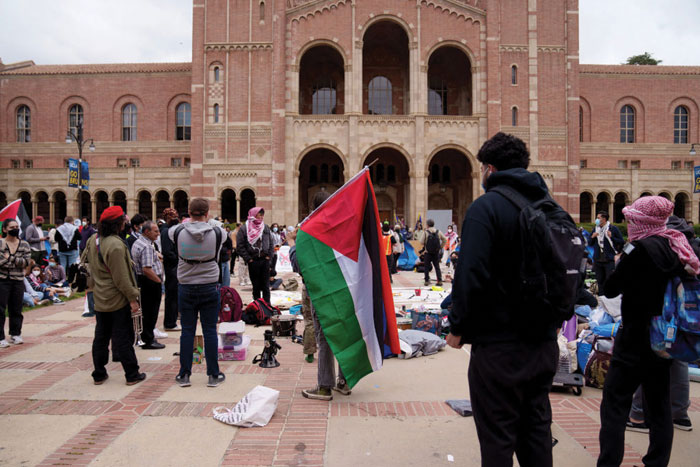
The Department of Education’s Office of Civil Rights (OCR) announced on Dec. 20 that it has reached a resolution agreement with five UC campuses — one of which is UCLA — over complaints that the universities failed to adequately respond to instances of antisemitism, Islamophobia, and discrimination based on Israeli, Palestinian and Arab ancestry.

The resolution agreement involved nine complaints involving UCLA, UC Santa Barbara, UC San Diego, UC Davis and UC Santa Cruz. OCR’s announcement particularly focused on UCLA, noting that the complaints involved reports in which there were chants of “death to Israel” and “intifada now” as well as video showing students beating an effigy of Israeli Prime Minister Benjamin Netanyahu on campus and one student purportedly shouting “beat that f—ing Jew” during that incident. OCR had also investigated reports that Jewish students were barred from entering parts of campus by members of the anti-Israel encampment over the spring unless the students renounced Zionism. Additionally, OCR investigated reports that Muslim and Palestinian students were followed, doxed and filmed without their consent and that UCLA campus police “allegedly failed to protect Palestinian, Arab, and/or pro-Palestinian student protestors while they were violently attacked, injured, and intimidated by counter-protestors.”

(UCLA campus police) allegedly failed to protect Palestinian, Arab, and/or pro-Palestinian student protestors while they were violently attacked, injured, and intimidated by counter-protestors.”

“Of particular concern were reports of violence against students of Jewish and Israeli ancestry by protesters at the encampment and of a violent assault by counter-protestors on pro-Palestinian protesters at the encampment on April 30, 2024, and the subsequent law enforcement response, which the UCLA Chancellor described as one in which students ‘feared for their safety,’” the OCR announcement stated. “In addition, OCR has a concern that the encampment at UCLA in spring 2024 may have subjected students to different treatment based on their national origin/shared Jewish ancestry, when their access to parts of the campus or UCLA programs was limited. OCR identified a similar concern about possible disparate treatment with respect to Jewish students’ access to a multicultural center at UC Santa Barbara.”

Regarding the other UC campuses, OCR stated that “UC Santa Barbara received notice of antisemitic vandalism at a dorm room and signs posted at a student center that targeted some named Jewish students and stated that Zionists were not welcome. UC San Diego and UC Davis also received reports and complaints about students witnessing or experiencing antisemitic comments or actions by students and professors at protests, online, or in campus departments. Chancellors at various UC campuses made statements to their communities acknowledging hate speech, antisemitic and anti-Muslim discrimination, and/or other harms that students on their respective campuses had experienced.”

Under the resolution agreement, the UC schools will review all complaints of harassment and discrimination in the current and previous academic school years, receive OCR approval for any changes to policies and procedures to ensure they’re compliant with Title VI of the Civil Rights Act, provide training to school employees and police to ensure they know how to respond to reports of discrimination and conduct a campus climate survey.

Regarding UCLA, the resolution agreement states that the university will investigate “(i) whether UCLA students were blocked from accessing parts of campus based on their actual or perceived Jewish and/or Israeli shared ancestry and/or the association with these national origins/shared ancestries as a result of the Encampment between April 25, 2024 and May 2, 2024; (ii) whether UCLA faculty/instructors held classes or office hours in the Encampment between April 25, 2024 and May 2, 2024; and (iii) whether UCLA, including its police, public safety officers, and security contractors, engaged in disparate treatment or harassment of UCLA students and employees based on their actual or perceived national origin/shared ancestry, including the association with these national origins/shared ancestries, when responding to the UCLA Encampment on April 30, 2024, and May 1, 2024, including when responding to the actions of protestors, counter-protestors, and non-UCLA law enforcement.”

The UC Office of the President said in a statement to The Journal: “The University of California unequivocally rejects antisemitism, Islamophobia, and all forms of harassment and discrimination. The University is pleased to share that it has entered a voluntary resolution agreement with the U.S. Department of Education’s Office for Civil Rights (OCR), furthering UC’s commitment to cultivate a respectful and welcoming environment free from discrimination and harassment based on national origin. This agreement builds upon the University’s ongoing efforts to combat discrimination and harassment based on national origin, including Jewish, Israeli, Palestinian, Arab, and Muslim ancestry, and/or association with these actual or perceived identities.” The office added that the agreement “is one of many important steps reflecting the University’s continued commitment to supporting the wellbeing of impacted community members, education and training, and prompt and appropriate responses to all reports of discrimination and harassment. Key among these is the 2024 launch of UC’s Systemwide Office of Civil Rights and the University’s systemwide Anti-Discrimination Policy. To further support these efforts, the University also issued a systemwide directive on policies impacting expressive activities to protect the UC community from harassment or threats, from impediments to access to classrooms and other buildings, and from violence of any kind.”
Education Dept., UC Schools Reach Agreement Over Antisemitism and Islamophobia Complaints Read More »

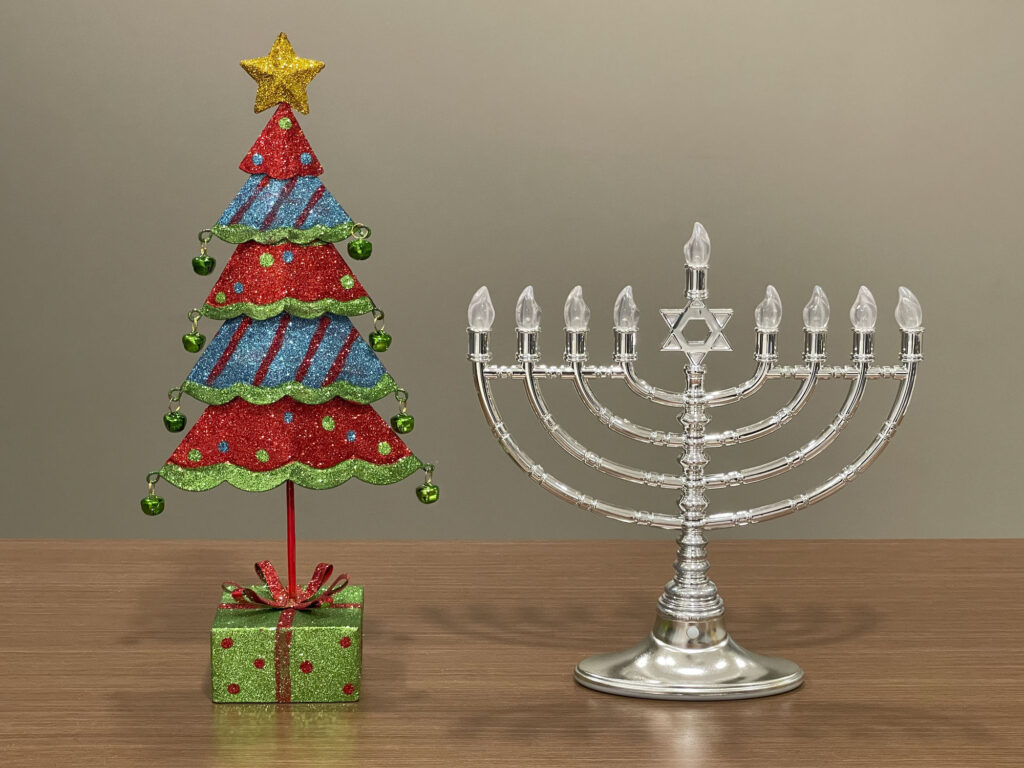
Why Did We Replace “Merry Christmas” With “Happy Holidays?”

I was visiting a Christian hospital the other day that glittered with Christmas decorations. The whole vibe was in the Christmas spirit, except for one thing. Instead of “Merry Christmas,” people kept wishing me, “Happy Holidays!”

Maybe because the person I was with introduced me as a Jew (“he’s with the Jewish Journal”), people didn’t want me to feel “excluded.”

Christmas, after all, is not my holiday.

But here’s the thing. I love living in a country that has a whole bunch of holidays, like Christmas. I love that some Americans honor Kwanzaa, a celebration of African-American culture, while my people celebrate the eight days of Hanukkah. I love honoring Muslim friends during Ramadan and Christian friends during Easter.

At the hospital, every time someone said, “Happy Holidays,” I responded with “Merry Christmas.” I wanted them to know that I’m honoring their holiday and the country we share that gives us the freedom to do so.

And yet, at the same time I can see how there’s something very American about saying “happy holidays.” Because we’re a nation of immigrants where peoples from around the world brought their own customs and traditions, but where “becoming American” was also a shared aspiration, “happy holidays” became a gesture of national kinship– a reminder that “we’re all in this together.”

The trend has accelerated in recent years as we’ve become more sensitive to any “microaggressions” that might offend cultural sensibilities. A neutral greeting like “happy holidays” fits perfectly into this new ethos.

At this time of year, when the holidays of Christmas, Hannukah and Kwanzaa overlap, this cultural dilution is especially prevalent. If you’re not sure what someone celebrates (if anything), why take a chance to possibly offend them?

“Happy holidays” is our end-of-year catch-all greeting that keeps us all out of trouble.

We lose something, however, with this cultural dilution. We lose the magic of difference; the magic of living in a multicultural society where we can share and learn about our differences. Words like “Christmas” “Kwanzaa” and “Hanukkah” are so much more meaningful than “holiday.”

I’m thinking maybe we can start a clunky new trend with “happy whatever holiday you celebrate.”

Shabbat shalom.

Why Did We Replace “Merry Christmas” With “Happy Holidays?” Read More »

Breaking Out – Comments on Torah Portion Va-yeishev 2024 (adapted from previous versions)


Breaking Out

Torah Portion VaYeishev 2024 (adapted from previous versions)


Of all of the sublime indications that “the Bible is literature, not journalism,” the subtle threads exuding from this week’s Torah portion stand out.


The story of Joseph and his brothers looms large over our parsha. Joseph is the elder son of Jacob’s beloved wife Rachel, who died birthing her second son, Benjamin. Jacob’s grief for his deceased wife is (dis)placed onto Joseph. The tragedy of the “preferred child,” haunting the Bible since the Cain and Abel story, is played out again.


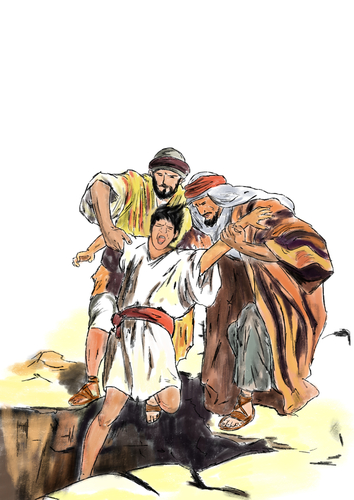
The story of Joseph and his brothers is well known, in literature, theater and screen. In their bitter envy, the brothers conspire to kill Joseph. At the last minute, Reuben adjured his brothers not to shed blood, but rather to throw him into a dry pit. Reuben hid his plan to come back later and rescue Joseph and apparently departed from his brothers to carry out the plan in secret.


Judah, not knowing of Reuben’s plan to rescue Joseph, also wanted to save Joseph from dying in the pit. Judah led the other brothers to lift Joseph out of the pit and sell Joseph as a slave to caravaners heading for Egypt. Reuben came back to the pit and was struck with grief when he saw that Joseph was gone. Reuben returned to his brothers. With bitter hearts, they shared what they had done.


We don’t know how the brothers reacted to Reuben’s compassion, a compassion only exceeded by his fear of their knowing he wanted to break up the plot. Reuben didn’t want Joseph killed, and neither did Judah. They didn’t speak up, bond in the realization that they were their brother’s keepers.


They seem to have been paralized with their guilt. Instead of chasing down the caravan, the brothers planned a cover-up, a lie to tell their father. They soaked Joseph’s coat in the blood of a ram, and told Jacob that a wild beast had killed Joseph. Not far from the truth.


Instead of retelling this grievous story, I’d like to focus on the strange interlude in this week’s Torah portion, chapter 38.


Briefly, Judah married the unnamed daughter of a Canaanite named Shu’a. Their elder son, ‘Er, married Tamar, a woman of unknown origin.‘ Er dies, and the second son Onan must take Tamar as wife, according to the laws of levirate (brother-in-law) marriage. Onan refuses to impregnate Tamar – he also dies.


The obligation of brother-in-law marriage was still required, but Judah, worrying that his last son Shelah might die if he too married Tamar, delayed their union. Tamar took the initiative, dressed up as a harlot, seduced Judah, and became impregnated by her unwitting father-in-law. She was determined to bear an heir to Judah, either through Judah’s son Shelah or through Judah, personally.


Tamar and Judah produce twins, just like Judah’s grandmother, Rebecca. At birth, one of the twins extends his hand from the womb. The midwife, recalling the sad story of Jacob (Judah’s father) and Esau (Judah’s uncle), immediately ties a crimson thread to that hand reaching out from the womb, saying, “this one came out first!”  That baby retracts his hand, and his brother is born. The midwife exclaims, seemingly in admiration, “Mah paratzta.” That exclamation is hard to translate – maybe something like “Wow, you really broke out of there!” Judah, taking the midwife’s cue, names him “Peretz,” “Breakout.” We have the image of Peretz crawling over his brother to get fully out of the womb first.


What became of Peretz, the breakout son of Judah and Er’s widow, Tamar?   We find out at the end of the book of Ruth. We are told: Peretz (the son of Judah and Tamar) sired Hezron; Hezron was the father of Ram; Ram was the father of Amminadav, who was the father of  Nachshon, who was the father of Salmah, who was the father of Boaz, Ruth’s husband. Boaz and Ruth bore Oved, who was the father of Jesse, who was the father of David, the future king, prototype of the Messiah.


In short, the authors/editors of the Bible made sure that we know that the story of the widow Tamar and Judah continues straight into the story of Ruth the Moabitess, and Boaz, the descendant of Judah and Tamar. Ruth, the Moabitess, is the grandmother of King David; she is the ancestor of the Messiah, as well.  David is descends from Tamar and Ruth.


Then what happens? David, of course, is the father of Solomon. Solomon married Na’amah the Ammonitess (among other women). Solomon and Na’amah bore Rechav’am (Rehoboam), who succeeds Solomon as king. While Rechav’am’s poor leadership is a factor in splitting the United Monarchy, he and Na’amah bring the lineage of David forward.


I hope you are still reading, because here’s the gold: buried in these lineages is the Bible going to great lengths to tell us that the line of David, understood to be propelling into the future to bear the King Messiah, son of David, is the product of both a Moabitess and an Ammonitess. (Much of this is discussed in the Talmud, Baba Kamah 38b)


Moab and Ammon are the sons produced by the daughters of Lot, who consorted with their father under the belief that humanity had been wiped out with the destruction of Sodom and Gomorrah. They saw themselves as the new Eve, or the new wives of Noah, regenerating humanity.


At first glance, what a sordid mess. Sons die. Onanism gets its name. A daughter-in-law parading as a prostitute to have sex with her father-in-law. Capping all of this off are descendants of the products of incest marrying into the family.


Of course, the sordid nature of the story is reversed when we see that these women are the ancestors of the Messiah, that intrepid Ruth is King David’s grandmother, and that fiercely devoted Tamar bears Peretz into the world, and the young lad who broke out was to become the ancestor of David, of Solomon, and of King Messiah, down the road.


The Bible is literature, not journalism. We want to ask, “What does all this mean?” but that is too facile a question to ask of great literature. The Bible is not Aesop’s fables.


What is clear is that something unclear is happening. Something strange, upsetting and beautiful. Jacob’s tricking his father and betraying his brother sets into motion further stories of masking, impersonating, and hiding.


We add to this story that of Joseph and his brothers – the envy, the attempted murder of Joseph, the selling of Joseph into slavery, and the eventual reconciliation between Joseph and his brothers  that caps off the book of Genesis, a reconciliation plotted by Joseph, but led by Judah. We will discuss what motivated them another time.


For now, I can only offer a mid-point thought based on the spiritual- psychological- philosophic- literary journey through which the Bible leads us.


We are thrown into life, into situations that we cannot understand, and we barely know what is at stake. No law, ethical code or cultural tradition can prepare us for, or guide us through, moments of being stranded, times when we find ourselves on the rocks and shoals upon which we have thrown ourselves, or which life can thrust upon us.


We can find only the answers within. Maybe someone else can advise us what to do, but we are the ones who have to decide. The story of Tamar in search of Judah’s seed in this week’s Torah portion is just one of the stories of courage and cunning we find in the book of Genesis. These stories tell us that to retreat into conformity betrays the truth of the moment. But we also know that to revel in nonconformity robs us of the existential experience of courage.


And these tales, exquisite literary products of deep and fine minds, evoke the tortured, miraculous, and stunning contours of the journeys of our own souls.


At different times in our lives, we are Jacob, Leah, Joseph, Reuben, or Judah. At other times we are Tamar, or Lot, or the daughters of Lot, or Potiphar’s wife. At other times we find ourselves in the pit, or holding a bloodstained jacket, or bearing a dream of the sun, moon, and stars. We might even be the man wandering in the field, pushing Joseph to the bitterness that waited for him.


Read the story deeply and read yourself deeply. Soak in each scene, each character. See what emerges. A truth within is waiting to be born.


Breaking Out – Comments on Torah Portion Va-yeishev 2024 (adapted from previous versions) Read More »