
fbpx

March 25, 2024

A Day that Will Live On in Infamy

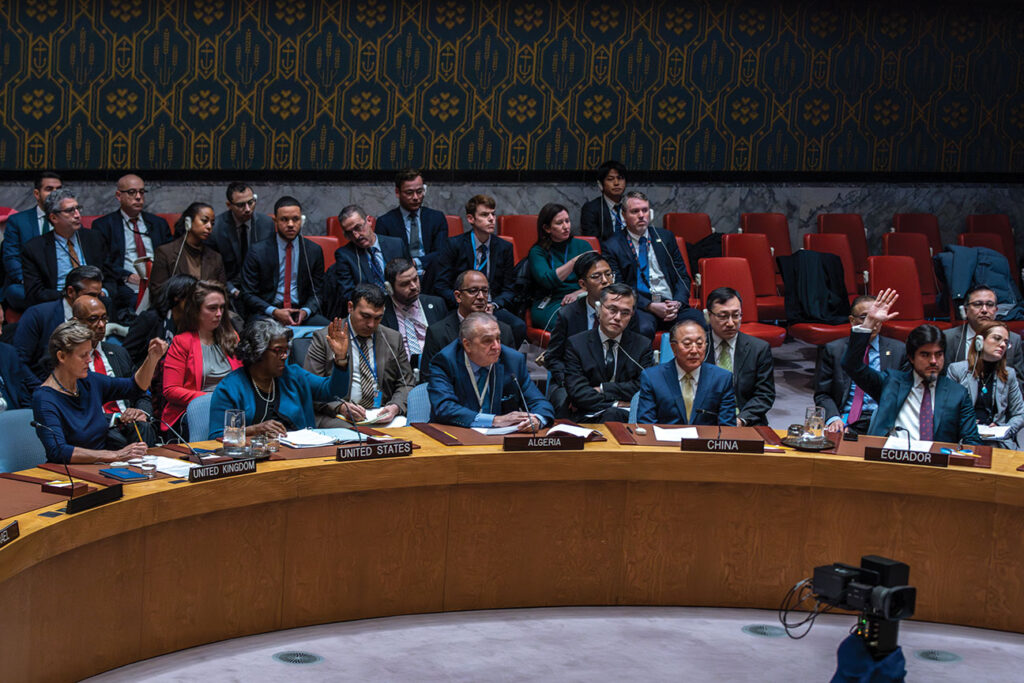
Today is a dark day for the Western world; a day that will live on in infamy. The decision by the United Nations Security Council to impose a ceasefire on Israel without condemning Hamas for instigating the current war, or insisting on the immediate return of hostages before a ceasefire begins, is surely one of great injustices imposed on a country since the creation of the United Nations in the wake of the Second World War.

Since its establishment in 1945, the United Nations has ostensibly aimed to be the fulcrum of global peace and security, intervening in conflicts to halt wars and foster negotiations. However, the decision today by the UN Security Council marks a stark departure from historical precedents. It is also galling hypocrisy to use Ramadan as a foil for this resolution, when Hamas deliberately chose a Jewish festival day as the date to launch its violent bloodbath against Jews.

These omissions are not just notable; they are literally unprecedented, except when it comes to Israel. In past interventions when the Jewish state wasn’t involved, the UN has repeatedly taken a more balanced approach, recognizing aggressions and violations of international law by all parties involved. This latest stance, with a resolution that is void of any condemnation of Hamas or demands for the return of hostages for there to be a ceasefire, raises questions about fairness and the underlying principles guiding the UN’s decisions in international conflicts.

Just by way of comparison, in January, the UN Security Council adopted Resolution 2722, which called for the maintenance of international peace and security in the face of Houthi attacks on commercial navigation in the Red Sea. The resolution unequivocally condemned the Houthi’s aggressive actions, including the seizure of the ship, Galaxy Leader, and its crew, emphasizing the vital importance of unimpeded maritime commerce and the exercise of navigational rights under international law. The resolution demanded an immediate halt to such attacks and called for the release of the seized vessel and its crew, highlighting the broader implications of these actions on global trade and regional stability.

And yet, the resolution also affirmed the international community’s commitment to supporting Yemen’s sovereignty and the capacity-building efforts of its Coast Guard, and underscored the need to prevent the provision of arms that could escalate the conflict. Significantly, Resolution 2722 balanced its firm condemnation of the Houthis’ actions with a call for restraint in military countermeasures and diplomacy, and urged all parties to engage in enhanced diplomatic efforts to address the root causes of the conflict and prevent further escalation in the Red Sea and the surrounding region. This balanced approach clearly demonstrates that the UN Security Council is capable of adopting a resolution that is comprehensive and balanced – except, apparently, when it comes to Israel and the Palestinians.

That Israel will feel a sense of grievance over the UN Security Council’s resolution calling for a ceasefire is totally reasonable. Israel is surrounded by entities and nations with whom it has a complex and often hostile relationship, and rightfully views its security and sovereignty as paramount. The failure of the resolution to explicitly condemn Hamas for initiating hostilities not only undermines Israel’s longstanding security concerns but also raises questions about the UN’s impartiality in resolving this conflict.

Moreover, by not insisting on the immediate return of hostages before the ceasefire—a fundamental humanitarian concern—even as it expresses concern for the humanitarian needs of Gaza’s residents, the resolution has manifestly overlooked the human rights of Israeli citizens. To have done so is to have neglected the very principles of justice, fairness, and protection of civilians that the UN purports to uphold, contributing to Israel’s feeling of isolation and bias against it within the international community.

The resolution adopted today highlights the grave dilemma facing Israel: how should a country that must confront terrorism, military threats and an international community that is seemingly more concerned for its enemies address legitimate security needs and their right to self-defense in an arena where its actions are often scrutinized more heavily than those of state actors and non-state actors perpetrating violence against it.

Considering the far-reaching implications of having called for a ceasefire without directly addressing the actions of Hamas or the pressing issue of Israeli hostages, the UN Security Council must urgently reevaluate. The United Nations purports to bear the mantle of peace and justice on the global stage – in which case it must immediately issue a new resolution that comprehensively addresses the concerns raised by this latest resolution. The new resolution should explicitly condemn Hamas aggression, demand the immediate release of all the hostages, and outline clear expectations for the cessation of hostilities that ensure the safety and security of all civilians – not just those living in Gaza.

Failure to reevaluate and issue a new resolution addressing the legitimate concerns of all parties involved – including Israel – will show that the United Nations has devolved into nothing more than an instrument for the most corrupt elements within the international community. Such a scenario would irreparably damage whatever remains of the UN’s credibility, not only in the eyes of Israel, but also for any nation or group entangled in a conflict where alleviating human suffering is paramount.

Unless the current resolution’s shortcomings are promptly and effectively rectified, the consequences will be dire. The world will be markedly worse off, with human suffering only set to escalate. This moment calls for urgent action and integrity from the United Nations, lest its role as the foundation of hope and fairness in the international arena be forever compromised.


Rabbi Pini Dunner is the senior spiritual leader at Beverly Hills Synagogue, a member of the Young Israel family of synagogues.

A Day that Will Live On in Infamy Read More »

The Black, the Blue and the Jews

The tale I am about to tell started out as a feel-good movie of the week and ended up as a two-hanky tearjerker of bitterness and betrayal. From solidarity to the nearly unsalvageable, within a matter of decades.

I am talking about the once unshakable bond between Blacks and Jews, which is now about as solid as quicksand within a desert of separation—with some of the most recent enmity emanating around events in the Middle East.

But Israel’s war in Gaza is not the sole rift. Old antisemitic canards have been resurrected and shamefully adopted by some African-Americans.

Recently, Congressman Jamaal Bowman (D-NY) urged that a mural honoring notorious antisemite Louis Farrakhan should remain untouched. (Farrakhan has referred to Jews as “termites” and called Judaism “the synagogue of Satan.”) Just last month Farrakhan promised an adoring audience that Allah had told him, personally, that the genocide of the Jews is near.

Last week, African-American conservative provocateur Candace Owens was fired from the Daily Wire after a series of remarks accusing Israel of genocide, referring to a “sinister gang of Jews” who control Hollywood, and liking a tweet that referred to a rabbi as being “drunk on Christian blood.”

Bowman and Owens share nothing in common politically. They are simply African-Americans who hate Jews without ideology getting in the way.

Over the past several years, antisemitic sluices have surged, and influential African-Americans can’t stop libeling Jews. One of the four original organizers of the 2017 Women’s March, Tamika Mallory, caused the two Jewish co-founders to resign when she berated them for belonging to a people responsible for the slave trade.

In 2020, professional athletes DeShawn Jackson and Stephen Jackson took to Instagram to praise Adolf Hitler and Farrakhan. Actor Nick Cannon used his YouTube channel to accuse the Rothschild family of conspiring with Zionists to control world banking. Rapper Ice Cube promoted a cartoon of caricatured Jews playing Monopoly on the backs of Black men.

In 2022, rapper Kanye West released a torrent of antisemitic greatest hits that Spotify would have rejected. He praised Hitler and the Nazis, called Black Hebrew Israelites the true Jews, and threatened to go “death con 3 on JEWISH PEOPLE.” Basketball star Kyrie Irving endorsed a film that denied the Holocaust and claimed that Jews are lying about their biblical origins—and he did this while playing for Brooklyn!

Also in 2022, Whoopi Goldberg used her platform on The View to educate America that the Holocaust was not racially motivated. Obviously she adopted a Jewish surname, but not a Jewish brain.

Back in 2019, Hasidic Jews living in Williamsburg, Crown Heights, Borough Park, and Monsey, New York, and Jersey City, New Jersey, became targets of African-American teenagers and Black Hebrew Israelites.

Stand-up comedian Dave Chappelle, in one of his recent shows, accused Israel of committing war crimes. There’s a history here. In 2019, on Netflix, he made a joke about “Space Jews” that was an allegory for either Jewish power or Zionist “colonialism.” A year later, while hosting Saturday Night Live, he defended West and Irving by stating that Jews shouldn’t blame Blacks for their past trauma. Who’s doing that? The blame is in promoting vile tropes and lies that foment antisemitic violence among young Black males.

How did things get so bad, and so fast? The political alliance was once obvious on paper. Today it is paper thin, a relationship best defined by mutual suspicion and grievance. The condition of African-American and Jewish relations in the United States today is no longer a matter of black and white—or even a noncommittal shade of gray. It is best described as black and blue.

It began with the best of intentions. Two peoples inexorably drawn together by a history of persecution—victims of different masters (although not in the case of the lynching of Leo Frank), but sharing a common belief that Blacks and Jews were subhuman.

Jews helped found both the NAACP and its Legal Defense Fund. When Thurgood Marshall, who directed the latter, was appointed to the federal bench, he anointed Jack Greenberg as his successor. A Jewish lawyer defended the Scottsboro Boys, pro bono. Half the Freedom Riders were white, and 50% of those were Jewish. Two of the three murdered civil rights workers in Mississippi were Jews. Rabbi Abraham Joshua Heschel linked arms with Martin Luther King Jr. throughout the Deep South. One of King’s closest confidants was attorney Stanley Levison.

Not long after King’s assassination, African-Americans came to resent the perceived sanctimony of Jewish paternalism; Jews who had placed their bodies on the line sensed ingratitude.

Eventually, Black Power led to Jewish exclusion. Malcolm X shattered the moral foundations of King’s passive nonviolent resistance with high-octane militancy. A once peaceful movement morphed into urban riots.

Over the ensuing decades, Jewish economic success robbed Jews of their underdog, underclass status. African-Americans made great progress, too, but powerful forces found it politically expedient to remain stuck in the grievances of 1960s.

Meanwhile, Israel, and the memory of the Holocaust, became ethnic priorities for Jews that didn’t align with an African-American agenda. Palestinians were anointed as successors to the civil rights struggle, even though their methods, which depended on terrorism, had nothing in common with the marches and sit-ins perfected by King. And the Holocaust seemed like special pleading for a people who were doing just fine.

These tensions reached a crescendo with the death of George Floyd, the rise of Black Lives Matter and Israel’s war in Gaza. Suddenly, it became fashionably convenient to forget the Jewish contribution to civil rights—if it was remembered at all. Allegations of apartheid and genocide, inveighed against Israel, went unrebutted. African-Americans were color-blind to the Instagram postings of Ethiopian Israelis fighting for the IDF, or a Black former Miss Israel calling for the return of the hostages.

Nothing was allowed to exonerate the Jewish state.

That’s why so many within the Congressional Black Caucus and the Squad are in lockstep when it comes to condemning Israel. And it’s what makes African-American leaders who support Israel, like Sen. Tim Scott (R-SC), House Speaker Hakeem Jeffries (D-NY) and Rep. Richie Torres (D-NY), exceptional outliers.

With rising incitement against Jews globally, American Jews are feeling betrayed by former allies—those who are outspokenly antisemitic, and those who remain silent. Polarization of this magnitude has caused Jews to remain silent, too.

That’s understandable. The acronyms BLM, BDS, DEI and CRT are unassailable in this political culture. Faced with such a winning combination of race cards, Jews are likely to fold.


Thane Rosenbaum is a novelist, essayist, law professor and Distinguished University Professor at Touro University, where he directs the Forum on Life, Culture & Society. He is the legal analyst for CBS News Radio. His most recent book is titled “Saving Free Speech … From Itself.” 

The Black, the Blue and the Jews Read More »

Far Right and Far Left Converge — Against the Jews

An extremist distributes a flier about “Zionists infiltrating the media.” A political activist tweets, “Nothing is creepier than Zionism.” A pundit writes about “the dirty tactics of Zionist censorship.”

Can you tell which of these haters is coming from the political right, and which from the political left? The world of antisemitism has become so muddled that it’s almost impossible to tell one from the other.

Consider: One of these three haters was recently arrested for painting the slogan “White Power” on synagogues. One co-chaired the Women’s March on Washington. One is a former New York Times correspondent and speechwriter for Ralph Nader. Can you tell which one is which?

One of the three is a Presbyterian minister. One is a devout Muslim. One owns a Ku Klux Klan robe. Still can’t tell who’s who?

Although these three bigots come from very different places on the political and religious spectrums, they have managed to find something in common: hatred of Jews, thinly disguised as hatred of “Zionists.”

Among the most troubling phenomena of our time is the extent to which antisemitism has become interchangeable among individuals who hold starkly differing views on other issues, from abortion to immigration to civil rights. Yet they all hate Jews.

There is no simple explanation for this because there is no simple explanation for antisemitism. Some bigots hate Jews for religious reasons, some for political reasons. Some focus their ire on Jewish philanthropists, some focus on Jews in the media, some focus on the Jewish state.

And sometimes they focus their hate on each other. In the 1930s, Nazi Germany and the Soviet Union both violently persecuted their Jewish citizens, even as the two regimes went back and forth between being enemies and being allies. The Germans oppressed Jews and Judaism in the name of Aryan racial purity, the Soviets oppressed them in the name of working-class solidarity. Even when Hitler and Stalin hated each other, they never stopped hating Jews.

Leafing through the American Communist press in the 1930s is a ride on an intellectual roller-coaster. U.S. Communists dutifully followed the Soviet line, regularly and passionately denouncing Nazi Germany—until the Soviets signed a nonaggression pact with the Nazis in August 1939, at which point the American far left suddenly declared that the British, the French, and “the capitalist press” were the real enemy, to cite an editorial which appeared in that month’s issue of Young Communist Review. Two years later, Hitler tore up the pact and America’s Communists returned to being anti-Nazi. All the while, Jews and Judaism remained in the crosshairs of both Marxism and Nazism.

Adam Braun is the name of the aforementioned extremist who was so worried about “Zionist infiltration” of the media and other institutions. He was recently arrested in Oregon for painting the slogan “White Power” on a synagogue. Searching his belongings, the police found the antisemitic flier as well as a Ku Klux Klan robe.

Linda Sarsour, whose tweet fretted about the “creepiness of Zionism,” is a Muslim rights advocate and self-identified feminist leader. Despite her extremism, she remains in good standing in the feminist movement.

Chris Hedges is the former Middle East bureau chief for the New York Times who rails about the “dirty tactics” of “Zionist censors.” He is also an ordained Presbyterian minister, and he is no outlier in the church when it comes to Israel. The Presbyterian Church USA opposes American aid to Israel and responded to October 7 by blaming both sides.

Braun, Sarsour and Hedges are as different from one another as night from day, but they have one important thing in common: Hatred of Jews has created a bond between them that their disparate religious and political affiliations apparently cannot tear asunder.


Dr. Medoff is founding director of The David S. Wyman Institute for Holocaust Studies and author of more than 20 books about Jewish history and the Holocaust. His latest is Whistleblowers: Four Who Fought to Expose the Holocaust to America, a nonfiction graphic novel with artist Dean Motter, published by Dark Horse Books.)

Far Right and Far Left Converge — Against the Jews Read More »