fbpx

February 9, 2024

Mishpatim and the Study of Law and Ethics – Thoughts on Parashat Mishpatim 2025
Mishpatim and the Study of Law and Ethics

Thoughts on Parashat Mishpatim 2025


The major part of our Torah portion, Mishpatim, raises important questions about Judaism, religion in general, ethics, and law.


First, the nature of Judaism. I have a brief definition of Judaism:  a community rooted in texts and traditions, together producing a complex array of beliefs and practices.


Part of this “complex array” is Jewish law and ethics. Many of our legal philosophers have divided Jewish law, halakha, into two areas: commandments that connect us to God, and commandments that connect us to other human beings.


Examples of commandments that connect us to God are keeping the Sabbath and devotional practices – prayer, meditation, and so forth. Commandments that connect us to other human beings are related to ethics and justice.

We use the term “moral law” to differentiate between morality that can be legislated and that which can’t.

What is the connection between ethics and justice? Ethics has to do with right relationships between people, and justice attempts to formalize those relationships as communal norms. Ideally, the law of a community is rooted in ethics, but not all areas of “right relationships” can be dictated by law. We use the term “moral law” to differentiate between morality that can be legislated and that which can’t. The moral law requires that we be as kind and honest as is reasonably possible, for example, but those duties cannot be legislated. In the same way, we can speak of “legal justice,” issues of justice that you can take to court, and “natural law justice,” which can never be fully legislated.


Our Torah portion contains commandments that cover all these areas – ethics, legal justice, and natural law justice. Many people define their Judaism through the lens of ethics and justice, hence the importance of this Torah portion. Here is the problem: both words are profoundly difficult to define.


“Ethics” is from the Greek term “ethos” – normally translated as society’s norms. Morality, by the way, is simply a Latin translation of ethics. Morality, like ethics, is etymologically connected to “mores,” also meaning societal customs or norms. Etymologically, there is no difference between ethics and morality; they are translations of each other. Both terms, ethics and morals, eventually moved away from societal norms, what people do, to what people ought to do, rooted in what is truly right by its nature, not by people’s opinions. Is theft really wrong, or wrong because most people think it is wrong? Eventually, the idea of “natural law” took hold in Western thought. Actions are right or wrong by their nature, not because of opinions.

For all our focus in Judaism on ethics, it is interesting that there is no single word in Hebrew for the English words “ethics” and “morals.” The Hebrew language uses the term “mussar” for morality and ethics, but this term in its natural habitat connotes character ethics, not morality as a whole.


For all our focus in Judaism on ethics, it is interesting that there is no single word in Hebrew for the English words “ethics” and “morals.” The Hebrew language uses the term “mussar” for morality and ethics, but this term in its natural habitat connotes character ethics, not morality as a whole.


In the same way, there is no simple Hebrew term for “justice.”  Sometimes the word “mishpat” is used, but this word can simply mean “law,” but sometimes means “law that is just.”  The most common word for justice in Hebrew is “tzedek,” but this word also carries the idea of “righteousness.”


“Justice” is very difficult to define in any language. Etymologically, it comes from something being according to a line or standard, as in wanting something to be “just so.” Justice, of course, is concerned with the line of what is fair and right.


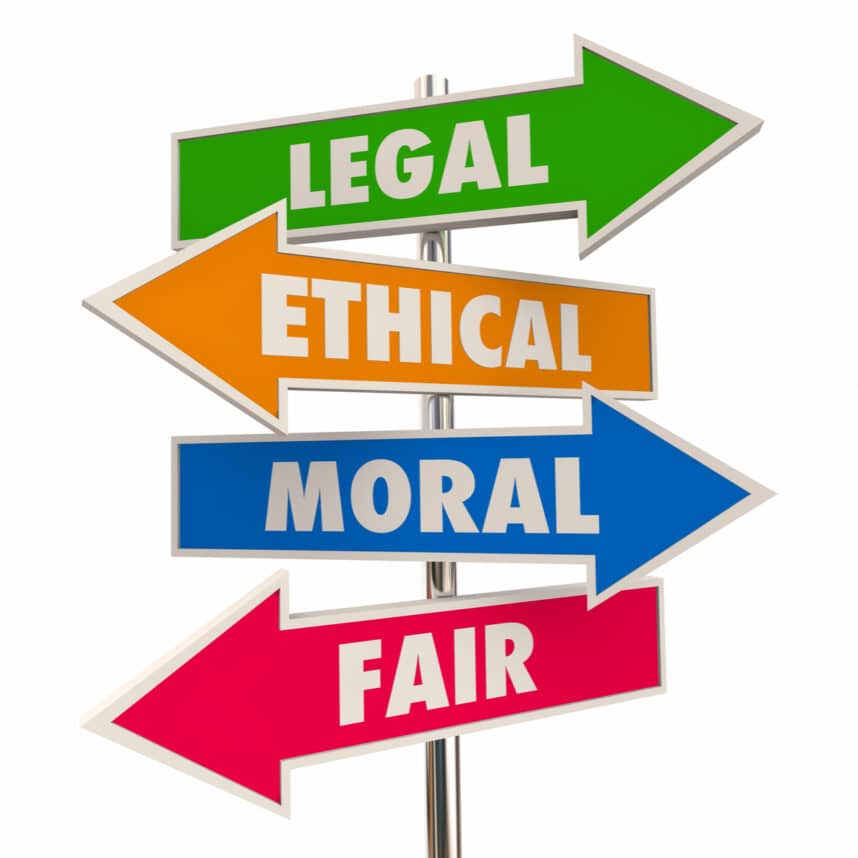
There are no satisfactory definitions of these terms – ethics, morals, justice, fair, and right, for example. When you study these terms, the definitions always end up using some of the other terms. What is fair, is just. What is just, is fair.


Through a lifetime of study of these ideas, I find that defining these terms is less important than studying cases where these terms play a decisive role.


In any well-functioning society, there is enough consensus on what is ethical and just to create a legal system, law being the attempt to consolidate ethics into an enforceable code of behavior. All well-functioning societies also understand the difference between law and ethics, in two ways.


One difference between law and ethics is the understanding that law will always lag behind ethics, that law won’t always line up with evolving understandings of what is right and fair. When enough people in a society recognize that the law in a given case is not fair, there is a way to change the law in well-functioning societies. The legislature or courts step in. Crisis occurs when people in a society have radically different understandings of what is right and fair. Ideally, we work these things out at the ballot box.


Another difference between law and ethics is that ethics (what is truly right and fair) requires things of us that the law can’t. Ethics would require, for example, that we be civil to other people going about their business. Law could never delineate what it means for us to be civil to others –  law waits for a civil wrong or a crime.


In our Torah portion, we see many examples of what is mostly case law, “if this happens, then this happens.” It seems clear that these legal problems presented in the Torah are the result of generations of questions regarding law and ethics, normative ways to settle disputes. It is also clear that the legal and ethical issues presented in our Torah portion are frozen in time, often expressed in ways that are foreign, or even objectionable to us.


Our work as faithful interpreters of Torah is to look behind any legal case and find the ethical dimension – what problems of fairness and justice are being addressed? Studying how our textual tradition addresses questions of fairness and justice in its time can teach us how to address problems in our own time.


In my view, every well-functioning religion (especially to the degree that religion and law intersect) and society are always working both to close the gap between law and ethics and to support ethical behavior that the law can’t cover.


From this point of view, there really is no such thing as “Jewish ethics.” Ethics, meaning the study of what is truly right, fair, and just, is universal. I prefer a longer term: “Jewish ethics is the articulation of the Jewish tradition’s participating in the human struggle to discover what is right, fair, and just.”


Every religion, every society, struggles with questions of ethics. Ethics is universal, but the understanding of ethics differs depending on a given society or culture at a given moment in history.


Our goal in studying Jewish law and ethics is to sharpen our sensibilities regarding these issues. One example of a Jewish approach would be that traditional Jewish texts focus on duties more than, for example, the Aristotelian tradition, that sees goodness in terms of a rational goal of well-being. In the Torah tradition, we have a duty not to steal because it is wrong, not because stealing does not lead to human flourishing.


In modern questions of law and ethics, Judaism focuses, again, much more on duty than rights. The rights-oriented discourse in American society can be enriched greatly by the concept of duty, focusing less on what we deserve from others, and more on what we morally owe others.


In our study of this week’s Torah portion, we will study different aspects of law and ethics that can enrich us as human beings, and that can even enrich our participation in our nation’s ongoing struggle with what is right, fair, just, and true.

Mishpatim and the Study of Law and Ethics – Thoughts on Parashat Mishpatim 2025 Read More »

Diary of Determination: Ensuring Israel’s Food Security and Future

“We are building a country, not martyrs,” Yael, my guide in Israel, told me. Despite the most horrible circumstances, Israel continues to thrive, head held high, with dignity, determination and resilience.

Recently, I spent five days volunteering in Israel’s communities bordering Gaza, and never have I been prouder to be a Jew and a Zionist.

On Oct. 7, when the savage brutality of Hamas was unleashed on innocent families and music festival attendees, I didn’t hesitate to look for a way I could help. I didn’t just need to be there. I had to.

Israel is a place I consider my homeland, in addition to the United States.

My first instinct was to work on a kibbutz out in the fields, as I did when I was 16. At the time, I was assigned to Kibbutz Hatzerim, tying weaker avocado branches to stronger ones. It was hard work for a young girl not used to the Israeli summer heat.

Now, a few decades later, the imminent war seemed much more intimidating than the heat, so I looked for a group that would provide me with a tangible and meaningful way to help while also providing some measure of security. This time, I joined Jewish National Fund-USA on a mission to serve Israel in any way I could. Agriculture was guaranteed to be a big part of the week.

Gardening gloves packed and boots on the ground, I arrived Friday just in time to join a friend of a friend at their home for Shabbat. That’s how it works: You tell someone you are heading to Israel, and the next thing you know, there are three invites waiting in your WhatsApp chat — Jewish geography at its finest.

Walking around Tel Aviv, the trees brimming with oranges, one could hardly tell a war was going on. Many soldiers were out and about, rifles slung over their shoulders, but that’s everyday life in Israel. Notably, if it wasn’t a weapon, it was a musical instrument. It’s not a surprise, considering Israel is home to one of the finest Philharmonics in the world.

Sidewalk cafes were filled with people having a coffee or glass of wine before heading home for Shabbat. I walked the streets alone, feeling very safe.

The next day, I walked through the old city of Jaffa and visited one of my favorite bakeries, Abulafia. Open on Shabbat, Abulafia is owned by Arabs, coexisting with Israelis and baking the most delectably soft pita bread topped with zaatar. Happily savoring my snack, my walk quickly turned to sadness as hostage posters were everywhere, a constant reminder of the pain our friends and family here are dealing with.

Monday started with a trip down south, where I picked Clementines. Upon arrival at the Kibbutz, the farmer could not stop thanking us for coming. Due to rain from the night before, he had his doubts about our abilities. However, having flown 6,000 miles, there was no way that rain and mud would stop me and the rest of my group — we were ready to go.

Before Oct. 7, there were about 25,000 Thai workers on the farms. It is a great opportunity for them to send money home. However, after Hamas took 14 Thais hostage, most left on their own and the remaining few followed at the behest of their government. The other workers were Palestinians and young Israelis, the latter now called to serve in the war. Therefore, the farmers desperately needed laborers to help them maintain Israel’s food security. Furthermore, if the fruit is not picked, it negatively affects the following year’s yield.

The farmers desperately needed laborers to help them maintain Israel’s food security.  … If the fruit is not picked, it negatively affects the following year’s yield.

Despite the mud and the ever-present war just miles away, we managed to pick 13 huge bins of citrus — a lofty achievement for our budding group of agriculturalists.

The next day, I arrived at Noor, a restaurant owned by a Druze Israeli. I say that because so many people are surprised to learn that many Arabs live peacefully in Israel. In fact, Basma, the restaurant’s owner, is an Israel Defense Forces (IDF) widow, proudly living and working in Israel’s north — the Galilee. Noor, named after her son, offers a beautiful, traditional menu using fresh ingredients harvested from surrounding farms.

Due to the lack of tourists, Basma was financially unable to keep her restaurant open. So she pivoted and had the restaurant certified Kosher so she could cook for the IDF, which her son is also serving. After several weeks of doing this alone, many people, including Jewish National Fund-USA, rallied to help provide her with the funds and volunteers needed to assist her venture.

I loved working with her and learning about her authentic recipes. We made grilled chicken, cabbage slaw, and mejedra (a warm lentil concoction topped with fried onions).  Four-hundred-fifty hot meals were prepared that morning with her staff. As a former restaurant owner myself, I can fully appreciate her passion, hard work and the quality of food and cleanliness. It was such a pleasure.

On the Wednesday of my week-long volunteering mission, I found myself back in southern Israel, near Be’er Sheva, at an IDF base preparing food boxes for the soldiers in Gaza. I was surprised to see hundreds of volunteers from all over the world: Australia, Great Britain, South Africa, France, Mexico and beyond. It was quite heartwarming and only confirms my belief that we are a people of unity and problem solvers.

Everyone volunteering at the base worked together on an assembly line, making boxes, adding stickers, and filling them with canned food and dried soup. Never one for self-pity, we Jews do what must be done – a spirit that has sustained us for 4,000 years.

On my last morning, I arrived on the bus with my eyes half closed, only to learn I would be heading to a farm near Haifa to plant broccoli. Immediately, I perked up as being in an open field on a warm day was most certainly my happy place. We ended up planting broccoli seedlings. It is laborious yet gratifying. The sandy earth was a gorgeous color and had a soft smell. Surrounded by cypress trees, I literally felt as if I was in an impressionist painting.

That afternoon, I stopped at a coffee shop to find two Muslim women sitting peacefully at a table while a tall IDF soldier was ordering his drink, rifle slung over his shoulder. Another untold example of coexistence that most of the world doesn’t know or chooses to ignore.

Although it’s only been a week since I returned, I look back on this most meaningful experience with such joy in my heart, hoping I made a difference, however small. I’m already planning my next trip back, with at least ten friends in tow. I’m not quite sure what the end game was for the terrorists on that day in October, but we Jews are strong and will continue to stay in Israel and pick up the shattered pieces that were left behind with grace. We will never succumb in numbers and in spirit. Am Yisrael Chai!

Diary of Determination: Ensuring Israel’s Food Security and Future Read More »

Jewish Communities Need to Play Chess and Avoid Whack-a-Mole to Fight Antisemitism

The American Jewish community is losing an information war.

There’s a gnawing feeling in our guts that we’ve fallen inexorably behind in a competitive marketing war that paints Israel as an aggressor in the minds of a generation of young people. Disinformation regarding Israeli and Jewish values has successfully colored the perceptions of a great many Millennials and Gen-Z’ers. They hear the false, but simplistic, messages spread by our enemies over-and-over again and buy into the narrative that the Jewish state is an oppressive aggressor and that the so-named Palestinians are hapless victims.  Those people who experienced or know 20th century history recoil at this concept as if somebody was telling them that gravity makes things fall up, not down – for no nation or people have been victimized in contemporary times more than Israel and the Jewish people.

Across U.S. local Jewish communities, people newly awakened to the threat of antisemitism due to the post-October 7th news cycle and daily, publicized local activism are shocked and horrified. But’s it’s no surprise that, in the absence of accurate, impartial information about Israel that is equally simplistic and repetitive, that disinformation has rushed in to fill the void. In an ill-advised reaction, some in our Jewish community wrongly cast blame on Jewish organizations that they feel are not doing a sufficient job fighting this misinformation. This criticism has been directed at organizations from the national to the community level.

Humans have a natural inclination toward fight or flight. An increasing number of Jewish leaders are choosing to fight by playing “rugby,” engaging in local scrums with college campuses, city councils and school boards because they feel pressure to confront activist-driven and creeping institutional antisemitism in visible, head-on ways.

This can be a useful tactic, as the Jewish community needs groups that are willing to debate its adversaries head-on. But jumping into a scrum with anti-Israel activists does not always align with objectives of this war and can often serve to publicize the misinformation narrative. In a rugby match, the opposition puts the ball in play, and the players soon cluster around it and engage.  But we’re playing a game where the ball bounces across many fields, and there are no referees.

So, instead, the game becomes multi-dimensional whack-a-mole. In this game, the moles pop up and spew vitriolic antisemitic and anti-Israel hate.  And it should not be lost on anybody how the misinformation war bears similarities to the physical war of whack-a-mole going on in Gaza as Hamas moves fighters and weapons underground and then pops out of its tunnels.

What many outraged Jews do not realize is that we’re not playing whack-a-mole, we’re playing marketing and messaging chess. And we’ve been playing chess since at least 1948.

The opening move came from Israel’s enemies, who callously turned the 700,000 displaced Arabs into political pawns, now numbering approximately 6 million permanent “refugees.” The establishment of the United Nations only a few years prior in late 1945, meant that the rules of international engagement were still being written. The next move was one of vocabulary: Israel’s adversaries weaponized academic terms like “Palestinians”, “refugees”, “occupation,” “Zionist,” “resistance,” and “decolonization,” to deepen their portrayal of Israel as an oppressive, racist, irredeemable settler colony.  These adversaries never dare mention that Jews are only .2% of the world population, that Israel has only .1% of the land area in the Middle East, and that Israel has endured multiple genocidal attacks.

For the past 20 years in the United States, there has been a concentrated, centrally organized effort to institutionalize the false narrative regarding Israel and Jews. Anti-Israel activists have infiltrated colleges and universities, K-12 education, teachers unions, school boards, local city councils, courts and even law enforcement agencies. Today’s resurgence of antisemitism can be traced back to these efforts.

Unlike whack-a-mole, chess has two players. The adversaries of Israel and Jews started making their moves decades ago; and hard as it is to acknowledge, we have made fewer effective moves and spent far less resources.  Thus, we must make stronger and better moves going forward with the recognition that you cannot revise decades of indoctrination overnight.

As chair of the Rose Project of the Jewish Federation of Orange County, I have been fortunate to work with a group of community leaders since 2006 who play the long game and recognize that comprehensive, multi-step strategies are a better play in the information war than getting into a visible scrap with every antisemite and Israel-delegitimizer who pops up.

We need to step back and play chess by understanding the multi-dimensional way that a worldwide marketing campaign of antisemitism and Israeli delegitimization is being funded and executed in a well-planned, multi-generational way.  Reactive tactics cannot, alone, defeat strategy.  Although occasional punches in the nose can throw adversaries off their plans.

The Jewish community needs to remember that across our history, our biggest defeats have come when Jews work against the interests of other Jews.  As American Jews, we must understand that marketing and messaging propaganda against us is powerful, and not have false security in our local communities that atrocities of the past cannot recur here at home. Our communities need to combine the strengths of strategy and direct engagement to avoid wasting energy on a game of whack-a-mole that is meant to exhaust us and our resources.

When we come together, our community achieves great successes—unprecedented successes—from winning Nobel Prizes to realizing the dream of Jewish statehood. Now, we must come together once more to reframe the narrative around Israel and ensure that future generations know Israel not as an evil oppressor, but as the emblematic conveyance of democracy and peace in the Middle East.


Jeff Margolis is chairman of the Rose Project of the Jewish Federation of Orange County.

Jewish Communities Need to Play Chess and Avoid Whack-a-Mole to Fight Antisemitism Read More »

We Stand With the IDF

Next week, I will be taking a mission to Israel; this is my third trip there since October 7th. Like the previous two trips, we will be making an unusual stop: an army base.

Soldiers and tourists are a strange combination; in no other country do visits like these happen.

So why are we going to the army bases? Because the soldiers of the IDF are our heroes.

You would get a very different picture of the IDF on Tiktok, in college campuses, and at the International Court of Justice. There, the State of Israel is libeled, and the IDF is the very source of demonization.

Israel (and the IDF) have been charged with genocide in this so-called court of justice, whose judges include representatives from China and Russia, well-known paragons of human rights.  The ICJ filing notes that the following countries have made official claims that Israel is committing genocide:

Bolivia, Brazil,Colombia, Cuba, Iran, Türkiye, and Venezuela.

This recalls the well-known adage that you can judge a person by the character of their enemies. When such a rogue’s gallery are your accusers, you know you must be doing something right.

There is much to be said in response to this accusation, but I will not rehash those arguments here. Suffice it to say that Bret Stephens got it right when he called the accusation of genocide against Israel a moral obscenity.

It is an obscenity because genocide is precisely what Israel’s eenemy Hamas is attempting to do.

It is an obscenity to equate the Jews, the victims of the worst genocide in human history, with the Nazis.

It is an obscenity because countries like North Korea, China, and Iran, are treated as upstanding members of the international community, while a democracy is the subject of obsessive criticism.

It is an obscenity because it avoids even the smallest measure of truth. The Arab citizens of Israel live in freedom, while the Arab citizens of Gaza have lived in fear since Hamas took over in 2006. Arab Israelis have supported Israel in its war against Hamas; one early poll found 70% of Arab Israelis support the war. But neither before October 7th, nor since then, has there been much mention of the crimes Hamas perpetrated against its own citizens, including murdering opponents and stealing aid for the poor to build its war machine.

And the accusations against the IDF are a bald-faced lie. Yossi Klein Halevi wrote in 2014:

Israelis know that the IDF does not deliberately kill civilians. We know this because we are the IDF—because our sons, our neighbors’ sons, have been fighting in Gaza. We know that dead Palestinian civilians serve the interests only of Hamas, not Israel….We know that mistakes happen in war because, unlike many of Israel’s critics in the West, Israelis know war. We know that houses in Gaza were booby-trapped, that schools and mosques concealed arms caches and entrances to tunnels and were repeatedly used as launching pads for rockets.

That was 2014. Plus ca change, plus c’est la meme chose.

This horrid accusation in The Hague is of great strategic value to Hamas. It is an ugly piece of propaganda masquerading as idealism, and manages to shape the entire world’s perspective on Israel. It stretches open the window of what is acceptable discourse about Israel, and allows lies and libels to go mainstream.

Relative moderates unconsciously follow suit. The New York Times had an absurd article analyzing the social media accounts of Israeli soldiers who had posted insensitive TikTok videos from Gaza. Yes, they found 50 videos the reporters considered inappropriate. How is this a headline in a war that had disgusting and depraved crimes filmed with delight by Hamas? And you make a case based on 50 TikTok? Tens of thousands of Israeli troops have served in Gaza, the vast majority of whom have conducted themselves with honor.

The Times hasn’t informed its readers when it will analyze TikTok accounts of other armies.

The IDF is held to a standard of perfection, and criticized mercilessly for every misstep.

Where does this criticism come from? Undoubtedly, some are pushed by compassion for the Palestinian civilians who are caught in this crossfire.

It goes without saying, although it still needs to be said, that we are in profound pain because of the death and destruction the Palestinians have had to endure.

Jews see every human being as one of God’s children, created in the divine image. Jews dream of a day when all of humanity turns to peace, and comes together as one.

It is precisely this idealism that leads many people, including some young Jews, to feel an intuitive sense of compassion for the poor victims of this war.

But compassion should never distort our sense of justice.

There is a strange verse in Exodus 23:3, which is directed at judges:

“You shall not show deference to a poor man in his dispute.”

The commentaries are perplexed by this. Generally, it is the powerful, not the poor, who can influence judges and twist judgments. Why is a commandment required to tell judges not to favor the poor?

On this point, many commentaries respond that pious judges may be tempted to distort judgment out of compassion, hoping to give the underdog a leg up.

But there is a further question. The phrasing of this command in Hebrew refers to “deference” which the court might consider giving to the poor person. That seems strange; the verse should have referred to mercy on the poor, which might interfere with judgment. Honoring the poor seems incongruous; people ordinarily honor the wealthy.

Rabbi David Tzvi Hoffmann notes that the Bible critic Karl August Knobel emended the text, and turned poor (dal) into great (gadol.) But well before Knobel confronted this problem, Rabbi Abraham the son of Maimonides offered a thoughtful solution. He explains that some assume misery implies a noble goodness. One’s poverty is thought of as proof of virtue. One might be tempted to assume that the underdog is always right.

This is why Israel faces a unique challenge; in the court of public opinion, those who are strong are assumed to be wrong. Might makes for moral failure.  Those who wear the laurels of victimhood best deserve the sympathy of the world.

Because of these unconscious assumptions, the IDF is maligned; even allies engage in a perfunctory denunciation of Israeli excesses.

Some newspaper reporters have become advocates, and turn every bit of data into an indictment of Israel. To quote Alice in Wonderland, these journalists practice the method of “sentence first, verdict afterwards.”

But the evidence shows otherwise. John Spencer, chair of urban warfare studies at the Modern War Institute at West Point, wrote that:

“In my opinion Israel has implemented more measures to prevent civilian casualties in urban warfare than any other military in the history of war.”

Spencer points out the multiple measures Israel has used to diminish civilian casualties, including the use of air-dropped flyers to give instructions on evacuations, radio and social media messages, phone calls and texts to civilians, and roof-knocking, (which Spencer points out that “no military has ever implemented in war.”)

A quick comparison to the battle in Mosul from October 2016 to July 2017 is instructive. The US coalition attacked ISIS in an urban area slightly less densely populated than Gaza, which resulted in killing 2,500 ISIS fighters. However, this battle resulted in somewhere between 5,000 and 11,000 civilian deaths. This ratio of civilian to military deaths of anywhere between 2:1 and 4:1. Currently, the ratio in Gaza 1.8:1.

Spencer is right about the IDF.

Death is always horrible. And all the data in the world will not overcome the tragedy of dead children. And that is what Hamas has been hoping for; they take their own civilians and use them as human shields, and hope that by doing so, the world will prevent Israel from fighting back.

It is here where the calls for a ceasefire begin. But they are generally an exercise in moral condescension. Those who live comfortably in America and have nothing to lose counsel a country that has everything to lose to be patient and lay down their arms in the face of a depraved, bloodthirsty enemy. Sinwar and other Hamas leaders have vowed to repeat October 7th again and again until they destroy Israel. We must take them at their word. To ask Israel, in the name of a phony peace, to allow Hamas to regroup and attack again is suicidal.

Jews know better; empty moral gestures are actually immoral.  In 1938, Mahatma Gandhi wrote the following to the head of the German Jewish community, Rabbi Leo Baeck: “My advice to German Jews would be that they commit suicide on a single day, at a single hour. Then would the conscience of Europe awake.”  Baeck gave a blunt response:  “We Jews know that the single most important commandment of God is to live.” For Jews, pacifism is immoral, because we have a responsibility to care for our own lives and defend ourselves.

Baeck is absolutely correct. Rashi in our Torah reading cites the well-known Talmudic rule that “one who comes to kill you, you kill them first.” There is a holy obligation to defend our own lives, our own children, and our own country.

Yet this is a very painful obligation. Israel sends its best and brightest to the front lines; and far too many have fallen in battle.

But there is no choice. Cowardice in the face of evil surrenders the world to the wicked. The young men and women in Israel put their lives on the line for the sacred task of protecting those who are good.

Hamas fights because they hate those who stand before them; the IDF fights because they love those who stand behind them. And that is why the soldiers of the IDF are our heroes.

I recently read a short post about Capt. Rotem Levi, who fell in battle in December. His aunt sent this story to Sivan Rahav Meir, who shared it on her social media accounts.

“During the Shiva for Rotem, a comrade of Rotem’s explained that one night during battle, when they were together, this soldier couldn’t turn on his lightstick, and in frustration called out ‘enough, what do you want! Everything here is darkness.’

Rotem, with absolute calm, said “Turn around. Do you see Nir Oz? (A Kibbutz in the Gaza envelope that was attacked.) This is our light, this is what brings us light.”

Rotem knew why he was on the front lines; he could turn around and see exactly what he was fighting for. I am heartbroken that this great man had to give up his life to protect Israel. But even in the darkest stretch of Gaza, he kept his eye on what matters: his people, his country.  He was thinking of all of us right before he lost his life.

And that is why we are visiting army bases. When the rest of the world turns its back on IDF, we will be there for them. We will tell our beloved soldiers that we stand with Rotem, and we stand with the IDF.

And to tell them that Rotem was a hero, they all are our heroes.


Rabbi Chaim Steinmetz is the Senior Rabbi of Congregation Kehilath Jeshurun in New York.

We Stand With the IDF Read More »

Former Co-President of Columbia Barnard Sikh Group Says She Was Forced Out for Being Pro-Israel

The co-president of a Sikh student group at Columbia University’s Barnard College is claiming that she was forced out of her position in the club in December simply for being pro-Israel.

The student, who identified herself solely as Simran, told her story in a Jan. 29 episode of “The Uproar,” a podcast hosted by Columbia student Eliana Goldin to tell people what’s happening on campus since Oct. 7. Simran, a psychology senior at Barnard, was the co-president of Sewa, which describes itself as being “a social justice and community service organization that is based upon the Sikh value of sewa (selfless service).”

Simran explained that the pressure on campus to “socially conform” to the pro-Palestinian view has intensified ever since the university’s Students for Justice in Palestine (SJP) and Jewish Voice for Peace (JVP) were suspended. The suspension of the two chapters was a catalyst in the revival of the Columbia University Apartheid Divest (CUAD) coalition that had been inactive since 2020; the coalition calls for both the SJP and JVP chapters to be reinstated with an apology, a ceasefire in the ongoing Israel-Hamas war and the university to cease ties with Tel Aviv University on their joint program, among other demands. Initially, Simran felt like there was minimal interest from Sewa members to sign onto CUAD, primarily out of concern of it potentially harming their future employment opportunities, but some members did “recognize Oct. 7 as a tragedy.”

“As president of the group, I felt a responsibility to protect the social and career interests of everyone in the group,” Simran said. “I thought that staying sort of neutral group but obviously allowing members to do what they wanted in their free time was the best way to go. I think it’s damaging to conflate an entire religion with one view or another on such a polarizing issue.”

However, in November Sewa faced “immense pressure” from a couple of recent alumni to sign onto the CUAD’s demands and that “there was a lot of shaming going on” for not doing so. Simran, who is open about her pro-Israel views, claimed she got a lot of messages from Sewa members about how they did not want to sign onto the CUAD’s demands, and thus Sewa decided to remain neutral.

But the group again faced “resistance” from alumni, and there were a couple of older members in Sewa who were vocal about wanting to sign on, which Simran believes had some sway over younger members who wanted to run for leadership positions in the club. Consequently, Sewa decided to put the issue up to a majority vote rather than a unanimous vote, a move that Simran viewed as “very, very dangerous” for “individuals that may not share those views to be labeled as supporting CUAD.” The vote in Sewa was held anonymously, and 75% voted in support of signing onto CUAD’s demands; an unspecified number of members voted to abstain.

A few days later, the co-president of Simran’s chapter of Sewa told her during a FaceTime conversation that “my personal views have made individuals in the club and that it was their belief that had I not been co-president, they would have reached the same decision to sign onto CUAD sooner. So for that reason, they had given me the option to either step down and resign as co-president, or be put through a formal impeachment process.” Simran then decided to resign.

Simran believes that she was discriminated for simply being supportive of Israel. “Some of these people I was so close with that were like my family, I am never going to speak to again in my life,” she said, “because I was discriminated against for a personal view. They told me how to practice my religion and shamed me for not practicing it a certain way. And it’s sad.”

She has been in contact with both Columbia and Barnard about the matter. “I do feel the support of the university behind me,” Simran said. She has no intention of returning to Sewa.

Simran herself became pro-Israel when she attended a Jewish preschool. “It’s not even about being pro-Israel, it’s just seeing an issue a little more objectively than how the world wants to see it,” she said. Simran does not really consider herself to be a political person.

The reason why so many people are pro-Palestinian at Columbia is because it’s “trendy” in the “social justice warrior” campus culture, Simran opined.

She believes that a way to create more dialogue would be for groups like Students Supporting Israel (SSI) to engage more with other religious groups on campus. “I think that if SSI were to speak to religious leaders the way that we’re getting like a million [direct messages] from SJP and JVP …  it would be easier for groups to be bipartisan at the least, if not so vehemently pro-Palestine,” Simran said.

A university spokesperson said in a statement to the Journal, “We encourage everyone in our community to report if they feel they’ve experienced bias. You can access the form to report here.” The spokesperson elaborated that this statement is more of a generalized comment and that the university cannot comment on any individual cases due to confidentiality policies.

Sewa did not respond to the Journal’s requests for comment.

Former Co-President of Columbia Barnard Sikh Group Says She Was Forced Out for Being Pro-Israel Read More »