fbpx

January 23, 2024

Chosen Links – January 21, 2024

Thank goodness I didn’t fall into the trap! This week, some friends sent me tragic info, shared by multiple trusted sources: 21 bodies of Israeli hostages held by Hamas were found. Something didn’t smell quite right to me. There are always trolls on every post, heckling and mocking in nasty disagreement, but this time I noticed something additional. A couple of seemingly friendly, pro-Israel comments were begging the sources to remove their tweets, because things were unverified. It was not trolling; it was caution. I saw more good people share it, but I still withheld until we knew more. Sure enough, my Spidey Senses were correct, and it appears to NOT have been accurate reporting. For the sake of the families and loved ones, I would far prefer to be late in sharing and disseminating accurate information, than possibly be wrong in my rush to be first to the party. You should too. When in doubt, just don’t press the share button:

https://x.com/melissaeweiss/status/1748225311446044705

And I’ll remind you to read my article on this very topic, which was put in print this week (though that version is cut down for space):

https://jewishjournal.com/…/366646/know-your-sources/

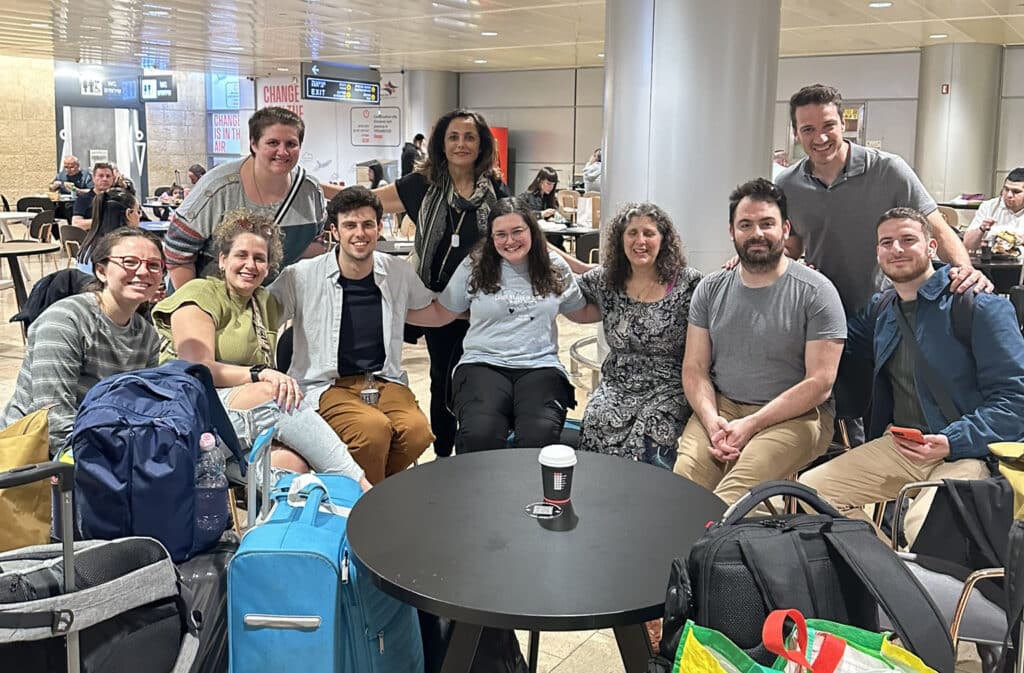
This week’s photo is a lovely one from touring Mahane Yehudah Market (aka “The Shuk”). Pictured with me and Adi are my dear cousins, Yonatan, Eitan and Ruth Ebenstein who is a far more accomplished writer than myself.

ARTICLES/THREADS:

1a. Do you know those moments during a Shiva visit, where the mourner changes the subject and starts to laugh about something, and it gives you that complicated feeling of smiling with them, but also being on guard for the second he or she pivots back into sadness mode, making your smile disappear? That’s human nature for you, and certainly applies to how Jews cope with sadness.

Sarah Tuttle-Singer does a beautiful job as usual, telling the story of a man who tries to guilt a woman for enjoying her morning so near the suffering of Gaza. She finds small moments to make lovely stories from:

https://blogs.timesofisrael.com/at-aroma-cafe-it-almost…/

1b. Oh damn, this is another great one by Sarah. The world loves to hate us, no matter what/where/how we are. “They also love us for a moment when we are the victim…like always, like clockwork, they all find a reason to blame us for our own suffering: we are either too passive and weak – the eternal Ghetto Jew crawling in the gutter – or we are the constant Aggressor, the too-powerful villain who brought it on ourselves.” Damn she’s a powerful writer, and fun fact, Adi and her brother Adam went to school with her in LA:

https://blogs.timesofisrael.com/im-a-jew-ill-hold-my…/

2. Seth Frantzman writes a great thread about Hamas and the West. They sit in the lap of luxury in Qatar, and enjoy the wealth of support from around the world, while they attack Israel.

“Hamas leaders literally live in a sparkling city near a US military base…so it’s clear this attack could have been prevented. But it wasn’t. Because for a long time Hamas was coddled, empowered, enriched. It was even enriched MORE than the Palestinian Authority, which is backed by the West”. Worth reading:

https://x.com/sfrantzman/status/1746505466673275151

3a. It’s strange to think that Turkey not long ago was getting closer to having a good relationship with Israel, because they are now siding entirely with Hamas. To that end, this week Israeli soccer player Sagiv Jehezkel merely showed solidarity with the hostages, and the result was his detention and charg by the police, and condemnation by the country.

Not to be outdone, a second player is also in trouble for being pro Israel, “pressure was also being seen on Turkish social media for the İstanbul Başakşehir soccer club to take action against a second Israeli soccer player in the Turkish top league, Eden Kartsev, who published an Instagram story similarly identifying with the Gaza hostages and echoing the slogan calling to “Bring them home now.” We live in a world where expressing solidarity with the victims of terror can get you in trouble:

https://www.timesofisrael.com/turkey-to-deport-israeli…/

3b. Defense Minister Naftali Bennett expressed his outrage effectively here with his tweet. But please also see the first comment by Seth Frantzman. It sharply points out that time and time again Turkey acts like this in bad faith against Israel, and time and time again Israel dresses up their relationship with Turkey as being friends. Almost like an abusive relationship where you keep going back to the one who hurts you:

https://twitter.com/naftaliben…/status/1746663353118789951

4. This is a great thread by Shany Mor. He completely obliterates the terrible op-ed in the NY Times, and shows piece by piece how it was removing parts of quotes and any and all context. She completely reframed the facts to fit her own anti-Israel narrative:

https://x.com/ShMMor/status/1746187331441140113

5. Wow, this is a tough read, and not for the reasons you might think. There’s nothing graphic here, that’s not it. What’s tough is knowing that if this is the reality of Gaza, things are far more bleak than we had hoped. Israeli journalist Roi Yanovsky published a piece about Gaza that’s translated into English in this thread. It describes the beauty of the land that could have been ShangriLa. It describes just how many homes are full of weapon stockpiles. It splashes cold water on our hopeful faces, as we want to believe that Hamas is an evil leadership over a country of innocents. But reminders keep coming up that they may have far more support from the general population than we want:

https://x.com/JewishSpaceLazr/status/1746809941803896943

6a. John Spencer serves as the Chair of Urban Warfare Studies at the Modern War Institute at West Point. His analysis on battles and wars have been exemplary. He breaks down in great detail why Israel fighting in Gaza is simply incomparable to any and all previous wars. “Unlike other battles, the Hamas strategic goals are not to hold terrain or defeat Israel’s military but to sacrifice their civilians (so not human shields, but human sacrifices) to cause the international community to force Israel to stop their counter-attack.”

He also concludes that he is amazed by how well they are assisting civilians against all odds:

https://x.com/SpencerGuard/status/1746725914312847646

6b. Spencer here writes an article analyzing the strategy of the tunnels. “Hamas has built a tunnel network to gain not just a military advantage, but a political advantage, as well…Hamas weaved its vast tunnel networks into the society on the surface. Destroying the tunnels is virtually impossible without adversely impacting the population living in Gaza…Hamas’s strategy is also not to hold terrain or defeat an attacking force. Its strategy is about time. It is about creating time for international pressure on Israel to stop its military operation to mount.” I love getting his American, military, strategic perspective:

https://mwi.westpoint.edu/gazas-underground-hamass…/

7a. Fern Reiss goes into great length, explaining the 100 days that have passed with so many of the hostages still gone, and what options Israel has at this point. “We need a solution that deters future kidnappings, because the penalty is perceived as being too onerous by the terrorists, or we will be having our citizens kidnapped on a regular basis. In the meantime, no one has a good solution.” There really are no good solutions yet, and we continue to see the world try to tie Israel’s hands behind its back, while victim-blaming them incessantly:

https://fernmusing.substack.com/…/war-day-100-bring-our…

7b. Fern gives one of her great updates full of quick hits, that I highly recommend. Among other things mentioned, she lists the numerous actual genocides since the Genocide Convention was created, none of which were actually brought to court. But Israel was, shocker.

She also mentions this part, which plays directly into my recommended “For Your Consideration” section this and last week. “Israel’s health care system is preparing for its largest post-trauma wave in history. An estimated 30% of the population may develop post-trauma disorders in the next few months. There are already months-long waiting lists for trauma/mental health needs. Psychiatry experts estimate that one in three people affected by the war, including families and friends of the kidnapped or injured, or who have lost loved ones—might develop post-trauma disorders in coming months.” This is why the efforts of my cousin Micki Lavin-Pell, and the organization NATAL are so crucial:

https://fernmusing.substack.com/…/war-day-107-the…

8a. An awesome exposé by Hillel Neuer and UN Watch about the UNRWA. UN Watch had revealed a Telegram account full of UNRWA teachers celebrating October 7. So the organization denied everything, and claimed those weren’t their teachers. So just like that, Neuer is giving proof after proof that YES THEY ARE YOUR STAFF. Epic:

https://x.com/HillelNeuer/status/1746962851955191937

8b. It appears that this tweet by Eitan Fischberger, was the breaking of the story about this Telegram account:

https://x.com/EFischberger/status/1741930405958160398

9. It’s great that this is being discussed and prepared for, but it’s also really brutal to even think about. Israel is trying to plan for the event of pregnancies due to rape, in the hostages who are still being held. “When the pregnancy is a result of a terrorist who previously murdered her relatives, and brutally raped her, the emotional aftermath is unimaginable.”

Know what else would be helpful? If the Red Cross would actually help check on the hostages and get them medications! ” We have been pressing for a long time with requests to allow medical examinations and the transfer of medications. If there is a captive woman who, God forbid, has conceived from rape, it is imperative to bring her home urgently.” A necessary topic that someone needed to bring up; thank you Dr. Itay Gal:

https://www.jpost.com/israel-hamas-war/article-782096

10a. Really great tweet that’s clear and to the point, by Hussain Abdul-Hussain, Research Fellow for the FDD. He goes into what would realistically happen if the world got what it wanted, and Israel was taken over by Palestinians – abject failure. “Their demand for the destruction of Israel and their whining for being everlasting victims is the only thing they can do, and they do it to deflect attention away from their own failure.” I really find his commentary fascinating:

https://twitter.com/hahussain/status/1746918583655907660

10b. Hussain Abdul-Hussain, a proud Arab, also takes huge issue with who he calls the most prominent Palestinian in America, Rashid Khalidi. “This is is exactly what Khalidi wants Jews who moved from Europe to Palestine to have done: Learn Arabic, become Arab, not have your own national state with your own Jewish heritage…But here you have Khalidi, a prominent historian, blaming Jews — without blinking — for not Arabizing.” It’s a wonderful explanation of what the Arab leaders were comfortable offering other nations (like the Jews) to live with them, versus what is unacceptable to them. I’m sharing his great rebuttal, but if you so desire to watch the video of Khalidi, who literally worked for Arafat’s PLO in the past, that link is at the bottom of his tweet:

https://twitter.com/hahussain/status/1748075867605979454

11. Avi Siegel created this extremely helpful guide, to help teenagers navigate the antisemitic waters of today. It includes links and tips, and I find it very useful. He happens to be a friend who works at the Federation in NJ, but who’s from LA:

https://www.jfedgmw.org/what-our-kids-need-to-be-alright/

12. A scathing article about Netanyahu and his government, that can objectively be described as highly divisive. This piece in the New Yorker was written by David Remnick. “Naftali Bennett, a former Prime Minister, told me that Israel was experiencing a self-defeating level of division. “In the past year,” he said, “Israel has been tearing itself apart and its immune system became weak. Our enemy saw that and attacked.”

This piece is so vast and thorough, it is like reading a novella on the subject, covering the history of Bibi, attitudes of the West Bank Palestinians, dissent from Israelis, and so much more. ““Politically, Bibi sold himself as Mr. Security, but that was obliterated on October 7th,” a leading conservative in the Knesset told me. “Now he is Mr. Standing Up to America Who Will Impose on Us a Palestinian State. He is pivoting. After his grand failure, he needs a new story. He is going to try to sell the story that the security establishment failed, not him, and he is the only one to kill a Palestinian state.””

I find some of the language unfair, such as the usual repeating of Gaza death toll that we know is highly flawed to say the least. However, I’m not sure if you’ll find a better attempt to fairly represent both sides, and what most of Israel thinks of their Prime Minister:

https://www.newyorker.com/…/benjamin-netanyahu-israel…

13. Still waiting for the story I helped break (discussed as the focal point of last week’s Chosen Links), to actually break big, and get Wikipedia to even respond. But in the meantime I’ll beat the drum again, and show that another outlet reported the story:

https://www.israelnationalnews.com/news/383752

14a. David Suissa kicks off every issue of the Jewish Journal with his thoughts, feelings and commentary on the world that week. Recently, he brought up the idea that we need to start focusing some of our talking heads, and PR, on the people in Israel who have actually GROWN to care about it as their own – Israeli-Arabs. “Because they value the freedom and opportunities that Israel has brought to them, Israeli-Arabs can become our most powerful allies. It’s time we enlist their support in a dignified way. They deserve a chance to become an integral part of the public face of Israel…We should initiate a major outreach effort and seek their input. This campaign, once formulated, should become a top priority for 2024.” I fully endorse this idea:

https://jewishjournal.com/…/as-jew-hatred-hits-record…/

14b. Taking this idea a few steps further is Uri Dromi, Israeli Government Spokesman in the 1990s. He takes us through his own personal history of unsuccessful peace attempts. On the other side of it, he recommends making things as economically successful for the Arab-Israeli citizens as possible, and in doing so, they would organically be our best allies in the fight. “If Israel was smart, it should have made its Arabs citizens the happiest people in the Jewish state, enjoying full equality, respect and opportunities. As such, they could have served as our best marketing agents, telling the rest of the Palestinians: You want to be free and prosperous like Lutfi Mashour? Then hurry and make peace with the Israelis.” I really do feel like these ideas need to be further explored:

https://jewishjournal.com/…/can-there-ever-be-a-real…/

15. Thane Rosenbaum cleverly writes about how we used to be given empathy and sympathy for our multitude of persecutions. You know, things like the Holocaust and pogroms. But good luck finding that goodwill anymore, it’s often turned against us. “But we can still go see a Broadway show or catch a movie if we need cultural confirmation that Jews have always been the object of insatiable malice—the planet’s most enduringly persecuted people.”

There is a Broadway play and a theatrical movie coming out, and each very much about Jewish persecution. But between it’s marketing, and actual narrative, each one has been altered to minimize who the aggressors are, or who the victims are:

https://jewishjournal.com/…/catch-the-holocaust-before…/

16. I’m torn about sharing this one, because I have generally avoided anything that’s graphic. Don’t worry, there are no photographs, but the mere imagery of what’s described here is nauseating. So read the short news piece, about a father of a fallen soldier looking for the rest of his son’s body, at your own peril:

https://themessenger.com/…/terrorists-dead-sons-head…

17. I try to either share things because they are new ideas, better written versions of the same ideas, or interesting perspectives. This article by The Guardian isn’t offering anything new that we haven’t read in many Jewish publications, and the eventual exposé in the NY Times. However, I do like to point out when a mainstream publication actually reports on something that isn’t just crapping all over Israel, since that’s what we’re used to.

“Association of Rape Crisis Centers in Israel, said: “Everyone is looking for that golden piece of evidence, a woman survivor who testifies publicly about what happened to her. But think about it: someone suffering with that kind of trauma, why would they put themselves through that? Sexual violence is underreported everywhere. This is no different.” Yes indeed, rape is always one of the most disgusting crimes on earth, and it’s nice to see acknowledgement when its victims are Jews, too:

https://www.theguardian.com/…/evidence-points-to…

18. Very interesting take by Mira Fox, on social media deliberately linking up politics with hotness.

“That substance-free quality is a feature, not a bug; the politics of promoting an ideology’s sex appeal often feels disconnected from any actual, well, political beliefs. Being hot online will not #freepalestine or #releasethehostages. In fact, it seems distracting from the real issues at play, more about building your personal brand than working toward world peace.”

A hot girl, saying that “hot girls hate genocide” with a Free Palestine hashtag. A hot guy in Yemen on his way to attack a cargo ship, suddenly making the Houthi terrorist look like a rugged Timothy Chalamet. People are influenced by beauty, and it shapes their politics more than you’d like:

https://forward.com/…/zionism-palestine-israel-hamas…/

19a. I love that we have an insider at Columbia giving us insight into their BS. Shai Davidai is mad and hell, and can’t take it anymore. He reveals that the university is bringing in antisemitic speaker Hatem Bazian to lead a “day of dialogue”. He then brings proof after proof at how insulting that is:

https://twitter.com/ShaiDavidai/status/1748147004331717019

19b. Shai brings proof after proof that Columbia is continuing to allow these pro-Hamas, inciteful groups to use the campus as their soapbox. “Columbia has completely ceded control over campus to explicitly pro-terror organizations. Columbia cannot guarantee the safety of its Jewish and Israeli community member. Columbia is engaging in selective enforcement of its rules.” I really hope he gains traction, because it feels like he’s one man against a massive institution:

https://twitter.com/ShaiDavidai/status/1748449953309929758

20. Wow, this is an incredible thread. A detailed history of how Hamas actually got it’s money, the timeline when many became millionaires, and how signing up was financially incentivized. “Militancy was no longer just ideological; it became a job with a monthly salary and other benefits in a society with persistent unemployment and poverty.” I’m always amazed by how intellectually honest Ahmed Fouad Alkhatib is about Israel and Gaza, given the famous history of his family being killed by the IDF:

https://twitter.com/afalkhatib/status/1748210003541098665

21. “Dimpy Sanganee works in the Foreign Office’s Gender and Equalities department and has an “instrumental” role in tackling violence against women and girls.” In a case of sickening irony, she signed a petition that denied any evidence of sexual crimes against Israelis, in the NY Times article that was literally full of evidence. The number of people in influential positions in media, politics, the UN and more who seem comfortable committing the equivalent of present day Holocaust denial, is truly astounding:

https://www.thejc.com/…/deep-concern-over-anti-israel…

22. Anna Stanley recounted her experiences taking a course about terrorism in Kings College. “The mere mention of Islamist extremism makes Muslims ‘feel uncomfortable’, she argued…I raised the point that nearly 70 per cent of terrorist attacks in the UK are Islamist. Similarly, 70 per cent of lung cancer cases are caused by smoking. It would be absurd to avoid mentioning this in the study of cancer so smokers don’t feel uncomfortable. Unsurprisingly, this comparison was not well received.” This shows how civil servants like herself were being taught the usual binary methods of Israel being the oppressor:

https://fathomjournal.org/scandalous-indoctrination…/

23. This is reprehensible. The MLA, which we have used as our English language handbook throughout school, has completely sided with the anti-Israel movements. They passed a motion to protect any student or faculty who denounce Israel, BUT refused to give that same protection to students or faculty who defend Israel. WOW. “Enraged at Israel, the MLA has decided to discount the attacks on its Jewish members and their students. With this vote, the MLA allies itself decisively with anti-Zionism. Worse still, by considering Jewish students unworthy of equal protection, it crosses the line into antisemitism”. One speaker had the audacity to suggest that ALSO affording those same rights to pro-Israel people is as insulting as the “All Lives Matter” counter-movement:

https://www.thecollegefix.com/modern-language…/

24a. This hits VERY close to home. Nicholas Merkin and his wife Sharon are friends since, well, forever. I grew up with Sharon and her family the Steins, with her parents Etti and Alexander like second parents. Later in life I would see Sharon and Nick in my shul Bnai David, and then they said goodbye to our Pico Robertson community, and moved to Israel with their awesome family.

Then last week happened. A terrorist attack, where a car deliberately rammed into many people in Ra’anana. 2 people from the West Bank did this, stealing multiple cars violently, and ramming then into people repeatedly, and stabbing a few to boot. Just awful. And our friend’s youngest son Ilan was one of the injured, though thank goodness he’s physically going to recover:

https://www.timesofisrael.com/woman-killed-17-wounded-in…/

24b. Here comes the part where insult is added to injury. In addition to Ilan, multiple other victims are also American citizens. And yet, there hasn’t been a word of US government condemdation nor even compassion to the families. “Not as much as an acknowledgement from a US official, an email, or a phone call recognizing that several American children were the victims of a brutal terrorist attack. This is despite the fact that I contacted the US embassy in Israel within a day of the attack to report what had happened.” This just isn’t okay, and I appreciate Nick writing this up:

https://blogs.timesofisrael.com/a-strategic-failure-and…/

25. This is the first of a 2-part essay, where Tabby Refael tries to explain what it’s like to be Jewish while still living in Iran. It’s incredibly complicated for her to even write about this, because, as she explains, “If writers, even those in the West, condemn the regime too much, especially by making the grave mistake of actually quoting sources from within Iranian Jewry who might describe life as miserable, they may risk actual Jewish lives back in Iran. But if Western journalists…downplay the risks and paint a rosy picture of a community that is generally doing well in a Middle East otherwise plagued by violence and antisemitism, they aren’t telling the whole story.” She does such a great job writing week to week about Jewish Iranians/Persians, in a way that truly helps them be seen. I can’t wait for Part Two:

https://jewishjournal.com/…/what-will-become-of-the…/

26. Dan Schnur comes up with this punny title for something that I was completely unaware of. I think of the LA Times as being like most mainstream media, more often bad than good with its Israel coverage. It turns out, things might only get worse soon, with their editor Kevin Merida resigning recently. The daughter of the LA Times owner posted the following dangerous statement after the events of October 7, “It’s not journalistic malpractice to describe the state of Israel as an Apartheid state. This is well-established in international law.” If we thought things were biased already, it’s possble they are about to get worse:

https://jewishjournal.com/…/the-times-they-are-a-changing/

27. Marcus Freed writes a witty column for the JJ that he called “Satirical Semite”. This time he points out the dichotomy between being from England, a famously colonial country, and a Zionist, who are seen as oppressors while actually being the oppressed. “Of course, being British and Jewish means that I have to apologize to myself for colonizing and oppressing myself, although rather than having an equally split identity, this level of internal conflict sounds one hundred percent Jewish.” The best satire comes from the truth, and this one is just full of it:

https://jewishjournal.com/…/satirical-semite-a-messy…/

28. Yaara Segal specializes in the Abraham Accords, and she is frustrated by the constant push for a 2-state solution, before there is any partner for such a thing. We are well aware that Hamas is not a partner for peace, but she points out that the PA itself follows much of the same genocidal hate rhetoric towards Israel. “Asking Israel to support a two-state solution at this time is tantamount to asking Israel to commit suicide. Israel simply cannot allow the creation of an Iranian-backed Islamist State at its doorsteps…Israelis are eager to see a brave Palestinian leader who would stand up and denounce terrorism, recognizing Israel’s right to exist as the homeland of the Jewish people. For now, a leader like this is nowhere to be found. Sadly, one of the only times we see Palestinian leaders united is in their radicalization against Israel.” A depressing take, but one that’s important to read:

https://jewishjournal.com/…/at-this-point-in-time-a…/

29. Dr. Masua Sagiv does a fabulous job breaking down the legal reasons why the case against Israel in South Africa should be, and is, on Israel’s side. She explains it analyzing the law, the politics, and the antisemitism behind it. “In a court of law truth should matter, and from a legal perspective Israel’s case is ironclad. However, this legal case is also clad with politics and tinged by antisemitism. Unlike most of the world’s democracies, South Africa has refrained from identifying Hamas as a terrorist organization…with the politicization of today’s international institutions, it is unclear whether Israel will receive a just trial. ” Really great, and clear way she explains it:

https://jewishjournal.com/…/law-politics-and-antisemitism/

30. Thank you Mayor London Breed! The San Francisco mayor was asked to sign a statement demanding a ceasefire in Gaza, and instead she wrote this amazing letter and returned the resolution unsigned. She even explained that vetoing it would put it back in the hands of the very people who inappropriately sent it to her, and by NOT signing it, it could end there. Bravo:

https://twitter.com/yashar/status/1748572431965643048

31. Great post by Hillel Fuld. “The line between legitimate criticism and full blown Jew hatred is a fine one, but a good litmus test is to ask yourself “Is what I am demanding from the Jewish state something I demand from other nations/countries or is this opinion of mine only applicable to the Jews?”” He gives many examples of legitimate criticism versus antisemitism within:

https://twitter.com/HilzFuld/status/1747497930582298991

32. You must read this accounting from 17 year old released hostage Agam Goldstein-Almog. She recounts being held for a time in the tunnels, and seeing many other girls around her age. “These young women were scared and feared for their lives. They begged us to meet with their families if we were released. Tell them you saw us, they said, but don’t tell them everything. Save their souls from the ghastly details, they said, some of them close to their breaking point. They pleaded with us to continue to fight for them. To make sure they come home. Don’t let the world forget us, they whispered.” We need to bring them ALL home:

https://www.thefp.com/p/the-girls-i-met-in-the-tunnels

33. What??? This can’t be real. “The U.N. just announced the Islamic Republic of Iran will take the Presidency of the Conference on Disarmament, starting March 18th.” But it IS real. And it’s insane.

“2022: Ayatollah joins UN Women’s Rights Commission

2023: Ayatollah chairs UN Human Rights Council forum

2024: Ayatollah chairs UN Conference on Disarmament

2022: We expelled IRI from UN Women’s Rights commission: https://unwatch.org/victory-iran-expelled-from-u-n…/

2023: We exposed IRI’s appointment to chair UN Human Rights Council forum

2024: We’re leading the campaign for walkout of UN Disarmament Conference when Iran takes the gavel”

Read the thread by Hillel Neuer and UN Watch. If you know anything about Iran and nuclear weapons, then you know this is pure insanity:

https://twitter.com/HillelNeuer/status/1748356062808309975

VIDEOS:

1. I had no idea that Micah Smith was doing this, I’ve known him many years! If you were to take a program like John Oliver or The Daily Show, and do segments that were actually pro Israel, this would feel like the end result. It’s snappy, with witty little cutaways, plus highly informative:

https://youtu.be/0AvQ0pLRPKY

2. Decent video courtesy of HonestReporting. The important point it makes is the obvious difference between how Hamas present themselves to Western media, versus Muslim or Arab media. In the former they dodge the questions about their plans to massacre the Jews, in the latter example they proudly boast they will repeat October 7 again and again. People see what they want to see, helped by what their news chooses to show them:

https://www.instagram.com/reel/CzJ3Tsjtm-8/

3. This is a very meaningful, quick video of Israeli Soccer Team Captain Eli dasa holding the shoe of an 8 year old taken hostage:

https://youtube.com/shorts/QcZjDceGZOc

4. Canadian journalist Daniel Bordman filmed what happened at their local Red Cross office, when they announced that the Jewish community was bringing over care packages for them to bring the neglected hostages. Spoiler alert: they fled the scene:

https://fb.watch/pBjMqb1oTh/

5. This is just brief a clip from an interview on Piers Morgan, but I really feel the sadness behind the frustration for this man. Thomas Hand is sitting with his 9 year old daughter Emily, who was held hostage by Hamas, and he is asked how he feels when he hears the usual chants against Israel. His stammering frustration, his baffled anger, he just does not understand how people can be this ignorant and call Israel apartheid when it so clearly is not:

https://x.com/piersuncensored/status/1746998694124138552

6. Last week I shared a thread from Hillel Neuer of UN Watch, giving proof that UNRWA teachers were celebrating October 7 on a large scale. More recently he went on TV and did a good interview explaining the same thing:

https://x.com/UNWatch/status/1747767163102900558

7a. I’m really glad I watched this, and thought it would be more upsetting than it was. Konstantin Kisin visited a large pro-Palestine March in London, and asks many people some very basic questions, such as why they are there, what they believe, what the signs they are holding literally mean, and what they want to happen in Israel/Palestine.

What makes this different from many I’ve seen, is that it’s not quick cuts and edits where you have no idea what’s was fully said, nor do you know if it’s a true representation of the crowd. You also usually have questioning that does not usually feel neutral. Here he lets you in many cases watch the beginning, middle and end of his interview, and he is very polite and neutral with his questions. In between he gives you his takeaway. So many of those protesting are holding signs they say they were given, and have no idea what they mean. Many answer that they want Israel and Palestine to be free with no idea what the from the river to the sea slogan actually refers to. And there’s even a Hindu man he talks to, who’s there in support of Israel. A huge takeaway he mentions is that when he was at the march against antisemitism there were tons of British flags in addition to Israeli ones. Here he didn’t see a single British flag. Hmm…

Oh and don’t miss the 26 minute mark when he meets Jeremy Corbyn’s brother Piers Corbyn, and you get to hear him spout his crazy “Israel was in on it” conspiracy theories:

https://youtu.be/GByFJ1fgazI

7b. On the flip side, this made me go back and watch his previous video at the march against antisemitism. I enjoyed observing the contrast between the two. In each one, Konstantin just let people speak their minds, and didn’t try to bias the conversation. He noticed how patriotic and proud the pro Israel crowd was, brandishing their British flags all over the place. He also noted that this was entirely peaceful and full of love. The one contention was against the Neturei Karta fringe Jews, who for religious reasons, are so against the idea of Jews being allowed to live in Israel, that they literally side with the Iranian regime. But otherwise it was all peace and love. And I appreciated seeing many non Jewish allies there.

Notably, it was a less young crowd, which speaks volumes about the anti Israel crowds being more of the social media crowd.

Ironically, neither crowd was a fan of the coverage of the BBC or mainstream media:

https://youtu.be/QjJAHHYykjA

8. Wow, color me shocked and impressed that a band as big and famous as Five For Fighting, would create a song so blatantly in support of Israel and Jews. It’s wonderful, good music, and shows dozens and dozens of headlines and footage since October 7. The title of the song is self explanatory, “We Are Not OK”. No we aren’t, but we very much appreciate getting your public support:

https://youtu.be/XDJXo2Gn-ww

SPOTLIGHT:

Patricia Heaton has been such a tremendous ally. Whether on Facebook, Twitter or Instagram, her feed has been an incessant barrage of pro-Israel, Bring Them (the hostages) Home, decrying antisemitism information. Just one thing after another, and we really do appreciate it! Follow the actress here:

https://www.instagram.com/patriciaheaton/

https://twitter.com/PatriciaHeaton

PODCASTS:

1. Hillel Neuer runs UN Watch, and his life is a neverending battle against the double standards and hypocrisy of the UN’s anti-Israel bias. I’ve shared and will continue to share many of his and their great information. But today you get a chance to actually hear him explain why human rights organizations became particularly obsessed with Israel.

“Together in conversation with Mosaic editor Jonathan Silver, he asks several pressing questions about this history…How did the human-rights movement and Israel start together? How did they grow apart? Can the human-rights movement change course, so that it can still highlight violations of human-rights law without falling prey to the obsession with Israel that today undermines its credibility?” A great episode for your listening interest:

https://pca.st/episode/cc25d900-0d6d-47dc-b745-375a85a0a1c4

2. Haviv Rettig Gur is wonderfully interviewed by Amanda Borschel-Dan on this TOI podcast. He points out that 80% of polled Israelis, thought that compassion for the suffering of Gazan civilians should be taken into consideration, whereas 80% of Gazans felt that they should not take into consideration the suffering of Israeli civilians.

They discuss “Israelis’ awareness of the humanitarian crisis in Gaza and the death toll, and how much this is taken into account by Israelis, who are still overwhelmingly supportive of the stated goal of toppling Hamas.” Great stuff: https://www.timesofisrael.com/what-matters-now-to-haviv…/

3. This is pretty clever. The famously antisemitic and anti-Israel singer Roger Waters, was legally forbidden from displaying or proclaiming his usual hateful info on stage in Argentina. In America this wouldn’t fly, but in Argentina they warned him that he could be criminally liable if he said anything antisemitic. Phyllis Zimbler Miller and Evelyn Markus interview the lawyers in their Never Again is Now podcast:

https://www.youtube.com/watch?v=fTXm1SjkezE

FOR YOUR CONSIDERATION:

NATAL is Israel’s Trauma and Resiliency Center. My beloved shul B’nai David-Judea has chosen it as our current Israeli organization that we highlight and encourage. “We are in awe of the work that NATAL does, and all the work that still lies before the enormous number of doctors, social workers, psychologists, psychiatrists, and other professionals who are treating so many individuals and families as they return to a new reality in their daily lives.” They have a helpline that people call for their trauma and PTSD, and it has proven fantastic:

https://www.afnatal.org/

An informational video about them:

https://www.youtube.com/watch?v=ouES35wliCA

An excellent interview with Dr. Itamar Barnea, psychologist, who explains his own history as a prisoner of war in 1973, and the psychological trauma that ensued. He recommends the work of NATAL for both personal and professional reasons:

https://www.youtube.com/watch?v=-tXQgU2IbLE

ON A LIGHTER NOTE:

1. If you wanted to better understand the bizarre Chabad tunnel story, but absolutely HILARIOUSLY, then this video is for you! Alex Pearlman yells the news with his own style:

https://www.instagram.com/reel/C1-qgVXrxhK/

2. Not a new one, but plays as well today as it did in October:

https://babylonbee.com/…/hamas-explains-they-only-want…

3. I haven’t shared any of the gems by Daniel-Ryan Spaulding in too long. Let’s end that drought now, with his rant against the ironic genocide name-calling against Israel:

https://www.facebook.com/reel/1553838975382880

4. Hehe, I’ll need to start following The Daily Brine account:

https://www.instagram.com/p/C1ovHoprVQF/

BUT WAIT, THERE’S MORE!

1. MIT Computer Science lecturer Mauricio Karchmer, just resigned from his teaching position at the prestigious university, due to his disgust with the school’s handling of antisemitism. “Some areas of study at MIT seem to prioritize promoting a specific worldview over teaching critical thinking skills. This seems to have been institutionalized in many of MIT’s departments and programs.” He posted this letter on LinkedIn:

https://www.linkedin.com/…/mauricio-karchmer-88a3631…/

2. Before being comfortable sharing, I needed to know the accuracy of these numbers, comparing Qatar contributions to US universities, versus AIPAC‘s all time contributions. Then my contact in the financial side of the US government told me no, it’s not accurate, it’s even WORSE. The Qatar number is merely what the universities have REPORTED. It’s clearly higher than that. So who’s really causing the larger societal influence? Might not be the big bad Rothschilds after all, in spite of what the antisemites like to say:

https://x.com/ZachLewis3187/status/1749025442353344735

3. Did you see this really great update? The EU are actually stating what we’ve been wanting everyone to say all along. Condemnation of Hamas, which need to dismantle and release all hostages. Was that really so hard? Better late than never:

https://twitter.com/elnetwork_eu/status/1748003995623313631

Or here:

https://twitter.com/Aizenberg55/status/1748083942123540757

WHAT I’M ENJOYING THIS WEEK:

Godzilla Minus One. It was an awe-inspiring 2 hours in the movie theater this week, something we rarely have been able to do since Liam was born. It plays like an Oscar movie, taking place in the immediate aftermath of WWII Japan. Entirely in subtitles, you may think you’re watching an international drama, except…Godzilla. It’s really damn good, you care about the characters so much, and they managed to make their 15 million dollar budget look as good as any 300 million dollar comic book movie. (Full disclosure: Part of that is reportedly because of sketchy Japanese labor laws). But as a cinematic experience, just, wow.

This week’s photo is a lovely one from touring Mahane Yehudah Market (aka “The Shuk”). Pictured with me and Adi are my dear cousins, Yonatan, Eitan and Ruth Ebenstein who is a far more accomplished writer than myself.

Boaz Hepner works as a Registered Nurse in Saint John’s Health Center. He moonlights as a columnist, where his focuses are on health, and Israel, including his Chosen Links section of the Journal. He is a Pico/Robertson native, and lives here with his wife Adi, and children Natalia and Liam. He can be found with his family enjoying his passions: his multitude of friends, movies, poker and traveling.

Chosen Links – January 21, 2024 Read More »

Jewish Actor/Comedian Nathan Fielder’s Show Comes Out of Left Field

Nathan Fielder, a Jewish comedian and actor, has established himself as someone who can get laughs and serious praise; in “Nathan For You” he ineptly attempted to help people, and “The Rehearsal,” where he blurred the lines between scripted and reality TV.

His new show, “The Curse” (Paramount+/Showtime), created with Jewish director and actor Benny Safdie (who was excellent as a Jewish physicist Edward Teller in “Oppenheimer”) is both brilliant and disturbing.

Fielder and Emma Stone (who brings her sly intelligence and glamor to the project) star as Asher and Whitney Siegel, a couple who are trying to sell HGTV a show about selling eco-friendly houses in a small New Mexico town that abuts tribal land. Whitney, who has converted to Judaism, designs “passive houses” that diminish the owner’s impact on the environment. In the first of 10 episodes, Asher has a meltdown when a journalist brings up that Whitney’s father, a Santa Fe slumlord.

The early episodes are tough going: Asher’s wealthy father-in-law, Paul (Corbin Bernsen), urinates on tomato plants while he jokes with Ash about their less-than-impressive endowment. And when we see Asher and Whitney kind of have sex, it’s so uncomfortable and bizarre (she yells the name “Steven”) many might not go on to the second episode. There’s also Asher’s friend Dougie Schechter who is directing their show and who feels guilt over his wife’s death as he was largely responsible for it.

In the community of Espanola, the couple claims to care about the people, but many questions arise. Asher is filmed giving a $100 bill to a young beggar girl (so he looks good), but when the camera is off, he then takes the money back, prompting her to declare that she curses him. At first, he doesn’t believe she has the power to harm him, but eventually he does. In a later episode, he can’t figure out how she correctly guesses how many nails he has in his fist, he squeezes the nails so hard he draws blood, which looks like a stigmata. Barkhad Abdi, who was nominated for an Oscar for his role as a terrorist in “Captain Phillips,” is wonderful as her father, who is squatting in an abandoned home Asher and Whitney bought.

Fielder, like Larry David and Sacha Baron Cohen, enjoys making the audience cringe. In the first episode, Dougie tosses water on a grandmother, not caring she is dying of cancer, but wanting to make it look like she is crying tears of joy because Asher and Whitney have given her son a job at a coffee shop they’ve opened in town.

The beauty of “The Curse” is twofold: We see Asher and Whitney lying on camera and to each other and we gradually detest them, and we ponder what the point of the show is.

The finale, which begins with Whitney waking up in bed and Asher waking up in a position not possible by the modern laws of science, gives us many clues. “The Curse” is a condemnation of people who claim to care about the environment but really don’t. And in the upscale (and always empty) jeans store Asher and Whitney have opened, after a local is arrested for shoplifting, in an ill-thought out plan to not antagonize the people of Espanola, she tells the cashier to charge the jeans to her credit card rather than call the police. When the bill ends up being about $14,000, she admits to Asher that it’s too much! Whitney can’t understand how an artist who couldn’t sell enough quit being artist and got featured in the New York Times. And of course, there’s a critique of social media/television where things are curated to look a certain way and not true to reality. There’s also an indictment of how white America has treated Native Americans.

Is the real “curse” that in order to not be boring, we have no idea what the real naked truth is? Is everyone always acting in public and “performing?” Fielder loves calling out hypocrisy. Whitney says she doesn’t want to sell to a 20 year-old whose father would pay for it, but her father has financed her business. She alsodoesn’t want to sell a home to a man with deeply conservative views. Is Fielder saying the media should calm down about calling conservatives loonies or less than?

In one episode, Asher tells his wife that Mel Brooks made “The Producers” and Jews were upset at first when the film came out as it mocked the Holocaust when it merely showed there was humor in the outrageousness of Hitler.

“I mean, sometimes you have to go to extreme lengths to make your point,” Asher tells her.

The show is extreme. Some will find it challenging to watch and there are times it will make you feel uncomfortable. Whether it is money, being seen as sexy, a person who cares about civil rights or the environment, there are forms or currency and people will want to make it seem like they have plenty of it in the bank when they may have less than they claim or none at all.

It’s possible to interpret the show’s ending as an attack on Christianity or all religion, but it may be more about performative virtue,  the lack of consistency in what one claims to believe and what one actually does. And there’s the fact that Asher can’t explain the reason for lighting Shabbat candles, but all people of all religions have varying degrees of exposure and knowledge (Stone is at her best when attempting to recite the baruchas over the candles and challah).  People will also wonder if the show mocks the stereotype of the nerdy Jewish man who doesn’t feel masculine enough or perpetuates it.

Fielder knows how to do this shtick. He is at his best in a scene where a man offers to help him with an ATM, in a Seinfeldian moment where he asks for his bank card PIN. Stone is exceptional as a beautiful, spoiled woman who assumes she will be a TV star, being at times seductive and sweet, other times angry and confused. Safdie is excellent as Dougie, a guy who one minute is chill and cool and the next minute looks like he may murder his date, himself or Asher. During the surreal finale, when the insane moments of the finale happen, his only concern is to have a drone get the footage. He wants conflict on the show and is happy to fake anything as long as it looks good. When Whitney has the idea to call the show “Green Queen” he thinks it’s great and that’s because we live in a world where there power in rhyming and slogans.

“The Curse” is a provocative series that deals with power. Who has it in a marriage? Who has it in the media? In every relationship, are we salespeople hoping that people still buy our words as meaningful? Does a promise nearly need to sound good? There’s no explanation of why Whitney married Asher, but there are many marriages that have no explanation..

Fielder’s humor is an acquired taste, but “The Curse” is a fitting comedy for a time that is so absurd.

Jewish Actor/Comedian Nathan Fielder’s Show Comes Out of Left Field Read More »

CA Senate Candidates Discuss Israel-Hamas War, Antisemitism at USC Debate

The top four candidates in the race for California’s open senate seat sparred on the Israel-Hamas war and discussed the recent surge antisemitism in Monday’s debate at USC.

The candidates featured in the debate were three Democratic U.S. House members, Adam Schiff (Burbank), Barbara Lee (Oakland) and Katie Porter (Irvine), and former Los Angeles Dodger Steve Garvey, a Republican before a full house at Bovard Auditorium, which can hold up to 1,235 people. The debate was contentious throughout the night, but the differences between the candidates became particularly pronounced when it came to their views on whether or not there should be a ceasefire in the ongoing Israel-Hamas war.

FOX 11 Los Angeles anchor Elex Michaelson, who co-moderated the debate with Politico reporter Melanie Mason, kicked off the discussion by pointing out to Lee that she called for a ceasefire shortly after the Oct. 7 massacre occurred. “If that happens now … what’s to stop Hamas from retaking control and launching another Oct. 7?” Michaelson asked.

Lee replied: “Israel deserves to live in peace with security, free from Hamas and all terrorist attacks and I’m going to continue to condemn the horrific terror attacks of Oct. 7.” But she argued that the ongoing war is “counterproductive to Israel’s security.” “The only way Israel is going to be secure is through a permanent ceasefire,” Lee continued. “The only way that is going to happen is with a political and diplomatic solution… killing 25,000 civilians, it’s catastrophic and it will never lead to peace for the Israelis or the Palestinians.”

Michaelson then turned to Schiff, pointing out that the congressman has not called for ceasefire. “The magnitude of that horror is still shocking to me,” Schiff said regarding Oct. 7. “No country, after being attacked like Israel was Oct. 7 … could refuse to defend itself. It has a duty to defend itself, and I think the United States should support Israel in defending itself.”

He did, however, call for the U.S. to help Israel reduce the number of civilian casualties in the Gaza Strip. “It’s not, in my view, incompatible with human nature to grieve the loss of both innocent Palestinians as well as innocent Israelis,” Schiff contended.

Schiff voiced support for a two-state solution, but argued that Hamas cannot remain in power in Gaza. “They are still holding over 100 hostages, including Americans,” he said. “I don’t know how you can ask any nation to ceasefire when their people are being held by a terror organization.”

Lee’s rebuttal: she voted against congressional authorization for the wars in Afghanistan and Iraq. “I said then, and I’m saying now: it can spiral out of control,” Lee said. “You see what’s happening, it’s escalating in the region. We have to make sure that our national security is also protected and in fact, as this war escalates, as the Arab nations pull back … we do not have a path to Israel’s security, nor do we have a path to a Palestinian state. It will spiral out of control like I said it would after 2001, and it did.”

Michaelson proceeded to ask Porter for her view on the matter, pointing out that she has faced criticism for trying “to have it both ways on this.” Porter replied that she has mourned “the loss of Israeli lives and the loss of Palestinian lives” and that she believes that the U.S. needs to create the conditions for a “bilateral, durable peace.” Porter’s proposed solution involves “a permanent ceasefire” along with releasing “for all the hostages, resources to rebuild Gaza, making sure Israel is secure and a free state for Palestinians where they can thrive.”

Michaelson followed up by saying that Lee is calling for a ceasefire now, whereas Porter is calling for other conditions to happen before a ceasefire. “The parties to this conflict are Israel and Hamas,” Porter replied. “Ceasefire is not a magic word. You can’t say it and make it so. But we have to push — as the United States, as a world leader — for us to get to a ceasefire and to avoid another forever war.”

Lee then interjected that unless a permanent ceasefire happens right away, “more people are going to get killed and there will be less security that is even possible for Israelis and Israel in the future.”

It was then Garvey’s turn, as Michaelson asked the former Dodgers star if he is “troubled” by the amount of innocent Palestinians killed in the current war and if that means “the U.S. should pull back its support for Israel, militarily, financially.”

“I stand with Israel, yesterday, today, and tomorrow, for whatever their needs are,” Garvey replied. “One of our greatest allies, and our greatest ally in the East.” He called the Oct. 7 massacre “atrocious.” “We have to give Israel the opportunity to fulfill their sovereignty, to fight back,” Garvey added. “I think it’s naïve to think that we can ask our government to influence them or try and tell them to ceasefire. If 9/11 became 9/12 and one of our allies came to us and said, ‘We want you to ceasefire,’ what we would have done? We would have looked at them [and said], ‘Thank you for being our ally, but we must control our destiny and our sovereignty.’”

Garvey also pointed out that Israel has had “short ceasefires, that makes a statement for how they feel about the compassion.”

Porter interjected by declaring that voters should know if Garvey supports a two-state solution. Garvey called it “naïve” to think that a two-state solution could happen this generation. “Know that if peace was broken — and it was broken on the 7th — it won’t be until the next generation when we will be able to talk about that again,” he contended.

Lee concluded the discussion by declaring that those who don’t believe in a two-state solution don’t believe in “peace and security” for the region.

Toward the end of the debate, USC student Jacob Wheeler asked the candidates how they would address the spike in antisemitism and Islamophobia on college campuses since the Oct. 7 massacre. Garvey called for a return to “faith and belief in each other” and ask those who run campuses “what do they really stand for. They’re supposed to stand for unilateral commitment to equality.”

Porter said that campuses “should never become places of hate, and so I think it’s really, really important that we continue to encourage young people to learn and to be in dialogue with each other.” She touted her work in fostering dialogue with “the interfaith community in Orange County” and the fact that she is the lead sponsor of a bill “to keep our places of worship safe during this difficult time.”

Schiff, who is Jewish, said that he has dealt with a ton of antisemitism, such as being told on social media to “go back to Auschwitz with your family.” “What’s happening on college campuses I think is terrifying,” Schiff said. “Students don’t feel safe. I’m the only member of congress here that’s voted on each of the antisemitism resolutions that have come up this year. We need to speak out forcefully and condemnation of this. We need to fight online hate, because the online hate seldom stays in the online world, as we saw in the Tree of Life shooting.”

Lee pledged to combat antisemitism “until we dismantle it totally” and also vowed to fight all other forms of hate, warning that “hate speech can lead to hate violence.” As a Black woman, she said, “I know what hate is,” and added “believe you me, fighting against antisemitism, I’m bringing together right now Muslim communities, communities of color, all who are experiencing hate. And it’s important as a United States Senator and as a member of Congress we bring people together and fight against hate.”

Ultimately, the discussion about Israel and antisemitism only consisted of a fraction of the debate Other issues discussed in the debate included climate change, immigration, Donald Trump and abortion. The three Democratic candidates did take shots at each other, which notably included Porter lampooning at Lee and Schiff over their support for earmarks; additionally, Porter and Schiff traded barbs over campaign contributions, as Porter hit Schiff for taking money from “from companies like BP, from fossil fuel companies.” This prompted Schiff to retort: “I gave that money to you, Katie Porter. The only response I got was ‘Thank you, thank you, thank you.’”

“I didn’t realize how much dirty money you took until I was running against you,” Porter fired back.

But the three candidates frequently focused their ire on Garvey, the lone Republican on the debate stage, particularly trying to press him on if he supports Trump. Garvey would not say if he would vote for Trump this time around, prompting Porter to say: “Once a Dodger, always a dodger.”

CA Senate Candidates Discuss Israel-Hamas War, Antisemitism at USC Debate Read More »

Democrat Senate Candidate Christina Pascucci Aims to Stop “Degradation” of CA

Christina Pascucci, 38, a former journalist for KTLA and FOX 11, is running to be the Democratic nominee for the late Dianne Feinstein’s Senate seat. She fancies herself as a political outsider hoping to reverse the “degradation” of California. And she didn’t know until her early 20s that she is of Jewish ancestry and has been on a journey of “self-exploration” regarding her Judaism.

Pascucci is running in a field that includes Representatives Adam Schiff (D-Burbank), Barbara Lee (D-Oakland) and Katie Porter (D-Irvine), as well as former Los Angeles Dodgers baseball player Steve Garvey, a Republican. She has been endorsed by Rabbi Marvin Hier, the founder and dean emeritus of the Simon Wiesenthal Center; Pascucci told the Journal in a Zoom interview that she is honored to have Hier’s endorsement.

At a Jan. 7 #EndJewHatred rally in Los Angeles, Pascucci mentioned that her grandmother “was in Munich, Germany during the Holocaust and had to hide her religion to survive. And I just think of how many Jews around the world who don’t know their own story.” Pascucci told the Journal over Zoom that she was raised as a Christian and that her grandmother died when she was a baby. But when she learned of her Jewish ancestry, she “went on a mission of self-exploration to figure out as much as I could,” including going on a Birthright trip to Israel.

Pascucci was already familiar with the Jewish community, having grown up around the Jewish communities in Calabasas, Woodland Hills and the San Fernando Valley; additionally, she “had a serious boyfriend who was Jewish.” And every Christmas, her family would make latkes. “It’s pretty amazing to think how food is the thing that ties you to your past,” Pascucci mused.

The former journalist eventually became connected to Rabbi Chaim Mentz from the Chabad of Bel Air, who Pascucci described as a “second father.” “He has taken me under his wing and we go to his home with his beautiful family for Shabbat dinner, and we would do sessions on the phone where we talk about the history of Judaism and the Jewish people,” Pascucci said. “Just to try and learn, I go for high holidays to his temple.”

“[Rabbi Chaim Mentz] has taken me under his wing and we go to his home with his beautiful family for Shabbat dinner, and we would do sessions on the phone where we talk about the history of Judaism and the Jewish people,” – Christina Pascucci

Pascucci acknowledged that her “Christian upbringing will always be a part of me,” but so, too, is her Jewish ancestry. “To me Judaism … it transcends religion, it’s like a culture, a way of being,” she said. “The sense of family and togetherness is so beautiful to me. Especially now that I’m going to be a mom, this is something that I’m very excited to share with my own daughter.” Pascucci is seven months pregnant.

Pascucci decided to leave her journalism career and run for public office because she had “a front row seat to the degradation of our state” throughout her career as a journalist. “As I saw this more and more, I became increasingly frustrated,” Pascucci said. “I realized that we were having the same elected leaders who were part of the problem getting reelected and contributing further to the problem, and I had to step in and do something.” She believes the state needs leaders “who reject polarization by bringing us back to our ideals where we have decency and we reach across the aisle and we collaborate and we truly serve the American people.”

In Pascucci’s view, the “degradation” of California includes “how unaffordable it is to live here, how the border is complete chaos and not secure, how homelessness is rampant and we’re not taking care of our people.” She is called it a “travesty” that “60-70% of our kids aren’t reading at grade level.” “That’s like a national security concern, frankly,” Pascucci contended.

Additionally, Pascucci believes that mental health should be prioritized “in a way that can really move the needle” through “innovative new therapies like psychedelic therapy research that could really change the scope of how we deal with mental health.”

Another motivating factor for Pascucci to enter the race was learning that she was going to be a mother. “Her future and her generation’s future depends on us really stepping up and changing the trajectory of what we see now,” Pascucci said.

In October, Pascucci visited Israel with 30 Chabad rabbis, where they met with the families of hostages. “Their message really continues to ring true and reverberate in my brain of just, don’t forget us,” she said. “Keep sharing this story. It’s so important as the news cycle goes on that people don’t forget.”

Pascucci was in awe when watching the rabbis bring “a lot of joy” to Israel during a dark time in the country. “They would bust out their guitars, they would start singing,” she said. It was also special for Pascucci to be part of that group as a woman, as she was able to give an injured woman in a hospital a hug whereas the rabbis could not. “Having that contact was very powerful and profound,” she said.

Visiting the Western wall was such a powerful moment for Pascucci, given her family history and the current times, that she began “weeping.” That location was also where Pascucci was bestowed her Hebrew name: Hannah Esther.

Life in Israel during the war is similar to other “war zones I’ve been to, where people become almost used to the conflict,” Pascucci said, although there is “heightened tension … The pilot on El Al, when we landed, he had a very emotional message too,” she recalled. “He said something about, ‘We know that all other airlines have stopped coming here but we had to make sure to bring you home.’”

She also recounted seeing a playground in Sderot that was a “makeshift bomb shelter.” “It looks like a cute little caterpillar, but it’s actually a bomb shelter for them to go in in case there are incoming missiles,” Pascucci said, “and that’s a reality they deal with.”

Additionally, Pascucci arranged a meeting between one of the Chabad rabbis and a Palestinian who heads an organizationthat helps provide economic opportunity to children in Gaza. “It was a very tough, but important conversation to have and I think more of those need to be had,” Pascucci said.

If elected, how would Pascucci address the recent surge in antisemitism? “When you see that people are 70% more likely to spread an untrue story on social media than a true story — this is per an MIT study — that is a problem when you look at the conflict right now in Gaza,” Pascucci said. “I think misinformation threatens our democracy and having some sort of regulation around misinformation is an important step to take as one of many.” She also believes that educating people about antisemitism and treating antisemitic incidents as hate crimes are part of the solution to combating Jew hatred.

Pascucci described the December congressional hearings from the university presidents of Harvard University, University of Pennsylvania and MIT — two of whom have since resigned — as being “a painful reflection of the reality that Jews face across America today” and that “drastic steps” need to be taken for change on campus. “These kids are our future leaders,” she said. “So that’s a scary prospect to think that our future leaders have such profound misunderstandings when it comes to Jewish Americans.”

She urged for “all parties” to come to the table and “see the humanity in one another.” “If they had the discussion and heard from one another’s perspective, there’s so much that could come from that in a productive way,” Pascucci contended.

Asked if Congress should use federal funding as leverage for universities to take stronger action against antisemitism on campus, Pascucci replied that it should be “a case-by-case basis” but “everything should be on the table when you’re looking at something like this to show how serious it is.” The Journal also asked Pascucci about reports that MIT didn’t suspend students involved in an unauthorized pro-Palestinian protest because it would cause issues with their student visas, Pascucci replied that that too should be a “case-by-case basis, but if someone’s being explicitly antisemitic or saying something that would threaten genocide against Jews or anything that takes it to that level, I’m sorry but that’s a price that you’d have to pay for perpetuating hate.”

As for the current conflict, Pascucci called for “lasting solution” involving dialogue from all parties (i.e. Qatar and Jordan) and condemning Hamas. “It’s crazy to me that that’s even a controversial statement to make,” she said.

Pascucci’s pitch to the Journal readers: She supports “people over party,” which she says is what differentiates her from her “Democratic establishment opponents.” “If there’s anything that goes against their own party, they don’t want to call it out,” she contended, claiming her Democratic opponents cling to “their party allegiance to the death.” As an example, she argued that none of her opponents spoke out when pro-Palestinian protesters rallied outside of a home owned by the president of AIPAC in Brentwood during Thanksgiving, where the protesters threw smoke bombs and left faux dead babies on the driveway.

“We need leaders who will stand up for what’s right and call out things even if it’s within their own party, or if it’s something that might go against a narrative within their own party because that is how you build trust with the American people,” Pascucci said. “It’s incredibly important more than ever to build that trust, it’s at an all-time low in government and media. And so we must always speak up and stand for truth.”

Pascucci is “proud” of how her campaign has performed thus far. “Our message is really resonating with voters,” she said, arguing that people simply want someone who “has common sense around the foundational issues that can make life better,” such as the economy and “how people don’t feel safe.” “I’m very proud that out of nearly 30 people running, we’ve been polling, despite not being part of the establishment and Democratic machine,” she said. “I know that we are the underdog, but in politics anything is possible.”

Democrat Senate Candidate Christina Pascucci Aims to Stop “Degradation” of CA Read More »

Mission Recap: Heartbreak and Inspiration in Israel

Here in Israel, every day is Yom Kippur. Who shall live and who shall die in this unfathomable conflict? How much longer? On the 100th day of captivity of our hostages in Gaza, I am on a plane heading back from Tel Aviv to Los Angeles. As a rabbinical student, I came to Israel last week with the Sinai Temple Rabbinical Fellowship Volunteer Mission to work, support the people and the country and find answers to many questions after the fateful Simchat Torah attack. I find that I am returning with even more questions than before.

Israel has been part of the fabric of my life for the past 63 years. During childhood, we would visit our relatives there regularly, I spent my summer after high school in an Ulpan learning Hebrew, Judaism and Zionism, our daughter attended Sackler School of Medicine in Tel Aviv, I came on Bnei Mitzvah trips, Passover and several missions. I am no stranger to life in Israel both from a political, social, and religious perspective. Over the years, I learned to not love Israel blindly, but appreciate it for its diversity and all the difficulties that come with it.

Volunteers from our group shaking dates off the palm trees at Be’er Milka

Our group came here in June. We were prepared because we had learned about Israel for an entire year hearing about the history of Zionism in the U.S. and Israel relations, Palestinian history, why the progressive left has adopted the cause of the Palestinians, and other engaging topics. In June we witnessed a divided country, most prominently about the humane treatment of the Palestinians and judicial reform. On this trip, however, I saw an entirely different Israel with a changed narrative.

Our volunteer mission took place in the south of Israel, where we worked at Be’er Milka, about 3 kilometers from the Egyptian border. We picked dates, sorted olives, made carob juice, and cleaned the orchards. We visited the cemetery at Mitzpe Revivim, where many of the civilians who perished on Oct.7th are temporarily buried, until they can be reburied in Kibbutz Be’eri. We heard the heroic story of Ido and Alon Even, two brothers shielding their younger brothers to protect them from the attacks. The Ido and Alon perished with their parents; the younger ones survived. We visited Soroka Medical Center and heard the deputy director of the hospital, Tzachi Slutsky, tell us about their medical responses on Oct. 7th, as most of the wounded were brought there due to its proximity and being the number one trauma center in Israel. We heard testimony from residents of Kibbutz Urim located near the border of the Gaza Strip. We visited Sderot and saw buildings impacted by missile attacks. Most horrifyingly, in the Sderot war room, we saw security footage of how a family was trying to escape in their car was stopped; the father was shot and the three-year-old was running around crying. We heard more testimony from displaced families and concluded the trip with a lecture by our leader, Yisrael Klitsner, on the current geo-political situation. We heard many facts, but I will never forget personal stories.

This trip was conflicting, heartbreaking, and inspiring.

I believe we cannot assume that people of similar race, religion, gender, country, or background think uniformly. I, myself, sometimes break the mold. Therefore, I hoped to find stories of Gazans who helped the wounded, much as we heard of Righteous Gentiles in World War II. I refuse to believe that all Gazans or Palestinians are evil. But the stories I heard broke my belief. Granted, my account is skewed. I only heard from those Israelis who were directly affected and yet, I am bound to see the truth of their stories. While I previously believed that only Hamas terrorists infiltrated, raped, and murdered, we heard eye-witness accounts to the opposite. Gazan civilians came over the border to rape and murder Israelis. Some came to plunder, engaged in looting without any moral regard. One Gazan, who had been employed by one of the attacked Kibbutzim for 30 years, gave detailed directions to Hamas as to where families lived, which houses were occupied, etc., so that the terrorists could kill the maximum number of people. I further thought that terrorists had a mission to exclusively attack Jews, whom they regard as the oppressors. However, I learned that the first trauma victim at Soroka on October 7th was a Bedouin woman who was at full gestation and was shot directly in the abdomen. “The sky was red, there was smoke in the air, and it smelled like burning flesh,” Orit, a displaced mother of five, told me with pain in her eyes as she remembered that fateful day. What should we believe when we see such random violence and animalistic behavior?

I hoped to find stories of Gazans who helped the wounded, much as we heard of Righteous Gentiles in World War II. I refuse to believe that all Gazans or Palestinians are evil. But the stories I heard broke my belief.

Israel has suffered losses on so many levels. Above all, there is the loss of life. For all Israelis, even though they have always been on alert, there is a loss in their sense of security. There is an unsettling nervousness to which Israelis wake up every morning, hearing accounts of further deaths. After all, the IDF and the secret service failed significantly to protect its citizens coming up to October 7th. Among the displaced families, there is the current loss of their home and stability. Tamar Razon, a teacher in the community of Shlomit (in the Gaza Envelope, 0.5 km from Egypt and 3.5 km from the Gazan border) reports that their 80-family community is being housed in the Carmit Hotel in Jerusalem. This is a religious community, averaging six children per family. Many men are off at war and the women have taken charge. Families and relationships are broken because of so much trauma. Furthermore, perhaps not a quantitative loss, but a deep, weighty, and enduring one is the loss of friendship and trust among Jews and Arabs. A Jewish doctor recounted that, while she reached out to her Arab friends, they showed no sign of compassion to her or any of their staff who had lost or kidnapped loved ones. Many displaced people mentioned they could no longer trust the Arabs, even if they were friendly, because they doubt their sincerity. How can we move onto peace without some measure of trust?

Where a missile had hit the community center in Sderot

There is a strong sense of emotional instability. Several people reported that they were unable to go to the funerals and memorials of their friends. They refused to call anyone to inquire who had survived. For two to three months, staying away was their coping mechanism. Many are receiving treatment for PTSD, and have renamed the condition Continuous Traumatic Stress Disorder, as they remain living under threat. Soldiers who enter the service compartmentalize their emotions while they serve and fully release them only when they return home. And then, of course, there is the unresolved grief, anxiety, and anticipation of the families of the hostages.

I perceive an irony of fate that some of the victims lived in the Gaza Envelope because they wanted to create peace through assistance and relationships with their Arab neighbor. Vivian Silver was a Canadian Israeli peace activist and women’s rights activist who was killed in the massacre on Kibbutz Be’eri. Bret Stephens reported in the New York Times on Nov. 10, 2023, that Kibbutz Be’eri “had a special fund to give financial help to Gazans who came to the kibbutz on work permits, and kibbutzniks would often volunteer to drive sick Palestinians to an oncology center in southern Israel.” All I can do is wonder about the dynamics of living in Gaza and their level of rage to cut off the hand that reached out to them.

Among all this chaos and pain, however, there are inspiring and heroic stories. The country is united, sadly through war but nevertheless united, in its goal to survive and bring all the hostages home. I witnessed unprecedented resilience in the displaced families and the power of their communities. As soon as families were resettled, they established schools in the hotels and a set routine for their children. This was the only way for them to move on. They needed stability among uncertainty. Tamar Razon shared that many of their men entered military service, and, as a result, her community became a matriarchy. It gave the women an opportunity to be there for one another. Whomever we spoke to was grateful for what they had. Even if they had lost a loved one, they compared themselves to those who were worse off. No one played into the culture of victimization. From a pragmatic perspective, the health and welfare systems worked very well, and people received the monetary assistance they needed. The government also assisted with the logistics of moving. Other organizations such as the Tel Aviv-based NGO Achim LaNeshek (Brothers in Arms), put together a massive logistics effort to serve soldiers, as well as those who were displaced. This is the organization that organized to protest the judicial reforms. Having had a strong administrative structure in place, they used it to support the victims. I saw that, at the time of war, everyone comes together; politically left and right, religious and secular, Israeli and Diaspora Jew.

A sign reading “Am Israel Chai,” showing the unity of all Israelis

I pray for and crave peace. I cannot stomach bloodshed and wish that no one had been murdered. That must be very Jewish about me as I subscribe to the Jewish ideal of the holiness of life. Is there a way out? I see Jews building and thriving in the Negev. Tamar shared that living there is an ideological mission for them. Even though the Negev comprises 70% of Israel, it is largely unpopulated and thus it was their Zionist ideal to build a life there. I contrast this to the Hamas ideology off their charter. Article 19 stipulates that “there shall be no recognition of the legitimacy of the Zionist entity.” And Hamas rejects any alternative to the full and complete liberation of Palestine, from the river to the sea (Article 20). When Israel moved out of Gaza in 2005, they left behind homes and greenhouses. They had built a beautiful infrastructure which was destroyed by Hamas. I conclude that Hamas’ interest is not in building a peaceful state for its citizens, but in controlling them and inciting hate and violence. At this point, Hamas has been in power since 2007. Seventy percent of the Gazan population is under the age of 30 and have mostly grown up with the rhetoric of hate. It reminds me of the story of the Exodus, where the Jews had to wander the desert for 40 years so that those holding slave mentality would die off. I believe, if we can subjugate and conquer Hamas, it will take generations to change the culture of the Gazans. Perhaps, if they change their leadership and start to flourish, it might happen sooner when there is hope and they see they have something to lose.

There is much rhetoric out there with loaded keywords such as “apartheid.” I would urge us all to educate ourselves with their meaning and linguistic history. “Apartheid” is an Afrikaans word and a policy to separate people based on racial or ethnic criteria. In Israel, all citizens, Jewish, Arab, Christian or Druze enjoy the same rights. Words create our reality. If we misuse them, we misrepresent. I know that Israel is not perfect, but I know that this term does not apply to Israel. I suggest we use our voice engaging in factual interchange to possibly move the needle on Israel’s poor public relations. Of course, that is my personal view and what I have described is my opinion based on numerous anecdotal reports and rooted in the deep ideological belief that Jews have a right to exist and to live in the Jewish State (we can talk about the borders). Nothing about this trip changed that, but my naïve belief that humanity is inherently good is fractured. Oct. 7th is my generation’s second monumental event, after 9/11. We are on a new page of the Jewish history book.


Angela Maddahi is a second-year rabbinic student at the Ziegler School of Rabbinic Studies in Los Angeles. Formerly, she was the president of Sinai Temple Los Angeles. She is a mother of three and grandmother of five.

Mission Recap: Heartbreak and Inspiration in Israel Read More »

What Will Become of the Jews of Iran? Part II

There are two spaces outside of Israel that I consider hallowed ground: The first is the Jewish cemetery in Tehran. That is where my grandparents, great-grandparents and other loved ones are buried. I cannot return to this space. Nor can I currently return to the country where I was born. 

The second hallowed ground is in Washington, D.C., specifically, Room 2141 of the Rayburn House Office Building. 

Yes, Room 2141 is sacred to me, because it was there, on May 3, 1979, that the Subcommittee on Immigration, Refugees, and International Law of the Committee on the Judiciary House of Representatives held the first of several hearings that changed my life and sealed my fate, years before I was even born.

That morning, House members heard from government officials as well as from activists about the critical need for America to revise its policies on refugees. One of those who testified before Congress was the late Bruce Leimsidor, who for 20 years from 1982 to 2002, served as director of HIAS (formerly the Hebrew Immigrant Aid Society) in Central Europe, and who helped save tens of thousands of Jews fleeing Iran and the former Soviet Union. 

I know the exact room where my life would be redeemed. I also know the words — eternal to me and many others — that began the process of my redemption in America, before I even entered the world. Subcommittee Chairwoman Rep. Elizabeth Holtzman (D – N.Y.) began the hearing by stating: “Today we begin a series of hearings on comprehensive legislation to revise and rationalize our laws relating to the admission of refugees to the United States and to the provision of resettlement assistance after their arrival in this country. The primary focus of these hearings will be on the Refugee Act of 1979, H.R. 2816, which was introduced by Chairman [Peter W.] Rodino [D – N.J.] and me in March. 

“There is a broad consensus that our refugee policy up to this time has been haphazard and inadequate. Current programs are the result of ad hoc responses of our government to refugee crises that have existed throughout the world — in Hungary, Cuba, Eastern Europe, or Indochina. Current statutory provisions are outdated, unrealistic, and discriminatory. Even the definition of refugee — limited geographically and ideologically to persons fleeing from the Middle East or from the Communist countries — is a cold war relic.  In good measure, our country’s humanitarian tradition of extending a welcome to the world’s homeless has been accomplished in spite of, not because of, our laws relating to refugees.” 

I recently reread Rep. Holtzman’s words from 45 years ago — mere months after the Islamic Revolution in 1979 turned Iran into an official Shiite theocracy, endangering the lives of thousands of religious minorities — and I cried.

In hindsight, Representatives Holtzman and Rodino were prescient in fighting for the lives of refugees. Less than a week after the first hearing, Ayatollah Ruhollah Khomeini’s new regime in Tehran executed the legendary Iranian Jewish philanthropist and industrialist, Habib Elghanian, on charges of Zionism. His death horrified thousands of Jews in Iran who were forced to gather their belongings and try to escape.

In hindsight, Representatives Holtzman and Rodino were prescient in fighting for the lives of refugees. Less than a week after the first hearing, Ayatollah Ruhollah Khomeini’s new regime in Tehran executed the legendary Iranian Jewish philanthropist and industrialist, Habib Elghanian, on charges of Zionism. His death horrified thousands of Jews in Iran, who were forced to gather their belongings and try to escape.

Today, fewer than 10,000 Jews remain in Iran (compared to over 100,000 before the revolution). Last week, I discussed the current state of Jewish life in Iran, particularly after Oct. 7, and anticipated that readers would have one question on their minds at the end of my column: Can Jews today leave Iran?

We’ll get to that question, but first, some important background: There were a total of five hearings in May 1979 that, one year later, culminated with then-President Jimmy Carter signing the Refugee Act of 1980. That act established the pathway to safety and citizenship that would take my family to the United States ten years later, when HIAS enabled us to resettle in this wonderful country.

In 1989, The Lautenberg Amendment, proposed by the late Senator Frank Lautenberg (D – N.J.), was enacted to “address the arbitrarily high number of denials of refugee status by the U.S. Immigration and Naturalization Service [INS, whose functions were subsumed into the Department of Homeland Security in 2002],” HIAS President and CEO Mark Hetfield told me. The amendment clarified the U.S. government’s standards for granting refugee status to Soviet Jews and certain other religious minorities, resulting in consistently higher approval rates. The Amendment allowed HIAS and other U.S. resettlement agencies to receive and resettle tens of thousands of refugees. Like my family and I, many Jews from the former Soviet Union were stuck in Italy in the late 1980s because it was a transit country.

Jews were leaving the former Soviet Union en masse, but over time, the number of Jews leaving Iran dwindled, according to Pooya Dayanim, whom I interviewed for my January 10 column, “We Need to Talk About Iran.” Dayanim, a Los Angeles-based activist who has advocated with U.S. governmental and nongovernmental entities, told me that in the decades after the revolution, many Jews in Iran had simply become so accustomed to life in a fanatic theocracy that they no longer even realized they were being persecuted. And if they did realize their own mistreatment, they often did not know how to articulate their experiences to those who wanted to help.

Over a decade after my family and I left Italy, Iranian Jews and Christian also found themselves stuck in Vienna, thanks to sudden and seemingly arbitrary denials by USCIS (U.S. Citizenship and Immigration Services, the agency within DHS which adjudicates refugee applications). Fortunately, in 2003, the late U.S. Senator Arlen Specter (D – Penn.) introduced legislation that expanded the Lautenberg Amendment to include Iranian religious minorities, extending to them the presumption of persecution which the Lautenberg Amendment had extended to Soviet Jews, according to Dayanim.

In recent years, I have metaphorically bitten my nails this time of year. That’s because the Lautenberg Amendment expires and must be extended each year, as part of annual Congressional appropriations legislation. 

In February 2017, under the Trump administration, the U.S. Refugee Admissions Program for Iranian Religious Minorities (the part of the Lautenberg Amendment that was expanded in 2003) was suspended, only to reopen late last year. That meant that from 2017 to 2023, HIAS was unable to help any religious minorities resettle from Iran. The resettlement program at Jewish Family Services was also closed under the Trump administration, but Hetfield assured me that HIAS has since “reopened refugee resettlement at JFCS [Jewish Family & Children’s Service] of Long Beach, and we are grateful that the Los Angeles Jewish Federation is working with the Jewish Family Service of L.A. to try to reopen a site in Los Angeles. In the meantime, in 2023, HIAS directly accepted applications from sponsors in L.A.” Hetfield said that HIAS is also “so grateful” that the U.S Refugee Admissions Program for Iranian Religious Minorities has restarted.

According to HIAS, over 12,000 people in Iran are registered for the program, and over 600 of them are Jewish. But HIAS faces a challenge: The Lautenberg Amendment lapsed on September 30, 2023, and no appropriation legislation has yet passed this year. 

According to HIAS, over 12,000 people in Iran are registered for the program, and over 600 of them are Jewish. But HIAS faces a challenge: The Lautenberg Amendment lapsed on September 30, 2023, and no appropriation legislation has yet passed this year. The original deadline for an extension of the amendment has been pushed back to March 8, since Congress voted to avert a shutdown. The Lautenberg Amendment is not a funding provision, but it still needs to be included in the final fiscal year 2024 State, Foreign Operations, and Related Programs (SFOPs) appropriations bill. That’s due to the fact that it is “an authorizing provision that must be attached to a long-term appropriations vehicle,” according to Hetfield.

I am eternally grateful that this was not an issue when the fate of my family was decided in 1989. Still, I wonder whether the members of Congress who may prevent Lautenberg’s renewal truly understand what is at stake for thousands of applicants.

If the Lautenberg Amendment is not extended, those in the “pipeline” will still be protected, according to Hetfield, but there would be “urgent, new cases which we would not be able to get out of Iran, absent a renewal of the Amendment.” In the wake of Oct. 7 and the new challenges that Iranian Jewry has experienced (and which I detailed in last week’s column), I cannot think of a more urgent time for such a renewal, and for the Jews of Iran to at least know their options in a post-Oct. 7 reality. 

“The Lautenberg extension language was included in the necessary Senate appropriations bill, but not the House version,” Naomi Steinberg, HIAS’s vice president, U.S. policy & advocacy told me. “We are concerned that the Amendment is now held up by the House Judiciary Committee as part of a larger effort to influence larger border and immigration policy through the appropriations process, and in doing so have conflated those issues with other non-related topics, including the extension of the Lautenberg Amendment.” 

HIAS, Steinberg said, “is working very hard to make sure that the Amendment makes it into the final appropriations package for this fiscal year and is ultimately disentangled from policy debates that have nothing to do with allowing religious minorities from Iran and former Soviet Union countries to come to the U.S. and reunite with their loved ones.”

Since summer 2023, fewer than 200 applicants from Iran have been admitted. “More than half of the program are Christians, the rest is a mixture of four other religious minorities, with the Jews being the smallest of the four groups, consisting of Jews (a little over 5% of the caseload), Zoroastrians, Baha’i and Sabaean Mandeans,” said Hetfield. “Right now, we have a total of over 12,000 individuals pending in Iran.”

For his part, Dayanim believes that America’s current program for helping Iranian religious minorities is “ill-equipped for the chance of war [between Iran and other countries] or a change of treatment of the Jews in Iran.” 

For his part, Dayanim believes that America’s current program for helping Iranian religious minorities is “ill-equipped for the chance of war [between Iran and other countries] or a change of treatment of the Jews in Iran.” 

His words remind me of one moment during those May 3, 1979 hearings, during which Leo Cherne, the legendary, four-decade head of the International Rescue Committee (from 1951 to 1991), was asked whether there would be a “foreseeable flow” of refugees from Iran the following year. 

Cherne answered, “I can only answer that personally. To me, a flow from Iran is not only foreseeable, but I personally regard it as virtually certain.” It was then that Peter Bell, then deputy undersecretary for the Department of Health, Education, and Welfare, responded, “We saw one last weekend, last Friday. We admitted five Russian citizens to this country. I guess we could let them in under provisions of the law, but they could be refugees. We could have taken some people from Iran. We might have saved some lives.”

For more information on efforts to rescue Jews from the Soviet Union, watch the documentary, “Stateless” (www.stateless.us).


Tabby Refael is an award-winning writer, speaker and weekly columnist for The Jewish Journal of Greater Los Angeles. Follow her on X and Instagram @TabbyRefael 

What Will Become of the Jews of Iran? Part II Read More »

The Speech I Was Supposed to Give Until I Was Shouted Down

Recently, Arthur Valenzuela Zavala, an Oxnard California City Council member, tried to bring a resolution to the full Council in support of House Resolution 786 — created by anti-Israel members of the House of Representatives — which called “for an immediate deescalation and ceasefire in Israel and occupied Palestine.”

Fortunately, members of the public were allowed to comment (for three minutes) before any vote was taken. So, I got to work writing a speech expressing my concerns and then patiently waited to be called up to the podium. Unfortunately, I never got to utter a word. A sizeable, keffiyeh-wearing, pro-Palestinian contingent (mostly non-local, I discovered) showed up with large signs, flags, and other symbols of their ideology.

I got to work writing a speech expressing my concerns and then patiently waited to be called up to the podium. Unfortunately, I never got to utter a word. A sizeable, keffiyeh-wearing, pro-Palestinian contingent (mostly non-local, I discovered) showed up with large signs, flags, and other symbols of their ideology.

They then proceeded to shout down anyone who got up to speak in defense of Israel. After numerous warnings to the disruptors, Mayor John Zaragoza stopped the proceedings and told the police to clear the room. The protestors at first complied but then forcefully tried to push their way back in — all while vehemently shouting explicit threats at “the Zionists.” The police, outmanned and concerned for our safety, sequestered us in a back room for almost an hour, expecting the protestors to leave. Presumably waiting for us, they didn’t. Ultimately, we were driven home by the police and fire department and made to come back later to pick up our cars. When I shared my story with Editor-in-Chief David Suissa he suggested I use this platform to share what I’d wanted to say but that the angry mob desperately hoped I wouldn’t.

___

I’ll start by reading a quote:

“Out of my family of 20, and from closer and more remote relatives — another 30 — I alone remained. I went to the place where my house used to stand … where my kids used to play … It had all been turned into desolation. I was left alone with no family or relatives.”

That was written over 78 years ago by my great Uncle Avram on returning to his home in Poland, after having been rounded up with his entire family and shipped by cattle car to a camp whose only stated purpose was to turn him — and everyone like him — into ash.

They nearly succeeded.

Hi, my name is Daniel Kollin and I’m a local. Fifty members of my family were brutally murdered in the Holocaust.

Because. They. Were. Jewish.

For us, today is not Jan. 9th, 2024. It’s Oct. 94th, 2023. Ninety-four days ago, over 1,200 Jews and other members of the international community were butchered, raped, and burned alive by the Islamic fundamentalist terrorist group known as Hamas. It was the worst attack on my people since the Holocaust. Teenage girls at a music festival were gang raped and dismembered while their friends were forced to watch — the live streams of which were gleefully recorded by the animals doing the crimes. Elderly people and children were beheaded, pregnant women had their wombs cut open and their babies ripped out. Entire families were butchered in their homes — all proudly recorded and disseminated. “Father, father!” shouted one of the terrorists in a call recorded and verified by both Israeli and U.S.Intelligence, “I killed 10 Jews with my own hands!” “G-d is great,” his father answered back.

Whose G-d? Certainly not mine. Nor, I suspect yours.

Thirteen members of the House of Representatives, all on record having expressed strong anti-Israel sentiments, introduced the proposal you’re now considering. Some, notably the three Congresswomen referred to as “the Squad,”have been particularly outspoken in their hostility towards Israel. Given that only 13 out of 435 House members support the resolution, its likelihood of passing is extremely low. So, why on earth are you considering its endorsement —especially without examining the motives of those who’ve proposed it?

Our city council meetings ought to serve as a forum for tackling local issues and for making decisions that enhance the well-being of all Oxnard residents. I urge you to dismiss this resolution and refocus your efforts on the fundamental responsibilities of local city government. Let’s agree to uphold our reputation as a city that not only opposes hatred but in 2022 was named as one of the most neighborly cities in the US.

I’ll finish with another quote, “We know each other. We’re a big city but yet small enough that we have a hometown-type feeling.” I agree with you, Mayor Zaragoza. Please, let’s keep it that way.

Thank you all for your time and dedication to our great and neighborly city.


Daniel Kollin is an advertising copywriter, children’s author, and award-winning science fiction author. He lives in Port Hueneme, Cal.

The Speech I Was Supposed to Give Until I Was Shouted Down Read More »