fbpx

January 18, 2024

In the Shadow of War, Global Women Leaders Meet Online

A Global Leadership Conference for Jewish women entrepreneurs & leaders, which was originally scheduled to be held in person in Jerusalem in January, will happen online instead, due to the war in Israel, on January 21, 2024.

Under the banner “Become the Leader That the World Needs!” this conference was initiated and is led by Nathalie Garson, who has been a business mentor for 12 years in Israel. She launched The Global Network for Jewish Women Entrepreneurs in 2020, and in 2023 it became a nonprofit with the mission to create bridges between Jewish women from Israel and from all around the world, and to empower them to become the Jewish leaders they were born to be.

”Now that the very existence of Israel and the Jewish people are at stake, it is our responsibility as Jewish women to connect to our Jewish identity … and to become the leaders that this world needs to be agents of change.” – Nathalie Garson

The goal of the conference, Garson said, is “to raise awareness around Jewish leadership. A few months ago, we could not imagine that this horrible war would break out in Israel on Oct. 7th 2023, and that we would all be going through such difficult times in Israel and around the world. Now that the very existence of Israel and the Jewish people are at stake, it is our responsibility as Jewish women to connect to our Jewish identity, to align with our values and to become the leaders that this world needs to be agents of change.”

Garson’s hope is that, by moving the conference to an online presence, more women from around the world will be able to join “and be a part of this paradigm shift.”

Every woman who participates will “leave the conference feeling even more connected to her people and to her values, and will know what it means to be a Jewish leader and to take responsibility on how she will be part of the solution during this important time in the history of Israel and of the Jewish people as a whole,” she said. 

Garson herself has an intriguing background and journey. She was born in France, then lived for many years in the U.S. In New York she studied at the Rika Breuer Teachers Seminary in Washington Heights and attended City College, then lived in Lakewood and worked as a teacher, and later lived in Los Angeles, where she was a teacher and lived in the Pico Blvd. area. She returned to France in 1997 and made aliyah in 2004. She has two children, 28 and 29 years old, and lives in Jerusalem. 

Asked if anything in her personal life led her to creating this organization and conference, Garson said that while living in France and the U.S. she had always felt a strong connection to her Jewish identity, and that she decided to come live in Israel to be able to align fully with this identity. 

Today, she wants to offer this opportunity to women from all over the world, even if they cannot physically be in Israel. “The Global Network” she said, “is a place for women from all over the world to connect with their Jewish identity. Especially after what happened on Oct. 7th, women feel that they need to connect with other like-minded Jewish women, because it doesn’t feel safe to be in other circles anymore.”

Garson said “I have always been passionate about my Jewish identity and feminine leadership. The Global Network is bringing my two passions together and I really believe that the Jewish people need more women leaders.” 

Among the questions addressed at the conference will be: Do you feel that it is not safe to be Jewish anymore, whether you are in Israel or anywhere in the world? Do you feel powerless and frustrated because you don’t know how you can contribute? Is it difficult to focus or find meaning in anything? Are you not sure how you can support the Jewish people and the Jewish nation?

Inspirational keynote speakers include Rivka Ravitz, chief of staff of former Israeli President Reuven Rivlin; Fleur Hassan Nahoum, deputy mayor of Jerusalem in charge of foreign relations, who has been very active in Hasbara on the international scene since the war began (and before); Justine Zwerling, head of The Middle East for Shore Capital Markets and founding member of The UAE-Israel Business Council and Gulf Israel Women’s Forum; Adrienne Gold Davis, director of experience and engagement for Momentum and an international Jewish educator; Joelle Eckstein, chair of the Eckstein Fund, board member of the Global Network; Daphne Lazar Price, executive director of Jewish Orthodox Feminist Alliance; and Maayan Hoffman, deputy CEO of strategy & innovation and senior correspondent for The Jerusalem Post, among others.

The conference has partnered with Momentum, and will include Jewish leadership round tables which will be spearheaded by Dana Sender-Mulla, Momentum’s director of leadership development, to discuss, brainstorm and reflect in small groups on Jewish leadership, facilitated by female Jewish leaders from around the world. 

Questions in the round tables and panels will include: 

• How do you want to show up for yourself, your family, your business, your community, your people and your country in these difficult times?

 • Where do you think that you could make a difference, share your expertise and be an agent of change for the Jewish people?

• What are the core Jewish values that you want to emphasize in your life and your business?

 • How to respond when Israel is being attacked by people who are spreading lies or ignoring the facts?

• How can you contribute to the war effort in Israel and how can you fight antisemitism around the world?

• How is being resilient in the Jewish people’s DNA and how can one be resilient even in the most difficult times?

And most of all: What is the vision for the future of the Jewish people and of Israel and how can Jewish women contribute to it and be a part of it?

For more information on how to register, go to https://bit.ly/GlobalLeadershipConference2024

For questions contact: contact@gnjwel.org.


Toby Klein Greenwald is an award-winning journalist and theater director, editor of WholeFamily.com, and will be leading one of the Round Tables at the conference.

In the Shadow of War, Global Women Leaders Meet Online Read More »

At This Point in Time, a Two-State Solution Is Asking Israel to Commit Suicide

American activist and author Maya Angelou once said: “When someone shows you who they are, believe them the first time.”

October 7th was by no means the first time that Hamas showed the world who they were, but the atrocities committed that day will forever mark a massive turning point in the Israeli-Palestinian conflict. For perhaps the first time, Israelis were left with no choice but to believe the Palestinian side whose actions were nowhere near signaling for peace, nor any solution resulting in any type of coexistence.

Shortly after the immediate shock and strong condemnations of the October 7th monstrosities, we watched the American administration hastily return to its usual ways, as it repeatedly stressed the importance of returning to the old and familiar path of a two-state solution which would entail the creation of a Palestinian State next to Israel.

In pushing for this solution, the administration made it very clear that it is completely oblivious to the new reality Israel has been facing in the aftermath of the October 7th attacks.

Asking Israel to support a two-state solution at this time is tantamount to asking Israel to commit suicide. Israel simply cannot allow the creation of an Iranian-backed Islamist State at its doorsteps.

On his most recent visit to Israel, U.S. Secretary of State Antony Blinken, raised the so-called two-state solution again, when he said the following during a press conference in Jerusalem: “As I told the prime minister [Benjamin Netanyahu], every partner that I met on this trip said that they’re ready to support a lasting solution that ends the long-running cycle of violence and ensures Israel’s security. But they underscored that this can only come through a regional approach that includes a pathway to a Palestinian state. To make this possible, Israel must be a partner to Palestinian leaders who are willing to lead their people in living side by side in peace with Israel and as neighbors.”

What Blinken and the U.S. administration are actually suggesting is that Israel, in response to the October 7th massacre, should reward Hamas by allowing them to create a sovereign Palestinian State.

Who exactly is the Biden administration thinking of giving the control to? To the incompetent and corrupt Palestinian Authority (PA), whose leaders, Yasser Arafat and Mahmoud Abbas, have turned down every single Israeli peace offer since the botched Camp David summit in the year 2000? 

Both Arafat and Abbas had several opportunities to establish a Palestinian State, however they rejected these offers time and time again, denying their people the opportunity to live in peace and security in their own state next to Israel.

Since the signing of the Oslo Accords in 1993, the Palestinian Authority has done literally nothing to prepare its people for peace and compromise with Israel. 

Even in the aftermath of the October 7th massacre, the PA has continued to launch a massive campaign of incitement against Israel. PA leaders have refrained from publicly condemning the atrocities. In fact, senior officials, including Jibril Rajoub and Azzam Al Ahmad, have praised Hamas, calling the Iran-backed Islamist terrorist group an “integral part of Palestinian society.”

Instead of calling for the removal of Hamas from power, PA officials are now talking about the possibility of forming a “National Unity Government” after the war ends. They have made it crystal clear that they see Hamas as a legitimate and acceptable partner in the Palestinian arena despite the savage murders, rapes, beheadings, mutilations, and kidnappings they committed on October 7th.

If we’re being honest, in many ways, it is hard to see how the PA is any different from Hamas. When speaking in Arabic, the PA and Hamas leaders sound almost identical, especially when it comes to talking about Israel. They both employ the same vapid terminology in their condemnation of Israel, accusing it of “war crimes,””genocide,” “ethnic cleansing,” and “apartheid,” while simultaneously calling for its destruction. As such, it’s hard to see how the PA under its current leadership could be entrusted with managing a Palestinian state that exists peacefully alongside Israel.

And there’s another problem. When Blinken and other Western powers talk about the need to establish a Palestinian State alongside Israel, they are turning a blind eye to the sentiments of the Palestinian public.

The vast majority of the Palestinian public has lost confidence in Abbas and the PA leadership. Public opinion polls published by the Palestinian Center for Policy and Survey Research (PSR) have shown that most Palestinians prefer Hamas over the PA. Moreover, between 70% to 80% of the Palestinians are demanding the resignation of 88-year-old Abbas, while more than 50% support the option of an “armed struggle” against Israel. If Presidential elections were held today, the polls showed that most Palestinians would vote for Hamas leader Ismail Haniyeh, as opposed to less than 40% who preferred Abbas.

According to these findings, a future Palestinian State (if established anywhere in the near future) would be run by a Palestinian terror group that does not recognize Israel’s right to exist, believes in Jihad (holy war), and openly declares that its ultimate goal is the elimination of the only Jewish state.

Since 2005, when Israel withdrew from the Gaza Strip, it has been transformed into a de facto semi-independent Palestinian State. At the time, Israel handed over the coastal enclave to PA leader Abbas and his government. A year and a half later, the PA collapsed, leaving the territory to Hamas.

In some ways, Gaza had more signs of sovereignty than the West Bank. Unlike the West Bank, there was no Israeli military or civilian presence in Gaza. Israel even abandoned the Philadelphi corridor, which stretches between Gaza and Egypt. This meant that Gaza had full control over the Palestinian side of the border with Egypt and the outside world.

Hamas had the opportunity (and the funding) to build schools and hospitals and turn Gaza into the “Singapore of the Middle East.” Instead, the terror group chose to turn the area into a major base for global Jihad, and a launching pad to attack Israel.

Hamas turned Gaza into an independent Islamist State, one that built an army and manufactured its own rockets as well as other types of weaponry. Due to the absence of the Israeli military presence along the border with Egypt, Hamas managed to smuggle in large amounts of weapons and construction materials that were used to build one of the world’s most sophisticated underground tunnel networks.

Hamas didn’t attack Israel to liberate Gaza from “Israeli occupation.” That “occupation” ended in 2005, with the Israeli disengagement. What happened on October 7th illustrated Hamas’ top and only priority: murdering Israelis. Hamas leaders repeatedly state their intent to “liberate Palestine” from the Jordan River to the Mediterranean Sea, replacing Israel with an Islamist State. They have openly promised to launch as many “October 7s” required to reach this goal.

Before October 7th most Israelis believed in peace with the Palestinians and the establishment of an independent Palestinian state next to Israel. Even hardline right-wing Israeli leaders such as Benjamin Netanyahu and the late Ariel Sharon voiced support for the two-state solution. Today many Israelis no longer believe that this is a realistic scenario in the foreseeable future. A barbaric massacre will do that to people.

Israelis are eager to see a brave Palestinian leader who would stand up and denounce terrorism, recognizing Israel’s right to exist as the homeland of the Jewish people. For now, a leader like this is nowhere to be found. Sadly, one of the only times we see Palestinian leaders united is in their radicalization against Israel.

It’s hard to understand why the U.S. administration is unable to see what many of us in Israel now know for certain: You can’t reach any solution that includes the word “two” in it, when only one side is willing to recognize the other.

It’s hard to understand why the U.S. administration is unable to see what many of us in Israel now know for certain: You can’t reach any solution that includes the word “two” in it, when only one side is willing to recognize the other.

Hamas showed us who they are on October 7th, and we believe them.


Yaara Segal served in Israel’s Ministry of Foreign Affairs and is the former senior advisor to Israel’s ambassador in the UAE. She is a specialist on the Abraham Accords and a strategy and communications consultant on the MENA region.

At This Point in Time, a Two-State Solution Is Asking Israel to Commit Suicide Read More »

The Conductor Behind the Names

I refresh my screen throughout the day, waiting to see the names, to see if any new names have been cleared for publication. I am struck by the names of the fallen soldiers. I can’t put myself in their parents’ shoes on the day of their loss, but I imagine being in their shoes on the day they chose that name. I think of the wishes and blessings that they infused into the name while looking at their precious and perfect newborn baby. These babies were not brought into the world on a mission of holy war, or on a mission for revenge, they were brought into this world to make it better, to shed light, to spread faith.

Roi – “my shepherd” the poignant reference to G-d’s hand, leading our every movement and showing us the way to a better life. Maor/Meir – “a light.” Shalev – “serene,” Malachi – “angelic,” Shalom – “peace,”  Netanel – “given by G-d,” a name I lovingly gave to my own child. Shai “a gift.” Yosef – Yosef in the Torah who overcame such immense struggles in his life and never lost his faith, and never lost sight of the bigger picture. Shlomo – King Solomon, whose timeless words of wisdom are as applicable today as they were the day they were written. Daniel – spared in the lion’s den for doing what he knew to be right. The list goes on and on. Name after name, each one a window into the hopes that were held for every child. Each name, a reminder of yet another void being left in this world. Parents, friends, spouses, children, who will forever mourn the ones they’ve lost.

We are a people of life. We do not support martyrdom. Needlessly endangering a life is considered a serious sin. Saving a life is the paramount act, one that supersedes everything else. Seeing the death toll slowly climb is not just watching a number grow. Because we are a people of life, every loss of life hurts. It is a physical and emotional pain that the whole nation feels. How can we come to terms with the losses, the sacrifices? So many lives cut short and dreams still unachieved.

The conductor knows the value of every individual’s role, the conductor directs all of the moving parts that when combined can create absolute harmony and beauty. The conductor does not hear what we hear. He hears the bigger symphony that we cannot comprehend. When we lose track of the conductor, we get brought down by our cacophonous surroundings.

While reciting Tehillim (Psalms) recently I was suddenly struck by one of the most common opening words – lamnatzach. Over one third of the chapters of Tehillim start with it, but I had never stopped to really acknowledge it. My initial thought was of victory, nitzchon – to the victor, or to He who makes victorious. To make something netzach is to make it eternal, everlasting, forever. I then came across a meaning that really illuminated the Psalms for me and enabled me to reframe my prayers. A “menatzach” is a conductor, as in of an orchestra. The conductor knows the value of every individual’s role, the conductor directs all of the moving parts that when combined can create absolute harmony and beauty. The conductor does not hear what we hear. He hears the bigger symphony that we cannot comprehend. When we lose track of the conductor, we get brought down by our cacophonous surroundings.

We can’t understand why G-d takes back the souls of all the fallen soldiers when He does. We can’t understand all the hatred and confusion in the world. There is so much that we don’t know. All we can do is apply ourselves to “play our instrument” as best as we can and trust that the conductor will piece everything else together.


Ariella Tenenbaum was born and raised in Venice, California. She now lives in Jerusalem with her husband and children.

The Conductor Behind the Names Read More »

Hebrew Teacher Uses Meditation and Tapping to Help Clients to Heal

“We can heal ourselves and each other,” Ziva Plattner said casually, after using a sweet Israeli song to teach Hebrew to students and parents at YULA at a Yom Iyun on Dec. 25.

After giving a lesson in Hebrew on the topic of the importance of creating Ahavat Chinam, as the world around us reels with Sinat Chinam, I asked whether she could elaborate on her ideas on healing.

“We can use meditation to release whatever sits in our unconscious that might be blocking us.” – Ziva Plattner

“We can use meditation to release whatever sits in our unconscious that might be blocking us,” said the kind and energetic teacher, who grew up in Haifa.

As someone who’s been “meaning” to learn how to meditate for years, I was interested in learning more, but the bell signaled that Plattner’s class was over.

“Text me, and I’ll teach you how,” Plattner said, who for the last four-and-a-half years has taught clients and groups in both L.A. and Israel meditations that help her clients remove emotional blocks that can cause physical and mental distress. 

A few days later, I walked over to  Plattner’s home and was welcomed warmly before I was invited to settle on her comfortable couch.  

After taking a few deep breaths, she told me to “pull a white light directly into my head,” which reminded me of something I had just learned in the “Tanya,” written by Rabbi Shneur Zalman.

 “When we recite the Shema, we pull down God’s infinite light, accept it, and absorb ourselves in it,” the Alter Rebbe of Chabad Chassidus writes.

After teaching me two different meditations that include colorful images,  Plattner told me, that instead of worrying about others, we can meditate for them and surround them in “protective bubbles.” 

Meditation can help in so many ways, she explains, because body and soul are so intertwined that together she calls them, “gufnefesh,” combining the Hebrew words for “body” and “soul.”

Plattner, who volunteers once a month to lead meditations for current and former cancer patients, says that the light she often evokes is like a channel that brings down Hashem’s goodness.

Tzinor, which is ‘pipe’ in Hebrew, is spelled: tzadik, yud, nun, I had yeah yeah vav, and resh, which are the same letters as, ‘Yehi ratzon,’ or ‘May it be Hashem’s will,’ she explained. 

Whenever any man puts on Tefillin, for instance, she says, he protects his wife and kids.

While meditation can be wonderful when we are already on our way to relaxing, such as right before bed, for those times when we are hit with unexpected triggers and emotional wallops,  Plattner taught me an Emotional Freedom Technique (EFT) called “master tapping.”

 Using two fingers to tap on places on one’s face, neck, chest and hands can stimulate our central nervous systems to release chemicals that can relieve stress.

The tapping points, which are the same “acupoints” that needles stimulate in acupuncture, are passageways through which energy flows throughout the body, she explained.

While encouraging me to say positive messages, like, “I trust Hashem,” or “I love myself, and I allow myself to make changes for the better,”  Plattner showed me where and how to tap.

The tapping did feel relieving, like a light massage in just the right place, along with a gentle reminder to relax and to feel loved when feeling distressed.

“By finding where we hold on to our emotional blocks, we can trace them back to their roots and prevent them from reoccurring,”   Plattner said, who right away intuited that I held a lot of energy in both of my hands and my eyes, which I often use to type, while looking at my laptop.

“You need to take more breaks,”  Plattner said definitively. “Plus, meditating even once a day for a few minutes can help you to release your worries.

“We all have thoughts and assumptions that we think we cannot stop thinking. But you can clean them out. You can do it. 

“Just give yourself rest and meditate consistently to keep yourself healthy.”

Readers can reach Ziva Plattner at Dzrplattner@gmail.com, and at (310) 384-7904.

Hebrew Teacher Uses Meditation and Tapping to Help Clients to Heal Read More »

Israel on Campus Coalition Hosts Star-Studded Retreat for Pro-Israel College Students

Some of the best-known pro-Israel advocates gathered in New York City Jan. 2-5 for Israel on Campus Coalition’s ICC Geller Fellowship Retreat. The event, which is for pro-Israel students on college campuses, featured talks with actress Debra Messing, social media influencer Lizzy Savetsky, Executive Director of UN Watch Hillel Neuer, activists Hen Mazzig and Sarah Idan, author Dan Senor and Boundless Israel Founder Aviva Klompas. 

In a time when antisemitism is growing on college campuses across the U.S., ICC is working to support students and give them the information and tools they need to stand up to the hate and anti-Zionist rhetoric.

“Attending the Geller Retreat replaced those feelings of burnout and isolation with community, solidarity and renewed energy to fight for the truth.” – Luda Isakharov

“As we hit the three-month mark since the Oct. 7 attack, I have reflected on how mentally and emotionally taxing it is to advocate for Israel while simultaneously grieving and processing what is going on, and continuing obligations as college students — especially since we often find ourselves advocating and processing alone on college campuses,” said Luda Isakharov, an ICC fellow and Jewish senior at the University of Oregon. “Attending the Geller Retreat replaced those feelings of burnout and isolation with community, solidarity and renewed energy to fight for the truth.”

ICC works both Jewish and non-Jewish students who support Israel. It was at the retreat that Isakharov met the diverse group of fellows who took time out of their winter breaks to come together.

“I connected with students from completely different walks of life — Christians, Jews, students attending historically black colleges and universities, members of the LGBTQ community, progressives, conservatives, liberal arts majors and STEM majors, every unique life experience you can imagine,” she said. “Yet we all shared one thing in common: our solidarity in supporting Israel, and our commitment to fighting for the safety of Jewish and Zionist students on college campuses across the United States.”

Sessions at the ICC Geller Fellowship retreat included “The Genius of Israel with Dan Senor,” a fireside chat moderated by Klompas; “The War for Attention in the Modern Media Landscape” with former Jerusalem Post editor Avi Mayer, moderated by Jewish Insider Executive Editor Melissa Weiss; a dinner with Savetsky and Marty Geller, founder and chairman, Geller & Company; and a session with Messing and Mazzig called, “Going Viral – Defending Truth Online.” Neuer spoke with Jacob Baime, CEO of ICC, during a fireside chat as well. 

Photo courtesy of ICC

In his talk, Senor touched on the Abraham Accords and why he believes an alliance with Saudi Arabia could still happen if Israel wins the war.

“The reason these Arab countries wanted to partner with Israel and normalize with Israel is they saw Israel as an economic superpower in the region,” he said. “They saw Israel as a technology superpower in the world, and they saw Israel as a military and intelligence juggernaut.”

Messing spoke about going to Israel to bear witness to the destruction and offer support to her people.

“When you’re there, when you are standing in the kibbutz and you are talking to a parent who has lost their children, and you hear the stories, it just becomes so, so real,” she said. “I had the privilege of sitting down with some of the families whose loved ones are still being held hostage. It’s easy for us to forget the anguish and the excruciating pain that these families are going through every single day.”

The actress assured the fellows they are not alone in what they are feeling, and that they do have ample support. 

“There are so many people who are working behind the scenes every single day, every single hour, fighting to make campuses safer, and for making the world safer for Jews,” she said. “And if you’re feeling that you are out at sea and that you’re dealing with this alone, I just want you to know that there are people who have your back, even if you don’t experience that on a daily basis.”

George Moore, a non-Jewish senior at the University of Georgia, walked away from the retreat with new insights and, like Isakharov, enriching connections with other fellows. 

Photo courtesy of ICC

“The guest speakers and engaging dialogue opened my eyes to so many people hurting, and I was able to learn more information to make myself a more educated listener and leader on campus,” he said. 

Isaac Weiss, a Jewish junior at Ohio State, welcomed the positive energy of the retreat after what he called a “tough fall semester.” Going back to school for the spring semester, he is equipped with renewed energy and motivation to keep being proudly pro-Israel and Jewish on campus. 

“I felt an instant connection to the Geller Fellows as we learned together, shared stories from our campuses and made our own memories on the retreat,” he said. “Leaving the retreat, I felt empowered, and I now return to campus more confident in my identity and better equipped to serve my community.”

Israel on Campus Coalition Hosts Star-Studded Retreat for Pro-Israel College Students Read More »

Wingz of Love: An LA Family Who Made Aliyah Provides 7,000 Meals to IDF Soldiers

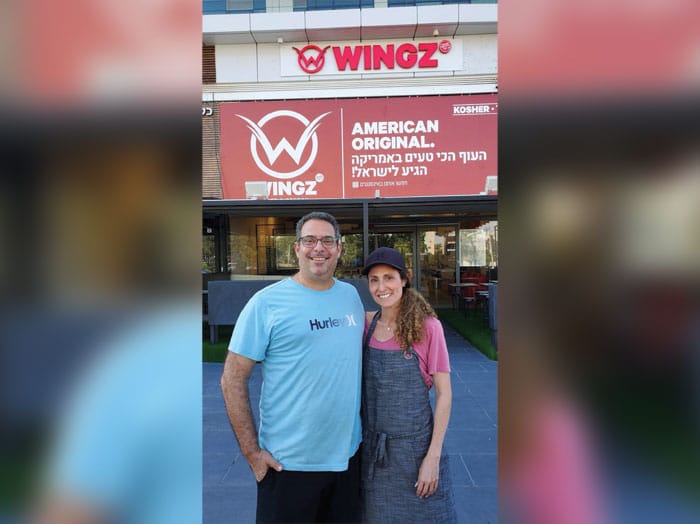
Anat and Drew Rosen made aliyah from North Hollywood in July 2022 and settled in Ra’anana. The couple, who own a catering company in Los Angeles called Nes Events, initially planned to open a new restaurant, Wingz, in Giv’at Shmuel. However, when the war started, instead of opening their restaurant, they shifted their attention to providing free meals for thousands of Israeli soldiers in Gaza.

“These soldiers are living off canned food and have not had a hot meal; we needed to change that.”
– Drew Rosen

“These soldiers are living off canned food and have not had a hot meal; we needed to change that,” Drew said in a phone interview with the Jewish Journal.

The decision to dedicate their restaurant primarily to providing hot meals for soldiers led to an incredible response from the community. The couple’s four sons, aged 19, 16 and 14-year-old twins, also volunteered to help in the kitchen. 

“We opened a WhatsApp group where we posted requests such as: ‘We need someone to come at 2 o’clock and take food to the soldiers in Gaza,’ and people responded immediately,” said Drew. 

Volunteers took hundreds of packed meals, including chicken kabob, rice and potato salad, to the border of Israel and Gaza, where they were picked up and transferred to the soldiers serving in Gaza. With the community donating over $37,000 and volunteers assisting in packing and delivering the food, Wingz Israel provided 7,000 meals to IDF soldiers.

A couple of weeks after the war began, the Rosens shared a post on their Instagram page: “Our restaurant, Wingz Israel, has been a testament to the commitment we feel to Israel. Just last week, we were informed of 500 soldiers without food for Shabbat. In just four hours, with the help of friends, we prepared meals for all of them. This was a feat even more intense than our experiences catering for large events in Los Angeles. Since then, we’ve provided over 2,000 meals in just five days, partnering with organizations like @leket_israel to support our soldiers and fellow Israelis in need.”

For seven weeks, the Rosens dedicated all their efforts to providing meals to the soldiers, putting their plans for the restaurant on the backburner. On December 18, they finally opened Wingz, and the response has been positive.  It was 11:15 p.m. in Israel when Drew finally had time for the interview. “We’re actually closing at midnight, but we have run out of food so we closed earlier. Thank God the feedback we got had been great, and we keep very busy here” he said. 

For Americans visiting the restaurant, the experience is akin to a homecoming — the familiar scent of buffalo wings, the backdrop of football or basketball games on the big screen TV, and the continuous buzz of conversation in both English and Hebrew. This vibrant atmosphere played a crucial role in Wingz’ success.

Drew was born in the United States, while Anat was born in Israel and immigrated to Los Angeles with her family when she was 3 years old. The idea of making aliyah had been on their minds for a while, but the decisive factor that prompted them to act was the onset of the Covid pandemic.

As the war continued, they could have returned to the U.S. without facing criticism. However, when asked about the possibility of moving back to L.A., Rosen acknowledged that he was often asked that question; his answer remains a resounding “definitely not.”

 “We had anticipated potential conflicts, but not so soon after our move,” he said. “Adjusting to life in Israel has had its challenges but despite these hurdles, our love for Israel remains unwavering. There is no future for the Jewish people if you pack up and leave when there is a problem. You can’t run away from a situation like that, and when you witness so much devastation. This is the time you need to see what you can do. It was unbelievable to see how the country had come together and wanted to help.”

The Rosens now plan to provide meals to wounded soldiers in Israeli hospitals. 

To donate to Wingz Israel, visit: https://my.israelgives.org/en/fundme/WingzLeketIsraelSupport

Wingz of Love: An LA Family Who Made Aliyah Provides 7,000 Meals to IDF Soldiers Read More »

Who’s Afraid of the Big Bad Jew? Lies Taught about Israel and Jews in the Public School Classroom

As NYC public schools wipe Israel off the map in their classrooms, take note of public school classrooms in California. The California state-approved Ethnic Studies Curriculum, rich with anti-Jewish and anti-Western content, has provided teachers an imprimatur to bring into the classroom lesson plans, handouts, PowerPoints, and tests filled with propaganda meant to instruct a generation of activists that Zionists are colonizers and must be rooted out— a euphemism for genocide.

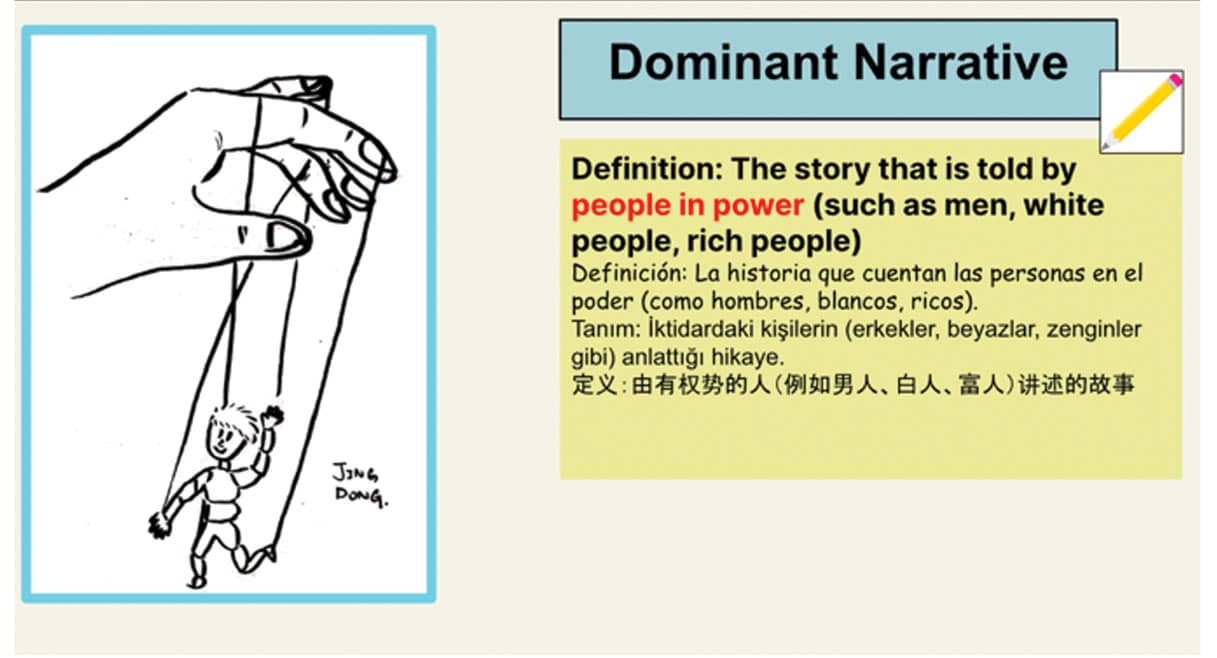
This educational malpractice is on display in Woodside High School and Menlo Atherton High School, both in the Sequoia Union High School District. In Woodside High School, a teacher of World History took the liberty to devote weeks to Israel and the conflict. In Menlo Atherton High School, a teacher of ninth grade Ethnic Studies and History broached the conflict with a unit titled “Life in Palestine Today.” In it, one will find the term Palestine designated to mean “originally their [the Arabs’] land… now the Palestinians are being oppressed by the Israeli government.” An introduction to the “Dominant Narrative” compels students to question stories told by “people in power (such as men, white people, rich people).”
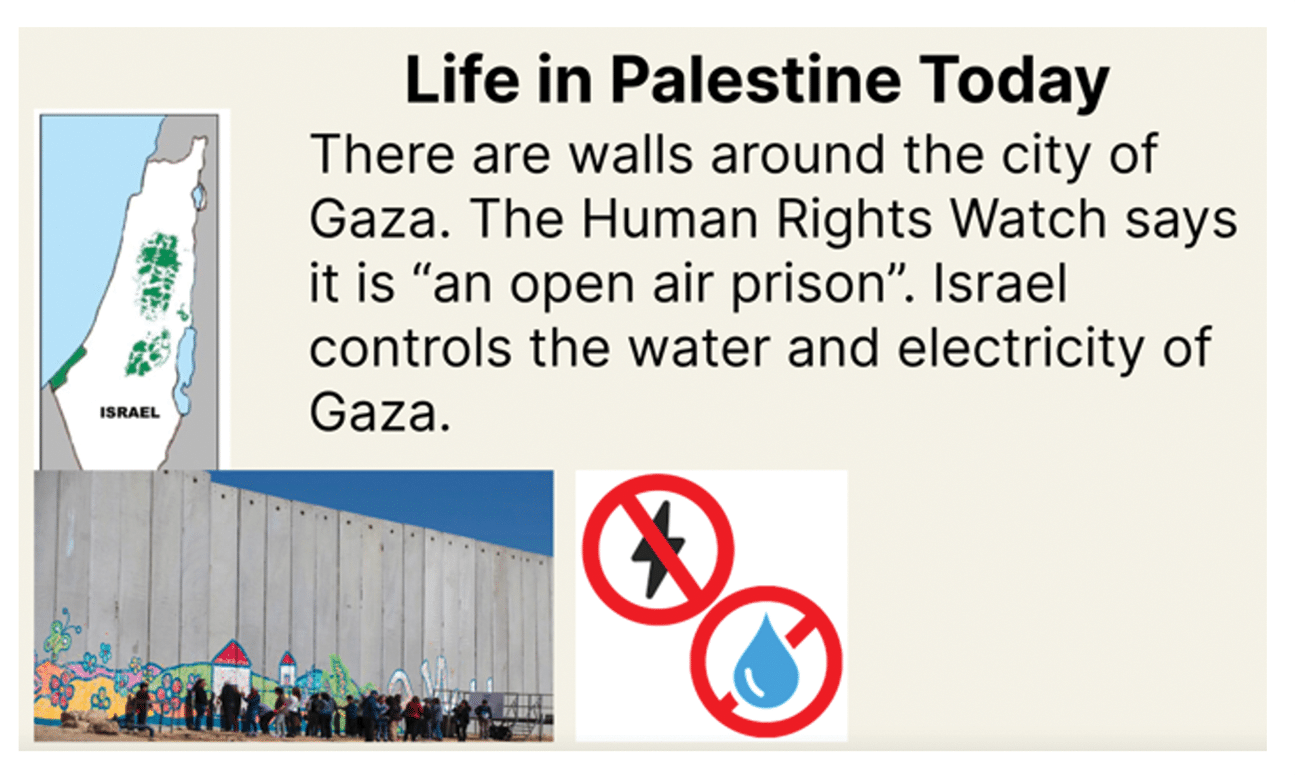
One can only imagine the agony of parents having to help their Jewish child study for the Israel-Palestine Conflict quiz, where, among other things, the correct answer for Hamas—a terrorist organization that videotaped their joy on October 7 of the massacre of Jews in Israel—is “a political party which is continuing to fight against Israel.” In response to the falsehoods being taught in schools, Jewish parents are forming grassroots groups, mobilizing in WhatsApp groups, and reaching out to legal counsel.

A tool of formative assessment, tests are central as they recap the main ideas and concepts from the unit; they also signal to the student that there are correct and incorrect answers. One such quiz given to students in Woodside High School asked students to match terms such as “Palestine,” “Intifada,” and “Hamas” with what the teacher deemed to be the correct answers: “Arab lands currently occupied by Israel,” “uprising,” and “a political party which is continuing to fight against Israel,” respectively.
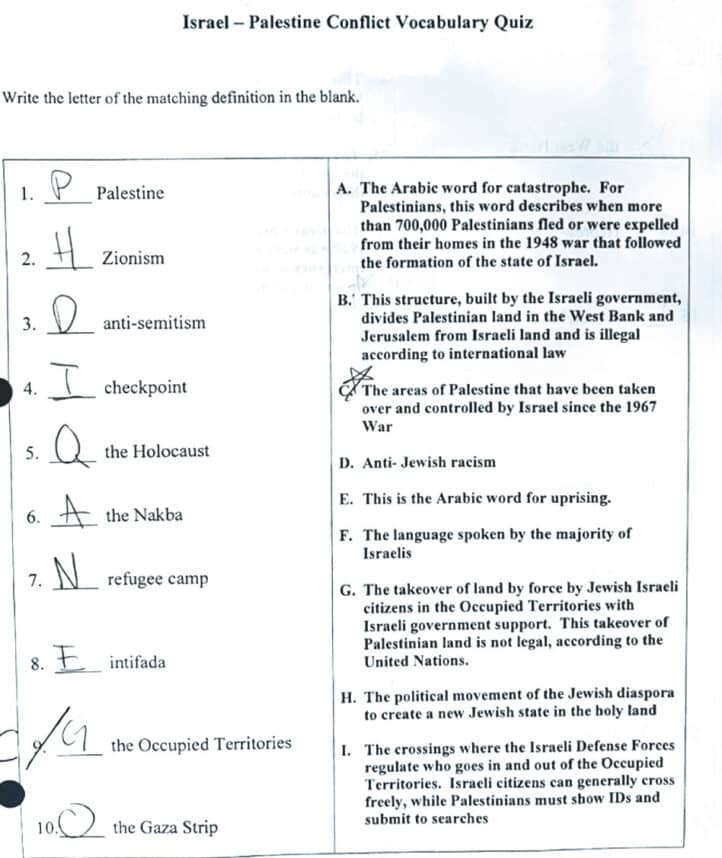
The “correct” answers should come as no surprise, for these would be the “correct” answers if you were a student in one such classroom, sitting for weeks “learning” about the Arab-Israeli conflict. Having gone through all the documents and PowerPoint presentations, I found that students in the Sequoia Union High School District are being taught material that does not make them better educated. What’s worse, it gives them commonality with the poor children in Gaza and the Palestinian Arab territories in Judea and Samaria, who are raised on propaganda given to them by UNWRA, the UN agency for Palestinian refugees—lies that not only “incites extreme anti-Semitism and glorified violence,” according to Israeli NGO  Institute for Monitoring Peace and Cultural Tolerance in School Education, but demonstrates a strong “link with the Oct. 7 massacre.”

We must get rid of the Ethnic Studies curriculum not because there is an antisemitism problem, but because there is a truth problem.

Having obtained and analyzed the many documents from parents who wish to remain anonymous, I have discoveredthat the material is, among many other things, an assault on the institution of learning. The lies peddled in these handouts, lesson plans and tests must be exposed and the schools held accountable for teaching falsehoods. From the many lies masquerading as historical facts, below are the ten starkest lies taught in the California classroom: lies that contribute not only to the world’s fixation on and cultivation of the “big bad Jew,” but also erode the pursuit of truth and critical thinking—goals that once informed the institution of learning.

Lie #1: During his life, he [Jesus] traveled around northern Palestine.”

Truth: In this extract from a document, given to the students on the origins of the three monotheistic religions, Jesus is described as having lived in Palestine. But during Jesus’ lifetime, the term “Palestine” did not exist. It was called Judea, which means “Jew,” as Jesus was born in a Jewish sovereign kingdom called Judea, not Palestine. This historical anachronism incorrectly signals to students that there once was a country or political presence known as Palestine, and implicitly denies Jesus was a Jew.

Lie #2: “Although the population of the Holy Land was very diverse, the majority of people who were living in Palestine around 1900 were ethnically Arab and majority Muslim.”

Truth: In 1900, the land was called the Ottoman Empire and the land we call today Israel was, according to the Ottoman Empire, marked according to municipalities. As such, the Ottomans themselves did not call it Palestine, but rather the “municipality of Jerusalem” or the “municipality of Damascus.” This incorrect term leads to historical misinformation. In fact, in 1896 the denizens of Jerusalem were majority Jewish (62%).

Rhetoric that continues to refer to Israel as Palestine is not only a lie, but one that contributes to what I call “the Great Occupation Lie,” a libel no different than the blood libel or the Protocols of the Elders of Zion.

Lie #3: “Israel won the [1967] war and captured Palestinian territory, nearly doubling its size.”

Truth: Israel did not capture “Palestinian territory” as there was no sovereign Palestinian state or kingdom to capture. Likewise, Israel did not “double its size” because when the Arabs rejected the 1947 U.N. Partition Plan, the borders outlined by the U.N. were thus not binding: the borders outlined by the U.N. would be considered binding ONLY if both sides (Jews and Arabs) agreed. Since the Arabs rejected it, the borders were nullified, and the U.N. proposal was thus not binding.

Lie #4: “The Allied forces [of World War I] betrayed the Arabs and claimed Palestine, Transjordan, and Iraq.”

Truth: This is historically inaccurate. Before World War I, there were no countries known as Palestine, Transjordan, or Iraq. The League of Nations (the Allied forces) created these countries out of mandates and gave them largely to the Arabs.

Lie #5: “During the 1948 war Israel forcibly displaced 750,000 Palestinians from their homeland.”

Truth: Like the ”Great Occupation Lie,” the “Nakba Lie” is not only false but contributes to demonizing Jews and Israel. But like all great propaganda that latches onto truths and then manipulates them, the “Nakba Lie” latches onto the reality that as a result of the war started by the five Arab countries, people on the ground fled war zones. What it fails to mention is that many of the Arabs who fled their homes were told to do so by Arab leaders who promised a swift victory. This has been well-documented by historians.

In fact, the term “nakba” was first used by Syrian historian Constantin Zureiq. But for Zureiq, “nakba” meant something entirely different.  In his book Ma’na al-Nakba (The Meaning of the Disaster), Zureiq described the flight of the Arabs from the region as a direct result of the pan-Arab attack on the nascent Jewish state. “We [Arabs] must admit our mistakes,” he wrote, “and recognize the extent of our responsibility for the disaster that is our lot.” The mistake Zureiq is referring to is that instead of accepting the 1947 U.N. partition plan to divide the British Mandate for Palestine into a Jewish country and another Arab country, the surrounding Arab countries waged a war, putting Arab civilians on the ground in direct danger. Years later Zureiq doubled down in his book published after the Six-Day War, The Meaning of the Catastrophe Anew, again employing the term “nakba” to mean the pan-Arab inability to “confront Zionism.” At that time, Dr. Raphael G. Bouchnik-Chen writes, “the term ‘Nakba’ was glaringly absent from Arab and/or Palestinian discourse.”

Lie #6: “Palestinians, deprived of their land by Israel, lived in 58 refugee camps, both in Palestine and in neighboring countries.”

Truth: In 1949, Jordan and Egypt, two countries that waged war against Israel in 1948, illegally occupied Judea andSamaria (what many today call the “West Bank”) and Gaza. Jordanians placed the Arabs in refugee camps; Egyptians likewise placed the Arabs in refugee camps and did not give them citizenship. Between 1949 and 1967 when the “West Bank” and Gaza were not under Israeli control, there were no calls to “free Palestine.” Jordan did not liberate the Palestinians from Jordanian occupation; Egyptians did not liberate the Palestinians from their occupation. Jordan treated the Arabs as second-class citizens and Egypt kept them in refugee camps, never giving them a path toward citizenship.

Lie #7: “Again [in 1967] Israel won & captured the Egyptian territory of the Sinai Peninsula, the Syrian territory of the Golan Heights, and the Palestinian territories of the West Bank, Gaza Strip and East Jerusalem.”

Truth: Another lie that latches onto reality is the lie that Israel willy-nilly decided to “capture Palestinian territories.” While it is true that after the Second Arab-Israeli War of 1967, Israel tripled in size, the document fails to mention that the war was once again started by the Arabs when Egypt enacted a casus belli, a declaration of war, by closing the Straits of Tiran. Telling the UN who were stationed at the Sinai border with Israel to leave, Egypt began to mobilize their troops to the border thus signaling preparation for all-out war — not a fantastical reality since Egyptian President Nasser had employed genocidal language in newspapers and on radio programs. The document fails to mention that Israel had fought a defensive war.

Lie #8: “Palestinians are mistreated under Israeli occupation.”

Truth: Deploying language rich with references to decolonization, this highly damaging statement is fraught with lies. First, what is the occupation referred to? Israel unilaterally left Gaza in 2005, uprooting living and dead Jews from the Gaza Strip in hopes that the Palestinian Arabs would finally accept what they had been calling for, their land. And while in Judea and Samaria there is a military occupation, entirely legal according to the Geneva Convention, the land is divided into Areas A, B, C. In Area A the Palestinian Authority has entire control politically over the land.

Lie #9: “Gaza is an open-air prison.”

Truth: In 2005, Israel unilaterally left Gaza. What this means is that the Israeli government took all Israeli presence, from political and military institutions to Jewish Israeli citizens, and uprooted them from Gaza. Moreover, Jewish graves were exhumed and reburied in Israel because the Israeli government knew that the graves would be destroyed and that the Jewish family members would not be able to visit for no Jew would be allowed into Gaza. Please let that sink in. A future Palestinian state means no Jew can physically enter. This is not a theory, it is a reality. In Area A of Judea and Samaria, where the Palestinian Authority fully governs the land and the people, no Jew is allowed to enter.

So how exactly is Gaza an open-air prison after 2005? Of course, as in all great propaganda that sinks its teeth into truths, the truth is that Arabs in Gaza cannot easily enter Israel as there is a border wall. (Gaza also borders with Egypt, whose border with Gaza is on perennial lockdown.) But why would Israel open borders with Gaza, from which rockets have rained ever since 2006? Why would Israel open their borders to a population that has been raised to hate Israel? Sadly, Israel made this mistake as many of the workers from Gaza had work permits and were instrumental in the October 7 massacre. The libel that “Gaza is an open-air prison” is meant to demonize Israel.

Lie #10: “Israel began building its separation wall in the occupied West Bank in 2002.”

Truth: Language is critical to shaping our reality. The word “separation” echoes language used to describe apartheid in South Africa and, for American students, the dark history of segregation. Imagine if the sentence read, “Israel began to build a security wall …” thereby using the correct word for the wall built as a direct result of the Second Intifada—a surge of violent attacks against Israelis coming from Judea and Samaria. Likewise, the term “occupied West Bank” is ironic since the term “West Bank” originates with Jordan, which illegally occupied this region after the War of Independence in 1948.

Jewish parents are rightfully angry. Diana Blum, a parent at Menlo Atherton, expressed her shock and anger: “I think it is egregious that the school still hasn’t notified the parents of the students who were exposed to the factually false and biased lesson. How can they fix a problem they are not willing to admit was made?” A father of a tenth grader at Woodside High School has been asking to see the course materials and source materials, as well as the final exam. The request to see any content from public schools is entirely legal, as all taxpayer money goes toward the salaries of the teachers, the school building, utilities, printers, etc. The father has yet to receive any material and scheduled meetings between him and school administrators continue to be postponed.

At its core, the problem with the Ethnic Studies curriculum in California is not that it is antisemitic, but that it is anti-truth. “I write and say what the teacher wants to hear because I need the grade,” a sophomore in the Sequoia High School district told me. “Even though I know it is a lie.” Adapting to lies buttresses ideological tyranny. How can we demand courage from our youth when they are being desensitized to lying? Do not, therefore, ask them to seek truth, for as George Orwell writes, “In times of universal deceit, telling the truth will be a revolutionary act.”

Inevitably, as more and more egregious curricula will be exposed, a critical question emerges: what are we to do? Many are looking toward mandating training on antisemitism and/or urging schools to adopt the IHRA definition. But if we are to follow Orwell’s sound advice that telling the truth will be an act of revolution, then our duty—not only as Jews, but good citizens—is to demand that education be rooted in critical thinking and the pursuit of truth. As we know, antisemitism is the age-old alarm bell: where there is antisemitism, morality and culture are broken.

As we know, antisemitism is the age-old alarm bell: where there is antisemitism, morality and culture are broken.

The revolutionary strategy, therefore, must not solely focus on antisemitism, for this is a symptom. The danger beyond is the lies that inveigle students into believing they have become educated. We must get rid of the Ethnic Studies curriculum not because there is an antisemitism problem, but because there is a truth problem.


Naya Lekht received her PhD in Russian Literature and wrote her dissertation on Holocaust literature in the Soviet Union. Naya is currently the Education Editor for White Rose Magazine and a Research Fellow for the Institute for Institute for the Study of Global Antisemitism and Policy. 

Who’s Afraid of the Big Bad Jew? Lies Taught about Israel and Jews in the Public School Classroom Read More »

Grab the Dough, We Gotta Go – A poem for Parsha Bo

The people picked up their dough when it was not yet leavened.
~Exodus 12:34

We like to joke when any Jewish Holiday comes along
(and there is always a Jewish holiday coming along)

you can count on the supermarkets to put up a display
of matzah. I mention this because Tu b’Shevat is coming

and even though they’ve barely taken down the Hanukkah matzah
and Tu b’Shevat isn’t really on their radar and wouldn’t typically

get an end cap at the store, if we did tell them about it, for sure
that end cap would be full of matzah. Praise God, at least the grocers

are not anti-semites. You can understand their confusion when it is
only January and months before we officially sit down in comfy chairs

to remember our quick exit from the narrow place, we’re
already talking about the unleavened dough on our backs.

I mean Purim hasn’t even happened yet and that’s one of our slightly
more famous holidays, let alone this one about trees or something.

It was a strange choice, the dough, when today if we’re asked
what we would take if we had to leave the house suddenly

we usually mention photos, and important documents
and maybe the dog. But no, after four hundred and thirty years

our first thought was let’s not let this dough go to waste.
We didn’t know manna would eventually rain from the sky.

We just knew we’d complain if it didn’t. So out we walked
with the dough and much of Egypt’s riches leaving them

with their dead and their sorrow and their lubed-up chariots
ready to leap into action when Pharaoh changed his mind, again.

But that’s a story for another poem. Tune in next week and
we’ll see if I remember to mention it.


Rick Lupert, a poet, songleader and graphic designer, is the author of 27 books including “God Wrestler: A Poem for Every Torah Portion.” Find him online at www.JewishPoetry.net

Grab the Dough, We Gotta Go – A poem for Parsha Bo Read More »

Satirical Semite: A Messy Mandate

The critics were correct after all. I am from a nation of oppressors. We colonized Palestine. My people were imperialists, took a land that was not ours, and rewrote the maps. I unreservedly apologize for being British.

Being British and Jewish means that I have to apologize to myself for colonizing and oppressing myself, although rather than having an equally split identity, this level of internal conflict sounds 100% Jewish.

Of course, being British and Jewish means that I have to apologize to myself for colonizing and oppressing myself, although rather than having an equally split identity, this level of internal conflict sounds one hundred percent Jewish.

I first became aware of the inner conflict when visiting the Akko prison in Northern Israel. There was a plaque commemorating where the British army had captured Palestinian soldiers from the Irgun and Lehi, and hanged four Jews in April 1947. One of them, Dov Gruner, said that the British Army and Administration were “criminal organizations.” Bizarrely this kind of thing never made it onto the educational syllabus during all my years of English schooling.

The British rule of Israel was a royal mess. As we know, there was never a country called Palestine, but there was a region of that name that was run by the Ottoman (Turkish) Empire from around 1550 until World War 1, after which the League of Nations awarded the area to the British Empire under the League’s “mandate” system. The Sykes-Picot Agreement was drawn up in 1917 between British politician Sir Mark Sykes and French diplomat François Georges-Picot. Their agreement gave Britain control of what is now southern Israel, the Palestinian territories, Jordan and southern Iraq, while giving the French control of Lebanon and Syria. The subsequent Balfour Declaration suggested that part of Britain’s possession would become a “National Jewish Home.” What could possibly go wrong?

The question should be, “what could possibly go right?” Sykes is also credited with designing a flag for the local Arabs who came from Egypt, Israel and Transjordan, which became the modern Palestinian flag. In other words, the great symbol of modern Palestinian nationalism was designed by a bloke in London.

In the end, the British couldn’t handle the local territory disputes, so Lord Peel (also in London) drew up the 1937 Partition Plan, which awarded 80% of the land to Arabs and 20% to the Jews. It failed because the Arabs wanted 100%. Silly folks. Any good gambler knows when to leave the table and cash in your chips. They didn’t.

The Arabs turned down other offers for their own state in 1947, 1967, 1994, 2000, 2001, 2005 and 2007, and the offer for an independent state is still on the table. They really should attend a Gamblers’ Anonymous meeting and quit the river-to-sea gambling habit. Unless they want the land from the mouth of London’s River Thames to the North Sea, in which case they are welcome to it.

Today I vacillate between shame and pride. Shame in light of the antisemitic BBC who still won’t call Hamas terrorists, and pride that they once allowed me a decade’s broadcasting of Torah teachings to the nation on BBC Radio 2’s “Pause for Thought” slot. I feel shame when I consider London’s pro-Palestinian marches, and pride regarding the British government sending warships to the Eastern Mediterranean. Another destroyer ship, the HMS Diamond (the “HMS” stands for “His Majesty’s Ship”), was patrolling the Red Sea to secure shipping lanes, and just shot down a missile targeting merchant ships. It was the first sea-to-air missile shot by the Royal Navy since the First Gulf War in 1991. Good work, chaps.

There’s also pride over King Charles’ unreserved support of Jews, and I won’t even mention our national shame for his Montecito-dwelling American daughter-in-law.

The irony is that Britain never colonized Israel. The League of Nations’ mandate system was specifically designed to prevent colonization, and a way to help “develop the territory for the benefit of its native people” as a short-term solution, which is why Britain ran the Palestine mandate for only 24 years, seven months and 16 days (to be specific). Although it was messy, problematic and mistakes were made, the mandate came to an end and the British left the region.

Identities can be confusing, since we are made of multiple parts that can sometimes contradict each other. Nevertheless, I am still proud to be a British Jew, and will still fly the flag for King and country.


Marcus J Freed is an actor, writer, educator and founder of the Jewish Filmmakers Network. He will be leading a “Filmmakers Against Anti-Semitism” event at this year’s Sundance Film Festival. www.marcusjfreed.comwww.freedthinking.com and on social @marcusjfreed.

Satirical Semite: A Messy Mandate Read More »

Author Jennifer Lang on Her New Book and Living in Israel

Author Jennifer Lang was on a six-week book tour in America on Oct. 7, when her adopted country, Israel, transformed overnight. 

She’d just published “Places We Left Behind: a Memoir-in-Miniature” about her marriage to her French-Israeli husband Philippe and their journey living in different places. The conversation suddenly shifted after the attack on Israel. 

“My story is all about my husband and I moving countries and continents, each in search of home, but really it’s about his knowing Israel is home up against my wrestling with a place that made me feel unsafe because of the nonstop cycle of violence,” Lang said. “Sadly, it almost reads like a prophecy. Sadly, the book was released on Sept. 5, 2023. Sadly, it is more relevant now than ever before. [It’s] about what it’s like to try and live and be human in a country where the personal and the political are enmeshed and inseparable.”

When Lang returned home on Oct. 31, it took her almost all of November to adjust to what she called a “shell-shocked, partially functioning society,” with “memorials and vigils and art installations in large open spaces like Dizengoff Fountain and Habima Plaza, and the Tel Aviv Museum area now called Hostage Square and days punctuated by occasional sirens.”

Like those around her, Lang has put aside her full-time job and volunteered. She showed up to sort men’s and women’s clothing donations for evacuees at TLV Expo, make sandwiches at a Modi’in factory, pit dates at a frozen fruit farm in Kadima, cook for soldiers at Citrus & Salt cooking school, lead writing sessions and teach yoga to moms whose husbands are serving. 

“Anything to feel helpful,” Lang, who will be in Los Angeles from Feb. 11 to 15 speaking at Adat Ari El in Valley Village, the Chai Club at Temple Isaiah and Zibby’s Bookshop in Santa Monica, told the Journal. 

The author, who was born in the Bay Area, fell in love with Philippe in Israel during the First Intifada, a time when Israel was also upended due to Palestinian attacks and riots. They were both 23-years-old and Jewish, but she was a secular tourist and he was an observant immigrant. When they got married, they raised their family in Westchester, New York, and moved to various places before going back to Israel.

In the book, she puts her marriage under a microscope, examining how she and her husband made their commitment work despite their differences. She has lessons for her various audiences.

“For women, [I hope they learn] how crucial it is to hold onto your voice whether in a marriage or in the workplace or in a relationship of any kind,” she said. “Many of us so easily yield and withhold our opinions in order to please others or keep the peace. For readers, how fun it is to read outside the box and norms of conventional reading. For writers, how refreshing and rewarding it is to play with form and content. For memoir connoisseurs, how vital it is for the narrator to turn the camera on his/herself, how humanity shines through writers who make themselves vulnerable.”

Lang isn’t afraid to be vulnerable about how the situation has affected her and her family. While she promoted her book as it was pre-Oct. 7, after that, she focused on passages about hearing air raid sirens, experiencing the First Gulf War, running for shelter and how she lost an argument with her husband that the U.S. was safer than Israel.

“Everybody needs light, especially now.” – Jennifer Lang

“Reading those passages was difficult,” she said. “It was never my intention to spotlight that aspect of life here. But I felt compelled to shine a light on what it’s like to try and be a woman, wife and mother here. Everybody needs light, especially now.”

Author Jennifer Lang on Her New Book and Living in Israel Read More »