fbpx

January 10, 2024

Chosen Links – January 7, 2024

CRAZY PROLOGUE – While writing this week’s “Chosen Links”, a big car accident just happened in font of our home. Literally, at 1130pm. A young mother was driving her daughter home from a sleepover party, when her tire blew out and their car smashed into a parked car. I just spent the past hour in the cold midnight air offering my help, along with some great neighbors (thanks Kevin Feller!); and stayed until the fire department, police, and eventually the tow truck arrived. The daughter was hysterical, refusing snacks or any distraction, but the police had a wonderful idea that I encouraged, to have her sit in their car. I told her it would be like getting to visit the cockpit of a plane, and with her mom’s permission took her to their passenger seat where she immediately cheered up, and was chatty for the remaining hour. This child will always have a scary memory of her first car accident, but now she can also link it to her fun memory of exploring a cop car.

I then asked her mother if she wanted a hug, and she strongly nodded her head, embraced me, and cried. I then told her, scary things happen in life, and it’s okay to let it out and cry, while at the same time prioritizing wanting to protect your children. It’s not easy to see, but I promised they would be fine after this crisis.

I feel like there should be an obvious lesson to draw from this, somehow poetically connecting it to the mothers and daughters in Israel; but rather than manipulate this into the thread, I’ll let the story just speak for itself.

This week my intro will be a bit different, as I’m creating this after working shifts at the hospital all weekend (including Shabbat), with 3 more long shifts to go. Luckily, I write my commentary as I read/watch things during the week, so most of the work is already done for me when I post each weekend.

I will follow-up here about something that elicited varied reactions from last week’s post. If you recall, we excitedly found the “In This House We Believe” poster, updated by Artists 4 Israel to proudly include representation against antisemitism, plus a written support of Zionism. Some friends immediately ordered one, as I hoped would happen (I’m not a big fan of “virtue signaling”, but if it’s happening without us on the reg, let’s at least flood the neighborhood with these and replace the ones that ignore us). Many loved the idea. But some had pause, or even strong objection due to its inclusion of the slogan for the grossly antisemitic BLM movement, which has in some chapters even celebrated the October 7 massacre. As this was a reasonable objection, I asked the nonprofit why they made that choice, and here’s their answer – reprinted with their blessing:

“Hi Boaz,

Thank you for asking.

There are two answers:

First, our goal is to incorporate ourselves into the greater social justice narrative, to demonstrate that antisemitism and Zionism are part and parcel of modern, progressive movements. As such, we need to include all relevant movements and to keep the sign as similar to the original as possible. This leads to the second answer which is that like everything else on the sign, Black Lives Matter represent the concept, it does not represent the organization.

If someone saw the sign without that saying or with it altered, it would look like we were trying to co-opt the sign and would seem an insult to those who think of that sentence as a statement of fact and not a political movement. From experience, I can tell you that we as a community think far more about this divide than does anyone else looking at it. With this being the lead line and the one most famous to the sign, changing it would be immediately noticeable and curious to the average person we are trying to get on our side.

Hope that helps!”

They even publicly thanked me for helping bring the poster back – wow!

https://www.facebook.com/craig.dershowitz/posts/pfbid0V2LA2vZfryxfExHSEz11Gfi7JQmjKGdTbUyqbKaGVNSbHuXKTrvnPWaMaH7mxRJ6l

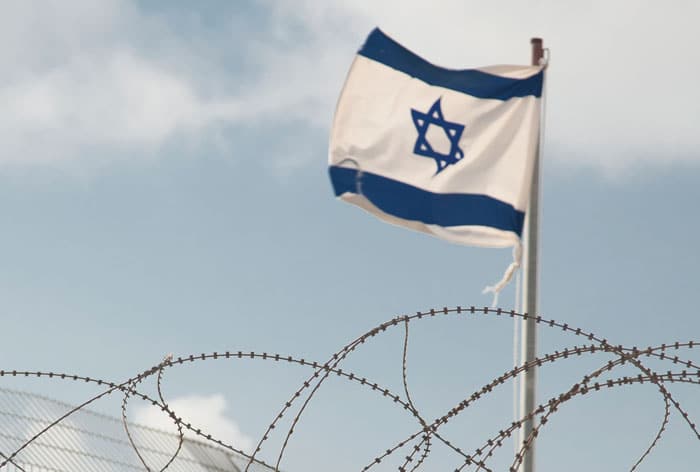
The photograph is from my family’s 2019 arrival in Israel, where the Hebrew words announce WELCOME, as you enter the only Jewish land on earth.

EPILOGUE – That brings us back to our regularly scheduled programming. I now present this week’s Chosen Links by…ME!

ARTICLES/THREADS:

1. Sarah Tuttle-Singer writes a story that almost works like a modern day parable. It must be SO hard for people like this Arab taxi driver, who care about Israel, hate Hamas, worry about the soldiers… But have friends and family back in Gaza who are caught in the middle of the horrors of war. We need to fight this war, Hamas has given us no choice, but it’s important for our humanity’s sake that we not forget the lives that are affected outside of our own:

https://blogs.timesofisrael.com/almost-like-brothers/

2. “The truth remains the truth: Israel is acting as any other democracy would in impossible circumstances.” Jake Wallis Simons writes about how Hamas is manipulating the world into believing backwards logic:

https://www.telegraph.co.uk/…/hamas-is-succeeding-at…/

3. Avi Ciment writes a letter to Lorne Michaels, giving him 6 million reasons to use his SNL platform to promote satire that supports the fight against antisemitism, or at the very least not feed into it:

https://www.jewishpress.com/…/dear-lorne/2023/12/21/

4. This is a great piece about how much in sync, or lack thereof, the other terror organizations backed by Iran were with Hamas prior to its October 7 attack. “Hezbollah, which had been planning a similar assault on Israel, was not pleased, the report claimed. “The cards they had been holding for a future attack against Israel had been shown by the Palestinians: penetrating inside Israel, airborne [assaults], the element of surprise,” said the Lebanese source, noting a “well-known plan by Hezbollah’s elite al-Radwan to infiltrate the Galilee.”

Uh oh, mom and dad are fighting again:

https://www.timesofisrael.com/report-details-ultra…/

5. Ana Diamond was a hostage in Iran from 2016-2018. CNN gives her a platform to use her experience and expertise to discuss not only how awful it must be for the Israeli hostages, but how gross it is that people try to claim they are being treated nicely, and look happy. “…the sensationalist commentators that make light of the ordeal of the hostages, or provide Hamas an equal platform for positive PR, are engaging in irresponsible behavior that could endanger those still being held.”:

https://www.cnn.com/…/israel-hamas-gaza…/index.html

6. “This ensures that the foundation can identify itself as a private organization, which enables Qatar to conceal its state funding as private donations…The State of Qatar contributes more funds to universities in the United States than any other country in the world…” A comprehensive report on money coming into American universities from Qatar, and the influence it creates:

https://www.gatestoneinstitute.org/…/qatar-bought-ivy…

7. “You can’t say Black Lives Matter and then look at the two sides of this conflict and support the side who is killing Black people.” This article shines the spotlight on 6 Israeli people of color, trying to deflect the ignorant perception that Israel is a white country. They are each fighting, online and some also in the army, to speak up for the country they live in and love:

https://www.timesofisrael.com/israelis-of-color-push…/

8. One of the most beautiful things about Israel, and all true democracies, are the ways that people freely give their ideas and even dissent in how things are done. This is something truly lacking in the tyrannical Hamas-led government in Gaza, where speaking up can get you killed. Israel is full of protests, and 3 opinions for every 2 people. One thing that still has to be decided, is what what happens after the war? The question has often been asked, and Rabbi Bradley Shavit Artson does not know of an easy answer, but he feels confident it has to happen with our ethics and morality uncompromised. He comes up with goals that he hopes we can achieve, and they may seem hard to swallow when we are in the midst of a war, but we need something idealistic to look forward to, if we are ever to start to dig ourselves out of this mess. It’s reasonable to hope for a goal that we may never succeed at, than give up and say it’s not worth the effort of trying:

https://jewishjournal.com/…/to-my-israeli-family-and…/

9. As much as I enjoy throwing a life preserver, with positive affirmations of what hopefully will happen next… It’s equally important to give a well informed, brutally honest speculation as to what happens next. It isn’t always what we want to hear, but there’s logic to seeing why time and time again Israel gets hurt when it opens the floodgates; as Fern Reiss says, is it a few bad apples, or is it a culture of bad apples:

https://fernmusing.substack.com/…/war-day-88-the…

10a. Here’s what it looks like on the other hand, when you live in a society WITHOUT free speech – Nizar Banat. May his memory be a blessing. A Palestinian political activist who spoke up against the Fatah PA. Very few are willing to take such a risk. He was imprisoned for it by the Palestinian Authority, and died in prison about 2 years ago: https://twitter.com/itsmichalll/status/1742160176721862825

10b. Here’s an article about him and his death for context. Though it does make me queasy sharing The Guardian, which casually refers to Israel as an occupation, glaringly without clarification. However, I don’t throw out the baby with the bathwater, and it’s otherwise a worthwhile read:

https://www.theguardian.com/…/nizar-banats-death…

11. Defense Minister Yoav Gallant gave a good status update about the war. Curiously though, the language as Seth Frantzman notes COULD be a moving of the goalposts of the war, or perhaps are merely a clarification:

https://x.com/sfrantzman/status/1742163600100225309

12. Here’s a strategy for potentially ending this war. “To simplify, the Biden admin can affect how Israel fights the war, but not whether they fight it. It’s also not realistic to move Palestinians out of Gaza.” He explains that what needs to happen next is finding Yahya Sinwar, likely in a bunker with hostages:

https://twitter.com/AGHamilton29/status/1741889690498699578

13. Did you realize that most airlines still have not resumed their flights to and from Israel? Tour guides are obviously taking a real hit. (Shout out to 2 such professional tour guides: dear friend Joel Haber and brother-in-law Adam Bodenstein!) This article nicely covers things:

https://jewishinsider.com/…/with-foreign-airlines…/

14a. There’s sad casualties of war, and then there’s evil, genocidal leaders of terrorist organizations who we can be relieved are gone. This is the latter. The comment under it saying that “per the Gaza Ministry of Health he was actually a 12 year old journalist” is gold:

https://x.com/HilzFuld/status/1742227391882166383

14b. The name of that “12 year old journalist”, Saleh al-Arouri, has a long history with Israel being a big bad wolf, and the go-between for Hamas and Iran, under the more recent auspices of Hezbollah in Lebanon. A great history, as recommended by the highly reliable David Makovsky:

https://x.com/DavidMakovsky/status/1742308401906843650

15. “And any group that is against Israel gets put on steroids…now that the Houthis agreed to be against Israel with their attacks in Red Sea, they will gain more wealth and power. Hezbollah bankrupted Lebanon the same way. Hamas grew more powerful.” Seth Frantzman explains more than just the history of Hamas; he spells out why they have so much international support.

This thread reads like a John Grisham conspiracy theory novel, where you wish it wasn’t actually real, but sadly Frantzman generally has his finger on the pulse of Middle East analysis:

https://twitter.com/sfrantzman/status/1742496008288813488

16. This man grew up in Gaza, and was almost killed along with friends from Israeli attacks years ago. And yet, amazingly, he fights today as a peace activist, for coexistence with Israel, against Hamas, and for the release of the hostages. Just incredible to be where so few are given his journey. Here he claps back angrily at this blood libel of a post about Jewish and Israeli doctors. Thank you Ahmed Fouad Alkhatib:

https://x.com/afalkhatib/status/1742390339095458169

17. As bad as the tunnel system in Gaza is for Hamas, intel from Israel demonstrates that Hezbollah may have a far more dangerous and massive tunnel network in Lebanon. “Digging tunnels in Lebanon was done from the start with the assistance of North Korea — as far back as the 1980s and especially toward the end of the 90s. There is evidence of this. North Korea has historic expertise in the digging of tunnels in mountainous and rocky areas.” A good read:

https://www.timesofisrael.com/expert-hezbollah-has-built…/

18. This is the sort of post we need to not take for granted. A gay Muslim, who speaks up and says it’s literally self-preservation for him to stand with Israel. “I stand with Jews today, not as an act of defiance against my culture, as some believe. But because, as a gay man, I know what it feels like to be hated and loathed for something that I did not choose.” The fact that most LGBTQ+ organizations are not on the same page as this man Luai Ahmed, is astounding. As Douglas Murray said, Queers For Palestine is like saying Chickens for KFC: https://twitter.com/JustLuai/status/1742519903511351326

19. Doron Katz Asher was interviewed by CNN about her experiences as a hostage. “She said the streets were lined with thousands of people – including children and the elderly – trying to hit the car and knock on its windows. Asher said she feared she would be lynched.” I appreciate when these interviews are done by mainstream media like this:

https://www.cnn.com/…/israel-hostage-doron…/index.html

20. Oy, this isn’t good. Schools often have partnerships of some sort with other organizations and countries. Usually it means they will have some of the intellectual rights gained in the research, but with this school it runs even deeper. “Because the Qatar Foundation owns the research of the Texas A&M campus in Doha, this frenemy is reaping a bounty in patents, blueprints, and other intellectual property created in part by professors at one of the crown jewels of American higher education.”

Qatar, which sponsors, gives a platform to, and protects Hamas leadership, is the benefactor of Texas A&M University. As a result, they have rights to nuclear reactors in Texas, and research that could have military applications; not to mention obvious political bias siphoned into the school. We know this isn’t the only American college with Qatar money, but this is a really strong example of what we need to worry about. Eli Lake writes:

https://www.thefp.com/…/texas-a-and-m-qatar-deal-iran-u…

21. Stanislav Pavlovschi is a former judge of the European Court of Human Rights, and Arsen Ostrovsky is an Israeli Human Rights attorney. They write a good article for The Hill about the kangaroo court that South Africa is planning to convene, in their false charge that Israel is commiting genocide. They explain not only the USA staunch defense of this allegation, but that they should be bringing this charge against Hamas, who actually admit to their attempts of genocide. Such hypocrisy never ceases to amaze:

https://thehill.com/…/4388533-israel-is-not-committing…/

22. A great thread by Shai Davidai who teaches at Columbia. He connects some very crystal clear dots about Students For Justice in Palestine (SJP), rebranded in NY in 2018 as Within Our Lifetime (WOL), and their glorification of Hamas. All the while, these groups are supported by Columbia organizations. Sources and evidence are provided throughout his thread:

https://x.com/ShaiDavidai/status/1742780543618478330

23. Follow the bouncing ball. From the minute an explosion in Iran went off, killing dozens, and a statement was quickly released by Iran blaming Israel. Watch and learn how little things changed, once ISIS took responsibility – explained nicely by Fern:

https://fernmusing.substack.com/…/war-day-91-if-you…

24. Ali Adi, an Israeli Arab political activist, addresses head on many of the things people tend to defend about the October 7 attack. Is this an expected act of resistance, a reasonable way to treat prisoners of war, and more. A short thread, but a helpful voice in the Twitterverse:

https://twitter.com/AliAdiOK/status/1743289548270878905

25. Lt Colonel Richard Hecht gives a solid update about the hostages, and the IDF efforts in Gaza. Of note, I appreciated learning about Unit 669, their emergency and rescue unit. Unbelievable heroes on the front lines: https://idfspokesperson.substack.com/…/updating-the…

26. Dr. Einat Wilf gives a really helpful explanation about Arab rejection of Zionism. It addresses a huge fallacy of logic.

“The idea that Arabs oppose Zionism because it displaced them is a a historical argument that reverses cause and effect…Arab displacement was not the cause of Arab Anti-Zionism – it was its tragic outcome.” Such a great logic puzzle to read:

https://www.instagram.com/p/C1xie2KNaAX/

27. The history of antisemitism, including the word itself. “And so, in the late 1870s people like Wilhelm Marr in Germany and Eduard Drumont in France developed a new philosophy. It was Marr who coined a new term: “Antisemitismus.” Pretty good refresher:

https://www.jpost.com/opinion/article-780346

28. It’s incredibly hard to imagine myself being on a college campus these days. Last week I visited Adi’s alma mater, UCSD, and as lovely as it was to see their campus, one look at the latest issue of their newspaper made me instantly upset. The cover story was something along the lines of casually referring to Israel as both an apartheid and committing genocide. And you wonder how there’s such a high percentage of our youth who are anti-Israel these days.

Gil Troy writes a love letter to Jewish students, and gives them great advice to help navigate that frequently hostile environment:

https://jewishjournal.com/…/open-letter-to-jewish…/

29. I continue to wish TikTok would just erased from most screens, because the multitude of dangerous content on there is unparalleled. Matthew Schultz covers many of the popular, dangerous examples:

https://jewishjournal.com/…/peeking-inside-tiktoks…/

30. Sam Abrams gets into the hotly debated topic of DEI, the movement of Diversity, Equity and Inclusion. He explains how it has bred a new generation full of hatred of Jews, who feel righteous in their stance:

https://www.aei.org/…/fueled-by-dei-a-dangerous…/

31. This is such a great piece by Shmuel Rosner. He explains the bind that Israel finds itself in with Lebanon. He breaks down all of the options for what Israel could or should do, which range from going to war, to making all of the area near the border no-man’s land. Really is an important analysis:

https://jewishjournal.com/…/rosners-domain-the…/

32. It’s a very scary world we live in so Karen Lehrman Bloch sets out to answer the question, Is America still safe for the Jews?” As seen in this week’s JJ cover story:

https://jewishjournal.com/…/can-things-get-even-worse…/

VIDEOS:

1. As I’ve explained in my “Know Your Sources” article, it’s so important to not be sharing incorrect info online, but it’s also quite difficult to avoid. PBS interviews Shayan Sardarizadeh and Valerie Wirtschafter about this. As they explain, just because something has gone viral, or the person posting has millions of followers, that’s not enough of a reason to trust it. And if you aren’t sure, just don’t share it! This is true of info that’s both anti and pro Israel btw:

https://www.pbs.org/…/the-online-information-war-over…

2a. Lilaq Logan is providing wonderful Israel content, as a woman of color defending the nation as an IDF commander. This one is about the safety of Jews in the world, and the dangers posed by the so-called Pro-Palestinian protests:

https://www.instagram.com/reel/CzjVbPYsqsg/

2b. Here Lilaq breaks down the fallacy of the word “genocide” as being used against Israel, versus “casualties of war”:

https://www.instagram.com/reel/C1UavzpMR2Q/

3. Hersch Goldberg-Polin is one of the hostages taken from the music festival. His mother Rachel is here talking with Scooter Braun, and they are making the most basic ask: please speak up about the violence at the music festival NOT being acceptable. The murders, the rapes, the hostages, not okay at a peaceful music festival. Obvious? They thought so; but so few in the music industry are willing to speak up, so this is them making that basic ask:

https://www.instagram.com/reel/C1KGrqRrOdB/

4. Think of The Quad as an Israeli version of The View, and it’s both incredibly watchable, and really gets into the issues. The hosts are a panel of 4 highly accomplished women:

Fleur Hassan-Nahoum, deputy mayor of Jerusalem.

Emily Schrader, activist and journalist.

• Ashira Solomon, political moderator.

• Vivian Bercovici, former Canadian ambassador to Israel.

This episode starts by discussing what to expect from other terror groups. Then they interview Brett Gelman and his fiancée Ari Dayan, and hear about his journey to passionately caring about Israel. Then they finish off with the panel explaining who they each choose as their “scumbag and hero of the week”. I thought this hour of TV was extremely illuminating:

https://youtu.be/8PSmNsIF65I

5. I cried watching this video. There’s no graphic content, it’s a powerful interview with Sharon Aloni-Kunyo, who was taken hostage with her children and husband, and whose husband David is still there. She doesn’t talk about the war; she just one way or another wants and needs her husband and the rest of the hostages to be released ASAP. I don’t want to tell you snippets, just watch it; produced with photos and videos interspersed:

https://youtu.be/1MxEngtD5xc

6. My friend Nathan Brooks is one of a bunch of Americans who flew to Israel to help farm vegetables. This both helps the crops that are severely understaffed, and helps provide care packages directly for the soldiers. This piece is narrated in Hebrew, but all of the people talk in English so you will have no trouble following it all. I’m really proud of you Nathan, as well as Alisa Brooks who had to hold down the home front:

https://www.kan.org.il/…/kan/kan-actual/p-591147/666539/

7. Dan Abrams gives an A+ talk on NewsNation. “Israel’s response by any other nation would be considered perilous, but righteous. Because it’s Israel, they’re immediately the aggressors, they’re the bad guys and have been from the moment of the attack on them…Yes, there’s definitely anti-Semitism around the world. It’s a factor. But a lot of it here in the United States is just ignorance and a complete unwillingness or inability to answer the question: “What else do you think Israel should have done? What would you do if this happened to your country, to your citizens?”

He hits so many of the crucial points that are often missed. The numbers being not only untrustworthy, but no number being satisfactory within public opinion. The double standard of the international response to Israel versus all other countries. The fact that this plays directly into the hands of Hamas. A great 10 minutes of your time:

https://youtu.be/ys1Em_XxnxY

SPOTLIGHT:

You may know Mayim Bialik from Blossom, or maybe the Big Bang Theory. You could also know her as a recent host of Jeopardy.

I know her as a talented PhD student back when I was studying at UCLA, and her leading the Jewish a capella group Shir Bruin on campus. Her pride as a Jewish woman has never wavered.

Now I’m so proud to see Mayim continue to put up with the hateful trolls on social media, and show us her love for Judaism and Israel. Follow her here:

https://www.facebook.com/MissMayim

FOR YOUR CONSIDERATION:

This week I turned to some of my closest family in Israel, Adi’s brother Adam Bodenstein, and sister-in-law Tamar Bodenstein. Tamar is working hard at the hospital, and raising their nest of awesome kids right near the gorgeous, and historic city of Tzfat. Adam is usually leading Birthright and other tours, but has instead mostly been in the Army Reserve, driving trucks to help supply the IDF.

I asked them what they most care about and need, if I was going to recommend one charitable cause this week. This was their thoughtful response that I hope you’ll consider:

Dear friends and family,

After 3 months of our lives turning into something no one could have imagine, please help us give back to our wonderful soldiers who are doing the best they can in keeping us all safe.

Since the beginning of the war, we at One Front-Koach Tzfat have been providing over 500 meals a day and over 2600 meals on Shabbat for soldiers.

Unfortunately, as the war drags on the donations dwindle, and we are close to having to stop helping. It would be wonderful if you would join us as an “ambassador”, and help us raise donations so that we can continue to provide the soldiers with food and warm equipment that they so badly need….

Donate to this link, and you can create a “team” that you send to friends, just have them mention your name in the dedication:

https://www.jgive.com/new/en/ils/donation-targets/110056

ON A LIGHTER NOTE:

1. It’s been a while since I shared anything from this account that satirizes the so-called Gaza Ministry of Health, and this one cracked me up:

https://twitter.com/GazaHealth/status/1741968301163491643

2. A social media Talmud joke that many of us can get behind:

https://twitter.com/ModernTalmud/status/1742898413786509572

3. This might be over a month old, but it’s still bitingly (and sadly) funny, with a killer final line:

https://babylonbee.com/…/hamas-offers-to-release…

BUT WAIT, THERE’S MORE!

1. Dr. Alex Grobman, PhD is a member of the Council of Scholars for Peace in the Middle East. He has done something that you KNOW I adore, which is gathering links!

These are 8 organizations, WhatsApp/Telegraph groups, and digests that he recommends will help provide a more balanced view:

https://jewishlink.news/reliable-sources-of-information…/

2. A targeted protest that makes sense! Everyone talks to Qatar as if they are neutral goodwill ambassadors, trying to make the peace. In reality, it’s their nation that houses and protects some of the biggest and richest villains in the world, the leaders of Hamas. It’s Qatar that indoctrinates much of the world with pro-Hamas news on a daily basis, with Al Jazeera. I’m proud of the JCRC of Greater Washington for calling for a peaceful protest in front of the DC Qatari Embassy on January 10. As Lahav Harkov tweeted about this, “it should be the people who actually have the leverage on Hamas to get the hostages out of Gaza; enough treating Qatar with kid gloves.” Well said:

https://www.jcouncil.org/events/qatar-embassy-gathering

WHAT I’M ENJOYING THIS WEEK:

Season 5 of Fargo. This show is almost an anthology, as each season tells a different story, with different actors. But the more you watch, the more it provides fun links and Easter Eggs, connecting it and reminding you of other seasons and the Coen Brothers movie. (I’m helped majorly by close friend Mike Burgher, whose ironclad memory spurs him to message me every detail I’m likely forgetting). Although I’ve enjoyed each season, the last one was the most experimental, and the least easy to get hooked on. This gets back on track, and you’re hooked from the get-go.

My family’s 2019 arrival in Israel, where the Hebrew words announce WELCOME, as you enter the only Jewish land on earth.

Boaz Hepner works as a Registered Nurse in Saint John’s Health Center. He moonlights as a columnist, where his focuses are on health, and Israel, including his Chosen Links section of the Journal. He is a Pico/Robertson native, and lives here with his wife Adi, and children Natalia and Liam. He can be found with his family enjoying his passions: his multitude of friends, movies, poker and traveling.

Chosen Links – January 7, 2024 Read More »

The Ax in the Tree: Healing Childhood Bereavement

Next week will mark the sixtieth anniversary of my father’s death. Sixty years since my grim-faced brother came to tell me I had to come home from a play date where my 9-year-old classmate and I were baking a cake with sprinkles in the batter. I resisted, but he said, “Mom says you have to come home.” I walked into my living room and found my mother sitting composedly on a big armchair. She looked at me and said, “Daddy’s gone to God.” And my life caved in.

The next few years were a blur of outsized responsibilities, hidden grief, and financial insecurity. My siblings and I grew up and made our way through life. But every January, we recall the day our world imploded.

That’s how it is when you lose a parent in childhood. It never goes away. Imagine a young tree standing in a forest. One day, someone comes along and drives an ax into the tree’s trunk. Does the ax kill the tree? No, the tree grows. It may grow to be majestic and high; many more trees may grow from its seeds. If you stroll through the forest, you might see that tall, green tree, part of the pulse of life. But no matter how much the tree thrives, the ax will be permanently embedded in the trunk. That’s what it’s like to lose a parent in childhood. You grow up. You may get married and have children. You live your life. But the ax is always there.

After many years of inner work, I no longer define myself by my childhood loss. My father’s death was a bad thing – a very bad thing – that happened to me. But my life has been good. Against the odds, I have a happy marriage, amazing adult children, and a bevy of grandchildren. I have a career, friends, and a faith community. As my mother would have said, my life has “turned out.” 

And yet. 

When a friend tells me her son-in-law is on dialysis, I remember that my father died of kidney disease just before dialysis was invented. Could it have prolonged his life?

When my husband does not come home when he said he would and doesn’t answer his cell phone, I automatically dread disaster.

When I reflect on the period after my father died, I contemplate what I wish the adults in my life had done. I wish someone had encouraged me to talk about my loss.

[/speaker-muteChildhood bereavement has always been a challenge, but I feel a sharp pang for the Israeli children who saw their parents murdered in front of them on Oct. 7, 2023 – the pain is unfathomable! My heart goes out to those who have lost their parents in the ensuing war. For these children, parental loss is a pressing pain.

What You Can Do for a Bereaved Child

When I reflect on the period after my father died, I contemplate what I wish the adults in my life had done. I wish someone had encouraged me to talk about my loss. In that era —or at least, in my family – no one talked about the past. We just tried to struggle through the present. I wish someone had talked to me about my father and what his loss meant for me or perhaps encouraged me to realize that things would not always be so bad. I came to that realization myself years later, but a little compassion would have helped a lot. Here are a few other suggestions.

If the Loss Happened Locally

Don’t disappear after the shiva ends. During my father’s shiva, our house swarmed with strangers bearing platters of dried fruit (which we didn’t like). When the seventh day ended, the house was empty save my mother, my siblings, and me. Of course, go for the shiva. But stop by or call regularly in the weeks that follow. Let the family know they are not forgotten. 

Invite the family for a weeknight meal. Family dinners drag when a beloved family member is missing. Lift spirits midweek by inviting the family for a meal. 

Invite the children to play.  Sometimes, the bereaved child’s classmates do not know how to relate to him. Feeling awkward, they avoid contact. Counteract this by inviting the child for a playdate if they are in your child’s class. If not, offer to take the children to the park or zoo. Give them an outing where they can just be kids. 

If the Loss Happened in Israel

Send memories and condolences. Whether you write an email or a handwritten card, or record a video, let the family know that you are thinking of them even though you cannot be there physically. If possible, share a happy memory of the departed parent.

Send a weeknight meal. You can easily sponsor weeknight meals for a bereaved family through the MEALuim project (https://tzohar-eng.org/mealuim).

Sponsor a family outing.  Many widows are struggling financially and might not be able to splurge on a fun outing. You can send money earmarked for entertainment.

The years following my family’s loss were profoundly painful. The ax in the tree rattled me to my roots.

And yet. 

The same force that drives the tree to grow toward the sun, to reach for life even when it is flawed, that same energy drives me and other orphans on. Here’s what I wish I could say to children suffering loss: Our lives are not the same as if our parents had lived, but we live and strive toward the sun. Some of us fall into the shade; my prayer is that even they may sense that drive for life that powers even the smallest tree. The tree grows.


Elizabeth Danziger is the author of four books, including “Get to the Point,” 2nd edition, which was originally published by Random House. She lives in Venice, California.

The Ax in the Tree: Healing Childhood Bereavement Read More »

Speech Is Not Free

Speech is not free. In fact, it is very expensive. It is a builder and a destroyer. It is a train transporting the past into the present and the future. 

It is said that a dissident writer, at the border of the former Soviet Union, was asked if he had any dangerous weapons to declare: He handed them his pen. Speech, and its corollary writing, have great power.

The philosopher Friedrich Nietzsche said it most succinctly: “All I need is a sheet of paper and something to write with, and I can turn the world upside down.” In politics, British Prime Minister Benjamin Disraeli declared that “with words we govern men.” 

Because words, written and spoken, have enormous impact and influence on individuals and on nations, they must be used with precision and accuracy. It would be impossible for one to pay too much attention to the words we employ.

That is why Jewish tradition has much to say about the power of words: “Death and life are in the power of the tongue” (Proverbs 18: 21). There are more commandments in the Torah in regard to speech than any other mitzvah: 17 negative and 14 positive mitzvos (Aish.com). Words as builder and destroyer are expressed in Proverbs 12: 18: “The words of the reckless pierce like swords, but the tongue of the wise brings healing.”

In the Torah, Creation occurs through utterances of God. He commands that there be light and His words result in physical reality, demonstrating the power of the word, a power that He bestows as a trust and an example to humanity. Humans, created in the image of God, have a share in that power. Only humans can express thoughts in words and to communicate. This is an awesome responsibility. 

Rabbi Eliezer Diamond writes that we have “the ability to speak of the past and future, the ability to imagine and conceptualize” and also to act on those thoughts and words. Thoughts, words and actions are inextricably linked. 

As a sacred trust and a powerful force, speech is crucial and fundamental to the smooth functioning of civilized society. The corruption of speech is profoundly destructive and harmful. For example, if Israel is called a “colonial implant” when it is, in fact, the homeland of perhaps the most indigenous group in any country in history, then that is a distortion and a dangerous inversion of history. If unintended, it is the deepest ignorance. If it is intentional, it is a despicable and unforgiveable lie.

If Israel is declared an “apartheid state,” when Israeli Arabs occupy seats in the Knesset and the Supreme Court and are doctors in Israeli hospitals, then the accusers do not know the meaning of the word “apartheid” and need instruction in the history of South Africa, or they are shamelessly using language as a weapon to slander and destroy.

If Israel is defamed as an oppressor by nations and groups that treat women as chattel, gays as disposable and dissent as fatal, their language has become irredeemably damaged and broken.

If Israel is defamed as an oppressor by nations and groups that treat women as chattel, gays as disposable and dissent as fatal, their language has become irredeemably damaged and broken.

In “Through the Looking Glass” (1871), Lewis Carrol’s Humpty Dumpty says: “When I use a word, it means what I choose it to mean—neither more nor less,” and Alice responds: “The question is whether you can make words mean so many things.”

 In her Oxford University Press blog, Lucy McDonald writes that “in the philosophy of language, Humpty Dumpty is held up as an example of how not to think about meaning. Contrary to his claim that the meaning of words is determined solely by his intentions, there is broad agreement that what words mean is not solely up to us. We can change their meanings over time but that requires a group effort, and something like a consensus.”

Speech is one of society’s most important assets. It shapes interpersonal relationships and has vital impact socially and politically. It is a sacred responsibility with vast consequences. It is not free, but it is an expression of freedom when used carefully, honestly and with precision. To debase language is to destroy the foundation of society because once it is destroyed we can no longer have discussions of difficult issues honestly and rationally. As Alice so wisely responded to Humpty Dumpty, we cannot make words mean so many things.

If we are to prevent society from breaking down further into tribal battlegrounds of “my truth” and “your truth,” one narrative pitted against another, then we must begin with the language we use. We need to be precise and exacting in our speech and writing, and call to account and apply the same standard to those with different views.


Dr. Paul Socken is Distinguished Professor Emeritus and founder of the Jewish Studies program at the University of Waterloo. 

Speech Is Not Free Read More »

It’s Time for Hamas to Surrender

Why hasn’t Hamas surrendered? It may seem a fanciful idea, but it is worth contemplating. And further: Why, when options for the resolution of the current conflict are being proposed and considered, has there not been a chorus of governments and pundits repeatedly calling for Hamas to surrender as the right outcome, instead of putting the onus on Israel?

After Hamas’ murderous exterminationist assault of Oct. 7, Israel responded in the same manner that any country in the position to do so would. When it became clear that Israel was determined to apply its overwhelming military superiority, Hamas could have surrendered in a war it couldn’t win. Doing so would have saved the lives of the many thousands of Gazans who have been killed and would have prevented the widespread destruction that Hamas has brought down on Gaza.

While the Hamas-Israel conflict is being conducted as if both sides are engaged in the same thing, a war, they are wars of a different kind. Hamas alone initiated the exterminationist assault of Oct 7, and Hamas, from its founding until today, has steadfastly sought the annihilation of Israel as a country and the wholesale extermination of Jewish women, men, children, and babies. In contrast, Israel did not start this war and is categorically not fighting to destroy the Palestinian people. It is fighting in self-defense, and only seeks to destroy the martial, genocidal entity called Hamas, which had colonized and weaponized, in blatant contravention to many international laws, all of Gaza with its vast subterranean military infrastructure. This conflict is an asymmetrical engagement in intent.

In the language of Just War theory, Hamas, on Oct. 7, started an unjust war, a war of aggression, while Israel, the object of this unprovoked genocidal assault against its men, women, children, and babies, is fighting a just war, to destroy a quasi-state military organization that grievously assaulted it, that is animated by a cult of death, and that is dedicated to exterminating all Jews, or at least as many Jews as possible. Hamas, again according to Just War theory and international law regarding what is permissible in how one fights, is not fighting justly or legally, because it uses Palestinian civilians as human shields, fails to distinguish in their manner of dress its fighters from noncombatants, and deliberately targets civilians. Israel has been faced by terrible choices — even though it is clearly just regarding why it fights the war — about how to fight such an exterminationist foe justly. It must balance minimizing casualties among its own soldiers, and, precisely because Hamas has weaponized all of Gaza and uses Gazans as human shields, faces the daunting task of minimizing the killing of Palestinian civilians, which Israel has taken great pains to do. So far, the Israelis have privileged protecting their own soldiers, as, when push comes to shove, countries tend to do. About the Israelis’ strategic and tactical choices fighting Hamas, reasonable people can disagree.

Two analogous wars of aggression and eliminationism are instructive here. World War II in Europe began in 1939 when, unprovoked, Nazi Germany attacked Poland, in what became the poster child for wars of aggression, and began its half-decade eliminationist and exterminationist assaults on the peoples of Europe, with Jews being first among unequals. In the Pacific, Japan’s unprovoked war of aggression, with its eliminationist components, brought, with its sneak attack on Pearl Harbor in 1941, the United States into both wars. Faced by the predations of these two mass murderous regimes, the United States and its allies sought, and would settle for nothing less than, unconditional surrender. Animated by their own cults of death, neither of these two ideologically besotted eliminationist and exterminationist regimes would accept surrender until they were totally defeated, bringing unnecessary vast destruction to their countries, their cities, which were in rubble, and their peoples. The United States and its allies fought a just war, a war of necessity, which they did not start and never wanted, and realized, given the exterminationist nature of their foes, that they had to utterly destroy the capacity of the two countries who started the war to menace them in the future.

Hamas differs from the Nazis and the Imperial Japanese in one important respect. While all three started their exterminationist wars of aggression against foes that were ultimately too strong to be defeated, Hamas — unlike Germany or Japan which dragooned and threatened entire continents — was never a threat to conquer or militarily defeat Israel. But multiple other salient facts all point in the same direction, to the reality that this exterminationist organization and its members must be totally defeated or surrender unconditionally, as their forebears, Nazi Germany and Imperial Japan had to, and did. One: Hamas’ illegal and immoral weaponization of all of Gaza, as a terrorist and exterminationist base of operations. Two: Hamas and its members’ religious and ideological dedication to the extermination of Israel and its people, manifested in words — their eliminationist antisemitism (reminiscent to what animated Germans during the Nazi period) —  and deeds, in their Oct. 7 foray of slaughter, rape, butchery, and torture, and illegal and inhumane hostage taking of close to 1,400 Israelis, without regard to age or sex. Three: The constant future threat that Hamas poses with its continued shelling of Israel, which would kill more Israelis and render parts of Israel uninhabitable.

No country that had the power to do so would stand by as an exterminationist foe on its border, such as Hamas, acts, and promises to act again, to destroy that country’s people. 

No country that had the power to do so would stand by as an exterminationist foe on its border, such as Hamas, acts, and promises to act again, to destroy that country’s people. The real question is why Hamas, if it cares about the Palestinians of Gaza on whose behalf it claims to act, did not give up when it became clear that Israel would defeat Hamas militarily. That would have been the wise and humane thing to do. It would have saved so many noncombatant Palestinian men, women, and children, and forestalled so much physical destruction of Gaza.

So, when considering the range of possible resolutions to this conflict, the one that makes the most sense, the only one that has the hope of sparing everyone in the region much more death and destruction is simple: Hamas surrenders. When government officials and pundits talk about how this war should be ended, Hamas’ surrendering —  instead of calls for Israel to stop its just fight to destroy Hamas — should be put forward as the right and best path forward.

Hamas started a war. It lost. It’s time for it to give up. And, instead of pretending that Israel should desist and therefore let a dyed-in-the-wool implacable exterminationist foe next door resume its mass murderous mission, it’s time for governments and pundits alike to reframe the conflict in these terms so that politicians and publics across the world understand the right and just way to end this conflict, for good.


Daniel Jonah Goldhagen is the author of “Worse Than War: Genocide, Eliminationism, and the Ongoing Assault on Humanity,” and of “The Devil That Never Dies: The Rise and Threat of Global Antisemitism.” He can be contacted at danny@goldhagen.com. 

It’s Time for Hamas to Surrender Read More »

How Princeton is Whitewashing the Shameful Record of Ken Roth

In tracing the many sources for the explosion of hate directed at Israel, Zionists and Jews, Human Rights Watch (HRW) stands out. Although founded in the 1970s by Robert Bernstein as a bastion of morality in support of the post-Holocaust Universal Declaration of Human Rights, by the beginning of the 21st century the leaders of the organization had betrayed these principles. HRW became a central force in weaponizing human rights for antisemitism, and is continuing to promote this agenda in the wake of the October 7 massacre and the war in Gaza that it triggered.

The individual most responsible for this record is Ken Roth, Executive Director from 1993 to 2022. He controlled HRW’s agenda, particularly the obsessive singling-out of Israel for demonization, regardless of borders or policies. Under his guidance, HRW hired a number of individuals with clear records of antisemitism, and devoted a major part of its $100 million annual budget (as of 2022) to the unique and blatant vilification of the Jewish State. Roth and HRW championed the slogans – war crimes, apartheid, genocide, deliberate killing of children, etc. – displayed on signs and chanted by the mobs that today block access to airports, bridges and tunnels, and set fire to Jewish-owned businesses in North American cities.

After he retired from HRW in 2022, Roth began to work hard to rewrite this legacy. He attempted to remake himself into an academic expert, notwithstanding a lifetime devoted to advocacy and slogans, in contrast to serious peer-reviewed research. After receiving a strong rejection by the Dean of Harvard University’s Kennedy School of Government, Roth and his acolytes launched a wide media manipulation campaign and eventually succeeded in forcing the Dean to capitulate. It was a pyrrhic victory, as the one-year fellowship was soon over. For the following year, Roth engineered a special title as “Thakore Family Global Justice and Human Rights Visiting Fellow” at the University of Pennsylvania.

Princeton University is Roth’s current stop in this redemption parade, where he has jumped from a lowly fellow to the status of “visiting professor” (again, with no academic credentials) in public and international affairs. A predictably fawning profile of Roth in the Princeton Alumni Weekly whitewashes his 29-year record as head of HRW, in which he led the organization and the entire human rights movement to irrelevance and worse. The title of the profile, “Kenneth Roth Champions Universal Human Rights,” is itself a mockery – Roth, perhaps more than any other individual, is responsible for erasing the universality of these principles. The profile opens by repeating Roth’s standard exploitation of the Holocaust as a shield against criticism, as if the stories of “his father fleeing Nazi-controlled Frankfurt, Germany” somehow justify his perversion of morality and the legacy of the victims to demonize Israel.

Not surprisingly, the pseudo-profile erases the denunciation of Roth in the New York Times by HRW founder Robert Bernstein for betraying the core principles of human rights and “turning Israel into a pariah state.”  And there is no mention of the detailed condemnation from a senior HRW editor turned whistleblower. In her parting email to the NGO’s staff, Danielle Haas blasted the “years of politicization” that stained all of HRW’s activities related to Israel, violating “basic editorial standards related to rigor, balance, and collegiality.” She described the “shattered professionalism, abandoned principles of accuracy and fairness,” the ways that HRW “surrendered its duty to stand for the human rights of all,” and the methods used by HRW, under Roth, to manipulate journalists. According to Haas, there are others among the staff who agree, “but are fearful to speak out.”

Not surprisingly, the pseudo-profile erases the denunciation of Roth in the New York Times by HRW founder Robert Bernstein for betraying the core principles of human rights and “turning Israel into a pariah state.”

Similarly, and following Roth’s standard operating procedures, the Princeton Alumni Weekly article conspicuously erases major questions regarding Roth’s fundraising, particularly among Arab dictatorships. In 2009, Roth started hiding HRW’s full list of donors – a clear red flag – and sent Sarah Leah Whitson, then head of the Middle East division and a career Israel-hater, to Saudi Arabia and Gaddafi’s Libya. Details remain hidden, but in 2020, an internal leak was published revealing a $470,000 “donation” from a corrupt Saudi billionaire. And in November 2023, MEMRI (Middle East Media Research Institute) posted a letter apparently showing that Qatar – the petroleum-rich Gulf kingdom that supports Hamas, runs Al Jazeera’s propaganda, and buys influence through multi-million dollar donations to universities, the prestigious Brookings Institution and elsewhere — also secretly funds HRW. (The little that is known about these “donations” implicates HRW’s hand-picked board of Roth loyalists.)

The three universities – Harvard, Penn and Princeton – that have helped Roth whitewash his record through the facade of academic respectability, to the extent that this still exists, are deeply stained by antisemitism. And since October 7’s inhumanly brutal slaughter perpetrated by Hamas, Roth has continued to erase the Israeli victims, redoubling the campaign to demonize Israel, including apartheid, ethnic cleansing and “genocide”, again twisting and exploiting the Holocaust. While the heads of American universities are confronting the costs of Jew-hatred, their assistance to a leader in the subversion of the principles of universal human rights is entirely immoral.

Gerald M Steinberg is professor emeritus of political science at Bar Ilan University and president of NGO Monitor.

How Princeton is Whitewashing the Shameful Record of Ken Roth Read More »

The Braid Takes on Antisemitism with ‘I Loved Jew, I Loved Jew Not’

The Braid brings true stories of antisemitism to life in their latest salon show, “I Loved Jew, I Loved Jew Not.” The production, which runs from January 17 to February 4 in California and on Zoom, seems especially appropriate in this time of heightened antisemitism. 

“As always, The Braid strives for an emotional connection to a topic that we, not just Jews, but we, as humans, are experiencing,” Monica Piper, both actor and writer in this production and star of the off-Broadway hit “Not That Jewish,” told the Journal. 

The Braid is a Jewish story company with a celebrated 15-year legacy of advancing Jewish culture.

“To the audience, Jews and non-Jews alike, this show will offer unique perspectives on being Jewish in the face of those who, at worst, hate us, or, at best, don’t understand us,” Piper said. “And, of course, as in every Braid Salon show, the moving and soul-enriching experience of brilliant actors bringing powerfully written pieces to life.”

Five actors, including Piper, will take the stage to perform stories from more than a dozen contemporary writers, both Jews and their allies. Casey J. Adler (Freeform’s “Bunheads”), Nadège August (Tyler Perry’s “Ruthless”), Jasmine Curry (Amazon Prime’s “Partners in Wine”) and Lisa Ann Grant (“Les Miserables” on Broadway) round out the cast.

Monica Piper
Courtesy of The Braid

“These stories are stories from Persian writers, Jews of Color, Sephardim, Jews by Choice, Non Jews and Ashkenazi Jews,” Ronda Spinak, The Braid’s artistic director, told the Journal” We even have a story by a rabbi, Rabbi Ed Feinstein [from Valley Beth Shalom in Encino], a couple of songs [and] even a story with humor by Emmy award-winning [comedian] Monica Piper. Antisemitism touches us all.”

Piper said her story deals with a more subtle form of antisemitism. 

“It’s about my marriage, during which I learn that my non-Jewish husband doesn’t see Jews as individuals, but more as a crude stereotype,” she said. “I realize, with horror, then devastating sadness, that I’m married to a man who has no idea who I am.” 

Ronda Spinak
Photo by Penny Wolin

Courtenay Edelhart, a former journalist turned school teacher, came to college with no clear religious identity. Ironically, it was an anti-Semite who put her on the path to becoming a Jew.

“Antisemitism is hardly new, especially on college campuses,” she told the Journal. “But until recently, being a Jew of Color insulated me from it to some extent. I don’t have an obviously Jewish last name, and strangers don’t take me for a Jew even when I wear Judaica.” 

Since Oct. 7th, that’s changed. 

“Now, when strangers see me in Judaica, they ask me about it,” she said. “And when I get that puzzled question, ‘Are you Jewish?’ I brace myself. Because odds are good something ugly is about to happen.” 

She adds, “Racism and antisemitism are rising to levels not seen in generations. Now more than ever, our community needs honesty, empathy and unity.”

Spinak worked hand-in-hand with longtime collaborator and the show’s director, Susan Morgenstern, to find the right composition. 

In creating this show, Spinak looked through The Braid’s 1000+ archive of stories, pulling pieces that illuminated various aspects of hate and allyship.  

“I also researched antisemitism through the ages,” Spinak told the Journal. “I don’t recommend doing this…it’s very depressing and so widespread that one easily can lose hope.” 

She adds, “But Jews are resilient and their contributions to the world great, so the flipside is I also felt a growing pride in how Jews have overcome such adversity through the ages.”

Spinak interviewed people, reviewed submissions from The Braid’s website and read stories in magazines and newspapers.  

“I was zeroing in on the pieces that would make up the show, when the events on October 7 made all of us stop,” she said. “For the longest time after, I felt that no matter what I did, I wouldn’t be able in 65 minutes to truly dive into the theme.”  

She had to re-do the show. Spinak wanted the stories, not covered by the news, to speak to the moment.

“I can’t think of a more perfect time to be inviting our audiences to think more about antisemitism,” Morgenstern told the Journal. “It’s important to note that our shows are never political.  We welcome and encourage everyone in our larger community, from every walk of life and from every culture to hear personal stories about antisemitism and allies, and how this impacts us individually and, on a larger scale, how this impacts humanity.”  

Morgenstern thinks audiences will be surprised and delighted that in addition to some serious reflection, there are ways to look at a difficult topic with humor.  

“Yes, there are outright laughs in a show about antisemitism,” she said.

“Theater provides a unique space in which people can come together to reflect and experience profound ideas and emotions together.” – Susan Morgenstern

“Theater provides a unique space in which people can come together to reflect and experience profound ideas and emotions together,” Morgenstern said. “I hope audiences leave our shows eager to discuss what they’ve seen, not only with their fellow theater-goers, but with others in their communities; that they find new ways to think about and talk about antisemitism; and that they gain some new insight and courage to grapple with us in an effort to make our world a better place.”  

“We are not alone; we have allies, and we have friends,” Rabbi Feinstein told the Journal. “I hope the show substantiates my faith that there is a conspiracy of the good throughout the world.

“I Loved Jew, I Loved Jew Not” is real, raw and reflective of this moment in time.

“I Loved Jew, I Loved Jew Not” will be performed in person in California and live on Zoom from January 17 to February 4. For details and tickets, go to the-braid.org/lovedjew.

The Braid Takes on Antisemitism with ‘I Loved Jew, I Loved Jew Not’ Read More »

We Need to Talk about Iran

In previous years, friends would often ask me whether I had any New Year’s resolutions. This year, it seemed that the only question anyone asked me on New Year’s Eve was, “Do you think there will be war between Israel and Iran?”

The question is a sign of the times, and it is one I have been asked nearly each day since Oct. 7. 

But I have another question: We are processing Oct. 7 as the worst catastrophe in modern Jewish history since the Holocaust, but will this horrible date ultimately be remembered as a warning — a modern-day Kristallnacht — in the bigger, looming picture of what might happen if war breaks out between Israel and Iran?

It’s a sobering thought, yet my lived experience as an Iranian Jew has taught me to never stop asking this question, and today, the looming signs that warn of war can no longer be ignored.

We need to talk about Iran, and whether the war many of us have feared for the past two decades is at almost our doorstep. 

Some days, it seems that there are so many combustible players in the boiling pot of Iranian affairs that it would be naive if one didn’t ask when one (or all) of them is going to explode. 

There are the Israelis, who, at this point, seem ready for anything. In late December, Defense Minister Yoav Gallant told the Knesset’s Foreign Affairs and Defense Committee that Israel is facing a war on seven fronts. The Israeli military, according to Gallant, has responded to six of these fronts. Can you guess the seventh?

“We are in a multi-front war,” Gallant told Israeli lawmakers. “We are being attacked from seven different arenas: Gaza, Lebanon, Syria, [the West Bank], Iraq, Yemen, and Iran.” Then, he added, “We have already responded and acted in six of these areas, and I say here in the clearest way: Anyone who acts against us is a potential target, there is no immunity for anyone,” he adds.

Last week, Hamas’s second-in-command, Saleh al-Arouri, and other Hamas members were killed in an explosion in Beirut. Though Israel has not claimed responsibility for the assassination, Hamas and Hezbollah have declared they will respond. The Wall Street Journal described  al-Arouri as the “linchpin of relations” with Iran and Hezbollah. In Beirut, al-Arouri must have thought he was untouchable. But that’s the crux of the many battles that, historically, lead to all-out war: The once-untouchable are killed and the once-unthinkable occurs.

There is Hezbollah, which poses an even bigger threat to Israel than Hamas. Last week, Israel killed Wissam Tawil, a senior Hezbollah commander in southern Lebanon, prompting fears of an even wider escalation in the months since Israel and Hezbollah began trading fire after October 7. But Dr. David Menashri, founding director of the Alliance Center for Iranian Studies at Tel Aviv University, told me “Neither Iran and Israel nor Hezbollah seem to engage in a larger war. However, wars sometimes break out unintendedly or out of miscalculation of the other side’s intentions.”    

There is America, which has recently been forced to retaliate more against Iranian-backed militias in Iraq (in the last few months, two dozen American service members have suffered traumatic brain injuries from these attacks). And according to the Pentagon, the United States recently sunk three Houthi boats after an onslaught of Iran-backed Houthi rampages against American and Israeli ships in the Red Sea. In response, the Iranians, who support the Houthis, deployed a warship named Alborz, prompting many to ask whether a path to new war in the Middle East crosses through the Red Sea. 

As for Iran, the country is such a mess that in addition to an inflation level of nearly 50% and its nefarious entanglement with terrorist proxies, the Islamic Republic just sustained what some have described as the worst terrorist attack in its history. 

On January 3, two explosions killed nearly 100 people in the city of Kerman during a ceremony that commemorated the four-year anniversary of the assassination of Iranian Revolutionary Guards Corps (IRCG) leader Qassem Soleimani, who was killed by an American drone attack in Iraq in January 2020. 

Yes, it’s been four years since Soleimani was assassinated. I can’t believe it, either. 

I wouldn’t have been surprised if the regime had planned last week’s attack itself, because even Soleimani’s family members didn’t attend the ceremony, though the Islamic State has claimed responsibility for the blasts at the Martyrs’ Cemetery in Kerman. If you’re surprised that some believe ISIL/ISIS is attacking Iran, don’t be. It’s just another day in the Middle East. 

I asked Pooya Dayanim, a Los Angeles-based Iran policy watcher and former principal liaison between various Iranian pro-democracy groups and the administrations of Bill Clinton and George W. Bush, whether signs point to war between Iran and Israel (and possibly America and other states). Dayanim knows that since 1979, Iran has declared Israel its sworn enemy and continues to fund billions of dollars to terrorists worldwide. Like Menashri, he doesn’t believe all-out war will erupt in the next few months, but he told me if war does break out, it will be due to Iran prodding Israel.

“For 45 years now, the Iranians have been advertising the destruction of Israel as one of the major pillars of their revolution, and have been investing in it, including funding the Palestinians, Hezbollah in Lebanon, militias in Iraq and Houthis in Yemen,” he said. “They have what they think are all the elements that are necessary to carry out major jihad against the ‘Zionists’. It’s Iran that’s angling for an all-out war with Israel, and it now essentially has a nuclear weapon.”

Iran, said Dayanim, is within weeks of nuclear enrichment. “They bought themselves immunity, and now, impunity. Iran now believes it can do whatever it wants, and [helping Hamas plan] Oct. 7 is evidence of that.”

The aggression that Iran is carrying out against U.S. forces in the Middle East, including in Iraq, are also part of that deadly impunity. “Attacking U.S. troops are also challenges to the world order,” said Dayanim, who believes Supreme Leader Ali Khamenei is “still angling for a better deal from the West and using all of these skirmishes to say, ‘Look, I can do major damage to Western interests around the world.’” 

Still, Dayanim is no alarmist. In 2008, he participated in war games hosted by the Herzliya Conference, and in 2009/2010, in war games coordinated by the Washington Institute for Near East Policy. The takeaway from those war games were clear: If war broke out between Iran and Israel, Iran would win. 

Despite this, Dayanim views the threat of war today with a degree of sober calmness that I found reassuring, until he made a final observation: “There is a potential for a mistake,” he admitted. “Maybe it will be a false flag operation, where you intentionally attack someone else, or yourself, to start a war. Those are elements that are not controllable.” 

Writers dream of expressing timeless words, but it is my hope that in the future, this column will be regarded with something that is anathema to all writers: Irrelevance. Simply put, whether in one, five or 10 years, I hope this column will be completely irrelevant because war will never break out between Iran and Israel.

Though I ask myself about the nightmarish possibility of war each day, I can’t stomach the answer. There is too much at stake, and that includes the fate of the Jews of Iran, the beloved community my family left behind to find refuge in the U.S. 

But here’s my secret: Though I ask myself about the nightmarish possibility of war each day, I can’t stomach the answer. There is too much at stake, and that includes the fate of the Jews of Iran, the beloved community my family left behind to find refuge in the U.S. Their future is also unknown, and their modern story deserves much more attention. But that will have to wait until next week’s column. For now, I’m still listening closely to the whispering drumbeats of war.


Tabby Refael is an award-winning writer, speaker and weekly columnist for The Jewish Journal of Greater Los Angeles. Follow her on X/Twitter and Instagram @TabbyRefael

We Need to Talk about Iran Read More »

Ending the War Won’t End Jewish Problems

Benjamin Netanyahu made it clear last week that it will be many months before Israel’s war with Hamas will end. But let’s take a step back from the ongoing violence and acrimony to imagine what the world will look like when the Gaza War is over (at least until the next Gaza War, and the one after that).

The State of Israel will never be the same. No matter how persuasively Hamas is defeated, the Jewish state’s reputation of invincibility is gone for good. Israel’s foes now understand that that the country’s intelligence can be compromised, its defenses can be penetrated, and that its people can be killed or abducted in large numbers. The IDF is still far stronger than any other force in the region, but their soldiers bleed too. Others will now be emboldened to make similar attacks – and they will. We first talked about Oct. 7 as Israel’s 9/11. Now we must think about the war’s aftermath as Israel’s post-Vietnam moment, when military superiority no longer guarantees victory.

Israel’s safety now becomes much more reliant on the strength of its relationships with partners in the region. An anti-Iran coalition that formally joins Israel with Saudi Arabia and other Gulf states, and that strengthens its relationships with existing allies like Egypt and Jordan now become necessities on this new landscape. These partnerships will not happen until Israel’s leaders take steps to improve relationships with the Palestinians, which will require an intricate effort to differentiate between Palestinians officials who harbor no love for Israel but recognize the need for stability from those whose hostility toward Jews leads inexorably toward additional violence and bloodshed. 

After weeks of dismissing the Palestinian Authority’s role in a post-Hamas Gaza, Netanyahu’s government let it be known for the first time last week that they could work with some local Palestinian leaders to administer the area. But that will require a painstakingly difficult process of first identifying those leaders, then training them and finally learning to trust them. That process will not come easy and it will not come fast. After the trauma of Oct. 7, Israelis are not obsessing over a two-state solution: The question is whether these first tentative steps toward cooperation can change those attitudes. If not, it’s difficult to see how and whether the Saudis and other regional stakeholders could justify moving forward.

Israel’s domestic politics will be fundamentally altered as well. Now that the Supreme Court has ruled against Netanyahu’s judicial reform proposal, he could conceivably drop the plan, ditch his right-wing partners and fashion a center-right coalition that looks a lot like his war cabinet. His current ultra-conservative partners are taking increasingly uncompromising positions on war-related issues such as Palestinian deportation. A new coalition causes other problems for him, but Netanyahu would certainly prefer a center-right coalition that includes him to one that does not. And his dramatically diminished poll numbers will continue to limit his options.

Many of us have spent the last few months coming to terms with the fact that the anti-semitism we assumed was part of the past is very much part of our present – and our foreseeable future. 

The challenge for American Jews is just as seminal. Many of us have spent the last few months coming to terms with the fact that the antisemitism we assumed was part of the past is very much part of our present – and our foreseeable future. We now understand that this challenge will continue for us long after the war has ended. Gaza didn’t create this antisemitism: it merely exposed it. The Jewish community here faces years of repair work before we can again be confident that partners who we thought would stand with us as we have stood with them will return to our side. Like the Israeli military, we convinced ourselves that we were invulnerable to attack. Like them, we now know that strength and past success offer no guarantees of safety.

The war will end. But the new reality it leaves behind will require an entirely different approach for both Israel and Diaspora Jews. As we obsess over daily news bulletins in both countries and worry about our immediate challenges, it’s not clear who – if anyone – has begun to focus on these long-term challenges. Who would have thought that beating Hamas would be the easy part?


Dan Schnur is the U.S. Politics Editor for the Jewish Journal. He teaches courses in politics, communications, and leadership at UC Berkeley, USC and Pepperdine. He hosts the monthly webinar “The Dan Schnur Political Report” for the Los Angeles World Affairs Council & Town Hall. Follow Dan’s work at www.danschnurpolitics.com.

Ending the War Won’t End Jewish Problems Read More »

Montana Tucker, Emily Austin Highlight Los Angeles #EndJewHatred Rally

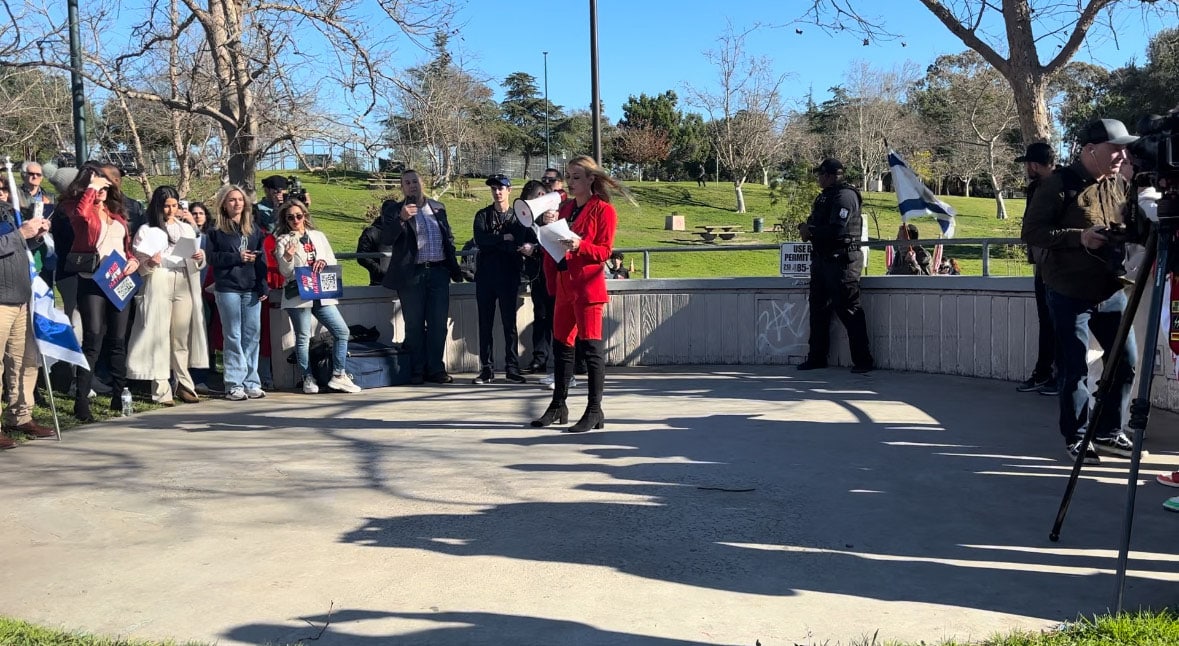
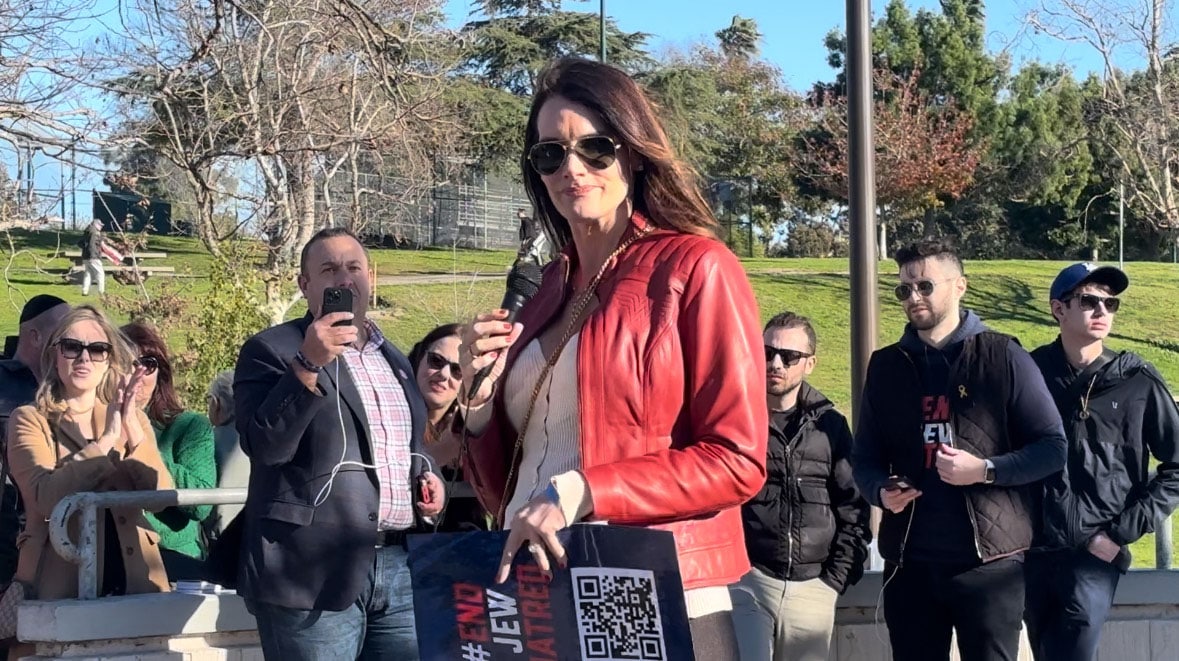
Singer Montana Tucker and sports journalist Emily Austin were among those who spoke at a rally organized by the grassroots organization #EndJewHatred in Los Angeles on Sunday, Jan. 7,  commemorating the three-month anniversary of the Oct. 7 massacre.

The rally, which attracted nearly 300 people, began at Pan Pacific Park near the Holocaust Museum in Los Angeles’s Fairfax district.  Tucker, who has more than 9 million followers on TikTok, began the protest by calling herself a “proud, proud Jew” and that she recently spent six days in Israel. In Israel, she met with survivors of the Nova Music Festival massacre, others who survived the Oct. 7 massacre, three recently released hostages from Hamas captivity, families of hostages that are still being held captive in the Gaza Strip and Israeli President Isaac Herzog. Tucker recalled being “unable to hold back tears” as she met with the survivors and released hostages.

Montana Tucker (Photo by Aaron Bandler)

She vowed to continue to use her platform to support Israel and fight antisemitism and other forms of hate. “I have always been taught to love people for their kind hearts, good souls, not for their race, color, religion or sexual preference, and I will continue to do so,” Tucker said.

“My grandmother is a survivor of Auschwitz,” added Tucker, who produced a short docuseries “How To: Never Forget” (streaming on YouTube) chronicling her trip to Poland retracing her grandparents life under the Nazis). “She was lucky she survived, but she has lived a lifetime of trauma. Upon her arrival to Auschwitz at the young age of 13, she was forced to witness the brutal beating of her mother by two Nazi soldiers and then her mother was dragged to the gas chambers, where my grandmother stood helpless. What is happening now is a scary parallel to what happened back then.

“All of us here have I’m pretty sure have always heard, never forget. Never again. We have had that our entire lives,” Tucker continued. “Well, never again is now.” She pointed out that the Oct. 7 massacre was “the deadliest day for the Jewish people since the Holocaust. How did this happen again? Never again is now.”

Tucker also recalled watching videos of the Hamas atrocities on Oct. 7 when she visited the United Nations as well as heard firsthand testimony from a first responder and a member of ZAKA. “Where are all of the women’s organizations?” Tucker asked to applause, adding that “we have used our social media platforms, we have contacted all the organizations. Where are they?”

She urged people to continue to speak out. “I will not stop until all of the hostages are returned, and until real change is made” Tucker pledged as the crowd applauded.

Austin told the crowd that “there is no more #MeToo unless you’re a Jew, because for too long, Jew hatred has been excluded from the conversation of consequences. And we won’t stand for it anymore. If you’re not going to be a good person by nature, then guess what? We’ll make it clear you won’t have a choice anymore, because Jew hatred will no longer be tolerated.”

Emily Austin (Photo by Aaron Bandler)

Austin continued: “It’s DEI, unless you’re a Jew. It’s believe all women, unless you’re a Jewish woman. And it’s united against hatred, except for when it comes to Jewish hatred. That seems to be the days that we’re living in … and the irony of it all, the same people who are screaming and spreading Jew hatred and are chanting for a free Palestine, are the very women who would not be free in Palestine.”

She then had a pointed message for models Bella and Gigi Hadid: “How do you think Hamas would treat you in Gaza? Bella, you and your naked photoshoots, does that abide by Hamas’ laws? Or Gigi, your baby out of wedlock, you know where they wouldn’t care? Israel! Or in America. But you know who wouldn’t tolerate that? Hamas, and the government that you’re advocating for, that lives to kill Jews.

“These are the hypocrites that we are up against, that we are outnumbered by.”

Austin reminded the audience that “we can stop this hate” so long as the community remains united. “Yes, we might be outnumbered, but look at Jewish history time and time again. That has never stopped us,” she declared to applause.

Also speaking was Christina Pascucci, the former KTLA News reporter who is running in the Democratic primary for the late Dianne Feinstein’s Senate seat, who explained that she didn’t know until her 20s that her grandmother “was in Munich, Germany during the Holocaust and had to hide her religion to survive. And I just think of how many Jews around the world who don’t know their own story. And my daughter will know her family’s story.” Pascucci is seven months pregnant.

Christina Pascucci (Photo by Aaron Bandler)

Pascucci said she visited Israel following Oct. 7 with 30 Chabad rabbis and visited the families of the hostages, who told them that it’s “gatherings like this that keeps their hope alive … when you keep the energy going, I know sometimes it feels hard and you get tired — especially when you see everything happening in the news — but keeping this up means so much to them and makes a huge difference.”

She urged attendees to hold their elected leaders accountable when they say nothing in response to Jew hatred. As an example, Pascucci pointed to how a home owned by the president of AIPAC “was terrorized” by pro-Palestinian protesters on Thanksgiving. “Elected leaders, including some of my opponents, said nothing,” she contended.

Families and friends of those who are still being held hostage by Hamas shared stirring, emotional speeches during the rally. One speaker, who did not identify herself, said her uncle, Oded Lifshitz, is one of the hostages. Fighting through tears, the speaker thanked the attendees for coming and their support “means the world.”

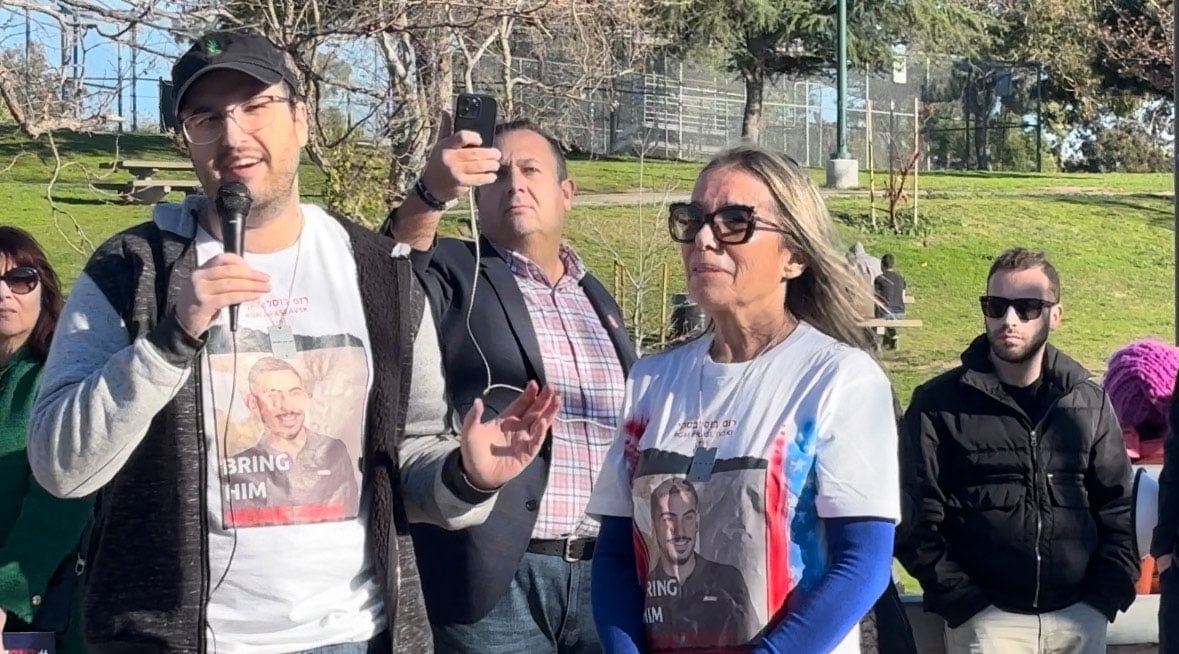
Roy Ben Menahem, said that his cousin, Rom Braslavski, helped several people — including those who were injured — at the music festival escape despite having many opportunities to save himself. Braslavski is currently being held hostage by Hamas. “I think Rom is a hero,” Ben Menahem said. “We’re waiting for him come back so we can celebrate and honor him. Let’s bring them home now everybody.”

Roy Ben Menahem and Yael Adler (Photo by Aaron Bandler)

Yael Adler, the grandmother of Ben Menahem and Braslavski who briefly spoke alongside Ben Menahem during the rally, described Braslavski to the Journal afterwards as being “a very nice person, very intelligent, always loved to help people” and that she’s “so proud of him and I want him back home.” Ben Menahem told the Journal that Braslavski was a security guard at the music festival and “he was probably the best security guard anybody could have ever asked for … his sacrifice saved multiple lives.”

At multiple points throughout the rally, chants of “Bring them home!” broke out throughout the crowd. Eventually, the protesters marched from Pan Pacific Park to IMG Models and rallied in front of the building; they protested IMG Models for representing Bella and Gigi Hadid.

“It is shameful to see the spreading of blood libels and misinformation manifest on social media to a degree we never have seen before,” said Adar Rubin, director of mobilization at #EndJewHatred, in front of IMG Models. “I’ve seen so much disinformation pushed — obviously debunked — but those who perpetuate it refuse to take those blood libels down.”

Adar Rubin, center (Photo by Aaron Bandler)

He did acknowledge that Gigi Hadid “apologized for invoking a horrific blood libel about organ harvesting, but the damage has already been done … People are looking all over right now, looking to amplify such a horrendous libel. There’s no amount of makeup, beauty anything in the world that’s going to cover up the damage that’s been done.”

Rubin demanded that “IMG Models takes the moral responsibility to end Jew-hatred within their own agency,” resulting in applause and chants of “Enough is enough!”

Jonathan Oswaks, who witnessed the altercation that led to the killing of Paul Kessler on Nov. 5, also spoke in front of IMG Models. “I’m here because on Nov. 5, I stood with Paul Kessler. And Paul Kessler was killed for holding this flag,” Oswaks said, referencing the Israeli flag. “I witnessed a hate crime where one of us was killed. Cold-blooded murdered. If you think that it can’t happen here, I’m living testament to tell you that it can.”

He contended that the reason why he is still here, and Kessler is not, is because Kessler insisted on holding the Israeli flag, while Oswaks held the American flag as they were counterprotesting a pro-Palestinian rally in Thousand Oaks on Nov. 5. “Before they went for him, they tried me,” Oswaks said. “But I wasn’t having it.”

Jonathan Oswaks (Photo by Aaron Bandler)

In November, the Ventura County Sheriff’s Office arrested 50-year-old Moorpark resident and college professor Loay Alnaji on charges of involuntary manslaughter and battery in connection to the killing of Kessler. Alnaji had pleaded not guilty to the charges and his lawyer has argued that video evidence will prove that his client did not kill Kessler. Ventura County District Attorney Erik Nasarenko said in a November press conference that they currently do not have enough evidence available that “meet the elements of a hate crime” but they are continuing to investigate the matter.

Oswaks warned that “there is not enough police presence to help all of us” and that “we need to stick together.”

“We saw an amazing resurgence of grassroots activism out here in sweet Beverly Hills,” Rubin told the Journal afterwards. “Home of some of the most elite of the elite and some of the most treasurable actors and most notable celebrity figures, but some of these celebrities right now have been espousing some of the most disgusting and despicable Jew hatred you’ve ever seen … it has to be taken on no matter the form and we’re starting to see that here today with the Hadid family.” He added that they’re calling on IMG Models “to cut ties with Jew hatred once and for all.”

Austin told the Journal afterwards, “If the Hadids said anything against Black people, you know they’d be fired. If they said anything against trans people, you know they’d be fired. So why is there an exception now when it comes to Jewish people? Why is that tolerated? That’s what they should go by.” She also lauded the fact that the Jewish community showed “our solidarity with the world and unify as Jews. Whether it’s on the East Coast or the West Coast or in Israel or all over the globe, we really show up when it’s time.”

Alexandra Smith, director of #EndJewHatred in Canada and one of the speakers at the rally, told the Journal that the rally was “an excellent start … I think we need to get loud about holding people accountable that seem to be an exception to the rule, and there is no exception to the rule. If you’re going to spew blood libel and you’re going to put bulls’ eyes on the Jewish community’s backs, then you’d better be ready for what’s going to come back at you. Either you need to cease, educate yourself, or it’s time for actual consequences because, like Brooke Goldstein says, without consequences people do not learn.”

Other speakers at the rally included journalist Stella Escobedo and entrepreneur Brock Pierce.

Montana Tucker, Emily Austin Highlight Los Angeles #EndJewHatred Rally Read More »

Rosner’s Domain | The Safest Place for Jews?

In general, the world is not a safe place. Humans expect stability and security, reality challenges them. When citizens are asked if their country is a place where they feel safe, it is their point of view that determines the answer: Safe in what sense – as they expect to be safe? As safe as citizens in other places? As safe as their parents were many years ago? Take the average Israeli: He is surely safer here than his grandmother was in Morocco or Poland. He might be safer than his father was, assuming that his father grew up when Israel was still weaker. He is also safer than most Ugandans, Brazilians, Bangladeshis. If some Israelis say that they doesn’t feel safe it means that the safety situation doesn’t meet their expectations. And expectation is a strange thing: The more you get, the more you expect.

Is Israel a safe place? Life expectancy in Israel is relatively high compared to most countries in the world. The Central Bureau of Statistics has a routine of “personal security” surveys. If one compares this data on cities such as the relatively safe Bnei Brak and Petah Tikva, and the relatively less safe Beer Sheva to data on other great world cities (Oslo, Ankara, Vancouver, Milan, Paris), the numbers aren’t bad. Israelis seem to feel safe. Of course, when Israelis are asked whether they feel safe in their city, or safe when they walk in the dark, their answers refer to personal security in the context of their locality. Tel Aviv is a safe city. In most places it is not scary (for men) to walk alone at night.

A question seeking to examine whether Israel is “the safest place for Jews … despite the security situation” is of course a different kind of question. This is not about quality of life in the everyday sense, but rather about terrorism and wars, a question that attempts to measure how Israelis assess Israel’s ability to survive.

A strange thing happens when such an assessment is made. The Center for Jewish Impact (CJI) asked this question in a survey, and discovered the opposite of what one might expect: A rise in the share of Jewish Israelis who feel that Israel is “the safest place for Jews in the world”. So after Oct. 7th, after the horrific massacre around Gaza, after rockets were fired on the north, after towns were evacuated, after hostages were taken – after all these, Israelis say more than in the past that Israel is the safest place for Jews. In the year 2020, 76% of such survey’s respondents agreed that Israel is the safest for Jews. In 2022 the share increased to 82%, and this year – this year! – in a December 2023 survey – 87% agreed that Israel is safer for, well … for you! (if you’re reading this in L.A.).

How can that be? 

Here are three possible explanations:

First – maybe Israelis are a just a bit, or more than a bit, delusional about their actual situation, and don’t exactly understand where they live. It’s a tempting possibility to consider, but it doesn’t explain the increase in the share of feeling-safe Israelis from 2020 to 2023. 

Second possibility – maybe the war has a psychological effect that makes us Israelis feel a need to insist on the Zionist ethos more than ever before, and maintain the claim that despite of everything, Israel is still the safest place for a Jew. That is, even if we don’t really think or feel that this is so, we do feel the need to say that we do, both to ourselves and to all others, as a way of convincing ourselves that there’s hope, that Israel will regenerate itself to become the safer place that it used to be. 

The third possibility is that despite everything that had happened, Israelis also pay attention to what happens there – in your out-of-Israel backyard. The wording of the question in the survey forces us to pay attention, because it specifically talks about the safest place “for Jews.” Is Israel a safe place? maybe not. But is there a safer place for Jews? That is another question. Antisemitism rears its ugly head, on campuses there is a sense of dread, the rhetoric of groups and leaders echoes voices from darker times. So maybe we Israelis were convinced that regardless of the disaster that is unfolding here, Israel is still safer for the Jews, because here they can at least take up arms and defend themselves.

Which of the three options is the one I assume it the most valid? I’d say it’s a combination of the second and the third. And there is something both empowering and depressing about this situation. The second option (psychological effect) represents a strengthening of our identification with Israel, with the Zionist vision, with the Jewish ethos. The third option (what happens in other countries) represents an understanding that living as Jews is by definition less safe. It is a life of lowered expectations. What better evidence does one have than to say that the safest place for Jews is this place, where rockets fly, where soldiers sacrifice their lives, where hostages are awaiting their release. The place where a general war for survival has been going on for more than a hundred years, and a fierce bloody war is now waged for almost a hundred days.

Something I wrote in Hebrew

Yes, Israelis want compromise. But there’s a caveat …

A significant part of Israel’s problems stems from the tendency of all of us to insist on our exact version of the truth. In theory we are all compromisers. We all support unity, we all pray for cohesion. But we all want to achieve this result through a very specific kind of compromise – the other side will give up its position, and thus a compromise will be reached. The ‘right’ wants unity: All that is needed to achieve it is for the ‘left’ to forgo its with two state solution insanity. The ‘left’ wants unity: All that is required is for the ‘right’ forgo its settlements insanity. Once this is done, there will be unity.

A week’s numbers

Last week I wrote about Israel’s Lebanon dilemma. Here are the numbers that prove how difficult it is: from the outside, pressure aimed at avoiding war. From the inside, Jewish Israelis lose patience (survey by JPPI). 

A reader’s response:

Dov Polin asks: “Are Israelis watching the U.S. primaries closely?” My answer: should they? If it’s game over, why waste their time? 


Shmuel Rosner is senior political editor. For more analysis of Israeli and international politics, visit Rosner’s Domain at jewishjournal.com/rosnersdomain.

Rosner’s Domain | The Safest Place for Jews? Read More »