fbpx

December 21, 2023

Ari Segal, Former Head of 2 Modern Orthodox Schools, Accused of ‘Sexualized’ Communications with Students

A Houston Orthodox day school says it found credible allegations that a former head of school engaged in “sexualized” communications with students.

The school, Robert M. Beren Academy, is inviting graduates with similar experiences to reach out to an investigator who is scrutinizing the behavior of Rabbi Ari Segal, who served in senior positions at the school from 2004 to 2011 before assuming leadership of a prominent Orthodox day school in Los Angeles.

“Recently, multiple alumni came forward and stated that our former Upper School Judaica Principal and later Head of School, Rabbi Ari Segal (who served from 2004-2011), engaged in sexualized, persistent, emotionally charged communications with them — including communications indicating each were in a relationship — while they were students at Beren,” said the email to parents and alumni sent Tuesday evening and signed by Ethan Ludmir, Beren Academy’s president.

An outside investigator “determined that these reports are credible,” Ludmir said. He appealed to any alumni who had similar experiences with Segal to write to the law firm of the investigator, Ellen Spaulding. He said Segal declined to cooperate with the investigation.

The email gained a wider audience when it was posted to Facebook on Wednesday by Asher Lovy, an advocate for sexual abuse victims in the Orthodox community.

“Upon learning of the allegations we activated this pathway quite simply because it’s the right thing to do,” Ludmir told the Jewish Telegraphic Agency in an interview.  He said the allegations came to light this year.

A 1997 graduate of Yeshiva University who also holds degrees in social work and business administration, Segal worked in Orthodox high schools for three decades until earlier this year, according to his LinkedIn profile. He gained a reputation for urging open-mindedness in the schools, including in columns arguing for more conversation about sex and sexuality.

“Why do we not have serious discussion in our yeshiva day school system about Jewish sexual ethics, the realities of Shabbat observance on a college campus, belief in God, the ubiquitous and insidiousness of pornography or the culture of drinking and drugs?” he wrote in a 2019 New York Jewish Week column about ideas he said he had raised at an Orthodox Union retreat.

After leaving Beren Academy, Segal served as head of school at Shalhevet High School in Los Angeles until 2021 and then as a consultant there until earlier this year. Shalhevet did not reply to requests for comment, nor did employers before he took his job at Beren, including the Ramaz School in New York City.

He and his family moved to Israel in 2019. His LinkedIn profile says he now acts as a strategic planning consultant for institutions including Yeshiva of Flatbush and Israel’s Diaspora ministry. He did not reply to a message sent via LinkedIn.

A 2019 article on the Shalhevet student news site announcing his phasing out said he was responsible for the school’s substantial growth, for bringing in more women educators to Judaic studies and for pioneering the first LGBTQ inclusion pledge in an Orthodox school.

Beren’s transparency stands in contrast to how other Jewish institutions have handled harassment and assault scandals, with some allegedly engaging in coverups.

 

Ari Segal, Former Head of 2 Modern Orthodox Schools, Accused of ‘Sexualized’ Communications with Students Read More »

Never Ask a Patriarch His Age – A poem for Parsha Vayigash

And Pharaoh said to Jacob, “How many are the days of the years of your life?” ~Genesis 47:8

The tradition of our land says to never ask a
[insert a gender-specific word of your choice] their age.

This was not the case in the days of Pharaoh
when he got to meet Jacob, or maybe it was

Jacob who got to meet Pharaoh. In either case
it was two heavyweights of their day

in the same room, thanks to the cache
of Jacob’s son and Pharaoh’s right-hand person

(Notice how I say that because it is now, not then,
and this is how I’ve learned to think) Joseph,

the dream catcher, the famine savior, the one
who got us to Egypt in the first place.

Jacob had a hundred and thirty years on him
and Pharaoh must have seen the stories

in the lines on Jacob’s face – The weight of
history in his older voice, the man who begot the

younger man who Pharaoh had entrusted everything.
I think about this when I meet the slower-moving

elder states-people of my circles. People who
were once like me in body (though maybe taller)

whose hearts still remember every second of youth.
We all get lost in the future as new buttons come along

that perform miracles only our grandchildren will understand.
May we treat our elders the way Pharaoh received Jacob.

May the history in their eyes show us the way
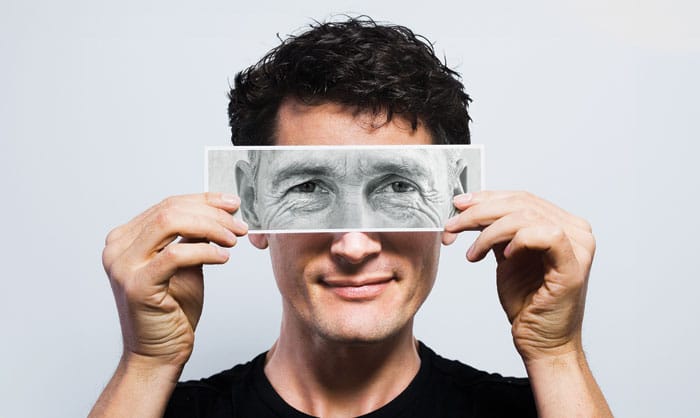
before we blink and find we’re already there.


Rick Lupert, a poet, songleader and graphic designer, is the author of 27 books including “God Wrestler: A Poem for Every Torah Portion.” Find him online at www.JewishPoetry.net

Never Ask a Patriarch His Age – A poem for Parsha Vayigash Read More »

Toasting Away

As 2023 concludes many of us could use a drink to celebrate the passing of another frankly rotten year: overseas wars, the tail end of the persistent pandemic, political turmoil and climate change. It was even a dismal year for local sports teams.

Out of a fondness for wine I once took a Court of Master Sommeliers exam and qualified for a first level sommelier credential. It’s not something I put on my CV yet, but I enjoy recommending wines to friends and family. It’s more fun and less stressful than medical advice. As Dr. Som I can’t avoid a few caveats. Although a glass of wine (or two) helps celebrations and eases some of life’s stress, drinking won’t solve our problems and we shouldn’t try. It’s also worth knowing that some evidence suggests that normative social drinking—two drinks daily or fewer for men and one or fewer for women—may confer more potential harm than previously realized. But, as my medical school pathology professor once commented, “my observation is that one out of one dies of something.”

For most of us, year’s end is a nice time to quaff. So, what to buy? For starters, good wine need not be expensive. Twenty dollars for a bottle can easily be enough to drink well. Spending much more usually means paying for prestige or for a wine in limited supply. That’s fine, but not necessary for a nice holiday wine. Second, wine pairings do matter. Although the old saw “red wine with meat, white with fish” generally holds, there are always exceptions. For example, we often enjoy a local Santa Rita Hills Pinot Noir paired with my wife’s outstanding salmon.

The advice of a salesperson at your local wine store can help you select a wine that takes a good holiday meal to the next level. Consider some off-the-beaten-track options. Instead of a Cabernet Sauvignon think about a South African Pinotage or a Spanish Tempranillo. You could substitute a Greek Assyrtiko or an Austrian Gruner Veltliner for that boring Chardonnay or Sauvignon Blanc. Looking for a Kosher wine? You may have to spend more to get the quality you desire, although Covenant wines of Berkeley offers an exception to that rule.

Picking up that special bottle is easier at a store with an outstanding selection, competitive prices and a friendly/informed staff. Southern California is blessed with a number that fit that bill including the Wine Exchange in Santa Ana, Woodland Hills Wine Company, K and L Wines in Hollywood, the Wine House in West Los Angeles, the LA Wine Company in Marina Del Rey, and Lincoln Wines in Venice. They all have websites with search engines to help you pinpoint a wine with good reviews in your price range.

Sparkling wine for the New Year is a justifiably entrenched tradition. Champagne offers a reliable option and pairs remarkably well with many foods. But it need not be true Champagne—sparkling wine grown from grapes in the French region of Champagne—to sparkle. The prestige of the Champagne appellation means paying more for your bubbles.   Other regions of France, notably Burgundy and Alsace, produce sparkling “crémant” that can offer Champagne level quality at significantly lower cost. Some of the California sparkling wines, like Mumm and Chandon, are affiliated with producers in the Champagne region. They also drink well at a significant discount to the French wines of their parent companies.

Honing one’s palate and appreciation for wine makes good sport. My wife lacks passion for the subject but nonetheless plays along. I tease her about blind-tasting a red wine that she jokingly but correctly identified as a Susumaniello, an obscure but tasty dark red from Puglia in Southern Italy. In wine tasting, like baseball, one sometimes hits the ball while swinging with the eyes closed.

If toasting can be aspirational, this might be the year for it. I’m reluctant to waste a good toast on 2024, which looks ominously stressful and momentous. Toasting might be like traffic. I’ve always wanted to figure out a way to honk at the driver past the one in front of me. Along the same lines, I’d prefer to toast to 2025. If 2024 does not go well, we’ll really need the help by then. And If it doesn’t, you may find me touting a toast with hard spirits next year. Cheers!


Daniel Stone is Regional Medical Director of Cedars-Sinai Valley Network and a practicing internist and geriatrician with Cedars Sinai Medical Group. The views expressed in this column do not necessarily reflect those of Cedars-Sinai.

Toasting Away Read More »

Welcome to My Kristallnacht

I was born on November 16, 1946 in Boyle Heights, Northeast of Chinatown. Jews from everywhere in Europe and the States settled in this little ghetto they affectionately called “The Heights.” It was one of the only neighborhoods with no deed restrictions we could settle in. The original Canter Brothers Delicatessen with kosher salamis hanging in the front window and oak barrels filled with sour pickles out in front was located on Brooklyn Avenue (now Cesar Chavez Boulevard) with other Jewish shops. I experienced overt in-your-face- antisemitism only once: a playmate from Mott Street called me a kike. His parents must have hated the Jews. My parent’s generation played it real cool, they liked to Swing and Sway with Sammy Kaye. Gentiles were able to keep us out, they were not able to keep us down. Life was a ball until the White Fence gang drove us out.

In 1946, German cities were in rubble like Gaza’s cities are now. Evil has to be obliterated. DP camps in Europe were chockablock with lost souls searching for shards of shattered lives. Some survivors were living in the camps, preserving them as evidence. “Gleaners” were sifting through the crematoria ash pits for gold teeth and jewelry the Nazis overlooked. The darkness of genocide had not lifted, no place felt sure.

By tradition, my mother was supposed to have named me after my paternal grandfather, Nochum. But terrifying stories of Nazi atrocities — outdone by Palestinian terrorists on October 7 — were reported daily over radio broadcasts by Lowell Thomas and Walter Winchell. Emaciated corpses stacked like matchsticks in the camps appeared on jaunty Movietone news reels in smokefilled theaters. My mother played it safe and gave me the gentile moniker, Noel.

The world before my birth was described by Susan Warsinger, a Jewish citizen of Bad Krueznach. As she  testified to the United States Holocaust Memorial Museum, on November 10, 1938—the second night of Kristallnacht:

”…. All of a sudden some bricks and rocks were being thrown through our window …. And [my little brother] went to the window to check to see what was going on. And he told me that it was the people… our neighbors. The people of our town were throwing bricks and rocks through the window. And he told me that the civil policeman in our town was standing on the edge of the crowd and he didn’t do anything about it. So we became very frightened.  …. Some of the people had uprooted a telephone pole and smashed the front door down. … [My family and I hid in the attic and] remained in that attic for three days.”

Nearly 80 years later,  on October 25, 2023, Jake Novak, a past media director for the Israeli Consulate in New York, posted the following message on Twitter:

“My sources tell me several Jewish students  @Cooperunion [a university in New York City] are currently locked in the school library as a pro- Hamas rally outside of the Cooper Union building learnt  the Jews were afraid and sitting in the library, then brought the protest inside and are barricading all exits.  Police have been called for 40 minutes and are afraid to get involved. Security locked the students in as they are worried, they cannot protect the Jews.”

The policeman in Bad Krueznach had been ordered by Heinrich Himmler, Director of all German police, to stand down. The New York City police, once the world’s premier police department, was afraid to act. So afraid NYPD Chief of Patrol John Chell told reporters, “There were no direct threats.” Denial of truth is a symptom of tyranny.

On October 6, my place in Los Angeles, the United States, and the world felt secure. Following October 7, and the tempest of hatred for the Jews that followed, an old feeling of doubt about our place in the world came back to me.

I believe we are at another beginning, another Kristallnacht. We are watching injustice metastasize on our iPhones. But for the support of a thin and demographically challenged majority of the Democratic Party in alliance with Republicans, America might withdraw her support of Israel and let the Islamic butchers and rapists have their way with the Israelis and their land of milk and honey. As the Israelis mount their counteroffensive there is a cry for a ceasefire along with handwringing about how much longer “the world” will support Israel’s fight for survival. To those who worry I ask, Where was the world when box cars packed with the living dead clacked down tracks to death camp crematoria spewing ash that covered the land in a silent shroud of the vanquished?

As I watched our two-year-old granddaughter play on the first night of Chanukah, I imagined how her life will be in decades to come. Our public spaces have been cleansed of God. It is forbidden to display the Ten Commandments in school classrooms. Grade school boys and girls are taught their choices about gender and sexual behavior, but they are not allowed to see commandments like “Thou Shall Not Murder.” We have lost the will to choose between Good and Evil. I fear that no matter how much wealth we create or how powerful our weapons become, my granddaughter’s future will be dangerous if we do not find our way back to God.


Noel Anenberg is the author of “The Dog Boy,” about life in Boyle Heights after WWII.


Welcome to My Kristallnacht Read More »

As Jew-Hatred Hits Record Highs, Our Best Allies Can Be Israeli-Arabs

A key principle of success is to adapt to changing times. When the game changes, it’s best not use the old playbook.

The world changed radically for the Jews on October 7, and yet, it seems we haven’t changed our playbook.

There’s no better indicator of how that world has changed than the latest Harvard CAPS-Harris poll that shows an alarming development among young Americans. When asked whether the grievances of Palestinians justify Hamas killing over 1200 Israelis and kidnapping over 250 civilians, 60 percent of Americans 18 through 24 agreed such violence could be justified, with half of that group supporting Hamas.

On the question of Israel’s statehood, a third of younger Americans believe Israel has no right to exist as a homeland for the Jewish people. Regarding the long-term solution to the conflict, a majority responded that “Israel [should] be ended and given to Hamas and the Palestinians.”

To make matters worse, this toxic worldview is morally justified in the name of social justice. As long as Israel represents the powerful “white oppressors” who oppress the powerless “brown oppressed,” it will always be seen as guilty. And because they’re seen as brown and powerless, Palestinians will always be off the hook– even if that includes Hamas.

It’s hard to overstate the danger of this emerging worldview among young Americans. This is why we need to take a new and deeper look at how we present Israel.

Because all of our arguments and initiatives come from our side, and look like they come from our side, they’re easily dismissed as oppressor propaganda. Even those videos of the barbaric acts, as dramatic and horrendous as they are, don’t seem to have made much of a dent with this new generation of Jew-haters. If one is locked in that Israel and the Jews are always guilty, that’s a hard narrative to dislodge.

We shouldn’t pretend there’s an easy solution to this conundrum. But instead of looking for “solutions,” maybe we ought to look instead for deeper truths that can make an impact.

One of those deeper truths is to recognize Israeli-Arabs in shaping the public face of Israel.

For starters, they represent the stereotype of the “brown and oppressed” that the new generation worships. These are Arabs living in the land of those “dreaded white Jewish colonialist oppressors.” For ignorant Jew-haters with a short attention span (the majority of Jew-haters), one would assume these “brown Arabs” would strengthen their case, right?

It turns out they strengthen Israel’s case.

Consider, for example, the story of a proud Palestinian born in Israel named Nuseir Yassin, better known as the hugely popular global vlogger “Nas Daily.”

On October 9, he admitted on X that “For the longest time, I struggled with my identity. A Palestinian kid born inside Israel.” When he resolved that struggle by mixing the two and becoming a “Palestinian-Israeli,” he thought this term reflected who he was: “Palestinian first. Israeli second.”

October 7 changed everything.

“After recent events,” he wrote, “I started to think. And think. And think. And then my thoughts turned to anger. I realized that if Israel were to be ‘invaded’ like that again, we would not be safe… And I do not want to live under a Palestinian government. Which means I only have one home, even if I’m not Jewish: Israel… Palestine should exist too as an independent state. And I hope to see the country thrive… But it’s not my home. So, from today forward, I view myself as an ‘Israeli-Palestinian’. Israeli first. Palestinian second.”

Reflect on just one part of that stunning statement: a proud Palestinian born in Israel admits publicly that he’d never want to live under a Palestinian government and that he’s Israeli first.

Yassin is not alone.

As reported in the Israeli publication Globes, a study conducted by Nimrod Nir of the Agam Institute and Dr. Mohamed Khalaily among the Arab public shows that “an overwhelming majority of the Israeli-Arab public opposes the surprise attack by Hamas, supports Israel’s right to defend itself, and even expressed a willingness to volunteer to help civilians who were harmed during the attack.”

The findings, the report concluded, “indicate a turning point in the attitudes of the Arab public that, in previous clashes, expressed support and solidarity with the Palestinian side.”

This is not to suggest that Israeli-Arabs will suddenly lose sympathy for the Palestinian cause. They won’t. What it does suggest is that the extreme and unprecedented violence of October 7 has shaken many of them, just as it has shaken so many of us.

As the study shows, “almost 80% of Israeli-Arabs oppose the Hamas attack, and 85% oppose the kidnapping of civilians. 66% of the respondents answered that Israel has the right to defend itself, compared with only 6% who said that it does not.”

These Israeli-Arabs are not just numbers in a survey. They are real people, many of them deeply engaged in Israeli society. They are doctors and nurses, lawyers and architects, waiters and maître d’s, grocers and pharmacists, judges and members of parliament, tech entrepreneurs and college students.

When they saw the invasion of their country on October 7, they took it personally. They didn’t react like the pro-Hamas demonstrators who are flooding U.S. streets, tearing down posters of Israeli hostages, desecrating the Lincoln memorial and intimidating Jewish college students.

No, they reacted as if some monsters invaded their homes, which they did.

Because they value the freedom and opportunities that Israel has brought to them, Israeli-Arabs can become our most powerful allies. It’s time we enlist their support in a dignified way. They deserve a chance to become an integral part of the public face of Israel.

Showing this new face of Israel that includes Israeli-Arabs is not just a good PR idea– it’s also the truth.

We should initiate a major outreach effort and seek their input. This campaign, once formulated, should become a top priority for 2024.

At the very least, this will turn the tables on the new generation of Jew-haters. Instead of seeing “white Jews” make the case for Israel, they will see “brown Arabs” telling them how lucky they are to live in the Jewish state.

Showing a new face of Israel that includes Israeli-Arabs is not just a good PR idea– it’s also the truth.

As Jew-Hatred Hits Record Highs, Our Best Allies Can Be Israeli-Arabs Read More »

Print Issue: Looking Back on 2023 | Dec 22, 2023

CLICK HERE FOR FULLSCREEN VERSION

Print Issue: Looking Back on 2023 | Dec 22, 2023 Read More »

Fueled by DEI, A Dangerous Generation of Jew Haters Has Arisen

In 1998, I was fortunate to participate in the March of the Living, which took me to the Holocaust concentration camps of Eastern Europe where I saw the horrors that humanity can inflict on others. I use the word “fortunate” because this extremely vivid and intense experience revealed to me how extremism, nationalism, scapegoating, misinformation, fear, hatred and manipulation of the ignorant can lead to truly inhumane and barbaric actions. Throughout this trip, the ideas of “never again” and George Santayana’s “The Life of Reason”— “Those who cannot remember the past are condemned to repeat it”—were omnipresent.

These messages have been with me for decades and I am devastated for humanity around the globe now for it has forgotten too much history and failed to learn from the not-too-distant past. Even worse, the Jewish community has repeatedly turned a blind eye to the woke, progressive revolution that has engulfed not only our colleges and universities but also entire industries like the mass media and Hollywood in the name of allyship to endorse an ideology that explicitly calls for the very destruction of the Jewish people.

Offices of belonging, diversity, equity and inclusion (DEI) along with historical ignorance and dangerous misinformation on social media platforms have collectively created an incredibly dangerous world for Jews today. From violence, intimidation and murders in cities globally against Jews, to endless calls for the destruction of Israel and dehumanizing rhetoric used against Jews on collegiate campuses nationwide, the Jewish people are under attack and the threat is existential but far too few Jews realize this.

The Israel-Hamas war and the tragic, horrific series of events unleashed the true hate-filled feelings harbored by so many, and the Jewish community must respond and react now. Jews cannot continue to simply make excuses, look the other way, and call for peace in the Middle East because the hate is far deeper: This is not about Israel, it is about all Jews, period.

The antisemitic identity politics that DEI offices and this culture of victimization promote is a sophomorically simple division of the world into oppressors and oppressed and almost any form of action taken to topple the perceived oppressors is considered acceptable, from violence to disruptions. Under this ideology, there is an unshakable belief that Jews are oppressors and that Israel is a “genocidal, settler, colonialist state.”

former DEI official rightfully found that “criticizing Israel and the Jewish people is not only acceptable but praiseworthy” and “if you defend them, you’re actively abetting racist oppression.” These dangerous ideas have infected countless younger Americans and we now have the proof despite so many Jews waiting on their hands and refusing to believe that this ideological virus is real.

Data from the latest Harvard CAPS-Harris poll offers firm evidence of just how deep this indoctrination and dangerous misinformation about Israel and Jewish community have become. Younger Americans, aged 18 through 24, who have grown up and been fully indoctrinated by diversity principles and are deeply ignorant about international history, hold shocking views that are notably divergent from older generations.

When asked about whether the purported grievances of the Palestinians against Israel justify Hamas killing over 1200 Israelis and kidnapping over 250 civilians, for instance, 60 percent of Americans 18 through 24 agree those genocidal actions could be justified and half of the same group support Hamas in the current conflict.

On the question of Israel’s statehood, a third (31 percent) of younger Americans assert that Israel has no right to exist as a homeland for the Jewish people. In fact, when asked about the long-term solution to the Israeli-Palestinian conflict, a majority of 18- to 24-year-olds (51 percent) responded that “Israel [should] be ended and given to Hamas and the Palestinians” with a minority (31 percent) rejecting a two-state solution or other Arab states absorbing Palestinians (17 percent).

Looking at the impact of this diversity and justice ideology domestically, 79 percent of younger Americans support the idea that white people are oppressors and that “nonwhite people and people of certain groups have been oppressed and as a result should be favored today at universities and for employment;” while a majority of younger Americans think that this ideology is helpful for society. As for Jews specifically within this DEI framework, 67 percent of young Americans think that “Jews as a class are oppressors and should be treated as oppressors.”

What is critical here is that this question refers to Jews collectively—not necessarily Zionists, not the Israeli government, but specifically Jews, many of whom have been on the front lines of social justice and are routinely critical of Israel. Again, regardless of Israel, there is intense hate, antisemitism and ignorance among younger Americans; and while pogroms have not yet begun, we have seen less than a century ago what happens when ideologies and misinformation take over the minds of a young group.

I cannot see how any Jew, on the left or the right, can dismiss these findings. All Jews should be calling for the end of the toxic diversity, equity and inclusion programs that have seeded this hate and ignorance. The Harvard-Harris poll is certainly imperfect as all polls are, but the findings are consistent: It is now clear that younger Americans hold a set of beliefs that call for the destruction of the Jewish homeland and support terror and violence. This should trigger immediate action among the global Jewish community.

We must act now because these same people maintain a worldview that says Jews can be harmed and hurt in the name of justice and equity. As was vividly seen during the Holocaust and now after October 7th in Israel, Jews globally are subject to linked fate—that is, a deep connectedness that minority groups have when under assault—and all Jews should be worried about the fact that a large segment of younger Americans holds such abhorrent views.

Even those Jews who traditionally see themselves on the left and who marched for BLM or are calling for a ceasefire now must understand that they are not viewed as allies; historically the Left eventually turns on itself and that is clear today when it comes to standing up to Jew hate. We must remember this critical piece of human nature as well as the events of the past which came on quickly, like today.

We cannot allow history to repeat itself and all Jews must recognize where young Americans now stand.


Samuel J. Abrams is a professor of politics at Sarah Lawrence College and a senior fellow at the American Enterprise Institute.

Fueled by DEI, A Dangerous Generation of Jew Haters Has Arisen Read More »

Campus Watch December 21, 2023

Harvard Chabad Rabbi Says University Forces Them to “Hide” Menorah Overnight “Because There’s Fear That It’ll Be Vandalized”

Harvard University Chabad Rabbi Hirschy Zarchi said in a speech on Dec. 13 that the university forces the Chabad to “hide” their menorah overnight out of fear that it would be “vandalized.”

Jewish Insider reported that Zarchi, who was speaking in front of the menorah at Harvard Yard with Harvard President Claudine Gay in attendance, said: “You know what happens to the menorah? After everyone leaves the Yard, we’re gonna pack it up. We have to hide it somewhere.” This is because the university “would not allow us to leave the menorah here overnight, because there’s fear that it’ll be vandalized.” He added that there will be change “when we don’t have to pack up the menorah.”

Oakland City Councilmember’s Speaking Invitation Revoked from Berkeley Class for “Spreading Pro-Israel Propaganda”

Oakland City Councilmember Dan Kalb was scheduled to speak at a class in UC Berkeley about environmentalism in November, only to find himself disinvited after students complained that he was “spreading pro-Israeli propaganda” on social media.

The Jewish News of Northern California (The J) reported on Dec. 15 that more than 30 students in the Environmental Problem Solving class co-signed a letter that stating that Kalb is supporting “the apartheid state of Israel and the current and ongoing ethnic cleansing of the Palestinian people.”

“If someone wants to go speak about climate change — they are an expert on climate change — what the hell does Israel or Zionism have to do with that?” Kalb, who is Jewish, told The J. “Why not put a yellow star on our sleeve? How about we do that too?”

Kalb also told The J that the adjunct professor teaching the class, Kurt Spreyer, is a “good guy” and that he “pushed back” on the students, but ultimately canceled Kalb’s speaking appearance out of concern that “students would force a conversation about the Middle East” and that there would be protests.

UC Berkeley Assistant Vice Chancellor Dan Mogulof told The J that “instructors are not supposed to rescind invitations for classroom speakers based on student disagreement with the speaker’s views” and that the university is investigating the matter.

Rutgers Suspends SJP

Rutgers University-New Brunswick suspended their Students for Justice in Palestine (SJP) chapter on Dec. 11.

In a letter from the university to the SJP chapter obtained by the New Jersey Globe, the university wrote that the “interim suspension” is due to “multiple complaints” that the chapter disrupted several classes and that vandalism at the Rutgers Business School allegedly occurred “while your program was taking place.” Consequently, “the organization is prohibited from participating in any University activity and promoting University programs without express permission from the Senior Student Affairs Officer or their designee.”

The SJP chapter issued a statement claiming that the allegations against them “are attempts to silence Palestinian voices and solidarity” and that the university hasn’t demonstrated that the chapter poses “a substantial and immediate threat to the safety and well-being of others,” per The National Desk.

Yale Condemns Placement of Palestinian Flag Placed on Menorah

Yale University issued a statement on Dec. 10 condemning the “desecration of a menorah” after an unknown individual placed a Palestinian flag on a menorah in the New Haven Green.

“The placement of a Palestinian flag on the menorah conveys a deeply antisemitic message to Jewish residents of New Haven, including members of the Yale community,” the statement read. The university added that the incident occurred “off the Yale campus during a demonstration sponsored by several groups in Connecticut. At this time, Yale has no information as to whether the perpetrator was a member of the Yale community.”

Jewish Federation Chair Named Interim Chair of UPenn Board

Julie Platt, who chairs the Jewish Federations of North America, was named the interim chair of the University of Pennsylvania (UPenn) Board of Trustees on Dec. 9.

Platt takes over for Scott Bok, who resigned on Dec. 8. “As current vice chair, Julie was the clear choice, and we are grateful to her for agreeing to serve in this capacity during this time of transition,” the Board of Trustees said in a statement. “Due to her current commitment as board chair of the Jewish Federations of North America, Julie will only serve until a successor is appointed.”

Platt said in a statement, “As Vice Chair of the university’s board these past several months, I have worked hard from the inside to address the rising issues of antisemitism on campus. Unfortunately, we have not made all the progress that we should have and intend to accomplish. In my view, given the opportunity to choose between right and wrong, the three university presidents testifying in the United States House of Representatives failed. The leadership change at the university was therefore necessary and appropriate. I will continue as a board member of the university to use my knowledge and experience of Jewish life in North America and at Penn to accelerate this critical work.”

Campus Watch December 21, 2023 Read More »

1,000 People Attend Chabad’s Unity Shabbat

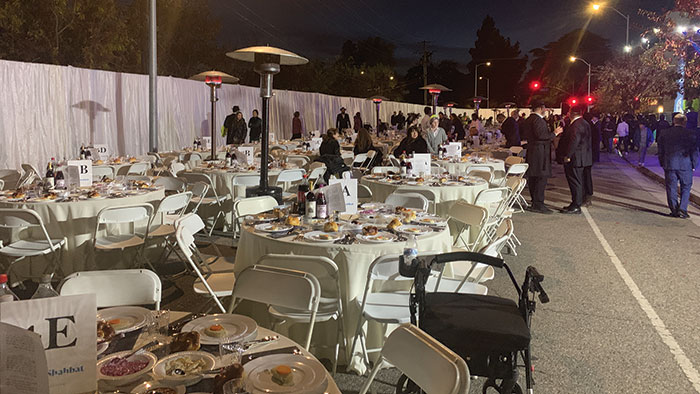
“Valley Shabbat 1000,” an outdoor Shabbat dining experience organized by Chabad of North Hollywood, was held Dec. 15, drawing nearly 1,000 people.  

As the war in Israel continues and American-Jewish communities grapple with rising antisemitism across the country, Chabad organized the evening to promote Jewish unity, Chabad of North Hollywood Director Rabbi Nachman Abend told the Journal.

“We wanted to do something special, to express a statement of unity for everything going on in Israel. Society is fragmented, and we wanted to bring a bunch of Jews together for Shabbat dinner.”– Rabbi Nachman Abend 

“We wanted to do something special, to express a statement of unity for everything going on in Israel,” Abend said. “Society is fragmented, and we wanted to bring a bunch of Jews together for Shabbat dinner.”

Free to attend, the event was held on a closed-off section of Chandler Boulevard, near Coldwater Canyon Avenue, outside the San Fernando Valley-based Chabad. 

Due to security concerns, Los Angeles Police Department (LAPD) officers, along with private security, were on the scene.

The gathering began on Friday at sundown, at 5:30 p.m. The sounds of traditional Shabbat songs filled the cool air as men in dark suits, young and old, filed out of the synagogue building and headed toward tablecloth-covered tables set up outside. Families walked over from their homes nearby in Valley Village, Sherman  Oaks and Valley Glen.

Individuals designated as “sections captains,” wearing yellow vests over their suits, were assigned to different areas of the dining area. They led their tables in kiddush and hamotzi. 

Guests enjoyed a delicious Shabbat dinner of chicken, matzah ball soup, gefilte fish and non-dairy deserts. They mingled with neighbors and friends, and they formed new connections. 

Throughout the evening, Rabbi Aharon Abend, the Chabad center’s senior rabbi, went from table to table to schmooze. Speaking to several LAPD officers, he explained why Jews eat gefilte fish. 

LAPD Captain Karen Leong, who works in the department’s Van Nuys division, was seated among the attendees. The event was her very first Shabbat dinner, and from the happy look on her face as plates of cakes and cookies arrived, it didn’t disappoint.  

The event marked the first time the Chabad of North Hollywood had held such a gathering. 

“I think it was fantastic,” Nachman Abend said afterward. “The response has been amazing. People felt proud of their Judaism.”

1,000 People Attend Chabad’s Unity Shabbat Read More »