fbpx

November 7, 2023

Kristallnacht, Act II

In an ordinary year, this week, specifically the days November 9 and 10, would call to mind Kristallnacht—the night of the broken glass. Given the grotesque carnage in southern Israel on October 7, global Jewry is today mindful of a brokenness far worse than glass—the confidence of their place in the world, which far too many had believed was secured. 

The year was 1938, and all throughout Germany, Austria and parts of Czechoslovakia, two days were set aside to kill and terrorize Jews. Nazi-affiliated paramilitary groups, the Hitler Youth, and willing civilians, murdered hundreds of Jews (hundreds more committed suicide afterward, when the fate of European Jewry was realized), 269 synagogues were reduced to rubble and glass or burned to the ground, over 7,000 Jewish-owned businesses were ransacked and destroyed, and 30,000 Jewish men were placed in concentration camps.

Hitler’s Final Solution to the Jewish Question was now, officially, in progress, and without the need for a question mark. The Master Race was determined to rid the world of that inferior race known as the Jews (sorry Whoopi Goldberg, the Holocaust was about race, because the Nazis made it so). Kristallnacht shattered both glass and illusions. All countries were placed on notice that world domination was only part of Hitler’s grand plan. The Jews were the Third Reich’s first victims, and their annihilation its ultimate aim.

With a war raging in Gaza to eliminate Hamas after nearly two decades of still unabated rocket fire, the anniversary of Kristallnacht—a mere month from that ungodly slaughter; October 7, a new date that will live in infamy—could easily go unnoticed. 

But Kristallnacht must be remembered, especially now, precisely because Jews, and not just those living in their ancestral homeland, but in the diaspora, as well, are once again facing threats of mass murder. The threats are largely empty, ironically, because of the existence of a Jewish state—the very same state that today’s murderous antisemites wish to eliminate. The safe haven of a Jewish homeland was not an option both before and during the Holocaust. The new obsession of this generation of Jew haters is to turn that escape route into a dead end.

The sheer bloodlust of October 7, and its colossal success as an invasion of Israeli sovereignty—Hamas storming through the security fence on motorcycles like Hells Devils; the mighty IDF nowhere in sight—perhaps for the first time gave the enemies of Zion a feeling that after 75 years dreadfully watching tiny Israel outshine the 22 failed Arab states of the region, the dream of driving the Jews into the Mediterranean Sea might actually come true.  The breaking of that barrier separating Gazans from Israelis on October 7 tampered with the psyches of both Jews and Arabs, and transported the symbolism of Kristallnacht to the Negev Desert.

In 1938, after two millennium of exile, persecution, forced conversions, and the occasional pogrom, the diaspora didn’t take their refuge, wherever that might be, for granted. Whether inside the original ghetto of Venice or the relative comfort of Amsterdam, Jews knew their host countries saw them as suspect outsiders—clannish and conniving wandering Jews. Some were hospitable, like George Washington’s letter to the Jews of Rhode Island; others, like Torquemada and Joseph Stalin, made Jewish lives insecure and instantly disposable.

But since 1948, with the creation of Israel, Jews suddenly had options. The Jewish state, understandably, made it easier to live as Jews in the United States, Canada, Australia, England, France, and even Germany. Sure, Israel was war-weary from its unwelcoming Middle Eastern neighbors. And it was a favorite target of U.N. General Assembly Resolutions. Perpetually under a microscope and subject to double standards. But it was a plucky and agile nation, resilient and resourceful, geographically small but to world Jewry, a Goliath.

Many Jews feel that the world’s reaction to the massacre on October 7 is a harbinger of something worse ahead, a premonition of the antisemitic alliances of this age. They may be right.

Many Jews feel that the world’s reaction to the massacre on October 7 is a harbinger of something worse ahead, a premonition of the antisemitic alliances of this age. They may be right.

Sympathy for Israel was short-lived. There were immediate denials of Hamas’ butchery. The graphic and grotesque video shot by terrorists, and the delight they expressed from having killed so many Jews, was apparently unconvincing. Why should anyone assume that terrorists acted like barbarians? A hospital parking lot bombed by Islamic Jihad was blamed on Israel—with the target now the hospital itself, and an exponential list of civilian casualties.

Even more disturbingly was the impulse to elevate Hamas to the role of statesmen. BBC and MSNBC refused to refer to them as “terrorists.” “Freedom fighters” was, apparently, a more fitting description since the babies Hamas beheaded, and the grandmothers they killed and kidnapped, were soldiers of a colonialist army. 

Savagery was suddenly justifiable “resistance.” Media outlets quoted Hamas as “Palestinian officials.” The accuracy of reports, issued by Hamas, as to the number of dead Palestinians from Israeli airstrikes were unquestioned and unverified. Israel somehow managed to only kill civilians, and never terrorists.

Faculty members on campus and their easily manipulated and largely ignorant students openly blamed Israel for Hamas’ actions, and expressed feelings of “exhilaration” at the thought of so many dead Israelis. The victims of October 7 were not victims at all. The babies and grandmothers deserved what they got. 

Universities that twisted themselves into politically correct knots over Black Lives Matter, transgender rights, and anti-racism, found themselves unable to denounce Hamas, or ensure the safety of Jews on campus, who suddenly were responsible for why Palestinians are still without a homeland. 

Nearly 30 congresspersons declined to vote in favor of a House resolution condemning antisemitism on campus. Members of the Squad converted their district offices into lobbying firms working for their main client, Hamas.

Israel descended quickly from aggrieved nation that possessed rights under international law to defend itself, to rogue nation that was violating the Geneva Convention and must consent to a ceasefire. No one mentioned the Geneva Convention on October 7.

Kristallnacht started out this way—the unleashing of violence against Jews was their own fault, and now nothing can be done to stop the inevitable. Are we in the midst of Kristallnacht, Act II, re-living the first days of the next Holocaust, a prelude to a newfangled “Final Solution.” This past week college students and raucous demonstrators in cities around the world screamed: “There is only one solution—a one-state solution!” Talk about coopting a message. We’re standing in the shoes of Berlin Jews from 1938, and we’re missing our cue.

All sorts of people with power and prestige are registering shock, and saying the same thing: “I have never seen antisemitism like this in my life.” So much for all those superpowers American Jews are thought to have possessed. It turns out that antisemitism is the Kryptonite of fully-assimilated, cosmopolitan Jews. It can fell Hollywood moguls, hedge fund managers, and Wall Street investment bankers faster than a speeding bullet.

Could it be that “Never Again” was never more than a provisional slogan—a feel-good antidote to an atrocity should another one ever materialize, a chance at redemption for a world that was largely indifferent to the Holocaust? Even the relative silence today of the outside world is feeling eerily familiar.

Jews on the left naively believed they had earned enough sweat equity in marching for the civil rights of others to ensure that these alliances could be counted on to pump their fists and chants slogans in support of Jews — should the need ever arise.

Liberal Jews are especially confused by this massive reality check. (European Jews have seen the graffiti on the wall for many years now, especially in France. A Jewish woman was stabbed in her home this past Shabbat, her assailant defaced her door with a swastika before departing.) Jews on the left naively believed they had earned enough sweat equity in marching for the civil rights of others to ensure that these alliances could be counted on to pump their fists and chants slogans in support of Jews—should the need ever arise.

Instead, it is precisely those very same unfaithful allies who have commandeered bullhorns and are reciting the catchy, genocidal theme song: “From the River to the Sea.” In far-flung places as Madrid and Melbourne, we are hearing: “Gas the Jews!” “Rape Jewish girls!” and “Intifada!”

Seriously? There are still people alive who survived the Holocaust, and we’re back to gassing? Hamas actually placed babies in ovens—two nouns that should never been uttered in the same sentence: “Jews” and “ovens.”

At least during the Holocaust, the world may have been asleep, but they surely weren’t cheering the Nazis on like they were this past week with the handiwork of Hamas. This is Kristallnacht on crack. Actually, it’s more like, Kristallnacht, meet the Arabian Nights.

So many of the protestors on campuses and in the streets are Muslims who have been galvanized by what is now happening in Gaza—and now have an opportunity to lawfully tell the world how much they really hate Jews. America is finally getting to see the Arab street, up close. It’s only in the Middle East, North Africa and Persian Gulf where thousands of people will burn American and Israeli flags and scream, “Death to America!”; “Death to Israel!”; “Death to British novelists!”; “Death to Danish cartoonists!”; “Death to the Pope!”; Death to death!”

With the steady migration of Muslims to Europe, such scenes have been played out throughout the continent, except in places like Poland, which, ironically, had a role to play in the Holocaust, but nowadays, the country has been relatively quiet in its antisemitism largely because they maintain a strict, airtight border. Very few Muslims have been granted refugee status. 

The Jews of Paris, Munich, Madrid, Brussels, Stockholm, and Copenhagen, however, have slowly emigrated to Israel. They have stories to share with American Jews, who have been largely oblivious to their departure. Now that Jewish-Americans are declining to openly wear the artifacts of their religion, they are catching up. 

There has been a lot of talk since the Trump administration about the return of the 1930s. The Alt-right and MAGA, and the Biden administration’s obsession with “white supremacy,” has sounded the alarm that fascists are among us. Remember the Unite the Right Rally in Charlottesville, with the chanting, “Jews will not replace us”? Sounds ominous, even though hardly anyone knew what that phrase meant. But only 30 protestors from the Alt-right showed up that day, compared with thousands of counter protestors.

Yes, I know that a few slackers hung antisemitic signs off the LA freeways in support of Kanye West, and his problem with Jews from a year ago. But how is that comparable to what we have been seeing on campus and city streets—a movement that is avowedly left-wing, progressive, and American Muslim. The fact that progressives are, paradoxically, standing in solidarity with those who believe in a strict adherence to Sharia law—where women, gays, nonbelievers, and artists do not fare especially well—one day will lead multitudes to feel foolish.

People protest in support of Gaza on November 4, 2023 in London
Carl Court/Getty Images

What we are seeing today is not a return to the 1930s, but something else entirely. It is an antisemitism rooted in Marxist theory, with its class consciousness and intellectual pretensions, its purity tests and loyalty oaths. It is fixated on race in ways that would have given Hitler a heart attack: the Master Race has dark skin! Pigmentation is a sign of virtue; whiteness nothing but shame. It reserves its most critical indictment of the colonialism of the west and the power it has exerted over oppressed peoples. 

No matter what ideological label it warrants, it is proving to be toxic for Jews who are presumed guilty because all the things Jews have benefitted from, and brought to, liberal societies.

So far the Biden administration is standing firm with Israel against global pressures to reward Hamas for using Gazans as human shields. I fear that will soon change. Jewish donors are finally sending a message to colleges that antisemitism is not some benign prerogative of free speech and academic freedom. But most don’t wish to jeopardize the legacy admissions of their children, even if that means betraying their fellow Jews.

The day after Kristallnacht, the Jews of Europe were without an army to settle the score and deter what would become the Holocaust. Many decades later, Israelis had the means for a reprisal after the slaughter on October 7. Given the Hamas Charter, and the chatter of its leaders this past week, their genocidal ambitions are undiminished. And so, the IDF must fight on.

Israel has never received global sympathy for its moral dilemma: surviving in a region that largely wishes for them to disappear, Abraham Accords, notwithstanding. Brace yourselves: There will be a new price to pay for all that glass.


Thane Rosenbaum is a novelist, essayist, law professor and Distinguished University Professor at Touro University, where he directs the Forum on Life, Culture & Society. He is the legal analyst for CBS News Radio. His most recent book is titled “Saving Free Speech … From Itself.” 

Kristallnacht, Act II Read More »

Schumer, Gold, Messing and Relatives of Hostages Speak to 10,000 at New York Rally

On November 6, an estimated 10,000 people attended the “United For Israel Rally” produced by UJA Federation of New York and the Jewish Community Relations Council of New York on Manhattan’s Upper West Side. Among the speakers marking one-month since Hamas’ attack were Senator Chuck Schumer (D-N.Y.), comedian Elon Gold, and actress Debra Messing. But the most emotional moments were appearances by some of the families of the more than 200 hostages taken by Hamas.

Gili Roman told the heartbreaking but inspiring story of his sister, Yarden, who is being held as a hostage by Hamas.

Roman explained that his sister, her husband Alon and 3-year-old daughter Gefen were taken in a vehicle by Hamas but they jumped out and his sister handed the child to her husband and the two escaped to freedom while Yarden was caught.

“I know it’s a horror story, (but) this is a story of courage,” he told the crowd. “ I think we owe Yarden the same courage to bring her back home…

In a brief interview with the Journal, Roman said the family was “absolutely shocked and worried beyond anything we ever imagined” on October 7.

“We have hope and this is what holds us together,” he said. “We are trying to advocate for her. I know there are concrete conversations being held so let’s hope for the best.”

Ofri Haggai told the story of her aunt and uncle, Gadi and Judith who were taken captive from Kibbutz Be’eri but said they did not have much information.

“My heart is broken,” she said. “They are not part of this conflict. They are civilians.”

Senator Schumer, who is Jewish, explained that he flew to Israel from China upon hearing about the massacre.

“I said to the Israelis, ‘You do not stand alone; we have your back,’” he told the crowd, adding that Hamas rockets flew over his Tel Aviv hotel and his family suffered under Nazi Germany in World War II. He also said the American government would make sure Israel has the support it needed. U.S. Representative Dan Goldman (D-N.Y.) credited President Joe Biden with supporting Israel and noted that Congress passed a resolution against antisemitism by a large margin.

Comedian Elon Gold said this was a rare time he would not employ his trade.

“I haven’t felt funny in 30 days,” he said. “I am heartbroken, I am full of despair, rage and fear.”

He said antisemites are falsely calling what Israel is doing a genocide.

“Instead of vilifying Israel, the world should be praying for Israel,” Gold said. said.

After the rally, Gold spoke to the Journal and said it is a hard time for everyone.

“My emptions are running from being still being completely shocked and depressed to feeling unified and inspired by thousands showing up,” Gold said. “It is a heartwarming moment in the middle of this Hell.”

He noted that many in Hollywood have spoken up but some have not.

One who has was Debra Messing, who played Grace Adler on the hit show “Will & Grace.”

Sometimes, Messing, who is Jewish, said, “it just feels like the whole world hates us.”

But she added there are many advocates of Israel who call out the barbarism of Hamas.

As part of her speech, she read a letter she would have written to her mother, Sandra, who passed away, telling her things will be okay.

Jewish actor Brett Gelman, who starred as Murray Bauman in Netflix’s “Stranger Things,” told the crowd he was disgusted by antisemitic infiltration on college campuses, gaslighting on social media and “genocidal chants masquerading as resistance.”

Noam Gilboord, CEO of the JCRC of New York, told those that came to the rally that at anti-Israel rallies there are chants that there is “only one solution, Intifada, revolution …

We know from our history what it means when someone says that for the Jews, there is only one solution. And to those people, this crowd of 10,00 strong, we say ‘never again.’” He ended by declaring that “murderers are not liberators.”

Los Angeles native Chiara Greene, who lives in Brooklyn, attended the rally and said she felt a lot of emotions.

“It’s bittersweet,” she said. “Obviously what happened is a horrible tragedy and it’s horrifying and there is so much suffering. But I feel like it’s powerful to see people come together.”

She said she hopes the hostages can come home safely and noted a rise in antisemitism in New York and across the globe.

“You definitely feel it,” she said. “But nothing is gonna stop me from wearing my Jewish star (necklace) and being proud.”

Ronen Barak, held a sign about freeing the hostages and said he moved from Kibbutz Be’eri to New York several decades ago.

He said Israel’s policy of hitting Hamas every few years and pulling back clearly does not make sense.

“Nobody wants war,” Barak told the Journal, adding that he has friends who have been killed and others who were taken hostage.  “But we have to finish Hamas or there will be no security. And we are praying that our hostages come home.”

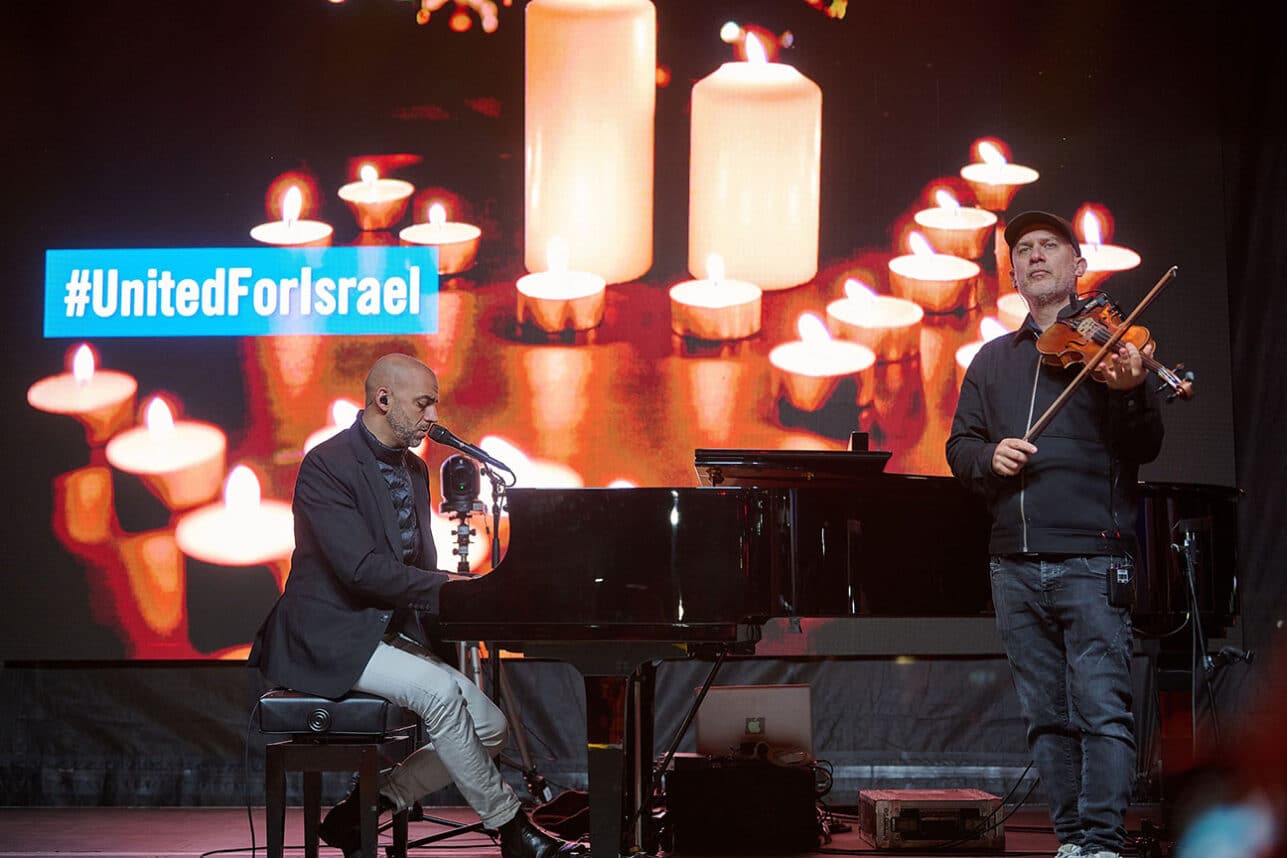
Israeli star Idan Raichel performed his hit “Mimamakim” while Gad Elbaz performed several songs and flawlessly belted out high notes despite the chilly weather.

Idan Raichel performs at the rally. Photo by Perry Bindelglass/JCRC

Gilad Erdan, Israel’s ambassador to the United Nations, said students who support Hamas should be expelled and professors who do so should be fired

Israel has the power to defend itself, he said, While it is 2023 and not 1943, Erdan said he is aware there is rampant Jew-hatred.

“Before we could even bury our dead we saw millions around the world rejoicing,” he said.

 Justice will be served.

“Talk is cheap, but Jewish blood isn’t.”

Schumer, Gold, Messing and Relatives of Hostages Speak to 10,000 at New York Rally Read More »

Burning in the Hearts of Be’eri

This story is about the experiences of several families whose lives were turned inside out one beautiful but terrible morning, October 7, 2023, by an event that would change not only their community but their entire country, the State of Israel.

Early that morning, 3,000 members of Hamas and allied terrorist groups penetrated Israeli towns and villages along the Gaza Strip border. Approximately 70 Hamas gunmen descended upon Kibbutz Be’eri, methodically moving from house to house and targeting entire families. The assailants executed parents in front of their children and children in front of their parents, ignited homes with families still inside, and seized hostages, forcibly taking them back to Gaza. On that day, Hamas abducted over 240 Israelis and foreign nationals; at least 26 of these were from Kibbutz Be’eri.

As we write this story, the Israeli military is investigating the possibility that four individuals believed to have perished at Be’eri may instead be captives. The precise toll and identities of the victims linger in uncertainty, as some remains discovered at the site defy identification.

This documentary narrows its lens to the events of that catastrophic day as experienced by several families. It also acknowledges the anguish of many hundreds more, whose loved ones were slain, kidnapped, or remain unaccounted for since October 7.

What follows is a transcript of the newly released documentary, Burning in the Hearts of Be’eri.

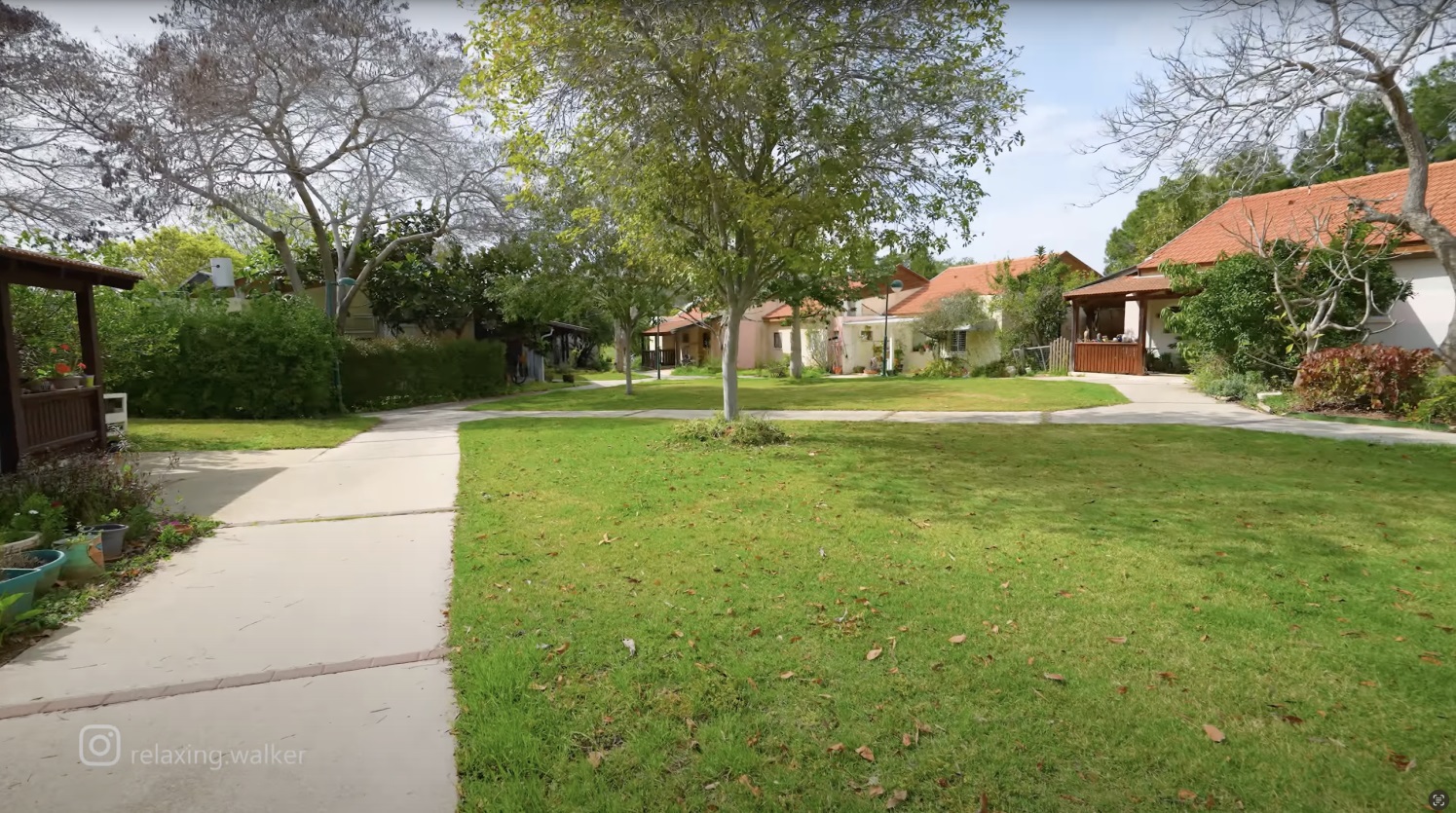
Felice Friedson: They called it a paradise on the border of Israel, they felt safe and at home with generations of family.

Kibbutz Be’eri … like a paradise. (Courtesy)

Thomas Hand: It was a great place to bring up your children. To live. To work. It was a perfect world. It was a bubble of safety.

Dalia Weissman: It was a kibbutz, like you were walking in paradise.

Like walking in paradise… Kibbutz Be’eri. (Courtesy)

Ella Ben Ami: We are a very strong community. We are like a big, big family. I love the community.

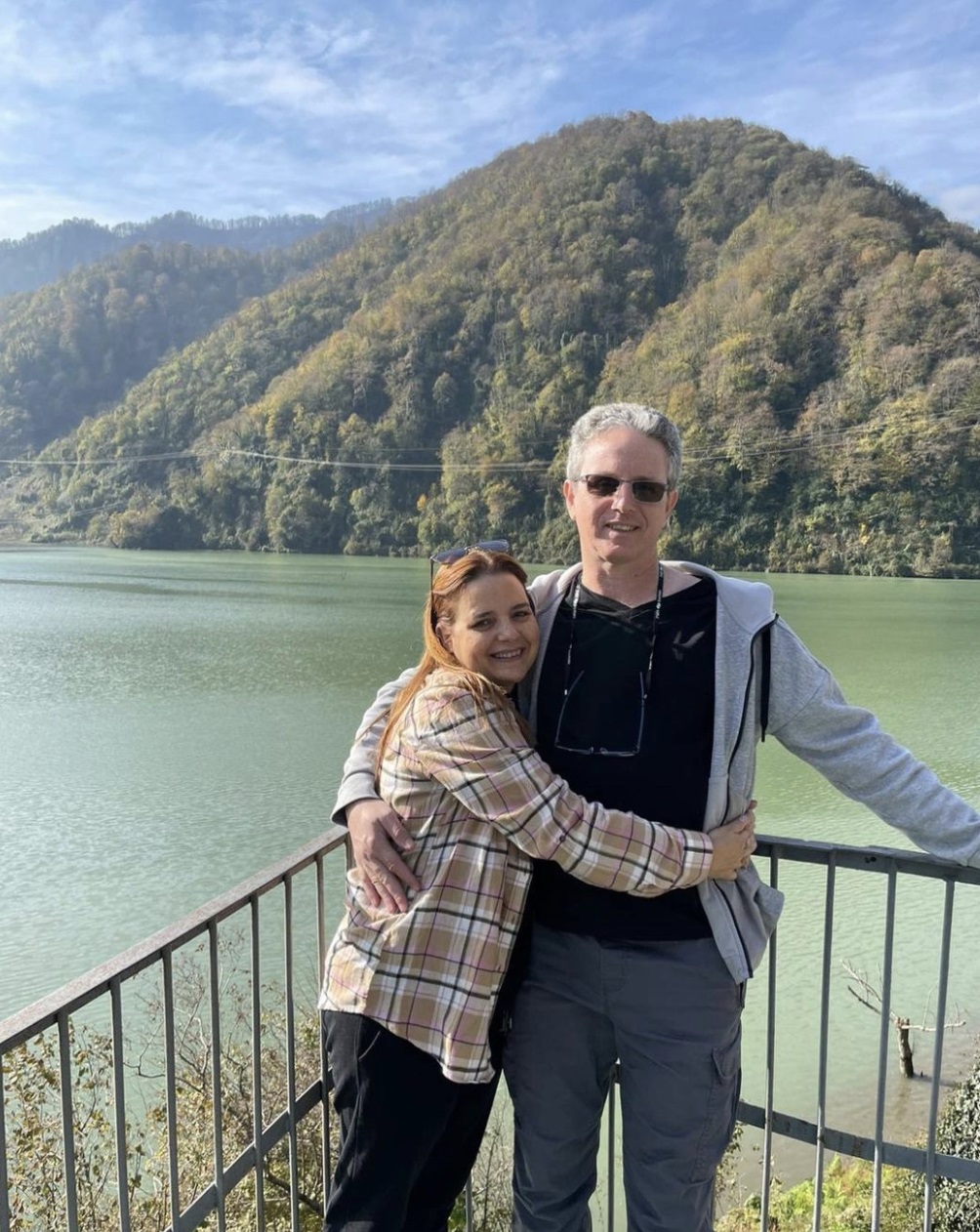
Nira Herman Sharabi: I want my husband, and I want my Ofir, my daughter’s boyfriend, I want Amit, the son of my neighbor, I want everybody to come back home.

Yossi Sharabi, abducted to Gaza, with wife Nira and their family. (Courtesy)

Thomas Hand: I can live with the grief of her being dead. I couldn’t have lived with the mental torture of what torture and conditions she would have been going through.

Emily Hand, daughter of Thomas Hand, murdered. (Courtesy)

Gal Cohen: We go from funeral to funeral, sometimes seven a day.

Ella Ben Ami: We just sat there and waited for death, or that someone would come and save us.

Felice Friedson: Thousands of Hamas terrorists infiltrated the Gaza border, which lies along this community, which was hardest hit. It’s Kibbutz Be’eri, where more than 100 people were murdered. Only a little over 1,000 people are residents here. Take a look at this home, which was destroyed. It was attacked by fire, and a family’s table here was set ready for a holiday. It was a Sabbath and a Jewish holiday as well.

And look out here, and you see blown-out windows and someone placed an Israeli flag, but the whole community has been devasted like this. Some worse than others. It’s a sight that I think that the world is trying to absorb, where you see many families had not just been burned alive, but they were stabbed, they were tortured, they were raped.

It was one of the most devastating moments in the history of Israel.

Rami Gold has been a kibbutz member for 35 years and used to be on the emergency squad until the army decided he was too old to be responsible for a rifle. Attentive to sirens, Rami called to see what was happening and was told to come over. He rode on his bike, not knowing Hamas was there, and half of the squad was disabled. He was there for 12 hours until the army came.

Rami Gold: Now we are in grief burying people by the hour. I don’t think we fully understand ourselves.

Look, you have to understand, the defenses you see in back of you, a lineup of machine guns on them like ISIS. They were shooting at the fence while they were driving towards the entrance of the kibbutz. Once they got in they started blowing up everything in sight, and every team of them knew where they were going. Everybody is either dead or displaced.

When they came out, not all of them had weapons, so they used knives, axes, hammers. They killed everything in sight. My neighbor, a woman with a baby in her arms, was shot through her baby. She’s alive, but what kind of life is she going to have without the baby in her arms?

She lost her husband and another son.

Ella Ben Ami: At 6:30 in the morning, we heard a lot of bombs. We didn’t know what it was, but it is usual. It happens all the time. And we thought it was something usual.

Gal Cohen: It was something different. I could feel right away that it was something very, very massive.

And I saw these two guys dressed up really [thoroughly] and the green thing, the green bandana that Hamas wears, and I realized immediately that was the thing, and I called the security team.

Thomas Hand: Once I realized that the situation was bad, I could hear gunshots all around getting closer, now I shut the door [of the safe room]. I locked the Mamad [safe room] door as far as I knew. We never tested it.

Nira Herman Sharabi: We called to our daughter. She was with her boyfriend. She’s 17 years old and her boyfriend was there for the weekend. And we called everybody to come out from the rooms and another girl, and we went to the safe room.

After something like half an hour, it was something like [that], we started to hear some Arabic around us and shouting.

Thomas Hand: The local WhatsApp groups and stuff, you’re reading every couple of minutes, there’s terrorists in my house, there’s terrorists breaking into my Mamad, my bomb shelter, where’s the army? Where’s the army? Where’s the army?

Nira Herman Sharabi: And after a few minutes, you start to read messages like they shot my mom. They shot my brother. Please, someone, come here! Someone came to see us. What’s going [on]? Where is the army? Where is someone to save us? A lot of messages going around.

Gal Cohen: We tried to lock the shelter and we couldn’t lock the shelter, so I grabbed a knife. I said at least I’ll take one.

Ella Ben Ami: My dad wrote to me on WhatsApp, that they heard, my mom and my dad, a lot of terrorists outside the house.

He wrote to me at 9:30 that they [the terrorists] are inside their house. And there are a lot of them and they are going upstairs and they are breaking stuff, they are breaking the door, and they are doing a lot of mess. And then, half an hour later, at 10:07, my dad wrote me that they were inside the shelter.

I saw a picture of my father an hour later on Telegram with two terrorists that are holding him and he is in boxers and barefoot and I heard from him … nothing.

Ella Ben Ami’s parents, Raz and Ohad Ben Ami, abducted in Gaza. (Courtesy)

Dalia Weissman: She wrote me that she is hearing many, many bombs and she is hearing “[Allahu] al-Akbar” and she asked me, “Mommy, where are the army? They’re not here?”

Gal Cohen: If they knock on the door and you don’t come out, they will burn the house and then you’ll get choked with smoke and then jump from the window, and then they will shoot you.

Nira Herman Sharabi: And they came. We heard them going up the stairs and breaking the door in the house, and just going around the house, like, talking and laughing and opening places. And it was just a matter of time that they would come to our safe room.

And we saw them trying to open [the door]. We have a dog also in our safe room. A small dog. He didn’t do harm to anybody. And they just opened the door, and suddenly three terrorists go to our safe room with weapons [drawn]. They shoot the dog. At the beginning, they shoot the dog. And me and my husband, we just did like this. We held up our hands and said, “Please don’t hurt us! We didn’t do anything. Don’t hurt us!”

And they just spoke in Arabic and they told us, “Do you have a gun? Do you have something?” And we told them, “No. No. We don’t have anything there.”

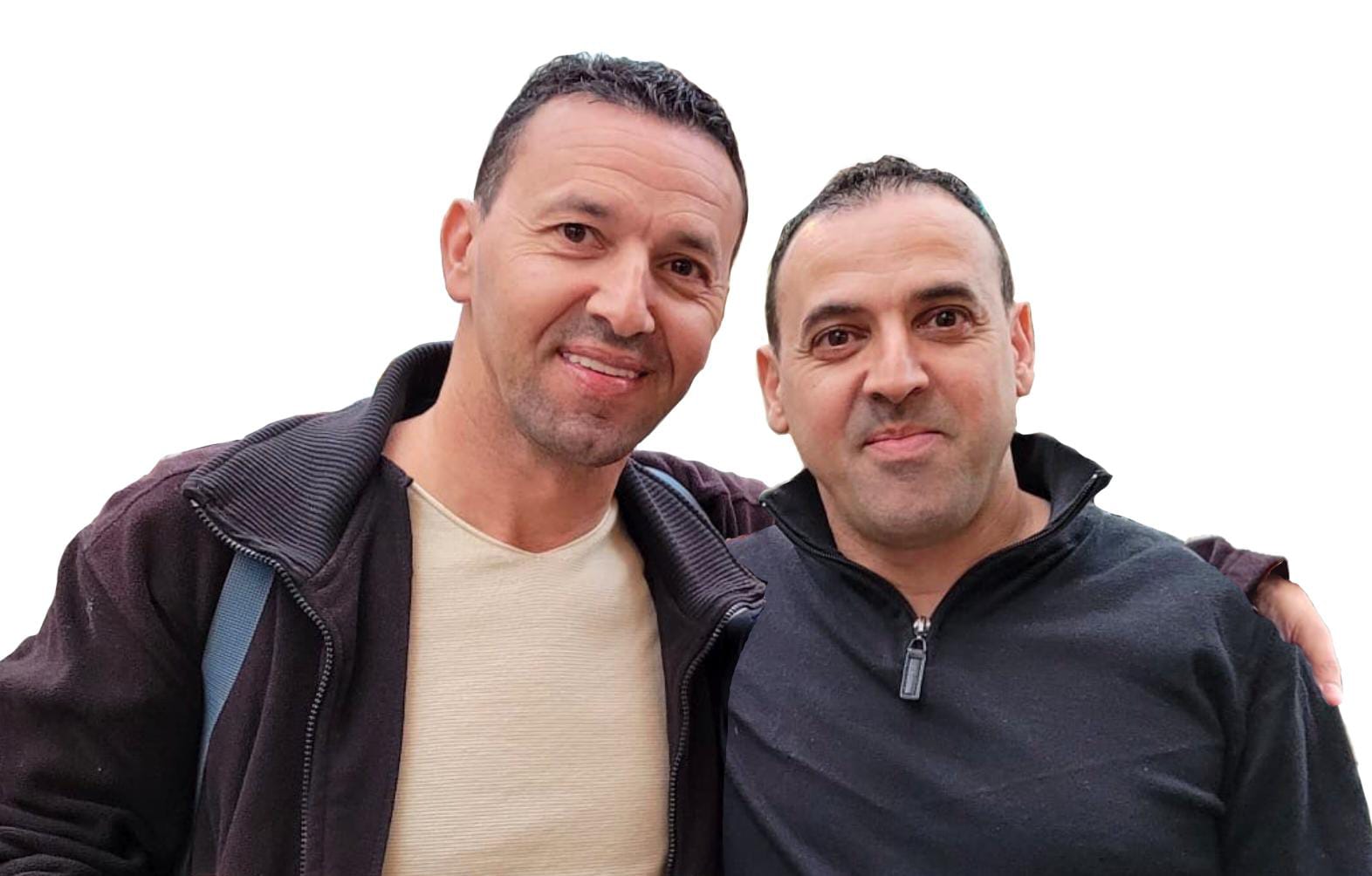
Brothers Yossi and Eli Sharabi, both abducted to Gaza. (Courtesy)

Thomas Hand: I knew that I’d have been overpowered, but that was my best chance. So, for 14, 15, 16 hours, time is sort of irrelevant, I just sat by the window. I couldn’t go to the toilet. I couldn’t eat. My sink in the kitchen is just there, but I’d turn around just to have a drink of water.

I couldn’t protect my daughter. She was at her friend’s house.

Nira Herman Sharabi: They took us from the house, and they brought us downstairs to the garden. They took our phones with their weapons [aimed at us]. All three terrorists. They were dressed in black with the whole package and everything. And they let us sit in the garden.

There was another mother, my neighbor with her three kids. It was a teenager, and Amit, who was kidnapped with my husband. And Ofir, the boyfriend of my daughter. And the two daughters were sitting there. And they let us sit there. And they took pictures, a selfie, you know, to spread it all around. And they just took the flag. We had a flag of Israel down in the house, and they just ripped it and they started to smash it. And they start to yell in Arabic, “Down with Israel! This is Palestine! This is not Israel! Israel does not exist! Kill all the Jews!”

And they told us to get up and they moved us to a point of a road, and there was a small car waiting there and two of the terrorists came with their weapons and talked to Yossi, my husband, and to Ofir, my daughter’s boyfriend. And to Amit. They told them to go inside the car.

Ofir Engel, abducted to Gaza. (Courtesy)

Dalia Weissman: He was shouting when they took him, and he told her, “Mommy, be quiet. They will kill us!” And then he was like this and they tied his hands [behind his back] and he went to the car. And he said, “It will be OK,” to my daughter. “It will be OK.” And then he went.

Amit Shani, grandson of Dalia Weissman, abducted to Gaza. (Courtesy)

Thomas Hand: I rang Narkis, my ex-wife. I rang Narkis and told her, get in your Mamad, lock the door, if you hear terrorists in your house, hold the handle locked, because again, I don’t know if it was properly safe. Wedge your shoulder against the door frame and hold on as long as you can.

Narkis Hand, ex-wife of Thomas Hand, murdered. (Courtesy)

Nira Herman Sharabi: All of this time you hear shooting and shooting and bombs and fire everywhere around. And smoke. And black smoke. You know, a lot of terrorists are running all around, dressed in black.

Thomas Hand: The closer you live to the road, the harder you are going to be hit, because they came in on transport so they’d stop and go through the line.

Nira Herman Sharabi: So, we’ve been in another room in the house. We just lay down there, everybody on the floor.

My daughter was telling me very quietly, Mom, I love you so much.

Everybody touched everybody [else] so nobody is going to miss everybody. And sometime around 4:30 or 5 o’clock [pm], because we didn’t have a watch, we didn’t have phones, we heard the Hebrew soldiers fighting and shooting with the terrorists.

Thomas Hand: Later on, that night, the army came finally and saved us and saved our neighborhood. Most of us got out, and I didn’t know anything about my ex-wife. I didn’t know anything about my daughter until three days later. Members of the kibbutz told me that they found Emily. They found Emily in the kibbutz, and they found her dead.

Nira Herman Sharabi: We get up and say, “Please don’t shoot at us! Please don’t shoot at us! We are Israelis.”

And I saw them and I can’t believe it and I’m crying. And everybody is crying. And these angels, our soldiers, are just looking around behind the window and they told us, we are just soldiers. Don’t worry. We came to save you.

Ella Ben Ami: Maybe at 9 [pm] my friend called me and said, I’m with a lot of soldiers outside your apartments, come out. We are going out of the kibbutz. So I went out with my partner and the kibbutz was not what we knew. I didn’t know the kibbutz, all the houses were burned to the ground, and a lot of dead bodies were on the floor.

Gal Cohen: Some of my best friends got slaughtered there, and I couldn’t do a bloody thing.

Nira Herman Sharabi: They told us to cover our eyes, but I couldn’t, so I looked around and saw the road. A lot of bodies. A lot of blood there, all around. And one of the kids said, “Mom, what is this?” And the soldiers said, “No. No. No. Don’t worry. It’s a terrorist. It’s none of us.” But we don’t really know if it was our citizens or if it was the soldiers or the terrorists that were there.

Idan Herman, nephew of Nira Herman Sharabi, murdered. (Courtesy)

Gal Cohen: You see the kids that stay with no parents, and they cry and tell you the story, how they shot their brother, and how the father [lost] a lot of blood and didn’t move and didn’t talk.

Ella Ben Ami: All of them with black on their faces from the burning from the fire. And actually, me and my sister look all over the people and look for our parents or family. And there was nothing, they weren’t there.

Felice Friedson: Once the army arrived, many of the families had minutes to collect a few items and depart the kibbutz for safety or medical assistance.

Thomas Hand: The army came in and said, you have a minute to grab your stuff and get out. It was under heavy gunfire as well.

Felice Friedson: Twenty-nine members of Kibbutz Be’eri were taken hostage, four are still unaccounted for, and more than 100 are dead. Among them are the relatives of Nira Herman Sharabi, Ella Ella Ben Ami, Dahlia Weissman, and Thomas Hand.

Thomas Hand: She was a beautiful little girl. A sweet, innocent angel. She absolutely loved life, even though at the age of 2 and a half she lost her mother to breast cancer.

Felice Friedson: What do you think happened in terms of an intelligence breach that day?

Gal Cohen: I wish I knew. I don’t know because the way it happened is not a script that we ever thought would happen, for so many hours to wait in the shelter with nobody coming to help. It’s something nobody, you, ever dreamed.

Ella Ben Ami: It’s very hard here because every family lost somebody. There isn’t a family that isn’t lost. And we all lost together.

The most important thing to me is that my mom will get her medicines or medications because if she does not get them, even if they don’t shoot her or do something to her, she will not survive.

Felice Friedson: So many questions remain unanswered. The deep scars that will stay with these families and the entire nation of Israel, where these families will live, if their loved ones being held hostages will come back home, and ultimately, how did October 7th ever happen?

Ella Ben Ami: I love Be’eri. It’s my home. I will build it with my own hands if needed. I will live in Be’eri, but with my parents and with no threat from anybody because it’s my home. It’s my safe place.

Dalia Weissman: He’s coming back home, I am sure.

Felice Friedson: The survivors of the massacre in Be’eri are now residing in hotels throughout the country. Looking into the eyes, seeing the tears, and feeling the hugs of this close-knit kibbutz community. They are determined to rebuild and stick together. Life will never be the same for any of the members of Kibbutz Be’eri and all those who lost dear ones on that very black day.

Dalia Weissman: The 7th of October, for me and my family, it’s something very, very big is broken. We don’t believe anymore. We understand that we can’t be neighbors. We can’t be friends. They are not thinking like us. We saw something else. We don’t understand how they think. We don’t understand anything, and this will not be again.

Ella Ben Ami: Right now, I don’t know who is involved and who is not involved and it’s very confusing and terrifying to know that there is a war between us.

Dalia Weissman: The world must understand this. Today it’s here. Tomorrow it will be maybe in another country. Terrorists must be wiped out. Absolutely! They are not human beings.

Felice Friedson: Behind me are candles that are lit in the memory of many of their loved ones who will never come back. Many of them are waiting to hear if their loved ones were murdered or are being held hostage in Gaza. Their lives have been turned upside down, and they do not know where they are going.

From The David Hotel at the Dead Sea, Felice Friedson with Debbie Mohnblatt reporting for The Media Line.

Dario Sanchez contributed to this report. 

To read more articles from The Media Line, click here.

Burning in the Hearts of Be’eri Read More »

Jen on a Jet Plane: Journeying Beyond Borders

I loved interviewing Jen Ruiz, Jen on a Jet Plane, to learn more about her as an accomplished travel content creator, author, and lawyer. Jen has dedicated her life to exploring the far corners of the globe, uncovering hidden gems, and sharing invaluable travel tips with her audience. Her insatiable passion for adventure has taken her around the world, and she is a true authority on all things travel. Get ready to be inspired, as we embark on an unforgettable journey with Jen, unraveling her remarkable tales and learning about her portfolio of projects.

Listen or watch our interview on SpotifyApple PodcastsYouTube or your favorite podcast platform

TRANSCRIPT from our interview below: (filmed 19 July 2023) Lisa Niver: Good morning. This is Lisa Niver, founder of We Said Go Travel and author of Brave-ish, One Breakup, Six Continents and Feeling Fearless after 50. I am so honored and excited to be here with Jen. Hi Jen. Jen Ruiz: Hi Lisa. Thank you for having me. Lisa Niver: I loved hearing you speak at Women’s Travel Fest, and I know everybody there in New York was so excited to learn from you. And, the accolades just never stop. You have the TED Talk, Amazon top bestselling books, and you have a brand new project! Congratulations. Jen Ruiz: Thank you very much. I work hard.
https://www.tiktok.com/@jenonajetplane/video/6815680240900263173
Lisa Niver: You do work very hard and I loved watching your TED talk and we’ll put it in the notes if people want to have the opportunity to learn from your brilliance. My book has 50 challenges before I turned 50. Many people talk to me about ageism and how we represent older women. You’re talking about being 29, turning 30, and the stereotypes of the box of “this is what women must do.” Talk about your TED Talk and 29 turning 30 and what inspired your life of being on the road. Jen Ruiz: Absolutely. So for me, it was very much a pressure because I’ve always been an overachiever. It’s just been a lifelong thing for me. Turning 30, which is a big milestone birthday, I feel like it’s the first milestone birthday where the birthday matters not in an eager way, but in an anxious way. Because at 10, you’re not realizing it. At 20, you’re wanting to get to 21 so you can drink, but 30 becomes the point where you’re like, oh man, it’s getting real. Now, I’m an adult and there are things that are expected of me. Am I where I want to be in life? It’s where you really start reckoning with yourself. And as a woman particularly, as a single woman, who was very successful in her career. I had already started getting a lot of comments about why I wasn’t married, why I didn’t have children, if I was at all worried about my clock stopping, being able to have healthy children, having geriatric pregnancies. READ THE FULL INTERVIEW on We Said Go Travel

LISTEN on APPLE PODCASTMAKE YOUR OWN MAP

Jen on a Jet Plane: Journeying Beyond Borders Read More »

Ventura County Sheriff: “Conflicting” Information on Altercation That Killed Paul Kessler

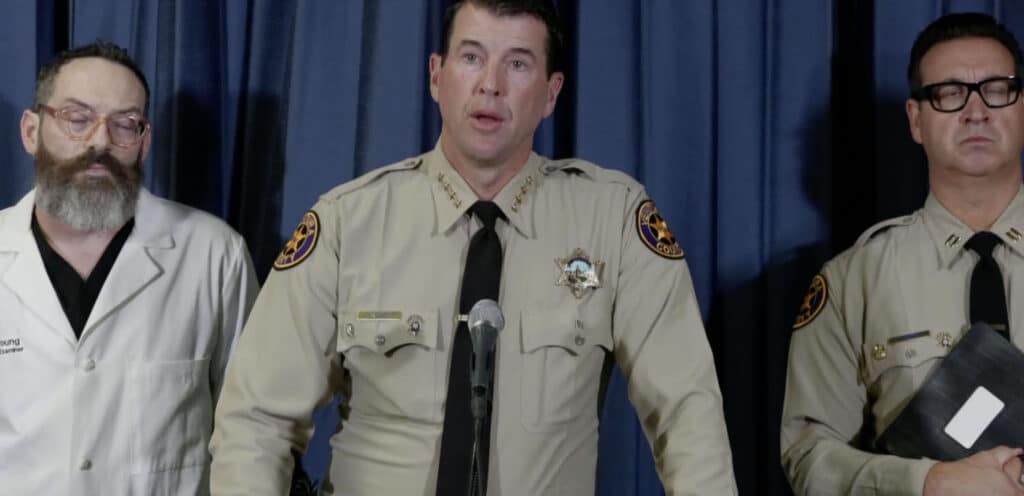
Ventura County Sheriff Jim Fryhoff said in a press conference on Tuesday morning that there is “conflicting” information on the exact nature of the altercation with a pro-Palestinian protester on Sunday that led to the death of a 69-year-old Jewish man Paul Kessler.

Fryhoff said that at around 3:20 pm on Sunday, the sheriff’s office receival several calls of an assault and unconscious man bleeding that was “related to a rally or demonstration that was occurring.” Flyers showed that a pro-Palestinian protest and pro-Israel counterprotest was occurring at the intersection of Westlake Boulevard and Thousand Oaks Boulevard. Officers arrived the scene a couple of minutes later, where they found Kessler, who had been protesting in support of Israel, was lying on the ground, conscious and responsive. Kessler was “bleeding on the head and mouth,” Fryhoff said.

The suspect, who Fryhoff said is a 50-year-old man from Moorpark and a pro-Palestinian protester, remained at the scene and was interviewed by deputies. The suspect admitted to being a part of the altercation and was one of the people who called 911. Fryhoff said that several witnesses were interviewed about the confrontation and they “provided conflicting statements” as to what exactly happened and how it started. Kessler “fell backward and hit his head on the ground,” Fryhoff said, but it was unclear what led up to that moment.

Police obtained a search warrant for the suspect’s home, and the suspect was detained while they searched the home, but the suspect was later released, according to Fryhoff. Fryhoff said that the suspect has been cooperative with law enforcement. No arrests have been made yet and the investigation remains ongoing. Police have not yet ruled out a hate crime or the possibility of other suspects, per Fryhoff.

Ventura County Medical Examiner Dr. Christopher Young said during the press conference that the investigation  into Kessler’s death remains ongoing and that Kessler succumbed to his injuries at around 1:10 a.m. on Monday. Kessler had nonlethal injuries on the left side of his face and additional injuries to the back of the head that Young said are “typical of injuries sustained from a fall.” Young confirmed that the injury to the back of the head was the lethal injury that ultimately killed Kessler. CT scans at the hospital revealed that Kessler had intercranial injuries including swelling and hemorrhaging of the brain.

“Cause of death has been certified as blunt force head trauma,” Young said. “The manner of death is homicide.” However, Young clarified that the medical conclusion that the cause of death was homicide “does not indicate that a crime has been committed,” as that is for the District Attorney’s Office to decide. A “homicide” simply means that “the actions of another person” contributed to the death, Young said.

Fryhoff later said that it is currently unclear how exactly Kessler and the suspect interacted before Kessler hit his head. The police currently don’t know if a “blow to the face” is what caused the fall. Addressing claims that Kessler was bludgeoned to death with a megaphone, Fryhoff said the police don’t have any information whether they recovered a megaphone from the suspect; however, Fryhoff did say that the medical examiner’s office has acknowledged the possibility that the injuries to Kessler’s face “could have been caused by a megaphone.” But Fryhoff said they don’t have any further information on that. Police also don’t have any information on if Kessler and the suspect had any prior interactions before Sunday.

Fifteen minutes prior to the altercation, Fryhoff said that the Thousand Oaks police chief drove through the area and saw 30 people there and nothing to indicate that violence was about to occur; police had been driving by the area periodically to keep tabs on the protest. Both organizations behind the protests had posted to social media beforehand encouraging people to remain peace, according to Fryhoff.

Fryhoff asked for the public’s help in providing further information that could bring more clarity to what happened during the altercation. “We urge you to remain calm and peaceful and patient,” he said. He also vowed that the sheriff’s office would bring the people responsible to “justice” if they discover “criminal wrongdoing.”

This is a developing story. We will update as we hear more.

Ventura County Sheriff: “Conflicting” Information on Altercation That Killed Paul Kessler Read More »

Brandeis Center Says Harvard Celebrated Prof Who “Marginalized” Jewish Israeli Students

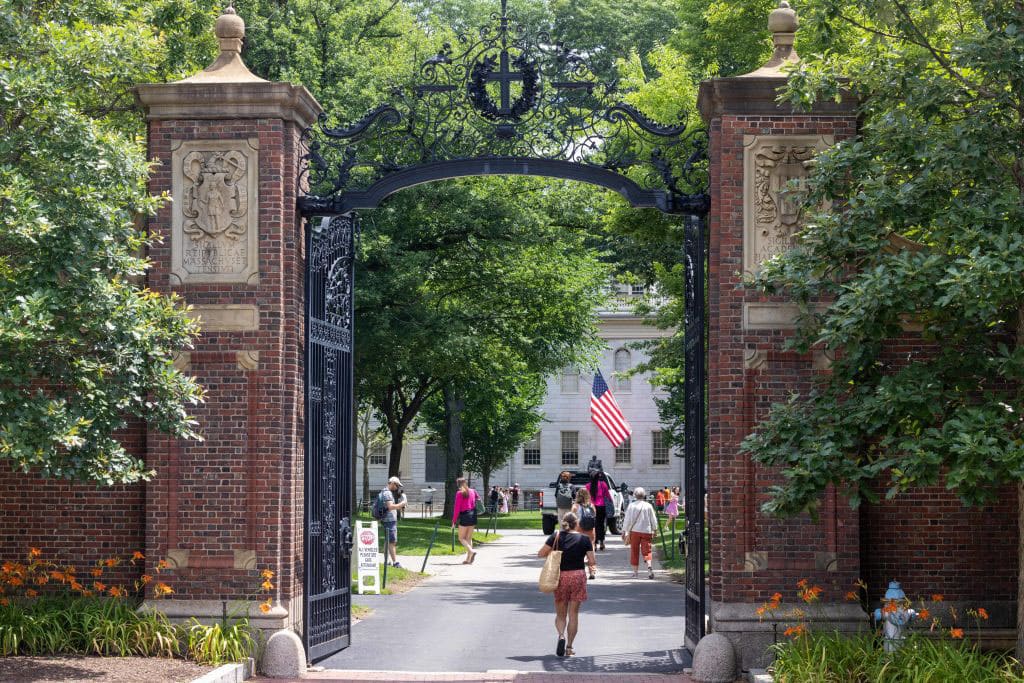
The Louis D. Brandeis Center for Human Rights Under Law is alleging that Harvard University is celebrating a professor who “marginalized and belittled” three Jewish Israeli students for referring to Israel as a “Jewish democracy” in their group project.

According to documents obtained by the Journal, the Brandeis Center sent a letter to the university in March alleging that earlier that month, Professor Marshall Ganz, who is Jewish, called the three students into his office, asking them to remove any mention of Israel being a “liberal Jewish democracy” from their project. The three students’ project was a plan to “unite a majority of diverse and moderate Israelis to strengthen Israel’s liberal and Jewish democracy.” The students initially attempted to rephrase it to say, “liberal democracy in the Jewish homeland,” but Ganz also disapproved of this description. The professor specifically took issue with the use of the words “Jewish state” to describe Israel, which he said was analogous to describing the United States as a white supremacist, the Brandeis Center alleged.

Ganz later emailed the three students to tell them that it was unacceptable for the students to describe Israel as a “liberal Jewish democracy,” stating that a lot of the students in the class found such a description for Israel “deeply offensive.” The three students explained how they viewed Ganz’s words as demeaning because to “many Israelis like us, the idea of Jewish democracy is not just an idea. It is deeply woven within our identities as Israelis and as Jews” and that they are essentially being told to “forego opportunities available to all the other students in the class.” Ganz replied by warning them of “consequences.”

The three students did present their work to “a small working group” and “received universal praise,” the Brandeis Center documents state, but Ganz did not select their project to be presented in front of the entire class. Instead, he directed his teaching fellows to lead a discussion session on “Palestinian solidarity.” During this session, an anti-Israel student blamed every Israeli for Palestinian riots in the West Bank city of Huwara, where she said a Palestinian was killed after providing aid to earthquake victims in Turkey. The anti-Israel student, the Brandeis Center alleged, “invited the other students and teaching staff to demonstrate support for Palestinians suffering at the hands of Israelis by posing for a class picture wearing keffiyehs (a traditional Middle Eastern scarf/headdress often worn to demonstrate Palestinian solidarity). The picture was taken at the end of the class, with many students and TFs wearing the keffiyehs provided by the student, who had brought them with her to class, suggesting she was aware ahead of time how events would unfold.”

After class, the three students asked Ganz if they could have the opportunity in class to respond to the anti-Israel student; at this point, Ganz angrily replied that the three students “caused enough problems already” and would need to make their case elsewhere.

Documents from the Brandeis Center further show that in June, Harvard Kennedy School Dean Douglas Elmendorf accepted the findings of a third-party investigator who concluded that Ganz “more likely than not” engaged in behavior that violated the school’s free speech and anti-bias policies. And then, on October 30, the Brandeis Center argued in a letter to the university that Harvard has not taken requisite action since June; while Elmendorf did issue an apology to the three students for Ganz’s behavior and said that personnel decisions would be made, the Brandeis Center noted that the university has not issued a public statement on the matter. Additionally, the Brandeis Center pointed out that Ganz was recently lauded for his civil rights work in the most recent issue of the Harvard Gazette.

“The professor’s work on behalf of minorities in the sixties may be admirable, but publicly featuring him in this fashion, mere months after he was found to have created a hostile environment for his students, suggest the pledge made to the Students that the university would fully address the violations were mere empty words,” the Brandeis Center wrote. “Harvard, it seems, has no genuine intent to address the anti-Semitism on its campus, choosing instead to publicly celebrate a professor who recently subjected Jewish and Israeli students to bias and discrimination.”

They concluded the letter by urging the university to issue a public statement and implement training for the campus community “so that they are able to recognize anti-Semitism.”

“Harvard leadership has allowed its campus to run amuck with anti-Semitism for far too long,” Brandeis Center Founder and Chairman Kenneth Marcus said in a statement. “This outrageous, irresponsible and illegal failure of Harvard’s administration to address even undisputed anti-Semitism has paved the way for the problems they are now facing. It is high time the university provides the leadership it is required under the law.”

A spokesperson from the Harvard Kennedy School said in a statement to the Journal, “Harvard Kennedy School takes any allegation of bias or discrimination very seriously. In this case, the School brought in an experienced outside fact-finder to determine what happened and to consider the facts in the context of the School’s and Harvard University’s policies. Dean Douglas Elmendorf accepted the findings and took action responsive to the allegation. The School does not disclose the details of personnel issues.”

The spokesperson added: “Dean Elmendorf joins Harvard President Claudine Gay in rejecting hate in all forms, including antisemitism and Islamophobia. As does all of Harvard, the Kennedy School stands for free expression and academic freedom while standing firmly against any form of discrimination.”

Ganz did not respond to the Journal’s requests for comment.

Brandeis Center Says Harvard Celebrated Prof Who “Marginalized” Jewish Israeli Students Read More »