
fbpx

October 22, 2023

Gaza—Where the Moral Math of Revenge Has No Equal

Take out your calculators. While you’re at it, a set of blinders, too. Israel’s imminent Gaza campaign is going to get ugly. If you’ve been paying close attention, the moral and mathematical problem has already been revealed.

More Palestinian civilians undoubtedly will be killed in the latest chapter of this ongoing war between Israel, a democratic nation, and Hamas, a brutal terrorist entity. The word “de-escalate” was uttered by progressives even before Israel began to retaliate. “Ceasefire” was the operative word on American college campuses this week, along with “Intifada!”—words otherwise irreconcilable in their meanings.

Very soon the IDF will accelerate its Hamas manhunt. Going house-to-house will invariably include collateral damage. There will be calls for Israel to exercise “restraint.” Another phrase will enter the national conversation: “proportionate response.” Is the death toll lopsided with a far larger Palestinian body count?

All these words mean the same thing: “Israel, put down your weapons. You are disqualified from getting justice for the biggest massacre of Jews since the Holocaust. A terrorist can’t be touched if it might result in a civilian death.”

No other nation, most especially the United States, with its atomic payload over two Japanese cities, the bombing of Dresden, Germany and Vietnamese villages, its post-9/11War on Terror against the Taliban and al-Qaeda, and Allied Coalition Forces removing ISIS from Mosul, has ever been held to such an exacting standard of precision while responding in self-defense.

I know about this topic. During Israel’s last war with Gaza in 2014, I wrote what became a widely decried Op-Ed in the Wall Street Journal, in which I examined the crazy-making moral position Israel finds itself in.

That dilemma in Gaza is present, still.

“An eye for an eye,” found in the Old Testament, along with Hammurabi’s Code, is often mistaken for blood vengeance when, in fact, it’s a call for proportionate justice. The loss of an eye creates a debt for the repayment of the wrongdoer’s eye—no less, and no more.

Vengeance and justice are really the same. Too much of the former is unjust, but there is no justice if victims are not made to feel vindicated. That’s why the language of revenge is always framed in mathematical terms: “measure for measure,” “settling the score,” “evening the debt,” “demanding payback.”

It is the handiwork of CPAs, not lawless vigilantes. It has worked all throughout the world to keep the peace long before courtrooms were introduced to resolve disputes.

This kind of rational, proportionate revenge fails in the context of warfare, however. Measurements are invariably inexact—the nearly 3,000 murdered on 9/11 were surely dwarfed by the number of dead Iraqis and Afghanis. Got a problem with that? Should the War on Terror have come to an end when we killed 3,000, or the moment Osama bin-Laden was assassinated? Most Americans would not have felt satisfied, I suspect.

These disparities in body count are especially present in Fourth Generation Warfare, where enemy combatants wear no uniforms, hide behind civilians, and shirk the laws of war. Exploiting these asymmetries is Hamas’ specialty.

For nearly 20 years, Hamas has launched tens of thousands of rockets at Israel. Fortunately, most either landed harmlessly or detonated in the sky courtesy of Iron Dome. Until October 7, relatively few Israelis were killed by Hamas. Does proportionality require Israel to not deploy its missile defense system so it can achieve a more balanced body count of dead Jews?

Hamas is seeking the annihilation of all Jewry. Should their intent not matter simply because, in the past, their aim was off?

Making matters worse is that Hamas chooses to fight Israel on a battlefield that looks exactly like its home turf—because that’s what it is: A war inside the homes of its fellow citizens, or in mosques, hospitals, and schools. Because Hamas places no value on human life—whether it be Jewish or Muslim—it regards this theater of war as a home court advantage. The rules of engagement are discarded in favor of a civilian death strategy that culminates in the global condemnation of Israel.

What this all means is that Gazan civilians are going to die—and a lot them. But the Geneva Convention, which prohibits the targeting of civilians, was not written with Gaza in mind—both the necessity of urban warfare, and a complicit civilian population that offers homes as command centers and children as human shields. The parents are civilians, of course, but are they “innocent”? Remember, Hamas was democratically elected. Gazans saw Hamas’ genocidal campaign platform, and cast their ballots accordingly.

Hamas knows the West suffers from short-term memory lapses. The Iran Hostage Crisis? 9/11? Munich Olympics’ Massacre? London Subway Bombing? Boston Marathon Bombing?

Ring a bell, anyone?

Hamas also knows that the West faints at the first sight of blood. The New York Times, MSNBC and BBC view dead Palestinian children as Pulitzer Prize-worthy material. Dead Israeli children merit not even a footnote.

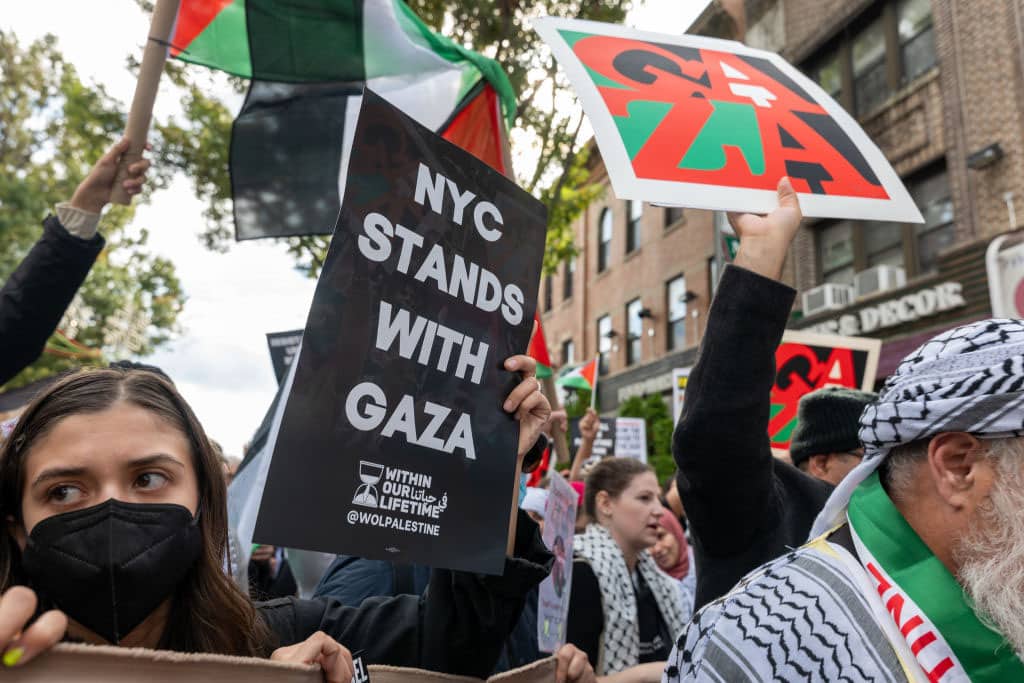
Public sentiment is worsening each day—especially on the Arab street, which, as Europeans have come to learn, gravitated to their streets—replete with death chants and flag burning. Until last week, Americans didn’t realize how much Muslims enjoy gathering in large mobs and calling for the death of another country and its people. Soon you’ll hear “Death to America!” in Detroit, “Intifada!” in Brooklyn, and the burning of American flags in Pico-Robertson—all protected by the First Amendment, and the protocols of political correctness.

In a less antisemitic world, the evil handiwork of Hamas would have generated enormous sympathy for Israel and a judgment that Hamas is a menace to humankind—like Nazis and ISIS. Instead, we have Jewish students afraid to walk around campus, a female synagogue president fatally stabbed in Detroit, and rallies around the country glorifying Hamas as heroes.

Given the grisly crime scene in southern Israel, justice is an unsolvable equation. When you chop the heads off 40 infants, and gang rape and mutilate scores of teenage girls, there is no equivalency in “eye-for-an-eye” parlance, no precise number for getting even. The proportionate response is infinite.

IDF soldiers are in a war, but more accurately—they are on a mission. Setting anguish and hesitancy aside, they know they must kill all who are responsible for these monstrous crimes. Human shields are tragic, but the world should be denouncing Hamas for using them, not Israel for trying to avoid them. Israel is now justifiably guided by a moral imperative, and they will not be denied.

For those shouting “ceasefire” and “proportionality,” would they prefer to see IDF soldiers getting even by slitting the throats of 40 Palestinian infants, and then raping Palestinian teenagers. Sorry, Jews won’t oblige, and no moral principle in Judaism would excuse it—for any reason.

Besides, the people demanding Israel’s surrender are the very same ones who refuse to even acknowledge the depravity of what Hamas did.

A mammoth debt was created on October 7, and satisfaction is owed. Settling this score won’t be easy. The wrongdoers committed unspeakable acts. Numbers can’t be assigned. In Gaza, the math of revenge will have no equal.


Thane Rosenbaum is a novelist, essayist, law professor and Distinguished University Professor at Touro University, where he directs the Forum on Life, Culture & Society. He is the legal analyst for CBS News Radio. His most recent book is titled “Saving Free Speech … From Itself.” 

Gaza—Where the Moral Math of Revenge Has No Equal Read More »

Karabakh: Flag of Hope, Promise of Peace

31 years ago, as a young adult with my first job out of high school, my life was turned completely upside down in one night. 

My hometown of Khojaly, once idyllic, was destroyed overnight in one of the worst massacres of the century. Some managed to escape the onslaught of Armenian invaders; many perished that night of February 25, 1992, their bodies strewn across the fields and forests they had run through in hopes of escape. 613 unarmed men, women, children, and elderly were murdered in cold blood. 

I was captured. Because I worked for the phone company, the Armenian soldiers assumed I had knowledge of Azerbaijan’s communication systems, and I was tortured for information. I was beaten and abused, degraded in the worst ways imaginable. I only survived when I was traded for cigarettes and gasoline, left on the side of the road and thankfully rescued. I have endured immense pain and multiple surgeries to treat the damage they caused to my young body. 

And despite all I endured, I have spent decades sharing my story of survival and endurance and working with organizations across the globe to spread a message of hope and peace. A great ally in this effort has been leaders and members of the Jewish community, worldwide, and especially in Los Angeles. I remember several years ago, a synagogue in Los Angeles hosted a memorial for the victims of the Khojaly Massacre, a rare example of compassion and collaboration; memorializing the massacre of Muslims in a Jewish space. 

And so despite these immense tragedies and all that has been lost, today I share a glimmer of actual hope, and a sign of a better future for the survivors of Khojaly, and for  survivors of injustice and inhumane war across the world. This week, Azerbaijan’s President, Ilham Aliyev walked through my hometown of Khojaly, where I have been exiled from for over 30 years, and raised the Azerbaijani flag. For so many years, I have longed to return home, and I have waited for the violent occupation of my hometown to end, and for the  entire Karabakh region of Azerbaijan to be free from the invaders. 31 years is a very long time to wait, but witnessing the flag wave in the Karabakh wind, knowing that my home and the home of my friends and family can be returned to now, it makes 31 years feel like a small amount of time. 

Nearly 1 million Azerabaijanis have lived as internally displaced refugees since Armenia invaded and ethnically cleansed the Karabakh region Azerbaijan in the early 1990s. Khojaly, an Azerbaijani-populated town in Karabakh, was one of many occupied towns, but it was also the tragic place of the largest massacre in the conflict, as characterized by Human Rights Watch. It was the place where I spoke my first words, learned to read, grew up with my family and friends – and the place where I saw the worst example of human brutality imaginable. Now I look to the coming  weeks and months, to the rebuilding and revitalization of the many towns across Karabakh that have been liberated, and I feel that absolutely anything is possible. If we can endure and survive such an atrocity and still face tomorrow with a sense of hope and purpose, I believe anything is achievable. 

I believe peace and friendship is obtainable with our Armenian neighbors, with those that have left Karabakh and those who remain. I hope those Armenians who recently left Karabakh will return and live with us peacefully together. 

As the surviving residents of Khojaly, we will now return to our hometown with the uncompromising values of tolerance and acceptance of diversity – qualities that are embedded in our national value system. We will make neighbors and friendships with all peaceful residents of Karabakh; we have all witnessed the power of peace over the calamity of war and hatred, and we know better.  

31 years ago my heart was broken, alongside my back, and the dreams of my youth. But with the support of so many friends and family, with the full support of my countrymen, I have recovered and grown into this day with a renewed sense of hope and purpose. I am grateful to the world and to God that my hometown has  been fully recovered and will be fully restored. 

I pray for this and peace for all of us, Azerbaijani and Armenian alike. I believe that through compassion and kindness, miraculous outcomes can be achieved and friendships can be formed. The Azerbaijani flag waving  in Khojaly after 31 years is one such miracle, and I believe, and hope, there are many more to come. 

Karabakh: Flag of Hope, Promise of Peace Read More »

Why I Went to Israel in Wartime—And Why We All Need to Find Ways to Show Up

I’m in the TSA line at LAX for my flight to Israel when I see the guy in the black tank top. Tall, early twenties, built like a tank, with bulging biceps three times the size of mine. He tells me his name is Kfir. He’s from Rosh HaAyin, east of Tel Aviv.

Kfir recently completed his active duty in the IDF and he’s been traveling around the U.S. Now he’s been called back to serve with his unit.

A couple of decades earlier, that would have been me (minus the biceps). Now I have my own reasons for traveling.

Ever since Simchat Torah, when my family text group started pinging nonstop from loved ones and friends in Israel, my heart has ached like never before. Reading and hearing of the massacre — babies murdered, Holocaust survivors abducted, families gunned down — I felt rage, anger, and despair. And very far away.

Many of the pings on my phone were from a WhatsApp group called “Tzevet Shalosh,” — Team Three, my lifelong brothers from the army. I made Aliyah in the early 2000s and served two years in a paratrooper unit. We fought side by side, visited friends wounded in battle, held each other as we mourned other friends.

Hearing of the pogrom in Israel’s south, I knew immediately that I had to go. Sure, my life is different now. I live in Los Angeles, where I’m one of the rabbis of a large synagogue. I have a wife and children. But my brothers, my family, my people were suffering. I had to go. I had to be at their sides.

It might sound irrational, rushing to a war zone. But I thought of my parents, who traveled to Russia in 1975 to bring hope to Refuseniks, Jews who were struggling to escape to freedom. I thought of Reb Mimi Feigelson, my rabbinical school mentor, who showed up at my door to comfort me just after a close friend died of cancer.

And I thought of my cousin Evi on a kibbutz in the north of Israel, who had no choice but to leave his own wife and kids to head to the border to protect our homeland.

I knew I had to go.

I also knew there were needs. With the IDF calling up hundreds of thousands of reservists on short notice, my colleagues at Sinai Temple had heard pleas for essential supplies: knee pads, flashlights, backpacks. Practically overnight, a remarkable team of volunteers had collected countless donations. Our schools’ students had handwritten hundreds of messages of gratitude and encouragement to IDF soldiers.

I arrive at LAX Sunday morning — just over a week after the attack—with more luggage than I’ve ever checked: Four overstuffed duffel bags and five large boxes of supplies. (Another helper has secured permission from El Al to check them.)

Still, I wonder if I’m doing the right thing, causing worry and anxiety for my wife Amy and our children. Until I met Kfir in the TSA line, and knew I made the right decision.

“Don’t worry, brother,” he says to me in Hebrew. “This war will end quickly.”

As I settle into my seat on the plane, I’m surprised that most of the travelers aren’t returning soldiers like Kfir, but families — parents, grandparents, children. Israelis returning after vacation trips for the Sukkot holiday.

My eyes land on two babies nearby, both around six months old, precious, adorable. I feel a tear stream down my face as I watch them, smiling, happy, safe in their parents’ arms — where they should be.

A few rows back I see Kfir, about to hoist his backpack to the overhead bin. I quickly grab a handful of papers from my own pack and approach him. “Put these in your bag,” I say.

“Ma zeh?” He asks. What is it?

“Letters of support for you and your team,” I say. “From the kids in our community.”

He smiles. “Todah, achi,” Kfir says. Thanks, brother, “I’ll take a bunch.” And he gives me a hug.

Fourteen hours later we arrive at Ben Gurion. It’s 2:30 p.m.  At baggage claim, I’m wondering how I’ll manage all my cargo. A guy with a Russian accent named Igor offers to help — for a small fee.

Unfortunately, a customs officer stops me. Israel’s famous bureaucracy doesn’t pause for war, apparently. Over a couple of hours, I manage with the help of Meir, the cousin of a congregant, who has generously arrived to pick me up with his wife, Eliann.

Somehow we’re able to cram everything into Meir’s compact sedan and hit the road. Waze directs us to the Tel Aviv office where my army friends are collecting and sorting supplies. Just as we’re approaching, we hear the sudden wail of an air-raid siren—a signal of incoming rocket fire.

Meir quickly pulls to the curb and helps me to get out. Everyone around us is running for shelter. We pass a restaurant, then run into a hotel next door. A worker calmly directs us downstairs to a bomb shelter, where we join about three dozen others—hotel guests, other passersby, Israeli-Arab hotel workers.

We wait for a few tense minutes until we hear a loud boom — a rocket being intercepted by Iron Dome. Another few minutes, we hear the all-clear and emerge.

As luck would have it, our destination is just next-door in a two-story office building that normally houses a high-tech firm. I text one of my army friends, and suddenly they appear to greet us: Sahar, Avrami, Manubela. My army brothers. We hug. There are no words.

Just then, Gidon, one of my closest army teammates, pulls up with his own carload of donated supplies.

Together, we haul the boxes and duffels inside, where we’re greeted by others from our unit and dozens of others — all volunteers, most on leave from work while they wait to be called up as reservists.

We’re not on the front lines, but we are all doing what we can. Others in Israel are sending meals or Shabbat challahs to soldiers. Or opening their homes to survivors of the massacre. My cousins Avishag and Tomer, grocers in the Tel Aviv, are sending fruit and vegetables to soldiers.  My brother-in-law is doing a late-night shift as a watchman for his community. I make it my business to connect, to lift their spirits, to let them know that millions of Jews around the world support them.

Less than three days later, I’m back on El Al, on an L.A.-bound flight full of children, many traveling without their parents who have sent them to be with relatives, far from war and terror.

I leave each person I see with the same greeting: Tishmeru al atzmechem. Take care of yourselves. Each friend and relative, the airport security screener, even the flight attendant as I’m exiting at LAX. Take care of yourselves.

But what I learned from my trip — from Kfir and from Meir and from Gidon — is that we all need to take care of each other.  We each need to find a need and fill it. We don’t all need to fly to Israel, but each of us needs to find a way to show up. Our brothers and sisters have never needed us more.


Rabbi Avi Taff is associate rabbi at Sinai Temple.

Why I Went to Israel in Wartime—And Why We All Need to Find Ways to Show Up Read More »