fbpx

October 13, 2023

The Earth Was Filled with Hamas – Lawless Violence – Thoughts on Torah portion B’reisheet


The Earth was Filled with Hamas – Lawless Violence


When people complain about reading the Bible, they often point to the “begots.”  “This one begot that one, and that one begot this one.”


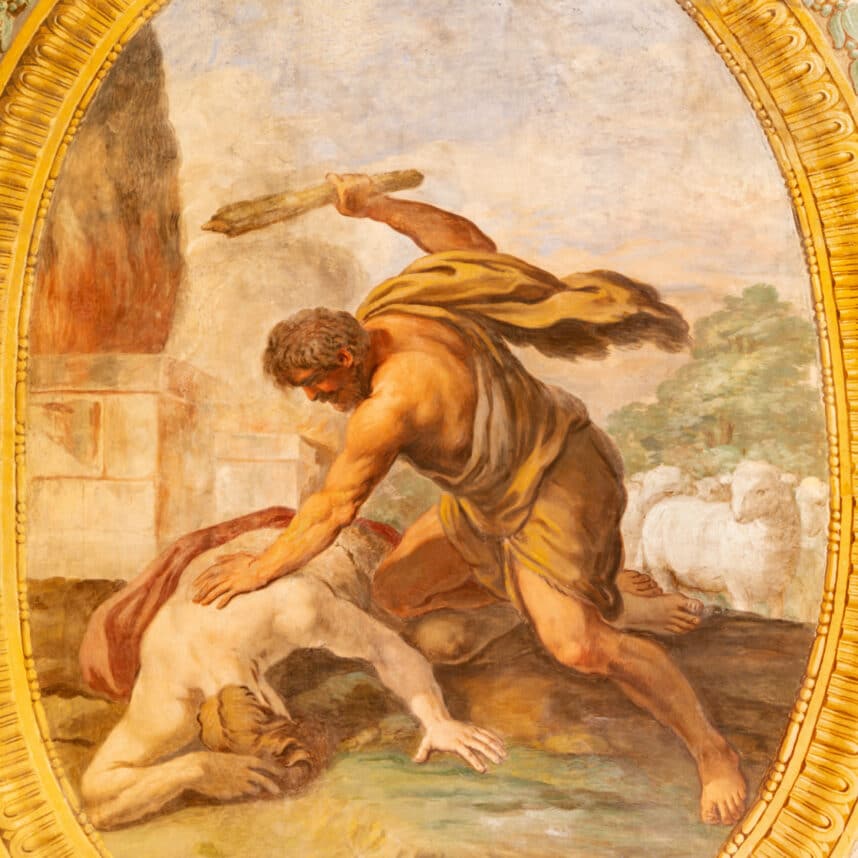
The “begots” are worth a close reading, especially the first set in Genesis 4. The narrative in chapter four begins with Kayin (Cain) murdering his brother Hevel (Abel), apparently from envy. The God-character in chapter four curses Kayin with eternal wandering. Kayin complains that anyone who sees him will kill him.


Appropriately so, we might add, as we see from a later teaching (Genesis 9:6), that anyone who sheds human blood, his blood shall be shed.


That law apparently not being in force yet, God places on a Kayin an “ote” – a sign, that anyone who kills Kayin will suffer seven-fold, so that no one who finds Kayin will strike him.

It seems that God was young then and didn’t quite grasp the consequences of allowing murderers to roam about freely.

It seems that God was young then and didn’t quite grasp the consequences of allowing murderers to roam about freely.

Satisfied with this promise of immunity for the consequences of murder, Kayin, we are told, leaves God’s presence and heads east of Eden (Genesis 4:16). Being a murderer does not seem to harm Kayin’s love life; he marries and bears children.


One of his descendants, Lemech (the Lemech of Genesis chapter four, not chapter five), boasts to his wives:


Adah and Zillah hear my voice, wives of Lemech give ear to my speech:

I have murdered someone for wounding me, a child for bruising me.

If Kayin is avenged seven-fold, then Lemech seventy-seven fold!


Lemech seems to think that the immunity promised to Kayin is grandfathered to Lemech, but only strengthened. Perhaps, in the background, the God of Genesis chapter four is beginning to doubt himself and his grants of immunity for murder.


I can imagine the heavy heart of the author of these passages, writing things down from previous generations, perhaps wondering, “What has gone so terribly wrong with human beings, that they kill a child for suffering a bruise, and that their sense of immunity for the crime is seventy-seven fold?”


Perhaps it is this same author who speaks for a heartbroken God at the end of the first Torah portion. The author writes (Genesis 6:5-7):


Adonai saw how great human wickedness was upon the earth, how the shape of every thought devised by his heart was evil, all the time. And Adonai regretted that He had made the human being on the earth, and was saddened unto his heart.


And Adonai said, “I shall wipe out the human being whom I have created upon the earth, man to breast, to crawling ones and flying ones, because I regret having made them.


In the next Torah portion, Noah, God notes (Genesis 6:11):


The earth has become corrupted before Elohim, and the earth is filled with Hamas (lawless violence).


At that point, Elohim decides to flood the earth (Genesis 6:13):


God said to Noah, “I have decided to put an end to all flesh, for the earth is filled with Hamas (lawless violence); because of them, I am about to destroy them with the earth.


Noah is saved and humanity is regenerated, but it seems clear, that until this very day, there are those who decide to follow the ways of Kayin and Lemech, people who decide to follow the ways of Hamas (lawless violence).


In the Biblical narrative, God regrets having wiped out nearly all of humanity, and places a rainbow in the sky to remind him to restrain himself when the urge arises.


As an interpreter of the Bible, I think that insomuch as this God of the Bible might actually exist, that God is sorely tempted to wipe out humanity again and again. This God of the Bible, I reckon, recalls the conversation with Abraham when Abraham was pleading on behalf of Sodom and Gomorrah, “For the sake of 10 I will not destroy the city” (Genesis 18). The reader must remember than in the end God could not find the 10 righteous ones in the city, who would protest the evils of Sodom and Gomorrah. The cities were destroyed.


Perhaps we today can learn something from this, as we look at the rainbow, recall Kayin and Lemech, the mistaken immunity given to murderers, and the law that whoever sheds human blood, his blood will be shed.

Perhaps instead wiping out all of humanity, if we would just, in every generation, wipe out Hamas (and those who harbor them), the earth will eventually be cleansed of violence and the just and righteous can beget a generation of peace.


Perhaps instead wiping out all of humanity, if we would just, in every generation, wipe out Hamas (and those who harbor them), the earth will eventually be cleansed of violence and the just and righteous can beget a generation of peace.


The Earth Was Filled with Hamas – Lawless Violence – Thoughts on Torah portion B’reisheet Read More »

Journalist EmilyinTelAviv on the Media Hypocrisy During the Israel-Hamas War

Emily Schrader, AKA EmilyinTelAviv, a journalist and prominent pro-Israel activist, was filming one of many TV interviews this past week when a siren went off and forced her to find shelter in her Tel Aviv home, live on camera. She was safe, but she subsequently posted the clip to her 97,000 followers on Instagram, showing them the realities of what it’s like to be in Israel right now.

“Hamas fired a rocket at my house I had to run to the bomb shelter while on television… even more insane? It was a debate with Palestinian who was trying to gaslight and claim that it’s Israel’s fault we were slaughtered by Iranian Regine backed terrorists. I won’t stand for this.”

Schrader was born in Los Angeles and made Aliyah in 2015. Since then, she’s built a following showing the beautiful side of Israel on Instagram and Twitter, as well as reporting on what’s happening in her country and Iran following the murder of Mahsa Amini. She has a huge fan base in the U.S., Israel and Iran, and writes her posts in English and Arabic to Persian.

Since the war started, she’s barely been sleeping, anxious for her own life and trying to do her part to clarify what’s really happening to the world.

“I’ve seen firsthand some of the most horrific scenes since the footage of ISIS or since photos and documentation of the Holocaust,” she told the Journal. “I hate making those comparisons, but the truth is there is no adequate comparison.”

Schrader, who writes for the Jerusalem Post, Politico and Ynetnews, has noticed that while the coverage of the war is less biased against Israel than it has been in recent years, she is worried that will shift following Israel’s defensive in Gaza.

“It upsets me to see some sources like RT are pretty much streaming nonstop coverage from Gaza about civilians getting injured and dying,” she said. “That is indeed a tragedy, but at the same time, you have to acknowledge if you’re being honest about reporting, it’s a response. What Hamas did was not a response or a military operation.”

Though it’s Schrader’s job to put on correct information, it’s been difficult emotionally to process what’s happening.

“On a personal level, I am absolutely devastated,” she said. “I don’t know how to put into words how much my soul hurts from the things I’ve seen, that I’ve had to look at and verify as a journalist. The level of cruelty is unlike anything I could have imagined. It makes it difficult to sleep, to enjoy anything. I speak for myself and many other Israelis when I say the whole country is traumatized by what we have seen and gone through. I wish the international community would understand more before demanding to see photos of decapitated babies, for example.”

Schrader points out the media’s hypocrisy, which only seems to happen when it comes to the Israeli-Palestinian conflict.

“I don’t think any country in the world or victim of massacre, rape or torture would be subjected to the same level of scrutiny by the international media,” she said. “The second there were eyewitnesses who reported about rapes, there were people who said there was no proof. In all my reporting on conflicts, genocides, massacres and terror attacks, I’ve never seen anyone respond like that about any other group or person who claimed they were a victim of such an attack.”

“I don’t think any country in the world or victim of massacre, rape or torture would be subjected to the same level of scrutiny by the international media.”

As someone who has long reported on the Iranian threat, she wishes that it would have been taken more seriously, since there are reports circulating that Iran was allegedly behind the attacks.

“As an Israeli and journalist, it was very frustrating to have been speaking about the threat of Iran, the support for terrorist proxies on pretty much all of Israel’s borders, and the genocidal rhetoric and intent that’s very clear in both the propaganda of the Islamic Republic and Palestinian society at every level. From the cradle to the grave, there is incitement of hatred of Jews that is not only accepted but celebrated. We’ve been speaking about this for years in the media.”

For now, Schrader will keep fighting in the information war. Her overarching concern? The fact that people on both sides will continue to die.

“More lives will be lost if the world doesn’t take these threats seriously, just was they haven’t before,” she said. “I don’t want to see that happen.”

Journalist EmilyinTelAviv on the Media Hypocrisy During the Israel-Hamas War Read More »

The Whiplash Between Journalism and Heartbreak

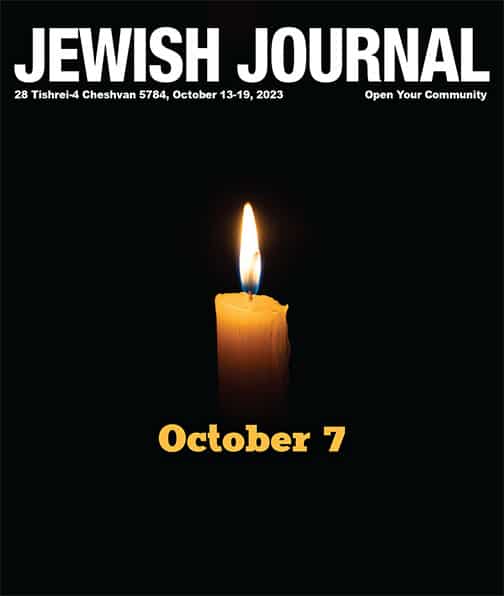
When readers opened the Jewish Journal this week, what they saw was page after page of coverage of the massacres of October 7, arguably the biggest Jewish story of our time. With more than 1300 lives brutally extinguished and many thousands wounded, this was a calamity of unspeakable proportions. The images of the barbaric violence were virtually impossible to watch.

This is one of the realities of journalism in times of intense human pain—it doesn’t allow journalists much time to feel that pain.

As I saw the horror, which got worse by the hour, my mind swung wildly between the disaster and my job. Consumed by grief one minute, obsessed with our coverage the next.

These rival impulses haven’t gotten resolved. They’re still with me; they’re still competing for my attention. One minute I feel like crying over an image of a baby I can’t even describe, the next minute I must respond to a writer waiting to hear about her op-ed submission.

One minute my heart crumbles as I read about an Israeli family burned to death in a safe room, the next minute I have to decide what war story should replace our music page.

One minute I read about the 260 young souls massacred at a desert party (which my daughter often attended when she studied in Israel), the next minute I have to decide if we should replace our popular Rabbis of LA page with a special prayer.

This whiplash went on for the good part of 48 hours, right up until the minute we went to press. I would text a friend who lives on the Gaza border to see if she was OK, and wait anxiously for her response, while getting back to the printer about how many pages we will need.

Meanwhile, the story got so big that we had to revamp our website home page to accommodate all the stories that were coming in. And as I wrote my own commentaries, I continued to grieve as the casualty count kept rising and the pictures got more horrific.

This is not a complaint. I understand that my professional obligation is to put emotions aside and work with the team to deliver the best possible coverage. I get that.

But I’m sharing all this because how we cover this enormous story and what we go through can itself capture the enormity of the moment.

For example, as the hours wore on, I noticed a kind of hidden force at work. I knew we had to pull stories we had already scheduled for this edition, including our cover story (which, ironically, was about Israel’s contributions to the field of solar energy, with the headline, “Here Comes the Sun”), but I didn’t know exactly how many or which stories we would have to pull.

I noticed that as we got closer to press time, rushing to gather as many war stories from as many angles as possible, we were replacing more and more non-war stories. A slew of our regular contributors were submitting their own pieces, some at the last minute. Anything that didn’t deal with the war– food, movies, arts, book, op-eds and local stories– became fair game.

By the end, we had gathered so much war coverage (more than 30 stories) that we had only one non-war page left—our Table for Five. We decided if we should keep only one page, let’s keep the Torah page.

As our readers go through this special October 7 issue, they won’t see any of the anxiety and last-minute decisions that went on behind the scenes. Everything looks neat and professional in the final product. I guess that’s the way it should be.

But I have to say that part of me is still an emotional mess. The images of the victims haunt me. The thought of grieving families haunts me even more. I can’t stop thinking of the hostages. I worry that things may get worse.

The work impulse, however, never stops pulling: After the October 7 edition went to press, we had the jump on the next edition and gather more war stories, because this crisis and this whiplash are not going away anytime soon.

Oh, and if you were wondering about my friend on the Gaza border, she finally got back to me. She and her son are OK.

Shabbat shalom.

The Whiplash Between Journalism and Heartbreak Read More »

Chief Rabbi of South Africa – Founder of the Shabbat Project – Launches Global Candlelighting Campaign to Bring in Light During First Shabbat Following Attacks

As the horror of last weekend’s attacks in Israel continue to unfold, Jewish communities around the world are rallying around the first Shabbat at war to show solidarity and support.

“This is a spiritual war by those who seek to destroy Israel not because of its borders but because of what it stands for – the world’s only Jewish state. Our response must be to reaffirm our eternal Jewish values – the spiritual light of Shabbat,” said the Chief Rabbi in a statement. “Together with my wife, Gina, we offer you our personal prayer, to recite after you light your Shabbat candles this week.

Ten years ago, the Goldsteins introduced the Shabbat Project, an international grassroots movement that brings together Jews from all walks of life and all levels of observance to keep one Shabbat.

Along with Chief Rabbi Goldstein’s appeal to light candles, he released a special blessing composed for the occasion. It reads in part:

Protect and deliver the soldiers of the Israel Defense Forces and Security Forces, and all those engaged in saving lives, from all trouble and sorrow. Strengthen their hands and adorn them with the crown of Your salvation and victory. 

I plead with You, Merciful One, in Your vast Majesty, liberate our captives, speedily deliver them from anguish to relief, and return them home to life and peace. 

Shabbat is a core feature of Judaism, so making it a tentpole to rally support for Israel stands to reason. The emphasis on the day speaks to its character as a time not only to rest but to renew.

In Ezra Klein’s podcast episode “Sabbath and the Art of Rest” from earlier this year, he and writer Judith Shulevitz discuss the famous “Good Samaritan” study, which suggested that “ethics becomes a luxury as the speed of our daily life increases.”

Efforts to show support for Israel through Shabbat may stem from understanding this principle – that slowing down for candle-lighting or longer may help us retain our focus.

The flood of community-based efforts – donations, chartered supply flights with equipment, and rallies, vigils and prayer meetings – are still proliferating, and will need to for the foreseeable future.

The Chief Rabbi’s full candle lighting blessing is available online.

Chief Rabbi of South Africa – Founder of the Shabbat Project – Launches Global Candlelighting Campaign to Bring in Light During First Shabbat Following Attacks Read More »

Injured IDF Soldier Set to Visit LA Killed in Israel War

Two and a half years after she lay unconscious under the wheels of a terrorist’s car, Raz Mizrahi, 22, was murdered by Hamas in the terror attack in Israel. This month, on October 9, she was supposed to arrive in Los Angeles with a group of eight IDF veterans who suffered various injuries during their service. Belev Echad, an organization that was established 14 years ago by Rabbi Uriel Vigler and his wife Shevy, brings each year wounded IDF soldiers to a 10-day dream vacation.

Mizrahi looked forward to that trip. A few days before she was scheduled to leave with the group to the U.S., she went with friends to the music festival in Nova, near Kibbutz Reim. This was one of the first targets for Hamas militants as they parachuted in the area and attacked the young men and women in the early hours of Saturday morning, October7. They shot at the crowd and grabbed as many hostages as they could. Mizrahi was shot to death.

A year ago, during a ceremony where she received her officer’s rank, she recalled the events of the day she almost died: “I will never forget this moment in my life. It was May 16, during the Operation Guardian of the Walls. I was at the checkpoint in Sheik Jarrah. Alerts for terrorist attacks arrived all the time. Suddenly, a terrorist’s car raced toward me and toward my friends at the checkpoint, I flew in the air.”

She continued, “Fractions of seconds pass, and I’m already under the wheels of the car, on the driver’s side with another policewoman, hearing gunshots overhead and saying goodbye to my future, saying goodbye to my dreams. If I stay alive, best case scenario, I will be disabled in a wheelchair.”

However, despite her severe injuries, Mizrahi survived. She finished an officer’s course of the MGB. “I didn’t let the injury, the physical pain that I still suffer from or the mental pain and anxieties to take over my life and divert me from the path I dreamed of: to be an officer in the MGB,” she said.

“I didn’t let the injury, the physical pain that I still suffer from or the mental pain and anxieties to take over my life and divert me from the path I dreamed of: to be an officer in the MGB.”

The commander of the MGB, Superintendent Amir Cohen, saluted his soldier.

“Raz is a true warrior,” he said. “I remember her in the hospital after the injury, and I am excited to meet her today as she attacks the target and fulfills her dream of becoming an officer who will lead the next generation of MGB fighters in the fight against terrorism and crime,” said the commander. “The story of Raz’s life, the injury and especially the heroic rehabilitation are an example and a model for everyone who will be under her command.”

Raz is survived by grieving parents, Gal and Nirit, and a brother and sister.

Injured IDF Soldier Set to Visit LA Killed in Israel War Read More »

Despite the Tears, A Shehecheyanu

There are times when the grief-stricken must recite a Shehecheyanu.

This blessing is meant for joyous occasions, and thanks God for having “kept us alive, sustained us, and brought us to this moment.”

When one is grieving, this blessing seems out of place. But Jewish law expects mourners to recite this blessing when they are the beneficiaries of a gift. We don’t ignore the good, even in the worst circumstances.

This past week, I was thinking about a Shehecheyanu that was recited 80 years ago.

In Hassidic Tales of the Holocaust, Yaffa Eliach recounts when the Bluzhever Rebbe, Rabbi Israel Spira, recited this blessing on a Chanukah evening in the Bergen Belsen Concentration Camp:

….a wooden clog, the shoe of one of the inmates, became a hanukkiah; strings pulled from a concentration camp uniform, a wick; and the black camp shoe polish, oil.

Not far from the heaps of the bodies, the living skeletons assembled to participate in the kindling of Hanukkah lights.

The Rabbi of Bluzhov lit the first light and chanted the first two blessings…When he was about to recite the third blessing, he stopped, turned his head, and looked around as if he were searching for something.

Immediately, he turned his face back to the quivering small lights and in a strong, reassuring, comforting voice, chanted the third, Shehecheyanu blessing: “Blessed art Thou, 0 Lord our God, King of the Universe, who has kept us alive, sustained us, and brought us to this moment.”

Among the people present at the kindling of the lights was Mr. Zamietchkowski, one of the leaders of the Warsaw Bund….Afterward, he turned to the rabbi and said, “I can understand your need to light Hanukkah candles in these wretched times. I can even understand the historical note of the second blessing, ‘Who brought miracles for our fathers in days of old, at this season.’ But the fact that you recited the third blessing is beyond me. How could you thank God and say ‘Blessed art Thou, 0 Lord our God, who has kept us alive, sustained us, and brought us to this moment’? How could you say it when hundreds of dead Jewish bodies are literally lying within the shadows of the Hanukkah lights …and millions more are being massacred? For this you are thankful to God? For this you praise the Lord? This you call ‘keeping us alive’?”

“Zamietchkowski, you are a hundred percent right,” answered the rabbi. “When I reached the third blessing, I also hesitated and asked myself, what should I do with this blessing? … But as I turned my head, I noticed that behind me a throng was standing, a large crowd of living Jews, their faces expressing faith and devotion… I said to myself, if God, blessed be He, has such a nation that at times like these … stand and … listen to the Hanukkah blessing, … if, indeed, I was blessed to see such a people with so much faith and fervor, then I am under a special obligation to recite the third blessing.”

This week, I was thinking about what the Bluzhever had said, because now too we are searching for hope while engulfed by tragedy.

Yes, our grief is overwhelming. A friend of mine in Israel told me that his children who serve in the IDF have lost more friends in the past few days than he did in his lifetime. Entire families have been wiped out. The loss is so severe that Israeli cemeteries are calling for volunteers to dig graves. The Jewish people are in mourning, just two degrees of separation from someone who was murdered or kidnapped.

Analogies fail when it comes to this attack. To call it a pogrom is a dramatic understatement. Even 9/11, which remains a deep American trauma 22 years later, pales in comparison to this attack; the Simchat Torah massacre is the equivalent of thirteen 9/11s. The only proper analogy for the two days of horror is the Holocaust.

The barbarism of Hamas is incomprehensible. They murdered individuals by shooting them at point-blank range with rocket-propelled grenades. They slit throats. They massacred 40 babies. They took such pride in their depravity that they videotaped what they did.

Actually, incomprehensible is the wrong word to describe Hamas’ crimes. Good people simply have a failure of imagination, and they often refuse to understand the mindset of those who are evil. And that is a flaw. It hobbles democracies when they have to take on dictatorships; they imagine they can negotiate with those who are ruthless, and “bring out the best” in them. One who desires love finds it difficult to imagine that there are people who have a passion for cruelty.

Our Torah reading introduces us to Lemech, the first person who takes joy in violence. He boastfully recites the following poem to his wives: “For I have killed a man as soon as I wounded him, Even a young man as soon as I hurt him. If Cain shall be avenged sevenfold, Then Lamech seventy-sevenfold.”

This passage is enigmatic and difficult to interpret, and commentators offer multiple approaches. But the above translation is based on the commentary of Umberto Cassuto, who follows the approach of Rabbeinu Bachya. Lemech is the one who popularizes violence; his son is the inventor of the sword. Lemech sings about how strong he is, how easily he killed a young boy who displeased him; as Cassuto puts it, Lemech “boasts with great bravado of this cruel murder.”

There are always people who love violence. Lemech, and his son Tubal-Cain, refine the brutality of their ancestor Cain. While most people compose songs of love and inspiration, Lemech sings a song of death. And the Torah wants to show us, up close, that there are evil human beings like Lemech in this world.

It is fascinating that Lemech refers to God’s protection of Cain. This reminds us that forgiveness is not endless. Perhaps Cain deserved God’s mercy; he had committed a then-unfamiliar crime and did so in extreme jealousy. But Lemech mocks God’s kindness toward Cain by expecting the same for himself. This violent murderer has the brazen chutzpah to demand forgiveness afterward.

What Hamas and its helpers in the international community do is pretty much the same. They expect all of their brutal crimes to be completely forgiven and any mistake by Israel to be severely punished. Our dear member Gilad Erdan has to combat the endless lies disseminated in the United Nations; dictatorships that murder their own people come forward to criticize Israel, and everyone sits and listens seriously to their prattling propaganda. But Hamas’ constant lying shouldn’t surprise us; if you’re willing to murder babies, how difficult is it to lie?

For the tragedies of this past week we all weep, and our eyes flow with tears. Yet even so, we must make a Shehecheyanu, just like the Bluzhever Rebbe.

We must make a Shehecheyanu on exceptional kindness. A friend described what is happening in Israel as a “balagan of chesed,” or a chaotic whirlwind of kindness. Everywhere people are running and doing what they can for those in need. One Chabad in Jerusalem packed 25,000 sandwiches for the soldiers. There are hours-long waits at hospitals to donate blood, because so many people have come forward. Hundreds of volunteers have come to Siroka Hospital to help the wounded and their families with laundry, prescriptions and rides. And here in New York, a lone man stood inside Kennedy Airport, buying plane tickets for soldiers returning home.

We have to make a Shehecheyanu on the beautiful unity. This was not the case at all a few weeks ago; but now, in a crisis, Israel has once again pulled together. (But why does it have to wait for a crisis?) Yotam and Assaf Doctor, who own the aptly named “Brothers Restaurant” in Tel Aviv, started delivering thousands of meals to the front lines. But many soldiers wouldn’t eat them, because the restaurant wasn’t kosher. What did the Doctor brothers do? They called in the Rabbinate, and for the first time, became a kosher restaurant. The Jewish people are brothers and sisters, and family must stick together, in good times and in bad.

We have to make a Shehecheyanu because of extraordinary courage. Perhaps, as the Haggadah says, in every generation someone comes to destroy the Jewish people. But more important to remember is that in every generation we have found the courage to overcome those enemies. They have been tossed into the ash-heap of history, and we are still here.

This brings me to another Shehecheyanu story, from just a few days ago. Israeli media shared a video of David, a soldier in camouflage netting, holding his smartphone. David was participating in his son’s bris, and saying his blessings while in the field of battle. Following the Sephardic tradition, David recited the Shehecheyanu blessing.

A pessimist might object to his Shehecheyanu, and see this as a moment of extreme disappointment. A young father should be with his family, not on the front lines endangering his life. A young mother should have her husband at her side, rather than worrying about if he will ever get to hold his baby boy.

Even so, David’s Shehecheyanu is a meaningful blessing, and expresses the destiny of the Jewish people. For much of Jewish history, we were defenseless. That ended with the establishment of the State of Israel. That’s why, despite the circumstances, David can say Shehecheyanu.

At the end of the bris, David and his fellow soldiers recited the words from Ezekiel (16:6), “And I said to you in your blood you shall live, and I said to you in your blood you shall live.” Some of the soldiers began to cry. It is a time of bloodshed; these soldiers have witnessed the aftermath of Hamas’ atrocities. But the message of Ezekiel is that even in the worst times, Jews know that there will be better days ahead. Even amidst the blood, there shall be new life.

And for that, we can all make a Shehecheyanu.

Am Yisrael Chai!


Rabbi Chaim Steinmetz is the Senior Rabbi of Congregation Kehilath Jeshurun in New York.

Despite the Tears, A Shehecheyanu Read More »