fbpx

October 11, 2023

Walking the Tightrope: Talking About the Current Situation in Israel with Children

Jews around the world have watched with horror as the tragic events in Israel and Gaza have unfolded in recent days. As we worry and pray and watch from afar, Jewish adults in the Diaspora have been left in an unenviable bind: there are no words adequate for this situation, and yet we must speak about the events of the moment—and we must do so with children no less. 

Doing this difficult and holy work will require all Jewish adults who care for children—teachers and rabbis, parents and grandparents—to become tightrope walkers, undertaking a series of high wire balancing acts. I’ve spent the last decade studying how Diaspora Jewish children learn, think, and feel about Israel, and based on what I’ve learned from children, I want to name three high wires that Jewish adults must walk in order to speak with children about the greatest Jewish tragedy of their lifetimes. 

High Wire 1: Don’t avert kids’ eyes, but don’t let them see. 

It’s clear that children pay careful attention to the words and unspoken signals they get from adults, so when adults in a community are grappling with a terrible tragedy, children know. In the digital age, when children also have access to the Internet and often search it from the moment they learn to read, it’s unlikely that we could shield children from the terrible news even if we wanted to. But it’s also clear that when children have access to violent videos and photographic images of gruesome events, they can experience trauma even if they are not in any physical danger. I call this “remote trauma,” both because the events children watch are far away and because they’re often accessed with a remote control or computer trackpad. The job of adults is, as best as we can, to shield children from experiencing trauma. 

Walking this high wire means that we can neither pretend around children that all is as it should be, nor can we allow children to perseverate over gruesome events or watch them on repeat. This requires that we provide opportunities for children to learn about, hear about, and process tragic events while also guiding them away from graphic images and videos.

Children need adult guidance in helping them understand both the context and the consequences of violent current events. Yet adults who offer that guidance must do so without undermining the magic of childhood.

High Wire 2: Help kids understand the world as it is and the world as it should be. 

Children need adult guidance in helping them understand both the context and the consequences of violent current events. Yet adults who offer that guidance must do so without undermining the magic of childhood, which includes children’s wonderful ability to see the future as hopeful even if the present is bleak. If adults fail to help children understand the world as it is, children are likely to be left with big questions and troubling misconceptions. If adults fail to help children envision the world as it should be, children may come to understand the world, but will lose the impetus to reconstruct it for the better.

Any attempt to walk this high wire—helping children understand this difficult moment and holding space for children’s optimism for a better future—must simultaneously embrace our painful reality and the power of hope. Walking this fine line means acknowledging the darkness of this moment and working with children to bring light into the world. This may involve collecting money for an Israeli organization, writing cards of support to children in a sister city, or offering heartfelt prayers for the injured, captive, and grieving. Children should also be offered a chance to think of their own ideas about how they might bring help or comfort to others at this difficult time, because sometimes their ideas are more powerful than ours. 

High Wire 3: Make Sense of the Senseless

When we give children the opportunity to voice their own thoughts and concerns about this moment, they will no doubt ask big and difficult questions: Why did this happen? When will it end? Who is to blame? Even if it might initially sound like children are asking us to be political pundits, it’s much more likely that they are actually asking questions of theodicy: Why do bad things happen?

Any truthful answer must recognize the limits of our own understanding. We can offer children no good reason for the current tragedy precisely because there is never a good reason for acts of terror. All we can do is offer to sit with children—to take seriously their thoughts and ideas, their hopes and fears—and not to answer for children the questions that are, in the end, unanswerable. 

Walking these high wires will require nerves of steel and continual adjustments as we assess each moment. And it will require us to do so while juggling care for children and the self-care necessary to let us be present for them. And yet walk them we must. There is no other path.


Sivan Zakai, author of My Second-Favorite Country: How American Jewish Children Think about Israel, is the Sara S. Lee Associate Professor of Jewish Education at the Hebrew Union College-Jewish Institute of Religion. 

Walking the Tightrope: Talking About the Current Situation in Israel with Children Read More »

A Mistake I Won’t Repeat Again

On October 6, I made a mistake I hope to never repeat again. 

It may have seemed innocuous enough then. But after the events that transpired in the Jewish world over the weekend, the gesture has come to embody an entirely new meaning. 

Friday morning October 6 was a bright and unseasonably warm day on the UCLA campus. We had just finished morning services at Hillel, and I was making the short walk to my first economics class of the year. 

Moving through the bustling campus corridors, I was overcome by a sudden sensation of self-consciousness and doubt. Despite it being the start of my third-year, I strangely felt a feeling of estrangement among my fellow Bruins.

The main culprit? My kippah, a navy skullcap perched atop my hair. Weighing only a few ounces, on Friday, that cap had felt unusually heavy.

Then came that crucial moment, when my inner skeptic got the upper hand of the situation. It isn’t worth the trouble, I explained to myself in justification. So I unclipped my kippah and folded it casually into my side pocket, without missing a step.

With the burden being lifted, I took a seat in the auditorium and blended in with the rest of the students for the duration of the lecture. 

It was only hours later, on October 6, 2023, that the State of Israel and the world’s Jewry would wake up to a terror attack never seen before in Israel’s post-independence era. The headlines offered no reprieve: Hundreds dead, thousands wounded, and dozens captured by the enemy.

The IDF, caught off-guard during the early hours of the jubilant Simchat Torah holiday, struggled initially to muster its forces against a brutal surprise incursion by Hamas. 

My initial reactions to the violence and bloodshed were of shock and devastation, feelings which have persisted as the conflict rages on. Like Jews in Israel and those in the diaspora, I felt a crushing blow to my Jewish identity, and even to my core existence.

I resolved to act against evil and to do what I could to help defeat the adversary. It was then, however, that I recalled, with humiliation, with my cowardly decision to take off my kippah before class. 

I knew that my fate was bound together with the Jewish people. I resolved to act against evil and to do what I could to help defeat the adversary. It was then, however, that I recalled, with humiliation, with my cowardly decision to take off my kippah before class. 

As I continue to process the tragic developments in Israel, I now know that I am no longer the same person I was before class on Friday morning. 

Recently, I was reading Yoram Hazony’s “The Jewish State,” where he discusses Theodor Herzl’s vision for the modern state of Israel, decades before its creation. I recall a particularly poignant passage in which Herzl describes the significance of a flag as a salient object, symbolizing national pride and identity. 

In a letter Herzl wrote to the German philanthropist, and advocate for European Jewry, Maurice de Hirsch, in June 1895, Herzl highlights the exceptional role that a flag can play in representing the core pillars of Zionism and Jewish destiny.

“With a flag you can lead people to any place that is wanted, even to the Promised Land,” Herzl wrote. “For the sake of the flag, people are prepared to live and to die. In truth, this might be the sole cause for whose sake the masses are willing to die.” 

Herzl, reflecting on the success of the 19th-century’s consolidation of German nationalism, explained that the Jewish people have endured almost two millennia of exile and persecution for the sake of a dream — or a “fantasy,” as he puts it — longing for the era when, as the Psalmist writes, the Lord returns the captives of Zion. 

Herzl’s ideas remained with me through Hamas’ relentless assaults on Israel’s people, values, and national identity. Much like a flag, a kippah is an object of great significance. It represents lofty, larger-than-life causes, many that cannot be expressed eloquently with mere words.

Wearing a kippah is a gesture of both the universal and the particular

Intrinsically, a kippah is a symbol of faith, the fear of Heaven, and the religious spirit. Wearing a kippah is a gesture of both the universal and the particular; it acknowledges one’s ties to their Creator, and demonstrates one’s belonging and identification with the nation of Israel. 

Such an object deserves to be worn proudly.

In times of such immense suffering and loss inflicted upon the Jewish people by terror, how are we supposed to respond?

Antisemitism and Jew hatred is an ailment that has afflicted K’lal Yisroel since their very emergence as a people. The first known instance — the Israelites’ brutal encounter with Amalek in the desert — is famous and archetypical for many other waves of subsequent antisemitism in Jewish history. 

When I think of terrorism, a portrayal of Amalek comes to the fore as its most vivid conception. In many ways, the two phenomena are one and the same. Many Jewish commentators, in fact, believe that Amalek represents an ideological enemy, in addition to being the historical nemesis of the Jews. 

Hearing of the Jews’ redemption in Egypt, the giving of the Torah, and their miraculous sojourn in the desert, Amalek couldn’t fathom the idea of a prosperous, harmonious society based on justice and fairness. Instead, Amalek thrived on chaos, violence, and confusion. It strove to sow discord and doubt, foster corruption and greed while perverting righteousness and charity. 

Historically, Amalek sometimes takes the form of a political force. Projecting The Jewish Question to the nations, Amalek demands the exclusion, marginalization, and, as history has shown, even the persecution and extermination of Jews. Amalek insists that the Jewish state is illegitimate, or that the Jewish people lack the right of self-defense.

Amalek is also a psychological force. It is the inner voice that utters self-contempt and insecurity. It revels in shame and unfettered cynicism. Such an ideology strives to warp one’s identity and undermine their dignity.  Amalek is also a feeling of self-consciousness, coaxing us to remove a kippah.

This week, I found myself, once again, among my peers on UCLA’s campus. This time, however, my navy kippah remains on head each morning following minyan. I like to think that, in some small way, this is doing my part in demonstrating Jewish resilience, might, and dignity.


Alex Rubel is a third-year student at UCLA

A Mistake I Won’t Repeat Again Read More »

New York Journalist Who Made Aliyah Is Reporting on Horrors of October 7

Shanna Fuld, host of the “Israel Daily News” podcast, moved from New York to Tel Aviv about five years ago, knowing she might end up reporting about war. But she never expected anything like the unprecedented October 7 assault on Israel by land, air and sea that stunned the world. A trusted news source, Fuld recently appeared on ABC and CBS (New York) Fox (Arizona) and News Nation.

Shanna Fuld

Fuld, who is observant, and doesn’t use the phone on Shabbat, went to her synagogue and heard a bit of what was going on but didn’t get a full picture.  She walked to a friend’s house for lunch and was surprised that nobody was in the street. In the evening when she turned on her phone, there were tons of messages and she saw the horrific news.

She ran into the stairwell as sirens went off and Hamas rockets landed. “I’d always been bracing for an attack by Iran,” Fuld told the Journal. “Iran’s power has expressed itself in a kind of attack I wasn’t thinking about, and Iran has found a way to terrorize us.”

While Iran has officially denied responsibility, and U.S Secretary of State Antony Blinken said he has not yet seen evidence of Iran’s hand in it, The Wall Street Journal cited senior members of Hamas and Hezbollah who told them Iran helped plan the attack and gave the green light.

The United States classifies Hamas and Hezbollah, based in Lebanon and Syria, as Iranian proxies.

Fuld said it was surreal to broadcast the unfathomable details: Residents who called for help as Hamas terrorists entered their houses, reports that Hamas had infiltrated Israel at 22 locations and that the death toll was the largest of Jews since the Holocaust. At the end of the podcast, she gave the locations for people to donate blood. The murder of 260 people who were attending a peace concert/nature party not far from the Gaza border, was especially harrowing as people raced for their cars, climbed trees or tried to hide. “They were mostly in their 20’s and 30’s and I’m in my 20’s, so I definitely thought that could be me there,” Fuld said.

“Israel is used to terrorism. But in this scope and with these numbers, it’s hard to wrap your head around this type of terror. It’s hard to imagine how this was possible. It is devastating. It is shocking. It was barbaric.“ 

“Israel is used to terrorism. But in this scope and with these numbers, it’s hard to wrap your head around this type of terror.” It is hard to imagine, she said, how this was possible. “It is devastating. It is shocking. It was barbaric. Everyone here is putting one foot in front of the other, but it is a scary feeling of what happened and what can happen. I think it has made people say, ‘enough is enough’ and support a forceful response by Prime Minister (Benjamin) Netanyahu.”

Other horrifying videos showed young women, the elderly and children captured by Hamas, and murdered Jews on the floors. Fuld said she does not want to think of what might be happening to those who are hostages. She added that the videos are so disturbing, people should be responsible and curtail their exposure if they are too traumatized.

At press time, reports said Israel announced its death toll at 900 with 2,500 wounded. CBS cited the Gaza Ministry of Health reporting 687 Palestinians had been killed from Israeli air strikes with 3,700 wounded. Fuld said there is uncertainty in what lies ahead.

Fuld’s podcast, which she has hosted for three years, is in English, and 65% of her audience is American.

Originally from Queens, Fuld previously reported for NY1 and founded Tribe Tel Aviv/Champion for Olim. Prior to the attacks, when Israel was focused on the crisis of judicial reform, Fuld said she was accosted by a group of men during an outdoor Yom Kippur service. She didn’t know of the 2018 law against gender separation at public prayer events. They’d had the event for several years without incident. The event had a mechitza, or divider between men and women. The men threatened her, mocked the rabbi, and told Fuld to go back to where she came from.

But Fuld, who covered President Biden’s visit to Israel in July 2022, as well as New York City Mayor Eric Adams’ trip to the Holy Land earlier this year, said her focus is on they days ahead. She has been impressed by groups of people working together, while acknowledging the attacks were “a reminder” of unfathomable violence.

The densely populated Gaza Strip has 2 million residents and Israel halted electricity, water and food from entering Gaza. She noted that Al Jazeera reported that IDF soldiers have texted Gaza residents to warn of imminent attacks.

Most of her male friends have been called up to the Army and many are flying to Israel from abroad to serve.

“We are going to get through this,” she said at the end of her Saturday night podcast. 

For more info, go to israeldaily.news.

New York Journalist Who Made Aliyah Is Reporting on Horrors of October 7 Read More »

ADL: At Least 39 Anti-Israel Protests in American Cities Following Hamas Surprise Attack

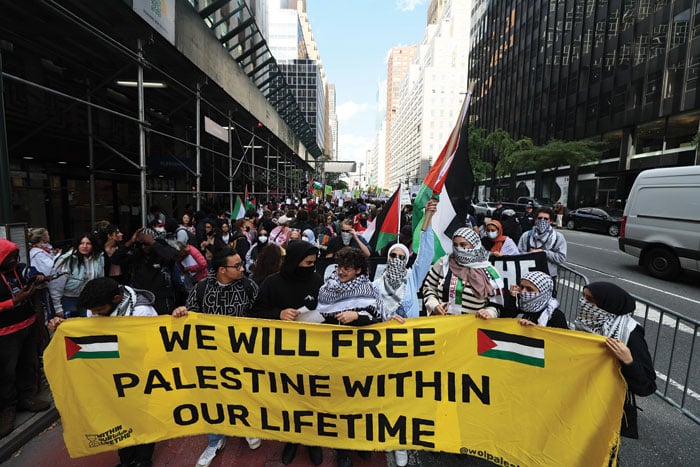
At least 39 anti-Israel protests were held in the United States on Sunday following Hamas’ surprise attack against Israel, according to an Anti-Defamation League (ADL) report. The report also noted that these protests featured rhetoric that “explicitly or implicitly voiced support for the Hamas terror attack.”

The cities in which these protests took place included New York City, Washington, D.C., Chicago, Philadelphia, San Francisco and Anaheim. Perhaps the one that received the most attention on social media was the New York City rally, as video showed protesters chanting “from the river to the sea Palestine will be free” and “resistance is justified when people are occupied.” A video showed one of the speakers at the New York City rally saying, “our resistance stormed illegal settlements and paraglided across colonial borders” and that “the resistance fired more than 5,000 rockets,” both of which resulted in cheers and applause from the protesters. Another speaker at the New York City protest said, “The media will tell you that yesterday, ‘terrorists’ invaded Israel. But we know that actually what happened is that the oppressed people of Palestine broke out of the open-air prison.”  After they were met by applause, the speakercontinued, “The White House is telling all its mouthpieces to tell us a false story. But we know that the real terrorist is the Israeli state that has been murdering, massacring, separating, displacing, torturing, imprisoning the Palestinian people for over 75 years.”

The ADL report also noted that the New York City protest also featured chants of “smash the settler Zionist state!” and that one protester held an image of a swastika on his phone. Another held a sign listing the attack as part of the “Zionist nightmares”; the sign also said, “Long live [the] intifada.” The New York Post reported that a fight broke out after pro-Paletinian protesters set an Israeli flag on fire, which resulted in three arrests. It was not immediately clear if those arrested were pro-Palestinian protesters or pro-Israel counterprotesters.

The rhetoric at the New York City protest prompted Mayor Eric Adams (D) to post on X, formerly known as Twitter: “At a moment when innocent people are being slaughtered and children kidnapped in Israel, it is disgusting that this group of extremists would show support for terrorism. I reject this. New York City rejects this. Do not use our streets to spread your hate.”

The American Jewish Committee also posted on X regarding the New York City protest: “Let us be clear: Anyone supporting Hamas’ assault on Israel is supporting their war crimes, slaughter, and kidnapping. Not to mention many innocent Palestinians in Gaza are suffering as a result of Hamas. This is not a Palestinian cause. This is a Hamas terrorist cause.”

The anti-Israel protest in Washington, D.C. also featured chants of “resistance is justified when people are occupied,” “there is only one solution intifada revolution,” and “they’ve got tanks, we’ve got hang gliders, glory to all the resistance fighters,” according to video posted to social media. The ADL report noted that the D.C. protest featured a speaker who said regarding the Hamas attack, “make no mistake, we are in celebration” as well as a speaker that said, “Zionism is deeply ingrained into our education systems, and we must do everything we can to combat it.”

That rhetoric was heard at other anti-Israel protests as well. According to the ADL, a speaker at a Philadelphia rally said, “What happened was freedom fighters fighting for freedom … every person who died yesterday wasn’t innocent. Every Israeli settler by default is a terrorist.” A rally in Anaheim featured a speaker that said, “Our fighters have started to fight back again. Does that mean that we kick our feet back and act like we’re going to celebrate and be happy at this moment? No, we continue the struggle because … people in Gaza right now are fighting so hard. Their lives are at risk and we’re right here in the United States fighting this battle with them, right?” And in San Francisco, a speaker at an anti-Israel rally said, “The intifada lives and Palestine lives!”

ADL CEO Jonathan Greenblatt posted on X  “One day after Hamas launched a horrendous, unprovoked massacre, brutalizing & murdering hundreds of Israelis — including toddlers, teenagers, disabled people, the elderly — anti-Israel rallies nationwide praised the terrorists’ ‘bravery’ and promoted hideous antisemitic tropes.” 

The ADL report only focused on anti-Israel protests in the U.S.; there have also been anti-Israel protests around the world since the Hamas terror attack. Stop Antisemitism posted video to X showing a truck in Canada filled with people holding Palestinian flags and chanting, “Allahu Akbar!” as well as video of pro-Palestinian protesters waving Palestinian flags on the Gardiner Expressway in Toronto; The Toronto Sun published a photo that showed a sign reading, “Honk your horns for Palestine” draped over an overpass. The Toronto Star reported that a pro-Palestinian rally was held in downtown Toronto on October 9 that attracted more than 1,000 protesters and chants of “Free Palestine.” B’nai Brith Canada and others have urged police to stop further pro-Palestinian rallies from being held throughout the country, arguing that “these rallies are showing material support for a terrorist organization” and that stopping such rallies is paramount for “public safety.”

In London, The Daily Mail reported on a protest that featured a Palestinian woman saying to applause: “For freedom fighters to break out of a 15-year blockade so successfully under the inhuman genocide of Israel was so beautiful and inspiring to see. It shows the world that we will always fight and always resist and we need to celebrate these acts of resistance because this was a success. Revolutionary violence initiated by Palestinians is not terrorism — it is self-defense.”

The Australian Jewish Association shared video on X of pro-Palestinian protesters shouting “Gas the Jews!” and “F— the Jews” in front of the Sydney Opera House, which was adorned with blue and white lights in solidarity with Israel.

“Terrorism is to be condemned, not glorified, and the sickening sight of the Hamas flag being flown in cities across America should serve as a wakeup call to anyone who believes that terrorists respect national borders.“
– Stop Antisemitism

“These rallies proudly celebrate the murder and kidnapping of hundreds of Jews, and those who participate are beneath contempt,” Stop Antisemitism said in a statement to the Journal. “Terrorism is to be condemned, not glorified, and the sickening sight of the Hamas flag being flown in cities across America should serve as a wake-up call to anyone who believes that terrorists respect national borders. We cannot allow the violence they idolize to reach us here — if you know someone who participated in such a rally, let the world know. Our collective security requires us to be honest about those who support genocide.”

ADL: At Least 39 Anti-Israel Protests in American Cities Following Hamas Surprise Attack Read More »

This Time, It’s Different

During Simchat Torah, I heard rumors of trouble in Israel. Since it was Yom Tov, I did not check my phone. When the holiday ended and I saw the news, I was grateful to have had that brief buffer of ignorance.

My son, Michael Danziger, who lives in Jerusalem, called me in the early morning Israel time after Simchat Torah ended in Los Angeles, where I live. After assuring me that he and his family were safe, he shared an encouraging viewpoint. 

What happened in Israel was a pogrom the likes of which has not been seen in recent history. Our enemies gleefully butchered or captured innocent civilians, including the elderly and small children. They have been doing this for thousands of years, different enemies in different guises, but all with the same demonic goal: To destroy the Jews.  

Pogroms happened in France, Germany, and Italy as well as in Iraq, Iran, and Egypt. In fact, most of the people living in Israel today are either survivors of pogroms or descendants of Jews who fled oppression in European and Arab countries. Jews have a long history of persecution within Israel as well, from the Babylonians to the Romans to the Crusaders scourging the Holy Land and the Grand Mufti’s devastation of the Jewish settlement in Jerusalem in 1929, followed by the constant toll of intifada and terrorism.  True, we have the Purim and Hanukah stories and Israeli military victories to uplift us, but historically, my son said, our response to a pogrom was to take our losses and keep our heads down until the next time. We dared not resist.

The people of Israel, so recently divided, have unified behind the effort to feed and house families fleeing from the south, make soup for families of soldiers who’ve been called to service, and wait in line for seven hours for the opportunity to donate blood.

This time, Michael said, it’s different. We are not going to lie low. This time, we fight back. The IDF will stop at nothing to rescue hostages and wreak vengeance on the cowards who perpetrated this evil on a civilian population. And it is not only the Israeli army that is fighting this war: The people of Israel, so recently divided, have unified behind the effort to feed and house families fleeing from the south, make soup for families of soldiers who’ve been called to service, and wait in line for seven hours for the opportunity to donate blood.

I spoke to my daughter-in-law, Rachel Sharansky Danziger, and asked her what I could do to help. She said, “Write to your congressperson.” Today, President Biden states his “rock solid” support for Israel.  But as anti-Zionist (read antisemitic) voices rise and the inevitable casualties mount, that support might begin to waver. International media outlets are sympathetic to Israel now, but when Israel responds to Hamas’s incursion with force, the media may revert to their pattern of blaming Israel – even though Hamas triggered the conflict. We need to keep the narrative clear.

No one thinks this war will end quickly. It will be long, and it will be bloody. American Jews need to unite, just as Israeli Jews have done, to advocate for the Jewish state. So here’s what I ask you to do: 

• Today, write to your Senators and Representatives (www.congress.gov), President Biden(www.whitehouse.gov), and Secretary of State  Blinken (www.state.gov), telling them you support Israel’s right to defend itself and urging them to provide all necessary aid. 

• Talk to your friends and neighbors, comparing Israel’s behavior with Hamas’s. Remind them that the Israeli army warns civilians before bombing buildings and never takes hostages. Remind them that Israel is the only liberal democracy in the Middle East, with a free press and equal rights for women and members of the LGBTQ community. Compare that to those who viciously quash dissent, throw gay men off of rooftops, and slaughter innocents. 

As the war proceeds, some Palestinian civilians will be killed, possibly when being used as human shields. Any loss of life is tragic. However, Hamas and its allies brought this war on themselves, and they are responsible for its consequences. 

Yes, it was a pogrom. No, it should never have been allowed to happen. 

But this time, it’s different. We fight back.


Elizabeth Danziger is the author of four books, including Get to the Point, 2nd edition, which was originally published by Random House. She lives in Venice, California.

This Time, It’s Different Read More »

In Judaism, There is a Time for War

Let’s begin with the obvious: Israel is embarking on a war of self-defense. What do Jewish sources tell us about such an endeavor? What does contemporary moral thought tell us? 

Talmud, Sanhedrin 72a: “If someone comes to kill you, rise up (first) and slay him.” In Jewish law, self-defense is permissible. Just one page later, the Talmud says that if you see someone pursuing another to kill him, you are allowed to slay “the pursuer.” After all, we read “Do not stand idly by while your neighbor bleeds” (Leviticus 19:16) – or when he is about to bleed, and the rabbis add in the need to protect a woman who is about to be raped. 

Self-defense is permissible. In fact, preservation of yourself and your neighbor is not just permissible, it is required. You neither are allowed to murder nor allow yourself or others to be murdered, raped, or violated.

But to what extent does that obligation for self-defense and self-preservation extend to war? Israel is facing an enemy that neither seeks peace nor pursues it. In fact, were it up to Hamas, the land of Israel would be judenrein – “Clean of Jews” to use a Nazi-era term.

What made the Amalekites so horrific? They attacked from the rear of the camp: seizing and killing the women, the children, the infirm. 

The Nazis and Hamas (as well as their Iranian backers) have a lot in common with each other. They act as clear descendants of the biblical embodiment of evil: Amalek. The Amalekites attacked us as we came up out of Egypt after being freed from Pharaoh. What made the Amalekites so horrific? They attacked from the rear of the camp: seizing and killing the women, the children, the infirm. 

On the quiet morning of Shabbat/Shemini Atzeret, Hamas terrorists systematically, and with great planning, broke through fortified barriers and drove into towns, villages, moshavim, kibbutzim – terrorizing and maiming, murdering and slaughtering, vandalizing and burning. They targeted women, elderly, and children. It wasn’t just an Iranian proxy that broke through the Israeli border – it was Amalek-incarnate.

The lives of nearly 1,000 Israelis have already been taken. 

The bodies of nearly 3,000 Israelis have been wounded. 

The fate of well over 150 Israelis is uncertain as they are held in captivity.

The souls, hearts, minds of the entire Jewish nation are rattled, shattered, broken, despondent. And they are also determined.

From the moment Hamas commenced its barbaric assault, this war became a “commanded” war – milchemet mitzvah – and thus justifiable and necessary.

From the moment Hamas commenced its barbaric assault, this war became a “commanded” war – milchemet mitzvah – and thus justifiable and necessary. Military action designed to take human life and destroy property is permissible in order to deliver Israel from its enemy and reestablish safety within Israel’s borders. 

Contemporary moral philosophy also has a voice on matters of war. Michael Walzer, noted author and expert of Just War Theory, describes civilian deaths, “…not just, but they are justifiable in the circumstances of war. At the same time, intentional attacks on civilian targets or disproportional injury to civilian populations are condemned and prohibited.”

In other words, both biblical and contemporary moral frameworks acknowledge that war can be necessary and that such war might mean some innocent people tragically die. Yet we are no less commanded to defend ourselves and our families from aggression. 

During these days, while tensions run exceedingly high, Israel’s challenge will be to defend its citizens and preserve innocent life on both sides of the battle. Some of those defensive efforts may yield unavoidable collateral damage, including the killing of innocents. 

While Hamas terrorists do not care about Just War Theory, Israel knows it stands among the nations of the world and seeks to uphold its own ethics within the obfuscatory conditions of the battlefield. 

May the leaders and advisors, the military forces and guardians of the State of Israel use every reasonable effort to secure its borders and reestablish safety for those who dwell within her borders. 

May the soldiers and officers, the navy, army, air force, police, doctors, nurses, medics,  firefighters have all the requisite resources and tools at their disposal to keep them safe and make their efforts effective. And may we–Jews of the Diaspora and friends of the Jewish state–provide them the political and moral support necessary to emerge victorious.  

“Choose life,” Moses instructs us. And so we will – even when it may come with heavy costs.


Rabbi Mark Cohn serves as Rabbinic Liaison of the Jewish Institute for Liberal Values.

In Judaism, There is a Time for War Read More »

The Anti-Rebels

Has there ever been a time in history when the reaction to tragedies is nearly as bad as the tragedy itself?

That’s certainly been the norm for the past decade, especially regarding Israel. But the scenes out of Israel this past week did manage to horrify even the most status-craven leftists. They wouldn’t dare go public with their horror — what would their friends think? — but some did manage to privately message videos of Hamas’s unfathomable barbarism.

One could take issue with their fears of public ostracism and the fact that it took Hamas dragging naked Israeli women through Gaza and chopping up Israeli kids with axes for them to even react. But for those who require social acceptance to live, this was a big step. Their souls may be blackened from daily virtue-signaling, but at least they still have one.

The same could not be said about the millennials involved with groups like IfNotNow and Jewish Voice for Peace. They’re not looking for dinner party invitations; they want to be seen as rebels: Cool, sexy, anti-establishment. Like ‘60s rock stars. I would say that this desire for “rebel fame” applies to the millennials involved with nearly every aspect of today’s woke movements.

There’s just this minor detail. They’re nothing like ‘60s rebels; in fact, they could easily be called anti-rebels.

Let’s start with the most basic aspect of true rebellion: truth. Whether they were fighting for civil rights, feminism, or gay rights, the rebels of the ‘60s didn’t have to lie, but probably wouldn’t have if they did. They were fighting for justice, and how does one fight for justice with lies?

By contrast, take a look at this Oct. 7th tweet by Simone Zimmerman, co-founder of IfNotNow:

“Israel makes every day under apartheid a living hell for Palestinians. Human beings can’t live like this … Blood is on the hands of Israel’s fascist government, army, and everyone who has aided their crimes against Palestinians.”

According to Zimmerman, if you happened to have missed all of those non-existent videos of the IDF dragging naked Arab women through the mud, chopping up the elderly and disabled, that’s on you. You’re just not as cool as Zimmerman thinks she is.

One could argue that people like Zimmerman don’t know they’re lying: They were taught to hate Jews and Israel by their neo-Marxist professors, so they naturally gravitate to “facts” that support that hate. Given their incessant use of Twitter, this argument is hard to believe but regardless: real rebels do their own research.

Not one member of this cult thinks for themselves. If they did, they would immediately be shunned and dumped into cancellation. 

Which leads to the second aspect of true rebellion: Non-conformity. Anti-Israel Jews today can tell themselves that they’re non-conformists, but the lies they believe about Israel come from the most conformist collective since the Soviet Union: Woke Neo-Marxist intersectionality. Not one member of this cult thinks for themselves. If they did, they would immediately be shunned and dumped into cancellation. 

In stark contrast to the ‘60s, there’s also been a glaring lack of new art and music during this period. It’s not a coincidence. To create art, one must think of oneself as an individual — the most basic aspect of classical liberalism. But these anti-rebels crave nothing more than fitting in to these fiercely unjust movements, even if that means inspiring violence.

Creativity also necessitates digging deep into one’s soul. That’s kind of a problem when you don’t have one: The third aspect of anti-rebellion. Who am I to say that Zimmerman and her buddies are soulless? Well, how else can you view these horrific videos and then blame the victims?

At the end of my book, “Passage to Israel,” I wrote: “Israel is a mirror to one’s soul. Those who see the beauty, who stand up for the truth, who understand the meaning, will never regret where they stood in this moment in history, when silence is not an option.” That was in 2016. Everything has gotten biblically worse since then.

And so we are now congratulating status leftists for allowing themselves to get a tiny bit upset — not publicly! — about one of the worst nightmares in Israel’s history. 

Is there any hope for the uneducated and soulless? In Judaism, we’re taught to always have hope. But hope, like rebellion, rests on truth. So I ask these shameless millennials: Want to be a rebel? Stop lying.


Karen Lehrman Bloch is editor in chief of White Rose Magazine.

The Anti-Rebels Read More »

A Prayer for Israel in this Time of War

God, our Strength and Protection, we pray for the State of Israel in this devastating time of war, shock and grief. Our hearts are breaking, God. We pray for the lives of the innocent civilians who have been heartlessly kidnapped by Hamas, bring them home, watch over them, God. We pray for the lives of the soldiers who have been taken captive, we pray for their safe return, shelter them, God. We pray for the souls of the innocent victims who were brutally slaughtered. Send comfort and strength, God, to the grieving. Send healing to the injured, and strength and wisdom to their doctors and nurses. We pray for all our brothers and sisters in Israel in this time of tragedy and crisis. 

Watch over Israel, God, spread Your shelter of peace over the land and over all our brothers and sisters who live there. Shine Your light upon Israel’s leaders, officers and advisers, innocent blood is calling out to them to overcome all divisiveness and to act with clarity and determination. Protect the men and women who defend Israel, let them be safe and may they be victorious over the Hamas terrorists who attacked our people. Watch over them, God. Hear their prayers. Bring peace, God. Let it rain down from the heavens like a mighty storm. Let it wash away all hatred and bloodshed. Peace, God, please, God. 

God of the brokenhearted, God of the living, God of the dead, gather the souls of the victims into Your eternal shelter. Let them find peace in Your presence, God. Their lives have ended, but their lights can never be extinguished. May they shine on us always and illuminate our way.

Amen.


Rabbi Naomi Levy is the founder of Nashuva and author of “Einstein and the Rabbi.”

A Prayer for Israel in this Time of War Read More »

Time to Fight

As my first High Holy days as a new Jew ended this weekend I was preparing to write to a personal private note to my Rabbis. Then our world changed.  And so I write to them here:   

“Rabbis Kligfeld, Schatz, and Chorny, I hope your loved ones are safe and well. It was just four weeks ago I sat before you at my Bet Din, excited that my 30-year journey was culminating as I crossed the threshold to become part of the Jewish people. I had told you that the abandonment of the Jews during the Holocaust had erased my own belief in deity. How could God allow such a thing? If indeed there was a God. Yet as I came out of the Mikveh and you blessed me, my faith was restored through the ancient covenant between God and the Jews.

The warmth I received at Beth Am over the last few weeks was overwhelming. I was embraced, cradled like a newborn. You gave me my first Aliyah on Shabbat Shuvah, I had the honor of holding the Torah during Kol Nidre, and again during the Yizkor service, as El Maleh Rahamim was recited in remembrance of the Six Million Jews murdered during the Holocaust.  

As my Bet Din, I told you that last year I had stood at the Western Wall. I had just completed 30 years of service as a non-Jew, teaching and researching the Holocaust. I had been in a fight for three decades.  I had been fighting for memory, fighting against denial, fighting for education, fighting antisemites, and fighting for justice. I had just completed my term leading USC Shoah Foundation as I stood before the stones of the ancient Temple.  I realized that I was no longer fighting. It was my time to be — to be a Jew, be a learner, be part of Am Israel, the people of Israel.

After my first Aliyah you called to the bimah my surprise guest, partisan Aaron Bell, the last of the four Bielski brothers. He and his family fought back against the Nazis and rescued 1200 Jews.  Today there are 40,000 Jews alive because of their courage in the face of genocidal murder. We stood together with the holy Torah, and I committed to Aaron that I would always fight for the Jewish people.

The fact that three weeks later, over 700 innocent Jews were massacred in broad daylight, in our homeland, seems inconceivable. My heart goes out to every parent, every child.

The memes circulating that harken back to our memory of the Holocaust are understandable. Genocidal killers – Nazis and Hamas alike – want us to quote the statistics of mass killing, it serves to further dehumanize their victims. What we must do now is honor every life. To honor their memory is to fight back. I am committing to know something about all 700 Jews that were murdered. 

There is a significant difference between the experience of the Jews of Europe in the 1940s, and our situation today. European Jews had no country to go to, no army to defend them, no weapons to fight with, no allies to come to their aid, no one to speak on their behalf.

Today we have a country, we have a world-class military, we have allies, who have now seen for themselves the genocidal intent of Hamas.  We also have Jewish people around the world, ready to use our collective voice.

I do not doubt that the IDF will prevail militarily, and thank in advance the young men and women who will sacrifice their lives in the coming weeks.

Antisemitism has an endemic grip on our society and feeds the beast that murdered our fellow Jews before our eyes. We are stronger than they are, but only if we act in unison. 

But there is another war raging — the battle for hearts and minds.  As I write, Pro-Hamas protestors are out on the streets of San Diego.  Antisemitism has an endemic grip on our society and feeds the beast that murdered our fellow Jews before our eyes. We are stronger than they are, but only if we act in unison. 

The biblical wisdom found in Ecclesiastes Chapter 3 states, “there is a time for peace, and a time for war.” I have dedicated my life to the pursuit of peace, but now is the time for war. The murder of our fellow Jews calls all of us to avenge their deaths, to protect each other with our bodies, our minds, and our single-minded determination to overcome those who would seek to destroy us.

Thank you for your warm welcome to the Jewish people. I do not fully understand that millennial covenant I entered. But I do know it is worth fighting for.

I am here to fight.


Stephen D. Smith is CEO of StoryFile and Executive Director Emeritus at USC Shoah Foundation.

Time to Fight Read More »

The Day After: Framing a Community Strategy

The anti-Israel campaign is alive and well. Immediately following the Hamas’ attack on civilians in southern Israel, groups across the anti-Israel spectrum were defending these actions. In their minds this is a war of liberation. As a colonialist occupier, Israel has no standing, and its American (Government) supporters are seen as enabling the Jewish State to unlawfully control peoples and lands.

The irony of this case against the Jewish State is that these liberationists are defending a theocratic Islamic regime, as Hamas in its political charter offers no space for liberal democracy while seeking the liquidation of all other religious communities. There is a total disconnect here between the aspirations of political left organizations embracing such an extremist religious enterprise.

Even as we watched it the tragic events unfold this past weekend, our disbelief and our sense of loss, our outrage, does not reflect the mindset or political consciousness of those who seek Israel’s demise. 

While their political message is not new, its presence however in the aftermath of such atrocities must be understood as something different. Jewish lives are expendable in the name of liberation politics. We should anticipate that many of these political battles will again take place on college campuses, as a second front is launched, the war over public opinion.

Even as we expect such campus diatribes from Israel’s political opponents, what we find unacceptable are university administrators equivocating on the safety and security of Jewish students, as Israel and its supporters are attacked.

As we focus on student life, we note that many Jewish students across the country awakened on Monday wondering where their “friends” and classmates were as a cone of silence replaced calls or texts of support and connection. 

Students are struggling this week as they uncomfortably enter class and are seated next to these individuals whose silence has been felt and heard. How will Jewish students deal as well with faculty members who launch a tirade of invectives against Israel and its colonist, imperialist government? 

Beyond the classroom, as they and we turn to social media, there one confronts the messages and images bashing Israel. So how do should we respond? Are we prepared, and especially our kids, to lose friends or alienate a colleague or professor, while dealing with our own sense of loss, as we struggle to give context to what is unfolding?

Who will reach out to our students, many of whom for the first time are feeling the anguish of being “a Jew” in a public setting?  Not only will our young people feel such pain and loss, as all of us are likely to experience similar reactions, as our friends simply go silent in this moment.

For many of younger Jews these events represent their first encounter in dealing with hate and in managing a defense on behalf of Israel. Some may feel unprepared to debate the merits of Israel’s case, while others may be uncomfortable in speaking before their professors or even their classmates. 

In the days and weeks ahead, as they and we experience the angry rhetoric of Israel’s critics, it will be our collective task to help our kids and grandkids manage the Zionist case, sharing with them the resources and tools to manage this struggle, while sharing them our support and care.

The contest before us will remind us about the nature of politics and the character of humanity.  We hold a very particular ideological position that the Jewish people have rightfully reclaimed their national homeland.  That statement only works if you believe in the idea of nationalism, accept historic reality, are prepared to uphold international law and practice, and support the rights and status of other peoples.

The battle ahead will be four-fold. As in the past, this remains a war over history and facts. This continues to be a conflict over land and rights. Third, this represents a contest over whose human tragedy is more real. And finally, this will be a power struggle over winning the public opinion battle, who will best make their case?

Jews don’t have the luxury of losing such a battle. The political street may be as challenging as what may lie ahead militarily for the State of Israel as it contends with Gaza and Hamas. Like the 1960’s and 70’s, when we introduced a coordinated effort on the part of the Jewish community relations field to manage and lead the political campaign to defend Israel. This is not the moment for institutional self-promotion as it demands a collective strategy, targeting key audiences and constituencies both in terms of education and advocacy. Hopefully, this is the time where religious connections, ethnic partnerships, business relationships and political alliances allow for a focused campaign of engagement with our key partners.

Everything we must do over these weeks and months ahead must benefit the case for Israel, while also giving support, guidance and counsel to our next generation of Israel activists. 

Everything we must do over these weeks and months ahead must benefit the case for Israel, while also giving support, guidance and counsel to our next generation of Israel activists.


Dr. Steven Windmueller is an Emeritus Professor of Jewish Communal Studies at the Jack H. Skirball Campus of HUC-JIR, Los Angeles. His writings can be found on his website, www.thewindreport.com.

The Day After: Framing a Community Strategy Read More »