fbpx

September 13, 2023

Rosner’s Domain | Basic Truth on Basic Laws

Sometimes there is nothing like going back to Israel’s founder, David Ben-Gurion. On Tuesday, Israel’s High Court convened to hear the case for and against striking down the so-called “reasonableness law,” that would curb the top court’s power to exercise judicial review over government decisions. As they were listening to the many hours of jargon-laden discussion, I was rereading an important 1950 Ben Gurion speech on the urgent question: “Constitution or laws.”

“This is a fierce debate about the essence of the state,” Ben Gurion said. Thus, we should not let the legal scholars determine its outcome. “It is not easy for a layman like me to take part in [this debate]. However, what is being discussed is a state matter and… every citizen must decide on it.” 

It would have been good had some of the participants in the court hearing spent a few minutes reading that speech. Ben Gurion opposed the position of those thinking that it was impossible for Israel to thrive without a constitution. He also opposed those thinking it was impossible for Israel to thrive with a constitution. A constitution, he said,  is “generally a new political device, which is not yet two hundred years old …  we need to examine whether our country needs this innovation.” Today, most Israelis believe that giving up on having a firm constitution was an error. But that’s Monday-morning quarterbacking. It is a fact that to this day no majority has been found and no formula for a constitution had been presented that can get a majority in the Knesset. The country nevertheless exists and prospers (albeit in a crisis).

Instead of a constitution came “Basic Laws,” whose role is to serve as an evolving constitution. But we have a problem with these laws. Thirty years ago, the court elevated their status and started using them as if they were constitutional. The politicians adjusted to the new interpretation in a typically manipulative way. And it is easy to manipulate Basic Laws. The mechanism for passing a Basic Law is identical to the one for passing a regular law. So the Knesset can call any law a Basic Law, and then argue that its constitutionality immunes it from judicial review. 

Manipulation of Basic Laws is not a disease of just one political camp. Two years ago, centrist Benny Gantz voted for a change in a Basic Law to assume the absurd role of an “alternate PM”. It was a clear example of a rash constitutional change, whose purpose is political, and yet it was implemented and approved by the court. Judge David Mintz, who ruled in this case, was consistent in his critique of the situation: “You can’t have it both ways,” he wrote. Since the court elevated the Basic Laws to a constitutional stature, it cannot strike them down as if they were just regular laws.

And yet, on Tuesday, lawyers and politicians — members of the two most manipulative professions — asked the court to consider whether it can strike down a Basic Law. That is, to consider if it’s necessary to add another layer of interpretation to a house of cards that already rests on shaky foundations. Of course, there is also another way– to simplify things rather than further complicate them. But this must begin with an acknowledgement of what is already self-evident– that the whole construct of Basic Laws does not work. 

One solution is to recognize that if the Knesset can call any law a “Basic Law,” and the court can invalidate any law including a “Basic Law,” then a “Basic Law” is nothing more than, well, a law. In that case, one can give up the extravagant title and decide that Israel has no Basic Laws, only laws. 

The second option is to strengthen the Basic Laws in a way that makes them more rigid and robust. This would prevent the Knesset from manipulating them and would also prevent the court from invalidating them. 

Until Israel does one of these two things, all we’re doing — laymen and legal experts — is much ado about nothing. The Basic Laws are talked about as if they are something  … but they are nothing but a fancy name. Sometimes the court clings to Basic Laws to apply judicial review. Sometimes the Knesset clings to the Basic Laws to try to escape judicial review.

This structure somehow managed to survive, largely because of a general sentiment of goodwill. But in today’s Israel, good will is all but gone, and with it the usefulness of Basic Laws.

It is fair to suspect that in the Court hearing no one was converted to a new position on the right balance between the court’s and the Knesset’s power. And it’s not because one side is wise and the other stupid, or because one side is evil and the other is righteous, or because one side is overbearing and the other rebellious. It’s because our Basic Laws were carelessly drafted and over-interpreted. This structure somehow managed to survive, largely because of a general sentiment of goodwill. But in today’s Israel good will is all but gone, and with it the usefulness of Basic Laws.

Something I wrote in Hebrew

PM Netanyahu elicited outrage in ultra-religious circles by trying to dissuade Hassidic Israelis from traveling to Ukraine for Rosh Hashanah. He said that “God has not always protected us …  on European soil.” Here’s what I wrote in this incident:

Netanyahu said what’s obvious to almost all Israelis: you shouldn’t rely on miracles because they won’t always come, and you shouldn’t trust God’s intervention, because He won’t always intervene … [Haredi] MK Eichler said what’s obvious to Haredi Israelis: “God is always there, and always protects us. And no — this is not a historical debate … Those who are willing to accept the possibility of the absence of God, and examine the historical development with a human eyes, see one thing, and those who believe that everything that happens in the world is the work of God, see another.”

A week’s numbers

Thirty years later, nearly 70% of the Israeli Jewish public believes that the decision to sign the Oslo Accords with the Palestinians was not a good one.

A reader’s response:

Erwin Dobby asks: “Why don’t we hear any more about the Western Wall women issue?” Answer: Because other things became much more urgent.


Shmuel Rosner is senior political editor. For more analysis of Israeli and international politics, visit Rosner’s Domain at jewishjournal.com/rosnersdomain.

Rosner’s Domain | Basic Truth on Basic Laws Read More »

In Praise of Starter Grandchildren

“Yay! The letter ‘A’ is my favorite!” Ainsley exclaims with delight. 

We are sitting on my front stoop drawing with chalk. I’d made a gigantic pink “A” and outlined it in bright blue. Ainsley is hard at work drawing her version of the letter. “You have to remember to connect the lines, Auntie,” she says to me with great seriousness, her tiny hands carefully making a dozen vertical lines in yellow chalk and then crossing each one for good measure.

Ainsley, my three-and-a-half year old niece, is often serious about the things that matter: Snacks and monster trucks and the toy chicken that she lost the other day and misses very much. Her seriousness makes her especially thoughtful and wise. But I’m also noticing lately that when she smiles, it’s like watching a sunrise, its warmth radiating on blast, turning everyone in the room into mush. 

If I sound more bubbie than auntie, it’s because I kind of am. Ainsley is my starter grandchild and boy, am I loving it. And I’m not the only one. This past weekend, my teenagers spent an hour playing hide and seek with her, including the 16-year-old with a busier social schedule than a Kardashian; he hid all 5 feet, 10 inches of himself behind the door of his room for 15 minutes until Ainsley “found” him. 

“Oh Ainsley,” we all say, “you are so cute.” 

And she is. But she’s more than that. She’s funny and gentle and wildly observant. “I just heard something,” she said to me out on the stoop, stopping everything, putting her chalk down to listen. 

“Was it the train?” I ask.

She shakes her little blond ponytail, a heart clip keeping the hair in place. “Nope, it’s not the train.” She turns the side of her head up, to hear better.

“Was it a plane?’

Another negative from the pony. “Not a plane.”

“Maybe it was that crow over there?” I say, gesturing to the black bird balancing on the top of a nearby tree.

“Yes!” she says, like I’ve solved the greatest mystery ever. She rewards me with the sunrise and I bask in it as there is no other choice. Ainsley sighs with satisfaction and gets back to her chalk work, “I love crows,” she says maybe to me, but I think maybe just to the universe, or to the crows.

“Me too,” I say. “I love crows, too.” We talk about how crows love their families so much. How they live together in great big ones.

Speaking of family, Ainsley’s mom is my 14-years younger sister, Jenni. She was my starter baby, long before my own kids were on the scene. From Jenni, I learned how much responsibility children were, how they never slept or ate or acted exactly as you wanted them to. And also, how adorable and loving they were. But mostly, as a teenager taking care of her, changing her diapers and lugging her to the park, she was an effective reminder to always use birth control. 

My starter baby taught me that children are a responsibility. 

When my own children came along, they reinforced how much of a responsibility being a parent was, of course, but this time I was sharing that load with my equally devoted husband and it allowed me to relax and enjoy them, too. To fall completely in love with them. To play and listen and dance and be silly. But still, there were (and still are) dishes to be done and places to be driven and life lessons to be taught. After all, we are making people over here and we need to get it right. 

My own babies taught me that children are a responsibility and a joy.

With Ainsley, I’m now peering into the magic portal of grandchildren. Becoming an aunt to her at this stage of my life, as my own children are getting ready to leave the nest, is allowing me to simply be present — for the chalk, the talk and yes, for the crows. 

With Ainsley, I’m now peering into the magic portal of grandchildren. Becoming an aunt to her at this stage of my life, as my own children are getting ready to leave the nest, is allowing me to simply be present — for the chalk, the talk and yes, for the crows. Ainsley has two devoted parents, so all I have to do is love her and watch her bloom right in front of me. And also read books and blow bubbles and run around the grass until we collapse in a heap of laughter.

My starter grandbaby is teaching me that children can simply be joy. 

I’m one lucky mom/aunt/bubbie. I can’t wait to witness all the joy to come for Ainsley. And she’s also made me excited to one day be an actual grandmother — in the very distant future, of course. 

Now if only my knees will hold out.


Geralyn Broder Murray is a Northern California-based writer whose work has appeared in Newsweek, USA Today and Shondaland. www.GeralynBMurray.com @GeralynBMurray

In Praise of Starter Grandchildren Read More »

Make a Reusable Lunch Bag Out of Duct Tape

Duct Tape, or “duck tape,” if you’re using that popular brand of tape, is so much fun for crafting. This past spring, I saw a news report about how high school students used it to create prom dresses and tuxedoes. While I have never been that elaborate with my duct tape use, I’ve done my share of experimentation.

Now that kids are in back to school mode, I thought I’d present this super easy idea for turning duct tape into a reusable lunch bag. The key is creating pieces of “fabric” out of the tape, and instead of sewing the fabric together, you just assemble the pieces with more tape. 

Maybe next year I’ll tackle the duct tape tuxedo. You know I’d rock it.

What you’ll need:

Roll of duct tape
Pen
Ruler/straight edge
Scissors

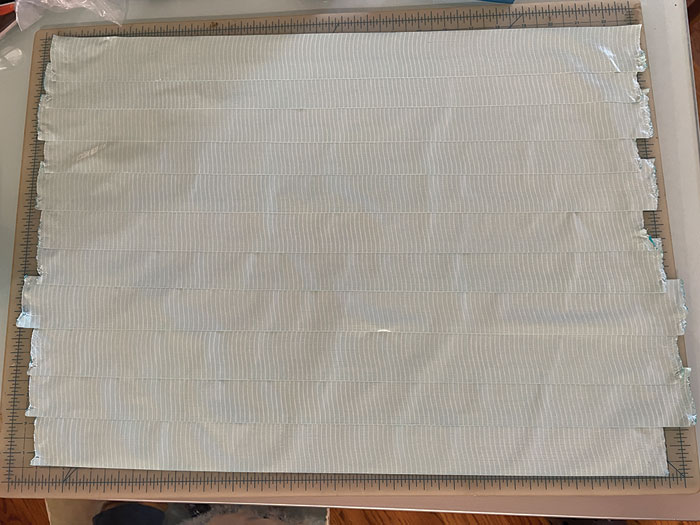
1. Cut a strip of duct tape that’s about 24 inches and position it face up. Then add additional strips of tape, overlapping each strip by about a quarter inch, to create a large piece of duct tape.

2. Cut more strips and position them face down on top of the large piece of duct tape, again overlapping each strip by about a quarter inch. I made a two-sided piece of tape that was 22×16 inches.

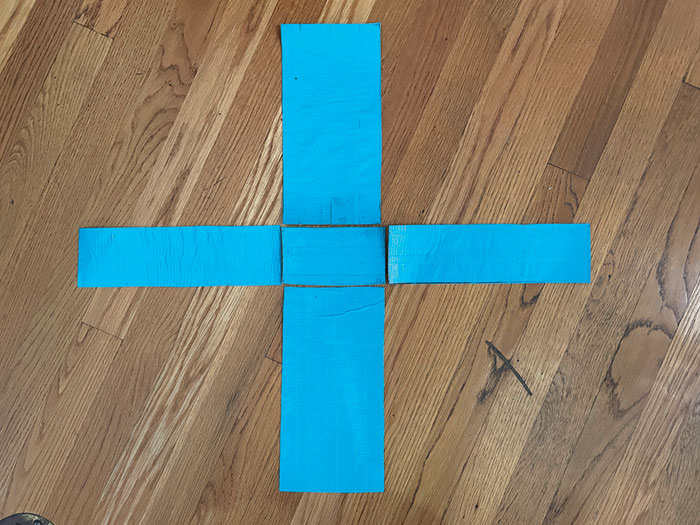
3. Cut the four sides of the bag and the bottom. I made the front and back 10×5 inches and the sides 10×3 inches. The bottom was 5×3 inches. You can make the bag  smaller or larger depending on your preference.

4. Line the pieces up with the bottom. 

5. Tape all the sides to each other using more pieces of duct tape. Be sure to tape both the inside and outside edges.

6. Decorate the bag with pieces of duct tape in a coordinating color.


Jonathan Fong is the author of “Flowers That Wow” and “Parties That Wow,” and host of “Style With a Smile” on YouTube. You can see more of his do-it-yourself projects at jonathanfongstyle.com.

Make a Reusable Lunch Bag Out of Duct Tape Read More »

What Part of Antisemitism Does the UPenn Administration Not Get?


View this post on Instagram


A post shared by Noa Tishby (@noatishby)

The Middle East may be complicated, but what part of antisemitism is so hard for the UPenn administration to understand? Is there any limit to defamatory, bigoted, and downright violent speech directed at those of Jewish and Israeli extraction that would be sufficient to get the administration to condemn the laundry list of antisemitic speakers scheduled to attend an on-campus event titled the “Palestine Writes” festival from September 22-24, 2023?

While I appreciate the administration’s attempt to condemn antisemitism in their statement yesterday, the administration must do more to condemn this hate fest. Otherwise, it brings into question whether there is a double standard when it comes to Jew hatred. The Jewish community writ large supports free speech but that is not what this is about. This is about protecting Jewish students on campus from a ripple effect of antisemitism that will inevitably occur from this hate festival. The administration knows full well that they can do more to stop antisemites like Roger Waters from speaking on campus, contrary to their statement.

The administration had no problem stopping hate speech in the past, as they did with Amy Wax when she brought a known white supremacist to campus. And as FIRE wrote in their 2024 College Free Speech Rankings blue paper, this administration also delayed approving the Hunting, Archery, and Shooting Club as a registered student organization, “claiming that due to the ‘nature of the group’s mission’ it could not make an approval decision until campus returned to normal operations post COVID-19. However, other groups intending to meet in person were approved during the pandemic.”

The administration had no problem stopping hate speech in the past, as they did with Amy Wax when she brought a known white supremacist to campus.

But when it comes to the Jews, it seems as if everything goes, or at least, every speaker is welcome, hate speech or not.

Speakers like musician Roger Waters, who infamously alleged in an interview that “particularly where I live in the United States of America[, t]he Jewish lobby is extraordinar[il]y powerful here and particularly in the industry that I work in…” Not much subtlety there, but this is the same artist who recently performed wearing a mock-SS uniform and projected Anne Frank’s name on stage at a Berlin concert. Is it any shock that Waters is also a prominent supporter of Boycott, Divestment, and Sanctions (BDS), a political campaign for the destruction of the State of Israel?

Or Randa Abdel-Fattah, who has written that “Israel is a demonic, sick project and I can’t wait for the day we commemorate its end,” as well as the equally charming observation that “Israel is an abomination. Every single act of violence is calculated & a logical manifestation of its core identity as a racist, Jewish supremacist, settler colonial apartheid regime of hell.”

Or Marc Lamont Hill, who was famously fired from CNN for calls for a “free Palestine from the [Jordan] River to the [Mediterranean] Sea,” which would wipe out the Jewish state. Hill also tweeted that calls for Palestinians to “reject hatred and terrorism” are “offensive & counterproductive” and said that terrorist and mass murderer Rasmea Odeh is a “freedom fighter being railroaded for her commitment to justice.”

Or Huwaida Arraf, who made the “inclusive” comment that the Anti-Defamation League (ADL) “like the entire Zionist project, is built on the propagation of Jewish supremacy.” Arraf is also the co-founder of the International Solidarity Movement (ISM), an organization that she herself has disclosed to have worked with terrorists from Hamas, PIJ, and the Popular Front for the Liberation of Palestine (PFLP).

In a 2002 article titled “Why Nonviolent Resistance is Important for the Palestinian Intifada,” Arraf and her co-author wrote that “[t]he Palestinian resistance must take on a variety of characteristics — both nonviolent and violent… we accept that Palestinians have a right to resist with arms… Yes, people will get killed and injured.” Apparently, UPenn’s administration thinks this is an appropriate message to be shared with students on campus.

Does UPenn President Liz Magill and her administration stop to consider what impact her institution’s hosting of this carnival of incitement will have on her Jewish and Israeli students, visitors, faculty, and staff? Are they supposed to feel comfortable wearing clothing that identifies them as Jews or Israelis, like kippot, clothes with Hebrew letters, or jewelry bearing the Star of David? Does the administration recognize the intimidation and exclusion they are subjecting Jews and Israelis at UPenn to, especially given that at least one-third of all U.S. Jewish college students now experience antisemitism on campus?

If so, the Administration needs to take a stronger stance by ensuring University departments, including The Penn Arts & Sciences Middle East Center and Near Eastern Languages & Civilizations, pull their co-sponsorship of the event and implement mandatory antisemitism training for all students, faculty, and administrators before the end of the fall semester. The sooner the better.

What Part of Antisemitism Does the UPenn Administration Not Get? Read More »

#BanTheADL Hashtag Only Benefits Antisemites and Jews Who Want to be Liked by Them

Not long ago, a major influencer known to her followers as Pearly Thingz (H. Pearl Davis) created a video that made a joke of antisemitism. Laughingly, she sings a song—dedicated to the antisemitic Christian White Nationalist influencer, Nick Fuentes, who had previously appeared on her podcast—and glibly says, “I am not saying that Hitler was a good guy, but I kind of want to know why…” But she wasn’t doing anything original. Nick Fuentes, who became mainstream through his Nazi glorification tour with Kanye, made a joke about Holocaust denial, suggesting, with a big smirk on his face, that there is no way one can bake “six million cookies” with a few ovens.

The #BanTheADL hashtag and the widespread attacks it has fostered have opened the door to gleefully hateful humor that takes the ADL as its target. Just the other day, for instance, Jewish comedian Danny Polishchuk released a video making a joke out of the Anti-Defamation League (ADL), which was liked and commented on by Elon Musk.

The goal of such antisemitic humor is to minimize the importance of Holocaust denial and antisemitism. The intended result is that when people engage in antisemitism, it is of little concern. After all, antisemitism and Holocaust denial, or happily admitting that you like Hitler, is normal these days; it’s the thing to do. It’s funny. When we see such trivialization of evil and genocide, which is now targeting the ADL (as a proxy for Judaism), we need to ask two questions: What is the goal of making such jokes or of attacking the ADL and who does this benefit most?  

The #BanTheADL hashtag was started by antisemites in response to X’s new rules about hate speech (that speak directly of Holocaust denial, antisemitism, etc.) and the meeting of the ADL’s Jonathan Greenblatt with the CEO of X, Linda Yaccarino. The purpose of the so-called ban was to serve the interests of real antisemites who want to show that they can single-handedly take down the ADL: the organization that got in the way of their efforts to spread antisemitism on Twitter (X). They can do this through equating antisemitism with “free speech.”

This has been their agenda all along. For these rabid antisemites, real free speech is epitomized by antisemitism (which Kanye and others, deludedly, see as speaking “the truth”). It’s the door through which they aim to make America into a Christian White Nationalist country that punishes Jews and reduces their power to defend themselves. It gives antisemites, who do not deserve to be called Christians, baseless exaggerated influence and opportunity to bully others with impunity.

So when Musk dialogues with or likes posts made by Nazis, he vindicates them, and makes way for baseless slander against Jews by attacking the ADL and belittling and muddling its main mission, which is to fight antisemitism. Musk has created a way for these antisemites to mainstream antisemitism. He gave their initiative a boost by approving their posts, and he knows it.

The bottom line: All people who launch attacks on the ADL, despite their “good” intentions, are in fact doing the bidding of people like Nick Fuentes, Keith Woods (Keith O’Brien) and Andrew Torba (to name a few key antisemitic influencers who passionately pushed this hashtag).

The last week has been very bad for the Jews in America. It will have reverberations for years to come that will, without a doubt, lead to an increase in vandalism, violence and hate crimes against Jews.

To better understand what is going on here, let’s take a look at what the main antisemitic influencers are saying and how not only mainstream conservatives like Christopher Rufo, Matt Walsh, Charlie Kirk and others, but also Jewish voices like Ben Shapiro, Yoram Hazony, Laura Loomer and Stephen Miller have made such hatred of Jews mainstream by attacking the ADL.

Attacking the ADL is a proxy for ending censorship of Holocaust denial and antisemitism and making antisemitism mainstream all under the guise of “free speech.” The goal is to separate good Jews from bad Jews and make antisemitism and Holocaust denial arbitrary. By making antisemitism into a free speech issue, by making the ADL into an evil Jewish organization, they act out the first phase of Hitler’s playbook, which is to separate good Jews from bad and make antisemitism commonplace.

One of the masterminds behind this plan to mainstream antisemitism is the Christian White Nationalist Andrew Torba. On a daily basis, Torba, who has over 370k followers, posts on antisemitism. He is the founder of Gab, an online platform for “free speech,” which serves as a place to gather the antisemitic base that he and people like Nick Fuentes, Keith Woods and others use as their shock troops.

Here’s how it works. While Elon Musk tweets about the ADL, Torba gives the antisemitic translation, the hidden reason behind why Elon is attacking them. So while Musk may claim to not be an antisemite, his actions show that he is teeing up the ball for antisemitic influencers to spread explicit antisemitism.

After Musk said he was filing a lawsuit against the ADL (who had the audacity to victimize antisemites), major antisemitic influencers celebrated.

Keith Woods, with whom Musk dialogued last week, granting him validation for the #BanTheADL hashtag, has big plans to normalize antisemitism by portraying the ADL as an organization that is based on keeping the real truth about “the Jews” and their hidden mendacity from the public. His libelous, antisemitic, twisted claim is that the ADL really isn’t there to protect Jews from antisemitism; its goal is to keep the fact that Jews are evil and perverted from the public. Popular antisemitic phrases/memes such as “The Goyim Know” say it all. It’s the utterly stupid and barbaric antisemitic secret knowledge (gnosis) of Jewish mendacity and perversion that binds the antisemites together. It’s their secret code and mythology, which aims to spur violence and hate.

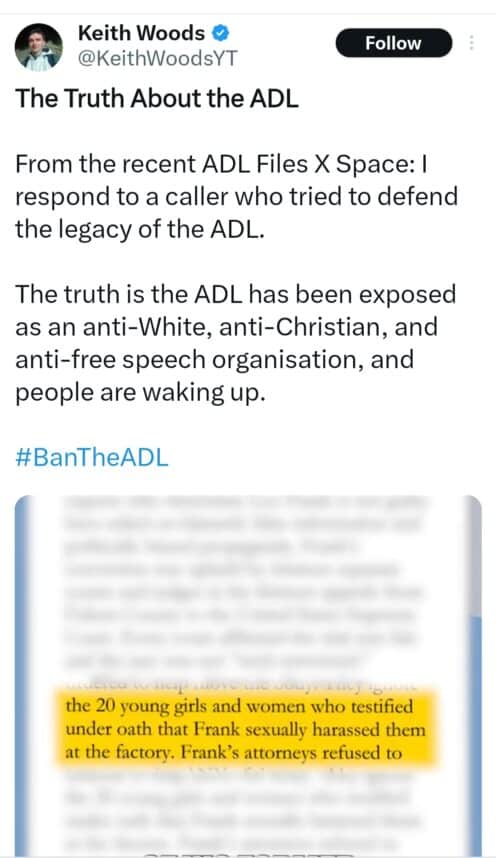
The #ADLfiles, which Woods has piloted, are a new thing (playing on the “Twitter Files” about censorship). They purport to expose the deep-dark secrets of “the Jews.” The ADL, he claims, is founded on protecting a sexual predator. His libel: They don’t fight antisemitism; they are founded on perversion and rape of white people. This kind of Nazi pornography is circulating right now on social media. Woods, who Musk encouraged and vindicated, is sharing this secret history of corruption and evil on Twitter (it currently has over 3800 likes and 1,232 retweets).

But the way all of this is given the final stamp of approval is through mainstream Republican thinkers, like Christopher Rufo, and even Jewish influencers.

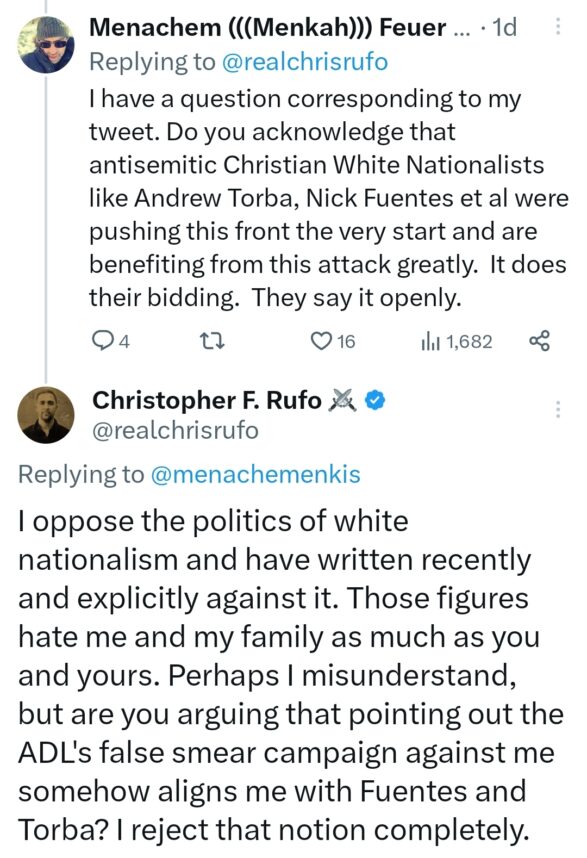
In a recent dialogue I had with Rufo on Twitter, I suggested that his attack of the ADL was benefiting antisemitic Christian White nationalists. He denied this, so when I asked him if he distanced himself from them, he said this:

“I oppose the politics of white nationalism and have written recently and explicitly against it.  Those figures hate me and my family as much as you and yours. Perhaps I misunderstand, but are you arguing that pointing out the ADL’s false smear campaign against me somehow aligns me with Fuentes and Torba? I reject that notion completely.”

Following this, Andrew Torba tweeted:

“I don’t hate you or your family, Christopher.”

But the implication is that Torba hates me and mine, because we are Jewish. Rufo replied to Torba’s tweet (since deleted by Torba) saying, “thank you, it’s the groypers who hate me and my family.” The conceit of this is that while the groypers are antisemitic trolls who align themselves primarily with Fuentes, they are also all over Torba’s X page and populate his Gab platform. Rufo’s reply is odd.

By thanking him, Rufo is doing what Torba wants. It’s socially symbolic. When the Republican mainstream aligns with or passes attacks against the ADL, they are providing a Trojan horse for increased antisemitism, which is exactly what Torba wants.

Jews can also play unwitting accomplices. Yair Rosenberg aptly describes some Jewish pundits and the situation they have created:

“There’s a certain type of Jewish political partisan who things that if they feed enough ‘bad’ Jews to the antisemitic dragon, it won’t eat them. But no matter what your politics, if you create an acceptable permission structure for antisemitism, it will ultimately eat you too.”

The goal of antisemitic influencers like Torba, Fuentes, Woods and Witzke and the groypers who are their shock troops and trolls (who promoted the hashtag to no end over the last week by adding thousands upon thousands of antisemitic comments) is to empty antisemitism of any meaning and to make the Holocaust, the Jews, and any organization that looks to fight it by pushing back against antisemites, into a joke. It’s already happening. We need to be vigilant and to fight against these people who—as Fuentes recently said—want to wage a “holy war” against Judaism, noting that some people “will die.”

By participating in the #BanTheADL hashtag, these antisemitic influencers showed us how they could turn criticism of the ADL into a proxy for spreading major antisemitism on Twitter and gaining more converts to antisemitism. They took their fringe antisemitism and made it mainstream.

Any Jew who has joined in on this attack and given power to this hashtag and plight has done the bidding of Fuentes, Torba, and others whether they admit it or not. Before we sign on to an attack against the ADL, Simon Wiesenthal Center, or other well-known Jewish organizations because it is trending on social media, we need to ask who started this hashtag, who is it benefitting, and why would they benefit from it.

While one may have a valid criticism of the ADL, when hundreds of thousands of people are attacking the organization, most of them spewing antisemitism, maybe one should reconsider voicing it at this time and aiding those who started it all and whose intent was not merely to get antisemitism into the mainstream, but also to divide Jew against Jew.


Menachem Feuer teaches Jewish Studies at the University of Waterloo. He has published essays on the Holocaust, Jewish American culture, antisemitism, and Jewish humor and is the author of the most popular blog on the Jewish comic character known as the schlemiel (www.schlemielintheory.com). Twitter (X): @menachemenkis

#BanTheADL Hashtag Only Benefits Antisemites and Jews Who Want to be Liked by Them Read More »

An Ex-State Dept. Official Is Disillusioned—Sort Of

A former State Department official who was deeply involved in U.S. Mideast policy for decades is feeling a little unsettled over the recent speech in which Palestinian Authority chairman Mahmoud Abbas justified the Holocaust.

“I have been despairing about how to respond to [Abbas’s] profoundly anti-Semitic diatribe,” Martin Indyk, former assistant Secretary of State and ex-ambassador to Israel, wrote on X (Twitter). “How could someone who has treated me as a personal friend for three decades at the same time harbor such hateful views of my people?”

Jewish disillusionment over the behavior of Palestinian Arab leaders is not a new phenomenon. A notable example was the wave of mea culpas in the American Jewish community in late 2000 and early 2001, after Yasir Arafat launched the terror campaign known as the Second Intifada.

On the op-ed page of the Washington Post, Labor Zionist Alliance president Menachem Z. Rosensaft confessed: “I was wrong, so many of us were wrong…for allowing ourselves to be convinced that Yasser Arafat ever actually wanted peace with Israel.”

Likewise, Leonard Fein, founder of Americans for Peace Now, wrote in The Forward: “Our mistake was to allow ourselves to be so carried away by the prospect of peace that we chose to close our eyes to the persistent Palestinian violations of the Oslo accords—and to what those violations implied about Palestinian intentions.”

The American Jewish Congress, for its part, placed a full-page ad in the New York Times under the headline, “It Takes a Big Organization to Admit it Was Wrong. We Think We Were Wrong About You, Chairman Arafat.”

Going further back in history, Martin Indyk’s tweet brings to mind the disillusionment that a few American Jewish leaders expressed after World War II, regarding President Franklin D. Roosevelt’s abandonment of European Jewry.

Nahum Goldmann, for example. In the 1930s and 1940s, he co-chaired the World Jewish Congress alongside Rabbi Stephen S. Wise. In 1975, Goldmann was interviewed by the historian Melvin I. Urofsky, who was writing a biography of Wise. Concerning FDR, Goldmann said:

“There is something [to the argument] that Rabbi Wise was too close to Roosevelt to be effective….Wise exaggerated his appreciation of Roosevelt. The accusations against Roosevelt [regarding the Holocaust] are partly justified…I never had full trust in Roosevelt.” Goldmann said he was also convinced that “Roosevelt would never agree to a Jewish state.”

During the Holocaust years, Goldmann was occasionally critical of FDR, but only behind the scenes. Briefing David Ben-Gurion and other Jewish Agency officials in Jerusalem in 1944, Goldmann complained that on the rare occasion an American Jewish leader was granted an audience with the president, it would be “for thirty minutes, ten of which are spent by him telling anecdotes, after which he expects to hear you tell him anecdotes, and then there are only ten minutes left for a serious conversation…”

Many years later, Goldmann felt remorse over the fact that he and his colleagues were not more outspoken at the time. In his autobiography, published in 1969, Goldmann expressed regret that despite their awareness of the mass murder, “Jewish leaders and organizations lacked the courage, vision and resolution to risk a radical and drastic move….All of us who spoke for the Jewish people in those days—and I emphatically include myself—bear a share of the guilt…”

It took Goldmann twenty years to admit that much, far too late to make practical difference. It has taken Martin Indyk thirty years even to express “despair” over Mahmoud Abbas’s antisemitic speeches. Will that despair translate into something more concrete, before it is too late to have any impact?


Dr. Medoff is founding director of The David S. Wyman Institute for Holocaust Studies and author of more than 20 books about Jewish history and the Holocaust. His latest is America and the Holocaust: A Documentary History, published by the Jewish Publication Society & University of Nebraska Press.

An Ex-State Dept. Official Is Disillusioned—Sort Of Read More »