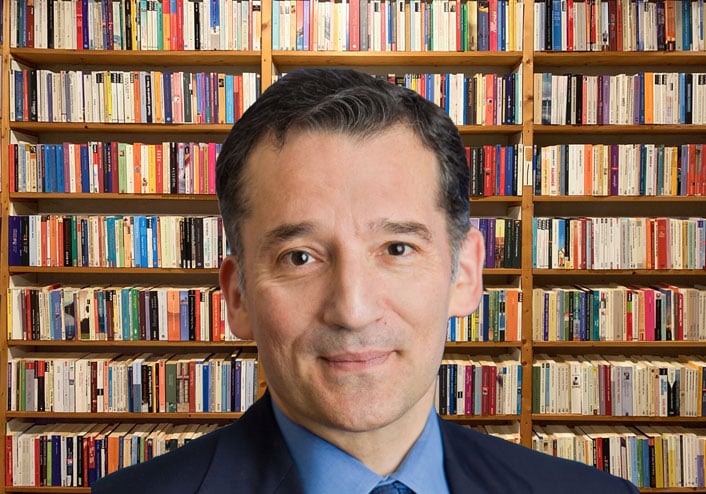
Elizabeth L. Silver’s new powerful page turner, “The Majority,” tells the story of Sylvia, a Harvard Law student, whose cousin, Mariana, has survived Auschwitz and the experiments of Dr. Josef Mengele. When she gets pregnant, she fears she could be kicked out of school.
Mariana, whose twin sister, Aviva, died at the hands of Mengele, wants Sylvia to make sure that what happened in Germany doesn’t happen in the United States. She tells Sylvia, regarding happiness: “It’s like candy. You want it but you don’t need it.”
Sylvia’s professor, James Macklowe claims to be an advocate of women’s rights, but she is not so sure. He tells her that her boyfriend, Joseph Bernstein, will only weigh down her career prospects. Her classmate Linda, one of the few Black law students at Harvard in 1959, tells her something that seems to be inexplicable, and we only understand the mystery at the end of the novel.
Sylvia keeps a secret from her husband and her daughter, Aviva, who is furious when she finds out what her mother has hidden. Sylvia, who hasn’t had a bat mitzvah, is happy that her daughter will have one, only for Aviva to say she suddenly drop the news that she doesn’t want one.
Silver, a Jewish Los Angeles resident, had a bat mitzvah, but said one element of the story was culled from her personal life.
“My mother grew up in Brooklyn and was secular and did not have a bat mitzvah when she was young but later had one in her 50s,” Silver told the Journal. “Women didn’t have them when she was growing up, so I thought about that a lot when writing this.”
The spark for the main character is clear.
“Ruth Bader Ginsburg was a huge inspiration for this book in so many ways,” Silver said. “I was always interested in her and curious about her life. I wanted to know about the fights and things left on the cutting room floor that are not talked about. Of course, Sylvia is very different, and this was just a jumping off point.”
Ginsburg became the first Jewish female Supreme Court Justice in 1993. Silver explained that when she sold this book, Ginsburg was still healthy. Dubbed “The Notorious R.B.G.” she died in 2020 at the age of 87. As Sylvia is 12 at the end of World War II, her character is born the same year as Ginsburg.
“The Majority” focuses on Sylvia’s fight against pregnancy discrimination in the workplace in and briefly mentions Roe v Wade, the 1973 Supreme Court decision that legalized abortion and was overturned by Dobbs v. Jackson Women’s Health Organization in 2022.
Silver, an attorney who was a judicial clerk for the Texas Court of Appeals, teaches creative writing at UCLA and said she was surprised that the Supreme Court overturned the landmark decision.
“It was so enmeshed in precedent, I didn’t think it would happen,” Silver said.
Sylvia becomes upset when she believes a case of a a woman who was abused by her husband is being mishandled. As she struggles with different issues with her family, she climbs the ladder and is ultimately a final candidate for the Supreme Court, where she believes a person from her past will likely get the appointment.
In a televised hearing, a senator asks her a question many would find inappropriate.
Silver skillfully writes short cinematic chapters full of tension and inertia. The author of the novel “The Execution of Noa P. Singleton,” crafts characters you will care about; you will check yourself and wonder if you’d make the same choices in their shoes.
In a gripping moment, Sylvia tells her daughter that “… no matter how much we repave the roads, they still lead to different places. And the sooner we can all accept that, the more will be seen, and the more equal we will finally be.”
It is a call to fight against current and futures wrongs, with the acknowledgment that even the best of intentions cannot erase mankind’s mistakes of the past, whether small or horrifically evil.
The novel is a healthy reminder that in the battle between what is right and what is convenient, it is not easy to predict which side will win. We may sometimes agree with a court ruling, or sometimes, we will agree with the dissenting opinion.
“The Majority” is a riveting tale of a woman fighting for justice and female empowerment as she battles personal traumas, never forgetting her cousin, who was murdered by a maniac. Put it at the top of your summer reading list.
Silver will be in conversation with author and fellow attorney Natashia Deon at Vroman’s Bookstore in Pasadena on July 12.
With all the hoopla last week about the United States Supreme Court’s decisions on affirmative action, student loan forgiveness programs, and websites for same-sex weddings, many people may have missed what was arguably the Court’s most important decision for the Jewish community. Last Thursday, the Court issued a unanimous decision in Groff v. DeJoy, which will provide substantially greater protection for Jewish employees in the workplace. Let me explain why Groff is so significant.
In 1972, Congress amended Title VII of the federal Civil Rights Act to provide that an employer must reasonably accommodate the religious observance or practice of an employee or a prospective employee unless the accommodation results in undue hardship on the conduct of the employer’s business. In Trans World Airlines, Inc. v. Hardison, however, the Supreme Court effectively eliminated the protections of this amendment, and dealt a significant blow to the idea of workplace accommodation for Jews and other religious minorities, by interpreting the phrase “undue hardship” to mean anything more than a de minimis cost. As a result, employers were able to refuse requests for reasonable religious accommodations and Jews and other religious minorities received little protection in the workplace.
This past year, however, the Supreme Court chose to hear the case of Groff v. DeJoy and revisit its holding in Hardison. Gerald Groff was an Evangelical Christian who worked as a mail carrier for the United States Postal Service (USPS). Groff believed that, for religious reasons, he should not work on Sunday. When the USPS began facilitating Sunday deliveries for Amazon, Groff was unwilling to work on that day. As a result, Groff received “progressive discipline” for failing to work on Sunday, and eventually resigned. Groff then sued USPS under Title VII, asserting that it could have accommodated his Sunday Sabbath observance without undue hardship to USPS’s business. Groff lost in lower courts, based on their conclusion that USPS had met Hardison’s de minimis standard, but the Supreme Court decided to hear the case.
Because the case was of major importance to observant Jewish employees, in March 2023, the National Council of Young Israel (NCYI), an umbrella organization representing more than 25,000 member families and approximately 135 branch synagogues throughout the United States, Canada, and Israel, filed a “friend of the court brief,” known as an “amicus brief,” with the Supreme Court. I was privileged to work on that brief, which was authored by Kate Stith and Nicholas R. Reaves (together with law students) of Yale Law School’s Free Exercise Clinic. The brief argued that the Supreme Court needed to interpret the language of Title VII more appropriately, to better protect Jewish employees and other religious minorities.
In its opinion issued on June 29, 2023, the Supreme Court clarified the meaning of Title VII, unanimously holding that the statute requires an employer to grant a reasonable accommodation to its religious employees unless the employer can demonstrate that the accommodation would cause “substantial increased costs in relation to the conduct of the business.” The Court also stressed that animosity of co-workers to a particular religion or to a particular religious practice or expression in the workplace cannot be considered in evaluating an employee’s religious accommodation claim.
In its ruling, the Court relied upon NCYI’s amicus brief, in which NCYI argued that, under the previous de minimis standard, accommodation for Sabbath observers was left to the goodwill of their employers and co-workers. The Court cited to NCYI’s amicus brief at page 13 of its opinion, noting that “a bevy of diverse religious organizations has told this Court that the de minimis test has blessed the denial of even minor accommodation in many cases, making it harder for members of minority faiths to enter the job market.”
The updated standard for religious accommodation found in the Supreme Court’s opinion should provide much greater protection to Jews and other religious minority employees in the workplace. Jewish employees who are forced to choose between their jobs and their religious practices should now be able to rely upon the Groffdecision and obtain the religious accommodations to which they are entitled under federal law.
David Schultz is a Los Angeles attorney and the Chairman of the Board of the National Council of Young Israel.
In what is the first of the three “haftarot of doom” leading up to the fast of Tisha b’Av, God asks the prophet Jeremiah “What do you see?” God is really asking Jeremiah if he understands the brewing political and social problems within the Jewish state of his day.
Jeremiah answers God’s question with a prophetic metaphor that reflects the impending doom on Israel: “I see a steaming pot.”
What was this “steaming pot”? Was it a description of Israel’s enemies that were waiting to unleash war and terror on the Jewish state? Was it a reflection on political, social and religious divisions that were brewing within Jewish society, about to reach a boiling point? It was both.
Israel’s enemies – in this case the Babylonians – were prepared to march on Jerusalem and lay siege to the city:
“They shall come, and shall each set up a throne, before the gates of Jerusalem, against its walls roundabout, and against all the towns of Judah” (Jeremiah 1:15).
The threats from Israel’s enemies were seen as a “steaming pot” by Jeremiah, and the pot was ready to explode any day.
Coinciding with the threats from beyond Israel’s borders were the equally disturbing threats from within Jewish society:
“They have forsaken Me and sacrificed to other gods, and worshipped the works of their hands” (Jeremiah 1:16).
Idolatry is understood as the moral decay of Jewish society. The ultimate downfall of the first Jewish State was due to widespread idolatry, sexual immorality and bloodshed – Judaism’s three cardinal sins.
Jeremiah’s “Steaming Pot” prophecy of doom teaches us that the enemies from beyond our borders go hand-in-hand with the threats from within.
This message was carried into the second Jewish State, where the “steaming pot” of its day was the Roman Empire’s oppression of the Jews, along with internal Sinat Hinam – baseless hatred – within Jewish society. That poisonous combination brought about the destruction of the second Jewish State.
Today, in the third Jewish State, Jeremiah’s “steaming pot” vision is unfortunately alive and well. Israel’s enemies continue to threaten Israel with terrorism and destruction, and Israeli society is as divided as it’s ever been – politically, religiously and socially.
From where can we draw strength in these challenging times?
I turn to the wisdom of the great Sephardic Hakham, Rabbi Ben-Zion Meir Hai Uziel.
In 1951, just three years into the newly declared modern-day Jewish State (and two years before he passed away), Rabbi Uziel wrote:
“Loving truth and peace are especially needed in the State of Israel today, for only truth and peace can create an atmosphere of pleasantness and tranquility throughout the land. Each individual in Israel must internalize truth and peace, which in turn will foster a true love for the State of Israel, and a genuine desire for its internal peace.
“This internal peace will ultimately lead to an external peace, guiding us towards peace initiatives with other nations and kingdoms.
“Let us conduct ourselves in the paths of true peace, respecting each other’s opinions and feelings, as well as respecting the differences amongst the factions in our country. Let us remove all language of hatred, animosity and provocation from our midst.
“Let us remember the enlightened deeds of our rabbis – Shammai and Hillel – who behaved with love and respect towards one another and respected each other’s opinions, fulfilling the verse ‘You shall love truth and peace.’”
The prophet Jeremiah described the “steaming pot,” and in almost equally prophetic words, Rabbi Uziel laid out the formula for cooling that pot.
In his vision, cooling the pot starts from within. Only when we have internal peace within Israel can we properly deal with our external enemies.
“This internal peace,” as he so beautifully envisioned, “will ultimately lead to an external peace, guiding us towards peace initiatives with other nations and kingdoms.”
Are we up for Rabbi Uziel’s challenge?
Rabbi Daniel Bouskila is the director of the Sephardic Educational Center and the rabbi of the Westwood Village Synagogue.
As a young woman, my husband’s grandmother, Etel, or Babi as we called her, went off with her sister Iren from their tiny village in eastern Hungary to the big city of Budapest, where they had adventures and worked in a clothing factory, one as a seamstress, the other a shipper. Had they stayed in Budapest, they might have faced a different fate during the war. But less than a year after going, they returned home to Óféhérto, and on Passover, they were rounded up and sent to a ghetto in nearby Kisvárda. This was happening all over the Hungarian provinces. There were about 800,000 Jews in Hungary at the time; as Jonathan Freedland writes, “They were the last ones left, the one major Jewish community not yet to have been pulled into the inferno.” For the period of the Omer, when Jews count down the seven weeks from Passover to Shavuot, Babi and Iren-nenye, though they didn’t know it, were counting down their time in the ghetto. At the end of it, they were told they were being transported to a new location, a work camp.
The name “Auschwitz” meant nothing to them.
Why would it?
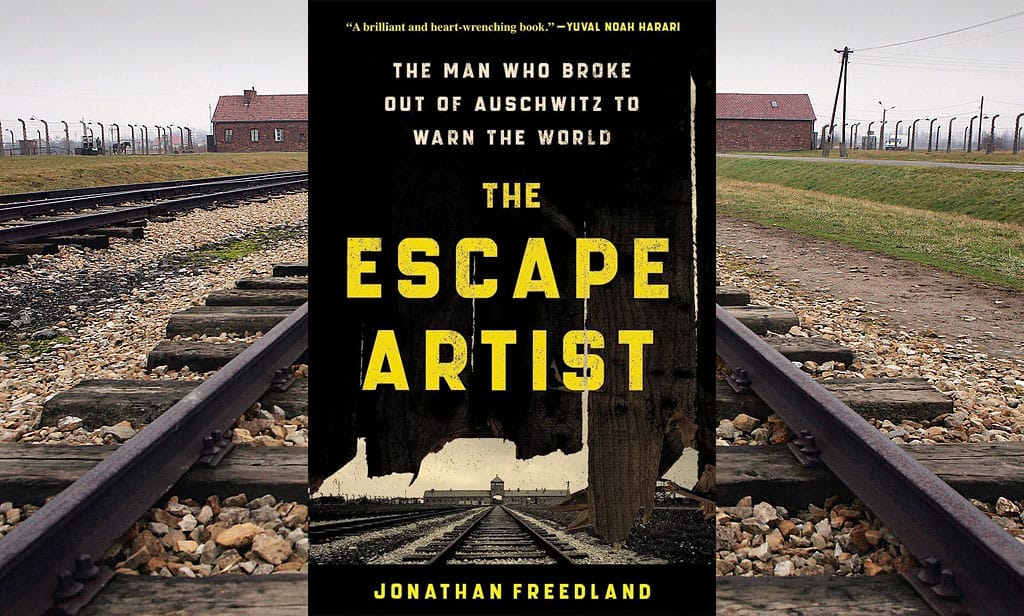
Reading Freedland’s new book, “The Escape Artist,” subtitled “The Man Who Broke Out of Auschwitz to Warn the World,” I can’t help but think how devastating it is that in April 1944 Babi and Iren-nenye—and other family members who did not survive—were ignorant of Auschwitz, the now notorious concentration and death camp where over a million Jews were slaughtered, most on arrival. Devastating—because they could have known about it. Known, and perhaps fought, or perhaps fled. After all, the very day that Babi and Iren-nenye arrived in Kisvárda, two Slovakian Jewish men, Walter Rosenberg and Fred Wetzler, did the impossible: They escaped Auschwitz. Their mission was to tell everyone exactly what Auschwitz meant and why it needed to be stopped.
“The Escape Artist” chronicles Rosenberg’s life, from his early days in Slovakia to his final days, like Babi and Iren-nenye, in Canada. His character—brilliant, paranoid, bad-tempered, charming—jumps off the page.
The vivid details of the escape by Rosenberg, who later became Rudolf Vrba (Freedland chooses to center him as the subject and hero of the book), and Wetzler make “The Escape Artist” read more as a thriller than a history textbook. Freedland, when not writing for the British newspaper “The Guardian”; doing his weekly podcast “Unholy” with Tel Aviv-based news anchor, Yonit Levi; or writing plays for the stage, is, under the pseudonym Sam Bourne, a thriller writer. Most chapters of “The Escape Artist” end with a cliff-hanger or a sense of ominous foreshadowing. Sometimes the impact of these closing lines rests on the knowledge of his readers. For example, when Rosenberg takes the opportunity to leave Majdanek, we read that “optimism entered his heart,” and Freedland adds, “Thank heavens he had rejected the advice that would have kept him in Majdanek and away from here. Because fortune really did seem to have smiled upon him” before adding the chapter’s concluding two-sentence paragraph: “It was 9 p.m. on 30 June 1942. And Walter Rosenberg was in Auschwitz.”
Rosenberg and Wetzler broke out of Auschwitz, an extraordinary feat. They made their way through the treacherous, enemy-filled landscape until they found the still-functioning Jewish council in Bratislava. They told their story and the story of Auschwitz in spare, unsentimental prose, and their report was replete with numbers, maps and names. It was translated into multiple languages and sent around the world. All this happened while Babi and Iren-nenye counted down the Omer.
So, what happened?
What happened was that the world didn’t listen. What happened was that the world didn’t care.
But there was one community that should have listened, cared, more than any other. Before the men broke out of Auschwitz, a German political prisoner told Rosenberg that Nazis were building a new railway line, direct to the crematoria, in preparation for the enormous influx of Hungarian Jews. His statement was confirmed by SS officers, who drunkenly revealed that they were hungry for some “Hungarian salami.” It would have been ideal if the information Rosenberg and Wetzler provided about Auschwitz caused the Allies to bomb the railroads or otherwise turn their attention to disrupting the deportations, but the immediate focus was on the immediate danger: Hungary.
Rosenberg and Wetzler understood this, as did the Slovakian Jewish council. And so, on April 28, the Vrba-Wetzler “Auschwitz Report” was handed to Rezsó Kasztner, the de facto leader of Hungarian Jewry.
What Kasztner did once he got hold of the Auschwitz Report is well known. Kasztner, deciding to save the few and risk the many, suppressed the information. The deportations began, and 437,402 Hungarian Jews, at a rate of 14,000-15,000 per day, were sent to Auschwitz; 90% of these men, women, and children were gassed on arrival. Babi and Iren-nenye were lucky; their sister, brothers, nephew, nieces and cousins were not.
The Auschwitz Report, however, did save lives. Although it is slightly misleading that “Rudolf Vrba and Fred Wetzler … saved 200,000 lives” as Freedland writes (a claim repeated on the back of the book), it is true that the report led to the cessation of deportations from Budapest at that time. Later on, unfortunately, more tragedy was to be had. In the autumn of 1944, the government was taken over by the Arrow Cross, the Hungarian party that was as hellbent on the mass extermination of Jews as the Nazis. Nonetheless, the rate of survival was higher in Budapest than anywhere else in the country, and more than 100,000 Jews were in the capital city upon liberation.
Nonetheless, the rate of survival was higher in Budapest than anywhere else in the country, and more than 100,000 Jews were in the capital city upon liberation.
There are many reasons that I think this book is essential reading. Remembering the heroes of the Holocaust, of which Rosenberg/Vrba and Wetzler are surely two, is important. But there’s more to it. Rosenberg’s unique overview of Auschwitz, his long period in the camp, and status and assortment of duties made him a key witness. No wonder he testified in the trials of Nazis and Holocaust deniers. Now that he’s gone and can’t testify himself, we need his story in his stead—and we can thank Jonathan Freedland, who conducted exhaustive research, including extensive interviews, for giving it to us.
In memory of Etel Gelbman Guttman (1919-2009) and Iren Gelbman Mandel (1921-2015).
Karen E. H. Skinazi, Ph.D, is Associate Professor of Literature and Culture and the director of Liberal Arts at the University of Bristol (UK) and the author of Women of Valor: Orthodox Jewish Troll Fighters, Crime Writers, and Rock Stars in Contemporary Literature and Culture.
Manhattan resident Chantae’ Vetrice says she’s had plenty of people tell her that deciding to become a musical artist and converting to Judaism were the wrong choices.
But she is confident her results have proven that she was right to listen to her heart.
A versatile talent, Vetrice raps, sings, makes artistic music videos, and also models. Vetrice says it is incumbent on people to be true to themselves and stand up for their beliefs.
One of her most impressive songs, “R.I.P,” decries the shootings of several artists from Nipsey Hussle, who was murdered outside his clothing store in Los Angeles, to Takeoff, from Migos, who was shot in Houston.
“I made that song after Takeoff was killed,” Vetrice told the Journal. “There were a number of hip hop artists killed with in the last few years. It’s crazy.”
Vetrice grew up in a single parent household with her mother in the New York City and moved to New Orleans for the last two years of high school. She then attended Georgia State University.
After reading about Judaism, she felt a strong connection and decided to convert.
“I didn’t consider myself to be particularly religious to begin with,” Vetrice said. “I considered myself spiritual and I had this curiosity. The process took about two-and-a-half years. I took it very seriously.”
Vetrice said she is proud to be Black, Jewish, and a Zionist. She added that she’s experienced racism, antisemitism, and some have told or messaged her that she should not be an ardent supporter of the Jewish state.
She has more than 76,000 followers on Instagram where she includes an Israeli flag and the word “Zionist.”
“I get a lot of DM’s of people telling me I’m crazy cause I’m a Zionist,” Vetrice said. “I don’t think you can be Jewish and not be a Zionist and I’m proud to say I am one. The belief some people have about Zionism is completely false… I’m proud to be who I am.” Her connection to
Israel was strengthened in April, when she visited the Jewish State. She loved going to the shuk and speaking with different people. Tel Aviv, she said, is a “particularly beautiful city.”
When she completed her conversion at a Chicago synagogue, she got some “not so nice looks” but eventually, people could tell she belonged.
The most difficult part of her life was when she was in an abusive relationship, but she got out of it and hopes others in the same situation can do the same.
“The straw that broke the camel’s back for me was that I had contemplated suicide,” she said. “I didn’t go through with it, of course. But just that I had contemplated that to be my only option to get out of that situation, I was like, ‘okay, this is enough.’ Thankfully, when I told my friends in my inner circle, there was great support.” While she was in the relationship, she was “embarrassed and ashamed that I allowed myself to be treated like that. I hid it from everyone. Even my mother didn’t know. What I would say to people that are in an abusive relationship is, ‘don’t be afraid to ask for help. Tell people that are close to you, because it can assist you to get out of it.’”
In her song “Elevated,” she raps the following verse:
“Cause them bills pile up, not buffalo/Screaming Black Lives Matter you don’t hear me though/Oh you put a sign on your window that’s cool/Now you think you down for the cause that’s new.”
The lyrics are based on stores or businesses putting up “Black Lives Matter” signs; Vetrice thinks many who did only wanted to increase their customer base and were not sincere in the fight against racism.
“Right when the Black Lives Matter movement became popular, every business was saying ‘oh, Black Lives Matter,” shesaid. “I truly don’t believe everyone feels like that. Some were in the moment and utilized it to capitalize on it. I didn’t appreciate that.”
She benefited from living in different parts of the country, including the South, where she likely picked up on something to put a twist on a traditional Jewish dish.
“I have Cajun spices because I like it a little spicy,” she said of what she puts in her cholent. “That’s my secret ingredient.”
A model whose image has been on magazine covers, she was selected for a prestigious Bacardi campaign, where her face was on thousands of bottles.
Vetrice has been singing since she was a child, and one of early inspirations was Prince.
“He was so talented, and I loved how he was the only guy who could wear high heels and get away with it,” she said. “He was a great songwriter and an incredible performer.”
Vetrice uses bold choices in her music videos.
“I try to surround myself with a lot of art and have been drawn to things that are obscure,” she said. “I implement that into my videos which are a reflection of my personality.”
In the video for “Remember” she is tied to a chair and there is fire coming close to her but by the end, she is free and kicks the chair over. It’s not all heavy issues; she sprinkles her songs with humor and wordplay.
In “Vain” she sings “you can’t be anti-social on social media.”
As someone whose choices have not always been easy, Vetrice believes no one should shy away from their creative impulses.
“Some people told me I’m not going to make it or I’m not good enough,” she said. “I just use that as motivation.”
For almost a decade, my soul sister Grace, who leads yoga retreats in Peru, has been inviting me to join her. But the time was never right.
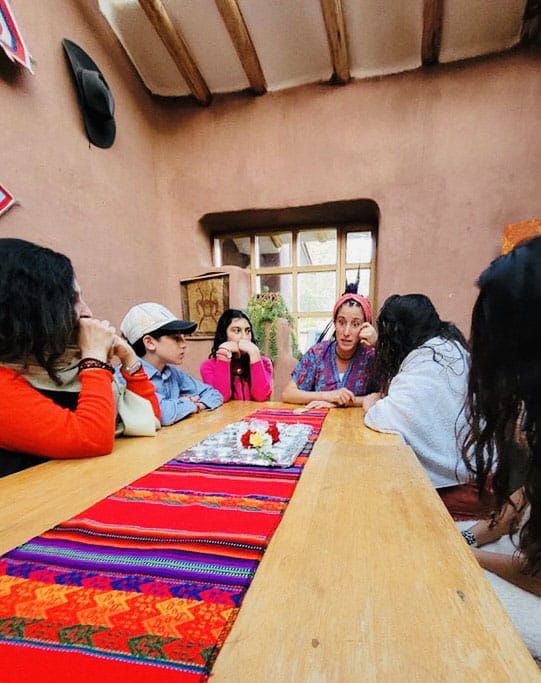
When I visited her this year in Colorado, we hiked together, in awe of the nature around us. Our nervous systems felt recalibrated, and as we reached the peaks of the snowy mountains we realized we were not separate from this extraordinary nature, but rather a part of it. In that moment, we knew we needed to share this sacred feeling with others, and so we decided it was finally time to take a trip to Peru. We created the “We Are All Extraordinary Retreat” to help us remember that each of us is truly extraordinary.
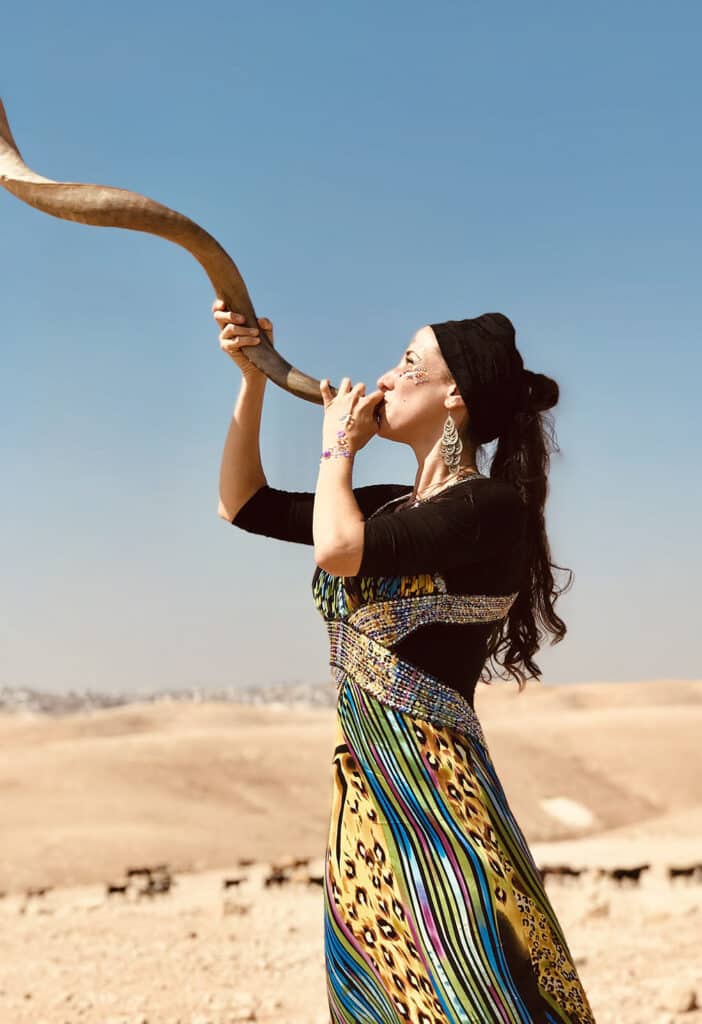
But I am a religious Jew, and it’s often difficult to travel in a way that is “kosher” while connecting with foreign cultures. There is the struggle to stay clean of Avodah Zara (idolatry), to keep kosher, and to have Shabbat with challahs, grape juice, Kiddush cups and hand-washing cups miles away from home. Because of this difficulty, I would take the lead on all things kosher. I would also bring the Torah and spiritual teachings, and of course my infamous enormous shofar. We wanted to give Jews the chance to really experience nature, while immersing in another culture in a way that still honors and celebrates our own.
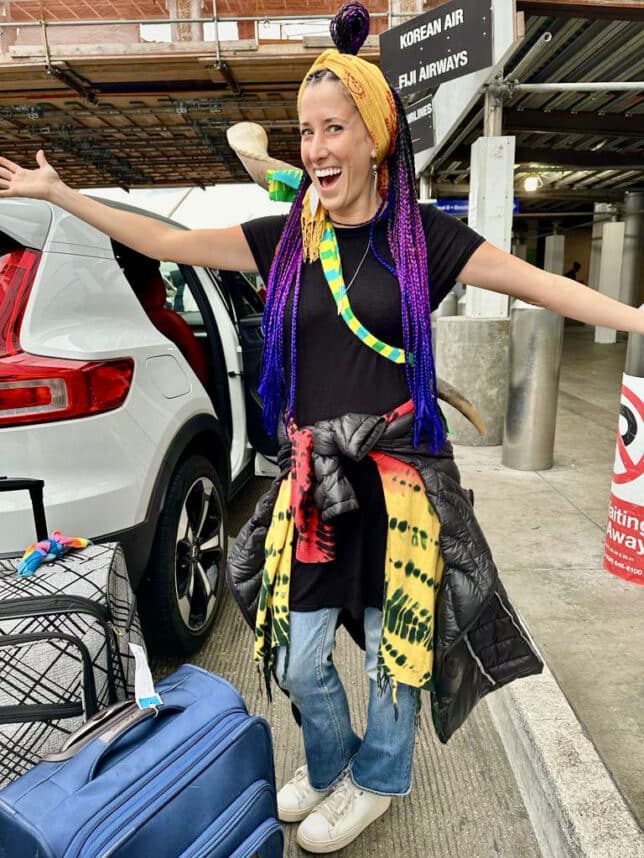
The anticipation was high. I felt so cool with my newly braided hair, which makes travel easier, and my beloved Shofar that I’ve taken around the world. I trotted happily off to Lima!
But then disaster stuck.
When he saw my shofar, the customs guard in Lima said, “Wow, what is that?” I said proudly, “It’s my ritual prayer horn, I am a spiritual leader, and I am leading a sacred retreat!” He asked to see it, as if he was curious, but little did I know it was his plot to seize it from me. He took it and ran to the customs office where he placed it in the trash. He crossed his arms, blocked the way and looked at me with apathetic eyes. My heart shattered all at once.
I can’t say I’m proud of what happened next because my middot (my good character traits) went out the window as I nearly lost my mind. “You can’t do that! You deceived me!” I tried to claim religious exemption. I called for help and for the police. I phoned friends who speak better Spanish than me and tried to have them explain that the shofar is a tradition of our ancestors (Peruvians respect ancestral traditions), but customs declared I would not enter the county with that horn no matter what, and that they must destroy it.
I was devastated and so my dear friend and co-leader, Tsipporah, and I did the only thing we knew to do: contact Chabad! She contacted Mendel Carlebach at Chabad of Lima who said they would do whatever they could, and they also reminded me to pray. Not only was I going to pray, but I was also going to ask everyone I knew to pray for the return of my shofar.
I posted quickly on Facebook since it’s the best way to access many people quickly: “Today I literally fell to my knees crying and begging as the airport in Lima confiscated my huge shofar aka my third arm. It is the most precious thing I own and I’m just devastated … Please, please, please give Tzedaka or say a prayer for the return of my shofar … It may sound silly to you, but to me it’s a part of my identity and purpose in this world and spiritual mission and destiny … And there is nothing we can’t pray about … so please, be my prayer team … the tears just keep welling up in my eyes … Hashem, thank You for taking it from me, and thank You, please, for bringing back asap.”
With my head hung I proceeded to fly to the retreat center in the Sacred Valley of Pisac, trying to trust and surrender. If it was God’s will that I get my shofar back, I would, and if not, it would be a tremendous lesson in letting go.
That evening I received an influx of messages, comments and emails from people sharing that were praying for me. Then I got a WhatsApp message from a man named Rabbi Shoshan Ghoori of the Orthodox Union. His message really shook me to the core: “You don’t know me but I saw your message on Facebook and I’m well connected in South America. I’m going to do everything I can to help you get this shofar back!”
He began to reach out to important people in politics and in the Jewish community. Later that day, his lawyer Sandro Monteblanco called me and said he was also on the case. Chabad called. Rabbi Ghoori’s wife Miriam called and said she was Peruvian and happened to be flying to Lima for a couple of days and would go to customs and see what she could do.
That Shabbat, as retreat participants gathered around the Shabbat candles, we shared our highs and lows. With tears welling up in my eyes I shared that my high was losing my most prized possession, because it reminded me how much Jews care for one another and how we come to each other’s aid in times of need—even complete strangers! I was deeply touched. And this was my first lesson: We truly are a loving family!
Elena Dabul actually captured the moment I was sharing what happened before the Shabbat candles.
I still had no shofar, but the Nation of Israel was on my team and I had a retreat to lead.
As we hiked and journeyed around the area, I realized that nearly every time we struck up a conversation with someone, we would find that they were an estranged Jew or a person with Jewish heritage. That there are “lost Jews” everywhere was my second lesson. My teacher Morah Leah Golomb used to teach us that when Mashiach comes we are going to be flabbergasted to find out who is Jewish.
For the second Shabbat (after the retreat participants had left), I went to a raw vegan restaurant to see if I could pay on Friday and eat on Saturday because “I am Jewish and I keep Shabbat.” The Rasta manager, with dreadlocks past his waist, looked at me and said, “I get it, I am too.” Then there was a light-skinned, blue-eyed 51-year-old man named Michael who had been traveling in the Caribbean for the last 13 years. He found out we lived in Israel and he told us that his mom is Jewish, and their ancestors had converted in 1492 in Spain. “But today I know nothing,” he said. We spent the rest of Shabbat answering his questions on Kabbalah.
Then there was Fito, the handsome young Peruvian ceremony leader with a stunning feather crown (donned for a healing ceremony I participated in). I approached him in advance and said, “Listen, I am Jewish and I only stand testament to One God, so if anything conflicts with that, I’ll need to leave the hut.” “Of course,” he answered, “I understand. My heritage is Jewish.” My mind was blown.
And of course there was David, a huge Shaman guy with a painted face from Venezuela next to me in the ceremony who said, “I want to tell you that before Venezuela, my family originally came from Israel.”
Perhaps the most special of all was Elena Dabul, a reiki specialist who was also staying at the retreat center. I could hear a hint of Israeli in her voice, and we bonded to share her first candle lighting and Shalom Aleichem in 25 years. She couldn’t believe she had come all the way to Peru to lead women’s prayer circles to reconnect to her Jewish roots.
The third lesson I learned is that we are all more similar than different. The conversations about prayer and the Shechinah (the Divine Feminine Presence) continued for hours with Elena. She told us about her practice of praying in the Four Directions (a widely held tradition in indigenous cultures in the Americas), and we shared with her that this is a deeper meaning behind waving the Lulav, and the esoteric wisdom behind the Magen David (the “Jewish Star”) and that we also acknowledge the directions. She shared with us about ego and fear in Shamanistic wisdom, and we shared with her how Judaism is all about teshuva (coming back to our highest loving selves) and working back to unity.
The fourth lesson: “There is nothing new under the sun” (King Solomon, Ecclesiasties). Between the epic Jewish heritage encounters, I was still yearning for good news about my shofar. My dear friend Jessica Leah Tabak left me a message about the missing shofar that helped me understand that all of our blessings and perils are found in the biblical narrative and we are simply re-experiencing different versions of the stories in every generation in order to teach us profound soul-lessons.
She told me, “Nili, you sound just like Yaakov and the ‘pachim ktanim’ (the small vessels).” There is a story in Parshat Vayishlach about how Yaakov left something very precious across the Yabbok River and needed to retrieve it even though his family was now in enemy territory. So the commentaries ask, what was so important that he needed to do this? My teacher Leah jokes, did he really care that much about his Tupperware? The sages answer that these small vessels contained oil squeezed out from the famous olive branch in the Noah’s Ark story (the branch retrieved by the dove that let Noach understand that the world would go on), and these small vessels actually represented Yaakov’s (and the people of Israel’s) purpose in life, to bring the message that there is hope for the world. She said, “You’re the same, just with your shofar. That’s why it’s so important to you.” She was right, and even more fascinating, it turns out that that is the Parshah I was born in.
All in all, it was worth losing the shofar to truly feel how much our national mission of bringing hope, peace and unity to the world truly means to me. (The shofar is said to be heard on the Great Day when Elijah announces the coming of the Messiah.)
All in all, it was worth losing the shofar to truly feel how much our national mission of bringing hope, peace and unity to the world truly means to me.
It was worth losing the shofar to show a small group of Peruvians how sacred and precious our holy tradition is still to the Jewish people today in 2023.
It was worth losing the shofar to see Am Yisrael come alive and support one another.
It was worth losing the shofar to remember that God always has a plan. Rabbi Ghoori’s wife Miriam (who had gone to customs for me to explain what the shofar was so they wouldn’t throw it away, and to stall them from destroying it until we could get permission to reclaim it) said that she had no idea why she made such a crazy and short trip to Lima when she had just returned from Israel. She was befuddled by her own weird and exhausting plan, but now she understood why she needed to make that trip—for another Jew.
The We Are All Extraordinary Retreat Participants at Machu Picchu
The final lesson I learned: It’s as if there’s a loving Creator of the Universe planning everything behind the scenes. The One who holds the stars is holding our whole lives. He is holding up the extraordinary Peruvian mountains of Machu Picchu and the whole Earth upon nothingness, and He is holding us and planning every detail of our lives according to our highest growth, goodness and unity. Sometimes that looks like a devastated heart and a lost prized possession like a shofar. Sometimes it looks like a lost Jew found and reconnected. He knows what He is doing, He is doing it with Love, and this whole experience has taught me that I can learn to trust and surrender—perhaps one of the most important lessons in life.
So did I get my shofar back? Thank God, yes! Through the help of all the wonderful Jews who reached out, and with my friend Rebecca Rocker going out of her way to pick it up from customs, I did get it back. But I got more than that. I had my faith reinvigorated: in others, in myself, and in God’s extraordinary plan. And now I get to share it all with you, my extended extraordinary family.
Rebecca Rocker Nazarian of Sinai Temple and the Balter girls who got the Shofar back from customs for me – bless them!
Nili Salem is a psychotherapist and a Torah teacher living between Los Angeles and Israel. Nili’s previous shofar videos from around the world, and a slideshow of her “We Are All Extraordinary” Retreat in Peru can be found on her YouTube channel, Instagram and Facebook. Stay tuned this coming month of Elul for a new Shofar video every da.! Nili can be reached at nilisalem@gmail.com.
To read more articles from The Media Line, click here.
A new survey by the Pew Research Center found that 87% of Israelis polled have a favorable view of the US. For the Fourth of July, The Media Line spoke with foreign policy experts and Israeli citizens to hear their thoughts on the US and its role in global affairs.
“The relationship that Israel has with the United States is not based upon religion,” said Dr. Yonatan Freeman, a lecturer in the Political Science Department of the Hebrew University of Jerusalem. “It’s mainly a relationship based on values and peoples.”
Freeman also said the US had supported Israel since its inception and funded its military for decades, further boosting public support.
“Everybody knows the US is a rich country,” said Israel resident Shelly. “It has an interest to support Israel because we’re kind of advancing Western culture in the Middle East.”
“I think we get pretty good support,” said Tel Aviv resident Hillel. “The US is a living country with a great tradition of democracy and a lot of good things are going on over there. So people [in Israel] are kind of inspired by what the US is doing.”
Military support is part of a long history of US aid to Israel and helps explain why the Israeli public has continued to back the US through multiple presidential administrations. In 2019, polls found that 71% of Israeli respondents had confidence in then-President Donald Trump’s foreign policy, a slightly higher figure than the 68% who reported confidence in President Joe Biden’s approach to global affairs.
Freeman says President Biden’s focus on domestic policy and his hands-off approach to Israel could also be helping his approval rates.
President Biden “is mainly focused on issues unrelated to Israel,” Freeman said. As a result, the Biden Administration has not dwelt heavily on the Israeli government’s controversial proposals to overhaul the country’s judiciary or its military operations in the West Bank and Gaza.
Freeman says President Biden’s unwillingness to loudly criticize Israel has been reflected in the Israeli media, which plays a significant role in shaping the public’s perception of the US.
“I think that looking at the media here, it has not been very critical of Biden,” Freeman said. “I think he’s seen in a positive light here in the media.”
Some of the Israelis that The Media Line spoke with had no strong opinion on President Biden or criticized his leadership for reasons unrelated to Israel or the Middle East.
“I don’t think he’s too involved with Israel,” Shelly said. “I just think he understands that Israel is important for the US.”
“I think he’s too old,” Israel resident Diane said. “I think you need a younger, strong—but not strong like radical, extreme right or something—a president that knows politics, that understands what’s going on in America.”
Freeman says Biden may also enjoy strong approval ratings in Israel because he has maintained popular Trump Administration policies, such as moving the US Embassy to Jerusalem and supporting the Abraham Accords normalization deals between Israel and several Arab countries.
And some Israelis, Freeman noted, disagreed with President Trump’s domestic policies.
“If you look at social types of policies, Israel is very much more liberal,” Freeman said. “When it comes to health insurance, when it comes to women’s rights and different things, some in Israel would find that maybe America is a little bit too conservative.”
A more liberal Israeli perspective on social policy has helped President Biden’s standing with many Israelis. Some, moreover, view the current president as a protector of Israeli democracy, while others feel he is a more calming presence on the world stage.
“Our situation is awful; we are not a democracy anymore,” said Israel resident Esther. “We need the United States and Biden.”
“The character he presents makes a good impression on people, kind of like this calming grandpa,” Shelly said. “He gives some a calm feeling. … People chose him, I guess, because he was better than Trump.”
Patrick Doyle is a recent graduate of San Diego State University and an intern in The Media Line’s Press and Policy Student Program.
It is spectacular watching the fireworks display on the 4th of July. Red, white and blue designs lighting up the dark of the night. The experience leaves adult and child alike with a sense of optimism and inner joy.
And yet, as the fireworks dissipate into the smoky oblivion, there’s a realization that there must be more than fireworks. What sustains and nourishes a beginning spark to ensure the light doesn’t sputter out?
The passion one pours into family, work, or a hobby begins with the glow of a lit match. Think of one of your greatest achievements. Behind success is the methodical, meticulous tending to the embers of courage and a willingness to learn.
When God created the world, we’re told that God’s light scattered. Sparks of holiness begging to be discovered and repurposed. The gathering of the sparks of light is what leads to the perfection and completeness of God’s creation. There is also an understanding that individuals are meant to find particular sparks of God’s light to help lift and refine the essence of their being.
When we discover what fuels us, it is a divine act to sustain the fire within. An act that leads to the repair of the world.
It is more than fireworks momentarily brightening a summer sky.
It is the revelation of God’s enduring light. The magic that emboldens your soul.
Shabbat Shalom
Rabbi Nicole Guzik is a rabbi at Sinai Temple. She can be reached at her Facebook page at Rabbi Nicole Guzik or on Instagram @rabbiguzik. For more writings, visit Rabbi Guzik’s blog section from Sinai Temple’s website.
no more will ruin this great rabbi’s breathless broth,
served hevellessly by the man while wearing cloth,
and who will go on serving, we hope, while in Cambridge,
not burning when in Massachusetts the same bridge
on which we used to meet in cyber-correspondence,
my hiddushim and my poems’ high preponderance
enhanced by comments made with brilliant insight,
which when he moves from Sinai to that sin site
will hopefully become less sinful, though I will not hold
my hevel lest he Qohelesses with unfrum fold;
unlikely, I think, since I’m sure he will continue
inspiring–sans his Sinai books!— the ivied retinue.
Sinai Temple announced on 6/23/23:
A Book Give Away
Rabbi Wolpe is Giving Away His Massive Book Collection
We are giving you an opportunity to own books from the library of Rabbi David Wolpe. Over his 20+ year tenure at Sinai Temple, he has amassed thousands of books including memoirs, biblical texts, history tomes, political books, poetry collections and more.
For one week only, his library is open to you. Come walk the bookshelves in his former office and take whatever books inspire you and pique your curiosity.
Gershon Hepner is a poet who has written over 25,000 poems on subjects ranging from music to literature, politics to Torah. He grew up in England and moved to Los Angeles in 1976. Using his varied interests and experiences, he has authored dozens of papers in medical and academic journals, and authored “Legal Friction: Law, Narrative, and Identity Politics in Biblical Israel.” He can be reached at gershonhepner@gmail.com.


 Los Angeles poet Rick Lupert created the