fbpx

June 23, 2023

A Day at Las Vegas’s Punk Rock Museum with its Jewish Founder, Fat Mike

One of the many Jews who have been a pillar of the punk rock music scene is Mike Burkett, aka Fat Mike, the singer and bassist of the band NOFX and owner of the record label Fat Wreck Chords. In April of this year, he opened The Punk Rock Museum in Las Vegas. It would have been natural for the museum to be located in New York, Los Angeles or Oakland, the cities where punk first took hold, but the real estate costs were simply too high. “Vegas is also the most punk city in the country”, Mike told the Journal. “It plays by its own rules.”

Fat Mike took the Journal on an exclusive tour of The Punk Rock Museum — and was apt to point out every Jewish-related artifact and musician, a group which includes Lou Reed, Joey and Tommy Ramone, Bad Religion‘s Brett Gurewitzand Greg Hetson. “I wanted everyone to feel comfortable coming to this museum,” he told the Journal. The lobby is a stark, modern-industrial space — black walls with oversized black-and-white photos. The rest of the rooms are packed floor-to-ceiling with memorabilia: Posters, crude, Xeroxed leaflets announcing gigs bands would wheat-glue onto utility poles and walls, albums, picture sleeves for singles, instruments, tee-shirts and more. They’re a testament to the punk scene’s tenets of inclusiveness and do-it-yourself style.

Throughout the tour, Fat Mike would unlock exhibits to adjust artifacts and add his collection of LPs. The first exhibit he adjusted was a tiny bag with what looked like dirt. It was the last bag of weed from the late Joe Strummer of The Clash. “Do you see the problem?” Fat Mike asked. “It’s poorly lit!” He opened the exhibit door and adjusted the spotlight with his bare fingers, letting out several audible screams. “Look how much better that is!”

The number of bands included in the museum is overwhelming. You’ll see collections of the now defunct Maximum Rocknroll magazine, a couch used by Kurt Cobain from Nirvana, L.A. Punk pioneer Darby Crash’s (The Germs) phone book,  Billie Joe Armstrong’s (Green Day) first amplifier, the shirt the late Joe Strummer wore at his last performance. There’s a letter from a 15-year-old Dave Grohl of the Foo Fighters wrote to Necros  — the Detroit hardcore band — asking for stickers and for them to play in his home town of Washington, DC. There’s original concert posters from Motörhead, a shirt from Iggy Pop’s 1977 tour, and an astounding amount of setlists and handwritten lyrics.

Two years ago, Fat Mike put out a call to all punk musicians to donate their own artifacts that might be rotting away in their garages or storage lockers. “If you want to see something, send it,” Fat Mike said. “We reached out to as many people as we could and a lot of people just didn’t send stuff. They didn’t really believe we were opening.” The band Pennywise donated tons of equipment from their Hermosa Beach rehearsal space they used in the early 1990s. They donated so much that the old rehearsal space itself was fully-recreated at the museum. The instruments are plugged in too, for future mini concerts.

One feature that sets the museum apart is the extensive lineup of punk musicians who will act as tour guides. In May, the punk docents included Greg Hetson, Strung Out frontman Jason Cruz, and Chris Demakes from Less Than Jake. This month included Marko DeSantis from Sugarcult and Jack Grisham from T.S.O.L. In July, visitors can get tours from Dave Baksh from Sum 41, Jonny Wickersham from Social Distortion and Stacey Dee from Bad Cop/Bad Cop. The July 23rd tours led by drummer, actor and Grammy-nominated comedian Fred Armisen sold out in mere minutes. The lineup changes daily, depending on who is in town. Since the museum’s opening this spring, there have been surprise visits from Flea of the Red Hot Chili Peppers, Dexter Holland and Noodles Wasserman of The Offspring and skateboarding legend Tony Hawk.

There is even a jam room where fans can plug in and play some of their musical heroes’ instruments — among them, Joan Jett’s guitar and the late Wesley Willis’ keyboard. There is no rule forbidding visitors from jamming an overplayed song — they can even play “Stairway to Heaven” if they want. The room is closely watched — both to make sure no one walks out with a valuable guitar, but also so no one decides to imitate the cover of the Clash’s “London Calling” and smash a guitar.

At one point on our tour, Fat Mike noticed a father and son, Omar Muniser Sr. and Omar Muniser Jr., both wearing keffiyeh around their necks. They reside in San Bernardino County where play in the punk duo Paint The Town Rad.  “I’m doing an interview with the Jewish Journal right now, and f–kin’ hanging out with the Muslims!” Fat Mike quipped. “Jews, meet the Muslims. Muslims, meet the Jews.”  It turned into 30 minute conversation about cycles of intergenerational hatred and abuse, squabbles with lovers and friends, and Fat Mike’s geopolitical observations from touring the world for nearly 40 years with NOFX. We talked about Middle Eastern food and customs and then Fat Mike regaled the story of his first visit to Israel as a teenager.  “Yeah, my dad tried leaving me at a kibbutz,” he said. Fat Mike dared the younger Omar to go to a telephone pole displayed in the museum with replica concert fliers stapled to it. When Omar Jr. finally ripped off a flier, Fat Mike yelled, “He’s taking shit from the museum!” Ripping the flyers is actually encouraged.
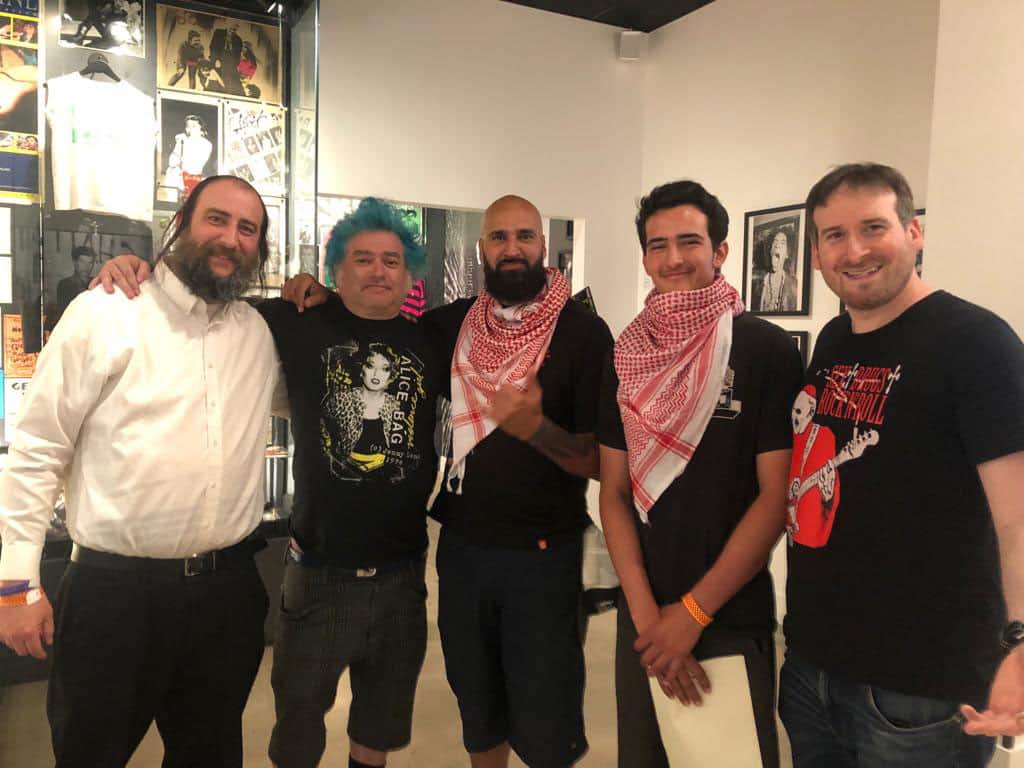
Omer Hendler, Fat Mike, Omar Muniser Sr., Omar Muniser Jr., Brian Fishbach (Photo by Melanie Kaye)

The Punk Rock Museum has much more than history. It encourages a communal feel where visitors are encouraged to meet each other. There’s a bar called the Triple Down where you can get several musician-concocted drinks, including one served in an empty Pringles bottle. There’s outdoor picnic tables with views of the Stratosphere Tower. On the museum’s second floor, there’s a chapel for punk fans to get married. There’s even a tattoo shop.

“Music transcends and brings people together on so many levels,” Maya Hendler, who was visiting the museum, told the Journal. “Go to a punk concert, everyone’s in a mosh pit together. The bigger people look out for the smaller people. Being the smaller girl, I’d always found a bigger guy that would look after me. It’s a community.”  Maya brought her husband Omer to the museum as a birthday gift. “The preconceptions that you have about people who you are not normally around or you don’t know, that all goes away with music because music is real,” Omer told the Journal. His friend Dovid then texted him the metaphor of the day: “Jews are the original punk rockers. Social outcasts, our mission shunned by mainstream society and a constant source of inspiration for those involved, while staying a target for those outside the fold. The metaphor continues…”

“Jews are the original punk rockers. Social outcasts, our mission shunned by mainstream society and a constant source of inspiration for those involved, while staying a target for those outside the fold.”

As we parted ways, Fat Mike said to me, “Man wasn’t that fun? Today was the most fun I’ve had here so far.” There’s no guarantee that Fat Mike will be there when you visit, but there is no doubt that there will be visitors from the punk community celebrating the music they love.

A Day at Las Vegas’s Punk Rock Museum with its Jewish Founder, Fat Mike Read More »

You Can’t Say You Can’t Play

We all carry the nicks and scratches of childhood.

I vividly remember an incident in the third grade. After a spat, two classmates ignored me all through recess. As we were walking back into school, one of them pointed to me and said “We aren’t talking to Chaim; he’s not normal, you know. He doesn’t have a father, and anyone who doesn’t have a father must be crazy.” The remark really hurt; being an orphan was something I was terribly self-conscious about. The cruel schoolyard teasing poured salt into an open wound, and this insulting rejection made me feel profoundly lonely.

No one likes being excluded. To have others judge you as undesirable is extremely painful. And while exclusion is challenging for individuals, social divisions are toxic for communities.

Korach is the paradigm of the community divider. The Talmud says “Anyone who perpetuates a quarrel violates a prohibition, as it is stated: “And he should not be like Korah and his assembly”; the importance of unity is derived from the negative example of Korach.

To fully understand this imperative, one must first consider how Korach’s quarrel started. The narrative begins with the vague words “and Korach took”; but what exactly Korach took is unclear. Perhaps, as the Midrash and the Netziv suggest, he took the hearts of his followers through persuasion. The Ramban sees it as referring to Korach taking a particular opinion; it is a reference to the inner workings of Korach’s mind, when he took the decision to mount a battle against Moses.  Rashi offers a very different view. He explains that the phrase means that Korach “took himself to one side” to separate from the rest of the community. Korach is creating social distance even before he comes with his complaint. Rabbi Yoseph Bechor Shor adds that the Hebrew letters for Korach are the same letters as the word for distant; the root of Korach’s rebellion is when one man decides to stand a distance from the community.

While this debate between Rashi and the Ramban is about the interpretation of one word, it offers as well an insight into the genesis of disputes, an issue that is frequently discussed by contemporary political scientists. Are the social divisions of polarization simply a product of intense disagreement, or does polarization itself begin with social distance, which then fosters disagreement? The Ramban focuses on the intellectual aspects of a community quarrel: two sides have conflicting views (and interests,) and for that reason are in conflict. Rashi offers a different account. Before Korach mounts his insurrection, he first and foremost separates himself, and stands alienated from the rest of the community. He’s no longer part of what they’re doing. Only then does the quarrel begin.

Rashi reminds us that polarization is often a product of social divisions and not the other way around. Local communities frequently forge strong individual bonds, and thereby avoid polarization despite political disagreements. Polarization arises when the conversation becomes global, and strangers, inflamed by TV talking heads, debate each other on Twitter; then it contaminates every community, no matter how tight-knit.

In short, distance fosters dispute and division. Similarly, small schools are less likely to form cliques than large ones; the intimacy of constantly being together with other students prevents exclusion.

The importance of community is critical in Jewish thought. The Talmud (Keritot 6b) says that any public fast day, (such as Yom Kippur,) that does not include the sinners of Israel is not a true fast day. The entirety of the community needs to come together as one, even if some have acted improperly and imperfectly. No person should be left behind.

This is easier said than done. Large synagogues can sometimes feel like train stations; everybody boards at the same time and take their seat, but outside of friends, have no interest in anyone around them. Gary Rosenblatt relates how a friend told him that when he was sitting shiva, he couldn’t identify someone who visited the shiva house several times. “He looked familiar but I couldn’t place him….I finally asked him who he was and he said, ‘I’m the guy who’s been sitting in your row in shul on Shabbat for the last six years.”

That’s what it’s like praying in a train station. You don’t know the other commuters. You can sit far apart, even while sitting in the very same row. And in that distance, exclusion emerges.

The most worrisome impact of these social distances is how they impact our kids. Even if the school mandates it, students will refuse to show up at the bar mitzvah of someone who isn’t part of their clique; they’ll simply mail in the reply card, and then claim to be sick that day; the empty seats at the Bar Mitzvah lunch speak of an ugly social divide.  Birthday parties will exclude some of the children in a class; parents will thoughtlessly push aside the kids they think “don’t belong.”

I have thought for a long time about how to address this issue. A quick review of Pirkei Avot makes it clear that exclusion is against fundamental Jewish values. Pirkei Avot teaches the importance of loving all people (6:6,) greeting others warmly(1:15,) bringing people together(1:12,) carrying the burden of others(6:6,) and not separating from the community(2:4.) It should be easy to preach against exclusion.

But I had to pause for a moment. If we are honest, we need to accept that it may be instinctual to exclude. The teacher and researcher Vivian Gussin Paley, in her book You Can’t Say You Can’t Play, describes an experiment in her Kindergarten classroom. She explains that she began to lose patience with the voices of exclusion in her classroom. So she put up a sign that said: you can’t say you can’t play. As she describes it: “I announced the new social order and, from the start, it is greeted with disbelief. Only four out of 25 in my kindergarten class find the idea appealing, and they are the children most often rejected.” There is enormous resistance in Paley’s classroom.

One child said it straight: “It will be fairer, but how are we going to have any fun?” This is not just how a kindergartener thinks; adults consider what is exclusive as being far more desirable. But exclusivity often begins by excluding others; one needs a bouncer to make any gathering truly unique. The allure of exclusivity is that it separates the elite from the ordinary; and there is no greater balm for a fragile ego than to imagine that one is something other than ordinary. (Yes, excluders are often quite insecure.) Exclusion is part of a quest to feel special; and doesn’t everyone want to feel special? If we are honest, we will recognize that exclusion is instinctive.

But there is more to humanity than instinct; and even these young children in Paley’s were able to listen to the better angels of their nature. She explains that after a short while, inclusion became the norm in her classroom; the new culture had a powerful effect on every child. They recognized it was the right way to do things and eventually embraced you can’t say you can’t play.

But for many children, it took an effort to be inclusive. In a later interview, Paley talked about Lisa, the kindergartener who at the time offered the most strenuous opposition to the you can’t say you can’t play rule. Lisa eventually understood how important it was. But as Paley explained:  “All the years later, whenever Lisa..met me in the hallway, she would always stop and ask me how is the rule doing, and give me an example of something she had done that showed she was still trying to follow the rule. The last time I met her was in the grocery store with her mother, and she said, “Mrs. Paley, it’s still pretty hard for me, but I know I can do it, and I always try.” And her mother nodded, and said, “She really does, you know.”

Yes, inclusion is possible if we really try. And try we must, because it changes who we are. Life is diminished when lived in a tiny corner. To be clustered into a tiny clique of the like-minded impoverishes the soul; it is like living in black and white, unable to appreciate the true color of the world around us.  More significantly, separating into little social factions weakens our sense of community; and that hurts our synagogues and schools.

But above all it is wrong. To take yourself to one side and create a distance between yourself and others is hurtful. The pain of the child who gets left out is very real, and I can personally attest to that. The echoes of exclusion linger, even decades later.

Perhaps exclusion is an inborn tendency. Even so, there is no question that all of us can do better. Kindergartners can learn the rule you can’t say you can’t play; so why can’t their parents?


Rabbi Chaim Steinmetz is the Senior Rabbi of Congregation Kehilath Jeshurun in New York.

You Can’t Say You Can’t Play Read More »

“You Stupid Jew”: Man Arrested After Shouting Antisemitic Slurs in front of Encino Kosher Restaurant

A man can be seen shouting antisemitic slurs to a handful of men in front of a kosher restaurant in Encino in a video that has gone viral on social media; a suspect has since been arrested.

In the video, the man confronts another man on the phone and says, “I came to ask you a question about why this s— is painted the way it is because it was stolen off my shirt when I walked by here. You understand that, you stupid Jew?” He then accuses him of “stealing money from everybody.” A larger man then confronts him, prompting the perpetrator to call the larger man an “immigrant f—” and to “go back to your country.” The man then pulls something out of his car, puts it back in and before driving away shouts, “Jew f—” and “I lost my virginity to a Jewish b—- and I was underage. Welcome to my country. Keep your mouth shut because you have a dumb accent.”

Yehuda Benschitrit, who took the video, told the Journal that he and his two business partners at a water damage company were parking to shop next door on Wednesday and the owner of Melrose Burger N’ Fries parked at the same time; they noticed the man was yelling at them. “We just see this guy yelling … and as soon as we looked, the guy was staring at us, he sees us staring at him and he’s like, ‘What you looking at? What you looking at?’ and trying to get all in our faces,” Benschitrit said. That’s when Benschitrit started filming. “He was just yelling antisemitic slurs, just yelling,” Benschitrit said. “I wasn’t really paying attention to what he was saying in the moment, I was just making sure that nothing was going to escalate. But the owner did tell us that this guy was there the night before, saying stuff to the owner as well. And when we parked, he was just there.”

When the man pulled something out of his car, Benschitrit tried “to run back into the next store because I didn’t know what he was pulling out.” What he pulled out was “a confetti cannon” that “shoots confetti with a loud noise,” Benschitrit said.

The owner of Melrose Burger N’ Fries––the man on the phone––was calling the cops at that time, Benschtrit said. A spokesperson for the Los Angeles Police Department (LAPD) told the Journal that they arrested the suspect, who the LAPD identified as Simi Valley resident Roy Azimi, on charges of criminal threats.

“The scene depicted in that video is egregious,” Anti-Defamation League Los Angeles Regional Director Jeffrey I. Abrams said in a statement to the Journal. “We are appalled by this blatant antisemitic hate incident but grateful for the swift action of the Los Angeles Police Department in taking the alleged perpetrator into custody.”

Melrose Burger N’ Fries posted to Instagram, “We know this incident is not an isolated one. Hate crimes are on the rise in our country, and we are all feeling the effects. But we are also inspired by the outpouring of support we have received. Your messages of love, solidarity, and strength have given us the courage to move forward. We know that we are not alone, and that together, we can make a difference.”

“You Stupid Jew”: Man Arrested After Shouting Antisemitic Slurs in front of Encino Kosher Restaurant Read More »

“No Hard Feelings” Delivers Easy Laughs

Those with a craving for a summer comedy will enjoy “No Hard Feelings.” Written and directed by Gene Stupnitsky, “No Hard Feelings” isn’t flashy but has a sure hand behind the camera. Lawrence hits a home run as Maddie, an Uber diver without a car. She spots an ad for a Buick, but it comes with a catch: She must agree to deflower the owner’s nerdy 19-year-old son.

Lawrence’s confident performance allows her to show off a knack for comic timing not seen previously.  Best known for playing Katniss in “The Hunger Games” and Mystique in Marvel’s “X-Men” movies, Lawrence won the 2012 Best Actress Oscar as Tiffany in “Silver Linings Playbook,” but she has never done a flat-out comedy. That an Academy-Award winner would be okay with a scene where she wrestles naked might seem like a step back. But that scene has a lot of laughs, and “No Hard Feelings” serves as a declaration of freedom by an actress that she can do whatever she wants and do it well.

Stupnitsky, who was born in Ukraine and grew up in Chicago, was bar mitzvahed, and has an impressive resume. On TV, he wrote and directed for “The Office,” and created two series: 2014’s fish out of water comedy “Hello, Ladies,” and “Jury Duty,” a combination sitcom and reality show currently streaming on Freevee. He wrote the 2009 Jack Black caveman comedy, “Year One,” and “Bad Teacher,” a 2011 hit starring Cameron Diaz, and  in 2019 wrote and directed “Good Boys,” a preteen farce.

“No Hard Feelings” is a story of two people who are radically different but have some things in common. Andrew Barth Feldman, who stars opposite Lawrence as Percy, the virginal teenager, shows shades of Jesse Eisenberg and Michael Cera. In a nod to the raunchy R-rated comedies of the 1990s, Stupnitsky lifts a gag from “American Pie.”

Feldman deserves praise for his first major feature film role, while Lawrence continues to show her versatility. Their chemistry is put to especially good use in a scene involving Hall and Oates “Maneater” as Maddie fights back tears.  “No Hard Feelings” is a well-executed film that may in a small way fight the stigma that comedies are of lesser artistic value than dramas.

“No Hard Feelings” Delivers Easy Laughs Read More »

All It Takes Is One Accident

2 weeks in a row during my excersise walk with Zero at La Cienega park – BOOM! – 2 cars get into pretty big accidents. Last week La Cienega and Whitworth, this time La Cienega and Olympic. Both times nobody needed medical attention when offered, both times I stayed and helped gather what they needed photos of and helped move their cars out of the streets. Just very weirdly deja vu…

Months ago, there had just been an accident on La Cienega and Whitworth, but this one a car and a motorcycle. That young man tragically lost his life. Accidents will happen, it’s not an if it’s a when, so put on your seatbelts at all times, make sure your kids are in their proper car seats of their correct age and size, and if you ride a bike or scooter, wear a damn helmet. Though don’t get me started on my feelings of the danger of motorcyclists on city streets. All it takes is one accident…


Boaz Hepner works as a Registered Nurse in Saint John’s Health Center. He grew up in LA in Pico/Robertson and lives there with his wife and daughter.

All It Takes Is One Accident Read More »

How to Buy a Rug in Marrakech

On the fifteen hour flight to Marrakech, I made a short to-do list: the city’s famed gardens, the Yves St. Laurent museum, the old Jewish quarter and cemetery, and couscous and tagines every night for a week were a must. I also knew what I didn’t want to do. I did not want to buy a rug, a mistake I had already made in Istanbul years ago. I decided to avoid the medina (old marketplace) until I was ready to plunge into what had been described as a maze of alleyways packed with a mind-boggling collection of merchandise and snake charmers.

Marrakech cast its spell immediately. After I unpacked, when the riad’s (small guest house) manager told me that the room did not come with a key because guests did not need to lock, I tossed out any pre-conceived notions about security and slipped into my alluring new world.

That first morning, after a light breakfast of small breads, apricot jam, orange-scented honey and strong coffee, I met my guide. I was still in a stupor from the flight but nicely tranquilized by the beauty of bird song and the scent of white roses and jasmine in the riad’s courtyard, when Abdellatif introduced himself. He came with a plan for the day.

An erudite charmer with a degree in English literature, he suggested we spend the day meandering through the medina. When I protested that I was too jet-lagged for the sensory onslaught, he explained his rationale. On Friday, the next day, many sellers would be closed due to religious practice at the end of Ramadan, he said. Besides, with the current heat wave the shade of the medina was the place to be. The new flexible me acquiesced with one caveat. “I am not buying a rug today,” I said, giving him my most serious look.

I fell in line behind him as we plunged into the twisty marketplace. The stench of ancient commerce was baked into the atmosphere. After briskly walking past a universe of tchotchkes, mystery spices, remedies, tea kettles, oils and incense, soaps, scarves and rugs, we dipped into a sophisticated emporium that had an interesting array of jewelry, antiques and ceramics. It was well-lit, air-conditioned and the Diet Coke was flowing. While Adbel took the first of many prayer breaks, I browsed the merch, settling on a modest silver beaded necklace. When my salesman Mohammed (Mo for short) invited me to climb the staircase to view his rug collection, politesse demanded that I say yes. “I will not buy a rug today,” I promised myself as I followed him up three flights of stairs.

Ten minutes later, my resolve melted like so much honey. Out of nowhere, his minions started flinging rugs on the white marble floor like so many pancakes. Before long, we were engaged in the ancient dance of negotiation and pride that takes place between buyer and seller in a land where worlds collide. How could I resist? I played along, pitilessly eliminating many designs. Before too long, to slow the action down I told Mo that I preferred simplicity, blue and yellow, in the modern/antique Berber style. By then we were sharing pictures of our grandchildren and bantering in French like old friends. Then, as my mind left my body, I narrowed it down to two beautiful antique Berbers, still not knowing the price of anything. As much as I like to bargain, I’m never comfortable when the negotiation doesn’t start with a price tag. Where to begin?

Then, as my mind left my body, I narrowed it down to two beautiful antique Berbers, still not knowing the price of anything.

Mistaking me for a rich American, Mo started insanely high and I told him so. After several rounds, when the price was within the normal range, my guide returned from prayer refreshed and ready to help. “Was the current price fair or was it crazy?” I asked Abdel, who I had known for exactly twenty minutes and who was now my trusty financial advisor. He refused to take sides in such a delicate matter. Instead he gave me a wink that said, “Go for it.”

Not quite ready to surrender, I wondered out loud whether I should call my husband, knowing he wouldn’t hesitate to slap me back to reality. That thought stopped Mo in his tracks. “Madame,” he said puffing out his chest. “We all know that you are the boss. Do not speak to me about your husband. You decide!” He had me pegged.

In the well-lit room where we went to sign shipping documents, I pulled out my credit card. I felt empowered by my new identity in the intoxicating city of Marrakech but my hand was still a bit wobbly from the quickness of the dance. Sensing my ambivalence, Mo reassured me.

“Do not worry, Madame” he said. “If you get the rugs home and you are not happy, you can sell them to Bloomingdale’s. This is where they come to shop.”

To celebrate, Abdel and I settled into a shady corner of the marketplace to sip mint tea and nibble on almond cookies. I felt relieved to have gotten the rugs out of the way on my first day. As I felt myself slipping into the gentle world of the ancient city, I was happy not to be thinking about anything as real as a budget. The rest of the week flowed smoothly, like a dream filled with whispering voices, brilliant color, lots of mystery and great beauty.

As for my husband, he loves the rugs. In fact, he’s thinking of framing one to hang over the fireplace.


Los Angeles food writer Helene Siegel is the author of 40 cookbooks, including the “Totally Cookbook” series and “Pure Chocolate.” She runs the Pastry Session blog.

How to Buy a Rug in Marrakech Read More »

4 Israelis Killed in West Bank Shooting Attack, Day After 6 Palestinians Killed in Jenin

To read more articles from The Media Line, click here.

Two Palestinian gunmen killed four Israelis and wounded four more on Tuesday near the Eli settlement in the northern West Bank, Israeli medics reported.

The victims were identified as Elisha Anteman, 17, and Ofer Fayerman, 64, both of Eli; Harel Masoud, 21, of Yad Binyamin; and Nachman Shmuel Mordoff, 17, of Ahiya.

According to Israeli media, one of the gunmen, Muhannad Faleh, was shot dead by an Israeli civilian at the scene of the shooting. The other gunman, Khaled Mustafa Sabah, fled the scene and was killed by Israeli special forces in the town of Tubas, around 18 miles north of Eli.

Prime Minister Binyamin Netanyahu has called for an “urgent security consultation” in response to the attack.His far-right coalition partners are urging a large-scale military operation in the West Bank.

Defense Minister Yoav Gallant described the incident as a “terror attack” and said security officials will meet on Tuesday evening to assess the situation.

Palestinian factions praised the attack. Hamas, the armed group that governs Gaza, claimed the two gunmen as members and said the attack came “in response to the crimes of the occupation in Jenin and the storming of Al-Aqsa Mosque.”

The shooting took place a day after Israeli forces launched a deadly raid in the northern West Bank city of Jenin, in which six Palestinians were killed.

Jenin has become the epicenter of the latest escalation in the Israeli-Palestinian conflict. During Monday’s raid, a gunfight broke out that killed six Palestinians and injured nearly 100. Israeli forces came under heavy fire, with eight soldiers injured in the clashes. Some of the wounded Israeli soldiers were injured after Palestinian fighters detonated a massive roadside bomb next to a military vehicle.

The battle saw the rare use of an Israeli helicopter gunship in the West Bank, which fired missiles in order to provide cover and enable the evacuation of injured Israeli forces.

Israel is conducting almost nightly raids throughout the Palestinian territories, with many of these military operations concentrated in the northern West Bank. Monday’s West Bank clashes were the most serious in years. Photos of the fighting brought to mind images from the 2002 Israeli military operation in the West Bank during the Second Intifada.

Intense fighting took place during the 2002 Battle of Jenin, which was part of Israel’s Operation Defensive Shield. Israel destroyed hundreds of Palestinian homes during the battle.

Defense Minister Gallant warned on Tuesday that “all options are on the table,” apparently suggesting the potential of a larger operation in the area.

During a visit to wounded soldiers, he said that he had “instructed the defense establishment to take proactive and offensive actions wherever there is a danger to the lives of our citizens and our forces.”

Senior Palestinian official Hussein al-Sheikh accused Israel of waging a “fierce and open war” against the Palestinian people, and the Palestinian Authority (PA) threatened retaliatory actions against Israel.

Brig. Gen. (res.) Udi Dekel of the Tel Aviv-based Institute for National Security Studies told The Media Line that the security situation in the West Bank is rapidly deteriorating.

“We are in a trend of escalation. The situation is very clear, especially in the northern part of the West Bank,” he said.

He said that continued Israeli military raids in the West Bank, which inspire resentment among Palestinians,will lead to more clashes similar to what happened on Monday.

“Younger Palestinians are ready to fight against us, because they are fighting against occupation, and they feel very good to fight against the [Israel Defense Forces],” Dekel said.

He noted that Palestinian fighters receive money from Iran and use weapons stolen from Israeli military bases or smuggled in from Syria or Jordan.

According to Palestinian security estimates, there are about 1,500 Palestinian fighters in Jenin and other parts of the northern West Bank, including Nablus.

Jenin is controlled by armed groups affiliated with Fatah, Hamas, Palestinian Islamic Jihad (PIJ), and other Palestinian factions. The various armed groups are closely coordinating their actions.

In addition to the groups associated with major Palestinian factions, a new class of Palestinian fighters is making itself known in Jenin and Nablus. Many of these fighters are younger Palestinians who are dissatisfied with the leadership of the PA. Some are loosely affiliated with the established factions without closely consulting with them or being directly under their command.

The PA security forces have little control in the northern West Bank, especially in Jenin and Nablus. Theirability to impose control in the area has diminished greatly in recent years, with several failed attempts to take charge led by PA President Mahmoud Abbas’ security forces.

Muhammad al-Masri, director of the Ramallah-based Palestinian Center for Policy Research and Strategic Studies and an expert in political and security affairs, told The Media Line that the ongoing raids in the West Bank led to the intensity of Monday’s clashes.

“What happened yesterday was bigger than what the Israeli army expected, and there were a lot of miscalculations,” he said. “This indicates the development of the resistance in dealing with daily intrusions and learning from its previous experiences and adapting.”

“These young men don’t have any past military experience and they seem to have gained a lot as a result of the almost daily clashes with Israeli security forces,” he said.

Al-Masri described Monday’s battle as “a moral achievement against one of the strongest armies in the region,” predicting that it will strengthen the Palestinian cause and lead the Israeli military to reevaluate its strategy around raids.

Both Israeli and Palestinian officials are worried that clashes like those that broke out on Monday could become widespread throughout the West Bank.

Monday’s gun battle was seen by many Palestinians as a victory and a sign of Israeli military weakness, potentially opening the door to bolder military action from Palestinians. The Israeli military may also respond to the clashes by using more troops and stronger equipment in future raids, potentially increasing Palestinian casualties.

Political scientist Menachem Klein of Bar-Ilan University described the “readiness of young Palestinians from all factions to use arms against the Israeli army” as a clear escalation.

“What we saw yesterday is something new,” Klein told The Media Line. “Palestinian resistance enjoys local success and support, and it’s a kind of big achievement in their mind.”

For Israel, the dilemma is whether to respond to the escalation by using increased force in future raids and staying longer in the raided areas, Klein said.

Leaders of the settler movement have called for a large-scale military operation in the West Bank. Far-right Israeli Finance Minister Bezalel Smotrich tweeted during Monday’s battle that “the time has come to replace the tweezer operations with a wide-ranging campaign to eradicate the nests of terror.” Smotrich himself lives in Kedumim, a settlement in the northern West Bank.

Klein said that the settler movement may succeed in applying pressure on the Israeli government.

Hamas and PIJ leaders praised the gunmen involved in Monday’s raid.

“The resistance in the occupied West Bank is strong,” Hamas spokesperson Hazem Qassem said. “The occupation is surprised each time it tries to end the resistance.”

Many members of Israel’s defense establishment claim that Iran is behind the recent escalation.

Iran’s Supreme Leader Ayatollah Ali Khamenei boasted on Twitter last week about PIJ’s actions in the West Bank.

“PIJ [and] other Palestinian resistance movements have found the main key to fighting the Zionist regime. The continually growing authority of resistance groups in the West Bank is the key to bringing the Zionist enemy to its knees, [and] this course must be continued,” Khamenei tweeted.

US Ambassador to Israel Tom Nides responded Tuesday night to the violence in both Jenin and Eli, writing on Twitter, “Deeply concerned about the civilian deaths and injuries that have occurred in the West Bank these past 48 hours, including that of minors. Praying for the families as they mourn the loss of loved ones, or tend to those injured.”

Security experts like Dekel say that the escalation in the Israeli-Palestinian conflict will likely continue.

“Without any political horizon, I don’t see any way, any ability to change the negative direction,” Dekel said.

4 Israelis Killed in West Bank Shooting Attack, Day After 6 Palestinians Killed in Jenin Read More »

The Perfect Drinks for Summer

Summer’s the perfect time to chill out with some refreshing beverages. Whether you are poolside or on the patio with friends or family, you can mix up your cocktail menu. 

Pam Wiznitzer’s Down by the Bay Breeze is a simple play on the classic Bay Breeze. “This frozen specialty adds a dash of sour to even out the flavor and gives it that big apple bite with the apple-infused vodka,” Wiznitzer, beverage director of The Lookup Rooftop in New York City, told the Journal. 

She added, “Apples are a symbolic fruit we eat during Rosh Hashanah, to symbolize the sweetness of the new year. We might as well enjoy that all summer long!”

Down by the Bay Breeze

2 oz apple infused vodka (or apple flavored vodka)
.75 oz cranberry juice
.75 oz pineapple juice
.75 oz lime juice
.5 oz cane syrup
1 cup of ice 

Blend in a blender until smooth. Pour into a rocks glass and garnish with a paper umbrella. 


A favorite cocktail from Mixologist Grant Kneble’s bar, Freddy J’s Bar & Kitchen in Mays Landing, New Jersey, is the Alibi Island Breeze. “This refreshing blend of Mr. Finger’s Alibi Gin, pineapple juice, lime juice, ginger beer, and orange bitters creates an icy, invigorating treat perfect for summer days,” Kneble told the Journal.

The Alibi Island Breeze holds a special place in Kneble’s heart. 

“It’s not just a delightful blend of flavors that encapsulates the spirit of summer, but it’s also a testament to the vibrant sense of community we have here,” he said. “Our local Chabad has even taken a liking to this cocktail, especially since we use a locally-produced gin, Mr. Finger’s Alibi Gin.” 

Alibi Island Breeze Photo courtesy Grant Kneble

Alibi Island Breeze

2 oz Mr. Finger’s Alibi Gin
3 oz Pineapple Juice
1 oz Fresh Lime Juice
3 oz Ginger Beer
2 dashes Orange Bitters

Chill your glassware. (A pint glass is recommended.)
Combine the gin, pineapple juice, and lime in a cocktail shaker filled with ice.
Shake well until the outside of the shaker feels cold, usually around 15-20 seconds.
Strain the cocktail mixture into your chilled glass.
Slowly top the rest of the glass up with ginger beer.
Add two dashes of orange bitters on top.
Garnish with a slice of lime or pineapple, and serve immediately.

“For those who prefer a non-alcoholic option, this cocktail also works brilliantly as a mocktail,” Kneble said. “Simply replace the Mr. Finger’s Alibi Gin with the Ritual Zero Proof Gin Alternative and forgo the orange bitters. You can add a small amount of fresh orange juice to retain a hint of the citrusy flavor.


Mixologist Bash Hovian, aka BASH the bartender, loves making the “Mazel Tov Margarita,” as it combines traditional flavors with a twist.

“The blue and white combination is reminiscent of tekhelet and a symbol of Jewish identity, particularly as it denotes the colors of the flag and unity amongst our community.”
– Bash Hovian

“The blue and white combination is reminiscent of tekhelet and a symbol of Jewish identity, particularly as it denotes the colors of the flag and unity amongst our community,” Hovian told the Journal. 

Mazel Tov Margarita

Mazel Tov MargaritaPhoto courtesy Bash Hovian
Getty Images

2 oz tequila
1 oz fresh lime juice
1 oz blue curacao
1 tsp agave syrup
Ice cubes
Lemon wedge
Kosher salt or sugar for rimming the glass

Mix tequila, lime juice, curacao and agave syrup with ice cubes in a shaker. Strain out the ice and put it in a salt- or sugar-rimmed martini glass. Garnish with lemon.

Caipirinha (eosanches/Getty Images)

Home mixologist Nathan Klabin is a huge fan of Caipirinha, a classic Brazilian cocktail known for its refreshing and tangy flavors. 

“Made with cachaça, a Brazilian distilled spirit, lime, sugar and ice, it’s a perfect drink for warm summer evenings or any time you want to transport yourself to the lively streets of Brazil,” Klabin, who was born in Rio de Janeiro and made aliyah five years ago, told the Journal. 

The first time Klabin had a Caipirinha, he was 16 years old. He was on a family trip, sitting on a hammock and watching the sun set, when his grandfather joined him, a glass in his hand. “I knew about Caipirinha but hadn’t tried it yet,” Klabin said. “With a mischievous glint in his eyes, my grandfather turned to me and said, ‘Care for a sip, young one?’” Klabin hesitated, unsure if he was ready for such a grown-up taste. But the twinkle in his grandfather’s eye reassured him. “I tried it and instantly, a burst of flavors exploded on my tongue,” Klabin said. “The tanginess of the lime, the sweetness of the sugar and the warmth of the cachaça danced together in perfect harmony.” 

He described it “as a symphony of sensations, both refreshing and exhilarating … It was a shared experience, a generational bond that transcended words,” Klabin said. “From that day forward, every time I see a Caipirinha, I’m reminded of that cherished evening with my grandfather.” 

Caipirinha 

2 limes
2 Tbsp granulated sugar (adjust to taste)
2 ½ oz (70ml) cachaça (can be replaced by vodka or rum)
Crushed ice
Lime wedges (for garnish)

Wash the limes thoroughly and cut them into small wedges. Remove any seeds if present.
Place the lime wedges into a sturdy highball glass or a cocktail shaker. Add the granulated sugar to the glass/shaker with the limes.
Use a muddler or the back of a wooden spoon to gently crush and muddle the limes and sugar together. This releases the lime juice and helps dissolve the sugar.
Pour the cachaça into the glass/shaker with the muddled lime and sugar mixture.
Fill the glass/shaker with crushed ice and stir the contents well to combine the flavors.
Taste the Caipirinha and adjust the sweetness by adding more sugar if desired. Stir again until the sugar is fully dissolved.
Transfer the drink into a rocks glass, ensuring some crushed ice goes with it.
Garnish with a lime wedge on the rim of the glass for an extra touch.
Serve immediately and enjoy the vibrant flavors of your homemade Caipirinha!

Note: You can also experiment with different variations of Caipirinha by adding fresh fruits such as strawberries, passion fruit, or pineapple for a delicious twist. Cheers! 

The Perfect Drinks for Summer Read More »

UC Berkeley Should Take Action Against Student Group For Airing Antisemitic Documentary

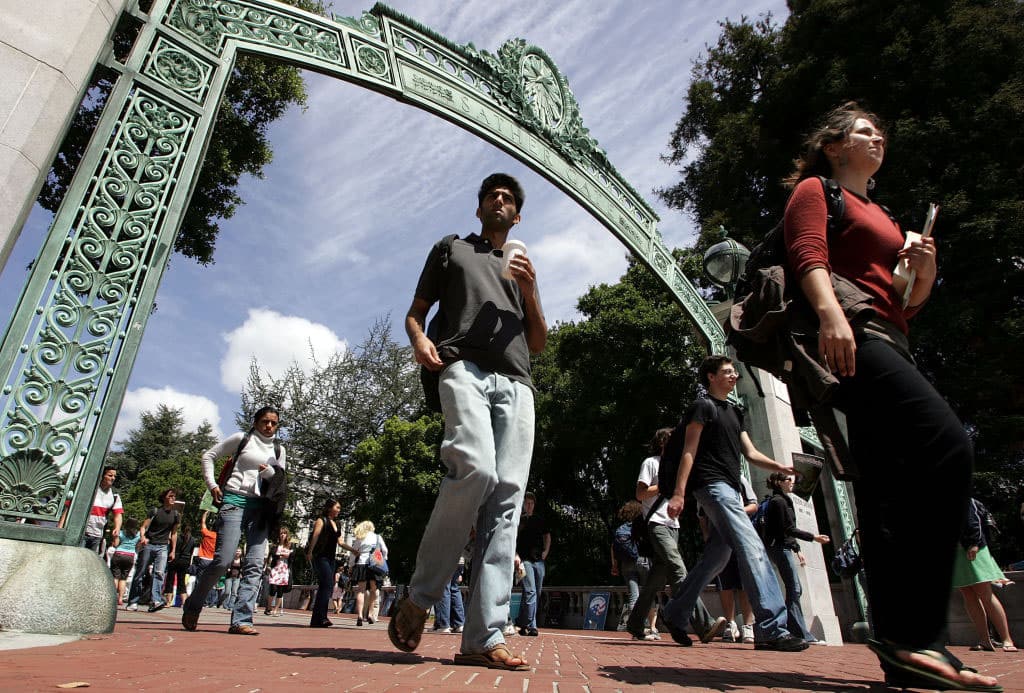
On Tuesday, April 26, Bears for Palestine, UC Berkeley’s Students for Justice in Palestine chapter, hosted a movie night featuring a 2021 documentary called “Boycott.” This documentary screening was hosted in partnership with Berkeley’s Department of Ethnic Studies and Department of Race and Gender as well as other outside organizations. This cooperation with the University is troubling because of the one-sided nature of this documentary as well as the antisemitic nature of “Boycott.

“Boycott” is a 2021 documentary produced by Julia Bacha, a Brazilian documentarian who has made several anti-Israel documentaries. This documentary follows three people in three states who are suing their respective state governments’ anti-BDS laws, claiming that the laws violate their first amendment rights.

The documentary is premised on the big lie that these laws are anti-free speech.

Courts disagree.

The three states in question are Arkansas (Act 710), Arizona (HB 2617), and Texas (HB 89). In Arkansas, the campaign against the anti-boycott law failed when the law was upheld by the 8th Circuit Federal Appeals Court, which concluded that “the certification requirement does not violate the first amendment,” according to Judge Jonathan Kobes.

In Arizona and Texas, after minor modifications to the law to exclude sole proprietors (Texas) or apply only to companies and contracts over a specific size (Arizona), the claims were dismissed as moot, as the statutes no longer covered the plaintiffs. Another attempt to challenge the Texas anti-boycott legislation on constitutional grounds was rejected in the Abdullah v. Paxton case earlier this year.

In other words, in all three attempts, the three “protagonists” failed to prove the central claim of the movie: that the laws somehow infringe on their right to free expression.

It is reasonable for a state not to partner with a business that does not hire or serve people based on race, ethnicity or national origin. As others have pointed out, the arguments against anti-BDS laws would inherently threaten other state anti-discrimination laws protecting vulnerable groups.

“BDS” is the acronym for the Boycott Divestment and Sanctions campaign, an effort founded by Omar Barghouti to promote an academic, economic and cultural boycott of the State of Israel and its supporters, of which the majority are Jews. Eight out of ten Jews say their care for Israel is essential to their Judaism, and an attack on Israel is an attack on Jews.

Barghouti is also a notorious antisemite who has publicly justified the murder of Jews by terrorists, perpetuated the conspiracy that Israeli money controls the U.S. Congress, and denied the Jewish right to self-determination in their ancestral homeland of Israel. Singling out and targeting the state of Israel while ignoring the fundamental human rights abuses in other countries, such as Russia and Iran, is a form of antisemitism that holds the Jewish state to a standard not held to any other country.

Another lie perpetuated in the video is that these boycotts are justified based on so-called human rights violations in the State of Israel. The images in this documentary do not consider the events leading up to the arrests, essentially blaming Israel for defending its citizens. Many so-called “Israeli war crimes” accusations are often false or misleading.

The documentary included images of Palestinians being arrested by Israeli police officers. These images do not consider what may have taken place before the arrest. Between January 2023 and April 2023, 18 Jews were murdered by Palestinian terrorists. Israeli citizens are victims of regular terrorist attacks, leaving Israeli police forces on constant guard to protect the citizens of Israel, as would any other country in a similar position.

I call on UC Berkeley to rescind their support of this event and take appropriate action against Bears for Palestine for promoting this antisemitic and misleading documentary on campus.


Ron Belman is the CAMERA Fellow at UC Berkeley and a Club Z alum. 

UC Berkeley Should Take Action Against Student Group For Airing Antisemitic Documentary Read More »