Ocean Guardians Unite! Celebrating World Environment Day with Richard Murphy of Ocean Futures Society and co-creator of Ambassadors of the Environment at Dorado Beach, A Ritz-Carlton Reserve
World Environment Day at Dorado Beach, A Ritz-Carlton Reserve, today was an extraordinary event that left a lasting impact on all who attended. The celebration was a perfect blend of inspiration, education, and action, bringing together passionate individuals from various backgrounds to commemorate this important day.
The highlight of the event was undoubtedly the presence of Richard Murphy, a true legend in the field of marine conservation, who has dedicated an impressive 50 years to the Ocean Futures Society working with Jean-Michel Cousteau. I had the privilege of interviewing him, capturing his insights and experiences in this captivating video podcast.
Throughout the day, the resort buzzed with excitement as guests engaged in various activities and workshops. From guided tours showcasing the resort’s eco-friendly initiatives to interactive displays and educational sessions, attendees were immersed in an environment of learning and discovery.
The celebration culminated with a meaningful tree planting ceremony. We came together, shovels in hand, to plant trees in the nearby forest. The act of planting trees served as a reminder that our actions today shape the world of tomorrow, leaving a lasting legacy for future generations.
World Environment Day at Dorado Beach, A Ritz-Carlton Reserve, was celebrated at the Ambassadors of the Environment Program, which inspires guests to embrace sustainability and take their newfound knowledge and passion back to their communities. World Environment Day was started by the United Nations in 1972. Join in the Ambassadors of the Environment Program on your next holiday with The Ritz-Carlton Family! READ MORE on We Said Go Travel
What should be done when it turns out that your neighborhood’s lake is named after a vicious antisemite?
The body of water in question is Stow Lake, in San Francisco, which was named after William W. Stow, a one-term 19th century California State Assemblyman.
During a debate in the Assembly in 1855, Stow clashed with Jewish storekeepers who opposed his proposal to force all businesses to close on Sundays. “I have no sympathy with the Jews and would it were in my power to enforce a regulation that would eliminate them from not only our county but from the entire state!,” he declared. “I am for a Jew tax that is so high that [Jews] would not be able to operate any more shops. They are a class of people here only to make money and who leave the country as soon as they make money.”
To be clear, the lake was not named after Stow because of his antisemitism; his opinion of Jews appears to have been a very minor aspect of his career. The lake was so named because he chaired the local Parks and Recreation Commission, and it was customary for a nature site within that district to be named for a commissioner following his death.
When some local residents recently discovered Stow’s antisemitism, they began calling for renaming the lake. The San Francisco Board of Supervisors has endorsed the proposal, and the city’s Parks and Recreation Commission will soon consider it.
Since the naming of the lake had nothing to do with Stow’s antisemitism, and almost nobody in in our own times even knew of his bigotry until the recent protests, does it make sense to change the name? Absolutely—for two reasons.
First, because it’s simply a matter of right and wrong; it’s morally wrong to honor a bigot.
But the second and more practical reason is the damage that can be caused by naming a site after such a person—that is, the danger that it could serve as a source of inspiration for extremists.
There are numerous streets, monuments and other sites in Eastern Europe that are named after World War II-era nationalists who collaborated with the Nazis. Such sites have become the location of rallies by local fascists.
Efforts to change those names have run into resistance. But the Ukrainian town of Tyvriv recently defied the extremists and changed the name of its Stepan Bandera Street. Bandera’s Ukrainian Insurgent Army fought for Ukrainian independence in World War II but also was involved in atrocities against Jews and other civilians.
In the Middle East, streets are sometimes named after terrorists precisely in order to honor their terrorism. Recall that Egypt refused to renew diplomatic relations with Iran for more than thirty years, until the Iranians finally changed the name of a street honoring Khaled Al-Islambuli, head of the group that assassinated Egyptian president Anwar Sadat.
The street on which the Palestinian Authority’s headquarters are located, in Ramallah, is named after Hamas bomb-maker Yihyeh Ayyash, who orchestrated attacks that killed at least 90 Israelis. Across the street is a square named “Heroic Martyr Dalal Mughrabi Square,” honoring the leader of Fatah’s Coastal Road massacre of 37 Israelis.
There are also schools named after Mughrabi in at least six Palestinian Authority towns, and lessons idolizing her are part of the curricula throughout the PA’s school system. Nasser Al-Rajabi, an elementary school teacher in Hebron, has posted a YouTube video of himself reading a section about Mughrabi from the PA’s 5th Grade Arabic Language school book. The text describes Mughrabi as “leading her group of self-sacrificing fighters” to carry out the 1978 attack, during which she “watered the soil of Palestine with her pure blood.” It asks students to answer questions about the massacre, such as “How old was Dalal Mughrabi when she died as a Martyr?” and “[Name] the number of heroes in the group of self-sacrificing fighters.” (Translation provided by Palestinian Media Watch)
Imagine our horror if, in between swimming and kayaking, visitors to San Francisco’s Stow Lake were taught that Stow’s “Jew tax” proposal was a visionary idea that should be implemented. That, essentially, is what Palestinian Arab school children are taught about Mughrabi.
It’s a scary thought, because while there is little danger of children visiting Stow Lake and then becoming pint-sized advocates of a “Jew tax,” there is ample evidence that Palestinian Arab youngsters are being groomed to follow in Dalal Mughrabi’s murderous footsteps.
Dr. Medoff is founding director of The David S. Wyman Institute for Holocaust Studies and author of more than 20 books about Jewish history and the Holocaust. His latest is America and the Holocaust: A Documentary History, published by the Jewish Publication Society & University of Nebraska Press.
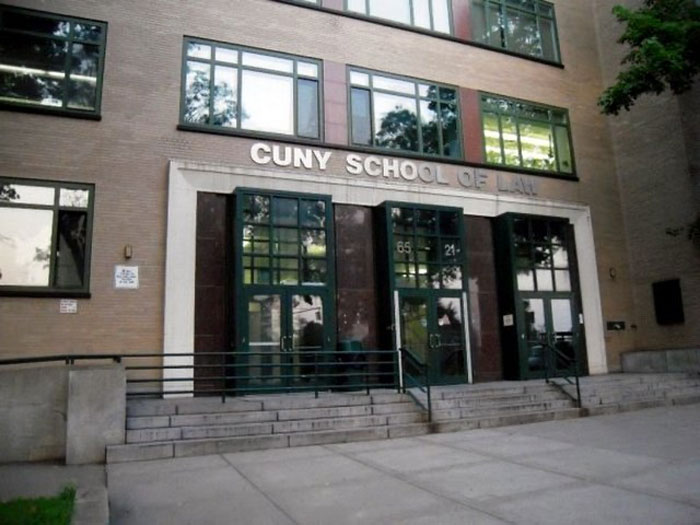
Two legal groups sent a joint letter to the Internal Revenue Service (IRS) urging the agency to investigate and potentially revoke the City University of New York’s (CUNY) School of Law’s tax-exempt status over the law school’s faculty unanimously passing a resolution supporting the Boycott, Divestment and Sanctions (BDS) movement last year.
International Legal Forum CEO Arsen Ostrovsky and National Jewish Advocacy Center Director Mark Goldfeder wrote in the June 2 letter obtained by the Journal that the May 12 commencement speech given by Students for Justice in Palestine (SJP) activist Fatima Mousa Mohammed “has garnered widespread condemnation from federal, state, and local lawmakers, as well as civil society leaders, the Jewish community, and even New York Mayor Eric Adams, due to its extremist rhetoric, divisive nature, and explicit display of antisemitism.” However, Ostrovsky and Goldfeder argued that Mohammed’s speech “did not occur in a vacuum.” “While the CUNY Board of Trustees and CUNY Chancellor Félix V. Matos Rodríguez have denounced the ‘hate speech’ in Ms. Mohammed’s address and deemed it ‘unacceptable,’ we find their response to be not only late but also grossly inadequate,” they wrote. “This is particularly troubling considering CUNY’s well-documented history of antisemitism and its failure to take any meaningful action in response.”
Ostrovsky and Goldfeder pointed to the pro-BDS resolution passed by the law school’s faculty in May 2022. “This resolution directly violates CUNY’s non-profit status as a 501(c)(3) non-profit entity, which prohibits engaging in substantial political or lobbying activities. It also runs counter to its ‘educational’ mission, because there is a difference between education and indoctrination,” Ostrovsky and Goldfeder argued. They noted that the American Association of University Professors’ (AAUP) 1915 Declaration of Principles on Academic Freedom and Academic Tenure state that educators are not to provide “students with ready-made conclusions, but to train them to think for themselves, and to provide them access to those materials [that] they need if they are to think intelligently” and that the 1957 Supreme Court case Sweezy v. New Hampshire concluded that “teachers and students must always remain free to inquire, to study, and to evaluate … otherwise, our civilization will stagnate and die.”
“To our knowledge, the CUNY Law School is the only law school in the United States that has formally adopted BDS as a core component of its educational mission,” Ostrovsky and Goldfeder wrote. “Today, the CUNY School of Law has become a staging ground for the systematic promotion of BDS activities, and anti-Zionist and antisemitic bias on campus, all of which are the opposite of ‘educational’, as well as clear violations of New York state law and federal policy.”
Additionally, the two lawyers pointed out that in response to the passage of the BDS resolution, the New York State of Division of Human Rights began investigating CUNY Law in February and the New York City Council rescinded funding from the school. “CUNY’s repeated engagement in activities that institutionally promote a specific political viewpoint against Israel, including hosting multiple speakers, attempting to remove Jewish educators from senior leadership, and unwavering support of the BDS movement, constitutes excessive lobbying and potentially jeopardizes its tax-exempt status,” Ostrovsky and Goldfeder wrote. Mohammed’s speech, for example, involved her promoting “the boycotting of Israel, specifically acknowledging that this was a policy supported and facilitated by CUNY Law School. By repeatedly inviting and supporting such speakers, CUNY actively promotes a particular viewpoint that aligns with the BDS movement. When considered in aggregate, these activities form a substantial part of CUNY’s overall operations.”
They added that “students are even getting academic credit for watching anti-Israel films” and that there are allegations of attempts to purge “Jewish educators from senior leadership positions suggest deliberately targeting individuals based on their Jewish identity,” all of which indicate “lobbying activities to advance a specific political agenda.”
Circling back to BDS, Ostrovsky and Goldfeder argued “that CUNY’s pro-BDS and antisemitic stance is contrary to public policy: It is the longstanding policy of the United States to oppose discriminatory boycotts against Israel, because such discriminatory practices are deeply offensive to our national morality.” “That is why U.S. anti-boycott regulations under the 1977 Export Administration Act, the Ribicoff Amendment to the 1976 Tax Reform Act, and the Trade Facilitation and Trade Enforcement Act all contain provisions that arguably prohibit such behavior, and violation of these and similar regulations can carry heavy administrative costs as well as potentially criminal penalties in state and federal courts,” they added. The two lawyers also contended that “there has been a substantial body of evidence indicating incontrovertible ties between the BDS movement and U.S. designated terrorist groups, such as Hamas and the Popular Front for the Liberation of Palestine.” “There is also mounting evidence that BDS groups in the United States have become a front for terrorist organizations, while many convicted terrorists hold senior leadership positions in the global BDS Movement, seeking to use their global network in order to advance their agenda to incite violence and pursue the destruction of the State of Israel,” Ostrovsky and Goldfeder wrote.
They later concluded: “We call on the IRS to conduct a thorough investigation into the tax-exempt status of CUNY Law School, based on the aforementioned reasons, and specifically whether their endorsement of BDS initiatives is a violation of federal law and regulations.”
Ostrovsky said in a statement to the Journal, “CUNY has become a hotbed of intolerable Jew hatred, including Ground Zero for the BDS Movement on campus. It is completely unacceptable that CUNY Law School leadership not only turns its back to this kind of racial hatred and discrimination, but actually takes an active part in leading and encouraging this, including being the only law faculty in the country to formally adopt the BDS campaign. As a public institution, with tax exempt status, this also places CUNY in potential violation of its legal obligations, including the prohibition against engaging in political and lobbying activities.”
He added: “Enough is enough, despite CUNY leadership’s prior commitments to tackle antisemitism and anti-Israel hatred on campus, the situation has only got worse, not better, and they must be held accountable for their actions.”
CUNY Law did not respond to the Journal’s request for comment.
The letter comes amidst controversy over Mohammed’s commencement address.
Representative Mike Lawler (R-NY) introduced a bill to defund any college campus that promotes “antisemitism at an event on their campus.”
No college or university should receive a single dollar of federal education funding if they peddle in the promotion of antisemitism at an event on their campus. That is why I have introduced H.R. 3773, the Stop Antisemitism on College Campuses Act. https://t.co/4fl2RyKhBi
— Congressman Mike Lawler (@RepMikeLawler) June 1, 2023
Similarly, multiple state Republican legislators are calling New York Governor Kathy Hochul (D) to defund CUNY or any other school that “supports, condones or allows hateful, antisemitic and intolerant speech to take place,” per The New York Post.
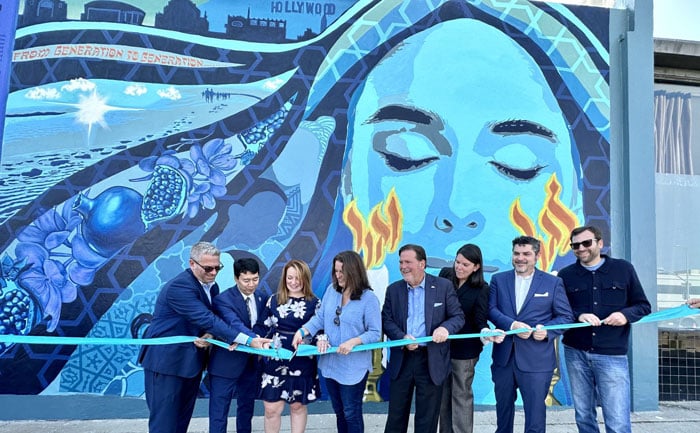
A mural that honors the Jewish community was unveiled on the afternoon of June 4 in the Pico-Robertson neighborhood, a couple of blocks away from where the February shootings occurred.
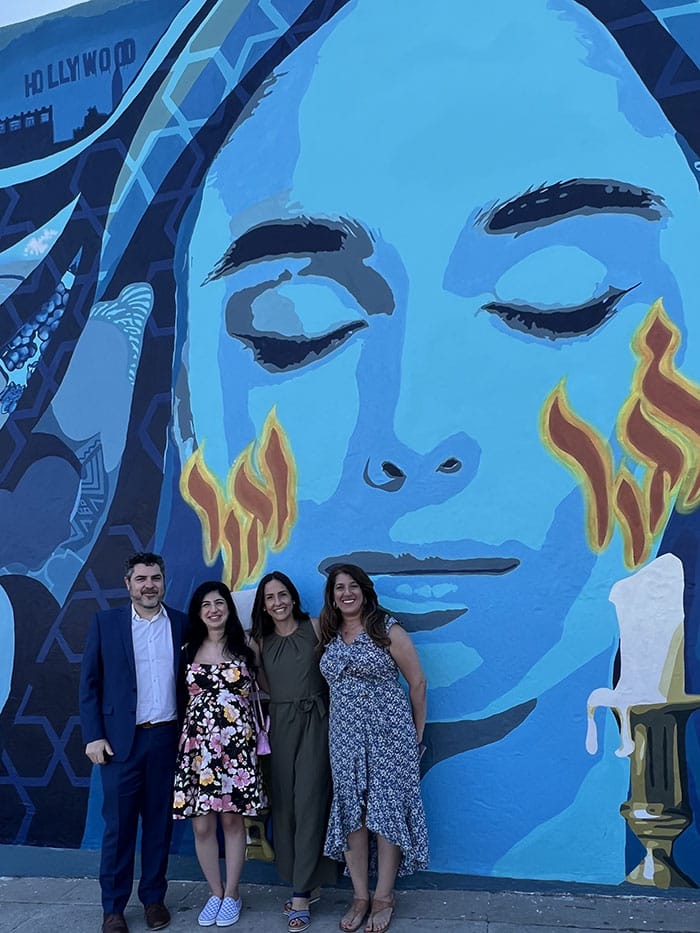
The mural, titled “The Common Thread,” is part of the LA vs. Hate initiative organized by the Los Angeles County Commission on Human Relations, Anti-Defamation League (ADL) and The Jewish Federation of Greater Los Angeles. Cloe Hakakian, the artist who drew the mural, told the Journal that it was “a community-based concept.” “The community all got together and they gave their input, and I used their input and created the artwork based on all their responses in the prompts,” Hakakian, an Iranian Jew, said. The mural centers on a woman with her eyes closed with lit candles in front of her. Hakakian explained that this “is supposed to represent a mother praying on Shabbat” and the candle flames say, “L’dor v’dor,” meaning from generation to generation. The woman is also wearing a headscarf with various layers of imagery; one layer “shows generations of women getting younger and younger, all kind of having each other’s backs,” Hakakian said. “They’re each wearing textiles from different Jewish communities: the Russian community, the Persian community, all showing that there’s different Jewish communities within the community.”
Another layer shows a pomegranate, saffron flowers and “specific spices that are unique to the Jewish culture,” per Hakakian, which she said stemmed from someone in the community saying that their “mother’s spice cabinet” was part of being Jewish for them. Above the pomegranate layer in the veil is a layer depicting “a migration in the desert, which shows the healing and trauma we’ve all been through,” Hakakian said. “The goal is to get towards that bright light, that beautiful sky.” Above that layer are the words, “From generation to generation” and various Los Angeles landmarks “where Jews feel their community is prevalent,” per Hakakian.
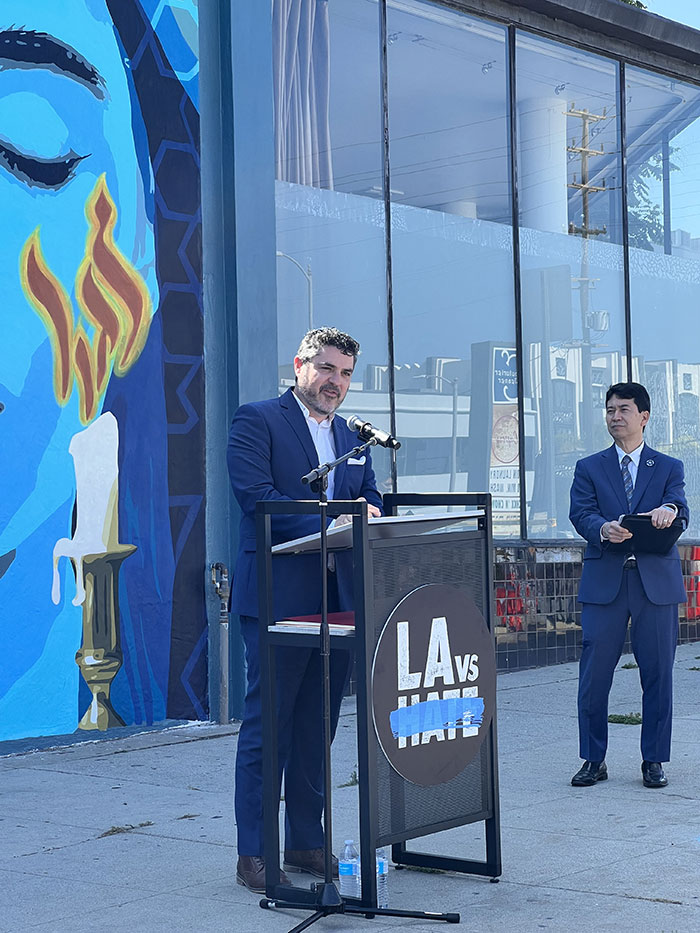
Robin Toma, who heads the County Commission on Human Relations, said during a press conference of the unveiling that the mural was aimed at celebrating “the values and contributions of this amazing community” and kicks off a “Summer of Solidarity.” “This is a time that we need to strengthen and showcase the unity within our county,” Toma said, contending the county’s unity is stronger than hate. He proceeded to tout the fact that the commission established a system to report all hate incidents, not just hate crimes. “We will be there to help you.”
Photo courtesy of The Jewish Federation of Greater Los Angeles
ADL Los Angeles Regional Director Jeffrey I. Abrams also spoke during the press conference, saying that the “mural sends a powerful message” to the community and is a reminder “of the greater community in which our Jewish community thrives.” Federation President Noah Farkas lauded “our partnership between the ADL, the city, the county, the state and the Federation” during the press conference as being “unprecedented in our community and we are building new roads together.” Farkas also touted the Jewish mother lighting the Shabbat candles as being a “very, very powerful symbol” that “must be shown to the world.” “Art is the best way to respond to hate,” Farkas said, adding that “love is what this city about” and that “this image of a woman blessing the candles for her family becomes an image that we take to heart as we bless each other in this beautiful space”
Some elected officials spoke during the press conference as well. “We’re fortunate to have a strong and resilient Jewish community throughout Los Angeles County,” Supervisor Lindsey Horvath said, adding that “there is absolutely no room for antisemitism in all its forms.” She said that when acts of hate like the Pico shootings happen, there are two ways to respond: “retaliate or take action to prevent these kinds of hate from happening ever again.” Horvath called the mural “a striking expression of Jewish history and culture between generation” and the “most beautiful embodiment of what LA is to use art to turn pain into power.”
Echoing the L’dor v’dor theme of the mural, City Councilmember Katy Yaroslavsky recalled her two and a half year old “playing with her trains” while singing the hamotzi. “As Jews this is how we’ve survived,” Yaroslavsky said, adding that “sharing these moments with your children” helps “ensure some continuity.” She then expressed worry for her three children amidst rising antisemitism, recounting how earlier in the week an individual stood up and started spewing antisemitism when the city council honored Jewish American Heritage Month. She argued that the way to fight hate is to “find ways of turning [fear] into meaning.” The mural, Yaroslavsky said, is the community’s way of “sending a powerful message that hate has no place in LA.”
Photo courtesy of The Jewish Federation of Greater Los Angeles
State Senator Ben Allen (D) said during the press conference that he had just come from a Pride event in West Hollywood, calling it “a great bookend for this event.” He contended that the country has taken “a couple steps backward” regarding bigotry and hate and “some folks at the national level seem to be focusing on how to divide us.” Allen pointed out that while the Pico shootings were a couple blocks away from the mural, the mural is also close to the Museum of Tolerance, Factor’s Deli, Young Israel of Century City and The Happy Minyan are also nearby. He added that he was “taken by the beautiful face of the Jewish mother” on the mural, as “you can see that the light is almost flickering on her face.” “Candles are such an important part of spiritual life of our religion,” Allen said.
The press conference also featured Cesar Echano, a survivor of a hate crime. In 2021, Echano was assaulted in a Cerritos park by a man who shouted anti-Asian epithets at him; the man punched Echano in the face multiple times. “It was terrible. It was painful,” Echano said. “Today I’m getting better because of the help of the community, the support of the people.” He added that he “will be strong forever” and “we don’t have a place here in our community for hate.” “We are all Americans,” Echano said. “We stand for unity. We stand for freedom. We stand for humankind. We stand for human rights. We stand for love and peace.” Toma said that a mural has since been erected in the park in response to the hate crime. “That park is united and stronger together against hate,” Toma said.
Other speakers included Human Relations Commission President Ilan Davidson––who is also a cantor at Temple Beth El in San Pedro––and Temple Beth Am Rabbi Rebecca Shatz. Following the press conference, a ribbon was cut and the bands We the Folk and Mostly Kosher performed; refreshments were also provided.
Farkas told the Journal that the mural is “the beginning of something” and the “stepping stone.” “We have secured funding from the city with our partnership with Councilwoman Yaroslavsky to help fund better security in the Jewish community,” he said. “County Supervisor Horvath has already also committed publicly to helping support us financially as well as with coordination work. Our antisemitism roundtable––which is us leading it with the ADL, LA Museum of the Holocaust, the [American Jewish Committee] and the Board of Rabbis––is looking to ever coordinate more on this issue … we are forming first in the nation type partnerships to address the scourge of anti-Jewish hate.”
Nathaniel Dorsey told the Journal that he came all the way from Victorville to the event, explaining that he is an African American who supports efforts to fight Jew-hatred because African Americans and Jews face more hate than any other ethnic groups in the country. “Other races get it, but African Americans and Jewish people get it more,” Dorsey said, citing the shootings at the Chabad of Poway and Charleston church in 2019 and 2015, respectively, as examples. “I’m a strong supporter of Israel and the Jewish people. I love you guys,” he said.
Dorsey first learned about the Pico shootings during the unveiling of the mural and said that the fact the mural is so close to where the shootings occurred is “perfect.” “It shows that we’re standing against hate and racism,” he said.