fbpx

May 18, 2023

“Who Are The Marcuses?” Documentary Makes the Case for Altruism to Solve Water Crisis

The largest charitable gift in the history of the State of Israel was in 2016: a $500 million donation to Ben-Gurion University of the Negev. President Isaac Herzog called it “unprecedented.” It seemingly came out of nowhere from Howard and Lottie Marcus, a wealthy couple that was not particularly well-known. And now, a  new documentary asks, “Who are the Marcuses?” and how did they live their life under the radar?”

And why did they donate half a billion dollars to Ben-Gurion University of the Negev in particular? The short answer: water.

Born in the early 1900s, both Howard and Lottie Marcus became Jewish refugees of Nazi Germany. Although they both have passed, their daughter Ellen shares details of their life. She specifies that her parents were, as interviewee Randol Schoenberg puts it, “Germans of Jewish faith, not Jews in Germany.” Her mother Lottie was beaten up every day on the way home from school. Howard was the only Jew in his elementary school. Despite being one of the smartest kids in school, his teacher would say to him, if he answered something correctly, “pretty good for a Jew boy.”

They both left Germany in the mid-1930s, which set them on a path to earn enormous wealth, along with ever-growing hearts for humanity.

When the story came to the attention of the filmmaker Matthew Mishory, he knew there was an important story to be told. And it wasn’t until he interviewed Warren Buffett, a man synonymous with wealth, that the documentary became what it is.

Director Matthew Mishory and Warren Buffett at the Omaha premiere.

“What could have been a small feel-good Jewish story about an act of philanthropy turned into a story of global import and global impact,” Mishory, the film’s director, told the Journal.

Buffett ended up becoming one of the most memorable interviewees on screen. The film concludes that at its core, humans crave gratitude.

“A Polish Jew who was in the camps, she ended up in Omaha,” Warren Buffett said at the end of the film. She was a really remarkable woman. She never talked about the experiences in the camps with me, but one time she said to me, ‘I’m slow to make friends because I can’t help thinking when I’m looking at somebody, would they hide me?’ And I know people aged 70, 75, that dozens and dozens and dozens of people would hide them. And I know others that had all kinds of good luck in life and got lots of money and people hold dinners for them— and their own kids wouldn’t hide ‘em. If you reach your older years and you have lots of people who would hide, you’ve led a successful life.”

It’s a story about wealth, generosity, innovation and Israeli pragmatism. In addition to answering who the Marcuses are, the film goes through Israel’s history as a leader in alleviating water scarcity. It chronicles the issue from Theodore Hertzl’s early writings about water for the people, to the research and innovations in desalination, water generation and purification at Ben-Gurion University of the Negev. The documentary shows that Israel has many of the answers to most of the world’s water problems.

President Isaac Herzog appears in the film, and called the Marcus’ donation “unprecedented.”

Director Mishory is a talent behind the camera. At the time of the filming, he had been making commercials for Pfizer and Greek NBA star Giannis Antetokounmpo. Mishory grew up in Los Angeles in an Israeli family, and didn’t expect that he’d become such a force in documentary filmmaking. His 2009 film “Delphinium: A Childhood Portrait of Derek Jarman” is part of the permanent collection at the British Film Institute’s National Film Archive. He also wrote and directed the feature film, “Joshua Tree, 1951: A Portrait of James Dean.”

The story of the Marcuses appealed so much to Mishory as an Israeli-American film director because of the many layers of family ties, generosity, Israel and the future.

While “Who Are The Marcuses?” will have viewers contemplating bequeathing, water scarcity and the future, Mishory’s next documentary, “Fioretta,” chronicles Randy Schoenberg (the grandson of Austrian-American composer) and his son Joey as they travel throughout Europe to gather 500 years of their family’s history.

And with the effects of climate change becoming more and a problem for humanity, the epilogue is quite uplifting with mentions about water deals between Israel, Jordan and the United Arab Emirates. California audiences will find the message dire and relatable—we have the world’s fourth largest economy and our water scarcity issues have been ongoing for over a hundred years.

“I liked that this was a different kind of story about Israel and a story that others were unlikely to tell,” Mishory said. “I felt a real personal connection to Israel’s water story because the Israel that my grandparents lived in, having narrowly escaped the Holocaust in Eastern Europe, was a water-starved, struggling country—a country that was still rationing food, that was basically dependent on the ebbs and flows of water into the Kinneret to provide water for the entire country. The Israel of today is something that my grandparents, or indeed my father, could never have imagined in their young adulthoods. That Israel would emerge as a sort of an eco-tech giant and have developed water technologies that not only solved its own water problem, but offer hope to the region. And I would say to the world, and specifically to the western United States and California.”

The documentary is also carried along with music by the legendary David Broza. It’s enjoyable, informative and inspiring. By the end, viewers will indeed know who the Marcuses are, and some just might be inspired to emulate their story.

“Who Are The Marcuses?” is being screened on Sunday, May 21st as part of the Los Angeles Jewish Film Festival. More information on the film can be found on its website: https://www.whoarethemarcuses.com

“Who Are The Marcuses?” Documentary Makes the Case for Altruism to Solve Water Crisis Read More »

The Jerusalem of the Simple Jew

On June 7, 1967, the Israeli army returned Jewish sovereignty to Jerusalem for the first time in 1,900 years. And for the last 56 years, this day has been celebrated on the Israeli calendar as Yom Yerushalayim (Jerusalem Day).

Yitzchak Rabin, who was then the Chief of Staff of the Israeli army, visited the Kotel (the Western Wall of the Temple Mount) that day. Rabin reported that when they “reached the Western Wall, I was breathless … I felt truly shaken and stood there murmuring a prayer for peace. The paratroopers were struggling to reach the Wall and touch it. We stood among a tangle of rugged, battle-weary men who were unable to believe their eyes or restrain their emotions. Their eyes were moist with tears, their speech incoherent. The overwhelming desire was to cling to the Wall, to hold on to that great moment as long as possible.” Rabin’s wife Leah would later say that he considered that visit to be the “peak moment” of his life. Even though he was a secular and stoic career military man, Jerusalem made a dramatic impact on Yitzchak Rabin, as it has on so many others. The question is why. Where does this Jerusalem mystique come from?

There’s no one answer to this question, and that’s part of the mystique. “Jerusalem has seventy names” declares the Midrash. And while the Tanakh does have several names for Jerusalem, including Tziyon, Shalem and Yevus, the Midrash’s point is that Jerusalem is transcendent, and as such, can be seen through multiple perspectives.

The student of history sees a city that has transformed the world, and is central to three major religions.

Extraordinary historical figures have traversed this city. The founders of Judaism lived here: Abraham and Isaac, David and Solomon, Isaiah and Jeremiah, Ezra and Nehemiah, Judah Maccabee and his sons, Hillel and Shammai, Rabbi Akiva and Rabbi Yishmael. And the list goes on and on.

Jerusalem’s influence is not restricted to Judaism; the important personalities of Christianity, Jesus, James, Peter and Paul, all spent time in Jerusalem as well, and Muslims revere the Temple Mount as the location of Muhammad’s night journey.

Due to religious influence, Jerusalem has always grabbed the headlines. For hundreds of years, maps put Jerusalem at the center. In the Bünting Clover Leaf Map of 1581, the three continents of Europe, Africa and Asia are the petals of a clover, with Jerusalem in a circle at the very center of the world.

Over 60% of tourists who visit Jerusalem are Christian; they come because of the deep connection they have to its history. Thomas Friedman tells of one such visit to Jerusalem:

“When American astronaut Neil Armstrong, a devout Christian, visited Israel after his trip to the moon, he was taken on a tour of the Old City of Jerusalem by Israeli archaeologist Meir Ben-Dov. When they got to the Hulda Gate, which is at the top of the stairs leading to the Temple Mount, Armstrong asked Ben-Dov whether Jesus had stepped anywhere around there. ‘I told him, “Look, Jesus was a Jew,”’ recalled Ben-Dov. ‘These are the steps that lead to the Temple, so he must have walked here many times.’

Armstrong then asked if these were the original steps, and Ben-Dov confirmed that they were.

‘So Jesus stepped right here?’ asked Armstrong.

‘That’s right,’ answered Ben-Dov.

‘I have to tell you,’ Armstrong said to the Israeli archaeologist, ‘I am more excited stepping on these stones than I was stepping on the moon.’”

If you ask a historian what is special about Jerusalem, they will tell you: It is a place that has changed the world. Wherever you go, you are walking in the footsteps of some of the greatest figures in history.

The student of Halakha stands in awe of Jerusalem, a place replete with unique mitzvot (commandments). One-third of the Talmud deals with religious laws connected to Jerusalem, including the Temple service and the rules of ritual purity. Jerusalem was once central to the religious practice of Judaism.

While it is forgotten now, the picture found in the Tanakh and Rabbinic literature is dramatic. The thrice-yearly holiday pilgrimage of aliyah leregel brought millions of Jews to Jerusalem for the holidays; Josephus, the first-century historian, writes of a year when 256,500 Passover sacrifices were brought. He estimates that at least 10 people shared each sacrifice, which works out to over 2.5 million cramming into Jerusalem for Passover! These holidays were a time when people of all classes, countries and observances came together. The Jewish philosopher, Philo of Alexandria, described how “countless multitudes from countless cities come, some over land, others over sea, from east and west and north and south at every feast.” A network of highways facilitated the trip to Jerusalem; these are now being discovered by archeologists, all around Jerusalem.

Religious visits to Jerusalem extended beyond the holidays. There is another law called Maaser Sheni, where four out of every seven years the farmer would bring 10% of the value of his produce to Jerusalem, either in fruit or in cash, and use them to enjoy meals in the holy city.

Mystics have a more dramatic vision. For them, Jerusalem is the center of the universe. The Midrash Tanchuma (Kedoshim 10) writes that Jerusalem is where the creation of the world began, or what is sometimes called Umbilicus Mundi, the navel of the world. Inside the Temple is “the foundation stone from which the world was founded.” The Spanish Kabbalist Yoseph Gikatilla takes this a step further and explains that: “From the Temple, all the channels of divine influence spread out to the world … the divine presence sends blessing to the entire world through the Temple.”

When it comes to Jerusalem, most people are mystics. They visit the Kotel and put in a kvitl, a small note of prayers. Everyone does this: Presidents, Prime Ministers, actors and rock stars.

The mystical view is well-traveled. There is an old joke, that was retold by Prime Minister Menachem Begin to President Reagan at a White House State dinner, that reflects this view. Begin’s joke goes like this:

“The President brought me into the Oval Office, and he showed me on the table three phones— one white and one blue. And he explained to me: ‘The white is the direct line to Mrs. Thatcher; the blue to President Mitterrand.’’ And then I asked him, ‘What is the red phone?’ ‘That is a direct line to God.’’ So, I asked the President, ‘Mr. President, do you use it often?’ And the President said, ‘Oh, no, very rarely. It’s very expensive. Long distance—so long a distance. And I cannot afford it. I have to cut the budget and…’ [Laughter]

So, then the President visited Jerusalem, and I showed him my office, and there are three phones. One was white, one was blue. And I said, ‘The white is a direct line to President Sadat.’ By the by, I have such a line, and he has such a line. ‘And the other, well, to Mrs. Thatcher.’ And there is a red phone. And the President asked, ‘What is the red phone for?’ And I said, ‘This is a direct line to God.’ So, the President asked me, ‘Do you use it often?’ I say, ‘Every day.’ ‘How can you afford it?’ And I said, ‘Here, in Jerusalem, it is being considered a local call.’

(Begin continued on another note and said: ‘Now, Mr. President, neither of us has direct lines to God. I only believe that God listens to the prayer of a Jew and a Christian and of a Moslem—of every human being. But, if I have to continue with the story, then I will say that when you come, as I do believe, to Jerusalem, I will immediately put at your disposal the red phone. [Laughter] On the house. [Laughter] A local call.’)”

To the mystic, Jerusalem is different because a call to God from Jerusalem is a local call.

To the mystic, Jerusalem is different because a call to God from Jerusalem is a local call.

I appreciate the perspectives of the Halakhist, the mystic and the historian, but I believe there is one perspective that exceeds them all: that of the simple Jew.

The simple Jew never left Jerusalem. Shmuel Yosef Agnon spoke for them when he said this in his 1966 Nobel Prize Speech: “As a result of the historic catastrophe in which Titus of Rome destroyed Jerusalem and Israel was exiled from its land, I was born in one of the cities of the Exile. But always I regarded myself as one who was born in Jerusalem.”

And in 1967, the simple Jew came home.

The first time I visited Israel was when I was 7. My grandfather, who was 71 at the time, came with us; it was his first trip to Israel. The look he had on his face when visiting the Kotel was the look of a man transformed, a Jew achieving his dream.

My grandfather’s dream is an ancient dream. Jews have dreamed of Jerusalem from the moment they went into exile. As they were driven out of their homeland in 587 B.C.E., they declared: “If I forget you, Jerusalem, may my right hand forget its skill. May my tongue cling to the roof of my mouth if I do not remember you, if I do not keep Jerusalem in mind even at my happiest hour (Psalm 137).”

Jews never forgot Jerusalem. We pray about Jerusalem every day, we pray toward Jerusalem every day, and at every wedding, we break a glass to remember Jerusalem. At the Passover Seder we sing “next year in Jerusalem.” In Ethiopia, Jewish children would look at the storks migrating northward toward Israel and sing a song:

“Stork, stork, how is our land?
Stork, stork, how is Jerusalem?
Stork, stork, give us the word!”

The simple Jew always dreamed of Jerusalem.

It is the love of the simple Jew that makes Yom Yerushalayim special. Moshe Amirav, one of the first soldiers to reach the Kotel on June 7, 1967, said this:

“I can’t help from smiling today when I recall how we searched for the Kotel. There we ran, a bunch of panting soldiers, wandering around the Temple Mount, looking for a huge stone wall … We pass the Mograbim gate, pushing, hurrying, and all of a sudden we are stopped, as if hit by lightning. In front of our eyes stands, grey and large, quiet and sad—the Kotel. … Little by little I started getting closer to the Kotel. Slowly … I came closer, an emissary of dad, grandpa, greatgrandpa, and all the generations from all the diasporas that didn’t make it here, and so they sent me here. Someone said the Shehechiyanu prayer, and I couldn’t say amen. All I could do was put my hand on the rock. The tears flowing out of my eyes were not mine … they were the tears of all the People of Israel, tears of hope and prayer.”

This is what the Jerusalem mystique means to me. It is not about history, Halakha or Kabbalah; it is about the simple Jew, and the dreams of the Jewish People.

Fifty-six years ago the simple Jew could finally go home again. And that is what I celebrate on Yom Yerushalayim.


Rabbi Chaim Steinmetz is the Senior Rabbi of Congregation Kehilath Jeshurun in New York.

The Jerusalem of the Simple Jew Read More »

Naomi Alderman Ignites “The Power” on Amazon Prime Video

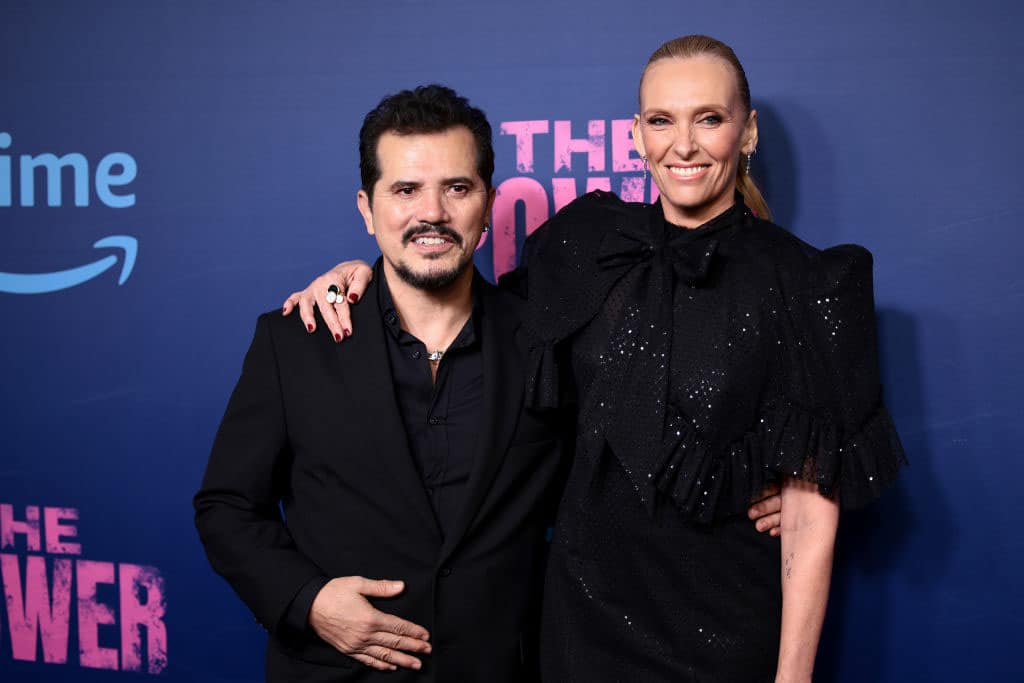
Imagine a world where women gain the ability to generate electricity through their bodies like electric eels. Naomi Alderman boldly details such an extraordinary transformation in her award-winning science-fiction novel, “The Power.” Originally published in 2016, “The Power” was selected by former president Barack Obama as one of his favorite books the following year. The provocative bestseller was adapted into an electrifying Amazon Prime Video series starring Toni Collette and John Leguizamo.

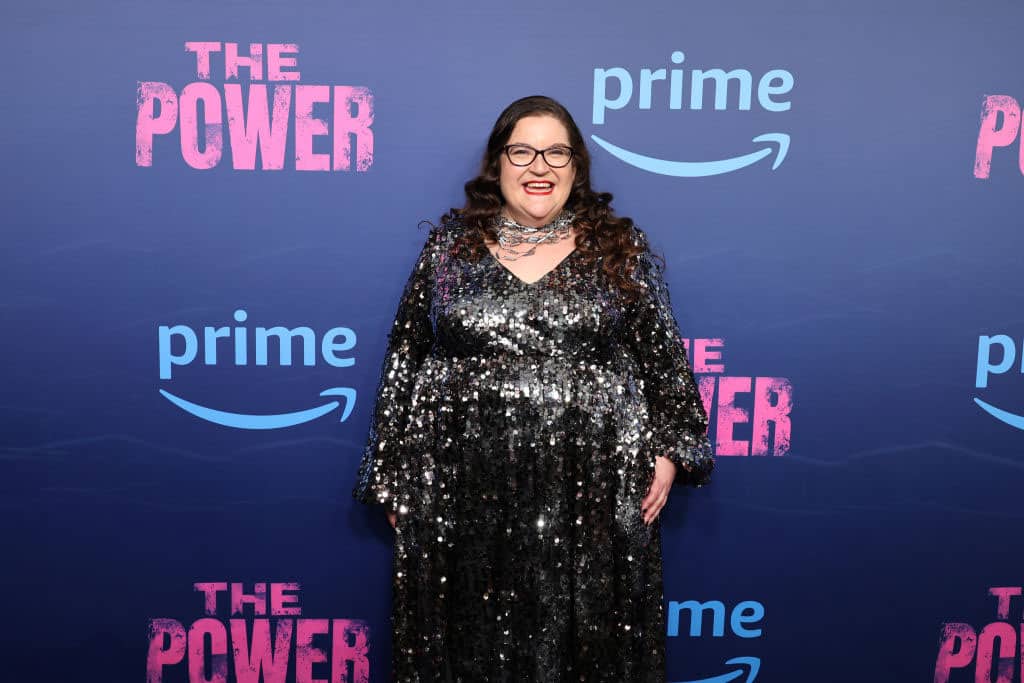
John Leguizamo and Toni Collette attend Prime Video’s “The Power” New York Premiere at DGA Theater on March 23, 2023 in New York City. (Photo by Dimitrios Kambouris/Getty Images)

It is no surprise Alderman’s favorite character is Roxy Monke (played by Ria Zmitrowicz), the sharp-tongued illegitimate daughter of a Jewish businessman.

“I really do love Roxy,” admitted the British author. “She’s the person who sat next to me in my imagination all the years that I sat behind a mechitza or in a ladies’ gallery. Yeah, she sat next to me punching holes in the furniture in my imagination. She is my rage.”

Alderman spoke with The Jewish Journal about religious influence on writing, the inspiration behind the feminist novel, and being mentored by none other than Margaret Atwood.

JJ: Roxy’s Jewish faith is really highlighted in the TV series.

NA: Her dad is Jewish in the book and the more we thought about it, obviously, that is the world that I come from. She’s in a really fascinating situation. Actually, of the four kids that her dad has, she’s the one most like her father. And she’s a girl, they’re boys. They’re supposed to be the heirs and she’s supposed to be the sort of afterthought. And yet, there she is. She’s very like him. It’s a real kind of richness.

I hope this is true. I think these days, viewers are more open to specificity and exactness—detail in the backgrounds of characters that you see on screen. You don’t expect everybody to kind of pretend that we’re all basically white in the same way and all backgrounds are the same. I think there’s a real interest in those sort of specific details. I thought, “Well, if I’m writing all these characters, I’m going to put a Jew in.”

JJ: How has your own Jewish upbringing influenced writing “The Power?”

NA: Well, I grew up really quite frum, which I would say left me with some—am I okay to say, “anger” about the position of women in traditional Orthodox Judaism and a real feeling of, you know, they know better. They know better and what’s sort of what’s hilarious is that it seems pretty obvious to everybody—that, in fact, Jewish culture is very based on education and what you know. For all that we can argue about like whether men are better than women at different kinds of specifically defined sporting activities, clearly women are as clever as men. That seems to have been proven quite well in the past hundred years since we started educating women properly. So, I guess, that feeling of like, “Guys, guys, we all know better than this now.” There is no reason not to have frum female rabbis. There’s literally no reason. You know, if we’re talking about understanding the material properly, it makes [the rabbis she grew up with] look a bit silly at this point.

I could talk about Jewish values all day. There’s a Jewish value of justice.

I could talk about Jewish values all day. There’s a Jewish value of justice. That’s a key value and that’s in there as well. I consider myself to be a very values-driven political writer. I’m interested in pointing out where there are things going on in the world that I think we all sort of secretly know we don’t agree with but decided that we don’t think about it too hard. That feels like one of the imperatives of Jewish justice, is to go, “No, we got to think about this.”

JJ: What was your original inspiration for writing “The Power?”

NA: I had a terrible breakup. That’s how all women become feminists—that’s a joke! That’s a joke. I had a terrible breakup where I was weeping every morning before I went off to work. At that point, when I was in that state, I got onto a subway train in London and there was a poster depicting a beautiful woman crying. Very artistically, it was one tear, advertising a movie. And something just snapped in my soul. It felt like the world telling me, “Oh, good, we like it when you cry.” And I just thought, “What would have to be different in the world for me to get into a tube train every now and then and see a photo of a handsome man crying?”

The question of the book is, “Why is it that it’s always patriarchy and so rarely matriarchy?” How do we get into this situation? My hypothesis is that a lot of it is about physical strength. I thought about women with enormous muscles, but that creates a very comedic mental image. I settled on electric eels because they really exist in the world. They are one of the crazy facts about the planet we evolved on, that this exists. Then, I had something real to research. The more I wrote it, the more I just really wanted it. That’s the problem.

JJ: What was the most difficult part of the adaptation process? 

NA: I would have to say that was the global pandemic. We were the show that started shooting in February 2020. You don’t want to be that show. All the actors know their characters inside out. All the sets are built. Then, you have to take it all down for eighteen months and then start again. That was bad. Just in terms of technical writing stuff, I wrote a book that has four, maybe five, main characters whose stories don’t intersect until about halfway through the book. I think the team working on it have done an incredible job. I think it all looks fantastic.

JJ: What were your most favorite scenes to shoot?

NA: I really do like the riots in Saudi Arabia. Oh, I just got a shiver down my spine even thinking about it. Can you imagine trying to do that? That was shot with pandemic restrictions. The director of the episode, Lisa Gunning, just did an incredible job. And you believe it and you feel like you’re there amongst a huge riot. To see that all come to pass. Also, that is a part of the book that makes me cry every time I read it. Sorry, I do sometimes cry while reading my own work. I guess, I cried when I wrote it, so that’s okay. Seeing that all come to life.

You know, the thing about writing this book and living inside it is that you start to feel a little bit disappointed that the world is not like that when you come out. I haven’t been actually able to give this [power] to women who are living in oppression all around the world. But just for a little while, when seeing that shot, you feel like, “Okay, it’s real! It’s really happening!”

JJ: Why do you think it’s important that most of the TV series’ writers and producers are women?

NA: We don’t go looking for women. We just wanted the best people for the job. There were amazing men who worked on the project. There’s the producer Tim Bricknell who ended up directing some of it because one of the directors was not able to be there. There are such things as wonderful male allies—that does exist.

JJ: You serve as an Executive Producer and Writer on the series. Have you considered directing?

NA: I have. I think significantly smaller than this show would be a good place to start. I’m afraid my ambition knows no limits.

JJ: What’s it like to be mentored by Margaret Atwood?

NA: It’s excellent and, also, quite frightening. Do you know what? I love her. I think she’s wonderful. She and her late husband, Graeme Gibson, really took me into their home. Literally, I stayed in their house. They took me on trips around the world. We went to the Arctic together. She said, “Come to the Arctic, Naomi. It will change you.” I can give you the advice that Margaret would give any woman writer, that is, “Learn to say ‘no’ more. Don’t let people take up your time and your life energy. Save it for your own work.” She has impressed that upon me. I’ve taken it in, and I live by it.

This interview has been edited and condensed for clarity.

Naomi Alderman Ignites “The Power” on Amazon Prime Video Read More »

Open Mouths in the Wilderness – A poem for Parsha Bamidbar

Count the children of Levi according to their fathers’ house according to their families. 
Count all males from the age of one month and upward.
~Numbers 3:15

The children of Lupert, according to their father’s house
(and honestly, their mother’s too, because we wouldn’t
dare leave her out) amount to a tally of one.

Children are expensive and we no longer have to
create a civilization in the desert so it felt like enough.
Their (or really his as we’re not trying to make any

statement here) name is Yehudah. He is not the
first of his name which is our way to tip our hat to
every single person who came before, all the way

back to the mountain. (Maybe even all the way back
to the open tent. Maybe further, check for leaves from
the garden in your sandals. You may be involved.)

We camp to the North (or the very very far west
if you use the original starting point as your reference.)
There are mountains nearby which remind us of

how it used to be, and it’s a short drive to where there
are buildings which remind us of how it is now.
We are charged with singing the songs.

Most of what we do, between finding, preparing,
and eating food (and the more than occasional
television program) is seeking out the songs,

learning the songs, practicing the songs. Then
singing the songs in a manner which, we hope,
shows that you should be singing them too.

It’s our favorite thing to stop singing the songs
only to find our ears filled with your voices
because you haven’t stopped.

This is the responsibility that was given to us
in the wilderness, when we began counting,
when we first opened our mouths.


God Wrestler: a poem for every Torah Portion by Rick LupertLos Angeles poet Rick Lupert created the Poetry Super Highway (an online publication and resource for poets), and hosted the Cobalt Cafe weekly poetry reading for almost 21 years. He’s authored 26 collections of poetry, including “God Wrestler: A Poem for Every Torah Portion“, “I’m a Jew, Are You” (Jewish themed poems) and “Feeding Holy Cats” (Poetry written while a staff member on the first Birthright Israel trip), and most recently “I Am Not Writing a Book of Poems in Hawaii” (Poems written in Hawaii – Ain’t Got No Press, August 2022) and edited the anthologies “Ekphrastia Gone Wild”, “A Poet’s Haggadah”, and “The Night Goes on All Night.” He writes the daily web comic “Cat and Banana” with fellow Los Angeles poet Brendan Constantine. He’s widely published and reads his poetry wherever they let him.

Open Mouths in the Wilderness – A poem for Parsha Bamidbar Read More »

Andrew Yang and Noa Tishby Celebrate AAPI & Jewish Heritage Month

On May 9 in New York City, former presidential candidate Andrew Yang and actress/Israel advocate Noa Tishby co-hosted a joint event celebrating Asian-American and Pacific Islander and Jewish Heritage Month. 

Yang and Tishby brought influential AAPIs and Jews for a sit-down conversation to discuss shared experiences and celebrate each other’s heritage. Among them were Evelyn Yang, Brooks Brothers C.E.O. Ken Ohashi, musician David Fung, filmmaker Nancy Speilberg, psychotherapist Esther Perel, entrepreneur Ari Ackerman and actress Debra Messing.

One of the most sobering moments of the evening came when Messing shared a story about being discriminated against because she’s Jewish.

“My parents moved to Rhode Island next to a farm, and I was one of three Jewish kids in the entire community,” Messing said. “And in second grade, I was getting in line for gym, and this little kid came up and said, ‘get to the back of the line, ki–.’ I didn’t know what that word meant.”

She continued, “I had decided I am just going to hide. I’m going to hide my identity. I’m going to try and just blend in because that’s the safest way.”

Today, Messing, along with the other attendees of the event, are visibly proud of their Jewish identities.

Because the event was a success, Tishby and Yang said that they plan to make it an annual gathering.

In a joint Instagram post, Tishby and Yang recapped the evening and why they were moved to create it:

“It was a thrill that into that energy stepped the one and only @estherperelofficial. In her unicorn ways she sensed the room and offered to ask us a few leading questions and see where the conversation goes. So she did, and into that space stepped another unicorn and @therealdebramessing started us off with a heart-wrenching story from her childhood. This exchange created the context for the entire night and from there on everyone simply opened their hearts. @amychua.author shared that her parents have to hide their faces when walking around the streets of San Francisco fearing attacks, and Ken Ohashi shared about raising a Jewish-Asian family.

Intimacy is into-me-you-see, and that was what the night was about. We SAW each other. We shared about being “othered”, discriminated against, treated with suspicion. We shared about how these challenges were horrible but also made us stronger. Andrew and I looked at each other every now and again in awe and disbelief over what we have created.

So we decided to make this an annual thing.

The Jewish and Asian communities have so much in common, we are going to start breaking bread and sharing some real talk. The people you know are the people you love and where is hate we spread L♥️VE!”


Andrew Yang and Noa Tishby Celebrate AAPI & Jewish Heritage Month Read More »

Codex Sassoon — Oldest Most Complete Hebrew Bible — Sells for Record $38.1 million

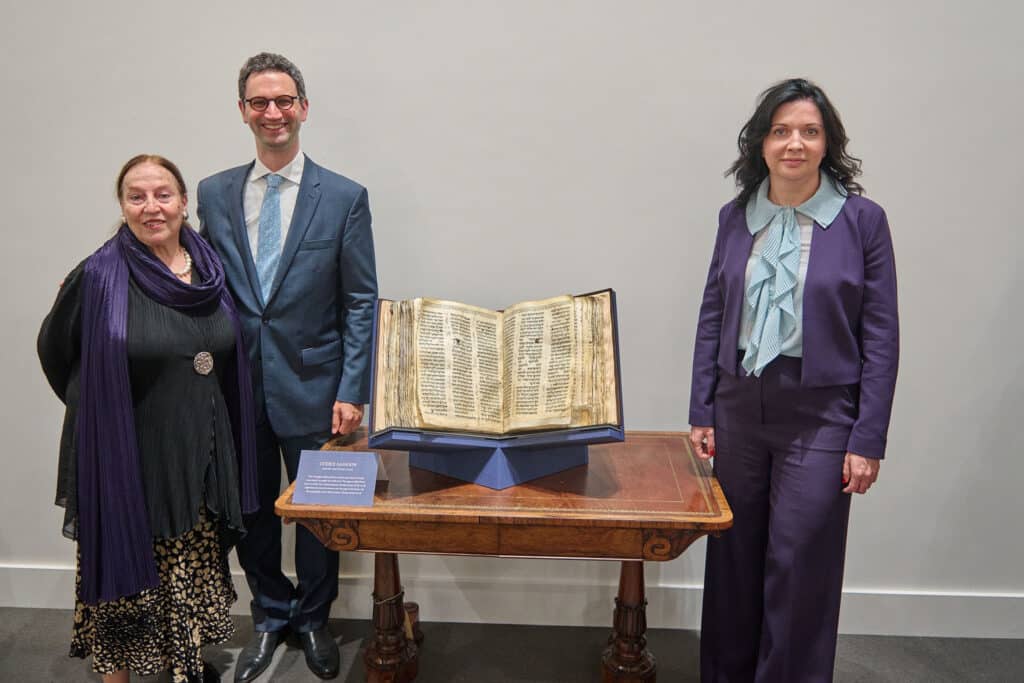
The Codex Sassoon, the oldest nearly complete Hebrew Bible, sold at Sotheby’s New York on May 17 for an all-inclusive total of $38.1 million. A spokesperson for Sotheby’s told the Journal that it marked the highest total for any book ever sold at any public auction.

It was acquired by the American Friends of ANU — Museum of the Jewish People in Tel Aviv, funded by a donation by Alfred Moses, 93, a former U.S. Ambassador to Romania.

“I didn’t want it to go into a bank vault,” Moses told the Journal, explaining why he decided to purchase and donate it after seeing a video about it. “The Museum of The Jewish People is the right place for it.”

The Chief Executive Officer of ANU-America, Shulamith Bahat, told the Journal she had a gut feeling since she learned that Moses would be bidding on the Codex Sassoon with the intent to donate it to the Museum the week before Passover.

“I had my bat-mitzvah seven years ago and the parsha (weekly Torah portion) was Parashat Yitro, including the Ten Commandments,” Bahat told the Journal. “When I saw the Codex for the first time on May 8, that is the part it was opened to. So I thought, ‘If you will it, it is not a dream’ a reference to Theodor Hertzl’s famous quoteon the dream of the Jewish State of Israel: “Im Tirtzu, Ain Zo Agaddah.”

Sharon Liberman Mintz, senior Judaica specialist for Sotheby’s New York, explained why the Codex Sassoon, which was estimated to sell for between $30 and $50 million, was able to fetch such a high price.

At the Sotheby’s auction, the Code Sassoon went for $38.1 million, as former U.S. Ambassador to Romania, Alfred Moses had the winning bid and is donating it to ANU. Photo by Perry Bindelglass for ANU

“It is the highest price for any manuscript because of its understood importance,” Mintz told the Journal. “There was chatter of how high it would go. In the world of auctions, you look for what is comparable but there is nothing like it. A copy of the U.S. Constitution, which was one of 15, sold for $43.2 million in 2002. As the Codex Sassoon is mostly complete, we thought it would go in a similar range.”

The Codex Sasson is believed to be more than 1000 years old and written in modern day Israel or Syria. Named after legendary Judaica collector David Solomon Sassoon, a Londoner who acquired the book in 1929, it contains the 24 books of the Hebrew Bible, in the three sections of the Torah, Nevi’im and Ketuvim. It includes vowels and cantillation notes for those who read from the Torah.

It was once housed in the town of Makisin, which was destroyed, possibly by the Mongol Empire in the 13th century. “There is very little known about the Jewish community of the town,” Mintz said. “There must have been prominent people for it to have been housed there and it makes the historical journey even more rich.”

It is missing eight folios, as opposed to the Aleppo Codex, which has been dated approximately to the year 930 and written in the town of Tiberias and thought to be missing about 180 folios, or about 35-40%. The Aleppo Codex was ransomed by conquering Crusaders, hidden in a washing machine; in 1988 a page of it turned up in Brooklyn, and was the subject of Matti Friedman’s 2012 book.

Shaul Seidler-Feller, a Judaica specialist at Sotheby’s, also spoke to the Journal. “I was overjoyed with the result,” he said. “A manuscript of this importance deserves to achieve a price on par with some of the most expensive documents sold at suction and this is well within that range. It was a real privilege to work with the Codex. So many people from all over the world came to our exhibits to see it and gain religious inspiration from it. It was a real Kiddush Hashem (sanctification of God’s name) to see lines of people waiting online to catch a glimpse of this holy book.”

According to Seidler-Feller, Sassoon bought the codex for 350 pounds. Since then, it has sold for $320,000 in 1978 and $3.1 million in 1989. If any of the missing portions of it were to be found, how much would they go for? “We don’t expect them to be turning up,” Mintz said. “That would be extremely unlikely.”

Since eight pages of the Gutenberg Bible sold in 2015 for $970,000 in 2015, if a portion of the missing Sasson Codex emerged, it would probably sell for many multiples of that. Seidler-Feller said the missing pages of the Codex could have been lost through wear and tear or damaged when Maksin was destroyed.

Sotheby’s Judaica specialist Shaul Seidler-Feller touches the Codex Sassoon. Photo by David Wachtel.

Mintz added that if a private buyer had the winning bid, it would not have precluded it from being shown in a museum, but she was happy the Codex Sassoon would be going to ANU in Israel. While it was displayed at Sotheby’s New York gallery, Mintz said those who saw it felt its power.

“People were drawn to the manuscript, and it is almost magnetic,” she said. “Looking at a bible from close to 1,000 years ago, there is a feeling of continuity of transmission from a population of Jews around the world.

As with the Aleppo Codex, there are myths and legends associated with the Codex Sassoon. “It contains a few inscriptions that curse the seller or thief of the manuscript,” she said. “These were likely meant to charge successive generations with making sure to keep the codex in their possession. We know, however, that the book changed hands several times in between the time when these inscriptions were added and now …” He noted that Sassoon was a pious man and put the item up for auction in 1978, being aware of the inscriptions.

What does Moses think of any possible curse regarding the Allepo Codex or the Codex Sassoon? “It’s a bubbe-meise,” Moses said, using the Yiddish word indicating he believes it to be a tale and not real.

What is real is that people will be able to view the Codex Sassoon in Tel Aviv, and Bahat said it was a moment she will never forget. She also said she got celebratory messages including one from someone who is Christian and was happy the Codex would be housed in Israel.

“We are extremely uplifted and elated,” Bahat said, adding that she was grateful to Moses, who is Chair of the Honorary Board of ANU. “This is the perfect gem and people from all over the world can see something so historic in the place where it belongs.”

Codex Sassoon — Oldest Most Complete Hebrew Bible — Sells for Record $38.1 million Read More »

Homeless Encampment Outside of Pico-Robertson Mikvah “Uncomfortable” for Women

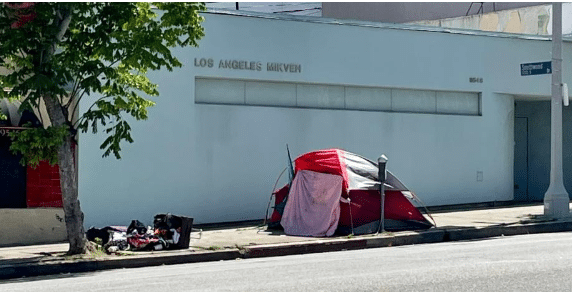
When women go to the mikvah, it is supposed to be a serene, spiritual experience. But now, a homeless encampment that’s popped up just steps away from the Pico-Robertson mikvah, Mikvah Esther, is making women uncomfortable about going for their monthly ritual.

On the morning of May 18, Mikvah Esther sent out a community-wide email with a photo of the encampment, stating: “There is a homeless encampment outside the Mikvah. It is important that everyone in the community email and/or call to request that the encampment be removed, and that the trash, which includes large shards of broken mirror, be cleaned up.”

The email encouraged the community to report the encampment to CD5 Councilwoman Katy Yaroslavsky, who represents the district, as well as submit a service request to have the encampment removed.

According to a spokeswoman from the mikvah, after the email was sent out, the tent was moved to just around the corner from the mikvah, where women park their cars.

“We are concerned some women may not feel comfortable coming,” she said. “One of our staff has said [the homeless person] is a friendly person, but the concern is only about our users continuing to come without hesitation.”

Pico-Robertson resident Yulia Medovoy Edelshtain, who is a doula and yoga teacher, said she enjoys the mikvah, but is now hesitant about going there.

“It’s a very vulnerable experience going to and from [the mikvah],” she said. “It’s already a little uncomfortable, and even more so now with the encampments.”

Sam Yebri, a local leader who ran for the CD5 position that Yaroslavsky currently holds, said that this encampment is just another example of the city’s failures.

“The fact that we are seeing an increasing number of homeless encampments near sensitive areas in our neighborhoods despite record spending reflects an utter failure of our policymakers to address this humanitarian crisis with urgency and common sense,” he said.

The Jewish Journal reached out to Councilwoman Yaroslavsky’s office for comment, but did not receive a reply.

The mikvah spokeswoman doesn’t know who moved the tent to the corner, and has not yet heard from the city or the police about this matter.

She said, “But, many people emailed/called, and maybe they have heard.”

Update: In a statement provided to the Journal, Councilwoman Yaroslavsky said, “My team and I are actively engaged on this issue. As a Jewish woman, I believe everyone should have the right to participate in their religious rituals and traditions safely and without fear. Our office has been working very closely with Rabbi Muskin and the community to find a humane solution.”


Homeless Encampment Outside of Pico-Robertson Mikvah “Uncomfortable” for Women Read More »

ICAN Hosts Inaugural LAUSD Summit on Antisemitism

The Israeli-American Civic Action Network (ICAN) hosted the first-ever summit with the Los Angeles Unified School District addressing rising antisemitism in the state.

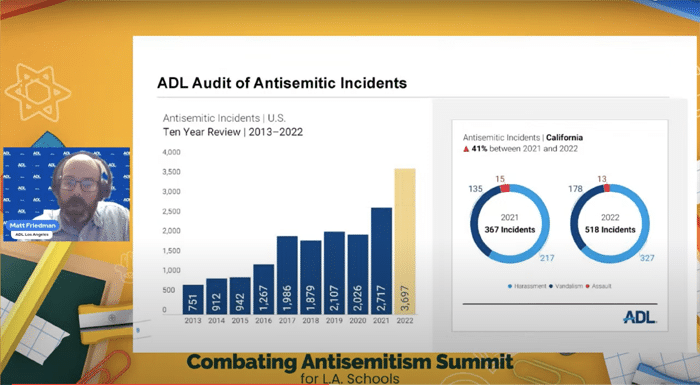
The summit, which was held virtually on May 15, featured Anti-Defamation League (ADL) Los Angeles Senior Associate Regional Director Matt Friedman reviewing data from the ADL’s latest report that was released on May 9. The report found 3,697 antisemitic incidents in 2022––the highest ever recorded by the ADL––a stark increase from the 751 incidents that were documented in 2013. In California, the ADL documented 518 incidents in 2022, a 41% increase from the 367 recorded the year before. Such incidents included the white supremacist organization Goyim Defense League’s (GDL) propaganda campaign through banners draped over freeways declaring that “Kanye Was Right” and flyers dropped on people’s porches blaming Jews for the “COVID agenda.” “Words escalate,” Friedman warned, pointing to the Pico-Robertson shootings in February as an example, since the shooter claimed to have been influenced by the GDL flyers.

Simon Wiesenthal Center Associate Dean and Director of Global Social Action Agenda Rabbi Abraham Cooper further explained the severity of the problem, citing FBI Director Christopher Wray’s figures that 63% of hate crimes targeting religious identity went against Jews, who comprise only 2.4% of the American population. “It’s an unacceptable situation,” Cooper said.

Jennifer, an LAUSD parent and educator who did not provide her last name, told viewers that she is a mass shooting survivor, as she was at the North Valley Jewish Community Center (JCC) that was targeted by a white supremacist with an Uzi submachine gun in 1999. “This changed my life forever, to say the least,” Jennifer said. “I am worried about the antisemitism that is happening in our schools.” As an educator, she recalled being yelled by an administrator for leaving early to observe Yom Kippur despite informing the administrator about her plans beforehand. 

Jennifer’s two daughters have also been subjected to antisemitism; her younger daughter was subjected to cyberbullying and told “she was a cheap Jew and no one liked her because she was a Jew.” Her older daughter was asked by her teachers if she was Jewish “with negative connotation” due to her last name, Jennifer added. “My daughter has cried to me on numerous occasions asking, ‘why do they hate me because I’m Jewish,’” she said. “It’s not ok that this is still happening in our schools in 2023.”

Various LAUSD officials spoke during the summit about their commitment to fighting rising antisemitism. Superintendent Alberto M. Carvalho said that while “schools represent a manifestation of this scourge” of antisemitism, schools are also the “perfect solution” to combating hate. “Education is the solution, and education must continue to be the solution to deal with antisemitic actions that unfortunately target students and adults in our community,” Cavalho said. “We want to understand the root causes and the manifestations of antisemitism so we can bring about educational solutions for these problems.” He pledged to make LAUSD a bastion of “safe havens” to protect students from hate. 

Cecily Myart-Cruz, who heads the United Teachers Los Angeles (UTLA) union, declared that more than 35,000 union members are “standing up to combat hate, injustice and antisemitism in our schools and in our workplaces and in our classrooms.” “This type of hatred has no business in our schools and in our workplaces and in the world and so it is going to be up to us working together to end these kind of practices,” Myart-Cruz said.

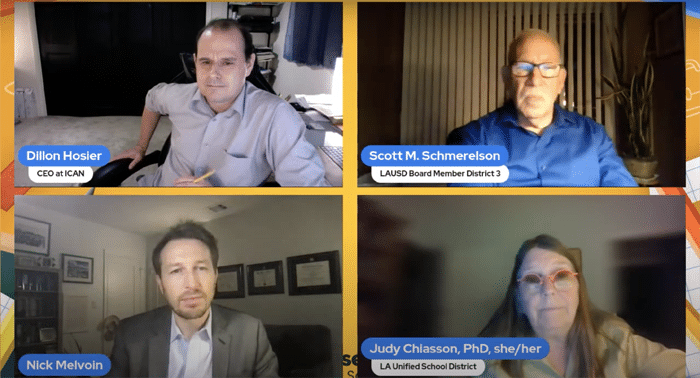
LAUSD Board Member Nick Melvoin, who is Jewish, explained to viewers that “most hatred stems from fear” and “fear comes from a lack of understanding.” He recalled that when he taught at a school in Watts, most of the students there hadn’t met a Jew before, which Melvoin said showed the importance of forging “bonds” with other communities. As a board member, Melvoin said he worked with the Jewish Federation and others “to end a biased pro-BDS [Boycott, Divestment and Sanctions] salary point class for our educators” and to establish “better vetting procedures” to prevent such rhetoric from entering the curriculum; Melvoin also was among lobbying for the defeat of a pro-BDS resolution in UTLA. The school board member said that the resolution “really awoke a sleeping giant” among Jewish educators and others, realizing that “we can’t sleep on our laurels.”

Melvoin called for a more “holistic” ethnic studies curriculum that “places [the] Jewish experience among others as a persecuted minority” as well as better reporting mechanisms to help fight antisemitism. “By continuing to spread awareness and understanding about the Jewish faith, I know we can create a future where the threat of antisemitism is a distant memory,” Melvoin said.

Judy Chiasson, coordinator for LAUSD’s Human Relations, Diversity and Equity Department, explained to viewers that if their child faced a hate incident at school, the best thing parents can do is simply listen and learn what their child experienced at school. When reporting the incident to the school, parents need to be “as factual as possible,” Chiasson said, as saying “my child was bullied” isn’t as effective as saying their child was pushed during lunch and called a slur. “The more factual information you can give … the better equipped they’re going to be to respond to that allegation,” Chiasson said.

During the Q&A session, Melvoin, Chiasson and LAUSD Board of Education Vice President Scott M. Schmerelson were asked about the possibility of the board adopting the International Holocaust Remembrance Alliance (IHRA) definition of antisemitism. Melvoin replied that “this summit is a good first step” toward that goal and that the community can provide “insight” on their “lived experiences.” Earlier in the summit, Cooper advocated for the adoption of IHRA, saying that he has heard officials from various universities lament to him that they don’t have a definition to provide bias training and identify acts of hate. He added that he hoped the summit would help create momentum for IHRA to be adopted. 

Cooper also said that the community “shouldn’t take it for granted” that the LAUSD superintendent and UTLA head were at the summit since often the community is at “loggerheads” with people in power across the country.

Other speakers included Jewish Federation of Greater Los Angeles Senior Vice President of Community Engagement Joanna Mendelson, LAUSD Board Member Kelly Gonez, and LAUSD Association of Jewish Educators Vice President and Fairfax High School Assistant Principal Lisa Regan-DeRoss. ICAN Chairman and CEO Dillon Hosier moderated the summit.

ICAN Hosts Inaugural LAUSD Summit on Antisemitism Read More »

Gal Gadot to Israel Supporters: “You’re the most important audience for me”

Israeli actress Gal Gadot was a surprise guest and honoree Wednesday night at Los Angeles’ official Israel Independence Day celebration at the Saban Theatre in Beverly Hills. She was honored with the Los Angeles Israel Award for Entertainment.

The event was co-hosted by the Israeli American Council and the Consulate General of Israel in Los Angeles.

Even as Gadot was revealed, the master of ceremonies, actress Alona Tal, admitted that she could barely contain herself.

“Sorry I’m fangirling over here!” Tal from the lectern, flanked by two giant television monitors. “Her magnetic presence and exceptional talent have captivated audiences worldwide from her breakout role and ‘Fast & Furious” to her iconic portrayal of ‘Wonder Woman.’” There was an audible gasp amongst the packed attendees in the Winnick Auditorium. Then the on-stage screens cut to a shot of Gadot in the front row, grinning ear-to-ear and covering her face with her hands.

“If you only knew how nervous I am right now, you’re the most important audience for me,” Gadot said to a packed audience. She admitted that her heart was racing as she spoke. “Today, we gathered here to celebrate a milestone: Israel’s 75th anniversary. Hallelujah! A land of rich heritage and vibrant history. The Jewish State has achieved an astonishing amount in its relatively short history. And as I always say, Israel is where—ha’lev sha’li v’habai sha’li —Israel is my heart, and my home. And we all here are deeply proud of our Jewish homeland.

“And this celebration, this recognition is a testament to our unity, our strength, and our shared vision. As an Israeli living in America, I’m very aware of the importance of enhancing and maintaining strong connections of building bridges between the Americans and the Israeli people. Our backgrounds might be different, our journeys unique, but our collective goal is shared: to create a future that’s rich in understanding, mutual respect and collaboration. You should all thank me for not starting to sing ‘Imagine’ here right now. So you’re welcome.

“Building these bridges is not just a matter of diplomatic ties or shared interests. It’s about strengthening the historic bonds between the United States and Israel. It’s about cultivating a deep, genuine connection that transcends boundaries, a connection rooted in shared values, shared history and shared aspirations. Let’s remember that each and every one of us in our own unique way contributes to this effort. Together we can contribute to a brighter future for both our beloved nations. Todah rabah, thank you very much.”

Other honorees included physician and philanthropist Dr. Miriam Adelson, who dedicated her award to her late husband, Sheldon. Also honored was oncologist, Kite Pharma founder and co-founder of Allogene Therapeutics Dr. Arie Belldegrun, as well as  Dovi Frances, founding partner of investment firm Group 11, who gave an impassioned speech.

Following the awards, singer Tamir Grinberg & His Band performed. The most moving tune of the night was Grinberg’s solo piano rendition of Leonard Cohen’s “Hallelujah.”

The full band returned for the next song, during which Gadot attempted to quietly slip out of the front row and out the side door. There were at least 30 fans ready to rush up to her security entourage for a slightly closer glimpse of Gadot. Although the most exciting face of the night had departed, the hundreds of miniature American and Israeli flags kept being waved throughout the auditorium and the music kept playing.

Gal Gadot to Israel Supporters: “You’re the most important audience for me” Read More »

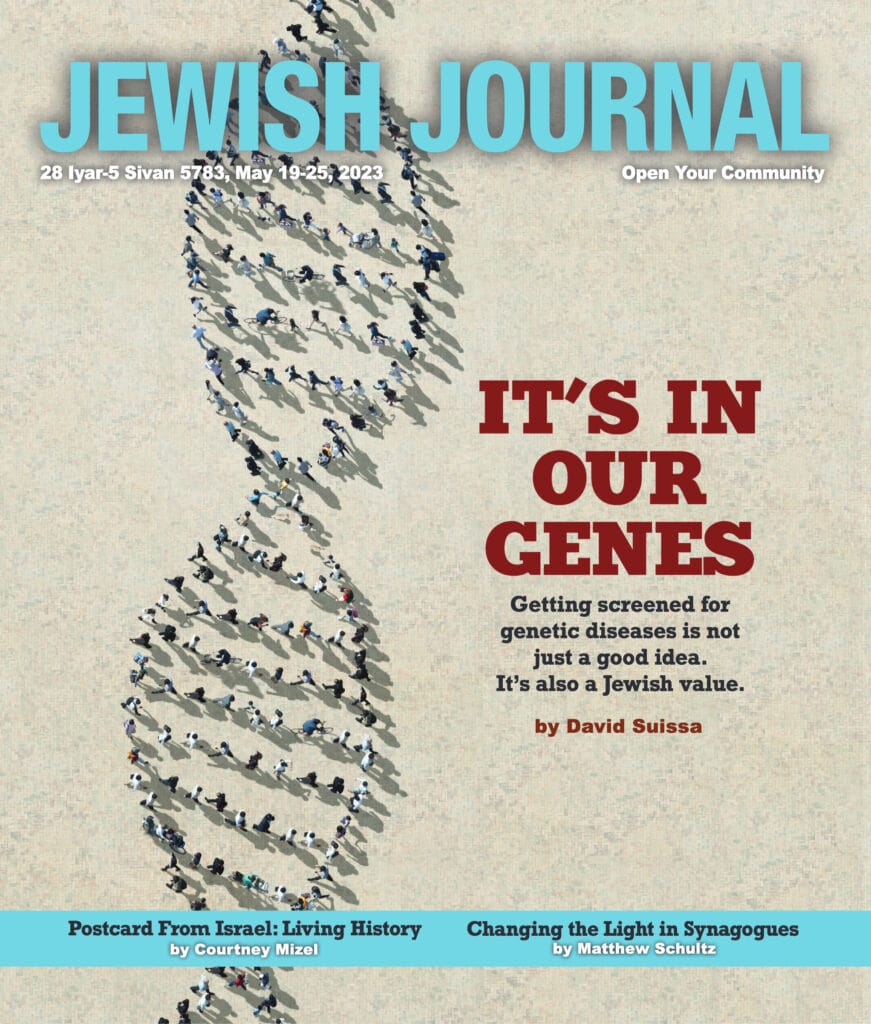
Print Issue: It’s in Our Genes | May 19 2023

CLICK HERE FOR FULLSCREEN VERSION

Print Issue: It’s in Our Genes | May 19 2023 Read More »