fbpx

May 5, 2023

The Gifts of the Holy Days – Comments on Torah Portion Emor


The Gifts of the Holy Days – Thoughts on Torah Portion Emor 2023

Our Torah portion, Emor, has the most detailed list in the Torah of our Festivals and other Holy Days. This Torah portion gives us the opportunity not only to study what the various holidays are, but also to contemplate what we mean by the idea of “holy day.” To discuss the meaning of a holy day, I’d like to offer a few thoughts on the idea of a personal holy day, and then expand that into the idea of a communal holy day. I’ll end with a brief discussion of how Passover can be a gift to humankind. In other words, I don’t think our holy days can be “appropriated” (used without a license) but rather are placed in the public domain, with our blessing.


What are personal holy days? There are moments in our lives in which the whole universe seems to open up. We all have moments of sublime integration, truth piercing the heart, a moment when all is known, when the mystery unfolds. This opening might happen in moments of synchronicity – coincidences far outstripping their mathematical probability. People say to me, “I feel that the Universe is speaking to me.” “Probably so, from the sound of things,” I reply. Those moments of mystical clarity and depth, of the world sparkling out a secret code, however, will soon pass.  We only have a memory of the magic. Now what? Therefore what?


Now what? We must turn those moments into personal holy days.


Therefore what? Therefore, know you have a soul, that there is mystery right at the threshold, waiting to be known, and that your soul lives for these mysteries.


How do we turn these moments into personal holy days? First, memorize the moment. Tell the story to yourself and others. Memorize the place, the before and after. What the moment meant to you. Memorize the date and time.


Second, know that this moment is soul-awakening. Your soul is experiencing the world in your depths, just as you are working (and working through) your life up on the surface. Most of us don’t actively and consciously know that the soul is alive, experiencing, interpreting, creating knowledge, working to communicate to us in intuitions and spiritual instincts, in moments of beauty and truth, in hopes and dreams. Our souls tell us that life is meaningful. When we are rooted in the soul, purpose will grasp us. We must be awake and remember and prepare ourselves for the next time the mystery appears. Our personal holy days will help us stay awake and remember.


Third, create a memento. When I was 14, I took a twig back home from Yosemite, where I had a series of deeply transformative experiences in the summer of 1969. Over time, I lost the twig. I remember, however, that twig and all it represented. I think of the twig when I consciously look at a tree.


Our conscious lives are filled with mementos, places, moments, experiences, some alone, some with others. Together, these moments engrave our identities onto the tablets of our hearts, as the mystery and its depths announce themselves, by thunder or whisper, into our lives.


Groups of people, communities, also have those spiritual identities. Jewish festivals are notable in this way. Our festivals, chagim, are memories of transformative moments (such as Passover) or are designed to create transformative moments (such as Rosh HaShanah). In each holy day, we have stories, rituals, liturgies, symbols, and paths of transformation. Passover, our most widely celebrated festival, contains every meaningful element of both marking and creating group consciousness. We have a story, tangible (and tasteable) rituals, an ever-growing panoply of symbols, guidance for reflection, and plenty of opportunity for fun, meaning, and creativity. Our memory of the redemption from Egypt shapes our communal sense of self in many ways. For example, we read:


You shall do no wrong in judgment, in measurement of weight, or capacity. You shall have just balances, just weights, a just ephah (a bushel), and a just hin (a sixth of a bushel); I am Adonai your God, who brought you out from the land of Egypt. (Leviticus 19:35-36)


Defrauding is not only wrong; it is an offensive to God. God did not bring us out to Egypt to cheat each other. Egyptian slavery is engraved on the heart, essential for our identity.


We suffered bitter work and brutal treatment in Egypt. We were redeemed by a God who has a purpose for us, to a create a “nation of priests, a holy people.” Freed slaves would create a consciousness of law and obligation, to be just and fair, never to forget, and to cultivate the world of the soul and closeness to God.


Each of our holidays has its unique message, history, rituals, practices, symbols, and meanings, all comprising paths to transformation.


The story and rituals of Passover were created by the Jewish people, but, in my opinion, are gifts to humankind. We recently had a worker in our home, who saw all our Passover preparation and Seders from a bit of a distance. This person, a devout Christian, was filled with questions. Did we actually just celebrate the Last Supper?


We shared that the Passover Seder described in Gospels was Jesus’s last supper (he died soon after), but not the last Passover Seder of the Jewish people. We continue to have those suppers. Our worker was truly astounded to learn that that “supper” of the Gospels continues until this every day. I brought out my Spanish language Bible and we read the texts related to Passover. He asked if he and his family could perform this ritual. I said yes; it is our gift to you. Please put your Salvadorian Catholic stamp on it.


We know how the Jewish Exodus story played a huge role in American Black slaves seeking freedom. These texts and rituals can play a deep role in the lives of any suffering people or even any suffering person, both in its reaching for freedom and as a guide toward inner reflection and transformation.


Our tradition, especially our holiday tradition as preserved in Torah portion Emor, is a gift of the ancestors down to you, to me, to us all, and to anyone who wants to taste of their transformative power.

The Gifts of the Holy Days – Comments on Torah Portion Emor Read More »

Harvard Student’s Thesis Alleges That Israelis Face Discrimination on Campus

Harvard University student Sabrina Goldfischer, who previously served as the president of the university’s Hillel, has published a thesis paper alleging that Israelis have faced discrimination on campus.

Goldfischer explained in an April 22 Times of Israel blog that the course of her investigation for her 110-page thesis––which examined the state of antisemitism on campus––revealed “the most acute examples of discrimination involved Harvard’s Israeli students.” “One student faced backlash for his involvement with Israel Trek, an Israeli student-led trip to Israel for Harvard students who do not identify as Jewish,” Goldfischer wrote. “He reached out to organizers of the anti-Trek movement on campus, hoping to begin a dialogue and potentially incorporate their feedback. They refused to speak to him. The Harvard Crimson published an article about the outreach effort, and quoted a member of the Palestinian Solidarity Committee, Harvard’s primary pro-Palestinian advocacy group, who had suggested, were they to meet with the Israeli student, that their physical safety might be jeopardized. He was shocked that The Harvard Crimson was willing to publish what felt like a personal attack.” She also recounted instances in which an Israeli student was allegedly told, “I can only imagine the war crimes you have committed” and another student who was barred from a “social organization” on campus due to being Israeli.

Goldfischer told the Journal that it was “shocking” for her to learn “the amount of the brunt of antisemitism and anti-Israeli discrimination that the Israeli community on campus has to bear.” “The stuff that Israeli students go through at Harvard … it’s outright discrimination that I don’t think would be tolerated for any other group on campus.” She added that she has heard even more “stories that I wish I could include” since finishing her thesis. “It’s really disgusting what Israeli students face on campus,” Goldfischer said, asking how it became this bad on campus and if it’s happening on campuses elsewhere.

Goldfischer took on the thesis after witnessing a spike in antisemitism on campus during the May 2021 conflict between Israel and Hamas as well as the dispute over the East Jerusalem neighborhood of Sheikh Jarrah. Goldfischer, who headed Harvard Hillel at the time, heard from Jewish students about how “a lot of their peers were posting stuff on social media being intensely critical––sometimes into antisemitic territory––of Israel, using tropes” on social media. “‘How can I be a student on Harvard campus when there’s such hatred towards a cause and community that I really care about?’” Goldfischer recalled hearing from students at the time.

Another factor that inspired Goldfischer to take on the thesis was out of concern for the fact that certain progressive spaces on campus reject Zionism. “A lot of people see being a progressive Democrat and being a Zionist to be contradictory views,” she said. “I view them as very much mutually enforcing of each other.” She added that “particularly in left-wing spaces, I felt some of that issue of bringing my full self and for me, my Zionism’s a part of me, my full Jewish self.” Having experienced “right-wing antisemitism” growing up in upstate New York, Goldfischer was interested in seeing how antisemitism “manifest at college campuses.”

Starting with a small list of people she had cultivated from heading Harvard Hillel, Goldfischer conducted 45-minute interviews––both in-person and over Zoom––with Jewish students at Harvard and at nearby campuses as well as Hillel staff members. Goldfischer aimed to make sure the various sects of Jewish community were represented, but told the Journal that “the real value of my thesis lies in the anecdotal work.”

One of the ways that Harvard can ameliorate the issues highlighted in the thesis is by “understanding how Diversity, Equity and Inclusion (DEI) efforts [can] better serve and include Jewish students on campus,” Goldfischer argued, recounting how some students she interviewed told her it was the first time they had ever spoken about what happened to them on campus. “This is serious stuff that impacted their mental, academic, social health,” she said. “I should not be the first person to hear about [it]. There should be ways for them to feel like they can record this, have someone to talk about it and understand it. That should be institutionally based within the college.”

A spokesperson for the university told the Journal they couldn’t comment on current students’ work.

Harvard Student’s Thesis Alleges That Israelis Face Discrimination on Campus Read More »

Consensus Isn’t Just Nice

Jews have a lot of holidays. The Talmud claims that Haman, when libeling the Jews to Ahasuerus, argued that the Jews constantly missed work with the excuse that  “today is Shabbat, today is Passover.” Since then, many other employers have had similar complaints. The current Supreme Court case of Groff v. DeJoy is the culmination of a half-century-plus of litigation regarding the right to observe the Sabbath and religious holidays.

Jewish holidays move around the calendar. Like the old joke, they are never on time, only too early or too late. Constantly moving dates are confusing enough for Jews, but can be bewildering for non-Jews.  A work colleague of a friend of mine wanted to ensure that her Jewish friends could make it to her wedding. This bride knew that the holidays of Rosh Hashanah and Yom Kippur could pose a conflict, so she consulted a Jewish calendar, found the dates, and planned her wedding for another day. The problem was that the bride used the current year’s Jewish calendar, not the following year’s; she assumed the dates for Rosh Hashanah and Yom Kippur never moved. As luck would have it, she booked her wedding for the following Yom Kippur!

The never-ending movement of the holidays magnifies their presence; everyone is constantly checking their agendas to see exactly when the next holiday is going to arrive. The Jewish calendar leaves one with the distinct feeling that every day is potentially a holiday; and that is by design.

The full list of Biblical holidays is found in the Torah reading of Emor (Lev. 23), and each has its own purpose. Rosh Hashanah and Yom Kippur foster spiritual growth and seek divine forgiveness. Pesach, Shavuot, and Sukkot, the three pilgrimage festivals, celebrate both Jewish history and the agricultural season. Shabbat commemorates the creation of the world.

But the holidays are not just a random collection of individual celebrations; together, they have a unified purpose. Rabbi Samson Raphael Hirsch explains that the holidays and Shabbat are the counterparts to the Temple. The Temple creates a center of holiness in space where one can find spiritual connection; the holidays create holiness in time, with multiple opportunities for spiritual renewal. To borrow a phrase from Abraham Joshua Heschel, the Shabbat and the Holidays are “a cathedral in time”;  and that cathedral is always in plain sight, with the next Shabbat or holiday just around the corner.

The Talmud describes the holidays as being “half of for God, and half of for you,” a mix of celebration and spirituality. As one would expect, most commentaries emphasize the spiritual aspects. Rabbi Ovadiah Seforno says the holidays are intended for learning, days when the community should gather to listen to wise teachers. The Kuzari (3:5) sees the holidays as a form of “spiritual nourishment,” and part of a larger cycle that includes the daily prayers. The three daily prayers rejuvenate the soul. After that, the Shabbat repairs what the prayers cannot, and the holidays repair what Shabbat cannot.

Maimonides takes a very different view, and emphasizes rejoicing as the central purpose of holidays. He explains (Moreh Nevukhim 3:43) that “the festivals are all for rejoicing and pleasurable gatherings, which is generally indispensable for humanity; they are also useful in the establishment of friendship, which must exist among people living in communal societies.” In a later passage, he talks about the holiday pilgrimage as reinforcing the sense of “fraternity of one to the other.” Joy brings psychological benefits to everyone; but it serves a critical communal purpose, in bringing people closer to each other.

The holidays are not merely conduits to the divine; they are meant to bring people closer together. That friendship is what makes the holidays holy.

It may seem surprising that Maimonides, who is usually depicted as an extreme rationalist, attaches such importance to friendship. The philosophic quest is of such importance that he advises that “every excellent man stays frequently in solitude, and does not meet anyone unless it is necessary.” (3:51.) But, as Don Seeman argues in his article Maimonides and Friendship, that represents a very incomplete picture. Maimonides emphasizes over and again that friendship is critical to human flourishing. At one point he declares I say then: It is well known that friends are something that is necessary for man throughout his whole life. …. When he is healthy and happy he will delight in them, in times of adversity he will turn to them, and in times of old age and weakness he will seek help from them. A single tribe that is united …. and because of this, love and help one another, and have pity on one another; the attainment of this is the most important of the purposes of the Law. (3:49.)

This is not just a rhetorical flourish; it is how Maimonides lived his life. This great philosopher did not live in a garret, alone. Even at a young age he devoted himself to the community, and he was a dedicated doctor who spent endless hours with his patients.

Contemporary Jewish philosophers take this idea a step further, and see friendship as opening the door to otherworldly inspiration; one can see a reflection of the divine in the shared love of two human beings. And, as Maimonides wrote, the emphasis on friendship is not a secondary goal of Judaism; it may actually be its most important goal.

Unity requires that no person be left behind. The joy of the holiday is meant to include everyone, which, Maimonides reminds us, requires a person to have an open door policy for people from very different social strata:

When a person eats and drinks [in celebration of a holiday], he is obligated to feed converts, orphans, widows, and others who are destitute and poor. In contrast, a person who locks the gates of his courtyard and eats and drinks with his children and his wife, without feeding the poor and the embittered, is [not indulging in] rejoicing associated with a mitzvah, but rather the rejoicing of his gut. (Holidays 6:18)

The Talmud also says that the ordinary rules regarding the am haaretz, the ignorant, whom one cannot trust to keep Torah law meticulously, are suspended on the holidays. Now, they are trusted regarding tithes and ritual purity, which allows everyone to eat from each others’ meals. In support of this ruling, the Talmud quotes a verse that says “and all the men of Israel gathered to the city, like one man, united as friends.” (Judges 20:11. In Hebrew “kol Yisrael chaverim.”) On holidays, when the community gathers, everyone must be united as one.

Bringing people together is the challenge of the 21st century; Socials isolation is the order of the day. Overwork, combined with an at the fingertips availability of endless food and entertainment, has led to cocooning, where people wrap themselves up in their own little bubbles. Email and social media have replaced in-person connections, and as a consequence we have lost the ability to bridge social gaps. Politics has become so toxic that people break off relationships with friends and family.

So, Rabbis and communal leaders make speeches about fostering community and building consensus. Everyone agrees it is a serious subject; but it is also seriously ignored. And that’s because consensus is perceived as something that is nice but not something important.

Consensus has an image problem; it is soft and sweet, like a young child’s Mother’s Day card. On the other hand, politics is powerful. The language we bring to debate is filled with military metaphors. Opinions are strong. Arguments are strong. To bring people together is what kindergarten teachers do; but to launch into battle is what generals do, to be competitive is what CEOs do. That’s why we don’t respect consensus.

Yet consensus is the very goal of the holidays. They are meant to bring together the wealthy and the poor, and connect comfortable families with widows and orphans. They are meant to unite the ignorant with the learned, the less observant with the pious. They are days of solidarity and connection, because that is the very purpose of the law itself.

Consensus isn’t just nice. Without it, we will have failed as a community and as individuals. And as Jewish history has taught us time and again, the end of solidarity is the beginning of exile.


Rabbi Chaim Steinmetz is the Senior Rabbi of Congregation Kehilath Jeshurun in New York.

Consensus Isn’t Just Nice Read More »

Fried vs. Kremer: For the First Time Since 1966, Two Jewish Pitchers Are Facing Off

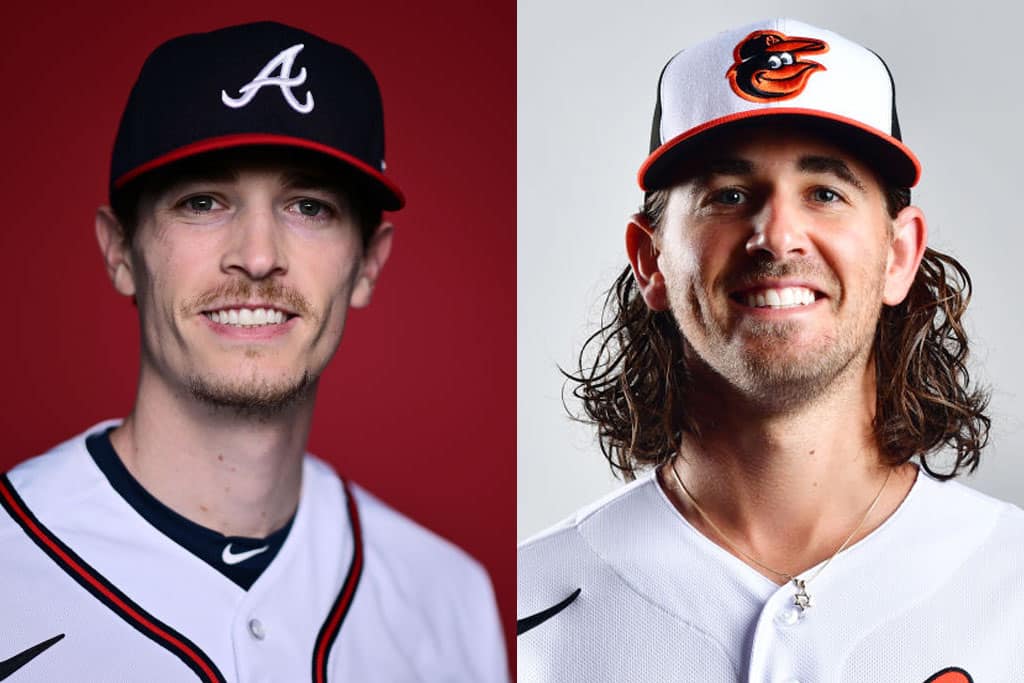
Tonight, the Jewish Sabbath, Braves’ pitcher Max Fried faces off against the Orioles pitcher Dean Kremer in Atlanta.

The last time two Jewish pitchers started for opposing major league teams was probably September 25, 1966, when the Dodgers’ Sandy Koufax (at the very end of his career) pitched against Ken Holtzman, a 20-year old rookie for the Cubs at Wrigley Field. Holtzman beat Koufax 2 to 1. (He’d pitched four innings for the Cubs the previous year, but was still considered a rookie in 1966). It was the day after Yom Kippur. Koufax and Holtzman had both refused to pitch on the Jewish holy day.

Everyone knows that Koufax had an outstanding career He is often considered one of the greatest pitchers of all time, although during his first six out of his 12 major league seasons he was plagued by wildness and was mediocre. But Holtzman had an outstanding career, too. Both were winning pitchers in a World Series Game 7. Both were lefthanders.

During his major league career, which was shortened by injuries (he retired at 30), Koufax won 165 games and lost only 87. He had 2,396 strikeouts. He was selected the NL’s MVP in 1963. He won the Cy Young Award as the game’s outstanding pitcher, unanimously in 1963, 1965, and 1966 when the honor was for all of baseball, not just one league. In those three years, Koufax led all major league pitchers in wins, strikeouts and earned run average. Over his career, he hurled four no-hitters, including a perfect game against the Chicago Cubs in 1965. In 1972, Koufax (then 36), was the youngest player ever elected to the Hall of Fame.

During his 15-year career, Holtzman had a 174-150 won-lost record. He threw two no-hitters for the Cubs. He was a two-time All-Star. He was a top pitcher for the Oakland A’s dynasty that won three consecutive World Series championships between 1972 and 1974. In 1973 he started 40 games for the A’s and had a 21-13 won-lost record. He pitched in 8 games in five World Series and was 4-1 with a 2.55 ERA.

In seven years with the Braves, Fried has an amazing 56-25 won-lost record, a .691 winning percentage, which is even better than Koufax’s .655. This season so far he’s started four games and is 2-0. He’s pitched 20 innings and has given up only one run, which translates into an almost impossible 0.45 ERA. Fried pitched in last year’s All Star game and has won three Gold Gloves for being the best-fielding pitcher.

Kremer became the first Israeli citizen to play in the major leagues on September 6, 2020, when he held the Yankees to one hit and one run in six innings and earned the win. His parents are Israelis who moved to the U.S. after they completed military service in Israel. Kremer was born and raised in Stockton, California. In four major league seasons, he’s 11-16. This season so far he’s started six games, pitched 29 innings, and is 2-1.

There are 14 Jews current on major league rosters. In addition to Fried and Kremer, they include  Harrison Bader (Yankees), Alex Bregman (Astros), Dalton Guthrie and Garrett Stubbs (Phillies), Joc Peterson (Giants), Kevin Pillar and Jared Shuster (Braves), Rowdy Tellez (Brewers), Jake Bird (Rockies), Richard Bleier (Red Sox),  Eli Morgan (Guardians), and Matt Mervis (Cubs).

Fried vs. Kremer: For the First Time Since 1966, Two Jewish Pitchers Are Facing Off Read More »

All the Jewish Details of King Charles’ Coronation, from Shabbat Accommodations to Jerusalem Oil

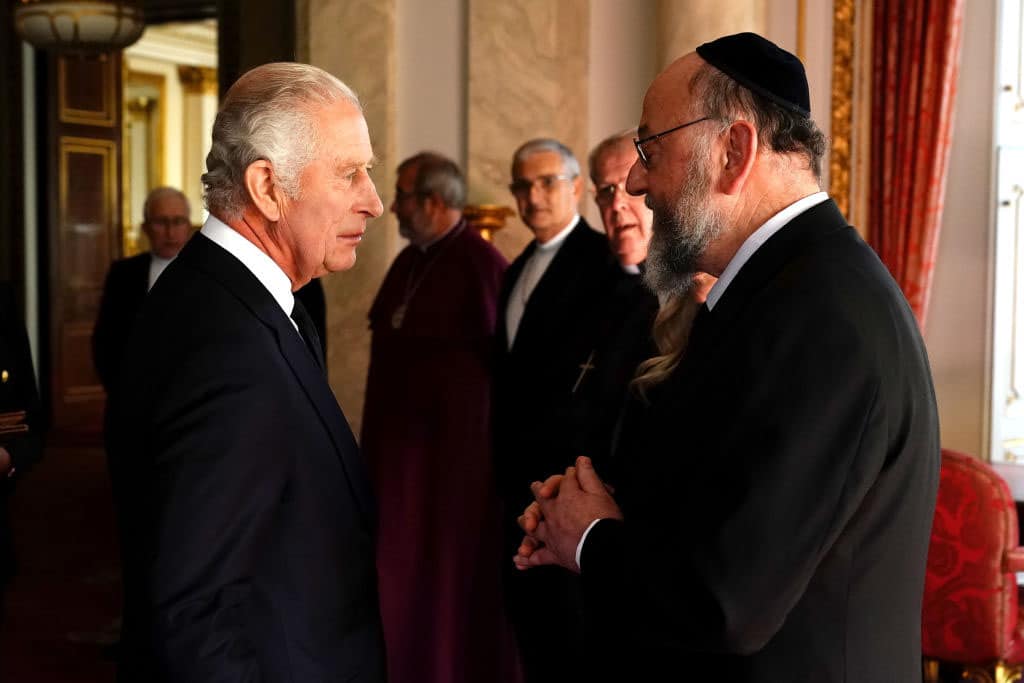
At a reception of faith leaders at Buckingham Palace the day after Queen Elizabeth’s death in September, King Charles pulled Britain’s chief rabbi, Ephraim Mirvis, aside for a word.

The reception was pushed earlier in the day than originally planned to accommodate Mirvis, since it fell on a Friday. But it ran long and Shabbat was approaching. According to Rabbi Nicky Liss, head of the Highgate Synagogue, Charles asked Mirvis what the rabbi was doing sticking around — didn’t he have to get home by Shabbat?

The protocol is that no one is allowed to leave the room before the king does, Mirvis responded. Charles then promptly told him to get home.

Both men are expected to bring that spirit of mutual respect to Charles’ coronation day on Saturday, as the new king will include a range of faith leaders who have never before been featured in a royal ceremony of this magnitude.

While much of the ceremony is still rooted in Christian rituals, representatives of Jewish, Muslim, Sikh, Buddhist, Hindu, Jain, Bahai and Zoroastrian communities will be incorporated into the proceedings. In fact, non-Jewish faith representatives will enter Westminster Abbey before Anglican clerics. Jewish, Muslim, Hindu and Sikh members of the House of Lords will hand Charles objects of the royal regalia. And in a notable cross-cultural mash-up, British Prime Minister Rishi Sunak, who is Hindu, will read a passage from St. Paul’s letter to the Colossians, which includes language on the “loving rule of Christ over all people and all things.”

There is one large obstacle for observant Jewish participants and onlookers: The ceremony falls on Shabbat. But Charles has invited Mirvis to sleep in his home on Friday night — Clarence House, located a 15-minute walk from Westminster Abbey, the site of the coronation — so he can easily get to the event without using electricity (he will attend an early morning Shabbat service on his way). And when religious leaders recite a “spoken greeting in unison” to Charles at the end of the ceremony, Mirvis will not use a microphone.

While many Orthodox interpretations of Jewish law hold that Jews should not enter churches, London’s top rabbinical court ruled in the 1970s that chief rabbis may do so if their presence is requested by the monarch. Coronations have held at Westminster Abbey since 1066; the last time one was held on Shabbat was in 1902.

Some Jews around London this week were not excited about the Shabbat timing, and like many other Britons, were still mourning Queen Elizabeth, Charles’ mother whose 70-year reign guided the kingdom through the second half of the 20th century and through the upheaval of the 21st.

“It’s a shame that we can’t fully participate in it but we do need to acknowledge that we’re such a minority and I don’t expect them to take us into account,” said Naomi Joseph, who was walking around Golders Green, a heavily Jewish neighborhood, on Tuesday. “But it does make me feel less enthusiastic. It’s like not being invited to a party.”

“The queen’s funeral did feel more poignant than the coronation,” said Keren Rechtschaffen, who researches Judeo-English, a local dialect. “People seemed more invested in it. We haven’t had a chance to see how Charles is going to reign. Although I’m sure he’s going to be great.”

But many Jewish congregations and families have for weeks been in the royal spirit, which engulfs England in an excited frenzy — and creates a huge market of monarch-themed merchandise. Some congregations will close off the roads near their synagogues to have celebrations on the street. Others will hold ceremonies and services of their own to honor the king, but a week later — so their members can watch the coronation live on TV on the day.

An office window shows coronation posters in Golders Green, a heavily Jewish neighborhood of London, May 2, 2023. (Deborah Danan)

Musical celebration and tribute is a recurring theme. United Synagogue, the union of British Orthodox synagogues, commissioned a new children’s choir recording of “Adon Olam,” a prayer perhaps most recognizable as the conclusion of Shabbat services, and dedicated it to the new king. The Shabbaton Choir, a group that frequently records for radio and television shows, created a new musical version of the Prayer for the Royal Family that’s recited by British Jewish congregations every week.

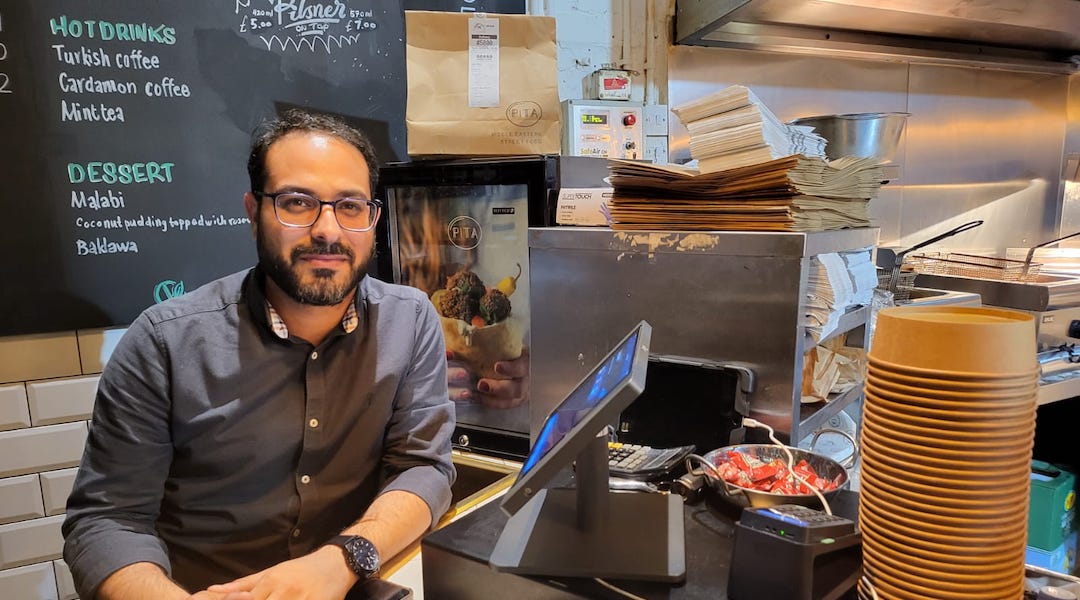
“We’ve waited a long time for this coronation. It’s exciting,” said Sahar Dadon, an Israeli who runs a pita restaurant and has lived in London for 20 years. “We bless the king with shem malchut [of God’s name]. It’s a divine thing.”

He added, “My wife feels it more. She’s English and goes to all the ceremonies. The kids are very excited, too.”

Israeli Sahar Dadon calls the coronation “a divine thing.” (Deborah Danan)

The Jewish connection to the coronation ceremony will get literal, too — the king and the soldiers involved will wear at least some pieces stitched by Kashket & Partners, a Jewish family-owned tailoring company that is the main supplier for Britain’s armed forces. Baroness Merron of Lincoln, a former chief executive of the Board of Deputies of British Jews, will hand Charles the long Imperial Mantle robe, which was first made for George IV in 1821.

“We’ve got our day-to-day business going on too but obviously the coronation takes priority over everything else,” Cheryl Kashket told the London Jewish Chronicle. “There is nothing more important than what is going on. It is very exciting and we realize how fortunate we are to be a part of history.”

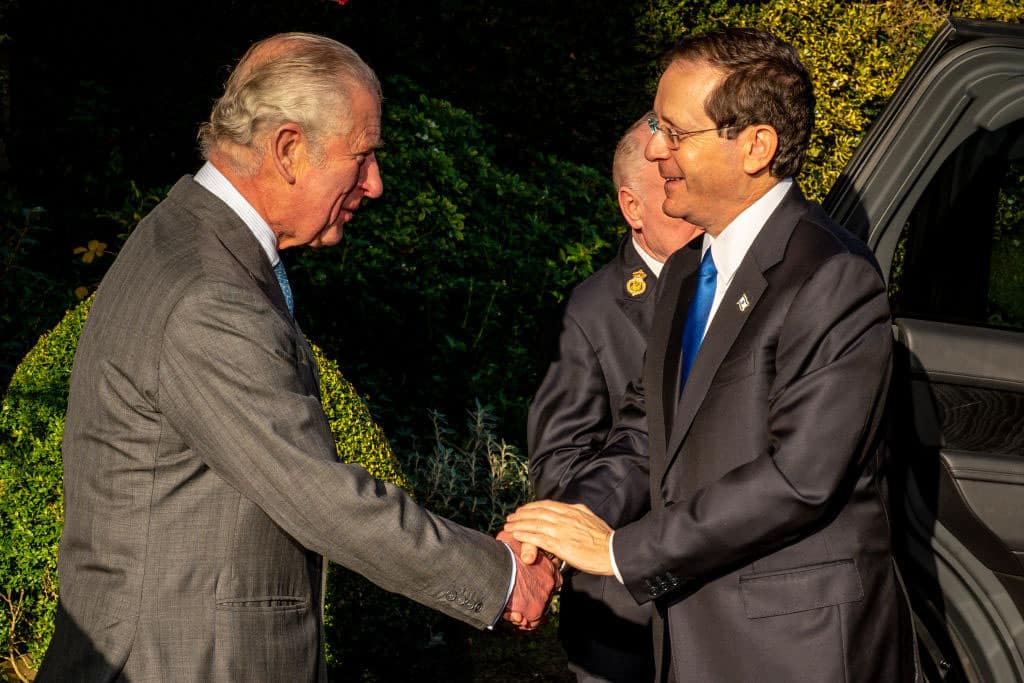
Israeli President Isaac Herzog will be in attendance on Saturday, too; a kosher caterer will provide food for him and Mirvis.

Ivan Binstock, a longtime senior leader for multiple London Jewish communities, said the actual coronation ritual, which involves anointing the new king with oil consecrated in Jerusalem, was especially resonant for the Jewish community.

“The most significant part of the coronation, that is shielded from public view, is in fact biblical,” he said, noting that the ritual has its roots in the anointing of high priests in the ancient Temple in Jerusalem. “It’s a source of great pride.”

All the Jewish Details of King Charles’ Coronation, from Shabbat Accommodations to Jerusalem Oil Read More »

Israelis Reflect on King Charles’ Ties to Jewish People Ahead of Possible Visit

As British citizens and royal enthusiasts around the world prepare to celebrate the coronation of King Charles III, Israelis are reflecting on the king’s connections to Israel and to the Jewish people. Some are hoping for an official visit after the coronation.

Rabbi David Rosen, the American Jewish Committee’s Jerusalem-based international director of interreligious affairs, told The Media Line of his admiration for Charles but said that he doubted a royal visit would happen in the current Israeli political climate.

“Prince William came, which is an indication that they are inching [forward], but I don’t suppose under the present government that that would be likely to happen,” he said.

Prince William visited Israel in 2018, as a few other members of the royal family did throughout the years, but no sitting British monarch has officially visited Israel.

Charles, then prince, came to Israel in 1995 for Prime Minister Yitzhak Rabin’s funeral and in 2016 for President Shimon Peres’ funeral. He visited again in 2020 following his son William’s visit.

Queen Elizabeth II, who died last year, never visited Israel. But her mother-in-law, Princess Alice of Battenberg, is buried at the Russian Orthodox Church of Mary Magdalene on the Mount of Olives in Jerusalem.

During World War II, Alice saved a Jewish family in Greece from deportation to a death camp. She is recognized as one of the Righteous Among the Nations—non-Jews who risked their lives during the Holocaust to save Jews—by Yad Vashem, Israel’s official Holocaust memorial.

Charles, who is known to be amicable to those from all religions, broke with royal tradition by inviting non-Anglicans to participate in his coronation on Saturday.

Israeli President Isaac Herzog and his wife Michal will be among the 2,200 attendees, including 100 heads of state from around the world. British religious figures such as Archbishop of Canterbury Justin Welby and Chief Rabbi Ephraim Mirvis will also attend.

As king, Charles is also the official head of the Church of England. Royals are required to follow Christian traditions, and the coronation has historically been a ceremony at which the regent accepts the royal title in the name of the church. Non-Anglicans were therefore barred from attending the ceremony.

Israelis who met Charles spoke fondly of his spirituality and his respect for those of all faiths.

“On the occasions I’ve met him, I’ve been very impressed with the conversation,” Rosen said. “I’ve been impressed with his spirituality, with the interest he takes in religions generally.”

He recalled Charles using the phrase “created in the divine fabric” to describe creation in the image of God.

“I’d never heard that phrase used in English before, but it seems to me to be an actual very good translation of one of the interpretations,” Rosen said.

He also recalled a speech that Charles once gave about religion driving people’s visions for a better world and a better society.

“There was a particular emphasis upon the fact that religions should lead an environmental awareness [campaign] precisely because religions affirm that our world was created and therefore it is a manifestation of the divine,” he said.

Rosen said that after Charles took over as king, he asked whether he could invite Charles to Israel. Charles responded that he would love to but that his advisers would probably tell him not to.

Former Ambassador of Israel to the UK Mark Regev similarly said that Israel may “have to have a little patience” as it waits for an official visit from Charles.

He told The Media Line that as constitutional monarchs, British royals make decisions based on the advice they receive. That explains why Elizabeth never visited, despite the fact that she would have probably liked to do so, he said.

Charles, too, probably wants to come, “but it’s fair to say it won’t be in the near future,” Regev said. He noted that Charles will probably visit some of the Commonwealth countries before coming to Israel.

British nationals in Israel are getting ready to commemorate the coronation. The British-owned Kumkum Teahouse in Jerusalem has planned a series of events to celebrate.

The teahouse prepared a special menu that includes similar treats to those eaten at coronation parties in England, such as scones, Pimm’s alcoholic fruit cup, and Buck’s Fizz cocktails.

On Thursday, dozens of people gathered at the teahouse for a “great British sing-along.” Although the coronation is set to begin on Saturday morning with live television coverage, it will be screened at the teahouse on Saturday night to allow observant Jews to watch.

Owner Elisheva Levy told The Media Line that about 90% of those registered are British nationals “who enjoy anything royal.”

At the official coronation ceremony, Charles will be anointed with oil consecrated by two clergymen at the Church of the Holy Sepulcher in Jerusalem.

“From ancient kings through to the present day, monarchs have been anointed with oil from this sacred place,” Archbishop Justin Welby said in a statement.

The Patriarch of Jerusalem Theophilos III and the Anglican Archbishop in Jerusalem Hosam Naoum consecrated the oil.

Additional celebrations are planned throughout the region. For example, the English College, Dubai asked its students and staff to dress up on Friday to celebrate the coronation and the Ambassador International Academy, also in Dubai, invited its students and staff for a live viewing of the ceremony.

Representatives from nearly every country in the world are expected to attend the coronation, including leaders from across the Middle East. Iran was one of the very few countries not to be invited.

To read more articles from The Media Line, click here.

Israelis Reflect on King Charles’ Ties to Jewish People Ahead of Possible Visit Read More »