fbpx

April 25, 2023

At an American Jewish Conference in Tel Aviv, Protesters are Driving the Energy

At a marquee conference of American Jewish leaders that kicked off tonight in Tel Aviv, the loudest cheers were for anti-government protesters, most of the energy could be found outside of the convention center’s gates, and the biggest news was who didn’t show up.

The General Assembly, the signature conference of the American Jewish organizational world, was meant to be a celebration of Israel’s 75th birthday and a testament to the enduring strength of ties between Israel and Diaspora Jewry. Sunday’s opening event, the Jewish Federations of North America said, was meant to pay tribute to that relationship — and feature speeches by Israeli President Isaac Herzog and Prime Minister Benjamin Netanyahu.

But in the face of loud protests outside the event, Netanyahu abruptly canceled his appearance on Sunday, citing a full schedule ahead of Israel’s Independence Day on Wednesday. Over the course of a series of speeches by international Jewish dignitaries, his name was not mentioned once.

Instead, both inside and outside the conference walls, the tone of the evening was set by the protesters. They gathered by the hundreds opposite one of the convention center’s entrances — and in smaller clusters around the building — giving the thousands American Jewish visitors a taste of the protest culture that has developed this year in Israel as huge numbers of Israelis have taken to the streets to oppose Netanyahu’s sweeping proposals to sap the power of the judiciary.

Protesters waved Israeli flags, chanted the word “democracy” syllable by syllable, and blew into small plastic horns whose blaring sound carried remarkably well —  permeating the walls of the conference plenary session. An entrepreneur standing at a card table was selling packages each containing a horn and a small Israeli flag for, depending on who asked, either 20 or 30 shekels (roughly $5.50 or $8).

The most direct route from the train to the conference was blocked off, owing to Tel Aviv’s ongoing quest to build a citywide light rail system. So, with roads closed, the best way to get from the train station to the event was to follow the protesters — identifiable by the huge Israeli flags they carried or wore around their necks. Many were also pushing strollers or walking dogs.

“Israel must be a free democracy,” protesters chanted as attendees exited the event. “Please help us. Fascism shall not pass.”

Most of the protesters were gathered far from the gate where conference participants actually entered. But they got a shout out in the conference program as well. Julie Platt, the Jewish Federations’ board chair, drew a sustained round of applause and whooping from the 2,000 attendees when she spoke about how inspiring the protests were.

“What is clear is how passionate we all are about Israel and how central Israel is to our lives,” Platt said. “Its struggles our are struggles, its success is our success, and its debates are our debates. To the leaders of Israel, including those attending tonight, we stand united in our support of dialogue and broad consensus based on mutual respect.”

Then, she added, “To the protesters exercising their democratic rights, we see you, we hear you and we are inspired by your love of Israel.”

When the Jewish Federations last held the General Assembly in Israel, in 2018, Netanyahu sat onstage for a Q&A with the group’s chairman for more than half an hour. In Netanyahu’s absence this year, the night’s keynote speaker was Israeli President Isaac Herzog. His role is largely ceremonial, but he has been spearheading dialogue about the judicial overhaul — as well as issuing dire threats about what may happen if that dialogue fails.

Herzog repeated a version of those warnings Sunday night, portraying the debate over judicial reform as a cautionary tale about the dangers of polarization.

“The fierce debate over Israel’s direction in recent months is a striking example of the ways that alienation between different groups, and polarization that festers for years, becomes corrosive and weakens the pillars that hold our nation together,” he said. “I am convinced that there is no greater existential threat to our people than the one that comes from within.”

In his speech, Herzog announced an initiative called “Voice of the People” that will be aimed at fostering dialogue between Jews of differing opinions across Israel and the Diaspora. That initiative will be anchored by a conference he called the “Jewish Davos,” in a nod to the Switzerland-based annual economics conference that is seen as a global meeting of the minds.

“Nonpartisan, apolitical, Voice of the People will be a collaborative forum — one that can hold and reflect the full and diverse range of Jewish voices,” he said. “It will be a place where we can engage in serious, sensitive and strategic discussions on the most complex and pressing issues facing our people.”

If that conference happens, it would not be the first of its kind. Israeli President Shimon Peres, who served from 2007 to 2014, held an annual conference featuring famous names discussing hot-button issues. And historically, the federations’ General Assembly itself has been viewed as an ecumenical Jewish conference to discuss a wide range of issues.

Aside from that, the night’s program featured mainstays of traditional American Jewish gatherings celebrating Israel: a video with black-and-white stills from the country’s founding years, testimonials from Jewish immigrants to Israel from around the world, a performance by a musical group composed of Israeli soldiers. The conference will continue with a full day of sessions on Monday.

Near the end of the night, as the festivities were winding down, two people in the audience held up Israeli flags. The corner of one of them featured a quote from Israel’s national anthem that has become a protest slogan: “Free in our land.”

At an American Jewish Conference in Tel Aviv, Protesters are Driving the Energy Read More »
Swastika Carved on Autistic Jewish Student’s Back in Vegas

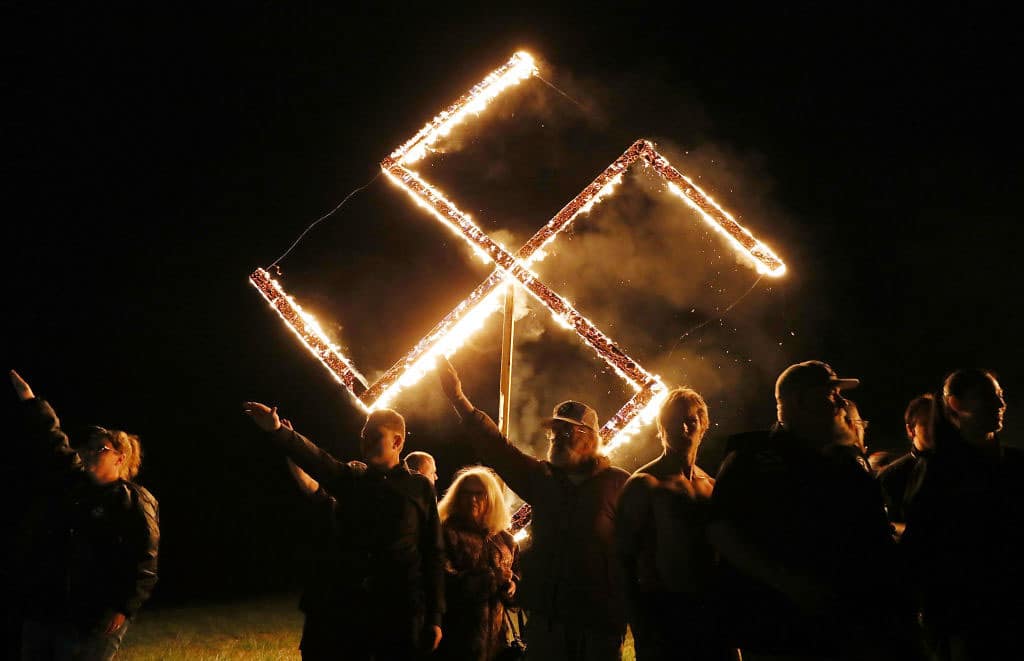
A swastika was reportedly carved on the back of a nonverbal autistic Jewish student in Las Vegas on March 9.

NBC News reported on April 22 that the mother of the 17-year-old Clark High School student reported the incident to the school district on March 13 and has taken the student out of the school. She also said that her son is the only student at school who wears a kippah. The district has said that police conducted an investigation but were unable to determine the perpetrator.

“We will not tolerate discriminatory behaviors that contradict an inclusive community and impact student safety and well-being,” the district said in a statement. “If anyone has any additional information related to this case, we urge them to contact school police immediately.”

The FBI said in a statement they “are in regular contact with local authorities.” “If during the local investigation, information comes to light of a potential federal civil rights violation, the FBI is prepared to investigate,” they said.

Shoham Nicolet, co-founder and CEO of the Israeli-American Council, which first reported the incident, said in a statement, “The Israeli-American Council was appalled to learn that a Jewish teen may have been targeted in such an inhumane antisemitic attack. We urge authorities to investigate this incident to the fullest.”

The Lawfare Project announced on April 24 that they will be representing the student in this matter.

“Antisemitic hate is no longer hiding in the shadows and in the darkest corners of the internet,” Lawfare Project Founder and Executive Director Brooke Goldstein said in a statement. “To attack an autistic child in a public place shows the brazen level of hatred people will display to harm the Jewish community. Our team will work with the victim and his family to ensure that the individual or individuals responsible for this will be held accountable.”

Other Jewish groups also denounced the swastika carving.

“ADL [Anti-Defamation League] condemns this violent, antisemitic act,” ADL Nevada Regional Director Jolie Brislin said in a statement. “Not only was this student targeted for his identifiable faith, but he was particularly vulnerable due to his disability. This incident illustrates points of intersectionality in how hate can show itself across marginalized communities.” She added that the ADL has been in contact with the district and law enforcement on the matter. “School should be no place for hate, and no student should be made to feel unsafe and threatened.”

Stop Antisemitism tweeted, “We are sick to our stomachs to learn a non verbal autistic Jewish student in the Las Vegas area (Clark County) had a swastika carved into his back. The FBI is currently investigating.”

Former New York Democratic Assemblyman Dov Hikind, who heads the Americans Against Antisemitism watchdog, tweeted: “A Jewish autistic student had a swastika carved into his back. 2 months later, the culprit has yet to be found. The FBI isn’t certain there was a civil rights violation so they haven’t investigated yet! But if ‘KKK’ had been carved into a black student it would rightfully be a national story! We’re sick of these double standards when it comes to hate crimes!! And we’re demanding a full FBI investigation into this doubly heinous attack on an autistic student because he’s Jewish!”

Swastika Carved on Autistic Jewish Student’s Back in Vegas Read More »

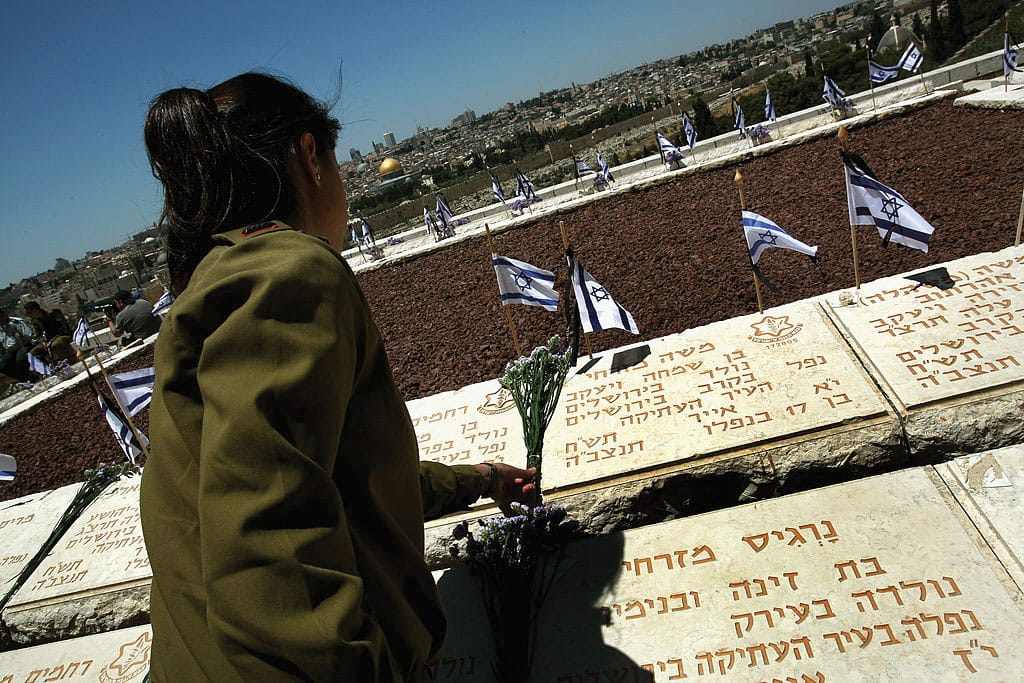
After the Siren: Yom Hazikaron 5783

Israel has two major memorial days: Yom Hazikaron, the remembrance day for fallen soldiers of Israel and Israeli terror victims, and Yom Hashoah Vehagevurah, Holocaust and Heroism memorial day. One is a reminder of the cost of having a Jewish State, the other is a reminder of the cost of not having it.

If you’ve ever spent Yom Hazikaron in Israel, you know how special a day it is — how far from the American Memorial Day that has become mainly an opportunity to catch a bargain in retail sales. No other memorial day in the world feels quite like Yom Hazikaron. The music on the radio is pensive and downbeat, the TV broadcasts the more than 23,000 names of Israel’s fallen in a loop alongside programs that honor the heroes and highlight the ordeals of bereaved families. Places of entertainment are closed and people adopt a subdued and reflective demeanor. Because everybody in Israel has a friend or family member who died in a war or attack, much of the country visits memorials.

Israel doesn’t have a National Memorial for the fallen. While many IDF soldiers are buried in the national Mt. Herzl Cemetery, most rest in the towns and villages where they lived. Every city has a “Yad Labanim” (a memorial to our children) that honors the local fallen. Ceremonies there are not stately and majestic but intimate and heart wrenching, because each town honors people that residents knew personally.

But the most compelling feature of Yom Hazikaron is the siren that sounds all across the country at 11:00am, bringing the country to a complete halt. If you haven’t seen it personally, watch it on YouTube.

People stop what they are doing and stand at attention for the two minutes that the siren blares; traffic stops in the avenues and highways and motorists step out of their cars to stand still. From the sands of Eilat to the shores of the Sea of Galilee, the country stops in its tracks. If it wasn’t for the siren itself, you could hear a pin drop on Netivey Ayalon, Israel’s most hectic freeway.

But to me, the most beautiful and meaningful part of this tradition is not the stopping, but the resuming. After the siren, people resume the normalcy of their lives: shoppers go back to buying groceries; drivers get back into traffic jams; employees go back to work; thieves go back to stealing, and policemen go back to catching them. This — Jews plainly leading normal lives in our own homeland — is the understated miracle of Israel and the best monument to those who make it possible.

After the siren, shoppers go back to buying groceries; drivers get back into traffic jams; employees go back to work; thieves go back to stealing, and policemen go back to catching them. This—Jews plainly leading normal lives in our own homeland—is the understated miracle of Israel.

Most of us have no memories of a time in which Israel didn’t exist. It’s only natural that we take Israel as a given. It’s part of our normalcy. But the Yom Hazikaron siren is there to remind us that this normalcy is nothing short of a miracle, that Israel’s normalcy is an act of defiance and a feat of heroism. That normalcy was bought with blood and broken lives.

I may be in the minority, but I have modest expectations for Israel. I don’t need Israel to be a technological leader; I don’t need it to have the most per-capita Nobel Prize winners in the world; I don’t need it to have the most vibrant intellectual debate in the world. Intel, shmintel; Waze, shmaze. All that is a bonus. What really moves me is the everyday miracles, the normalization of the extraordinary, the routine of the wonderful: A toddler speaking Hebrew; a Star of David on a jumbo jet; a radio broadcaster on Friday evening saying “Shabbat Shalom”; the obviousness of seeing matzah at every supermarket (or the mischievous defiance of going to the nearby Arab village to buy pita).   

In this light, the most important message of Yom Hazikaron is not sadness, but gratitude. And maybe that’s why the seemingly abrupt passage from the gloom of Yom Hazikaron to the euphoria of Yom Haatzmaut is somehow seamless. Gratitude links them — gratitude to those who sacrificed everything and gratitude for what they gave us; gratitude for being the recipient of a blessing that we didn’t earn; gratitude for the incredible gift of normalcy; gratitude because, for no special merit of our own, we get to be the first generation in a hundred for whom having a Jewish State is mundane.  

Israel is one of those rare utopias that came true; it’s sustained by a magnificent kaleidoscope of memory and hope. Israel proves the force of dreams and the power of visions. It shows what a people can achieve when it decides to become the master of its own destiny, when it chooses, cost what it may, to become the subject of its own history, rather than a passive object.

My parents met in Israel in 1958, when Israel was celebrating its first milestone birthday, and I always felt a little jealous of them; they got to be there at the beginning, during those first heroic years. But Israel at 75 is still a work in progress, a beginning that doesn’t end, and there’s still enormous heroism in working for the country in the normalcy of the daily grind.

Israel at 75 is not a perfect country, but it’s ours. Its complexities and problems are a call to action rather than an excuse for disengagement. Its failings are a gauntlet thrown down, daring us to get involved, to wrestle with the issues, to reject easy answers and simplistic responses. Israel is the ultimate collective experiment of the Jewish people, and, as such, it reflects us all. Its very existence endows us with a unique gift and a weighty responsibility.

On this milestone birthday of our old-new State, let’s take a breath and count our blessings. Let’s take a moment to feel gratitude for those who make that blessing possible and let’s honor them by celebrating the normalcy that they have bequeathed us. Let’s celebrate not with the forced love of the propagandist, nor with the naïve feeling of the ignorant. Let’s celebrate with the genuine love of the one who sees reality in all its beauty, its unruliness, and its complexity. Let’s celebrate Independence and honor its martyrs in the best possible way: defending and building an Israel that works ever harder to live up to the dreams of its ancient prophets and the wildest of its future possibilities — striving together, as a people, to make Israel’s normalcy ever more secure, prosperous, just, peaceful, and creative.


Andrés Spokoiny is President & CEO, of Jewish Funders Network

After the Siren: Yom Hazikaron 5783 Read More »

Former Israeli MK’s NYU Speech Disrupted

Former Israeli Knesset Member and legal advisor Michal Cotler-Wunsh’s speech at the New York University (NYU) School of Law was disrupted on April 20 with chants of “from the river to the sea Palestine will be free.”

Prior to the disruption, the words “Zionists Not Welcome” were written in chalk outside and there were flyers stating, “ZIONISM out of NYU!”; the flyers also referred to Israel as an “apartheid state” and “racist settler colonial project.” Cotler-Wunsh told the Journal that the disruption lasted “several minutes” before the protesters escorted themselves out and the university administration assisted in getting them out.

NYU spokesperson John Beckman said in a statement to the Journal, “NYU is troubled and disappointed by those who sought to disrupt the talk Michal Cotler-Wunsch was invited to give yesterday at the Law School. Members of the community who disagree with invited speakers’ views have a right to dissent in accordance with University rules, but we reject efforts to interfere with a speaker’s right to communicate and an audience’s right to hear a speaker. The regrettable disruption––which started shortly after Ms. Cotler-Wunsch began her remarks––was over in a matter of a few minutes: immediately after the disruption started, a Law School administrator promptly rose, publicly affirmed Ms. Cotler-Wunsch’s right to speak, and reminded the audience that it was a violation NYU principles and rules to try to exercise a ‘heckler’s veto.’ Within a few minutes, the protesters were gone from the room, Ms. Cotler-Wunsh had resumed her remarks, and the talk carried on for another hour, as scheduled.”

Beckman added that NYU “flatly rejects the sentiment chalked outside the event’s venue that asserted that ‘Zionists are not welcome.’ It is untrue, wrong as a matter of principle, and at odds with NYU’s academic and community commitments, which notably maintains through its NYU Tel Aviv location one of the most prominent academic centers of any US university in Israel, a vibrant center for Jewish student life in New York City, and a highly distinguished Hebrew and Judaic Studies Department.”

Cotler-Wunsh told the Journal that the disruption against her was a “very telling state of affairs.” “It has nothing just to do with me … but actually clearly what they were demonstrating [against] is me as a Zionist,” she said, adding that the “Zionist Not Welcome” message was reflective of “today’s antisemitism” masquerading as anti-Zionism.

“It was deeply disheartening to see a talk about contemporary antisemitism met with such vitriol from a group of NYU students,” Academic Engagement Network Executive Director Miriam F. Elman said in a statement to the Journal. “Instead of engaging with the speaker—a moderate liberal on the Israeli political spectrum—and her arguments, they attacked her very identity along with the identity of most of their Jewish peers. A leaflet and sidewalk chalking, that called for NYU to be rid of Zionists only days after Holocaust Remembrance Day, should disturb every university leader and administrator on the NYU campus.

“Full credit goes to NYU School of Law’s administrators, who not only issued the invitation to Adv. Cotler-Wunsh, but came to the event well-prepared to enforce the student code of conduct,” Elman continued. “When the students disrupted it at the start, a university official quickly restored order so that the talk could proceed as planned. That’s how it should be. The answer to the question, ‘how much time are protesters allowed to disrupt a speaker on campus?’ should be: none.’”

Both Cotler-Wunsh and Elman tweeted praise for Beckman’s statement. “Troubling this needs to be stated esp in context of talk on #Antisemitism but good to hear ‘Zionists are welcome’ at @nyulaw,” Cotler-Wunsh wrote. “Critical to ensure Zionist identity is protected & rising hate is identified & addressed comprehensively.”

“Kudos @nyuniversity @nyulaw for your powerful statement in support of campus free expression, open inquiry, and the #Jewish community on campus,” Elman wrote.

Cotler-Wunsh’s appearance at the NYU School of Law was part of a speaking tour at various law schools in the northeast United States this past week sponsored by AEN, Improving the Campus Climate Initiative and Antisemitism Education Initiative. Cotler-Wunsh told the Journal that she experienced similar protests at Columbia Law, but her speech was not disrupted there. Cotler-Wunsh’s speech at Yale Law on April 21 was jeopardized after the school’s Jewish Law Students Association abruptly revoked their sponsorship of the event without explanation, but was ultimately saved by the law school’s deputy dean Yair Listokin, per The Washington Free Beacon.

Former Israeli MK’s NYU Speech Disrupted Read More »

you-dont-know-schiff

Talking Schiff with Mark & Lowell #24: Restaurants

If you’re enjoying “You Don’t Know Schiff”, please do us a big favor and let a friend know about the podcast. And if you don’t already follow the podcast, click this link to go to Apple Podcasts and click the “+ Follow” button in the upper right hand corner:
https://podcasts.apple.com/us/podcast/you-dont-know-schiff/id1592741666

This week on the podcast Mark and Lowell offer some quick thoughts about eating at restaurants. 


Talking Schiff with Mark & Lowell #24: Restaurants Read More »

Talking Schiff with Mark & Lowell #24: Restaurants

If you’re enjoying “You Don’t Know Schiff”, please do us a big favor and let a friend know about the podcast. And if you don’t already follow the podcast, click this link to go to Apple Podcasts and click the “+ Follow” button in the upper right hand corner:
https://podcasts.apple.com/us/podcast/you-dont-know-schiff/id1592741666

This week on the podcast Mark and Lowell offer some quick thoughts about eating at restaurants. 

Talking Schiff with Mark & Lowell #24: Restaurants Read More »