fbpx

April 18, 2023

Nearly 80 Years After the Holocaust, A Survivor Tells His Story

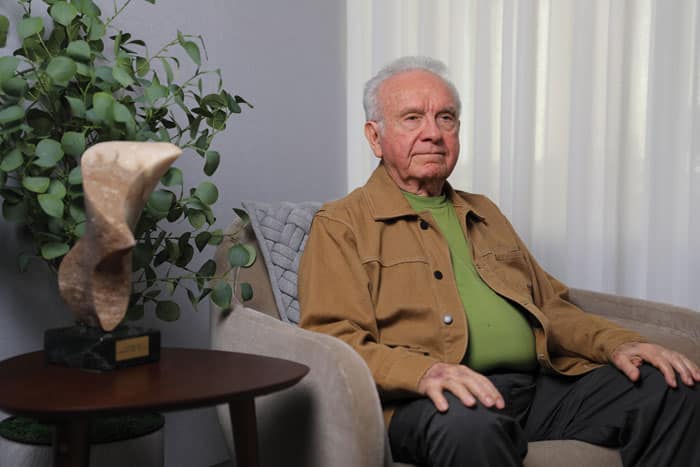
Gerald Szames was four years old when the Nazis invaded his Polish shtetl of Trochenbrod in 1941, but the images are vivid: dogs lunging from leashes held by German soldiers armed with rifles; hiding in an oven with his mother and brother in the Trochenbrod ghetto. And he will never forget living in pits in the forest – the family called them “graves” —for more than two years with four young cousins and five adult family members.  

But until a few months ago, Gerald, a retired pharmacist living in San Diego, never talked much about those years.  

Then, in October 2022, Gerald’s daughter, Deborah Walsh, asked if he would agree to record an interview for the Last Chance Testimony Initiative, USC Shoah Foundation’s urgent effort to record the last living Holocaust survivors. In the past few years, Deborah had managed to piece together enough of her father’s story to share it—with Gerald in attendance—at schools, business, and community groups. But she wanted to hear his story in his words. 

Last December, Gerald recorded his testimony at the new Ceci Chan and Lila Sorkin Memory Studio at USC Shoah Foundation, a state-of-the-art video recording facility that looks and feels like a living room. Gerald spoke for more than five hours. 


Giving Survivors The Last Word 

Crispin Brooks, curator for USC Shoah Foundation’s Visual History Archive and author of the Institute’s interviewer training guide, conducted the interview with Gerald.

Brooks is part of the Last Chance Testimony team recording oral histories in the Memory Studio in Los Angeles and in television studios in South Florida, Baltimore, and the Washington, D.C., area.  Some in-home interviews are also being scheduled.  

These newly recorded testimonies will be indexed and preserved in the Visual History Archive, along with the testimonies of 52,000 witnesses and survivors of the Holocaust, most of them recorded in the 1990s. The testimonies are used in educational materials, films, and other resources accessed by 35 million people annually. 

The survivors recording testimonies today are in their 80s and 90s and were children during the war.  

“We have an ethical obligation to record the testimony of every survivor who wants to be interviewed, of whatever age or experience, simply because they should be given a chance to tell their stories and to have their experiences become part of the historical record,” Brooks said. “It feels sort of like emotional justice to give the survivors the last word. They get to name the people whose names would otherwise be forgotten. They get to preserve the towns and shtetls that are no more.”  

Gerald’s hometown of Trochenbrod, also known as Sofievka, now in Ukraine, was unique in that it was an exclusively Jewish shtetl. In 1942, Nazis and Ukrainian collaborators rounded up and executed everyone left in Trochenbrod. The town no longer exists.  

Hiding and Running 

Gerald, who was called Jankiel Leib when he was born in 1937, was around 2 years old when Soviet troops occupied Trochenbrod in September 1939. The Communist government took over all the businesses, including Gerald’s father’s shop. 

When German troops invaded Trochenbrod in June 1941, the retreating Russians sent all the able-bodied men to the front, including Gerald’s uncle, David Katz, and his father, Shloima Szames. They never came back. 

Executions began almost immediately, and the ghetto was established soon after. Nightly raids, conducted by German and Ukrainian guards, terrorized the ghetto. Each night, Gerald’s mother, Taibel, found places to hide: She brought Gerald’s sister and brother to a secret cellar where leather was cured. His sister, Fay, then 7, hid between two barrels while his brother, Irv, 6, had to balance himself over a barrel of lye. 

Taibel and 4-year-old Gerald hid in a wood-burning oven, where they managed to evade a soldier – despite Gerald’s loud crying for water. Another night, when they were discovered in the oven, they were lined up for execution. Gerald’s mother begged for the life of her family and paid off a soldier with gold she had hidden in her underwear.

Eventually, Taibel got word: Run to the forest. The family is there.  

Living in Graves 

Taibel gathered her three children and managed to find her father, Pinchus Katz, in the forest, along with her brothers and other family members.

With a spade, an ax, and a knife, Pinchus and his sons dug pits big enough for all ten family members. They covered the “graves” with logs and moss and would stay there for two weeks, then move on and dig a new trench. 

Gerald’s older brother, grandfather, and uncles went on forays to trade or steal food – most often pig slop. They dug wells for water. 

On Yom Kippur in 1942, Pinchus returned to their grave at night in tears, saying, “They’re all dead. They’re all dead.” Everyone in the Trochenbrod ghetto had been killed.

In the graves, Gerald and his cousins passed the time picking lice from each other’s hair and bodies and squishing blood-filled mosquitoes. Gerald’s uncle kept the vermin in a pouch he said he was saving for Hitler. In the summer, Gerald played with fireflies. In the winter, they bailed out rainwater and snow and huddled to keep warm. 

But Gerald’s family lost patience with his frequent tears and his wails. One day, his grandfather removed the rope that was holding up his pants and used it to hang Gerald from a tree. His mother cut him down. Another time, his uncle kicked him into a well. Gerald grabbed onto a tree root, and his mother pulled him out. 

In 1944, Pinchus went to investigate a German plane that had been shot out of the sky. A Russian soldier told him the Germans were retreating. A few months later the area was liberated by the Russians, and in late summer 1944 the family left their hiding place. All ten had managed to stay alive, the only survivors of their extended family.

His Whole Story 

They moved to Russia and Poland and eventually to displaced persons camps in Germany. Samuel Katz, Pinchus’ brother, sponsored the family to move to the United States. In 1947, Gerald arrived in New York with his mother and her husband, Boroch Bernstein, whom she had married in a DP camp. They settled in Columbus, Ohio, and two years later were joined by Gerald’s siblings, Fay and Irv.

Gerald graduated high school in 1955, and then earned a bachelor’s degree in biology at Ohio State University, followed by a degree in pharmacy. In 1959 he and Eva Bekes, a Hungarian Holocaust survivor, were married. They had three daughters, Suzanne, Deborah, and Michelle.

While Gerald recorded his testimony last December, Deborah sat in the adjoining room watching a live video feed. It was the first time she had heard her father tell his entire story in his own words.

“It’s so important that his story will be there for my children and for their children, and for the world. Every story is important.” – Deborah Walsh, Gerald’s granddaughter

“It’s so important that his story will be there for my children and for their children, and for the world,” Deborah said. “Every story is important.” 

 USC Shoah Foundation’s Last Chance Testimony Initiative is interviewing survivor and witnesses of the Holocaust at the Ceci Chan and Lila Sorkin Memory Studio at USC, and in television studios in South Florida, Baltimore, and the greater Washington, D.C., area. For more information or to apply, go to Last Chance Testimony Initiative


Julie Gruenbaum Fax, a writer based in Los Angeles, is working on a book about her grandparents’ Holocaust experience. She is a communications specialist with USC Shoah Foundation.  This article was originally published on the USC Shoah Foundation website.

Nearly 80 Years After the Holocaust, A Survivor Tells His Story Read More »

The Political-Industrial Complex That is Destroying America

The 2024 race seems set to replay the last Presidential election, with battle lines likely to run even deeper.

Republican frontrunner and former President Donald Trump’s arrest energized the diehards in his base. Meanwhile, the abominable events of January 6th put fire in the eyes of Democrats trying to stop Trump from retaking the Oval office.

Politics seem likely to slide further toward divisiveness and incitement, but it doesn’t have to be this way.

I saw firsthand how toxic politics are manufactured and sold by an industry of political consultants who supposedly get candidates elected. Like algorithms on social networks, these consultants often push extremist content simply because it gets more attention, whatever the cost to the nation. When I spoke up publicly about the issue Trump’s number one media consultant and MAGA mogul Larry Weitzner of Jamestown Associates, based in New Jersey and Pennsylvania, went to extraordinary lengths to silence me, even hiring high-priced attorneys to threaten and muzzle me.
I have never reacted well to threats, and I have never believed in cowering before a bully.

Weitzner was once revered as the man who “crafted the Trump TV message.” He’s the self-described “lead ad maker for the Donald J. Trump for President campaign in both 2016 and 2020,” and made the first-ever presidential campaign ad—for Trump, of course!—to air nationwide during the Super Bowl. He was seen as a political powerhouse, a master of the dark arts, a man to be feared and a consultant held in awe. But now, the truth has come out.

For, believe it or not, Weitzner’s legal action against me alleges that I, a rabbi with a laptop, destroyed his strategy to elect Dr. Oz to the Senate and is ruining the name of his entire Jamestown brand. Yes, you heard it right. While media reports have it the Oz campaign spent some $100 million, a large part of it deployed by Weitzner in advertising, it was yours truly, writing in the Times of Israel and the Jewish Standard, among others, who brought Weitzner and Oz down.

Has anyone ever heard a more self-destructive allegation?

Weitzner’s reputation was already hammered by the implosion of my friend of many years, Dr. Mehmet Oz, who paid Weitzner more than a million dollars. Based on Oz’s catastrophic performance, Weitzner’s strategy, messaging and advice were, to use British understatement, apparently unhelpful.

Eventually, the campaign would go on to include body-shaming a stroke victim for his illness, election denial, an ad with a world-renowned heart surgeon sporting an assault rifle around the same week of the Uvalde school massacre, and genocide denial.

Despite being America’s most famous physician, Oz lost to the formerly unknown mayor of an 8000-person town who had experienced a stroke just days before the primary election. Dr Oz, who spent 18 seasons on national TV and $27 million apparently of his own money on his campaign, “should have beat [Fetterman] by three touchdowns.” As a key strategist behind the Oz for Senate campaign, Weitzner is left with a lot to explain.

It should be simple for Weitzner to admit his mistake. He tragically pushed Oz to the extreme fringes of the loony right in the primary, making the candidate into a fraud and irreversibly compromising him in the general election. Even the lawyer Weitzner’s using to sue me, George Bochetto, could see right through Oz. Running against Oz in the primary, Bochetto tweeted, “Dr. Oz is a Hollywood elite, not a Pennsylvania conservative.” Bochetto went on to call Oz a phony, a fraud and a liar. He launched StopMehmetOz.Com and decried Oz for having “lived in PA for TWO minutes,” excoriating him for “selling magic beans to little old ladies … A phony who supports government mandates and dances with Michelle Obama!”

On January 12, Whyy.org reported, “Bochetto, a Philadelphia lawyer who has lived in the city for 45 years, suggested that his out-of-state rivals shouldn’t bother spending millions to try to convince voters they really are Pennsylvanians. ‘They should be honest about it and just flat out say, “Look, I haven’t lived in Pennsylvania and I’m not a citizen of Pennsylvania, but I’m coming in because there’s a provision in the Constitution that allows me to do so,”’ Bochetto said in an interview. ‘And that’s fine. But why lie to me?’”

Well, counselor, those are all valid questions that perhaps you should put to your client, Larry Weitzner, Trump’s foremost media man.

But in typical juvenile political fashion, rather than accepting his licks and moving on, Weitzner would rather bully and attack a rabbi for the misfortune of these corrosive values urged on by the Oz campaign—claiming I damaged his reputation by criticizing the divisive partisan messaging he was selling Mehmet Oz.

As a citizen and especially as a rabbi who promotes universal Jewish values, and as someone who took Dr. Oz to Israel to promote a joint message of Jewish-Muslim brotherhood, I knew I had the responsibility to criticize the ads and policies broadcast by the Oz the campaign.

Whenever Mehmet and I had discussed his aspirations to run for office, I told him to run a bright and unifying campaign based firmly on universal Jewish values that he loved and always praised. American politics needed healing. Then one of America’s celebrated doctors, Oz seemed the perfect messenger to relay that crucial message.

But once Oz hired Larry Weitzner and his political consulting firm Jamestown, the advice of political guides and gurus quickly eclipsed mine.

Oz was gradually drawn from high ideals to the mire of partisan manipulations. Soon, Oz was brandishing assault rifles and insisting that “we can’t move on” from the 2020 election.

I sought to stop the damage being done to Oz shortly in the run up to the primary, telling Weitzner that Oz’s partisan stances made him “unrecognizable” to voters who knew him from TV.  Admitting to the fraudulence, Weitzner told me Oz “will be recognizable again very soon.”

When I expressed myself to Oz, Larry intervened to gaslight me for criticizing the campaign. He told me my suggestions were “unhelpful” and “more about … ego than about Oz … I am very disappointed.”

Weitzner even advised Oz to soften his stance on Israel, quashing the idea for a press conference I was strongly pushing for Oz—the first ever mainstream Muslim candidate for the U.S. Senate—to publicly support the Jewish state. Weitzner told me, “doing one now will only bring more attention to the Muslim/Turkish issue.” When I pressed on the issue, Weitzner wrote, “Israel is not the issue that primary voters are most focused on.”

He said this even while Pennsylvania has some 400,000 Jewish residents and a much large Christian evangelical community for whom the security of the Jewish state is of pivotal importance.

Eventually, I was forbidden from voicing dissent: “U have to decide,” Weitzner wrote to me, “do u want to be the outsider and critic. Or friend and advisor. Can’t be both.”

Realizing I couldn’t compete, I watched helplessly as the values-based campaign I discussed for years with Oz gradually faded away, leaving him not only with the most embarrassing loss of the entire midterm campaign but also with a destroyed career on TV and media. Since the election, America’s most famous physician has all but disappeared from public view.

Dr. Oz, a good and well-meaning man, was taken for a ride by a cottage industry of cynical consultants who will do anything to win—even if it means destroying the country with manipulative and fraudulent values, manufactured candidates, and ultra-divisive policies.

As a rabbi, values commentator, and member of the media I had every right—and as a rabbi and values commentator, an obligation—to speak my mind and distance myself from a campaign that had become a national disgrace. That I’m now being bullied and sued for doing so contradicts the institution of freedom of the press and the First Amendment. It goes without saying: I plan to fight these bullies vigorously and will not back down.

It goes without saying: I plan to fight these bullies vigorously and will not back down.

With this contemptible and frivolous lawsuit, Weitzner is trying to stop me from telling you what political consultants like him are doing to America. It’s a David and Goliath Battle, between a New Jersey rabbi with a laptop and nine children, and one of the most powerful political consultants in America who has untold millions at his disposal. It’s classic political dark arts, the goal being to silence me.

If Weitzner is concerned about his reputation, he shouldn’t be suing me for having ruined it. If a cleric with an iPhone can bring down his operation, wouldn’t Trump be wise to find somebody else to work with?

Instead of trying to silence and blackmail critics like me, Weitzner and all the other members of the political-industrial complex, the masters of the political dark arts, need to adapt to the fact that Americans now see right through these tricks, which is why Trump’s candidates were largely pummeled at the polls in the midterms. They need to alter their strategies and embrace unifying and inspiring political messages that candidates from both parties should be running on in a blessed country that is desperately in need of healing and unity.


Rabbi Shmuley Boteach, “America’s Rabbi” whom the Washington Post calls “the most famous Rabbi in America,” is the author of “Judaism for Everyone” and “The Israel Warrior.” Follow him on Instagram, Facebook, and Twitter @RabbiShmuley.

The Political-Industrial Complex That is Destroying America Read More »

As Mental Health Fault Lines Deepen, the Time to Act is Now

U.S. Sen. John Fetterman’s (D-Pa.) recent courageous disclosure that he voluntarily sought hospitalization for treatment of depression represented, in many respects, a watershed moment in the public discourse about mental health. Meanwhile, here in California, Gov. Gavin Newsom reiterated his commitment to this important issue, calling on state lawmakers to place on the ballot and voters to pass a $3 billion bond initiative to fund new behavioral-health-based housing and care facilities.

If we have, in fact, turned a corner, the heightened consciousness surrounding mental well-being is a long time coming. It is inarguably an outgrowth of the challenges posed to mental health that mushroomed and spilled into view during the pandemic. No one, from youth to seniors, was spared its impact. Effects ranged from anxiety to profound loneliness brought on by social isolation or worse. The toll was equally heavy on our frontline caregivers, who experienced nervous exhaustion, post-traumatic stress and a sense of hopelessness — particularly during COVID-19’s earliest, darkest days.

It would be naïve, bordering on arrogance, to think that our Jewish communities are somehow immune from these same, often-overpowering consequences. And it’s in part why the Jewish Community Foundation of Los Angeles (The Foundation), the institution where I lead grantmaking, is vigorously supporting mental health and wellness initiatives as it has for at least the past decade. In recent years, we have “doubled down” on those efforts through robust funding as well as advice and information to our family of 1,400 donors on how they can support these initiatives. Likewise, we routinely confer with other institutional funders, seeking intercepts on ways to best leverage grantmaking for greater impact.

Judaism unambiguously instructs us that health refers to both body and mind. This is not a novel notion, but one dating back more than 3,000 years and advanced in multiple books of the Torah, placing precedence on prevention of disease and illness — both physical and mental — of all kinds. In contemporary Jewish Los Angeles, while religious precepts guide us the hard data, as well as insight, understanding and access into the needs of the community, validate and drive our foundation’s funding for mental wellness as it has scaled over the past 10-plus years. The Los Angeles Jewish Federation’s 2021 “Study of Jewish Los Angeles,” the most comprehensive survey of local religious life in nearly a quarter century, included a significant section devoted to physical and mental health. The study’s findings on mental well-being are alarming even while offering proof points that The Foundation’s decade-plus of support is squarely on target.

With 30% of all Jewish households expressing a need for mental-health or substance-abuse treatment, we are at a critical crossroad. Especially so when demand does not, in any way, discriminate by financial condition of the respondents: Nearly 30% of the participants requiring services classified themselves as “well-off,” while 38% of those described themselves as “financially struggling.” By age group, millennials and Gen-Z, despite exterior appearances of youthful invincibility, are those most profoundly affected, with about one-third of 22 to 30-year-olds reporting recent mental or emotional difficulties and “feelings of persistent loneliness some or all of the time.”

Even before these confirming statistics, we had been reaching deep into the community to understand the extent of need and to address and support inspirational, sometimes groundbreaking, work in the mental-wellness field locally. We seek out and listen to the experts on the front lines of this epidemic who are invaluable in informing our granting. 

As a result, funding is layered by design, cutting across the expanse of Los Angeles geography and its diverse populations — from teens to seniors, diverse Jews, LGBTQ+, synagogue clergy and staff, and Jewish communal personnel — to make the farthest-reaching potential impact. Since 2011, The Foundation’s funding for Jewish causes addressing mental well-being totals over $4 million, a figure that climbs further if factoring in grants for initiatives that include mental-health components of some kind.

These innovative programs are as inspirational as they are vital. Consider BaMidbar’s Los Angeles Regional Programming Hub, a nine-month wellness fellowship for high school students focused on improving mental health among their peers while equipping educators and parents with the tools to recognize and address these needs among teens. With Foundation support, Hillel at USC launched the Bradley Sonnenberg Wellness Initiative, one of the first-ever at any Hillel in the country, providing mental-health services to Jewish college students, workshops and individualized counseling and support. JQ International created Caring for LGBTQ Jews and Families in Need, a crisis helpline that within its first three years served more than 1,000 individuals with culturally inclusive resources and support, social service referrals and emergency intervention. 

Under our Reimagine Grants, which were developed in response to crushing needs arising out of the pandemic, we awarded more than $1 million to 23 local synagogues. The purpose of the grants, in part, was to care for the mental health and well-being of synagogue clergy, staff and lay leaders that resulted from the trauma, burnout and other effects of the pandemic and, in the process, fortify their workplaces. Our rationale was that by addressing wellness among synagogues, we can by extension positively affect and sustain well-being among the memberships of these institutions as a whole, potentially benefiting thousands of people.

Our granting for mental well-being is not confined to the Jewish community. We are commanded as Jews by a call to care for all people: b’tzelem Elohim ( “in the image of God”). Since all humanity is created in the image of God, each person is equally valued and underscores the philosophy behind The Foundation’s general community giving. Over the past decade, grantmaking has been directed to mental-wellness programs supporting veterans, people experiencing homelessness, and victims of domestic and sexual violence.

Mental health should be addressed holistically and included as a funding element irrespective of whether the program’s primary focus is food security, homelessness, Jewish engagement, education or camping.

Mental health should be addressed holistically and included as a funding element irrespective of whether the program’s primary focus is food security, homelessness, Jewish engagement, education or camping. Let it take precedence locally and beyond because need runs far deeper than what any single funder can support. By all indicators, it is growing at a velocity that far outpaces resources, particularly those available from the public sector. Funders, both individuals with the capacity to give and institutional sources, need to step up.

The Talmud teaches that members of the Jewish community are responsible for each other. We are interconnected, and investing in mental wellness has profound implications on the well-being of everyone. Assistance takes many forms. Individuals with interest and commitment can lend volunteer support or serve in lay leadership or in board capacity. Most importantly, though, the conversation needs to remain top of mind, discussed openly and publicly. Funding for this issue cannot become a sidebar as we move away from the direct effects of the pandemic. Staff and lay leaders, whether serving youth or seniors or a specific identity group, should be mindful of their organizations’ programs doing so through a mental-health lens. This necessity extends beyond programming. Funders, foundations and nonprofit organizations can prioritize mental health among their own staffs because, in doing so, it will positively spill over to our constituents.

Mental well-being historically has been an uncomfortable topic to broach, in many ways a taboo subject. Emerging from the pandemic, there seems to be a newfound willingness to discuss it more openly, as Senator Fetterman’s radical honesty and humanity demonstrate. But mental illness is also “invisible,” unlike physical infirmity, and therefore a more amorphous condition. Healing, though, extends far beyond the physical and includes mental, emotional, social and spiritual components. That’s why The Foundation will continue to make support an imperative, but we share an obligation to make it a priority for others, too. The future of a robust, thriving local Jewish community depends upon it.


Naomi Strongin is vice president of the Center for Designed Philanthropy at the Jewish Community Foundation of Los Angeles, which manages approximately $1.3 billion in charitable assets and, over the past decade, has awarded more than $1 billion in grants, including $160 million in 2022.

As Mental Health Fault Lines Deepen, the Time to Act is Now Read More »

Natasha Feldman and “The Dinner Party Project”

Anyone can host a dinner party!

“I think you can be an absolutely sucky cook and still be a great dinner party host,” Natasha Feldman, author of “The Dinner Party Project: A No-Stress Guide to Food with Friends,” told the Journal.

Fun and colorful, “The Dinner Party Project” is filled with easy-to-follow hosting tips — including a clever “What Should I Make for Dinner” flowchart and timelines for dinner party prep, themed menus and more than 80 delicious recipes.
“If I had to describe my kind of cooking, I’d call it, ‘East Coast deli meets West Coast produce,’” said Feldman, who wears a black-and-white cookie necklace and whose favorite food is brisket. “It’s lighter, fresher California [cooking] that still makes you feel nostalgic and happy.”

Sections range from Noshes/Apps and Sweet Things to Tacos Get Their Own Chapter and Breakfast for Dinner. Jewish dishes include her grandmother’s borscht recipe, latke-style smash potatoes, babkaish monkey bread, the aforementioned brisket and more. It’s an easy read with tips built-in, although not all the recipes are kosher.

Natasha Feldman

Feldman is a cooking show host, culinary instructor and private chef based in Los Angeles. She came to L.A. to study theater in college, but at some point decided that wasn’t her path. Feldman still wanted to tell stories; she just decided to do it through food. Feldman went to culinary school thinking she would work in food media, which is exactly what she has done.

In addition to her Webby-nominated YouTube show “Nosh With Tash,” Feldman has been both in front of and behind the camera on shows such as Food Network’s “Cutthroat Kitchen,” “Chopped U” and “Craving Healthy.”

Feldman comes by her love of cooking and bringing people together naturally. Her great-great-grandmother Clara was a caterer in Poland, came over through Ellis Island and settled in the Lower East Side.

“They were poor, poor, poor, poor, poor,” Feldman said. “All the neighbors had money for bits and bobs, but not really enough for much of anything.”

They would all bring their groceries to Clara’s apartment, and she would turn these bits and bobs into cakes, pies, stews and soups.

“Everybody in the building was very well fed, because they brought their stuff together,” Feldman said. “Everybody was happy. And there was this really strong sense of community.”

Feldman’s mom also loved having people over. 

“If I had a friend over and we were studying, they always knew they were invited for dinner,” she said.

There are a lot of cultures that have that “let me feed you” philosophy; and that’s definitely true in Judaism. 

“It’s a way that a lot of us express our love for community, our love for ourselves, our love for religion,” she said.

Feldman believes dinner parties do not need to be formal. They can be messy and silly. You can even use paper plates. The food is secondary. Bringing people together is the priority.  

Feldman believes dinner parties do not need to be formal. They can be messy and silly. You can even use paper plates. The food is secondary. Bringing people together is the priority.  

“Find what works for you now,” she said. “Maybe it changes; you become a better cook and you host more advanced parties in the future. But you gotta start where you are, admit it and accept it. That’s how it’s the most fun.”

“The Dinner Party Project” was released on April 18. Go to NoshwithTash.com for more recipes and to learn about upcoming events.

Oops, I Forgot Dessert!
Choco-Dipped Fruit

Serves 6

Total time: 40 minutes

I can’t tell you how many times I’ve cooked a really nice big meal for friends and then, after dinner, realized I hadn’t thought about dessert for even one second. But, because I am both a chocoholic and a fruit head, chocolate and fruit are two things I always happen to have around. 

If you want to be all fancy, make the chocolate-dipped fruit in advance and present it on a plate à la mid-’90s Martha. OR you can drop the melted chocolate on the table with the fruit and lots of forks, à la fondue, and let people go to town. If you have random cookies, a slice or two of pound cake in the freezer, or anything else that sounds fun to dip in chocolate, you can put that out as well. One time I dipped a cucumber in chocolate just to see . . . It was not good. I’m a scientist.

1 cup (6 ounces) chopped semi-sweet chocolate

Pick Your Fruit! (choose one or a combo)
30 to 40 (2 pounds) ripe strawberries
6 ripe, juicy peaches
12 clementines
A bag of summer cherries
A few bananas
Whatever fruit you love!

Pick Your Toppings!
Toasted unsweetened coconut
Cacao nibs
Sprinkles
Flaky sea salt
Crushed cookies
Crushed candy bar
Chopped nuts

Wash, dry, peel, and cut all fruit. Line a baking sheet with a large sheet of parchment paper.
In a microwave-safe bowl, heat the chocolate in the microwave for 15-second intervals until mostly melted, stirring after each time. Stop before the chocolate is completely melted. The residual heat will melt the rest of it with a stir or two.
Dip each piece of fruit into the chocolate and twirl it around to cover all sides. Let it drip over the bowl for a few seconds before putting it onto the parchment.
Once all the fruit is dipped in chocolate, sprinkle the pieces with your toppings of choice. Set aside for 30 minutes to harden before serving or put in the fridge to serve later!

Tips + Timing
1. Prepare dipped fruit up to 6 hours in advance. Store in the fridge, uncovered, and remove 30 minutes before enjoying.
2. Get whatever fruit is in season and smells fragrant and delicious! A farmers’ market is a great source if you have one in your area.

From The Dinner Party Project by Natasha Feldman. Copyright © 2023 by Natasha Feldman. Reprinted by permission of Harvest, an imprint of HarperCollins Publishers.

Natasha Feldman and “The Dinner Party Project” Read More »

New Song Performed in Seven Languages Celebrates Israel’s 75th Anniversary

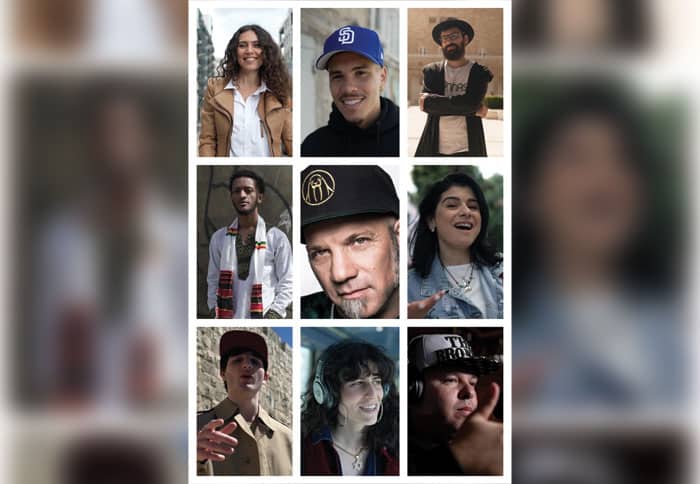
A new song featuring verses in seven different languages and eight separate singers from around the world was released this week in celebration of the State of Israel’s 75th anniversary. The song, titled  “Ma Nishma, Israel” is the culmination of a collaborative production spearheaded by the Jewish Agency for Israel (JAFI) and the Zionism 3.0 (Z3) Project. 

To gather the talent for the song, singers were encouraged to submit an audition video on the following prompt: “What you’d like to say at this moment about yourself, about your life, about your relationship to Israel?” The open-ended prompt elicited musical responses that went in many different directions. 

Shelley Kedar, director of Connecting the Jewish People Unit of the JAI, first hatched the idea last summer. “If we give people a voice that generates connection, that’s something that we believe in very strongly,” Kedar told the Journal. “We brewed the idea — which seemed very crazy at the time — to actually reach out to people around the world and say that we’ll give you a platform to share your voice, your opinions, your actual words, and tell us what you would like us to speak about at Israel 75.”

Kedar and the JAFI then combined forces with the Z3 project. Together, they called it the “Voices Together Project.” 

An online submission platform was created where singers could submit their words or a voice recording. There was a recording booth at the 2022 Z3 conference at the Oshman Family JCC in Palo Alto to help spread the word.

In the end, eight performers were selected; they performed in seven different languages, including American Sign Language. 

Kedar and Amitai Fraiman recruited recording artist Sha’anan Streett of the Israeli hip-hop/funk band Hadag Nahash, to lead the way with the production and direction of the eight artists. Artist and music producer Michael Cohen, (also known by the mononym Cohen) joined for the production of the music video. 

“It really was as organic of a songwriting experience as there is,” the Z3 Project’s Fraiman told the Journal. “Sha’anan led the way and had the vision for it. There were many conversations beforehand, but once it came to the musical components, it was in the hands of the musicians.”

The singers would all take turns recording their part in a Tel Aviv studio. The goal from the beginning was to create a song to embody the spirit of what 75 years of Israel means today. 

The singers would all take turns recording their part in a Tel Aviv studio. The goal from the beginning was to create a song to embody the spirit of what 75 years of Israel means today. 

The song opens in Hebrew with Sha’anan singing, “It’s the same talk in every language, it’s the same talk all around the world, a talk that flows, say ‘What’s Up, Israel.’”

One of the performers in “Ma Nishma, Israel” is Noah Shufutinsky, a hip-hop artist from San Diego who goes by the name Westside Gravy. 

“I had the chance to get on a call with Sha’anan and a few of the other artists just to hear more about the song a few weeks before we would be going to the recording studio,” Gravy told the Journal. “We spent 20 minutes or so brainstorming ideas for the song and just discussing what we individually wanted to represent in the song. By then, I’d heard a draft of the beat and it just hit me. After about 20 minutes I had my full verse ready to go. The writing process was in the moment, and full of excitement — followed only by more excitement when it came to the recording process and sitting in the studio with so many talented musicians.”

The verse in German was performed by Lea Kalisch, also known as Rebbetzin Lea. She was born in Switzerland, has performed in numerous Yiddish plays, and is best known for her debut single “Eshet Chayil of Hip-Hop.”  The Russian verse was performed by the Belarus-born Pinhas Tsinman (aka MC Pinhas), who emigrated from Ukraine to Israel about a year ago. 

Deres Worknech, (aka Dere Work) performed his verse in Amharic. Dere Work made Aliyah from Ethiopia when he was 11, and has been rapping in Amharic since serving in the Israel Defense Forces. The hook of his verse: “To be thankful for creation — isn’t it the secret of living?”

Sandro Koren (aka MC Sapinho), a rap and reggaeton singer originally from Rio de Janeiro, Brazil sang his verse in Portuguese.  Judith Hasin, known for participating in the Israeli reality performance show “Rising Star” in 2019, performed in French. Her verse ends with, “Everything will pass, except the strange feeling of being in the right place.”

Jonah Baron Cohen (aka JBC), an Australian-born, U.K.-raised singer, ends his verse with, “Look who you’re friends with, are they ready for anything?” And yes, Sacha Baron Cohen is his uncle. 

The chorus is also performed in American Sign Language by Hila Almog, vice president and deaf community manager of the Tel Aviv company Sign Now, which offers free, real-time sign language interpretation via smartphones. 

The music video also features dancers Viktoriya Bakhova, Polina Gutkina and Sonya Zavelska.

When “Ma Nishma, Israel” was finally complete, Kedar and Fraiman were blown away. “It’s catchy and it’s an interesting undertaking — how do you create an anthem of sorts in multiple languages?” Fraiman said. “This song is meant to remind us all that even though we look different, sound different, have different kinds of backgrounds, language isn’t superficial, but an immediate kind of code to the many levels and differences between us. It is a powerful message to have, especially in these moments. We didn’t know how timely the song would be. There’s the musical element on how this all came together, and now, the timing couldn’t be more perfect. The project couldn’t be more needed.”

New Song Performed in Seven Languages Celebrates Israel’s 75th Anniversary Read More »

you-dont-know-schiff

Jake Johanssen – Live at the Hollywood Improv!

This week we are thrilled to bring you another special live episode recorded at the world famous Hollywood Improv.
Our guest is the truly inimitable comic genius Jake Johannsen.

And a special thanks to the crew at the Improv who made this event possible.

To get more of Jake’s content, check him out here:

Website:
http://www.jakethis.com/

Instagram:
https://instagram.com/jakethis?igshid=YmMyMTA2M2Y=

Twitter:
https://twitter.com/jakethis?s=21&t=AI3cq9dOOxwtUrVNUObF5g

Facebook:
https://m.facebook.com/search_results/?q=jake+johannsen


Jake Johanssen – Live at the Hollywood Improv! Read More »