fbpx

April 3, 2023

Passover Seder: The Story of Us

If the point of the Passover Haggadah was merely to relate a concise national narrative—as the old joke goes, “They tried to kill us, we won, let’s eat”—the Seder would be both shorter and clearer. Rather, the Haggadah contains an endless number of narrative threads, all of which will be present when the Jewish people sit down for the holiday this week.

For some, the Haggadah recounts the story of how in every generation a Pharaoh figure arises to destroy the Jewish people: a reminder to us all of the importance of standing vigilant against the perennial threat of antisemitism. For others, the take-home message of the Seder is not vigilance, but empathy, that as Jews we must forever identify with the heart of the stranger, because after all, we too were once strangers in a strange land.

For some, the point of the story is freedom and self-determination; for others, it’s commitment and belonging. For some, Passover is the holiday of Dayenu, “It would have been enough”—a reminder to express gratitude for our portion in life. For others, it is a tale of the fights that yet lie ahead and a reminder that we are never satisfied until we reach the Promised Land, and maybe not even then. “Next year,” we conclude, “in Jerusalem!”

So it is, too, with the Passover symbols. There are as many explanations as there are people at Seder tables. Is the matzaha reminder of the haste in which we left Egypt, or is it, as we state at the beginning of the Seder, the bread of affliction, a reminder of our servitude? Is the haroset a reminder of the mortar with which we built the pyramids, or is it there to sweeten the sting of the bitter herb? Do we dip our fingers into wine with each plague to savor the vengeance exacted on our Egyptian oppressors, as a reminder of our ancestors daubing blood on the lintels of their doorposts, or to remove a drop of wine from our cups, a self-admonition against taking joy at the downfall of our foes?

Not only does the Haggadah contain multiple narrative threads, but also each thread and each ritual contain a multitude of interpretive possibilities. There is an archaeology to the Haggadah, it is a layered compendium of biblical texts, rabbinic texts, medieval texts, and modern texts interwoven and stitched together, with the seams visible to close readers, embracing a diversity of ages, sages and sensibilities.

But the Haggadah is more than that. Much more.

More of an invitation than a recitation, the Haggadah is engineered to elicit comments and debate from its readers. The Hebrew word “haggadah” doesn’t mean “story”; it means “telling,” an observation made even more interesting when one considers that the first thing one does in the maggid/telling section is not tell but ask a question: Mah nishtanah? “What makes this night different?”

Unlike every other liturgy, the Haggadah not only allows for interruption but also welcomes it. Unlike every other liturgy, the text of the Haggadah is directed not toward God but to the people sitting across from you at the table. The Haggadah reminds us that our stories are not only endlessly diverse, but also endlessly evolving, as in the case of the sages described in the Haggadah, all of whom continued to find new meanings in each word throughout their lives.

Most of all, the Haggadah is a reminder. It’s a reminder that our stories, interpretations and insights—diverse and evolving as they are—must sit side by side, literally and figuratively, with the stories, interpretations and insights of every other Seder participant. Each person, regardless of age, stature or wisdom is an equal stakeholder. Memorable as the rhetorical device of the four children may be, its point is not merely to prompt us to identify with one child or another; its point and power is to remind us that all four children figured out a way to sit at the table together. Who knows if the rabbis described in Haggadah—Eliezer, Akiva and Tarfon (among others)—actually liked each other? What we do know is that they made space for each other, debating until the break of dawn, their insights preserved in the text together with those of other rabbis.

Memorable as the rhetorical device of the four children may be, its point is not merely to prompt us to identify with one child or another; its point and power is to remind us that all four children figured out a way to sit at the table together.

The Haggadah is not just a story of one of us; it is the story of all of us. On one hand, this story is authentic to our respective lived experiences, and on the other hand it is inclusive and interconnected with the lived experiences of others. There is a lexical correspondence between the Hebrew word “haggadah” and the Hebrew root gid, meaning “sinew” or “tendon,” that which binds or connects us. That is what the Haggadah is: a story that invites other stories, that connects those stories one to another. It’s an inclusive tool of identity formation that binds each participant to a larger narrative and binds the Jewish people together through the ages.

Every year, it is important to fulfill the commandment of the Passover seder—this year more than ever. One need not look far to see the crises, schisms and ruptures facing Israel, America and the relationships between Israel and diaspora Jewry, and, for that matter, America and Israel.  Beneath all the tumult of the unfolding events is the pain-filled observation that everyone seems to have forgotten the dialogical model and message of the Passover Seder.

The Seder reminds us that though we may share a common narrative, each of us reads that narrative differently, that the truths that are self-evident to one person are the source of hurt to another, and that all reads—eilu v’eilu—reflect the will of the living God. The Seder reminds us of the importance of our stories, the importance of sharing our stories, and the importance of listening to the stories and views different from our own.

The Seder reminds us that far more important than the quick victory of a conversation-stopping zinger is the spirit of earnest and enduring inquiry. A well-placed question reveals our own uncertainties even as it challenges the counter-certainties of others. The seder reminds us not only that every person should have a seat at the table, but also that a person can sit down at a meal with one identity and get up from the meal with another and that to do so is a sign of strength not weakness.

The Seder reminds us that we are all members of an extended mishpokhe, a family, and that if we can see the world through the lens of family, we can stop thinking of winners and losers and start asking what is in the best interest of the whole. Most of all, the Seder reminds us that the success of our efforts is ultimately measured by how well we pass on our stories to the next generation and encourage our children to sit at the table together.

Most of all, the Seder reminds us that the success of our efforts is ultimately measured by how well we pass on our stories to the next generation and encourage our children to sit at the table together.

If you can, invite someone new to your Seder, not just someone who has never been to your Seder (or any Seder), but someone whose views differ from your own. If you can’t invite someone new, or if you will be a guest at someone else’s Seder, then bring a new Haggadah with new interpretations. Leave a seat empty and go around the table pointing to it, asking the question of whose voice is not being heard at your seder. Check yourself as you tell the story—your version of the story. Allow for your views to be challenged. Invite the questions, interpretations and comments of others. Make space for their views and let them sit uncomfortably alongside your own.

The Seder is a night to be our best selves, to imagine our world not as it is but as it ought to be. We may not be able to change the world from our Seder tables, but we can, at the very least, open our doors, and our hearts, wide enough for the hearts and truths of others, perhaps opening the door to a far-reaching and redemptive future.


Elliot J. Cosgrove is the Rabbi of Park Avenue Synagogue, Manhattan.

Passover Seder: The Story of Us Read More »
ADL Briefing on 2023 Antisemitism Audit

The Anti-Defamation League (ADL) provided a briefing webinar on March 31 about the their latest audit of Antisemitic incidents.

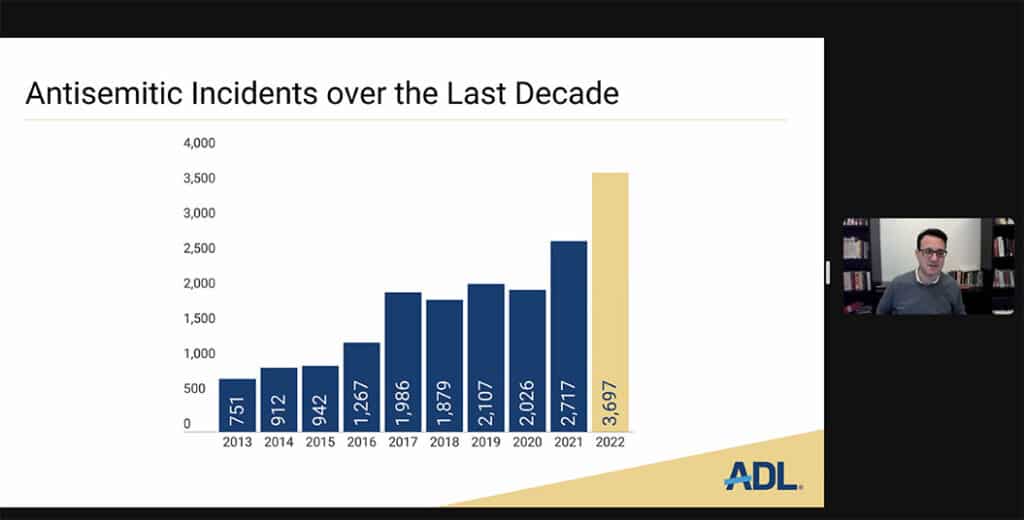
ADL Center on Extremism Director Aryeh Tuchman said on the webinar that the audit, which is conducted through people reporting antisemitic incidents to the organization and then the ADL verifying the reports, “enables us to quantify exactly what is happening in the American Jewish community.” The ADL recorded 3,697 antisemitic incidents in 2022, with increases in category.

The biggest increase was in white supremacist activity, Tuchman said. “There are networks of a small number of antisemites… who organize themselves with the express purpose of expressing propaganda, leaflets, flyers with antisemitic content,” he said. Harassment and vandalism also saw increases 29% and 51%, respectively in 2022, per Tuchman, and 53% of assaults targeted Haredi Jews.

ADL Antisemitic Incident Specialist Emily Snider provided more specifics about the assaults, pointing out that out of the 111 assaults recorded by the ADL, 72 occurred in New York. Only one person was killed from antisemitism: a professor at the University of Arizona who was shot and killed by a former student who thought he was Jewish. Five assaults took place at K-12 schools; a couple of examples included a high school student pushing a student against a fence while shouting “f—ing Jew” and a Jewish student at a middle school being punched while subjected to anti-Israel and antisemitic slurs.

Snider also pointed out 33% of antisemitic incidents occurred in public spaces, which she partly attributed to “the doubling of white supremacist propaganda distribution.” There were 589 antisemitic incidents targeting Jewish institutions in 2022, an increase from 525 in 2021 and 327 in 2020; nine of these incidents were assaults, which included congregants being shot at with a BB gun. Synagogues were the most targeted Jewish institution, but Jewish Community Centers (JCCs) were the most targeted by bomb threats. “We all know Jewish Community Centers don’t just impact one aspect of our community,” Snider said. “These are the centers are the life and breath of the Jewish community.” There was a 30% decrease in anti-Israel and anti-Zionism incidents in 2022, but Snider attributed that to the fact that 2021 saw a spike in such incidents as a result of the Israel-Hamas conflict in May of that year.

On college campuses, there were 219 antisemitic incidents in 2022, an increase from 155 in 2021 and 128 in 2020; 33% of the antisemitic incidents in 2022 involved swastikas and 25% of antisemitic incidents targeted Hillels. Snider described Hillels as the “center of Jewish life” on campus and thus it brings “fear” to Jewish students when Hillels are targeted. Campuses have also had to deal with “radical anti-Israel sentiment,” Snider said, citing examples of a Students for Justice in Palestine (SJP) rally attendee throwing a rock at a Hillel in April 2022 and in March 2022 an SJP speaker said at off-campus rally, “Demand that Zionist professors are not welcome on campuses!” and called Zionism a “genocidal threat to us.” The crowd then chanted, “We don’t want no Zionists here.”

“Calls like this have a tremendously negative effect on Jewish life,” Snider said, adding that they essentially “Jewish people responsible for the actions of Israel.”

Snider also expressed concern over The Mapping Project, which called for “dismantling organizations in Massachusetts that are complicit in Zionism.” The project called for disrupting 500 entities, including a Jewish high school and a synagogue, and posted their addresses. Snider said there was “concern” over whether these locations would be subjected to attack as a result.

During the Question-and-Answer (Q&A) session, Tuchman was asked if the record-high amount of antisemitic incidents is the result of a higher volume of reporting. “We can’t really draw large scale explanations for whether incidents are going up or whether they’re being reported because we can’t necessarily understand the larger context around these events,” Tuchman acknowledged. However, he expressed their confidence in being able to track assaults and vandalism since they could be more easily verified through media and law enforcement. Overall, Tuchman didn’t think that higher reporting “dramatically” affected their numbers.

He attributed the rise in antisemitism in America to a “small number of determined people who are trying to terrorize us.” At the beginning of the webinar, Tuchman had said: “Without minimizing the importance of these numbers … we cannot let them terrorize us, the Jewish communities in the United States. We should be proud. We should be confident and we really are secure.” Instead, the numbers should be “a call to action to make sure our Jewish institutions are protected” rather than a “call to hide,” Tuchman argued.

The webinar concluded with a guest appearance from Rabbi Charlie Cytron-Walker, an ADL Special Advisor on Security, who was one of the four hostages in the Colleyville crisis in January 2022. He explained that while he was in Colleyville, that hostage crisis was the only major antisemitic incident he had experienced there and he now lives in Winston-Salem, NC. The rabbi stressed the importance of establishing relationships with local law enforcement and the regional ADL office as well as reporting incidents. “We don’t have to live in fear,” Cytron-Walker said.

Rabbi Charlie Cytron-Walker on the Zoom briefing

ADL Briefing on 2023 Antisemitism Audit Read More »

‘Kosher’ Doesn’t Always Translate Easily

In 2000, after a decade as a professor, dean and vice president at USC, I began my tenure as president of Williams College. My first week of work, I sent handwritten notes (remember them?) to a number of our illustrious alumni, including Edgar Bronfman, president of the World Jewish Congress and former CEO of Seagram. It was a fan letter, given how I had long been in awe of the man.  

A couple of days later Edgar called me, inviting me to have lunch the next time I was in New York. I told him that by coincidence I was going to be in Manhattan the very next day and was free for lunch. He saw right through that and laughed, but offered to take me to the Four Seasons restaurant near his office.

At lunch I ordered a shrimp salad.  When it arrived, Edgar shook his head, and asked why I ate trayf. I remember being a bit defensive and muttering something about how the ancient Jewish dietary laws might have made sense in the days before refrigeration, but not today. Edgar interrupted me and said that restricting his diet wasn’t about adhering to any commandment; instead it was an opportunity to show how much pride he took in being Jewish. He predicted that with my new life as a college president, I would be attending events with influential people all over the world, and letting them know that I couldn’t simply eat what they served, would indicate something important about my Jewish identity.

On the ride back up the Taconic Parkway, I thought about what Edgar had said, and by the time I got home, my diet — and my life — were altered forever.

Edgar was right. From the White House in D.C. to the Blue House in Seoul, and countless other venues in between, I have been meticulous in sending a list of food restrictions in advance. Did I on occasion feel funny eating different food from most of the others? Sure. But reminding not just my dining companions but myself that I am a proud Jew, more than compensated for any awkwardness.

That doesn’t mean that all of my hosts understood what I was doing and why. Once my wife and I were having dinner in Beijing with a Chinese delegation led by a senior Politburo member.  It was a magnificent ten-course extravaganza, featuring seemingly every non-Kosher food imaginable — pork, shrimp, scallops, sea slugs, etc. It was vegetable after vegetable for me. Finally, the Chinese dignitary turned to the translator and asked why I was served a different meal from everyone else. I told the translator that I was Jewish and observed certain dietary laws. That generated a long back and forth between our host and the translator until the translator turned to me and said that our host had “great admiration for the Mormon people.” Not exactly the response I was expecting.

I replied that while I too respected Mormons, I was Jewish, which is a very different faith. Once again, a spirited conversation ensued until the translator stated “Mitt Romney is a Mormon.”  

Not giving up, I replied, “He certainly is, but I am not Mormon, I am Jewish.”  For the next five minutes they went back and forth, with several other members of the delegation joining in.  Finally, the translator proclaimed “While there are very few Mormons in the world, they control the banks, the media and much else.” Rather than reply “No!  That’s the Jews!” I just smiled and said “I share your admiration for the Mormon people.”

At least I tried.

But 23 years later, when I sit down to eat, I am reminded not just of my friend and mentor Edgar Bronfman, but of the many times I have been fortunate to demonstrate to Jews and non-Jews alike — including thousands of students, faculty, staff, alumni and civic leaders — the incredible pride I have in being a Jew. And even more importantly, each meal reminds me of the obligation I have to live a life worthy of our extraordinary faith.


Morton Schapiro moved back to Los Angeles in October following nine years as president of Williams College and then thirteen years as president of Northwestern University.  His most recent book (with Gary Saul Morson) is “Minds Wide Shut:  How the New Fundamentalisms Divide Us.”

‘Kosher’ Doesn’t Always Translate Easily Read More »