fbpx

March 20, 2023

Say No to Overflow: a Solution Against Floods?

About three years ago, during a storm that hit Tel Aviv, a young couple died tragically in an elevator flooded at an underground parking lot. This event took place after many Israeli winters saw days of roads turning into rivers and city streets transforming into streams. The solution to this problem is already well known: the municipal drainage systems, which cannot withstand the load of the rains, need an urgent major overhaul.

Since the death of the young couple, the danger of floods in cities has become crystal clear. Yet, the overhaul in question would be complicated and expensive, so the various authorities are in no hurry to do so. A new study, conducted at the Technion and recently presented at the biannual student conference of the Grand Water Research Institute (GWRI) at the Technion, attempts another solution to the situation. It is a simple, cheap, and quick construction that may reduce the pressure urban infrastructure experiences on rainy days. This system consists of containers on building rooftops that can accumulate rainwater and of a computerized system to release it when the sewage systems can handle it. Could this design put an end to urban floods?

Much rain, little time

In recent winters, we have all seen images of flooded streets and cars submerged underwater; some of us have even found ourselves in the middle of such events. But how does that even happen? How do floods form in Israeli cities?

One reason is that rain events in Israel tend to be intense and short – that is, a large amount of rain falls during a short period of time. For comparison, the average annual amount of precipitation in rainy London is similar to that of Tel Aviv, but in London this amount spreads over the whole year – and in Tel Aviv it is limited to the winter months only. This problem is expected only to worsen due to the climate crisis, which causes the severity of the rain events in Israel only to rise.

Secondly, when it rains in urban areas, it flows mainly over concrete or asphalt surfaces which do not let water seep into the ground. This mechanism is what creates urban runoff: rainwater, moving across sidewalks and roads, drains into lower areas or the municipal drainage system. Such waterproof surfaces, that don’t let rainwater seep through, are expanding rapidly – with the urban development and the constant increase in the rate of construction throughout Israel, which also comes at the expense of open areas.

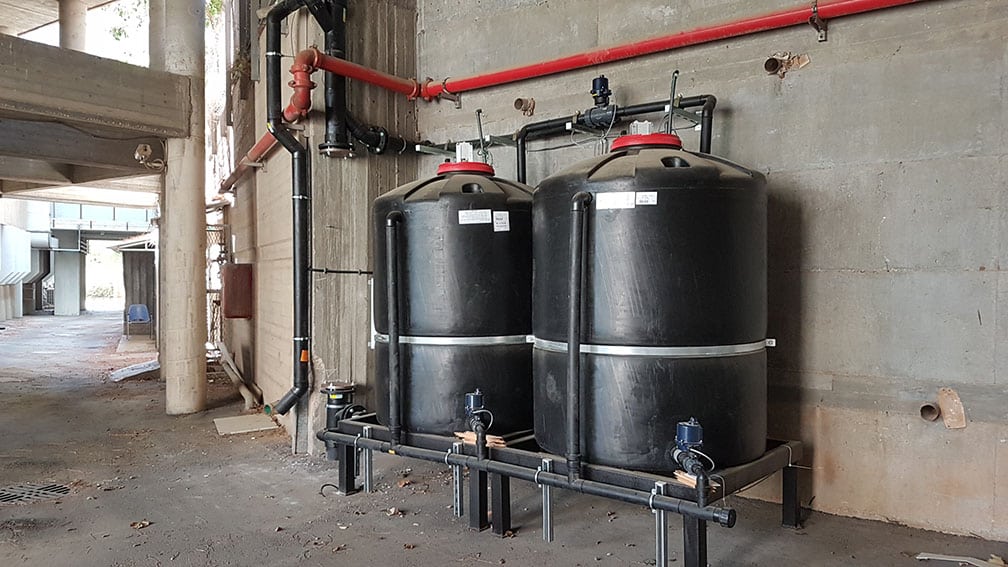
The new system may help prevent flooding due to the increasing urban runoff. It consists of water tanks placed on rooftops to accumulate rain and of a smart system to control the release of water into the municipal drainage system when it is at low capacity. How significant is this invention? It may reduce the load on urban infrastructure by 20–30 percent. In addition, residents of buildings with such water tanks can use water stored in them for various purposes, such as flushing toilets or dishwashing.

The system’s control interface, planned by David Hadad

Serendipitous discovery

The new research was led by Prof. Eran Friedler of the Environmental, Water, and Agricultural Engineering Unit at the Faculty of Civil and Environmental Engineering at the Technion, and Ofer Snir, a Ph.D. student at the Faculty, in collaboration with Prof. Luca Vezzaro of the Technical University of Denmark. Initially, the researchers were not looking for a possible solution to urban flooding. In fact, they intended the first study they conducted for a different purpose: examining the benefits of using rainwater for water consumption in urban households.

“Our research focused on saving drinking water – an expensive product in short supply in Israel,” Friedler explains. According to him, using desalinated water for purposes like flushing toilets is also a waste. “Therefore, any invention that will reduce the demand for desalinated water – and consequently the energy consumption required for desalination – with the help of a simple means that makes the city more sustainable – is welcome,” he says. Indeed, the computerized system evaluates the water consumption of the tenants – and tries to provide them with the necessary amount from the storage tanks to prevent the use of drinking water or desalinated water for purposes that do not require it.

In the follow-up study – the one presented at the conference – the researchers examined container efficiency with the help of a computer model. “We simulated a residential neighborhood in the central region of Israel that has about 150 residential buildings: we mapped its roofs and measured the capabilities of its central drainage system,” Friedler tells us. “We simulated a neighborhood where each building has a storage of 10 cubic meters (10,000 liters – J.S.).” In addition to the parameters of the neighborhood, the model also received the weather conditions that prevailed in the neighborhood during two extreme rain events in Israel: the storms of late February 2010 and late November 2020.

Water tanks – soon on your rooftop?

As mentioned above, the computerized experiment showed a reduction of more than 20 percent of the load on the drainage system in the simulated neighborhood when using the new design. This figure highlights the benefits of the new system. Since it is relatively simple, it may be the cheapest and fastest solution for mitigating urban floods. According to Friedler, many urban neighborhoods already have gutters to drain rainwater, so the next step is simple: connect them to tanks at the bottom of the building or underground.

According to Friedler, roofs make up about 40 percent of the waterproof area in the city, which is not a negligible part. “If this design is implemented in new neighborhoods, it will be possible to plan smaller drainage systems in the first place – so the financial saving may be large,” he explains.

At the same time, the researchers emphasize that this invention will only solve some of the flooding incidents in cities. One of the reasons for this is that when it rains intensely and without stopping, the tanks do not have a low moment when they can release the excess water into the drainage systems. “Therefore, such a method of collecting rainwater can only be a ‘first line of defense’ in a system controlling and monitoring the drainage system. For very extreme events (such as the events of late November 2020 – J.S.), however, it will not be enough,” explains Snir.

Another method, which is very durable, and has been used for many years around the world (including rainier areas than Israel), is rainwater harvesting, in which precipitation can seep into the ground next to the place where it fell. For this reason, waterproof surfaces (such as parking lots, sidewalks, traffic islands, etc.) must be made porous. This change can be done by building them from materials that allow percolation or piercing holes in waterproof surfaces for water to flow through. Additionally, planting perennial vegetation with roots will accelerate percolation.

These days, the researchers are already working on follow-up studies, which will test the system over longer times and on a more extensive scale. So if rainwater storage tanks become a common sight next to multi-story buildings in Israel in a few years – remember where you heard about them first.
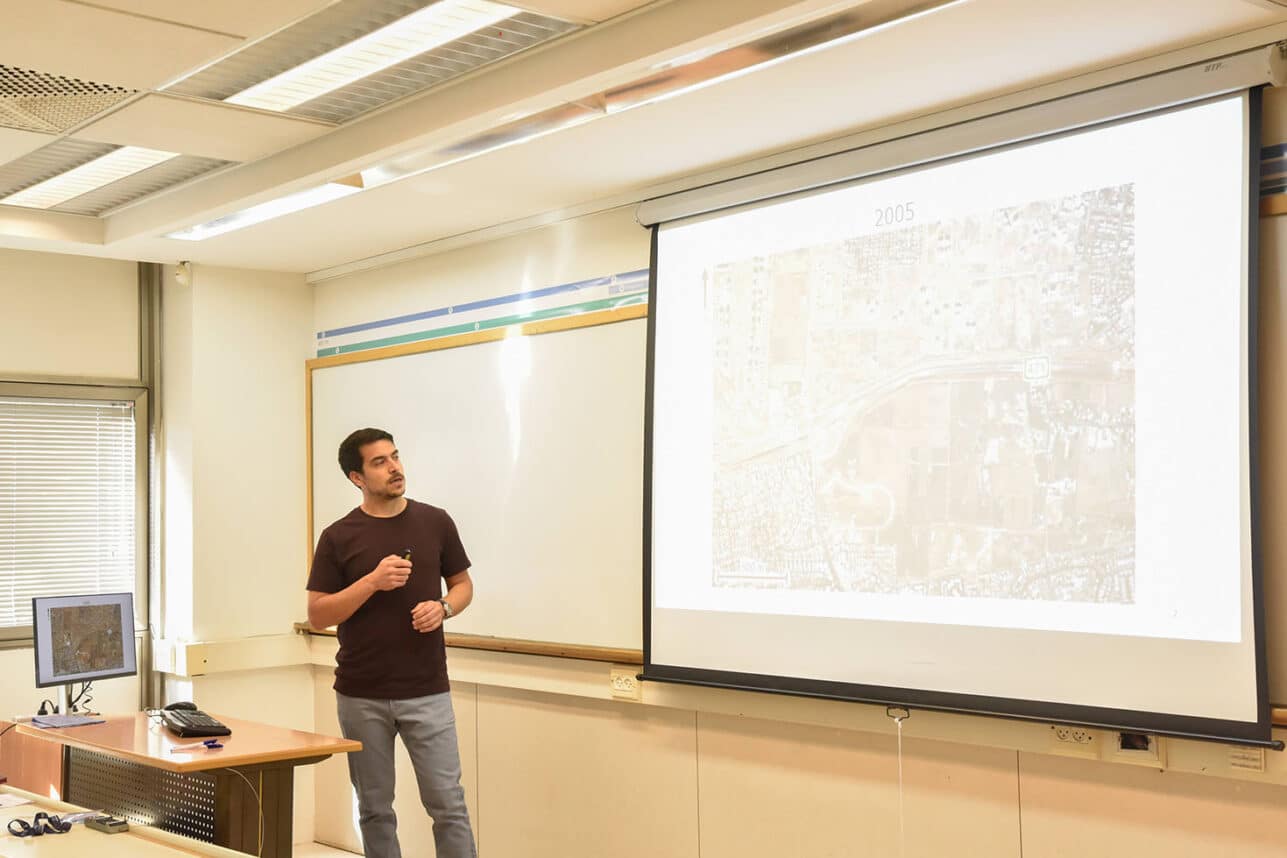
Ofer Snir presents the new study at the GWRI Conference in the Technion. Photo by Sharon Tzur, Technion Spokesperson’s Office

This article was prepared by ZAVIT – The News Agency of the Israeli Society of Ecology and Environmental Sciences

Say No to Overflow: a Solution Against Floods? Read More »

Poll: Democrats More Sympathetic to Palestinians Than Israelis

A poll released by Gallup on March 16 found that, for the first time, Democrats have become more sympathetic to the Palestinians than the Israelis.

The poll, from February 1-23, asked respondents, “In the Middle East situation, are your sympathies more with the Israelis or more with the Palestinians?” Forty-nine percent of Democrats said the Palestinians, 38% said the Israelis and 13% said neither. Gallup’s Lydia Saad noted that the 38% and 13% figures are “new lows” among Democrats and that the 49% figure was an increase of 11% from the previous year.

Forty-nine percent of independents said they were more sympathetic to Israelis, 32% said the Palestinians and 19% said neither side; Saad wrote that the 32% figure was a “new high” among independents. As for Republicans, 78% said they were more sympathetic to Israelis, 11% said the Palestinians and another 11% chose neither; Saad wrote that these figures are “unchanged.” 

Nationwide, 54% of Americans said they sympathize more with Israelis, which Saad noted was “similar to last year’s 55% but is the lowest since 2005.” Thirty-one percent said they sympathized more with Palestinians, a “new high” per Saad. “The resulting 23-point gap in Americans’ sympathy for Israel versus the Palestinians represents Israel’s slimmest advantage on this question in Gallup’s World Affairs poll trend,” Saad wrote. “It is also the first time Israel has not enjoyed a better than 2-to-1 advantage over the Palestinians in Americans’ sympathies.”

Additionally, Saad pointed out that there are generational differences in terms of support for Israel, as “net sympathy toward Israel—the percentage sympathizing more with the Israelis than the Palestinians—is solidly positive among older generations, including baby boomers (+46 points), Generation X (+32) and the Silent Generation (+31).” “By contrast, millennials are now evenly divided, with 42% sympathizing more with the Palestinians and 40% with the Israelis, yielding a -2 net-Israel sympathy score,” Saad wrote.

And yet, American “favorability toward Israel remains strong,” Saad wrote, noting that, when pitted against the Palestinian Authority (PA), Americans are far more favorable toward Israel by a margin of 68% to 26%. That 68% is among the “average” in past Gallup polls, per Saad. “Israel is viewed favorably by a majority of all party groups—82% of Republicans, 67% of independents and 56% of Democrats,” she wrote. “Conversely, relatively few in all three groups view the Palestinian Authority positively: 36% of Democrats, 28% of independents and 9% of Republicans.”

Saad posited that the Democrats’ increasing sympathies for the Palestinians could be due to two facts: more Palestinians being killed as a result of an “escalation of Israeli-Palestinian hostilities over the past year” and the fact that Democrats have become increasingly less religious. “Sympathy for Israel has historically been highly correlated with religion, with those attending religious services weekly being much more sympathetic to the Israelis than those who seldom or never attend,” Saad wrote. Saad concluded her analysis by arguing that the wide favorability disparity between Israel and the PA shows “that while rank-and-file Democrats may want Palestinians’ needs addressed, they will want solutions that respect Israel’s needs as well.”

Republican Jewish Coalition CEO Matt Brooks said in a statement that the March 16 poll reflected “an extremely troubling trend.” “Many elected Democrats claim to be pro-Israel, but party activists and rank-and-file members are increasingly indifferent and even hostile to the Jewish state,” Brooks said. “It’s long past time for Democratic leaders to admit they have a problem that must be addressed to restore the historic bipartisan support for Israel.”

Representative Rashida Tlaib (D-MI), an open supporter of the Boycott, Divestment and Sanctions (BDS) movement against Israel, argued on Twitter that the poll shows that “Americans are recognizing now more than ever that Palestinians face violence and racism from the Israeli government.” “New polling reflects the shift we’ve seen in our communities, with Democrats increasingly supporting Palestinian human rights,” she added. “At a time when so many Democrats have rallied against fascism at home, many of these same people are wondering why we send billions of dollars every year to a far-right government that leading human rights organizations say is maintaining an apartheid system.”

Jewish Democratic Council of America CEO Halie Soifer said in a statement, “There is no contradiction between being pro-Israel & supporting Palestinian rights, which is why Democrats continue to support a two-state solution to the Israeli-Palestinian conflict, as well as security assistance for Israel and humanitarian assistance to the Palestinians. The Israeli-Palestinian conflict is not a zero-sum game, and thus polling that presents it as a binary choice is inherently flawed. Also, there is no evidence of erosion of support for Israel among Democrats in Congress & the White House.”

Democratic Majority for Israel tweeted that the poll shows that “a majority of Democrats have a favorable view of Israel.”

Laura E. Adkins, Opinions Editor of The Forward, tweeted that the question Gallup asked respondents was “supremely flawed” in part because “many reasonable people ‘sympathize’ with *both* Israelis and Palestinians. It’s a false choice. Not to mention that the U.S., for example, gives ample aid to both sides.” She also argued that the poll was taken during February, a month that “was blood soaked, and well-documented in American media. Of *course* sympathies for the Palestinians were markedly higher in February!”

Washington Examiner Magazine Executive Editor Seth Mandel tweeted, “Fascinating to watch Chuck Schumer and Steny Hoyer preside over this shift” and then added in a later tweet that the results of the poll don’t “have much to do with the actions of Schumer/Hoyer, as there are no actions by Schumer/Hoyer.” He also tweeted that the wording of the question in the poll wasn’t “great” because “I disapprove of asking [people] to choose. Can sympathize with both! Sympathy is a good thing to have, and it’s not a finite resource. I encourage everyone to not think of the conflict as a binary choice.”

Poll: Democrats More Sympathetic to Palestinians Than Israelis Read More »

Naturalized

The naturalist is an observer

of nature, making him conserver

of everything that grows and does

no harm, thus giving him a buzz

from observing the performance

of what most naturally occurs,

and therefore in complete conformance

of what rarely ever errs,

to all of nature’s laws conforming

naturally, meanwhile performing.


Naturalized in Britain as a child,

the nature by which I’m beguiled

is the state called Torah I

observe with a poetic eye,

its citizen, whose verse and prose,

my I.D.’s, shorter than my nose,

prove I’m a member of a nation

I joined without naturalization,

and now, binationally Ameri-

can, loyal to two nations—very!


Abigail Green writes about a wealthy Tunisian Jew who became stateless in “Belonging to No Nation,” LRB, 3/2/23, reviewing The Shamama Case: Contesting Citizenship across the Modern Mediterranean by Jessica M. Marglin, writes:

Nissim Shamama, a Tunisian Jew, became an Italian count and fast-tracked his way to citizenship by royal decree. But he was also a refugee who fled his country of origin in a moment of political crisis, never to return, and lived for the rest of his life in Western Europe, without learning to speak a language other than Arabic. After his death in 1873, the civil court of Livorno declared him stateless, a ‘cosmopolitan’ who ‘did not belong to any nation, and thus did not have – nor could he have – any national law’. This verdict would have shocked Shamama, who was still bound to Tunisia by ties of family, ambition and financial obligation, but had taken great care to establish a new legal identity. If he had died poor, his citizenship would have been an irrelevance. The verdict mattered because he was so rich that it took nearly four years to establish an inventory of his estate, which turned out to be worth nearly 28 million francs, making him ‘among the very richest people’ in Europe. Despite this, he died, to use Theresa May’s phrase, a ‘citizen of nowhere’, and his estate, as Jessica Marglin details in this absorbing microhistory, became the subject of celebrated lawsuits.

Shamama was born in the hāra, the old Jewish quarter of Tunis. His family were influential but unremarkable. He started out under the patronage of a prominent local figure, Mahmud Ibn ‘Ayyad, as a tax farmer. Over time, more and more of the Tunisian state’s finances fell into the hands of Ibn ‘Ayyad’s family. Shamama then came to the attention of Ahmad Bey, the ruler of Tunisia, who eventually made him tax collector for the entire country and later receiver general. He began to acquire monopolies on the export of wood, lime, salt, charcoal and olives, and in time became rich enough to lend money to the government. The 19th century may have been the ‘European century’ – a bold new age of industrialisation, globalisation and empire – but it was still possible for a North African Jew to become one of the wealthiest men in the world.

When Shamama was making his fortune, Tunisia was on the path to financial ruin. Because this was the European century, countries like Tunisia were under pressure to modernise, in order to compete internationally and maintain their independence. But modernity did not come cheap, and the money Tunisia needed came from Europe – in the form of costly international loans, negotiated by bankers in Paris and London on terms that became ever more profitable as the Tunisian state finances grew more disordered. The result, as in Egypt, was bankruptcy. Tunisia was peculiarly vulnerable because it was not quite a state, but a semi-autonomous province of the Ottoman Empire (which disputed the government’s right to contract international loans at all). So when the Tunisian prime minister Mustapha Khaznadar set out to borrow money in Europe, he failed to attract established Continental houses and had to do business with an arriviste.

Nissim Shamama reminded me of my family who came to England before the Second World War as stateless refugees in 1939.  Whereas Nissim Shamama failed to become naturalized by Italy or France, our family became naturalized by Britain after war.  Unlike the naturalist described in the first verse of this poem, when my family became naturalized we were all observers less of nature than of halakhah, the Jewish law, whose observance is supposed to be based on a Jew’s second nature.


Gershon Hepner is a poet who has written over 25,000 poems on subjects ranging from music to literature, politics to Torah. He grew up in England and moved to Los Angeles in 1976. Using his varied interests and experiences, he has authored dozens of papers in medical and academic journals, and authored “Legal Friction: Law, Narrative, and Identity Politics in Biblical Israel.” He can be reached at gershonhepner@gmail.com.

Naturalized Read More »