fbpx

February 16, 2023

The Top 13 To Keep Your Eye On in 2023

Jeremy Garelick — Director, “Murder Mystery 2”

When Jeremy Garelick was a teenager, he wrote jokes for Adam Sandler and dreamed the famous comedian would get them. Decades later, Garelick stood behind the camera for “Murder Mystery 2” starring Sandler and Jennifer Anniston as Nick and Audrey Spitz.

“They say that Adam Sandler is the biggest mensch in Hollywood,” Garelick told the Journal. “After working with him I can attest to the fact that it is definitely true. He couldn’t have been nicer.”

Garelick worked with Anniston before, directing her and Vince Vaughn in 2006’s “The Break-Up” which he directed and co-wrote with Jay Lavender.  He also directed Josh Gad and Kevin Hart in “The Wedding Ringer,” which he also cowrote with Lavender.

“I feel lucky to get to work with so many talented people who are also good people and it was a pleasure to work with Jennifer another time,” Garelick said.

Garelick credited his wife Samantha, the daughter of a cantor, for lighting a spark in his heart and always keeping him grounded. The Los Angeles resident was never one to be bothered by pressure — playing basketball as an eighth grader for Solomon Schechter School (now known as Reuben Gittelman Hebrew Day School), his jumper at the buzzer traveled through the net to win the championship. The director of “The “Binge” has produced many other films and said he didn’t feel any pressure about coming in for a sequel for this film, and that he is happy with the result. “I had my own distinct vision that I was able to see through,” Garelick said. “We worked hard.”

In 2014, Garelick founded American High productions with the purpose of making high school comedies, and he purchased a high school building in Syracuse. He’s filmed a number of movies there.

“Murder Mystery 2” will be released by Netflix March 31.

Guy Nattiv — Director, ”Golda”

Guy Nattiv was surprised when he won an Oscar for his short “Skin,” about race relations.

“Not in a million years,” did he expect to win the Oscar, Nattiv told me in 2019.  When he expanded the story into a feature film, Nattiv masterfully directed Jamie Bell, who gained 40 pounds for the role.

Combining Nattiv, with Helen Mirren, an Oscar-winner for best actress for the biopic “The Queen,” “Golda” will showcase Nattiv’s complexity.   While some have complained that a Jewish actress should have played the role, Meir’s grandson doesn’t think so.

Shaul Rahabi, whose mother was Meir’s daughter, told The Jewish Chronicle, “I have no issue with Helen Mirren being Jewish or not Jewish playing my grandmother … It doesn’t matter at all. I’m sure Helen Mirren is great.”

Liev Schreiber plays Henry Kissinger so it should be interesting to hear him do that accent.

After premiering at the Berlin International Film Festival in February, “Golda” is scheduled to be released in the United States on August 23.

Matisyahu — Musical Artist

The Grammy-nominated singer and rapper recently said he will win a Grammy one day in the future. But he said he will release music according to a new model.

Grammy nominated artist Matisyahu says he will release songs every few months rather than one album every few years.

“Gone are the days where I will work with one producer for six to eight months and release music once every few years,” Matisyahu, whose real name is Matthew Miller, told the Journal.

He said he is enjoying fatherhood and is excited to see that his son Laivy has decided to become a musical artist. He said he is giving him advice.  Matisyahu recently performed at the Sundance Film festival. Matisyahu, who was impressive in the 2012 thriller “The Possession” said while he has no current plans to act, he is leaving his options open and would consider anything interesting that came his way.

In his latest, self-titled album, he sang about his difficulties with drinking. He said he is strong now, and was glad to see something come full circle, as he recently released a video with Chad Tepper.

“A fan of mine, who once came up to a show, who was really poor, I’m talking dirt-floor home,” Matisyahu said. “Now, he’s an artist in his own right, so we did a video together and it was really cool.”

The video is called “Buy Us A House,” a song that combines Tepper’s smoky rock voice with Matisyahu’s rap. The song would be a perfect fit for any soundtrack about a rags-to-riches story. This song has some funky greatness and is inspiring.

He said he is thankful for his “great fans in L.A., New York and around the world” and said he will release new songs every month or so, depending on his schedule.

“A lot of extreme things can happen in life,” Matisyahu said. “The main thing is to stay centered and control your destiny and not feel like you have to let others control you. And it’s important to believe in yourself and your talent. Not everything has to be perfect in life, it just has to come from the authentic fiber of who you are. If you want to get to the top of a mountain, you have to be willing to climb. But I’m blessed to be able to be on stage and perform and it makes me happy to be able to do that. I know my fans are interested in what I’m gonna do and the message is ‘look out!’

Taali — Musical Artist  

Grammy nominated singer-songwriter Talia Billig, who goes by Taali, recently wrote a song with Moby and her husband Jose James called “ache for.” She is the president of Rainbow Blonde Records, which she co-founded with James. From watching her perform at several New York venues, I can make you a promise: You will like her voice, or I will shave my head! She lived in Los Angeles for a few years and wrote a song about the city. She was in Manhattan for the worst of Covid and was ill but thankfully came out of it. She now lives in Pasadena and makes very cute challah videos on Instagram that you should check out. Her album release party will be in New York at Le Poisson Rouge on March 7. Taali, who has also worked with Aloe Blacc, said she is excited for her next chapter.

Taali has her album release show at March 7 in Manhattan at Le Poisson Rouge.

“There were so many things that were unexpected,” she told the Journal. “I love performing, writing songs and yeah, also showing people how I make challah.”

While her songs often evoke a feeling of introspection,

on stage she is apt break mid-vocal to say hello to a friend in the audience or crack an amazing joke between songs. Taali’s performances will leave you star-struck but her personality will make you feel like she is your long-lost cousin who you want to go out for coffee with and schmooze about the insanity that is life. The song “Hear You Now” is straight fire, with lyrics that  express her beliefs of empowerment and equality for all.

“Music is the way I communicate and grow and hopefully unite people,” Taali said. “I’m humbled to be able to bring people some moments of joy if they can hear one of my songs or watch one of my videos.”


Team Israel —World Baseball Classic

First, the good news. Team Israel, which shocked the world by beating teams including Cuba at the 2017 World Baseball Classic (WBC) now boasts several current major leaguers, including Giants slugger and former Dodger All-Star Joc Pederson (23 HR, 73 RBI last year) as well as Baltimore Orioles pitcher Dean Kremer, who was 8-7 with a 3.23 E.R.A. The bad news is that Atlanta Braves ace Max Fried and Houston Astros slugger Alex Bregman didn’t join the team and NY Yankee center fielder Harrison Bader won’t be part of the team.

Joc Pederson of the Giants is the biggest power threat for Team Israel.

“Israel has been the underdog in all its existence,” Team Israel general manager Peter Kurz told the Journal. “If it’s politics, if it’s the UN, if it’s the battlefield or the baseball field it’s always David vs. Goliath, and we’re used to it. We savor that role. There is no doubt about it. They thought we would lose all three games (last time) and were shocked. I asked Major League Baseball if they could put us in North America, so it’s helpful that we’re playing in Miami. I didn’t expect them to put us in the ‘’Death Pool.’”

Kurz is referring to the Pool D, a bracket of difficult opponents. On March 14, Israel will face the Dominican Republic, a team that is favored to be the best overall team. With a stacked lineup, the squad is expected to boast the Padres’ Manny Machado and  Juan Soto, Mariners’ Rookie of The Year Julio Rodriguez, Rafel Devers of the Red Sox, Jose Ramirez of the Guardians and Vladimir Guerrero Jr. of the Blue Jays. With starting pitcher Luis Castillo announcing he won’t be playing, Team Israel hopes to avoid Miami Marlins ace Sandy Alcantara, who went 14-8 with a 2.28 E.R.A. and struck out 207 batters, winning the National League Cy Young Award. On March 13, Team Israel plays Puerto Rico, a team that boasts NY Mets shortstop Francisco Lindor, Minnesota Twins infielder Carlos Correa and Javier Baez of the Detroit Tigers. They have starting pitchers Jose Berrios and Marcus Stroman as well as Mets closer Edwin Diaz and reliever Seth Lugo of the San Diego Padres. The odds are much better for Team Israel’s first game against Nicaragua.

“We have a number of major league relievers and the Dominican Republic beat us last time, but they were very respectful,” he said. “We’re having a clinic in Miami where some of the Dominican players and some players will come out together. We want to fight against antisemitism that is spreading.”

Kurz said the players for Team Israel are ready to play against anyone when the WBC begins March 11 in Miami.

“Ryan Lavarnway (a catcher on the Guardians) was the MVP of the 2017 WBC and we hope he will do well for us, and Garrett Stubbs (of the Phillies) is our other catcher. We have two really good catchers. Matt Mervis (Cubs) is our first baseman. He’s a kid that had the most home runs in Triple-A last year. Matt Mervis is our first baseman. He had 36 home runs, and led the minor leagues with 119 RBI’s and is nicknamed “Mash. We don’t have an Edwin Diaz like Puerto Rico but we have a number of guys in the bullpen that can get the job done. He is especially high on Ty Kelly.

“We’re looking for him to break out.”  He’ll be joined by the lone Sabra, Assaf Lowengart,  who can play infield or outfield.

“They said we had no chance last time,” said pitcher Shlomo Lipetz, who got former Mets third baseman Todd Frazier to ground into a double-play at the Tokyo Olympics.

Lipetz said it was a great honor to represent Israel on the world stage.

“The pressure will be on the other teams, not Israel,” Lipetz said. “I think our pitchers will probably just look to get batters to make outs because a strategy to try to strike out everybody isn’t a good one.”

Dmitriy Salita — Boxer/Boxing Promoter

Dmitriy Salita, an Orthodox Jewish boxer who didn’t fight on Shabbat, will be inducted into The New York Boxing Hall of Fame on April 30. He had a record of 35-2-1 with 18 knockouts, he was a Golden Gloves winner at 139 pounds and earned the WBF junior welterweight title as well as others.

A documentary Orthodox Stance was made about him and there was talk and preparation for a biopic starring Eminem as Salita, though it did not come to fruition. But Salita is making his real life seem like a movie in two parts. He’s taken off the gloves but making moves to becomes one of the game’s top promoters.

One of the fighters he represents, Claressa Shields is considered the best female fighter in the world and may have another match this year.  She had the biggest career victory in October, taking down Savannah Marshall in London. Salita returns to London April 1, as his fighter Jermaine Franklin (21-3, with 22 knockouts) takeson former heavyweight champion Anthony Joshua.

“This is a life-changing opportunity for Jermaine,” Salita said. “When I signed him more than three years ago, I believed he had the ability to be one of the best heavyweights in the world. On April 1, I am confident that he will show the world his true potential by beating Anthony Joshua, who for a decade has been one of the most dominant forces in the Heavyweight Division.

Ryan Turell — Motor City Cruise Basketball Player

Speaking of surprises, Orthodox basketball player Ryan Turell set new records in most categories at Yeshiva University. The 6’7” shooting guard/small forward, who attended Valley Torah High School scored the most points all-time for the university, scoring 2,158 points. There was talk about the possibility he could be drafted into the NBA. He suffered an injury during workouts, but he was drafted into the G League and plays for the Motor City Cruise, the affiliate of the Detroit Pistons.  He hasn’t gotten as much playing time many would have liked, but the 24-year-old impressed when he was on the court, scoring 21 points in only 17 minutes in a game in December. This YouTube video shows him nailing shots from all over the court.

“There are people that think I will wind up playing in Israel,” Turrell said.  “I appreciate all my fans. My main goal is to get stronger every day, improve every day, be a kiddush Hashem, play wearing my yarmulke and work to what my goal now is, and that is to get better and better; but my dream remains to make the NBA,” Turrell told me \a year ago, before he was drafted into the G League. Turell recently had a New York homecoming, scoring 11 points against the Long Island Nets. Should Turrell put together a few big games, even more people will be wearing a wig for Purim. The Motor City Cruise will return to Nassau Coliseum on March 7 on Purim. No doubt, there will be some dressed as Turell with a blonde wig.

Rudy Rochman — Israel Rights Activist/Influencer

Rudy Rochman, who lives in Israel, was quick to put out videos in response to Ye’s antisemitic remarks as well as the situation where Kyrie Irving tweeted a link to a film with antisemitic tropes and Holocaust denial.

“My drive to combat antisemitism stems from a personal incident when I was a child in France,” Rochman told the Journal, alluding to an incident where he was kicked off a bus. “Rather than just saying something is antisemitic, people need to understand why and that’s why I felt it was important to make my videos.”

 Rochman drew international news  in the fall of 2021 when he was in Nigeria working on his documentary series “We Were Never Lost.” He and two colleagues who were working on the series to explore the Jewish roots of people in different African countries, and had filmed enthusiastic people, some who wore tefillin and a tallit and chanted in Hebrew.

He thinks that as a result of a photo of his gifting a sefer Torah to the community being shown online, bloggers spread false claims that the men were working against the government of Nigeria.

Men with guns in ski masks forced them into a car. Rochman would be jailed for 20 days and shared a cage with a man who was a member of the terrorist group, Boko Haram. The floor was covered in urine, he said, and for the first few days they could not shower and when they could, it was just a bucket of water.

“It was insane,” he said, adding that he stayed up some nights in case he would be attacked.

He said the DSS (The Department of State Services) interrogated him and took his phone and of course, found no evidence of any efforts against the government, because he had none.

The former member of the Israel Defense Forces said he isn’t done.

“I plan to go back to Nigeria, hopefully, this year,” Rochman said. “The government is having new elections soon and either way, whoever is in power will know that I have not, nor will I be doing, anything illegal. I didn’t get the chance to complete my story.”

Asked why he would do something so risky, he said his mission to educate about Jewish culture and practices was important to him.

“I’m not afraid” he said. “If I was left behind from the Holy Land, I would want the people that made it there to help me, wouldn’t you?”

 As for antisemitism on college campuses, Rochman, who can be seen in numerous videos he filmed when he attended Columbia University, said it is important to stop the spread of false narratives and antisemitic tropes.

He also said he hopes for a solution that will lead to peace between Israelis and Palestinians.

“If one side says, ‘we are right’ and the other side says ‘we are right’ I don’t know how exactly that ends up in any peaceful solution,” Rochman said.

Rochman, who once debated Noam Chomsky, said he has no problem debating people he disagrees with and in the future may film dialogue he has with other noted figures.

Hillel Fuld —Tech Guru and Influencer

The tech and marketing guru who advises global brands has also helped more than 500 people find jobs, simply from his database, and he hasn’t charged a penny for it. Fuld said he expects 2023 to be the year that Artificial Intelligence is recognized on a mainstream scale.

“We have seen through Chat GPT and other manifestations that A.I. is going to have a significant impact,” Fuld told the Journal. “Some people are predicting tons of job losses but people were afraid with the emergence of the Internet and the iPhone. What we will see is that people eventually adjust to new technology and those who are good people use technology for good purposes and there are always others who may try to use it for not so good purposes. But I don’t think we need to be worried. We will see amazing advances.”

Fuld and his family made Aliyah from New York, and, heencourages others to do the same. Asked if the recent terrorist attacks in Jerusalem would scare people away from moving to Israel, he said he did not think it would.

“I think anyone who knows the history of Israel knows that there will be terrible tragedies,” Fuld said. “No places are 100% safe no matter what, as we painfully saw from the attack in Pittsburgh. But Israel is the one place where Jews have an army and we can defend ourselves. Looking at the big picture, I think for Jews in America or anywhere outside Israel who have been thinking about making Aliyah, it makes more sense no than ever before.”

On September 16, 2018, his brother, Ari, a father of four, was stabbed in the back and killed by a terrorist, though he was able to chase after and shoot his attacker in his last moments and was nicknamed the “Lion of Zion.” The murderer received a life sentence.

Fuld said on a weekly basis, if not more frequently, he receives messages from around the world of people who have been touched by the story of his brother and either named things after him or created artwork of him.

iHs brother is a hero, Fuld said, and part of his motivation to help people and make the world a better place is because of his brother.

From  politicians, to business leaders to people looking to for help being set up with someone, Fuld is often in meetings discussing strategy.

His advice?

“Do your research, be prepared and don’t be afraid to put yourself out there as long as you do it in a confident and respectful way,” Fuld says/

He also advises against petty online arguments with people.

He sometimes gets criticism for posting a pic of a conversation with someone  that some online may not agree with politically, or if he is with a celebrity they might not like.

“People seem to like being insulting sometimes,” Fuld said. “If someone is posing an argument and asking for opinions, that is one thing. But if someone posts a pic with a friend, I’m not sure why some think that is an invitation to a debate.”

He said people should be careful what they post online.

“Your words are your reputation,” the noted lecturer said.

Elon Gold and Modi Rosenfeld — Veteran Jewish comedians

Told that some look at these two Jewish comedians as Michael Jordan vs. LeBron James, only these two Jewish men came up together at the same time period with the same amount of heckling, Gold laughed.

“I like that, Gold,” told The Journal. “But to be accurate, Modi and I are very good at comedy but not quite as good at comedy as they were and are at basketball. Gotta keep it real.”

Gold appeared as a Hulu executive on “Curb Your Enthusiasm” and joined Rosenblum on HBO Max’s “Crashing.”Gold fakes people out a bunch of times in his YouTube special “Sets In The City: Elon Gold’s Favorite People.” He and Rosenfeld work exceptionally well together in the The Chosen Comedy Festival. They have unbeatable chemistry and when I saw the first festival in Brooklyn last summer, I laughed so hard, I almost got into the wrong cab. They did Miami and just performed at The Orpheum Theater in Los Angeles, with their sites on Dallas, Houston, Toronto and Montrel, with another one in New York City and Israel will hold the festival perhaps in 2024.

“People really love Elon and Modi. They give people a feeling of Jewish pride wherever they are,” Dani Zoldan, organizer of the festival, said.

Gold’s comedy special hits the mark. “Sets In The City, Elon Gold’s Favorite People” (available on YouTube) shows his charm and gravitas.

Rosenfeld told the Journal he is excited to perform at the Saban Theater in Beverly Hills on June 8 and will be doing a West Coast tour.

He said it’s been a thrill to perform with his friend and fellow comedian.

“To get to do comedy is a great high,” Rosenfeld said. “To get to do it with your great friend is even better and is really special and we’re good friends and we bounce ideas off each other and what I live with the festival is it unites people and it can go everywhere I’m sure will be in Israel and who knows what other cities. And the message is always to be a proud Jew and I think that’s a powerful force that unites people.”

Ariel Elias — Comic

The Kentucky comedian did something essentially Jewish — turning something bad into something good. At a New Jersey show, someone threw a bottle that missed her face by a few feet. She drank from the bottle,  to the applause of the audience. She said the beer was thrown by the husband of a woman who heckled her. Elias then got on “Jimmy Kimmel Live!”

In a previous interview Elias told me she thought the people were looking for an easy target.

“I am not an easy target,” Elias said.

She has gotten many fans due to the video that went viral and we will see if she parlays it into more shows, a special or more.

She was not surprised that some online wondered whether this was a stunt to get attention (it wasn’t) but said she is taking things in stride and feels like she handled the situation perfectly. Those that see her on tour will realize she is a great joke-writer as well as a great joke-teller.

Inna Vernikov — New York City Councilwoman 

One of three children in a family of Ukrainians immigrants, many pundits said Republican Inna Vernikov would not be able to win the New York City Council seat representing District 48 in Brooklyn , partly because the GOP has a tough time winning anything in New York City. For whatever reason, her opponent refused to debate her. Vernikov won by a landslide.

The attorney said she will aggressively fight for justice.

“I don’t want any person to fear walking in the street that they will be attacked or persecuted for who they are,” Vernikov told The Journal. “There have been rising levels of antisemitic attacks in New York and we must work to stop them.”

In an unprecedented New York City Council hearing on antisemitism on college campuses, Vernikov asked pointed questions of representatives of the City University of New York (CUNY) who were unable to answer them. Despite the event being scheduled on the date he could attend,  CUNY Chancellor Felix Matos Rodriguez decided not to show up. Scores of students and faculty members testified that they were treated unjustly at CUNY schools due to antisemitism.

Vernikov said she is planning another hearing for this year. She trained in Krav Maga with Legion, a nonprofit that trains mostly Jews in self-defense and has counterterrorism and active shooter drills. She recruited them to offer classes in her district.

“It is simply impossible for the NYPD to be everywhere at all times,” Vernikov said. “Jews have often been targets so it makes sense to be trained.”

She said she is proud of being Jewish, and is closely monitoring two cases of alleged antisemitic assaults. Joseph Borgen told police he was beaten up in Times Square by a gang and surveillance videos show him being struck by a person with a crutch. Borgen said he wore a yarmulke when he was attacked. Blake Zavadsky said he was punched in the face by a man who threatened to do so if he did not take off his IDF hoodie and when he refused, he was attacked, he said.

“The two cases are a little bit different,” Vernikov said. “But we are watching both closely and want to see that justice is served.”

“Oppenheimer” — Film

Only an idiot would try to use a pun and say that the film will be explosive. But director Christopher Nolan is one of the masters of direction. Yes, everyone knows that J. Robet Oppenheimer was a secular Jew who was able with his team to build the bombs that were dropped on Hiroshima and Nagasaki forcing Japan to surrender. But if you read the book it is based on, “American Prometheus; the Triumph and Tragedy of J. Robert Oppenheimer” by Kai Bird and Martin Sherwin there are many interesting points.  Some military officials didn’t want to give Oppenheimer clearance due to fear of communist contacts. Oppenheimer left Los Alamos to visit a “friend” who was a former lover, and he may have slept with her one last time before she’d later tragically die in what many think was suicide. He also thought President Truman was quite naive,  telling him that, as a scientist, he felt he had blood on his hands. Truman told him he thought Russia would never develop a capable nuclear program. There was an effort in which some tried to get Oppenheimer to spy for the Russians.

“Oppenheimer” hits theaters on July 21; It will be interesting to see Cillian Murphy as Oppenheimer, Robert Downey Jr, as Lewis Strauss, a man who cast aspersions on Oppenheimer, Florence Pugh as Oppenheimer’s lover Jean Tatlock, and Matt Damon, as Leslie Groves, the Army man who selected Oppenheimer despite objections of others.

If this film isn’t a blockbuster, I don’t know what is.

The Top 13 To Keep Your Eye On in 2023 Read More »

In a World of Loud and Violent Antisemitism, Listen to the Whispers

On social media, images of Palestinians celebrating the murders of Jews with fireworks, handing out sweets, and dancing in the streets presents the picture of the dehumanization of Jews by Palestinians that Hamas wants the world to see. But anonymous surveys paint a different picture. Today, despite rockets and other terrorist attacks on Israeli civilians originating in Gaza, almost 4 out of 5 Gazans agree at least somewhat with providing incentives to both sides to “take more moderate positions.” Among Palestinians overall, support for negotiations is increasing while support for armed attacks is declining. And roughly two-thirds of Gazans would like to see more Israeli companies in the Palestinian territories.

How is it that we only see images and messages that lead us to the worst conclusions about what Palestinians believe about and have in store for Jews?

In 2019, a thousand or more people attempted to peacefully protest aspects of Hamas rule. Gaza’s Health Ministry, which issues reports of alleged Palestinian casualties after clashes with the Israeli Defense Forces was suddenly silent on the number of deaths and injuries after the Hamas crackdowns. The cruel and violent treatment of protesters –– and even their family members –– along with the inability of journalists to effectively report on it illustrated to many Palestinians the futility of opposing Hamas.

But some Palestinians in Gaza continue to defy Hamas and send messages to the outside world. With the help of animators, illustrators, and musicians, filmmakers at the Center for Peace Communication (CPC) are turning Gazans’ private whispers into publicly defiant cries. Using altered voices to protect those who told their stories, the Whispered in Gaza series features Gazans from all walks of life who describe, in vivid detail, what life is like under Hamas. These 25 animated film shorts have been translated into six languages, including English, Portuguese, French, and Farsi.
“I now understand that their jails are full of honorable people,” one Palestinian says. “Anyone who tries to think for himself winds up there.” He uploaded to social media a video of Hamas police beating a child with Down syndrome and received thousands of supportive messages before being arrested. Others in the series describe the harassment, violence, cruelty, corruption, and even murder of Palestinians by Hamas. A mother shares her refusal to allow Hamas to turn her children into terrorists. “I don’t want my children to be exposed to that indoctrination,” she says. “I want them to think rationally.”

Only 7% of Gazans surveyed say conditions there are positive. Yet those who disagree with Hamas’s message or methods, or simply ask for better living conditions, are labeled “traitors” and “Zionist collaborators.” In other words, there’s no way to tell how many of the Palestinians in the videos depicting the celebration of terrorism are there because they support such attacks and how many are there merely to protect themselves and their families from Hamas.

As soon as the series was released, Hamas attempted to sabotage the films’ distribution platforms. Shortly thereafter, fake versions of the shorts appeared with Hamas-approved narration. (The Hamas-created counterfeits have been flagged as copyright violations and taken off various media platforms.) As CPC president Joseph Braude explained in the Times of Israel:

Their content predictably twists the testimony. For example, in one of our clips, the speaker explains that under Hamas, “it’s forbidden to say we don’t want war,” and change must “come from the people.” In the Hamas version, “The solution is in the Resistance, none other” and “though we’ve endured four wars, we stand with the Resistance and will never ever give them up.” in another clip, “Amna” describes her fear of sending her children to Hamas-run schools “where they indoctrinate people.” The Hamas version has the speaker proudly sending her children to a Hamas school for an upright Islamic education.

As of this writing, the videos have been up for about four weeks and have been viewed over 4.5 million times on the CPC’s platforms alone. Palestinian viewership is estimated at several hundred thousand. On social media, expressions of support for Gazans and their efforts to defeat Hamas are spreading, including across Arab countries, where historically sympathy for Hamas has been dominant.

The Egyptian news platform Al-Masry al-Yawm, for example, noted Gazans’ “testimonials of arbitrary arrests, extortion, and blackmail by Hamas members, as well as systemic violation of basic personal freedoms” as well as “the enrichment of Hamas members and their families even as most Gazans are impoverished.” Palestinian journalist Fadil al-Munasafah concluded “No rational person can deny that the [Whispered in Gaza] series captures much of what daily life in Gaza is actually like.” And protesters in Iran see similarities with their own efforts to reject Islamist rule.

In 2005, Israel unilaterally withdrew from the Gaza strip, requiring 9,000 Jewish residents to leave their homes. Some were even forcibly removed. Only hours after the withdrawal, two Gazan rockets were fired at Israel, the first landing near Sderot, an Israeli town less than a mile from the newly created border with Gaza. In an expression of solidarity and shared humanity, the first public screening of Whispered in Gaza is scheduled to be held in Sderot, the city most targeted by rockets from Gaza. “As educators living in Sderot,” writes George Stevens, who organized the event, “we found it important to understand, analyze and confront what living beside and beneath Hamas does to people.”

Despite Hamas’s brutal regime, the courage of Palestinians to speak out, to refuse to hand over their children, and to work toward a better life continues. And now that whispered Palestinian voices are being amplified, Israelis and Jews across the globe have a new way to connect with the humanity and dignity of the people Hamas wants to paint as Jews’ inhumane and eternal enemies. “What is so crushing about this whole thing is that we have the requisite capabilities [to build a good life in Gaza]” says one Palestinian in the film series. “I hope that those capabilities will be utilized soon, with the world’s help and with the help of ourselves, as Palestinians, working together to improve things.”


Pamela Paresky is a Visiting Fellow at the SNF Agora Institute at Johns Hopkins University and a Senior Scholar at the Network Contagion Research Institute. Her work has been published in a diverse array of outlets including Sapir Journal, Brookings, and the New York Times. She is a frequent contributor to Psychology Today online and her project, Habits of a Free Mind: Psychology for Democracy and The Good Life, is a set of teachable practices for fostering critical thinking as well as the habits of curiosity, compassion, courage and calling –– habits necessary for contributing to and thriving in a liberal, pluralist democracy. She is on Twitter @PamelaParesky.

In a World of Loud and Violent Antisemitism, Listen to the Whispers Read More »

Jewish Studies and Holocaust Inversion: Making Gaza Into Auschwitz

Over the past few weeks a controversy has broken out within the Association for Jewish Studies (AJS), the flagship academic organization for educators and researchers in the United States and beyond who work in all disciplines associated with the study and teaching of the history, religion and culture of the Jewish people. Founded over fifty years ago and boasting thousands of members, the AJS’s professed mission is “to advance research and teaching in Jewish Studies at colleges, universities, and other institutions of higher learning, and to foster greater understanding of Jewish Studies scholarship among the wider public.” Doctoral students rely on the AJS’s resources for making connections and building their careers, and established scholars regard the AJS as a necessity for ensuring that Jewish Studies is a respected field in the academy. The AJS’s widely disseminated publications, including the AJS Review and AJS Perspectives, showcase the best that Jewish studies has to offer.

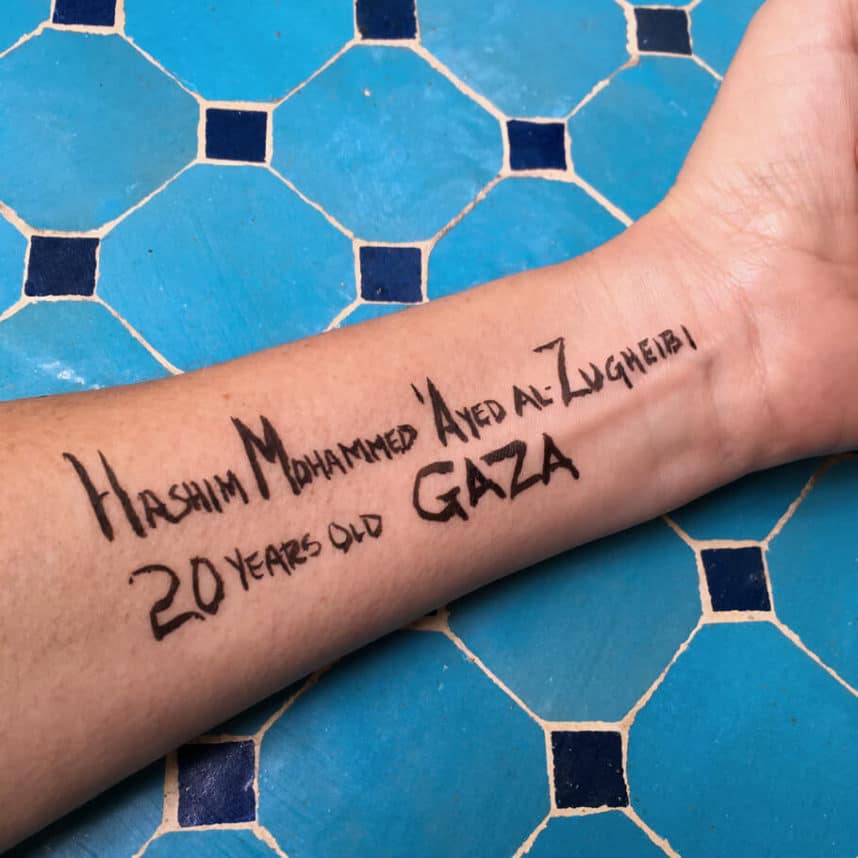
But many AJS members have been alarmed by the Fall 2022 edition of AJS Perspectives, titled “The Justice Issue,” which includes “Gaza Ghetto,” an artistic installation from Ruth Sergel. Sergel offered up a series of photographs (see image above) in which the names of Gazans who have perished during the ongoing Hamas-Israel conflicts are etched in ink on the artist’s arm. Her objective was clearly to evoke images of Jews tattooed as they were registered into the Auschwitz camp, thereby comparing Israel’s complex war with Hamas to the Final Solution.

Numerous critics have focused on the fact that the “art” of the “Gaza Ghetto” tattoos trivializes the Holocaust. As Professor James Diamond of the University of Waterloo recently wrote in an open letter to the AJS, “those images have graphically violated every principle AJS espouses and should stand for as a professional academic organization for crossing the line from provocative art to perverse exploitive misappropriation of one people’s suffering to capture another’s. … What is fashionably referred to in the issue as ‘embodied’ art, insidiously dispossesses the unimaginable suffering of millions of actual bodies, both of those systematically murdered and tortured in the Shoah, and those who survived the horrors.”

But Holocaust trivialization is a very complex topic replete with ambiguities and gray areas. What may seem to be trivialization is not always such, and more importantly may not necessarily be antisemitic. But universalizing the Holocaust through crude analogies is considered by some to be trivialization because it erases Jewish particularism. Perhaps it is, and it certainly is with “Gaza Ghetto.” But is it always? This is a legitimate debate and one that should be welcomed by scholars. Unfortunately, the editors of AJS Perspectives offered no opportunity for discussion over the possible offensiveness of these images.

But the gravest aspersion of “The Justice Issue” is not the trivialization of the Holocaust. Sergel’s art installation promotes what has been called Holocaust inversion: the practice of comparing Israel to Nazi Germany, of likening Gaza to Auschwitz, a mass extermination camp that at its peak gassed to death 12,000 Jews per day. According to Sergel’s artistic statement, Israel’s blockade and periodic bombing of Gaza—which are a response to an antisemitic Islamic fundamentalist regime’s launching of rockets at Israel—is no different from the extermination of one million Jews through the most systematic industrialized mass murder operation in history. Through a series of photographs, Holocaust inversion is accorded the status of provocative art.

Through a series of photographs, Holocaust inversion is accorded the status of provocative art.

If the perniciousness of Holocaust inversion is unclear, I invite you to consider the following two images. First we have the infamous “Warsaw Ghetto boy,” one of the most well-known photos from the Holocaust, taken in 1943 by a Nazi photographer during the liquidation of the Warsaw Ghetto and published in The New York Times in 1945. This disturbing image has become symbolic of the 1.5 million children who perished at the hands of the Nazis’ campaign to wipe Jews off the map. It has been indelibly etched into our collective memory of the Final Solution.

The second image is the “Warsaw Ghetto boy” refashioned into an exploitative depiction of “Palestinian suffering”. The armed Nazi is recast as a Jewish IDF soldier, further dehumanized (as if branding him a Nazi is not sufficient dehumanization) through a skeletal rendering of his face. The persecuted Jews, including the boy, are transformed into Palestinians.

Few would argue that this image does not trivialize the Holocaust, and I would like to think most people would consider this image antisemitic. Indeed, the widely adopted International Holocaust Remembrance Alliance’s Working Definition of Antisemitism (IHRA WDA) contends that “drawing comparisons of contemporary Israeli policy to that of the Nazis” can be construed as a form of antisemitism. If nothing else, the image is intended to demonize the Jewish state in the worst manner possible, and in a manner utterly devoid of scholarly foundation.

What should be clear is the transformation of the “Warsaw Ghetto Boy” into an artifact of Israel’s impugned oppression of the Palestinians is no different from Ruth Sergel’s antisemitic “Gaza Ghetto” art, which was met with approval by the two editors of AJS Perspectives, Mira Sucharov and Chaya Halberstam. In an exchange with me on social media, Sucharov disingenuously claimed that “it is not clear that Gazans were compared to victims of the Final Solution. That is an association you are drawing from the art.”

Yet a perusal of Sergel’s website makes it abundantly clear that this is about Holocaust inversion. On the page exhibiting “Gaza Ghetto,” she invites her audience to “Please stay informed. Resources include: Jewish Voice for Peace, Electronic Intifada, B’Tselem.” Jewish Voice for Peace is a notoriously anti-Zionist organization that has not shied away from using antisemitic tropes to engender the liquidation of Israel. And The Electronic Intifada is an inflammatory media outlet that likewise seeks Palestinian liberation through crude antisemitic stereotype. The latter has on occasion compared Israel to Nazi Germany, in one piece even misusing the “Warsaw Ghetto Boy” photo (and all that it implies) as an emblem of Palestinian suffering. If Sergel’s art contains any ambiguity, it is all but eliminated by the inclusion of her recommended anti-Zionist resources on her website.

Perhaps we should thank Sergel for making obvious what should have been obvious to the editors of AJSPerspectives. Unfortunately, their decision to publish “Gaza Ghetto” means they have either overlooked its Holocaust inversion or have decided to endorse it.

Either way, these images will now become part of the progressive antisemite’s toolbox. They can now cite the most prominent Jewish studies academic organization anytime they need a seal of kashrut from our public intellectuals. Whether deliberate or not, the AJS has sanctioned Holocaust inversion.


Jarrod Tanny is an associate professor and Charles and Hannah Block Distinguished Scholar in Jewish History at the University of North Carolina, Wilmington. He is the author of “City of Rogues and Schnorrers: Russia’s Jews and the Myth of Old Odessa” (Indiana University Press) and the founder of the Jewish Studies Zionist Network.

Jewish Studies and Holocaust Inversion: Making Gaza Into Auschwitz Read More »

Californians Must Speak Out About the Antisemitic Conference in Los Angeles

It’s time for Californians to speak out against the anti-Jewish hate fest coming to Los Angeles on February 17th-20th. The sponsor, the grandiosely titled Students for Justice in Palestine (SJP), has an articulated goal of gross injustice in what was once the British Palestine Mandate: ending the Jewish presence in our historic homeland, the Land of Israel, by dismantling the Jewish State. The mechanism by which it hopes to achieve this travesty is called Boycott, Divestment, and Sanctions (BDS), and entails refusing to engage with even the most moderate and pro-peace Israelis on the grounds that this “legitimizes” the State of Israel, which they intend to wipe off the map. This is the exact opposite of a peace movement – their avowed intent, war to the death, actually meets the definition of genocide.

But you don’t have to take it from me. Let’s consider the comments of SJP leaders themselves, and the people to whom they’ve given a platform before their conferences were suspended during the pandemic years. Attendees at the 2017 National SJP Conference included Samer Alhato of Saint Xavier University, who has tweeted “I support Hamas and I send then [sic] money every month[,]” called Israeli Prime Minister Benjamin Netanyahu “a dirty Jew[,]” and asked former U.S. President Barack Obama to “shut up about gay marriage and go kill all the Jews.” One of the 2017 organizers was Mohammed Nabulsi, who urged activists to “support Palestinian resistance groups … such as the Popular Front for the Liberation of Palestine [PFLP], Hamas and Palestine Islamic Jihad[,]” – all of which are on the U.S. list of terrorist organizations for perpetrating suicide bombings and other targetings of civilians. SJP founder Hatem Batezian, also chairman of American Muslims for Palestine (AMP) — one of SJP’s leading backers — has shared images featuring Jewish caricatures alongside ethnic slurs such as “Ashke-Nazi.”

SJP pushes for more than boycotts, actively supporting violence against civilians. SJP has hosted convicted terrorists like Rasmeah Odeh, who participated in a 1969 supermarket bombing that killed two college students. SJP has sold T-shirts honoring PFLP terrorist Leila Khaled, who hijacked and partially blew up Trans World Airlines Flight 840 in 1969. SJP activity on social media has celebrated convicted terrorists like Marwan Barghouti, who has been convicted of five murders including a drive-by shooting and a car bomb, and PFLP founder George Habash – known as “the godfather of Middle Eastern terrorism” – whose forces hijacked a 1968 El Al flight from Rome to Tel Aviv and held 21 passengers and 11 crew members hostage in Algeria for 39 days.

Consider also the antisemitism displayed on college campuses by SJP members and other BDS supporters. SJP chapters have engaged in antisemitic tropes like “the Zionist grip on the media is omnipresent” (by a New York University law student SJP member). At the University of Michigan, a recent rally called for the violent destruction of the Jewish state; at George Washington University, a professor described antisemitism as a form of psychosis. BDS forces have protested Hillels and other Jewish campus organizations while college students are attending social events and religious services. At Berkeley School of Law, BDS boosters hoodwinked nine affinity groups into pushing through a bylaw that could lead to the exclusion of Jewish members and speakers. Is it any wonder, then, that according to a Brandeis University study, one of the strongest predictors of hostility towards Israel and Jews on campuses is the presence of an SJP chapter? The AMCHA Initiative found that antisemitic activity was eight times more likely to occur on campuses where pro-BDS groups were present. SJP has played a dramatic role in the resurgence and mainstreaming of antisemitism in the United States.

California’s sensible leaders need to speak up against this madness and not allow this festival of Jew-hatred to be treated as normal. In 2018, Democratic Congressman Brad Sherman (CA-32) bravely stood up against the SJP conference, condemning the fact that SJP members “have posted violent anti-Semitic rhetoric on social media, ranging from calling for the annihilation of the Jewish people, to admiration of Adolf Hitler.” He wisely added that material on National SJP’s website would fall under the International Holocaust Remembrance Alliance (IHRA) definition of antisemitism that has been adopted by the U.S. State Department, such as its regular comparison of Israel – the refuge of the Jewish survivors – to the Nazis, our murderers.

Sherman’s comments demonstrated the kind of farsighted courage the Jewish people, and all our friends of goodwill, must ask from the leaders of California as, yet again, our most terrible enemies have gathered to seek our destruction. California prides itself on its progressive values. Los Angeles even adopted the IHRA definition of antisemitism. BDS and SJP are trying to position themselves as progressives and pacifists, but in reality, they are the exact opposite. They are a hate movement whose goal is to eradicate the only Jewish State in the world. There is no place in California of any kind for these antisemitic groups.


Noa Tishby, actress and co-executive producer of Emmy-nominated HBO series In Treatment, is Israel’s newly appointed special envoy for combating antisemitism.  She splits her time between Los Angeles and Tel Aviv.  

Californians Must Speak Out About the Antisemitic Conference in Los Angeles Read More »

Pico Shootings Suspect in Custody [UPDATED]

LATEST UPDATE: The LAPD announced that a suspect was arrested and taken into custody at around 5:45 p.m. on February 16. after tracking him to Riverside County; they found a rifle and a handgun among multiple pieces of evidence connecting him to the shootings. They are investigating the matter as a hate crime and are working with state and federal authorities on it. Police patrols will still be ramped up in Jewish community areas throughout the weekend as a precautionary measure. Both Young Israel of Century City and Beth Jacob Congregation sent out emails to their members, both of which were obtained by the Journal, saying that they would be beefing up their security after the shootings.

Mayor Karen Bass tweeted, “I want to be very clear: anti-Semitism and hate crimes have no place in our city or our country. Those who engage in either will be caught and held fully accountable. These acts have understandably set communities on edge. In December, I stood blocks away from where these shootings occurred as we celebrated the first night of Hanukkah. Now, my pledge is to fight this hatred vigorously and work every day to defeat it.”


Los Angeles District Attorney George Gascon said in statement they are “grateful to our law enforcement partners” and that the matter would be handed over the FBI and the U.S. Attorney. Previously, Gascon’s office had expressed horror over the shootings and that they “stand in solidarity with members the Jewish community and against these acts of violence.”

Anti-Defamation League Regional Director Jeffrey I. Abrams said in a statement that the arrest was a “sigh of relief” for the Jewish community. “We are aware that the case is being investigated as a hate crime and look forward to learning more about a possibly hate-driven motive.”

The Jewish Federation  of Greater Los Angeles said in a statement, “We are incredibly grateful for law enforcement’s diligence in apprehending the suspect. We have also learned that the suspect has a history of animus towards the Jewish community and these incidents will be treated as hate crimes. As such, we are encouraged to also have learned that the U.S. Attorney will take the case and file federal charges on civil rights violations. Our Community Security Initiative continues to be in touch with local law enforcement to make sure our Jewish community is being kept safe. LAPD has confirmed to us that they are increasing patrols in areas where our community is located. We have reached out and are coordinating with Jewish sites in the vicinity.”

American Jewish Community (AJC) Los Angeles Regional Director Richard S. Hirschhaut tweeted that they are “relieved that the suspect in the Pico-Robertson shootings has been arrested. We commend @LAPDWestLA for their relentless pursuit of the alleged perpetrator and for treating these attacks as presumptive hate crimes. Keeping a community safe requires community-wide engagement. As horrific as the shootings were, we are heartened by the cooperation between @LAPDHQ and a host of community organizations. This is police-community relations at its best.”

Community Security Service CEO and National Director Evan Bernstein said in a statement, “Although questions remain about motive, the fact that two visibly identifiable Jewish individuals were allegedly shot in the same vicinity by the same shooter over consecutive days raises legitimate concerns about the nature of the attacks. From a security perspective, we are deeply concerned over the timing and locations of the two incidents taking place as a possible desire to inflict harm on the Jewish community. Throughout the course of the LAPD’s search and ongoing investigation, we deeply appreciated not only their vigilance, but also the fast allocation of resources to provide a strong presence in the immediate area where members of the community are feeling vulnerable – particularly as Jewish communities across the country are experiencing a rise in antisemitism.”

He added: “The Los Angeles Jewish community should be reassured that the CSS Western States office is closely monitoring and working with its trained security volunteer leadership and teams on the ground, local law enforcement, and national Jewish communal security partners, including the Jewish Federation of Greater Los Angeles. We stand ready to continue ensuring the utmost safety and physical security of Jewish institutions nationwide.”

The Simon Wiesenthal Center (SWC) also said in a statement that they express their “gratitude to the Los Angeles Police Department, led by Chief Michael Moore, for the remarkable job they did in identifying, tracking down and arresting a man who shot and wounded two Jewish Angelinos on consecutive days as the exited prayers at a local synagogue. Throughout this crisis, SWC Associate Dean and Global Social Action Director Rabbi Abraham Cooper was in touch with top officials of the LAPD led by Chief Moore. The SWC reiterates it’s call to Los Angeles Mayor Bass and elected officials at the Los Angeles City Council to take immediate steps to fully fund and properly train more police so that all Angelinos in every neighborhood will no longer have to fear for their safety.”

Representative Ted Lieu (D-CA) said in a statement that he was “alarmed” by the shootings. “I am grateful both victims were not seriously injured,” he said. “Although the motivations for these two incidents are still being investigated, I continue to be concerned by the numerous malicious and antisemitic acts we’ve seen targeting members of the Jewish community in recent years. What’s more, these shootings compound the distress many of us were already feeling from mass shootings in Monterey Park and Beverly Crest earlier this year. No one should risk their lives to go to a dance or to religious services. I will continue to work with local and federal authorities to ensure the safety and well-being of our neighbors, and will continue to push for gun safety measures.”

UPDATE: The Los Angeles Police Department (LAPD) has issued a press release this afternoon stating that the February 15 and 16 shootings on Pico Boulevard “may have involved the same suspect”: an Asian male with a goatee driving a white compact vehicle. “The Los Angeles Police Department is aware of the concern these crimes have raised in the surrounding community,” the statement said. “We have been in close contact with religious leaders as well as individual and community stakeholders. In addition, we are re-allocating police resources to provide a highly visible preventative presence in the area.”

Anti-Defamation League Los Angeles Regional Director Jeffrey I. Abrams said in a statement, “The LA Jewish community is on high alert following two possibly related shootings in the past 24 hours. We remain in contact with law enforcement who have made this a priority investigation and we urge everyone to exercise caution and report anything suspicious to the police.”


Original:

A second Jewish man was shot in the Pico-Robertson area in as many days.

The Los Angeles Scoop first reported on the shooting, saying that the victim, who is in his 70s, was shot in the arm on S. Bedford and Pico Boulevard after leaving synagogue on the morning of February 16 and is in stable condition. A spokesperson for the Los Angeles Police Department (LAPD) told the Journal that the shooting occurred on the 1600 block of Bedford Street and that the suspect is believed to be a white male wearing a black mask, black glasses and a black sweater armed with a 9 millimeter handgun. The suspect is still at large and is driving an older model Hyundai sedan that is either black or brown.

Magen Am President Rabbi Yossi Eilfort said in a statement, “It is sickening that in Los Angeles today, two Jews have been shot in the street in two days as they were leaving prayers. Regardless of the motivation of the shootings, Jews deserve to be secure, living and serving G-d in peace.” He added that Magen Am is urging the city “to take a strong stand on behalf of the Jewish community.” “LAPD is currently saying there is no specific information indicating this was driven solely by antisemitism,” Eilfort said. “We await detectives’ updates. While the city does that, *we* choose to focus on what *our* community  can do. We are a *strong* community and we need to show this to the world. Magen Am has placed all of our protected schools, guard, and volunteers on a heightened alert.”

He concluded the statement with a call for the community to learn “situational awareness and self-defense” and to either volunteer or support security teams for Jewish institutions. “We are all in this together,” Eilfort said.

Mayor Karen Bass tweeted, “These attacks against members of our Jewish community are unacceptable. My office is monitoring these incidents and I am working closely with [City Councilwoman] Katy Yaroslavsky, [Jewish Federation of Greater Los Angeles President and CEO] @RabbiNoah [Farkas], and other community leaders to ensure that ALL Angelenos feel safe.”

Anti-Defamation League Los Angeles Regional Director Jeffrey I. Abrams said in a statement to the Journal, “For the second time in as many days, a member of the Jewish community was assaulted with a deadly weapon leaving a house of worship in the Pico-Robertson area. At this time, it is unclear if the two incidents are related. LAPD is investigating the incidents and continues to work with ADL. We will continue to share information as we learn more. Our thoughts are with the victims and their families.”

The Jewish Federation of Greater Los Angeles said in a statement, “We are aware of two separate shooting incidents involving members of our Los Angeles community. One occurred yesterday near the intersection of Shenandoah and Cashio Streets, where a Jewish man was shot but has survived. Another shooting happened this morning near the intersection of Pickford and S Bedford Streets. While at this time there is no indication that either incident is a hate crime, our Community Security Initiative has been in touch with local law enforcement to make sure our Jewish community is being kept safe. At this point, LAPD has confirmed to us that they are increasing patrols in areas where our community is located. We have reached out and are coordinating with Jewish sites in the vicinity. We will keep you updated with any further details.”

American Jewish Committee Los Angeles Regional Director Richard S. Hirschhaut said in a statement to the Journal, “Within 24 hours, two members of the LA Jewish community have been targeted for attack by a gunman who remains at large. While the motive for this horrific violence remains unclear, a presumption of antisemitism looms large. We pray for the full recovery of the victims and the swift apprehension of the perpetrators of these crimes. And we call upon our friends in law enforcement to redouble their efforts to protect the Jewish community.”

Agudath Israel of America said in a statement that they are “greatly concerned over two shootings on consecutive days victimizing Orthodox Jews leaving their synagogues following morning prayers. Our California office has been in touch with the Los Angeles Police Department, as well as Los Angeles Councilwoman Katy Young Yaroslovsky’s office, who are taking this situation very seriously. While we do not yet know who the shooter(s) are, if the cases are related, or what the motivations may have been, Agudath Israel feels that these incidents should be investigated as hate crimes until we know otherwise. In the meantime we ask all Los Angeles institutions to be especially vigilant in the days ahead. We pray for the complete recovery of the victims of these shootings.”

Rabbi Aryeh Sufrin, who heads YULA High School, told the Journal that YULA is currently under a “shelter in place” as a precautionary measure, meaning that students can’t leave campus but can otherwise walk around normally on campus.

This is a developing story.

Pico Shootings Suspect in Custody [UPDATED] Read More »

Print Issue: AI Is Here | February 17, 2023

CLICK HERE FOR FULLSCREEN VERSION

Print Issue: AI Is Here | February 17, 2023 Read More »

My Favorite Speech for Presidents Day

To honor Presidents Day, I went hunting for a presidential speech that I felt would really resonate with the times we’re in. I found several that I love — including, of course, Abraham Lincoln’s famous Second Inaugural — but there was one in particular that surprised me with its grace and elegance, and its faith in the power of American ideals to bring us together.

It sets the tone with the great character trait of humility:

“I am honored and humbled to stand here, where so many of America’s leaders have come before me, and so many will follow.”

It frames the American experience as a never-ending story that aspires to perfect itself: 

“We have a place, all of us, in a long story — a story we continue, but whose end we will not see. It is the story of a new world that became a friend and liberator of the old, a story of a slave-holding society that became a servant of freedom, the story of a power that went into the world to protect but not possess, to defend but not to conquer.”

In the spirit of humility, the speech avoids the rhetoric of triuamphalism by reminding us that the American story is one of “flawed and fallible people.” At the same time, it reassures us that we are “united across the generations by grand and enduring ideals.”

In the spirit of humility, it avoids the rhetoric of triumphalism by reminding us that the American story is one of “flawed and fallible people.”

At the same time, it reassures us that we are “united across the generations by grand and enduring ideals.”

These enduring ideals have been the key to America’s success. If there’s one thing that troubles me about the recent efforts to reframe the American story as irredeemably racist and unjust (see, among other things, the 1619 Project), it is this sense of pessimism, this absence of a mission to unify the nation around enduring ideals.   

In the speech, the “grandest of these ideals is an unfolding American promise that everyone belongs, that everyone deserves a chance, that no insignificant person was ever born.”

The speech hardly claims that we have succeeded in reaching these ideals. What it does claim is that we should all aim for them, that these ideals belong to all of us. That is what’s missing in today’s movement to redo America— the word “all.” This is a movement that speaks to “some,” but definitely not “all.”

Because the movement holds such chronic resentment over the country’s sinful past, there is a tendency to overlook our nation’s progress, further exacerbating our divisions. Indeed, unity has become a quaint and naïve notion in the midst of a perceived imperative to overhaul a “systemically racist” country.

We are a broken and divided nation today because we have lost sight of our shared and enduring ideals. Nestled in our tribal factions, we care more about grabbing power than finding ways of coming together around common concerns. 

For all of the activist talk, there is nothing unifying or elevating about such a movement. We are a broken and divided nation today because we have lost sight of our shared and enduring ideals. Nestled in our tribal factions, we care more about grabbing power than finding ways of coming together around common concerns. 

The speech frowns on such a cynicism of division, preferring the optimism of possibility. It calls on all Americans to enact the American promise:

“Americans are called to enact this promise in our lives and in our laws. And though our nation has sometimes halted, and sometimes delayed, we must follow no other course.”

Such steadfastness is justified because “our democratic faith is more than the creed of our country, it is the inborn hope of our humanity, an ideal we carry but do not own, a trust we bear and pass along.”

The speech is elegant and optimistic, but it doesn’t avoid hard-nosed realism:

“While many of our citizens prosper, others doubt the promise, even the justice, of our own country. The ambitions of some Americans are limited by failing schools and hidden prejudice and the circumstances of their birth. And sometimes our differences run so deep, it seems we share a continent, but not a country.”

Those failings, however, are no reason to give up on our shared mission:

“We do not accept [our failures], and we will not allow it. Our unity, our union, is the serious work of leaders and citizens in every generation. And this is my solemn pledge: I will work to build a single nation of justice and opportunity.”

So, as we celebrate Presidents Day at a time when our leaders seem to have forgotten these foundational and unifying ideals, let us honor words and ideas that do justice to these ideals.

Who delivered them? It almost doesn’t matter, because they belong in every presidential speech.

But, for the record, it was President George W. Bush, on Jan. 20, 2001.

Happy Presidents Day.

My Favorite Speech for Presidents Day Read More »

Table for Five: Mishpatim

One verse, five voices. Edited by Salvador Litvak, the Accidental Talmudist

You shall be holy people to Me: you must not eat flesh torn by beasts in the field; you shall cast it to the dogs. – Exodus 23:31


Yehudit Garmaise
Reporter, parsha teacher

Rashi explains that “People of holiness shall you be unto me,” is not a command, but a promise that is conditional upon fulfillment of the commandment not to eat, “flesh torn by beasts in the field.” 

While most of us have not considered eating mauled animals, this commandment is one of the parsha’s 53 mitzvot that command us to do things that may or may not have been intuitive to all people. The shocking need for a commandment, such as “Thou shall not eat roadkill,” underlines that, on our own, we cannot best determine how to live. 

“We are not allowed to make up concepts of right and wrong for ourselves,” writes Rabbi David Feinstein, zt”l. “However reasonable our own ideas may seem to us, only the Torah’s sense of right and wrong is correct.” 

Although secular society beats us silly with the idea that individuals are free to create their own moralities, “The goal of Torah Jews,” Rabbi Feinstein tells us, “is to align our thinking with that of the Torah.” 

Rabbanit Yemima Mizrachi tells us that the word mitzvah shares a root with the word, tzevet, which means team. 

By giving us 613 mitzvahs, Hashem is telling us, “I want to work with you, but you must put in the effort [to learn the Torah way],” she said. “Then, the shefa [abundance] will pour down from above.” 

Only by teaming up with Torah, can Jews sense and express the holy souls that Hashem gives us.


Rabbi Michael Barclay
Senior Rabbi, Temple Ner Simcha, NerSimcha.org

Much more than a practical instruction, this verse holds one of the most important teachings on how to truly act as a Jew. God tells us not to be scavengers and live off the scraps left in the field, but to be holy people unto Him. What does it mean to be holy? 

Holiness is based on faith. On knowing that God will always take care of us, even in the most challenging times. We can demonstrate that faith most easily in our dietary habits, and the injunction in this verse can bring faith and holiness to our consciousness. 

There are three types of animals: predators, scavengers, and grazers. Only grazers are kosher, and it is an ethical statement that we are committed to acting like grazers and receiving God’s sustenance as opposed to preying upon others or scavenging their leftovers. We are clearly taught here that rather than scavenging, we are to have faith and eat what God provides for us … both literally and metaphorically. In so doing, we make the basic need of eating into a holy activity. It becomes a reminder that through acting in faith in the most basic activity, we can achieve a holiness to God in all activities. 

Judaism teaches that through making the most basic act of eating into a conscious act of faith, we increase our holiness and conscious relationship with God. May we all remember that this teaching only begins with our diet, and that every activity in our life needs to become a statement of faith in the Divine: a commitment to receiving God’s blessings and never settling for the scraps that belong to the dogs.


David Porush
Student, teacher, writer at davidporush.com

You’re in desperate straits. You’re hungry and lost enough to shoo away jackals and eat what they’ve left behind. It’s a good metaphor: don’t succumb to your ravening instincts. Or maybe, become a vegetarian. But if we take it literally, it’s a crystallization of the Jewish ethic, a summary of Torah in one line: To be holy, don’t be a carnivorous beast. Leave it for the dogs. The epic of the Hebrews looks like a glorious experiment in domesticating the human animal, taming our savage nature. The Talmud tells us, “Man is forever wild.” When Esau pressures Jacob with his family and flock to go down with him and his army to barbarous Seir, Jacob begs off. “Milord knows how tender are my charges. They would perish alongside your roughriders.” 

Darwin’s nature is “red in tooth and claw,” favoring cunning and violence. The Hebrews, by contrast, select for an invisible gene, sensitivity. Isaac over Ishmael, Jacob over Esau … Divine tampering to evolve the morally fit. They learn that survival of their soul means leaving blood lust to the predators in favor of recognizing the inner life of others. The reward is a Promised Land, a sweet civilization, a utopia where laws demand you treat everyone as a relative because indeed they are. 

Blood is what defines family attachment. It’s not for eating with your muzzle to the ground like a beast. It’s the gift of the Jews to the world: civilization founded on a gentle heart.


Rabbi Chaim Tureff
Rav, Beit Sefer Pressman and author of “Recovery in the Torah”

Dog owners love watching their dog chow down on those scraps that have no other use. Unless of course it’s an expensive kosher steak that you’re about to cook and the dog jumps up to grab it. After the initial image of a dog eating meat in a glorious fashion, the first thing that comes to my mind is the Midrash which explains that the meat was thrown to the dogs since they were quiet when we left Egypt, hence they were rewarded with treifah [unkosher meat].

Our tradition is replete with sources that deal with Hakarat Ha’Tov, or gratitude. From daily prayer expressing gratitude to Hashem, including saying blessings for almost everything that we benefit from, to the story of King David praising his enemy for teaching him one thing. Research shows that gratitude is connected with greater happiness. In the addiction recovery world, there is something known as an attitude of gratitude, which is finding gratitude in all the components of your life. 

There’s an idea that a person must make 100 blessings each day and the Midrash says every breath we take, we should express gratitude. These two steps imbue us with a constant reminder that everything that we are doing has an ultimate source and a multitude of helpers along the way. If the simple task of not barking while the Jews left Egypt was noted by God, imagine how much light we can fill in the world by expressing gratitude to those around us. Go ahead and try it. 


Ilana Wilner
Judaic Studies Teacher & Israel Guidance/ Ramaz Upper School 

This chapter ends with the commandment to not eat meat torn by other animals; instead you should give this meat to the dog. The word for dog in the text is written in singular form:  “Give it to the dog”. The text sounds like it should be given to a specific dog. According to Ibn Ezra the dog in this verse is the one who guarded the flock. If a predator gets past the guard dog and mauls one of the flock, that animal cannot be eaten by us, but should be given to the dog. Kind of like rewarding the dog for his failure. Malbim picks up on this and adds that the dog was successful, partially, for at least saving something, and something of value the dog gets as a reward. “Throw it to the dogs” becomes not an expression of disgust but a positive imperative: the dog deserves this. According to the Malbim, the dog is given the reward in order for humans to learn ethics and to know the ways of God. From this mankind should see the divine imperative to feed the dog as a reminder of the divine justice that humans ourselves face. 

For me, this commandment will hopefully train us to recognize the work of others — animal or human — whose work supports us but whose diligence we may sometimes take for granted. Don’t take it for granted, says the Torah: make sure to thank the dog for even partial successes.

Table for Five: Mishpatim Read More »

Campus Watch Feb. 16, 2023

Rep. Josh Gottheimer Urges Education Dept. to “Expedite Rulemaking Efforts” In Light of GWU Antisemitism Allegations

Representative Josh Gottheimer (D-N.J.) wrote a letter to the Department of Education urging them to take action against George Washington University over allegations from StandWithUs that Assistant Professor of Psychology Lara Sheehi discriminated against Jewish and Zionist students in her class.

In the February 7 letter obtained by Jewish Insider, Gottheimer wrote that Sheehi, who is not named in the letter, also wrote “accusatory, hateful comments about Jewish students,” citing a February 3 piece she wrote for the anti-Israel website CounterPunch defending herself from the allegations in the complaint. “This is not an isolated incident. Recent trends show that now, more than ever, there is widespread belief in anti-Jewish tropes and Israel-focused antisemitism,” Gottheimer wrote. “A recent report from the Anti-Defamation League (ADL), noted that in 2021, 85% of Americans believe at least one antisemitic trope, compared to 61% found in 2019. ADL found that 40% of Americans at least slightly believe that Israel treats Palestinians like Nazis treated the Jews, and 18% of Americans shared they are uncomfortable spending time with a person who supports Israel.”

Gottheimer noted that a regulation codifying the International Holocaust Remembrance Alliance (IHRA) definition keeps being delayed. “Our students deserve to be safe,” he wrote. “I respectfully ask that you expedite rulemaking efforts, as this important step in combating hate is long overdue.”

NY Congressional Delegation Denounces “Anti-Israel” State Standardized Test Questions

A New York congressional delegation sent letters to the state government questioning a couple of standardized test questions that are “anti-Israel.”

Jewish Insider (JI) reported that Representative Ritchie Torres (D-N.Y.) sent a letter  to New York State officials — as did a cadre of congressional Republicans — over one question saying that “the Holocaust” is the event that “most directly influenced” the changes in the 1947 United Nations partition plan and Israel’s borders in 1949 and 2017. The congressional members were also irked at another question saying that “Zionists and Jewish immigrants” were the “group [that] benefited the most from the changes.” Torres told JI that these test questions “play into the character assassination of Israel as an aggressor with ever-expanding borders, the settler-colonialist caricature” and “reduces Israel [to] nothing more than a response to the Holocaust. The notion that the movement for Jewish self-determination has no raison d’etre outside the Holocaust is as offensive as it is ahistorical.”

The New York State Department of Education told The New York Post that the questions have undergone several layers of vetting.

Chants of “Intifada Revolution” at Brandeis University

Video of students chanting “intifada revolution” at Brandeis University circulated on social media February 8.

Stop Antisemitism posted a video of the chanting to Twitter and then announced that they have filed “a formal letter of complaint to Brandeis University Pres. Liebowitz due to yesterday’s calls for violence against Jews on his campus Brandeis was founded as a safe haven for the Jewish people … We must never allow anyone to alter that!” they added.

StandWithUs CEO and Co-Founder Roz Rothstein similarly told The Daily Caller, “Dangerous calls for violence, which diminish the value of Jewish life and can’t help but make Jewish students feel unsafe on campus, should prompt administrations to strongly condemn such extremist calls for the elimination of one country in the world, which happens to be the only Jewish country in the world.”

CUNY Watchdog Says University’s Online Discrimination Portal “Enables” Antisemitism

Students and Faculty for Equality at the City University New York (SAFE CUNY) is accusing the university’s new antisemitism portal of “enabling” antisemitism rather than ameliorating it.

United With Israel reported that SAFE CUNY Professor Jeffrey Lax wrote in an email that “the portal does nothing to specifically combat antisemitism. All it does is create a mechanical process to collect ALL discrimination complaint for ALL protected classes (in the same way it had previously done manually). That’s perfectly fine, but it is dishonest to tout that as somehow combating the well-documented and widespread antisemitism problem at CUNY.” Lax added that while the portal does link to IHRA, it also provides a link to the Jerusalem Declaration of Antisemitism (JDA) that “among other things, defends ‘opposing Zionism as a form of nationalism’ and declares boycott, divestment and sanctions against Israel as ‘not, in and of themselves, antisemitic.’” Lax noted that the JDA definition of antisemitism is supported by the anti-Israel group Council on American-Islamic Relations (CAIR).

“The JDA seeks to reinterpret and define IHRA by people and organizations with an insidious and antisemitic agenda,” Lax wrote. “By including the JDA on its discrimination portal page, CUNY has legitimized that agenda.”

Campus Watch Feb. 16, 2023 Read More »

Maman’s Precious Recipe: Potato Pastelle

What began three years ago as a dare from Jewish Journal editor David Suissa to Rachel has turned into this incredible Sephardic Spice Girls project. In a labor of love, we have recorded family recipes and community recipes, we have written about our family histories, ancient Sephardic communities, our lives and our travels.

We are so honored to be able to write this column and we are so grateful to all the readers who give us so much positive feedback every week. People have written to us from all over the world. Some tell us how happy they are to read our stories and to see recipes that are so close to the ones that they grew up with. Many have written that they are in tears when they see recipes that their mothers and grandmothers made, recipes they thought they’d never see again.

This week, Rachel tells us the story of Maman’s Pastelle.

—Sharon

People often ask Sharon and me how we come up with the recipes. For me, the recipes are the easy part. We emigrated from Casablanca, Morocco just before my eighth birthday. We left our family, our friends and community behind, so I stuck to my mother like glue. I was with her in the kitchen, watching, helping, tasting, remembering.

My parents wanted my brothers and I to adjust to living in a new country and they wanted us to be as American as possible. Weeknight dinners became an adventure in Americana. My mother cooked chicken pot pie, macaroni and cheese, corn dogs and sloppy Joes. We ate peanut butter and jelly sandwiches. We had all-American barbecues with burgers and hot dogs.

But for Shabbat, Maman always brought us back to our roots. There was always a beautiful table set with her fine china, her sterling silver cutlery and white linens. There would be salade cuite (matbucha), beet salad (my favorite), cooked carrot salad with Swiss chard, fresh orange salad with cured black olives, a roasted pepper salad and more. She made flavorful soups. There was always a fish course, sometimes a spicy Moroccan fish with preserved lemon or a Dover sole in a smooth, creamy lemon and egg sauce. The main course might be a stuffed boneless chicken or a stew with tender meat and briny olives or bright vegetables stuffed with ground beef, rice and herbs.

For the Jewish holidays, there would be couscous with all the trimmings. But our absolute favorite dish that my mother would make for Friday nights was her one and only meat and potato Pastelle. Call it a Moroccan Shepherds Pie. This recipe calls for the same sautéed onions, ground beef and mashed potatoes, but instead of the usual paprika and tomato sauce, Pastelle is seasoned with bay leaf, nutmeg, cumin, coriander and a zesty squeeze of fresh lemon juice.

My mother made it with layers of mashed potato, ground beef, thinly sliced hard boiled egg and topped it with pillows of fluffy mashed potato. Then she would take a fork and etch a crisscross design on top.

I was curious to see if other Moroccans made Pastelle the way my mother made it. My cousins have only ever eaten it with hard-boiled eggs. I reached out to David Suissa to ask him if his mother makes it with hard boiled eggs and he and his lovely sister Sandra concurred that she didn’t include it in her Pastelle.

So I pulled out all my Moroccan cookbooks to find out the real story. The French Moroccan authors, such as Danielle Renov in “Peas Love & Carrots” and Sina Mizrahi in “Good Food,” write their recipe without hardboiled eggs. The Spanish Moroccan authors, like Ana Bensadon and Viviane and Nina Moryoussef made pastel de papa with eggs.

This made me smile. Once again, the Jewish community within the same country had different ways of cooking the same dish, depending on the French or Spanish influences in their region. I searched online and found a flurry of different Pastelle recipes from France to Spain, from Argentina to Peru. Some included grated carrots, some tomato sauce, some were made with meat and some with cheese. Every recipe had its own twist. Food truly has the power to connect us, from around the world, in so many ways.

It is the connection that my mother created in my family that I try to recreate every Friday night, every Jewish holiday. I will continue to honor her memory by making her recipes and recording them for future generations.

It is the connection that my mother created in my family that I try to recreate every Friday night, every Jewish holiday. I will continue to honor her memory by making her recipes and recording them for future generations.

We truly hope you are enjoying the journey.

—Rachel

Pastelle (Moroccan Potato Pie)

Meat
2 tablespoons olive oil
1 onion, finely chopped
1 lb ground beef
1/8 teaspoon nutmeg
1 teaspoon salt
½ teaspoon white pepper
1 teaspoon cumin
1 teaspoon ground coriander
1 bay leaf
1 cup water
1 lemon, juiced
½ cup chopped Italian parsley
4 large eggs, boiled, peeled and sliced

Mashed Potatoes
2 tablespoons kosher salt for water to boil potatoes
10-12 large golden or russet potatoes, peeled
1 tablespoon turmeric
salt, to taste
½ teaspoon white pepper
2 egg yolks
1 tablespoon olive oil
1 egg, beaten (for egg wash)

In a deep pan, over medium heat, warm olive oil. Add chopped onion and sauté until starts to soften.
Add the ground beef and sauté. Use a wooden spoon to break up the meat into small pieces.
Add the spices and bay leaf and sauté for a few minutes.
Add water, then cover the pan and simmer for 30 minutes.
When the water has evaporated, add the parsley and cook for an additional 5 minutes.
Stir in the lemon juice, then remove from heat.
Drain any excess liquid and set aside.
Preheat oven to 350°F.
Fill a large pot halfway with water, add kosher salt and bring to a boil.
Add the turmeric and potatoes, then cover the pot, and simmer over low heat for 45 minutes until fork tender.
Drain the potatoes, reserving ½ cup of liquid.
Mash the potatoes and slowly add the reserved liquid.
Salt to taste, then add pepper and egg yolks. Separate into two portions.
Use olive oil to grease the inside of a large oven safe dish.
Spoon one half of the potatoes on the bottom of the dish.
Spoon the meat over the first layer, making sure not to compress the potato layer.
Place the egg slices evenly over the meat.
Lightly spread the remaining potato mixture over the meat and eggs. Use a fork to etch a diagonal pattern in the potatoes.
Brush the egg wash over the top layer of potatoes and bake for 45-60 minutes, until the top of the pie turns golden brown.


Rachel Sheff and Sharon Gomperts have been friends since high school. They love cooking and sharing recipes. They have collaborated on Sephardic Educational Center projects and community cooking classes. Follow them on Instagram @sephardicspicegirls and on Facebook at Sephardic Spice SEC Food.

Maman’s Precious Recipe: Potato Pastelle Read More »