
Print Issue: The Rebellion of Jewish Pride | Nov 18, 2022
Print Issue: The Rebellion of Jewish Pride | Nov 18, 2022 Read More »


A sign saying “from the river to the sea Palestine will be free” was found hanging on a fence at Northwestern University.
Stop Antisemitism tweeted out a photo of the sign on November 14, stating that it “was painted in bright red on pages torn out from the Bible.”
The Department of Education’s Office of Civil Rights (OCR) announced in a November 3 letter to the Zionist Organization of America (ZOA) that they would be investigating the group’s complaint that a Virginia school district has improperly handled antisemitic incidents on campus.
The complaint alleged that Fairfax County Public Schools didn’t properly respond to “alleged incidents of harassment including students making ‘Heil Hitler’ salutes and Holocaust jokes,” Jewish Telegraphic Agency (JTA) reported on November 11. OCR will be investigating that part of the ZOA’s complaint, but declined to investigate the aspects of the ZOA complaint involving a Fairfax school board member who issued pro-Palestinian social media posts during the 2021 Israel-Hamas conflict, per JTA.
Case Western Reserve University’s student government passed a resolution on November 8 calling on the university to divest from companies that conduct business with Israel.
University President Eric W. Kaler called the resolution “profoundly anti-Israel and anti-Semitic” in a statement the following day. “Passing this resolution last night undermines the safety and comfort on our campus of members of our Jewish community,” he said. “While the resolution calls for disinvestment in a naïve list of companies that they view as oriented to the military or in support of corporate correction prisons, undoubtedly it promotes anti-Semitism.”
A New York man threw two rocks at a Jewish day school on the evening of November 9.
The suspect threw one rock at a window at Ramaz Middle School and then another rock at a different window. The extent of the damage has not been made publicly available, but no injuries were reported. The man has yet to be identified, but police say that, according to surveillance, the suspect is 5’9” and was wearing a gray hoodie and black jeans.
Vanderbilt University’s Defensive Backs Coach Dan Jackson will take a “step back” from his position while the university investigates his social media posts defending rapper Kanye West’s antisemitic remarks, the university announced on November 7.
Jackson had written on Facebook that West is “two steps ahead of everyone” and called for more people to “speak their mind.” Jackson has since apologized for his posts and denounced antisemitism.
Vice Chancellor for Athletics and University Affairs and Athletic Director Cari Lee said in a November 7 statement that Jackson agreed to “step back from his responsibilities” for the time being. “Vanderbilt rejects antisemitism, racism and discrimination in all its forms,” Lee said.
An anonymous student at Ohio State University alleged in a November 8 op-ed for The Algemeiner saying that that the university’s student newspaper The Lantern was running Students for Justice in Palestine (SJP) propaganda promoting Palestinian terrorists while rebuffing pieces from Jewish students arguing the opposite.
The anonymous student wrote that The Lantern had ran an article in August about SJP holding a rally in which they referred to Palestinian terrorists as “innocent Palestinian civilians” killed by the Israelis; the article did not feature any opposing viewpoints. The rally featured chants to “mobilize the intifada” and that there should be “no peace on stolen land.” The student alleged that The Lantern rejected pieces highlighting the rally’s “gross incitement against Jews.”
A report released by the AMCHA Initiative on November 16 found that attacks on Jewish identity on campus doubled during the 2021-2022 school year from the year prior.
The attacks included efforts to divorce Zionism from Judaism and to boycott Birthright and other trips to Israel as well as bullying and intimidation of Jewish students on campus. Campuses with pro-BDS faculty were three-to-seven times more likely to have such attacks occur on campus.
“The assaults themselves constitute a degree of harassment and identity suppression unparalleled on college campuses today,” the authors of the report wrote. “No other campus identity group is routinely subject to the kinds of well-orchestrated campaigns of identity assault that Zionist and pro-Israel students have had to endure for the last several years at schools across the country.”
Campus Watch Nov. 17, 2022 Read More »

One verse, five voices. Edited by Salvador Litvak, the Accidental Talmudist
And Isaac went forth to pray in the field towards evening, and he lifted his eyes and saw, and behold, camels were approaching. And Rebecca lifted her eyes, and saw Isaac, and she let herself down from the camel.
– Genesis 24:63-64
The Netziv in his commentary addresses the unusual relationship between Yitzchak and Rivka that might have been rooted in this verse: “When Rivka saw this holy man praying in the field, looking like an angel, she was intimidated and awe lodged itself within her heart so that she never felt comfortable speaking openly to Yitzchak, like the other matriarchs did with their husbands.”
This first impression of Yitzchak praying in the field made Rivka feel inferior and insecure, and as a result, even more than 20 years later, she didn’t want to tell him about the bizarre battling in her womb, the prophecy she received regarding their two sons, nor to oppose him directly regarding Esav’s evil and receiving of the blessings. Perhaps she felt she needed to protect him from any painful information, and just took care of things to the best of her ability.
For Yitzchak’s part, it is clear he loved Rivka unequivocally, and considered her his ideal partner and matriarch to parent a nation. He prayed that she would be his only wife, differently than the other forefathers.
It’s interesting to learn that our matriarchs and patriarchs are human, can have insecurities, triggers and emotions like we do. This marriage is certainly not typical of our forefathers and foremothers. Yet, even with their seeming lack of communication, a culture and age gap, there was also deep love and a certain partnership between them that worked to fulfill their mission in life to create a Jewish nation.
Sometimes we get lost in the noise of the world around us. This is especially true when we’ve been through something traumatic. Prayer allows us to tune our frequency to what is happening within and open up our hearts to possibility and hope. We don’t know how much we need this. When Isaac goes out to pray in the field, he is in a state of shock. The last time we heard from him was when his father Abraham was about to sacrifice him. Since that time his mother Sarah has died and now he is alone. He goes out into the field filled with heartbreak. I imagine him sitting amongst the tall grasses, humming to himself, searching for comfort.
But perhaps he was not completely alone. The word “su’ach,” “prayer/conversation,” can also be read as “si’ach” “shrub”. Rebbe Nachman teaches that Isaac’s prayer was accompanied by every bush and shrub in the field, waving and swaying and giving strength to his prayer.
Only when Isaac felt that strength and support elevating his prayer was he able to lift up his eyes and see what life could look like beyond the pain of his mother’s death and the trauma of being bound. As Rabbi Naomi Levy writes, “But prayer is not an end in itself. It is a beginning. An opening up.” What would it look like for us, like Isaac, to awaken our prayer and the prayers of those around us as a vision of hope for the future?
The Hebrew word used for “let herself down” is “vatipol” which can mean to fall or to simply lower oneself down in a controlled manner.
Several Midrashim indicate that what transpired was in-between, not that she fell off, but that Rivkah let herself down quickly upon seeing the man coming towards them, who was Yitzchak. This sudden move, according to many, was because she sensed that this dignified and holy person approaching her was her husband-to-be and she let herself down to greet him.
We ask, why would she assume this? There were many people in Canaan going from place to place all the time! She only confirmed it was Yitzchak after she let herself down and asked Eliezer. It would seem that this experience parallels that of Eliezer; he first saw her kindness in watering his camels and assumed that she was the right spouse for Yitzchak, and only then affirmed this by asking her who she was. He then discovered that she was indeed of Abraham’s kin — from whom he was supposed to find a wife for Yitzchak. Her character spoke for itself and affirmation followed.
So too, Yitzchak’s demeanor and spirituality was obvious to someone of Rivkah’s lofty vision — she merely needed confirmation of that which she was already aware of by her own apprehension. This is a great theme in Genesis — that good character speaks for itself, and that is where our primary focus needs to be, and all other factors are subordinate to it.
Some moments are so extraordinary that we are forever changed. So, what’s so important about this one? Isaac goes “lasuach” (to walk?) in the fields. He looks up and sees Rebecca on the camel. Rebecca looks at Isaac, and falls off the animal. Learning who he is, she covers herself in a veil.
According to the rabbinic midrash, lasuach — a verb that appears just this one time in the entire Bible — means “meditate” or “talk.” In other words, the first moment Rebecca sees Isaac, he is talking, meaning he is praying. As a result, Rebecca loses it. So caught up in the moment, their eyes meet, and she literally falls for him. This is the first time the Hebrew word for love is used and perhaps the origin of “love at first sight.”
Another interpretation suggests that Rebecca was taken with what she witnessed in Isaac, a man who “walked among shrubs.” In the words of songwriter Naomi Shemer’s “Song of the Grasses”:
“Know that each and every shepherd has his own tune.
“Know that each and every grass has its own song.
“And from the song of the grasses the tune of the shepherd is made … And from the song of the grasses, the tune of the heart is made.”
In that moment, Rebecca and Isaac both understood that nature inspires prayer. And that prayer inspires connection to God and to others. In that one, indescribable, shared experience, they saw and knew that love linked their destinies forever.
The phrase “lifting one’s eyes” implies seeing beyond the immediate. In relating the first shidduch (arranged marriage) in the Torah, both Isaac and Rebecca “lifted their eyes” to see G-d’s Divine plan taking shape. The Midrash fills in some background: Three years earlier, Abraham bound Isaac in the ultimate test of faith (the Akeida), right after which Sarah died. For three years Isaac studied in the Yeshiva of Shem in Jerusalem, and now, at age forty, was ready to get married.
However, he was concerned about his widowed father being alone when he married, so he went north to Abraham in Be’er Sheva and proposed Abraham marry Ketura, (Gen. 25:1) who was Hagar, once Abraham’s wife. At this visit Abraham told Isaac that his shidduch was in the works.
Isaac was now ready to meet his destined one. Their encounter took place in Hebron where Sarah was buried, since it is customary to visit the grave of one’s parents before marriage. He also stepped into an orchard to pray for his future. When he saw a caravan approaching, he “lifted his eyes” and intuited that this was G-d’s synergy coming together, it was his past’s closure and his future’s beginning. Rebecca, upon seeing this dignified man with an aura of holiness about him leaving the orchard, also “lifted her eyes” to see not only her betrothed but also her past’s closure and her future’s beginning. She then humbly descended from the camel to meet her husband-to-be.
Table for Five: Chayei Sarah Read More »

Artist Gilah Yelin Hirsch has traveled the world painting and creating art since 1968. She is a pioneer of the Feminist Art Movement in California, a documentarian, and until 2020, a Professor of Art at CSU-Dominguez Hills.
Hirsch’s intentions while painting is a simple yet complicated quest: “to provide a vehicle which will heal, heal the mind, heal the heart, heal the body.”
Hirsch’s intentions while painting is a simple yet complicated quest: “to provide a vehicle which will heal, heal the mind, heal the heart, heal the body.”
And now her work is chronicled in a new illustrated book, “Archaeology of Metaphor, The Art of Gilah Yelin Hirsch” published by Skira Editore and curated by UCLA art critic Donna Stein.
Coinciding with the book’s release, last month, a Hirsch’s artwork was showcased at the Orange County Center for Contemporary Art. Hirsch drew quite a crowd — over 600 people attended the opening night, and continued giving packed tours of her gallery each week.
Hirsch describes the genre of her art to be “nature forms, becoming language forms, becoming body forms.” On display were several dozen paintings, including “Red Square,” a chaotic abstract inspired by the 1968 protest in the USSR and “Kingdom (Mayim/Shamayim)” with both floral and Hebrew language imagery.
The Journal attended one of Hirsch’s tours of the gallery. There, Hirsch regaled a story of one of her paintings that began when she was eight years old, growing up in Montreal. She went to a religious camp, where she would study English, French, Hebrew and Torah. When they studied Torah, they did it in Yiddish because they were forbidden from speaking Hebrew unless they were reading from the Torah.
“So I asked the Torah teacher, ‘It says here in Hebrew the names and pronouns of G-d are both male and female, and why do we only talk about God [in Hebrew]? Is he or him?” Hirsch recalled the experience to the art gallery attendees. “And my Orthodox teacher came down the aisle, he pulled me by the hair, threw me out and I was never allowed back.”
That moment threw her young creative mind into a tailspin.
“That made me question the injunction against Kol Esha, ‘the voice of a woman’ where no man should hear the voice of a woman because it would detract from his learning,” Hirsch told the Journal. That moment inspired her to write a letter to Albert Einstein two years later. She asked the physicist, “How could you be the most famous scientist in the world and still believe in the G-d of the Old Testament?”
To the young Hirsch’s surprise, Einstein wrote back to her within a week and a half. The most memorable advice in Einstein’s reply letter to her stated, “always form your opinions according to your own judgment, you have shown in your letter that you’re able to do.”
Einstein passed away two weeks later in Princeton, New Jersey. The year was 1955, yet to this day, Einstein’s words in that personal letter have remained the guide of Hirsch’s life. She has lived, by her own accord, “an unusual life that has moved into many disciplines and cultures around the world.” And it shows in her art.
One of the specific things that has concerned from early childhood has been the Hebrew alphabet and how she fits into Judaism. Being expelled from religious camp at age eight inspired her to make a controversial painting in 1999, titled, “Kol Esha,” which was one of the first paintings Hirsch showcased at the gallery tour.
“So I made a female Torah, and here she is with only the words, ‘the voice of a woman,’” Hirsch told the gallery crowd, who gasped upon hearing the subject of the painting. The oil on canvas painting features pastel colors with “Kol Esha” written throughout. Hirsch explains that, “Torahs are always in the wooden ark—impenetrable. And here it’s quite penetrable, [wrapped] in pearls and easily opened and available to anybody.”
Looking back on her career as an artist, mentor and inspiration to many, Hirsch has one large lament for the next generation of artists:
“It’s very important to know many languages,” Hirsch said. “And I really decry the fact that languages are not part of everybody’s schooling at this time.”
While Hirsch’s artwork is diversified amongst many subjects, the painting “Kol Esha” is quite emblematic of the themes she has depicted throughout her career. Her work is filled with metaphors and what she calls the “five forms in nature” that are her focus: angle, straight line, arc, meander and X. In other words, what Hirsch sees in nature resembles letter forms in various alphabets that she could read. Hirsch calls the shapes, “alphabetic morphology.”
“And I found that those five forms are used universally because they reflect the shapes of neurons and neural processes of perception and cognition,” Hirsch said. “And so we are universally more alike than we’re different, although our cultures provide richness to the tapestry of our lives. And these five forms eventually also became the basis for theories on healing.”
Hirsch’s book, “Archaeology of Metaphor, The Art of Gilah Yelin Hirsch” will be available for purchase on Hirsch’s website https://gilah.com/ and Facebook page https://www.facebook.com/gilahyelinhirsch.
Artist Gilah Yelin Hirsch’s Artwork Chronicled in New Book Read More »

On Aug. 7, 2020, Rabbi Adin Even-Israel (Steinsaltz) passed away in Jerusalem at the age of 83. But the Steinsaltz Center that he opened many years earlier continues to publish books in his spirit and style, and has catapulted its projects by moving into high digitalization mode.
To celebrate that scholarship and encourage participation in moving it forward, an elegant gala was held on October 2, after Rosh Hashana and on the cusp of Yom Kippur, at the Orient Hotel in Jerusalem, with the title, “A Living Legacy, Jewish Knowledge in the Digital Age.” It was organized by Liza Even-Israel, the daughter-in-law of the late Rav Adin Even-Israel and wife of Rabbi Meni Even-Israel, the Rav’s son, and was moderated by Israeli journalist Amit Segal, who is the chief political commentator of Channel 12 News and of Yediot Aharonot.
The speakers included Rabbi Meni and Ron Dermer, who served as the Israeli Ambassador to the United States from 2013 to 2021. Dermer told the dinner guests, “I first met Rav Steinsaltz 27 years ago when I was the president of a student society at Oxford University. We were hosting a debate between the Rav and Richard Dawkins, the world-renowned atheist, on whether God exists. It was a good debate. I think God won.
“I remember the Rav’s unassuming manner, his insatiable curiosity, those piercing blue eyes, and his singular sense of humor. I said that night that if a teacher is measured by how much knowledge they spread and how many students they have, Rav Steinsaltz is surely the greatest teacher of our generation. His Herculean effort to translate and write a commentary on the Talmud had already opened up the gates of knowledge to hundreds of thousands of students. But that was only the beginning. … We learn, therefore we are.”

His remarks were followed by a fascinating presentation of the English language Mishnah Project, the Steinsaltz Digital Platform, and a panel discussion of “Jewish Knowledge in the Digital Age,” that included, in addition to Rabbi Meni and Ambassador Dermer, Rabbi Pinchas Allouche, and Jordana Cutler. Rabbi Allouche is the founding Rabbi of Congregation Beth Tefillah in Scottsdale, Arizona, a former student of the Rav and a graduate of the Rav’s high school yeshiva, Makor Chaim. Cutler is Public Policy Director, Israel & the Jewish Diaspora, for Meta (Facebook). From Nov 2013 – Jul 2016 she was Chief of Staff of the Embassy of Israel in Washington, D.C.
Liza Even-Israel told this reporter. “We have the Steinsaltz Daily Study app that you can download to Android or Apple. It has over thirteen thousand users and is still only in Beta. In keeping with our mission to ‘Let My People Know,’ we are building a new platform which will include an archive of all the Rav’s materials including items that were never released to the public, that will be available for teachers, researchers and students.
“The Hebrew Mishnah was the last series the Rav translated during his lifetime. The Mishnah will be in stores G-d willing very soon. We are now fundraising for the English translation. The Rambam Mishneh Torah in English is also underway.” The evening also celebrated the new Steinsaltz web portal.
The Rav’s commentary on the Mishnah includes content from experts in zoology, astronomy, agriculture, and many other disciplines. Producing the Mishnah in English is expected to take six years, include 13 volumes, and make it accessible to millions throughout the world. Each volume of the Koren Steinsaltz Mishnah contains an average of 750 color photographs and illustrations.
The evening included musical accompaniment by Aaron Hillel Attia and Shmuel Allouche.
Rav Amechaye Even-Israel, Rav Steinsaltz’s son and project manager of the Mishnah Project, said in a pre-recorded message, “Saying good-bye for the last time to your father…standing there are the funeral, you could see that the closest people to him were his students … I lost a father. I think they lost something that was much more than that. It left me with the urgent call that his mission really needs to go on.”
Rav Meni said, “His main request, that remained through his last days, to his last moment, was to continue in his life’s mission – to make the Jewish canon accessible and available to everybody.”
The Rav authored more than 130 titles that have been translated and published in millions of copies. In a short film he had said, “My plans are for the next 140 years…”
The Rav authored more than 130 titles that have been translated and published in millions of copies. In a short film he had said, “My plans are for the next 140 years …”
Rav Meni described how when he was a teenager he remembers getting up in the middle of the night and seeing his father in his study with a Talmud open and next to it a book of science fiction (“Probably Asimov,” he said).
Rav Allouche described how when he was walking with the Rav in Time Square a number of years ago, the Rav would accept all the flyers pushed at him by multiple random people, and Rav Allouche asked, “Why are you taking them? You don’t need them.” And the Rav said, “I don’t need them, but these people need me to take them, because after they’ve given out a thousand flyers, they get their pay. So why not help a person get his pay a little bit quicker?’ Here was a man whose head was in the heavens, but his feet were on the ground.”
Cutler introduced to the audience the premiere of the first Metaverse Torah which is access with VR headsets. Four people virtually discussed a Torah issue, ending with a virtual “Shehecheyanu.” She said that they are asking, “How can we as a company help people to understand this technology? It is important that we be involved in how we want the internet to look for our children in the future. If we are involved in the design, it will be less frightening.”
Rav Meni: “With the new web portal, scholars will be able to cross-reference ideas and terms from early biblical and later Jewish sources. One can download an app that will give them nine different cycles of daily learning. Tanach, Mishneh, Talmud, Rambam, Tanya … all of it with the Rav’s commentaries.”
While Rav Allouche was with the Rav in America in 2014, it was he who got the call that the bodies of the three boys who had been kidnapped and murdered, two of whom were students at Makor Chaim, had been found. The Rav was told the news and was silent, and cried, and then he quoted the verse “Wake up God, why are you sleeping?”
Allouche added, “We spoke about death and about the afterlife and the Rav said, ‘They say there are angels in heaven and they have wings. But I’ll tell you what’s prettier. A human being with wings. And that’s what I try to do. To give people wings so that they too can fly, grow and soar to the heavens.’”
Toby Klein Greenwald and her husband Yaakov worked for Rav Steinsaltz in the 1970s. Yaakov was his student in earlier years, and Toby taught for seven years in his Makor Chaim high school yeshiva in Gush Etzion. She is an award-winning journalist and theater director and editor-in-chief of WholeFamily.com.
Steinsaltz Center Digitalizes the Rabbi’s Legacy Read More »

When I was a child, we lived down the street from a small conservative synagogue called Ner Zedek. I was there all the time. Not because I had to be, but because I wanted to be. Everything about the synagogue, from the warm, loving rabbi to the soulful services, meshed with every aspect of who I was: It made me who I was. Judaism was at the core of my identity. Warmth, intimacy, love, joy. I was living the Michael Steinhardt dream, even though I had no idea who he was at the time — the Steinhardt who at 55 years old left a stellar career on Wall Street to spend the next three decades launching innovative philanthropic programs like Birthright Israel and OneTable.
When I was 11, we moved further north to a big, impersonal synagogue. I hated every aspect of it. From the fashion show superficiality to the sterile, soulless services, I began to dread going to synagogue. I had been set on attending Hebrew high school and spending my summers in Israel. But after my Bat Mitzvah, I became part of the Steinhardt nightmare: I went to synagogue only on the High Holidays, grudgingly.
 The synagogue, in its keen desire for assimilation, had destroyed Judaism for me.
It was only when I was at The New Republic after college and told Literary Editor Leon Wieseltier the story that I slowly began to reconnect with the most essential aspect of my identity.
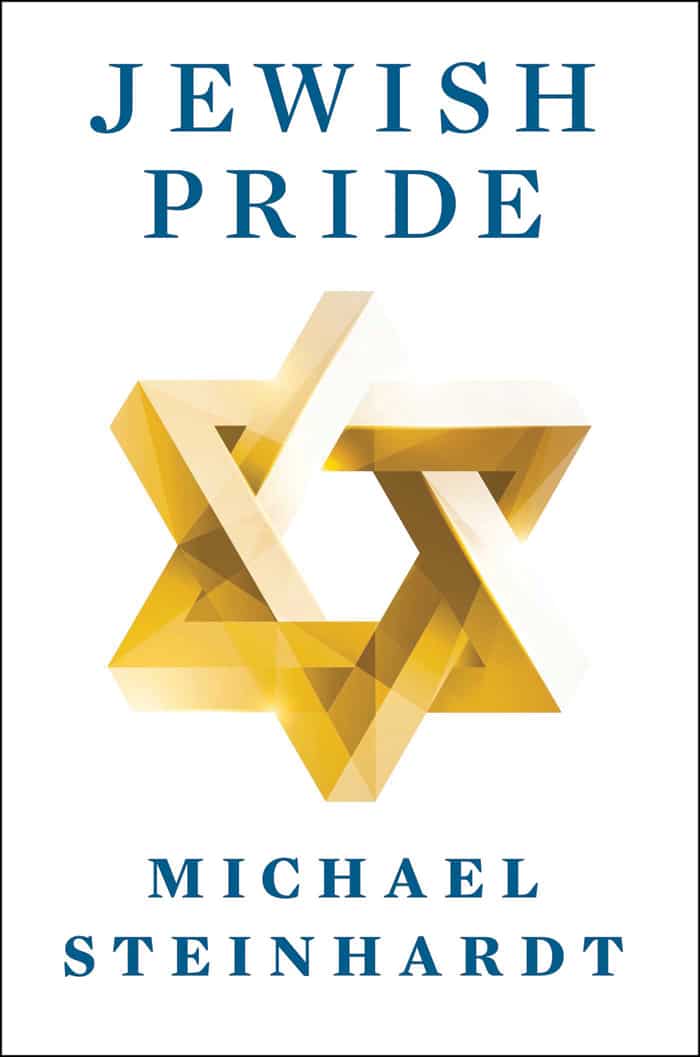
My relationship with Judaism mirrored other aspects of Steinhardt’s new book: “Jewish Pride.” When I moved to New York City, I, too, connected with the piercingly soulful music of B’nai Jeshurun Synagogue. I, too, have been disappointed by the mainstream Jewish establishment’s inability to process — to even understand — new ideas. When I tried to get funding for an international “Passage to Israel” exhibition that would show the inherent beauty and diversity of Israel I was met with mostly indifference.
“Our community has been, for decades, stuck in a kind of malaise,” writes Steinhardt. “On the whole, we are not fired up. We are not in love. We are not, as a community, showing courage or creativity or heroism. If anything, the opposite is true.
“Our community has been, for decades, stuck in a kind of malaise,” writes Steinhardt. “On the whole, we are not fired up. We are not in love. We are not, as a community, showing courage or creativity or heroism. If anything, the opposite is true. Every year, more and more young Jews seem to drift away …. [Our] sense of Jewish purpose seems to be dissipating.” The past month of incessant hate from all sides only underscores the problem. We can’t fight antisemitism if we don’t know who we are — and are not proud of it.
But that’s not the main issue for Steinhardt: “The real threat to Jewish survival is from assimilation.”
What’s noteworthy about the new book, part memoir, part manifesto, is Steinhardt’s unabashed honesty. In a world where status and partisanship play outsized roles, Steinhardt candidly states the hard truths: “It’s unfortunate that so many Jews require non-Jewish validation … but that’s the reality today.”
Steinhardt was born in 1940 in the Bensonhurst neighborhood of Brooklyn. “The New York I grew up in was filled with immigrant Jews who had a sense that you didn’t have to be embarrassed about your Jewishness to succeed … ‘Being Jewish’ in Bensonhurst was not a problem. We knew who we were, and we were proud of it.” As a result, “immigrant neighborhoods like Bensonhurst were much more of a mosaic than a melting pot.”
Steinhardt blames the Jewish non-profit world for the problem of over-assimilation. “[M]any major Jewish institutions … seem to care more about raising money than making your Jewish life rich, inspiring, and important.” Our institutions and leaders “failed to provide what you, as a Jew, truly deserve: a core of knowledge, personal heroic examples, a powerful bond to the Jewish people … and a sense of the incomparable joy of being Jewish.”
There were two opposing forces, writes Steinhardt. “One force, born of the fear of persecution and social rejection that we had faced for centuries, pushed Jews to downplay their ethnic heritage and minimize their difference.” The second force “encouraged secular Jews to embrace our uniqueness and wear it with pride.”
Unfortunately, the first force largely won.
“Jewish pride, once you’ve tapped into it, is an incredible thing. It’s invigorating, it’s life-changing, and it’s beautiful. But if you cut off the oxygen to pride, it withers.”
“Our most burning problem is spiritual: the strengthening of Jewish identity through the inculcation of pride,” writes Steinhardt. “Jewish pride, once you’ve tapped into it, is an incredible thing. It’s invigorating, it’s life-changing, and it’s beautiful. But if you cut off the oxygen to pride, it withers.”
“I know we have many of the tools we need to solve [the problem],” writes Steinhardt. “But do we have the courage?”
Steinhardt believes there are three elements of Jewish pride: a sense of peoplehood, the spirit of Zionism, and an understanding of Jewish “excellence.” “The first step is acknowledging that you are part of a people,” he writes. “Something special and distinct, with its own history. A unique tribe, a team, a nation.”
When I wrote a piece for the Journal on Judean ethnicity a few years ago and discovered the wealth of evidence that supports the “peoplehood” argument — the fact that Judaism is more than a religion — I kept thinking: Why hadn’t our synagogues and other Jewish institutions taught us this? Embodied in our Judean ethnicity is our indigeneity to the land of Israel. How differently would the last few decades have played out — especially on college campuses — if our synagogues had taught us these compelling and irrefutable facts?
For Steinhardt, who grew up in a traditional home but early in life became an atheist, the ethnicity truth was self-explanatory: “My overall attachment to being Jewish … is a thoroughly secular pride in being Jewish.” (Steinhardt does admit to having a “soft spot” for Orthodox leaders. “I sense in them an unabashed pride and joy in being Jewish that resonate strongly with me.”) While researching the piece, I had the same next logical question as Steinhardt: Why hadn’t we been taught conversational Hebrew? “Can you imagine how different things would be if a significant portion of non-Orthodox American Jews were fluent in Modern Hebrew? …. The case for Hebrew as a gateway to Jewish identity has always been obvious to me.” But instead, for many Jewish Americans, Judaism was reduced to a misunderstood notion of “tikkun olam.” It became merely a political tool to a supposed “more illustrious” assimilation. “Judaism itself became, at least for many secular Jews, almost entirely subordinate to the progressive school of politics,” writes Steinhardt.

“Jewish identity, while it contains universalist elements, is not itself a universal value. It is rather the specific identity of a particular people in history,” he explains. “By emphasizing only what we may give to others distracts us from what we owe ourselves.” Steinhardt believes that modern Hebrew is the best road to fully understanding and embracing our ethnicity — our peoplehood. “There will be many unengaged Jews for whom this can be a point of entry into a more powerful Jewish identity,” he writes.
Countless times I’ve heard secular Jews say that when they hear or see Hebrew unexpectedly, it hits them in a visceral way they can’t explain. A mini-version, perhaps, of Elie Wiesel’s insight: “When a Jew visits Jerusalem for the first time, it is not the first time, it is a homecoming.”
“What if American Jews embraced Hebrew as a living part of their Jewish lives, even writing Hebrew songs and producing Hebrew-language movies?” asks Steinhardt. “We can imagine Hebrew becoming a living language for Jews everywhere, in which we as a global people can talk and create and develop together.” And then there’s the crucial added benefit: “Today there is probably no greater single tool for building understanding and sympathy for Israel — among Jews and non-Jews alike — than fostering widespread fluency in Modern Hebrew.”
For Steinhardt, though, perhaps the most important reason for learning modern Hebrew is that “the spirit of Zionism is hard to translate into English.” The “spirit of Zionism” — which Steinhardt describes as an “inner strength and vibrancy, a confident boldness” — has inspired Steinhardt since he first worked on a kibbutz after college. “Throughout the years of my youth, I internalized the new state’s successes, its failures, and its fears as if they were my own.”
Indeed, the notion of peoplehood is already being fully played out in our homeland. Diasporan Jews only have to look at our Israeli brothers and sisters as role models.
“Israel, I began to realize, was nothing less than a living Jewish ideal: intense, proud, joyful, comprehensive, and full of fire. The contrast with Jewish communal life in America could not have been more striking.”
“Israel, I began to realize, was nothing less than a living Jewish ideal: intense, proud, joyful, comprehensive, and full of fire. The contrast with Jewish communal life in America could not have been more striking.” “Being Jewish was an act of defiance,” he writes. “Zionists … were all about taking this ancient truth and moving it forward.”
Steinhardt became mesmerized with Israelis in his early 20s. “Israelis knew how to dance and sing and celebrate life with an intensity I had not seen outside the Orthodox community of Bensonhurst. They possessed a powerful spirit that hid nothing and apologized to no one.”
Steinhardt saw his mission as “translating the deep, distilled Jewish spirit I had encountered in Israel” and making it come alive in the Diaspora. As such, Jews will never again feel a need to apologize for who we are. “We have always been a bit edgy. The Bible was a revolutionary book that changed the world.”
After the Holocaust, Jewish achievements were infused with a spiritual meaning for many. Indeed, Steinhardt had found much of the Zionist spirit in Bensonhurst, which had become a haven for Holocaust survivors. “When I was growing up, we knew we were Jewish … and we took pride in the achievements” of Jewish heroes. “We took pride in their accomplishments. And in a way, their accomplishments were our own.” He continues: “We didn’t question our connection to, and responsibility for, each other. We were aware of a certain kind of Jewish excellence, and we were not ashamed to say so.” “Today, it seems we take Jewish achievements for granted, and we often don’t feel like we are a part of them. … As a result, “we cut off the oxygen that fuels our pride.”
For Steinhardt, our “’secret sauce’ of spiritual and intellectual excellence” has little to do with our DNA. Rather it is “inextricable” from our upbringing, culture and identity as Jews. “We Jews had one huge advantage over other groups … Our parents taught us to care about doing well in school.” The “unwritten commandment that even the poorest Jews held sacred: Do thy homework.” Today, Steinhardt believes, we lack Jewish heroes. We lack Jews in every field who proudly make their Judaism part of their achievement. “Without a distinct sense of Jewish heroism,” writes Steinhardt, “there can be no Jewish pride.”
Steinhardt does not mince words when discussing the failure of Jewish institutions to both support and inspire the Jewish community, to help inculcate Jewish pride as the antidote to assimilation.
Steinhardt does not mince words when discussing the failure of Jewish institutions to both support and inspire the Jewish community, to help inculcate Jewish pride as the antidote to assimilation. For example:
With nearly everything he tried to initiate as an entrepreneurial philanthropist, there was major pushback from the establishment groups. Nevertheless, Steinhardt managed to create, with the help of partners, stellar programs like Birthright and OneTable; build 60 new Jewish day schools; and found a network of Hebrew language charter schools. “My first focus was on formal Jewish education, which was supposed to infuse our children with the core knowledge of who we are, what we have been through, and what we have achieved.”
Since the launch of Birthright at the end of 1999, more than 600,000 young Jews from across the Diaspora have been able to experience an intense, and free, ten-day trip to Israel. “A trip to Israel at a young age can have a powerful impact on the trajectory of one’s entire life,” as it had on his own. But even Birthright was met with disapproval from some of the establishment organizations.
Steinhardt, often in partnership with Charles Bronfman, tried to apply his business acumen to how these programs and groups functioned. Most especially, he tried to change how programs were evaluated: They should be based on impact, not donations. “The failure of the establishment to preserve Jewish pride from one generation to the next was rooted in an unaccountable system,” he writes.
A metaphor running through the book is the American Jewish obsession with planting trees in Israel as though its survival depended upon it. “If you ask any Israeli: Over the generations, what were the most acute needs facing the Zionist enterprise in the Land of Israel? You’ll discover that the absence of trees was always very low on the list.”
The underlying theme of the book is that the inculcation of Jewish pride begins in the home. Since my son was an infant, I’ve called him my “little Maccabee,” read him stories of biblical heroes, and watched “The Ten Commandments” about 10,000 times. His favorite character was Joshua—he was mesmerized by his confidence and courage. I began to use the phrase: “Use your strength for good.” I didn’t fully realize at the time how important this early cultivation would become. For lack of better alternatives, I ended up sending him to a synagogue that lacked the warmth I remember in my childhood. While I never directly encountered antisemitism growing up, he’s had to deal with various encounters that I still find breathtaking in New York City.
When he was five years old, one boy bluntly told him: “I don’t like Jews.” At six, he defended the Jewish people from accusations of killing Christ in his elementary school cafeteria. As he got older, I began to teach him about Israel’s foes, thinking I was preparing him for college. But last year, when he was in 7th grade, a current events discussion turned to Israel and Hamas — with the teacher defending Hamas. He stood up, offered the class ten minutes of facts, and then sat down. Apparently, no one said anything afterward.
Steinhardt stresses at every turn that the rebellion of Jewish pride must begin in the home because we can’t count on even our synagogues or schools to inculcate this pride.
Steinhardt stresses at every turn that the rebellion of Jewish pride must begin in the home because we can’t count on even our synagogues or schools to inculcate this pride. I couldn’t agree more, but I also think that Gen Z has an instinctive sense of real justice that is easier to build upon.
When the Kanye and Kyrie Irving incidents erupted, young Jewish leaders like Rudy Rochman, Noah Shufutinsky and Yirmiyahu Danzig were quick to chastise in innovative ways. Kosha Dillz created a mocking rap video called “Death Con 3 {Ye Diss},” which included the now iconic line: “I’m a naysayer and a Maccabee.” Irving was one of my son’s heroes. It was a difficult conversation explaining to him who the “Black Hebrew Israelites” believe they are and what is their particular brand of antisemitism. But much to my surprise, his initial reaction was similar to mine: “I thought they hate us; now they want to be us?” Sadly, some of his Jewish friends don’t have a feeling of “us.” But because I started early, it’s as natural to him as his love of basketball.
For Steinhardt, Jewish pride is the opposite of assimilation: We are who we are.
For Steinhardt, Jewish pride is the opposite of assimilation: We are who we are. If you don’t like us, that’s your problem; we don’t care what others think. We have been connected as a people for thousands of years. Indeed, our connection has been the ultimate act of non-conformity: continuing our traditions while enduring every possible type of persecution. As a result, an instinctive non-conformity is inextricably bound to the term “Jewish people.”
Between Steinhardt’s book, Ben Freeman’s new book “Jewish Pride: Rebuilding a People,” and the swift and searing reaction to Kanye and Kyrie, I think we can say that a “pride” rebellion has unofficially begun. And it is precisely this rebellion that agitates Jew haters.
We’re Jews, Maccabees, fearless non-conformists. We have a long history of people trying to tell us what shouldn’t upset us. But now, strengthened by our Israeli brothers and sisters, we can politely tell the haters to stay in their lane. We can hope that our rebellion — our identity as a proud ethnicity — will only get stronger. As Matisyahu so aptly put it: Our “strength comes not from man at all.”
Karen Lehrman Bloch is editor in chief of White Rose Magazine.
The Rebellion of Jewish Pride Read More »