fbpx

November 17, 2022

Q and A with Rabbi Steven Weil, CEO of Friends of the Israel Defense Forces

Over the course of a Scholar-in-Residence weekend in Los Angeles on Nov. 4 thru 6, Rabbi Steven Weil, CEO of Friends of the Israel Defense Forces (FIDF), spoke at a number of events in synagogues and private residences to explain why the organization is such an intrinsic part of the fabric of the State of Israel and the Jewish people.

Rabbi Weil is no stranger to Los Angeles. He served for nine years as senior rabbi at Beth Jacob Congregation in Beverly Hills. Then, for 11 years he was Managing Director of the Orthodox Union (OU) before assuming his current position two years ago.

Rabbi Weil’s appearances were supported by three members of the IDF — Second Lieutenant Yosef, Captain Tal and Captain Guy (last names are left off on purpose). The soldiers visited Jewish day schools on the Friday before Shabbat and also appeared where Rabbi Weil spoke.

(L-R) Captain Guy, Captain Tal, Second Lieutenant Yosef

Yosef told a gathering on Saturday evening how he grew up in a small religious community that faced antisemitism. “After making Aliya alone at the age of 14 and finishing high school in Israel, I decided to join the IDF as a combat Lone Soldier,” he said. He currently is assigned to the Kedem Battalion of the Home Front Command’s Search and Rescue brigade to protect the settlements in the Judea and Samaria region.

Tal is a Machine Officer in the IDF’s 3rd Missile Ship Fleet, the elite unit of Shayetet 3. Guy has been in the IDF since 1999 and serves as the Israeli Naval Attaché to Washington D.C.

The Journal spoke with Rabbi Weil about his work leading the FIDF, the importance of the organization and the role it plays in solidifying a country composed of people from 70 countries with diverse backgrounds.

Journal: You’ve been a pulpit rabbi, head of a major Jewish organization and now CEO of the FIDF. How do you compare the three jobs?

Weil: When you’re a pulpit rabbi, you’re on the frontlines. When you’re running the OU or the FIDF your job is to support those on the frontlines. In the case of the FIDF our job is to support the soldiers as well as veterans and their families through various programs.

Journal: For those who are unfamiliar, please clarify the mission of the FIDF.

Weil: The FIDF mission is to transform their the lives of those who have served in the IDF through educational, financial, well-being, and cultural initiatives. Every day, the young men and women of the IDF put their lives on the line to protect the Jewish homeland. The FIDF provides these courageous young men and women with a better everyday life and brighter future. What we don’t do is raise money for weapons or military equipment, that’s an unfortunate misconception. The FIDF exists strictly to provide services for those who serve and have served in the IDF.

Journal: As someone with an MBA from NYU, financial analysis is something you are very familiar with, how does Israel’s military spending compare with other countries, which leads to the need for an organization such as the FIDF.

Weil: It’s quite unbelievable. The average country spends about 2 to 3 percent of their GDP on the military. By contrast, Israel spends 14.9% of its GDP on defense. One of the greatest miracles in Jewish history is that Israel exists while having to spend so much on defense. That’s why it’s our responsibility as American Jews to look after those who are serving and so they can have a full life after they have given so much of their youth and innocence to the defense of Israel.

Journal: What are greatest defense challenges Israel faces today as opposed to the 1967 and 1973 wars?

Weil: It’s very different today. The whole enterprise of war has changed. Not long ago it was whoever controls the air controls the war. Today, it’s whoever controls cyber controls the battle. Cyber is two things. First, it’s cyber defense. Today, every day, in Israel there are over 1,000 cyber attacks. Attacks on the banking system, the water system, the electric grid, defense ministries and so forth. Many of those sophisticated attacks are coming from Iran, from the Shia. Traditionally, the best and brightest in the IDF served in the Air Force and become pilots and paratroopers. What you see today in Israel is the best and brightest, many of which are women, are the ones who are defending Israel as cyber experts. And God forbid if we have to go on the offensive militarily, cyber will be leading the way.

Journal: How has Covid impacted the role of the Israeli army?

Weil: The last three quarantines have devastated the Israeli economy. Unemployment has skyrocketed. At the height of Covid, the army was in every town and village giving out pharmaceuticals, delivering food to the needy. These young people were going to the grocery store for the elderly and anyone who couldn’t get there themselves because of the pandemic. And it was not only Jewish communities. IDF soldiers did the same in Arab villages, bringing them food and supplies during the quarantine. There weren’t enough soldiers to do all this work so they called up IDF divisions from all parts of the country to help. It really unified the country.

Journal: We hear about the Lone Soldier. Define that term and how is the FIDF involved in this issue?

Weil: There are soldiers in the IDF who don’t have family in Israel. There is nobody cooking for them when they leave the base on a weekend. Nobody to help do their laundry, make them a Shabbat dinner, get them pharmaceuticals. So to help what has become known as the “Lone Soldier” with a sense of home, we rent apartments all over Israel and put in refrigerators stocked with food. We supply kitchens and laundry facilities. We also are now building a $17 million, six story facility to give soldiers a ‘home away from home.’

Journal: To summarize, what makes the IDF different from other militaries?

Weil: The IDF instills in these young people the love of life. Statistically, Israel has among the lowest level of collateral damage of any country involved in warfare. For the last two Gaza wars, the collateral damage was two civilians to one combatant. And we’re talking about asymmetric warfare (a war where one side is not identified in military uniform). It’s unheard of. That’s why it is such vile nonsense what the ICC (International Criminal Courts) and the United Nations Human Rights Council are doing with their war crime investigations and attacks on Israel.

Last, it’s important to know that the IDF nurtures its children. Unlike other armies where so many veterans emerge with PTSD and then deal with their psychological scars, the IDF places psychologists with military groups so they don’t emerge broken when they re-enter civilian life. The IDF wants those who gave their youth and their innocence to the country to live normal, healthy lives. The IDF wants them to go on to have functional families so they can continue to build the country for the next generation. They give so much to Israel and the Jewish people, the least we can do is support them and assure they have decent, fulfilling lives.

Q and A with Rabbi Steven Weil, CEO of Friends of the Israel Defense Forces Read More »
YU Announces $15 Million Gift To Launch Perlmutter Center for Legal Justice

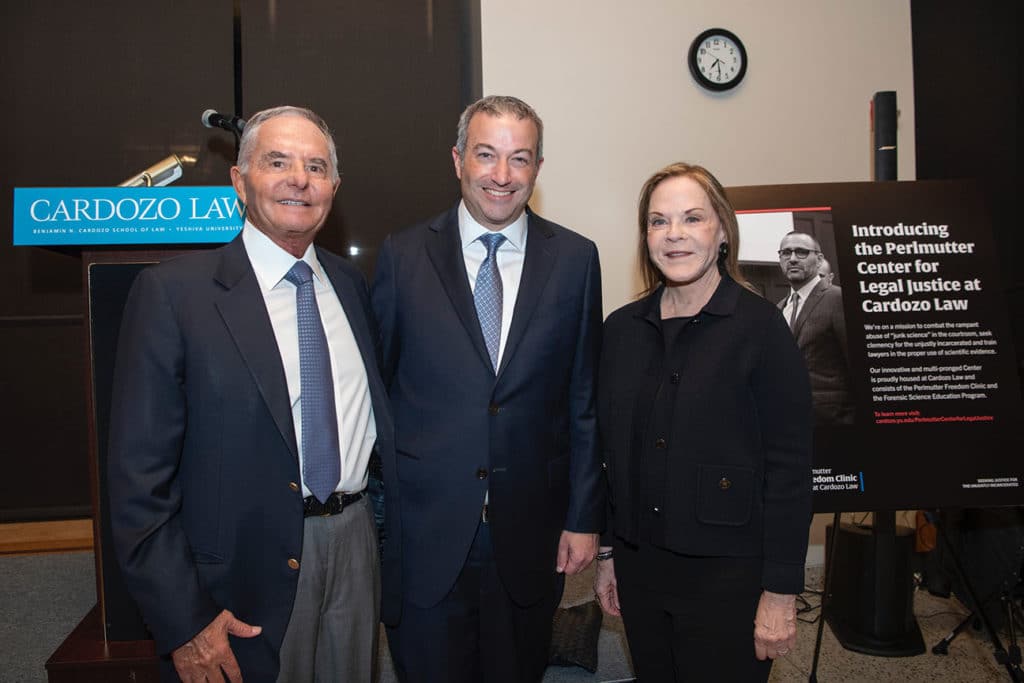
Yeshiva University (YU), together with the Cardozo School of Law, will create The Perlmutter Center for Legal Justice at Cardozo Law supported by a $15 million gift from Isaac and Laura Permutter and the Permutter Foundation, it was announced by Rabbi Dr. Ari Berman, president of YU and Melanie Leslie, Cardozo Law dean.

The donation is the largest in the law school’s history and a major contributor to the university’s Rise Up fundraising campaign.

In a statement, YU said the Center will: “train lawyers to prevent the use of junk science in court cases, fight wrongful convictions and obtain clemency for the unjustly incarcerated. It will focus on correcting the devastating consequences of junk science in the courtroom, a problem that is prevalent in the legal system and disproportionately impacts people of color.”

“We are tremendously grateful to Laura and Ike Perlmutter for this gift,” Berman said. “It builds on Cardozo’s proud tradition of innovation in the fight for justice, and it reaffirms Yeshiva’s core values of truth, compassion and redemption, among others.”

The Center will be led by civil rights attorney and criminal justice reform advocate Josh Dubin, who will serve as executive director. Derrick Hamilton, a formerly incarcerated individual who studied law in prison, will serve as deputy director.

“We are committed to seeking justice, equipping students and lawyers with the tools to confront junk science, and seeking clemency for those unjustly imprisoned,” Dubin said.

“It is essential that trial lawyers have a deep understanding of scientific evidence. The acceptance of and reliance on junk science has caused untold damage to the legitimacy of the court system and countless lives. The Perlmutters’ generous gift, and the new team at the Perlmutter Center for Legal Justice, will enable Cardozo to train generations of lawyers in the proper use of forensic science,” Leslie added.


According to the statement, the Center will have two components. The first will be a student field clinic called The Perlmutter Freedom Clinic at Cardozo Law that will focus on fighting wrongful convictions based on the misuse of scientific evidence and work to obtain clemency for individuals unjustly incarcerated. The second will be The Perlmutter Forensic Science Education Program and will feature a continuing legal education curriculum in scientific evidence designed for practicing attorneys.

The Laura and Isaac Perlmutter Foundation focuses on health care, social justice, the arts and community initiatives. For nearly 40 years, the Foundation and its founders, Laura and Isaac “Ike” Perlmutter, have supported a diverse spectrum of causes, from donations to NYU Langone Medical Center to support cancer research to universities, cultural centers and first-responder organizations

As part of Yeshiva University, Cardozo School of Law specializes on teaching intellectual property law, alternative dispute resolution, public interest law, criminal justice and clinical education.

YU Announces $15 Million Gift To Launch Perlmutter Center for Legal Justice Read More »

The Entire Thing – A poem for Parsha Chayei Sara

And she said to the servant, “Who is that man walking in the field towards us?”…And Isaac brought her to the tent of Sarah his mother, and he took Rebecca, and she became his wife, and he loved her.
-Genesis 24:65 and 24:67

Isaac marries Rebecca three sentences after
meeting her for the first time, and as we say in
our current vernacular – in the very same scene.

This is how it was when I met my wife who,
of course, was not my wife at the time but
it was inevitable like scripture.

It may have taken a few paragraphs and,
possibly, a trip to the tents of Kansas City
to confirm what we already knew

despite the cautiousness of everyone
who knew us. We’re eighteen years into
this situation, unless you’re reading this poem

in the future, in which case you’ll need to
do some addition because I’m quite sure
we’re still a thing.

Isaac and Rebecca had two kids who fought
in the womb (if you don’t mind me jumping ahead)
which may be why we only had the one.

He’s already traipsing around the southland
holding the hand of the one he regards to be
his Rebecca. Words like soulmate are

falling out of his thirteen year old mouth like
we’re still living in Biblical times. We hope
they avoid the Egypt situation altogether.

If you’re wondering about the meaning of life,
my friends, find your Rebecca or your Isaac.
Don’t let three sentences go by before

you acknowledge what is happening.
The money may come and go. Whose hand
you’re holding when you spend it

is the entire thing.


God Wrestler: a poem for every Torah Portion by Rick LupertLos Angeles poet Rick Lupert created the Poetry Super Highway (an online publication and resource for poets), and hosted the Cobalt Cafe weekly poetry reading for almost 21 years. He’s authored 26 collections of poetry, including “God Wrestler: A Poem for Every Torah Portion“, “I’m a Jew, Are You” (Jewish themed poems) and “Feeding Holy Cats” (Poetry written while a staff member on the first Birthright Israel trip), and most recently “I Am Not Writing a Book of Poems in Hawaii” (Poems written in Hawaii – Ain’t Got No Press, August 2022) and edited the anthologies “Ekphrastia Gone Wild”, “A Poet’s Haggadah”, and “The Night Goes on All Night.” He writes the daily web comic “Cat and Banana” with fellow Los Angeles poet Brendan Constantine. He’s widely published and reads his poetry wherever they let him.

The Entire Thing – A poem for Parsha Chayei Sara Read More »

Beth Am Weekend, Rabbi Family Runs Marathon, Wise Groundbreaking

On Nov. 13, Stephen Wise Temple and Schools celebrated the start of a new era by breaking ground on the transformational Aaron Milken Center for Early Childhood Education. 

Senior Rabbi Yoshi Zweiback, Head of School Tami Weiser, Aaron Milken Center Director Keri Loventhal, Lowell Milken Family Foundation Chairman and Cofounder Lowell Milken, donors, community leaders, and distinguished guests gathered together to mark the historic occasion.

Additional guests included temple president Steve Bram and building committee chair Leandro Tyberg. 

Wise School Head of School Tami Weiser is joined by young Wise learners at the groundbreaking for the Aaron Milken Center for Early Childhood Education. Courtesy Stephen Wise Temple/Stephanie Kleinman

When it opens in the fall of 2024, the state-of-the-art center will be a nurturing space for Wise’s youngest students and their families to gather, learn, and discover, embodying Wise founder Rabbi Isaiah Zeldin’s dream of providing lifelong Jewish education to all those who seek it. Aaron Milken Center will also serve as a living tribute to the late son of lead donors Lowell Milken and Sandra Salka Milken.

“It is our hope that the Aaron Milken Center will not only perpetuate Aaron’s memory but enliven it,” Lowell Milken said. “With this new campus, we will build on the program that he and so many children have benefitted from, while expanding it physically, conceptually, and professionally. We see the Center contributing tangibly to our heritage and experience as a Jewish community, benefiting Stephen Wise Temple — an institution dear to our hearts — while reaching meaningfully and innovatively toward the future.”

Designed by Abramson Architects, the 20,000-square-foot educational village on Wise’s mountaintop campus will feature a unique mix of indoor and outdoor spaces to facilitate learning and play, along with specialist areas, including an art studio, learning kitchen, music room, and tinkering space.

The construction of the $30 million center will help ensure Wise’s continued role as an international leader in Jewish early childhood education, according to a Stephen Wise Temple statement.


Stephen Wise Temple Rabbi Yoshi Zweiback, his wife Jacqueline Hantgan and their three daughters. Courtesy of Stephen Wise Temple

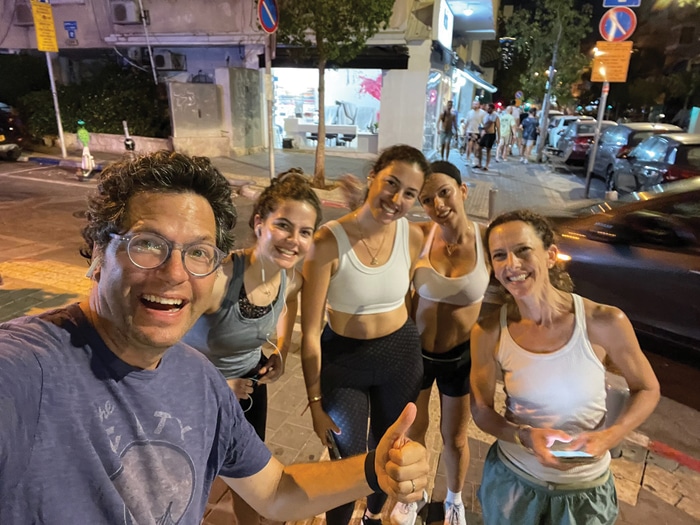
Stephen Wise Temple Senior Rabbi Yoshi Zweiback and his entire nuclear family ran in the New York City Marathon together on Nov. 6 to raise money for paralysis research, running for the Christopher and Dana Reeve Foundation. 

The family ran in memory of Rabbi Zweiback’s father-in-law, Henry Hantgan, who was confined to a wheelchair for the last 10 years of his life. Running as part of Team Handsome Hank, their hope was to raise awareness about the amazing work the foundation is doing related to spinal cord injuries and other neurological disorders. 

Zweiback leads one of the largest Reform congregations in the country. In a recent interview with the Forward, the rabbi said training for the marathon brought the family closer together.  


Temple Beth Am Weekend Steering Committee. From left, front: Tal Link, Teri Cohan Link, Danielle Berrin, Dorit Rabinyan and Rabbi Rebecca Schatz. From left, back: David Myers, Eddie Levine, Joel Grossman, Rabbi Adam Kligfeld and Ethan Pack. Courtesy of Beth Am

Temple Beth Am’s inaugural Baruch Link Scholar in Residence Program was a resounding success. Guests came from throughout Los Angeles, and from as far as Israel and Canada to join in an inspiring Shabbaton.

The weekend—held Oct. 28-30—featured the acclaimed Israeli author Dorit Rabinyan.

Beth Am Weekend, Rabbi Family Runs Marathon, Wise Groundbreaking Read More »

How to Kosher Your Thanksgiving

If you want to kosher your Thanksgiving, you have two choices. Eat vegetarian, or keep your sides and desserts parve. Whichever option you choose, the Jewish Journal has you covered.

Danny Corsun, founder of the Culinary Judaics Academy (CJA), loves Thanksgiving, because he feels it’s an inherently Jewish holiday. First, he explained, its birth comes from the Puritans borrowing from Sukkot, which is a harvest holiday.

”Secondly, Thanksgiving revolves around and celebrates family,” Corsun told the Journal. “And what’s more inherently Jewish than that?” 

Also important to us is giving thanks. 

“As Jews, we don’t only give thanks one day per year, we do so multiple times [every] day,” he said. “For us, it’s Thanksgiving every day of the year!” 

Celebrate the flavors of fall by adding CJA’s delicious dairy Pumpkin Spice Cranberry Scones to your vegetarian Thanksgiving menu.

Pumpkin Spice Cranberry Scones

2 ½ cups all-purpose flour, plus 1-2 tsp for
flouring work surface
¼ cup brown sugar
2 tsp baking powder
½ tsp baking soda
¼ tsp salt
½ tsp cinnamon
¼ tsp nutmeg
6 tbsp cold unsalted butter, cut into
1/4-inch cubes
½ cup canned pumpkin
1 cup dried cranberries
½ cup plain Greek Yogurt (or sour cream)
1 tsp vanilla
¼ cup cold milk
1 tbsp white sugar (for sprinkling on top)

  1. Preheat the oven to 425°F. In a medium bowl, stir together the flour, sugar, baking powder, salt, cinnamon, nutmeg and baking soda.
  2. Add butter, and using hands or a fork, work until mixture resembles coarse crumbs.
  3. Add pumpkin, vanilla and yogurt (or sour cream) to the milk and mix. Gently stir into dry ingredients.
  4. Do not over mix. If the dough is too wet, you can add more flour.
  5. Turn dough onto a floured surface and with floured hands, knead 2 to 3 times, until the dough is smooth and shiny. Pat the dough into a circle that is about 8 inches round and about 1 1/2 inches thick. Cut the circle in half, and then cut each half into 4 pie-shaped wedges (triangles).
  6. Arrange wedges on a parchment-paper-covered cookie sheet. Sprinkle each wedge with a little white sugar.
  7. Bake until golden, about 12 to 15 minutes. Remove the wire rack to cool. You can also use a griddle to cook these scones if you don’t have an oven – just cook until golden and then flip to do the same on the other side.
  8. Once cooled, serve with milk or tea.

Note: CJA is making this recipe at their complementary Cook & Learn Workshop on November 20th at 4:30pm PST. https://www.culinaryjudaicsacademy.com/communityhub


Cranberry Sauce
Jeff Frymer

Chef Jeff Frymer feels a bit conflicted about “celebrating” Thanksgiving, “given the nature of its origin, as compared to the story my naive, younger self was taught,” he told the Journal. “That said, Thanksgiving is a family tradition and an intensive familial cooking experience.”

For Frymer’s family, a kosher Thanksgiving means leaving out the dairy.

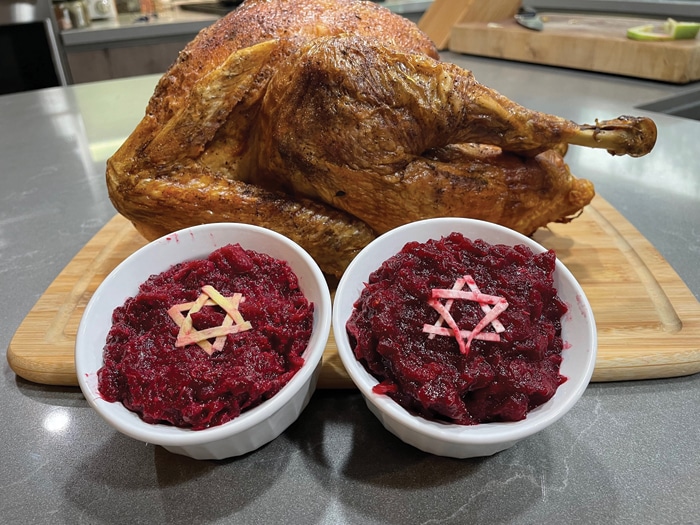
Staying on theme, he created a tale of two cranberry sauce recipes — one semi-sweet, the other with an aromatic bite.

Semi-Sweet Cranberry Sauce

1 Granny Smith apple, peeled, cored,
finely diced
1 tbsp peeled and grated fresh ginger
2 tbsp finely chopped candied ginger
3 tbsp honey
1/2 cup red wine

Toss all ingredients into a sauce pan and cook on medium-low heat, uncovered for about 15 to 20 minutes, stirring occasionally. The cranberries will begin to burst as they cook. In the last couple minutes smash ‘em up, stir a final time … that’s it.

The Bite Cranberry Sauce

3/4 cup peeled and finely grated fresh
horseradish
12 oz fresh cranberries
3 tbsp honey
1/2 cup red wine
1 tbsp prepared wasabi (or make from
scratch)
1 tbsp white or apple-cider vinegar
2 tbsp water
1/4 tsp salt

Part 1: Caveat up front: Preparing fresh horseradish may irritate your eyes in a similar way as chopping onions. Peel and roughly chop about a cup of horseradish chunks. Grate in a food processor or blender. Add water, vinegar, and salt during the process. You’ll have to start and stop a few times to scrape the sides back down. It should yield about 3/4 cup finely grated horseradish.

Part 2: Toss all ingredients into a sauce pan and cook on medium-low heat, uncovered for about 15 to 20 minutes, stirring occasionally. The cranberries will begin to burst as they cook. In the last couple minutes smash ‘em up, stir a final time … that’s it.

“Now, I know what some of you are saying, ‘Horseradish? That’s for meat, not turkey,’” Frymer said. “In my house horseradish is for everything. At least give it a try.”


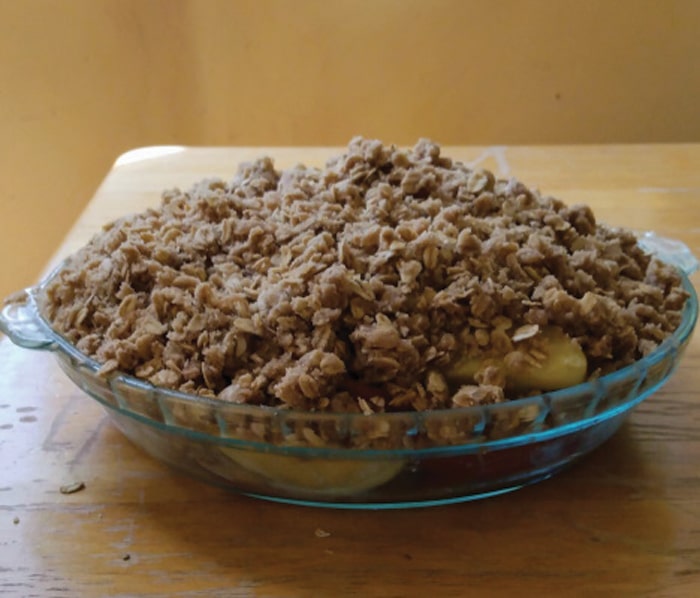
Apple Crisp @kitchngiggles

Culinary and nutrition educator Yael Friedman said dessert for a kosher Thanksgiving is hard, because, if you’re going to do turkey, you need to avoid using dairy in dessert.

“It’s really hard to find a good, non-dairy alternative to milk, butter and cream,” Friedman, founder of Kitch’N Giggles meal kits, told the Journal. 

When Friedman does non-dairy desserts, she likes to use canola oil, instead of margarine or other highly processed dairy substitutes. 

“This apple crisp is a great activity for families to make together,” she said. “Because holidays are a time for creating memories, baking a simple, fruit-based dessert is a wonderful way to come together as a family.”

Apple Crisp Recipe

4 apples, peeled and sliced
1/4 cup sugar
2 tsp cornstarch
1 tsp lemon juice
3/4 cup all-purpose flour
3/4 cup rolled oats (not instant)
1/4 tsp ginger
1/2 tsp cinnamon
1/2 cup brown sugar
1/3 cup canola oil

  1. Preheat the oven to 400°F.
  2. In a medium bowl, combine the apples, sugar, cornstarch and lemon juice. Set aside to macerate for a few minutes.
  3. In a large bowl, mix the flour, oats, spices and brown sugar together until combined. Slowly add the canola oil, mixing well until the topping clumps together.
  4. Pour the apples into the bottom of a 9 inch pie pan and top with the crumble topping. Bake for 30 minutes, until golden brown and bubbly.

Michael Tanenbaum’s Pumpkin Sweet Potato Pie is perfect for this season and the holiday. “It’s very rustic with a homemade crust of nuts and dates!” Tanenbaum, who is founder of the website Consciously Kosher, told the Journal.

“For many people, Thanksgiving is synonymous with carbohydrate and sugar overload,” he said. “I like this recipe because it provides a nutrient-dense, lower-sugar alternative to the typical heavily-processed holiday season desserts.”

This recipe takes about 25 minutes to prep and 1 hour to bake. Tanenbaum recommends chilling it 2 to 4 hours or overnight, prior to serving.

Pumpkin Sweet Potato Pie
Michael Tanenbaum

Pumpkin Sweet Potato Pie

The Rustic Crust:
1½ cups walnuts
1 cup pecans
1 cup dates, pitted
The Earthy Filling:
2 cups mashed cooked pumpkin
1 cup mashed cooked sweet potato
4½ tsp arrowroot
1 tbsp ground cinnamon
½ tbsp ground turmeric
2 large eggs
½ cup raw honey
½ cup coconut oil (organic, cold-pressed
and unrefined)
¼ cup water
1 tbsp vanilla extract

What’s Needed:
Large stainless steel pot for cooking the
pumpkin and sweet potato
Two large mixing bowls: one for the wet
and one for the dry ingredients
Food processor for mixing the crust
Blender for the filling (optional)
Glass/borosilicate pie pan (8.5 to 9.5
inches diameter)

The Crust:

  1. Preheat the oven to 350°F.
  2. Pit the dates.
  3. Pour the walnuts, pecans and dates into a food processor.
  4. Run the food processor for 40-45 seconds, stopping occasionally to stir the mixture so that it is evenly ground. Remove when the mixture is sticky enough between two fingers to hold together but not too finely ground.
  5. Pour the mixture into a glass pie pan, smoothing it out as uniformly as possible with a spoon or spatula so that the crust is about 1/8 inch thick.
  6. Cover the edges of the pie pan with aluminum foil: take a square piece of foil, fold into quarters and cut an arc from one of the sides with the folded edges to the other; then open and place around the edges of the crust.
  7. Bake at 350°F for 15-20 minutes, then remove foil and cool.

The Filling:

  1. Chop the pumpkin and sweet potato, then boil in a large pot for 15 minutes over a medium flame (using about 2 cups of water, or as needed). Let cool.
  2. In a large mixing bowl, combine the arrowroot starch, cinnamon and turmeric.
  3. In another large mixing bowl, combine the pumpkin and squash.
  4. Add the remaining wet ingredients (coconut oil, eggs, water and vanilla) to the pumpkin-sweet potato mixture.
  5. Beat the wet ingredients into the dry ones until smooth.
  6. OPTION 1: For an uneven, rustic texture, pour directly into the crust.
    OPTION 2: For a smoother, more refined texture, pour into a blender or food processor and run on high for 15 – 20 seconds. Then pour into the crust.
  7. Bake for 35 – 40 minutes, checking around the 30-minute mark until a knife inserted near the center comes out clean.
  8. Remove, let cool and refrigerate until chilled.

Marion Haberman, Content Creator @MyJewishMommyLife, loves celebrating Thanksgiving.

“There are two types of people at the Thanksgiving meal,” Haberman told the Journal. “Those who enjoy every dish to be eaten separately, one after the other, and those who need every bite to incorporate every flavor. I’m firmly the latter.”

Haberman’s Challah Sausage Stuffing – there’s a recipe combination you don’t hear every day. It’s okay, it’s kosher – is adapted from an original Ina Garten recipe.

“I like to find recipes that incorporate multiple layers of Thanksgiving flavors the way this one does,” she said.

Challah Sausage Stuffing
Marion Haberman

Challah Sausage Stuffing

1 loaf of challah cut into cubes
4 kosher sausages (any flavor, preferably
sweeter not too spicy)
1/4 cup oil
1 diced onion
1 apple chopped
1 tablespoon salt
1 teaspoon pepper
1 cup kosher chicken stock
3/4 cup dried cranberries

Toast challah cubes at 300°F for 7 minutes. Saute onion, apple, salt, pepper and sausage until the vegetables are softened and the sausage is browned (about 10 minutes). Next add in the toasted challah cubes, the stock and finally the cranberries. Mix everything together then bake at 350°F until the top browns, about 30 minutes. If you don’t have an oven safe saute pan transfer to a 9×12 baking dish before baking.

“I appreciate how America is such a beautifully inclusive home for me and my family, and we’re thankful to be here,” Haberman said.

She believes participating in American holidays and traditions is a big part of being part of a community.

“What we focus on becomes our reality, and I pretty much exclusively focus on the good around us and celebrating it, and being thankful for it,” she said. “Football, family, a kosher turkey…that’s what a Jewish family’s Thanksgiving is all about.”

Happy Thanksgiving!

How to Kosher Your Thanksgiving Read More »

Herzl’s Premature Death: “I Always Feel the Future Peering over My Shoulder”

Editor’s note: Excerpted from the new three-volume set, “Theodor Herzl: Zionist Writings,” edited by Gil Troy, the inaugural publication of The Library of the Jewish People, now available at www.theljp.org. This is 11th  in a series.

The Jewish world was devastated by Theodor Herzl’s death in 1904 at the age of 44 – yet surprisingly confident that his legacy would persist.

The playwright Israel Zangwill, who was so committed to the Kenya plan he would bolt from the Zionist movement with his Jewish Territorial Organization, was one of the many devastated optimists. Zangwill reassured mourners in London that “though there will never arise one like unto him, though there is no one with his fiery energy, his magnificent dash, his inspired impatience, yet our cause, as he said at the first Basel Congress, our cause is too great to rest upon an individual. …  Our Congress supplies a Jewish parliament,” Zangwill insisted, “and our Jewish parliament will one day supply a Jewish State.” A shrewd reader of the political tea leaves, Zangwill realized that “Zionism is not buried in the grave of Herzl. Far more likely anti-Zionism will be buried there.” 

Indeed, Herzl’s opponents were quick to eulogize him too. Menachem Ussishkin, still smarting from their clash, said, “Herzl brought the Jews unity and courage. … Those who came before him carried the ideal in their hearts but only whispered about it in the synagogues…. Herzl brought us courage and taught us to place our demands before the whole Jewish world.” And while Ahad Ha’am mourned Herzl’s opponents’ “crocodile tears,” he brilliantly summed up his rival’s pragmatic achievements – and inspirational legacy: “Herzl gave us the Congress, the Organization, the Bank, the National Fund. … But one thing Herzl gave us involuntarily, which is perhaps greater than all he did on purpose. He gave us himself, to be the theme of our Hymn of Revival, a theme which imagination can take and adorn with all the attributes needed to make of him a Hebrew national hero, embodying our national aspirations in their true form.”  

Some rabbis continued denouncing Herzl for advancing the “nationalist idea” as “a modern idol, not recognized by the Torah.” In Palestine, Rabbi Abraham Isaac Kook could not be so dismissive. Caught between the Jewish tradition proscribing eulogies for those who broke Jewish law, and the mass grief among so many Jews, including some of his followers, Kook gave a masterful eulogy. Without mentioning Herzl’s name, Kook praised him as the Messiah son of Joseph, focused on the Jewish body, material issues, and a universal orientation. The Messiah son of Judah, by contrast, is focused on the Jewish soul, spiritual materials, and a particularist orientation. Kook dreamed of unifying the “tree of Joseph” and the “tree of Judah,” rejoicing “in the national reawakening,” anticipating the full, complete, integrated Messiah, the son of David.

Many of us grew up believing that Herzl died suddenly “of a broken heart.” Indeed, doctors attribute between 20 and 40% of sudden cardiac deaths to intense emotional stress. Some legends blamed the rupture over Uganda, others, the generalized frustration that the miserable wandering Jews remained miserable and homeless. This new edition of Herzl’s Zionist writings, however, refutes the legend, demonstrating that Herzl lived for years with his impending death.

Herzl’s looming demise may have spurred his ambition, not dulled it. “I believe that for me life has ended and world history has begun,” he wrote in 1895, as his activist Jewish journey began. Feeling pursued by death, this literary soul naturally sought salvation in dreams, big ideas, and lasting identities. “No one ever thought of looking for the Promised Land where it actually is – and yet it lies so near,” he taught. “This is where it is: within ourselves!”

The cultural anthropologist Ernest Becker, who wrote the pathbreaking book “The Denial of Death” in 1973, explained on his own deathbed: “We build character and culture in order to shield ourselves from the devastating awareness of our underlying helplessness and the terror of our inevitable death.” Perhaps that is what Herzl meant in 1900, when he wrote: “I always feel the future peering over my shoulder.”

This decade-long dance with death may also have sharpened Herzl’s understanding of the intangibles needed to symbolize and galvanize the nation, along with this internal transformation needed to revolutionize the Jew. A friend once offended him by saying that “the whole movement was just ‘noise.’” Herzl replied: “Yes, everything is noise. …690- All of world history is nothing but noise. Noise of arms, noise of ideas on the march. People must make noise useful to them – and still despise it.”

The myth of a sudden death rather than the wrenching reality of a slow terrifying fading away suited Herzl’s place in the Zionist pantheon.

The myth of a sudden death rather than the wrenching reality of a slow terrifying fading away suited Herzl’s place in the Zionist pantheon. Although neither soldier nor athlete, he was more Maccabean than Maimonidean. Projecting strength not illness was essential to his legend.


Professor Gil Troy is the author of The Zionist Ideas and the editor of the three-volume set, “Theodor Herzl: Zionist Writings,” the inaugural publication of The Library of the Jewish People,  now available at www.theljp.org. 

Herzl’s Premature Death: “I Always Feel the Future Peering over My Shoulder” Read More »

The Eternal Hope of Israeli Art

“Ah but in such an ugly time, the true protest is beauty,” wrote Phil Ochs in 1967. I’m not sure even Ochs could imagine how ugly things would get in this country 50 years later, with vicious hyperpartisanship, Twitter rage-fests, and juvenile name-calling percolating through our days.

But on the night before the midterm elections, the America-Israel Cultural Foundation (AICF) offered a momentary respite for New Yorkers able to attend their Israeli Culture & Arts (ICA) award ceremony at the New-York Historical Society. Extremists on both sides would do well to take heed of the museum’s credo: “Because history matters.”

For over 83 years, AICF has supported more than 18,000 Israeli artists and institutions including Itzhak Perlman and the Israel Philharmonic Orchestra; their inaugural award ceremony was in 2019, but the pandemic lockdowns forced AICF to put the awards program on hiatus until now.

But this year’s ceremony at the Society’s exquisite Beaux-Arts building on Central Park West more than made up for the lapse. The four iconic 2022 ICA award winners are: Gal Gadot, Shira Haas (best known for playing Esty in “Unorthodox”), dancer/choreographer Ido Tadmor, and pianist Yefim Bronfman.

Throughout the evening, I was captivated by the performances of Israeli pianist/composer Guy Mintus. There’s something about his theatrical intensity, his poetic, fiery brilliance, that in many ways sums up Israeli creativity. I kept thinking: this is what we do best — we create light. 

In her remarks, Iris Reff Ronen, Global CEO of AICF, talked about the group’s support of Israeli artists since 1939: funding young artists and helping them become visionary leaders in their fields. “They are true cultural ambassadors for the State of Israel and help to shine a light on Israel as a global hub for the arts and culture,” she said. 

The artists supported by AICF have appeared globally with prominent orchestras, symphonies, dance and opera companies, in museums, galleries, jazz clubs and concert halls. During COVID, the AICF created a $2 million relief fund for Israeli artists.

“Israel is a complex place with a complex story. But I’ve seen firsthand how people suddenly view Israel differently through watching a TV show or a movie or seeing a concert.” – Asaf Zamir

“The relationship between Israel and the U.S. has its challenges,” said Asaf Zamir, the Consul General of Israel in New York. “Israel is a complex place with a complex story. But I’ve seen firsthand how people suddenly view Israel differently through watching a TV show or a movie or seeing a concert.” 

Haas lauded “the amazing talent we have in this very tiny country … in a world [where] sometimes, the value of art and culture can be left behind.” When asked for advice for young artists, Haas said: “Keep the creativity and fire alive. It’s a combination of passion and compassion.”

Gadot accepted her award remotely: “Now more than ever it’s important that we stand strong as a community and be proud of who we are and in our heritage.” 

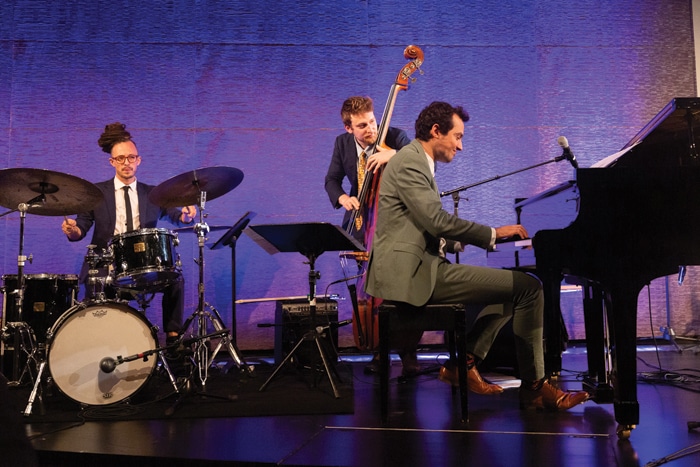
The Guy Mintus Trio

For me, the evening reached a stellar high when the Guy Mintus Trio performed an ethereal piece called “Our Journey Together.” Written by Mintus in response to the “difficult and violent reality of summer 2014 in Israel,” the piece is “an expression of hope.” For the accompanying video called “Can You Tell the Difference?” they photographed more than 100 children — Jewish, Muslim, and Christian — in five locations in Israel. “In its essence,” said Mintus, “this piece is a prayer for peace.”

Ido Tadmor has been the “Ambassador of Dance of Israel” for four decades, a government-bestowed honorific. In his acceptance speech, Tadmor made a much needed distinction between art and social media: “It’s great to be honored for performances on stage, not on social media, where everything can be filtered, changed.” 

Indeed, art is in many ways the polar opposite of today’s all-consuming social media. The former stems from the soul; the latter too often from hate and conformity. Hate can never lead to art, just as it can never lead to hope. 

But what’s clear is that art is precisely the antidote we need right now: to nourish our souls, transcend differences, and provide us with some semblance of hope. And in many ways, Israeli artists — raised in a cauldron of both light and hate — have a sacred mission: to use their gifts to inspire the best within us, to help us push through this very ugly moment in time. 

At its best, art is indeed a form of prayer. The evening ended with a performance of Arik Einstein’s “Ani Ve’ata”: “You and I will change the world.”


Karen Lehrman Bloch is editor in chief of White Rose Magazine.  

The Eternal Hope of Israeli Art Read More »

Meet The Nosher—Cookbook Author Shannon Sarna

Imagine our surprise when Shannon Sarna from The Nosher noticed our little Instagram account back in May 2020: We were so impressed that someone with such a noteworthy public profile liked our food! She generously featured some of our recipes on her Instagram account @Jewishfood (part of the 70 Faces Media Group). And we started to stay in touch with her. 

Through the magic of Zoom, we’ve become virtual friends. We’ve found out that she’s a lovely mom who lives in South Orange, New Jersey with her husband and three young kids, two rescue puppies and a little bunny named S’mores.

You can just feel the joy Shannon gets from talking about her bubbe’s food. She’s definitely an honorary Spice Girl!

We’re definitely on the same page as her — she’s passionate about sharing her love of food and good recipes and spreading the history of Jewish food traditions. You can just feel the joy Shannon gets from talking about her bubbe’s food! She’s the kind of person that you could just spend hours with — cooking in the kitchen or just schmoozing about cookbooks and kids and life over a good cup of coffee. 

She’s definitely an honorary Spice Girl!

—Rachel

The big news is that Countryman Press recently published Shannon’s follow up to her popular first cookbook, “Modern Jewish Baker: Challah, Babka, Bagels and More.” Titled “Modern Jewish Comfort Food,” her new book is a beautiful volume filled with the classics of the Jewish kitchen.

The nine chapters of the book cover the spectrum from Soups to Sweets, with everything crave worthy in between. Stuffed vegetables. Kugel. Shakshuka. Schnitzel. Meatballs. Dumplings. Pastries. Latkes. While the classic recipes are enshrined, each recipe is updated and explained and simplified. Classic chicken soup is there but so is Yemenite Chicken Soup and Greek Lemon and Orzo Soup. There’s Classic Schnitzel, Passover-Friendly Schnitzel, Zucchini Schnitzel and Fish Schnitzel Sandwiches. She offers user friendly options like “Make it in a Slow Cooker,” “Topping Variations,” “Turn Kreplach Dough into Noodles” and “Make it Cheesy!” 

The wealth of information, gorgeous food styling and step-by-step photographs will make this book a much loved resource in your kitchen. 

When Rachel and I found out that Shannon’s book tour was bringing her to the West Coast, we immediately reached out to her. We are so thrilled to be hosting her for a deliciously fun evening at Beth Jacob Congregation in Beverly Hills. We’re excited to hear her hosting tips and best baking techniques. 

Together we will be demonstrating how to make gravlax (sounds fancy but quite simple), cheese sambusak (hard to make but so worth it) and an apple tahini crumble (super easy and a great way to use  fruit). We hope you can join us. (Register at BethJacob.org/Sarna)

This week we share with you Shannon’s recipe for Israeli Chocolate Hazelnut Swirl Cookies. Her recipe calls for Nutella but we could easily see making these with a rich date spread as well. 

—Sharon

These “swirl” cookies may look similar to rugelach, a classic Eastern European cookie that is also shaped like a swirl, but the dough—and its origin—is different. sometimes called Israeli café cookies, they are a home treat that many Israeli bakers make weekly.

These “swirl” cookies may look similar to rugelach, a classic Eastern European cookie that is also shaped like a swirl, but the dough—and its origin — is different. Sometimes called Israeli café cookies, they are a home treat that many Israeli bakers make weekly.

These sweets are the perfect accompaniment to an afternoon cup of tea or coffee. They are also the perfect treat to throw together at the last minute for guests because the dough only needs to chill for 20 minutes, and the shaping is simple, which makes the task of whipping these up almost easier than opening a box of brownie mix.

—Shannon Sarna

Israeli Swirl Cookies Photo by Doug Schneider

Chocolate Hazelnut Swirl Cookies

Makes two dozen cookies
3 cups unbleached all-purpose flour
2 1/2 teaspoons baking powder
1/4 teaspoon salt
14 tablespoons (1 1/2 sticks +2 tablespoon)
unsalted butter at room temperature
1/4 cup sugar
1 cup full fat sour cream
1 cup chocolate hazelnut spread, such as
Nutella, for spreading
Powdered sugar for sprinkling

  • Combine the flour, baking powder and salt in a medium bowl
  • Using a handheld mixer and a separate medium bowl or stand mixer fitted with a paddle attachment, beat together the butter and sugar. Add the sour cream and beat until combined.
  • Add the sour cream mixture to the flour mixture and beat until just combined.
  • Wrap in plastic wrap and place in the refrigerator to chill for 20 minutes.
  • Preheat the oven to 375°F. Unwrap the dough and divide into two equal pieces.
  • Roll each piece of dough into a rectangle, around 8 x 14. Spread the chocolate hazelnut spread evenly across one rectangle.
  • Working from the longer end, firmly roll up the dough (not too loosely, as you might for cinnamon rolls or Babka.) As you roll up the dough, create more of a square shaped log, not perfectly round. Repeat with the other piece of dough.
  • Place each roll on a baking sheet lined with parchment.
  • Using a sharp knife, cut indentations spaced 1 inch apart (not cutting all the way through the cookies, just through the top.) This step will make it easier after the rolls are baked to cut them into pieces.
  • Bake for 26 to 28 minutes, until slightly golden. You can rotate the baking sheets halfway through for more even baking.
  • Remove from the oven and let cool slightly. Sprinkle all over with powdered sugar. Slice through each slit to separate into cookies.

Upcoming events:

A Thanksgiving Challah Bake, Monday, Nov. 21 7:30 p.m. at Kahal Joseph Congregation.Register at Kahal.Joseph.org

A Delicious Evening with Shannon Sarna, Tuesday, Nov. 29 at 7:30 p.m. at Beth Jacob Congregation. Register at BethJacob.org/Sarna


Rachel Sheff and Sharon Gomperts have been friends since high school. They love cooking and sharing recipes. They have collaborated on Sephardic Educational Center projects and community cooking classes. Follow them on Instagram @sephardicspicegirls and on Facebook at Sephardic Spice SEC Food.

Meet The Nosher—Cookbook Author Shannon Sarna Read More »

A Moment in Time: “Appreciating the Journey”

Dear all,

Our family visited the Getty Museum this past weekend. While Ron and I were eager to expose our kids to some great works of the world, we quickly learned that they had a different understanding of what constitutes “art.”

Mind you, they did enjoy the sculptures and the paintings, the gardens and the architecture. But they also reminded us that sitting and just looking out a huge window can be magnificent as well. They reminded us that frolicking in the outdoor spaces is important for our hearts. And they reminded us that ice cream is an important incentive after a long day.

So yes – we all appreciated the destination of the Getty. But more important, we appreciated each moment in time of the journey. (We’ll leave out the part about the tired kids during the car ride home!)


With love and Shalom,


Rabbi Zach Shapiro

A Moment in Time: “Appreciating the Journey” Read More »

Princeton USG Passes a ‘Resolution to Condemn and Combat Antisemitism’

On November 16, Undergraduate Student Government (USG) passed a “Resolution to Condemn and Combat Antisemitism.” The resolution calls on the Office of the Dean of Undergraduate Students (ODUS) to increase antisemitism trainings for undergraduates, graduate students, faculty, and staff.

It also urges the Office of Institutional Equity and Diversity “to include statistics and other information regarding antisemitism in the annual Report on Bias at Princeton and the Diversity, Equity, and Inclusion Annual Report.”

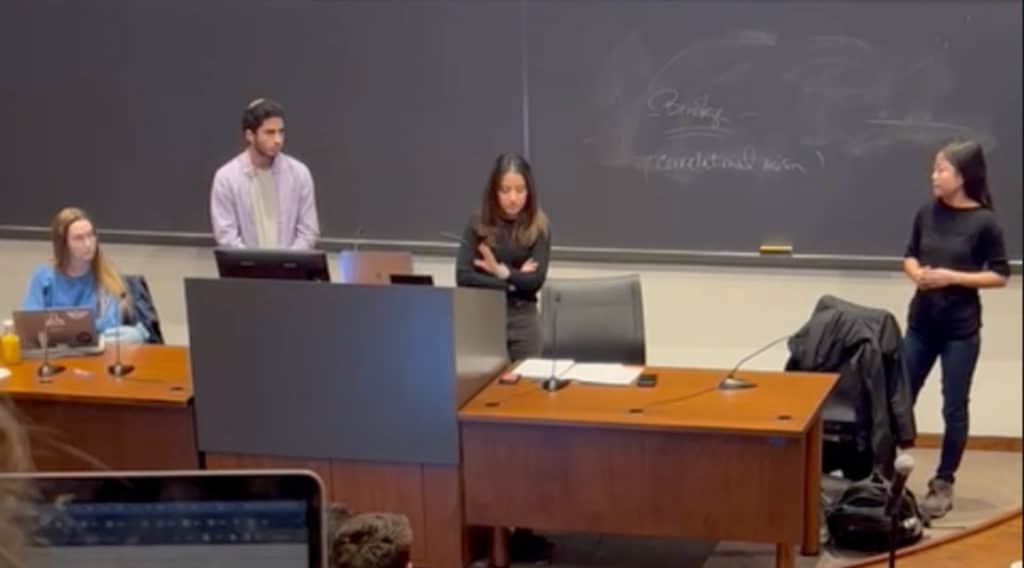
The resolution came on the heels of a November 13 USG meeting, at which USG treasurer Adam Hoffman ’23 proposed that the USG Senate sponsor a referendum supporting the adoption of the International Holocaust Remembrance Alliance (IHRA) Working Definition of Antisemitism.

The proposal failed after USG Senate member Judah Guggenheim ’25 publicly opposed the measure at the November 13 meeting, arguing against the following example of antisemitism provided by the IHRA definition: “Denying the Jewish people their right to self-determination, e.g., by laying bare that claiming that the existence of a State of Israel is a ‘racist endeavor’ is in itself.”

In response to that example, Guggenheim declared: “I wouldn’t say that arguing against that right [to Jewish self-determination] is antisemitic.” The referendum ultimately failed after Guggenheim’s public opposition, leading to severe pushback by the Jewish community on campus.

Already, the Center for Jewish Life had endorsed the IHRA, and Chabad responded to Guggenheim’s protest by affirmingits own support for IHRA. “It was clear that nearly all present at Sunday’s meeting appreciated the pernicious nature of anti-semitism and wanted a referendum on the adoption of language,” Rabbi Eitan Webb of the Princeton Chabad said in a statement. “In order to combat antisemitism, you need to first define it. That is what these discussions are about.”

“Our hope is that the definition is never employed. The way of Chabad is to invest in increasing acts of goodness and positivity. But we need a definition to exist, and I believe that this is a good definition,” Rabbi Webb said of the IHRA definition.

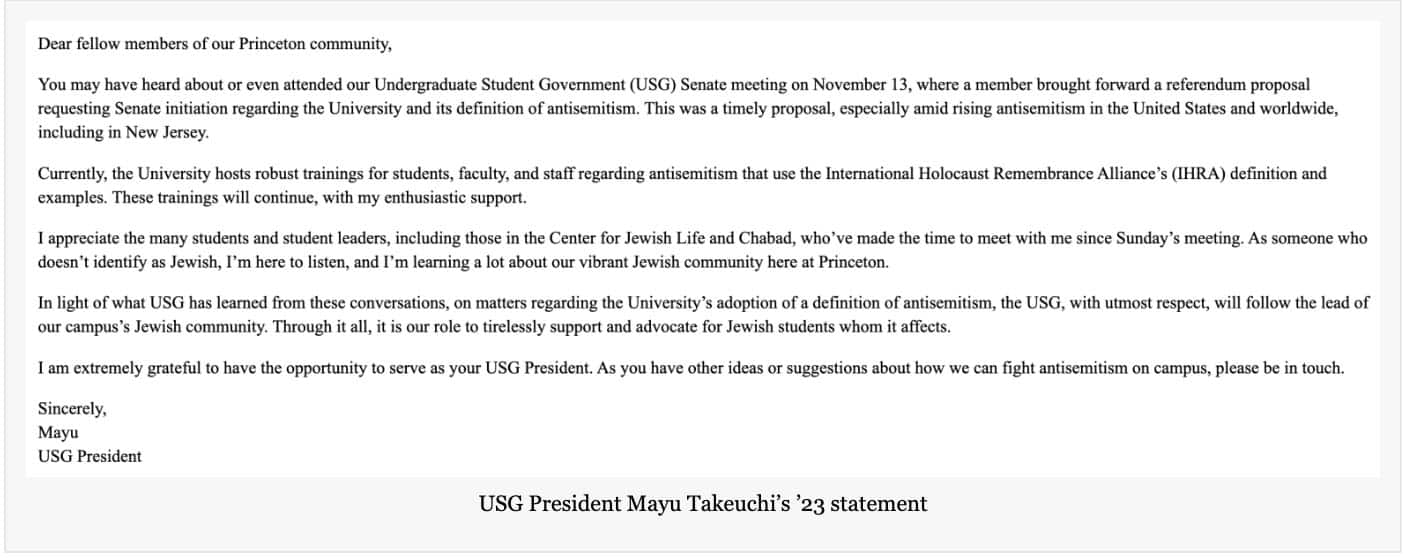
Following the response from the Jewish community, USG President Mayu Takeuchi ’23 gathered with members of the Jewish community to hear their perspectives and find a path forward. Takeuchi then worked on a new resolution with Guggenheim, entitled “Resolution to Condemn and Combat Antisemitism,” which was proposed and passed on the evening of November 16 by the USG Senate.

Before the proposal of the “Resolution to Condemn and Combat Antisemitism” in the November 16 meeting, Takeuchi read aloud a statement she wrote “in consultation” with leaders of the Jewish community. The statement was sent out to the Center for Jewish Life (CJL) and Chabad email lists following the meeting.

“This was a timely proposal, especially amid rising antisemitism in the United States and worldwide, including in New Jersey,” Takeuchi said of Hoffman’s November 13 proposal in her statement.

In the weeks leading up to the resolution, antisemitism was a topic of conversation on campus and in New Jersey at large. There was a statewide alert issued by the FBI regarding a possible threat to New Jersey synagogues on November 3, 2022.

On November 5, the Princeton Committee on Palestine (PCP) released a statement calling on the University to boycott Israel TigerTrek, a student-led winter break trip that brings a Princeton cohort to Israel to meet with key players in the nation’s high-tech startup industry.

The CJL was quick to condemn the statement, with its Executive Director, Rabbi Gil Steinlauf ‘91, releasing a statement to all Residential College listservs via HoagieMail condemning PCP’s words.

“The message crossed a line by engaging in age-old, classic antisemitic references to child killing, using well-known ‘dog whistles’ like Jewish ‘elitism,’ and rhetoric about colonialism which undermines Israel’s right to exist,” Steinlauf wrote of PCP’s statement.

He also announced that he will be running “a series of seminars to teach individuals across our campus community about the history, nature, dynamics, and challenges of dealing with antisemitism.” He emphasized that he is “particularly proud that the seminar promotes the official definition of antisemitism put forward by the International Holocaust Remembrance Alliance (IHRA).”

In her November 16 statement, Takeuchi expressed gratitude for “the many students and student leaders, including those in the Center for Jewish Life and Chabad, who’ve made the time to meet with me since Sunday’s meeting.”

She emphasized that “USG, with utmost respect, will follow the lead of our campus’s Jewish community.”

Rabbi Webb expressed that “it was gratifying to see Princeton’s student government unanimously reject antisemitism.”

Hoffman also expressed a positive outlook on the successful resolution. “I was glad to see the CJL, Chabad, and the organized Jewish community stand together against antisemitism in all its forms,” Hoffman wrote in a statement to the Jewish Journal.

“Because of the Jewish community’s organized response to USG’s previous vote, we are moving in the right direction. I’ve been inspired by Rabbi Webb [of Princeton Chabad] and Rabbi Steinlauf’s [of the Center for Jewish Life] leadership in fighting antisemitism and pushing back against those in USG who opposed the IHRA definition.”


Alexandra Orbuch is a sophomore at Princeton University from Los Angeles, California hoping to study Politics. On campus, she writes for The Princeton Tory, the university’s journal for conservative thought, and the Princeton Legal Journal, the university’s undergraduate law review.

Princeton USG Passes a ‘Resolution to Condemn and Combat Antisemitism’ Read More »