fbpx

November 11, 2022

Are Judaism and Zionism the Same Thing?

In a recent essay for the Jewish Journal, Rabbi Chaim Steinmetz makes the case that Abraham, the first Jew, was also the first Zionist.

“Abraham becomes a Jew and a Zionist at the same time” Steinmetz writes. “Genesis makes it clear that Zionism is central to Abraham’s new religious mission.”

Reading the piece, I was reminded of a debate I once had on Twitter over whether Queen Esther was a Zionist. I had argued that the claim was nonsensical and anachronistic. My sparring partner, on the other hand, was adamant that Esther, who sought to rescue the Jews from tyranny, was an embodiment of Zionist ideals.

This argument is impossible to win, as it traffics in something quite subjective, which is how we determine the historical continuity of an entity or an idea. For instance, what was the first chair? Was it the ground? Was it a stump or a rock that someone sat on? Or was it the first intentionally created piece of furniture designed explicitly for sitting? Depending on one’s definition of terms, any one of these answers could be correct.

Similarly, who was the first Zionist? Was it the first Jew who ever dreamed of journeying to the holy land? Or was it the first person to call himself a Zionist? Moreover, what is the meaning of Zionism? Does any expression of longing for holy land qualify as Zionism? Or does the term have a more specific meaning?

There’s no right or wrong answer to this question, but different answers will bear different fruit and serve different agendas. If we take the expansive approach of Rabbi Steinmetz, we have the benefit of seeing Zionism’s continuity with Jewish history and Jewish religious thought. If one’s goal is to imply that Jewish anti-Zionists are out of step with both, this approach will be useful.

This does seem to be part of Steinmetz’s thesis. “Today’s anti-Zionists take inspiration in an ideology shaped by long-forgotten challenges, and offer an alternative Judaism devoid of any national identity. But this is bound to fail; a Judaism without Zionism is impossible.”

As is evident from my Twitter debate over Queen Esther, I prefer to define Zionism more narrowly, looking at it in its historical context as an intellectual, spiritual, and political movement that arose in 19th-century Europe. This approach understands Zionism not merely as an expression of the age-old longing for Jewish self-determination and return, but as a very particular and novel approach to this age-old longing. Here, the emphasis isn’t on Zionism’s continuity with Jewish history and religious thought, but rather its radical break with the Jewish past.

The early Zionists were not pious Jews. They were often secular, and almost always radicals and freethinkers. Their ideas scandalized and enraged their elders. Their desire to build a secular state in Palestine was not interpreted as a seamless continuation of the ancient Jewish longing for the holy land, but rather as a shocking rejection of the way things had always been.

I fear that when we start Zionism’s clock with Abraham, we risk overgeneralizing the term in such a way as to erase the uniqueness and the boldness of those individuals.

This, however, is not the only reason I take the position I take. As I said, different answers to these questions bear different fruit. When we blur the lines between Zionism and Judaism, or Zionists and Jews, I worry that we are doing little more than deepening already deep rifts in our community.

In a recent op-ed in the Jerusalem Post, David Friedman argues that Zionism and Judaism are “inseparable,” and further, that “to be a Jew is to be a Zionist.”

“Theologically,” writes the former US ambassador to Israel, “there is no daylight between Zionism – the movement that has successfully brought the Jewish people back to its biblical homeland – and Judaism itself.”

Among the many implications of such a belief is the idea that non-Zionist Jews are doing their Judaism wrong. These ideas also have the potential to alienate Jews who live in the diaspora, whether they are Zionist or not. Citing the great bulk of “biblical commandments that can only be performed within the Land of Israel,” Friedmand states that “Israel is the only nation where Judaism can be fully actualized.”

Were Judaism’s “actualization” evaluated by nothing more than the sheer quantity of biblical commandments one can fulfill at any time, this point would be more convincing. In reality, Judaism without the diaspora would not be Judaism. There would be no Babylonian Talmud, no Kabbalah, no Hasidism, no Reform Movement, no Yiddish literature, no Lower East Side.

The truth is that Judaism is actualized wherever Jews come together in community, in prayer, and in study—both in Israel and out.

With increasing enmity between Zionist and non-Zionist Jews comes an increase in attempts to invalidate one other’s Jewishness. Gil Troy and Natan Sharansky went so far as to label anti-Zionist Jews as “un-Jews” while IfNotNow taunted Zionists by smugly tweeting at them: “Our Judaism welcomes the stranger and fights for justice. What’s yours?”

This goes beyond headlines and social media. As a rabbinical student in America at a pluralist academy who is currently studying at a pluralist yeshiva in Jerusalem, I live my life on the faultline of this issue. I am in close community with the future leaders of American Judaism, and I can attest that this issue is not going away.

From my vantage point as a Zionist in these spaces, I can attest that fierce disagreements over Israel are the most pressing challenge to Jewish pluralism today. Our communal debates about egalitarian prayer or kosher microwaves are logistical and academic. Our debates about Israel, on the other hand, threaten to make enemies of friends.

All of this should be considered when we ask questions about the relationship between Zionism and Judaism. These are, after all, challenging questions for a complex chapter of Jewish history, and our answers, as should be expected, will vary greatly between individuals and communities.

This is all the more reason to use our words carefully. As we debate one another over what it means to be a Zionist Jew or a non-Zionist Jew, we would be best advised to follow three rules: One, use terms with precision. Two, interpret one another’s words generously. Three, conduct these conversations face to face, and never—if at all possible—on Twitter.


Matthew Schultz is the author of the essay collection “What Came Before” (2020). He is a rabbinical student at Hebrew College in Newton, Massachusetts.

Are Judaism and Zionism the Same Thing? Read More »

Israel’s Left Is Down, But It May Not Be Out

To read more articles from The Media Line, click here.

Israel last week managed to elect what will be an apparently stable right-wing government coalition, seemingly breaking a cycle of close elections after five rounds of voting in less than four years.

And while former prime minister Binyamin Netanyahu and his bloc celebrate his imminent return to office after 18 months as opposition leader after winning 64 seats in a 120-seat Knesset, those on the other side are wondering whether the left-wing Labor and Meretz parties can recover after a dismal performance that saw the former win a precarious four seats and the latter out of parliament altogether.

The somewhat good news for voters who did not want Netanyahu redux is that there has been very little shift in evenly divided voting blocs. In fact, says Professor Gideon Rahat, chair of the Department of Political Science at the Hebrew University of Jerusalem, the final result was down to “an accident of political misjudgment” by Labor leader Merav Michaeli.

Michaeli declined to combine her party with the smaller, more left-wing Meretz, even as Netanyahu and his cohorts united, understanding that every vote counted in another tight race among an equally split electorate. As a result, Meretz narrowly failed to squeak past the 3.25% electoral threshold that would have given the party the minimum four seats in the next parliament. 

And a different distribution of votes could have shifted the balance in the next Knesset and denied the Likud leader his victory.

“The reason that the anti-Netanyahu bloc didn’t create a draw… is simply because Meretz and [Arab party] Balad didn’t cross the electoral threshold, so almost 300,000 votes went in the dustbin,” says Professor Jonathan Rynhold, head of the Department of Political Studies at Bar-Ilan University.

The bad news for Israel’s left-wing, say both academics, is that while the number of voters who do not want to see Netanyahu return has not changed, the number of voters who actively support Meretz or Labor is shrinking.

“I don’t think there is any more room for two Zionist left-wing parties,” Rynhold told The Media Line, citing a leftward shift by Labor in recent years.

“When Labor was more center-left like with [former party leader and current President Isaac] Herzog … that made room for Meretz,” he said, referring to the 2015 elections.

“In terms of the demography of the population, the pool that Labor and Meretz draw from is getting smaller as a percentage,” he said.

Rahat also posits that the left, which always stood for equal rights and furthering the peace process, no longer has a unique purpose as those issues have either progressed, fallen by the wayside or been adopted by other parties. As such, he told The Media Line, there is very little cause for the Israeli voter to plumb for Labor or Meretz when more successful outgoing Prime Minister Yair Lapid is promoting the same issues in the platform of his own centrist Yesh Atid party.

“The left was shrinking and was replaced by either Yair Lapid with his middle-class interests and policies or with [National Unity leader and outgoing defense minister] Benny Gantz,” with his security credentials, according to Rahat.

“That’s a problem of the left,” Rahat added. “You represent everything with your shrinking power [and] at the end of the day you are not needed anymore. Gay rights would be taken care of by Yair Lapid and Gantz and even Bibi [Netanyahu] would keep the status quo” on such social issues.

Even more damaging, according to Rynhold, is the perception of the left as the fervent promoters of an agreement with the Palestinians, something that he says is largely viewed in Israel as a failed policy.

“In terms of what it means to be left wing in Israel, the main component of that has been discredited for 20 years, which is supporting the peace process,” he said.

“So, what you’re left with is a number of issues to do with religion and state and for that you can vote for [Yisrael Beytenu leader Avigdor] Liberman on the right,” Rynhold added.

For “individual rights and things like that, there’s not really any difference between Lapid and Meretz,” he also concluded.

Rynhold and Rahat both believe that, for the left wing to survive, there will have to be an amalgamation of these smaller parties into a larger and therefore more politically robust entity.

A similar move was carried out by Religious Zionism and Otzma Yehudit, or Jewish Power –Netanyahu’s allies on the far-right – to great effect as the joint slate picked up 14 seats to become the third-largest party in the next Knesset.

“If they want to have any future of course they have to merge; they [just] have to decide how to merge,” Rahat said of Meretz and Labor.

“I think they need to very seriously consider creating one Zionist left-wing party,” said Rynhold. “It would have a clear identity and … it’s not something that you need two parties for.”

Israel’s Left Is Down, But It May Not Be Out Read More »

Forgotten Arabian Jews Recount Lives of Happiness and Horror

To read more articles from The Media Line, click here.

In the lands of Arabia, where Jews used to live, a tenacious explorer can – here and there – find remnants of a people swept away on the sands of time and political tensions.

Here in Sanaa lie the ruins of a synagogue, there in Cairo sit the cracked graves of a Jewish cemetery, bearing witness to the vibrant communities that once existed in happy harmony with their Muslim friends and neighbors.

That all changed in 1948 with the creation of the State of Israel, regarded by its Arab neighbors as an interloper in the Muslim world, an unwelcome usurper whose establishment led to the displacement of the Palestinians who lived there. These Arab nations and their inhabitants now viewed their once respected Jewish communities with antipathy, blaming them for Israel’s creation and accusing them of loyalty to the nascent Jewish state over their homeland.

The animosity morphed into persecution on a national and personal level – leaving the Jews of the Arab world with little choice but to flee. Some went to Israel, some found the sanctuary they sought in Europe or North America; almost all left almost everything behind, to be picked over those who had for so long welcomed them but then cruelly turned their backs.

And yet while the Palestinian refugees were embraced by the world, an international wall of silence surrounded the plight of the Jews forced out of the nations they had called home for centuries. This silence has eroded in recent years, but their stories remained little-known, little-shared and of little interest in the world.

Slowly this is changing. A new book titled “Sephardi Voices: The Untold Expulsion of Jews from Arab Lands,” by Henry Green and Richard Stursberg, seeks to bring these stories to even greater prominence, telling the events of this recent chapter of Middle Eastern and Jewish history through the eyes of those who lived it.

Green acknowledges the oddity of a Canadian Ashkenazi Jew (himself) and a Catholic (Stursberg) writing the story of the Sephardi Jews, but says it was ignorance of their plight that motivated him.

“The Sephardi Jews’ history ended for me in 1492,” Green admits, referring to the expulsion of Jews from Spain after centuries of persecution.

But arriving in Israel in the 1970s, Green was drawn to a social rights movement called the Black Panthers, thinking it was the same movement as in the US, from which its members had in fact taken their name.

“I got introduced to this other incredible population that makes up Israel [about] which I had no idea,” he tells The Media Line.

“It was so strange to me. They introduced me to a different culture, to a different food and music. I felt that I was kept from a secret that was very beautiful,” he says.

Green became the first person to write in English about the programs that then-Prime Minister Golda Meir was implementing in order to help integrate Sephardi Jews into Israeli society.

As the director of Jewish Studies at the University of Miami, Green delved deeper into the subject – developing and expanding his research, culminating in the Sephardi Voices project that unites the history of the million or so Jews who once resided between the Atlantic Ocean and the Tigris River, but whose presence was near gone in a single generation.

“I realized that the stories of all these people who were displaced were never heard and they needed a voice,” Green says.

Green does not apportion blame for the lack of public awareness about this other tragic chapter of contemporary Jewish history, but only seeks to understand and explain how this happened.

“Israel in the first generation was just trying to survive, there was not resources,” he says. “America did not supply military aid ‘til 1968; they were not supplying economic aid. Israel depended on the Diaspora to survive.

“They needed immigrants, but when they brought them, they had no resources. They did not speak Hebrew; they spoke Arabic, Ladino, or other languages, while the Jews that came from the Holocaust [Europe] were speaking German.”

Furthermore, he says, “the Europeans had more education.” They had the skills needed by the newborn, besieged state to consolidate and expand. And surrounded by enemies as it was, what began as expediency for a desperate nation became what Green calls “institutional discrimination.” In the newly created State of Israel, the Ashkenazi Jews were the elite and their Sephardi brethren seen as of a lower class.

“The people who could help build the country would go to the urban areas, and the ones who did not understand what was going on, would go to the more rural areas because Israel needed to develop it,” Green explains.

Making matters worse, he says, was the trepidation towards those who looked and talked like the enemies of Israel who had sworn themselves to its destruction.

“The people who came in from the European world, they looked white. But the ones who were coming from the Arab world, they look Semitic, and they spoke Arabic,” he tells The Media Line. “From a security issue, you did not know who was who, and this created another kind of fear.”

Green stresses that while the stories of the Jews of the Middle East and North Africa are similar in shape and form, individual experiences were distinct. Jews from across the region found themselves persecuted to varying degrees, in varying styles and with varying timeframes.

“The Middle East and North Africa is not monolithic,” he says. “Generally speaking, their rights are taken away over time in different ways.”

He cites the example of Iraq, which joined Egypt, Syria, Lebanon and Jordan in declaring war on Israel in the immediate aftermath of its birth in 1948, in what Jews around the world call the War of Independence.

“Iraq took the position that the Jews were detrimental for the country so they denationalized them, took away their property, they killed various Jews and made their life unbearable,” Green says.

“The Israeli government also did covert operations to increase the fear of the Jews there because they needed olim [immigrants to Israel]. That combination led the 150,000 Iraqis to leave between 1950-1951.”

Green is referring to bombings that targeted the Jews of Baghdad in those years. Some have attributed these attacks to Israel as an incentive for Jews to emigrate to the country, although Jerusalem has consistently denied involvement. The bombings directly preceded an Israeli operation to airlift the Jews of Iraq. Known as Operation Ezra and Nehemiah, the action saw around 130,000 Iraqi Jews taken to Israel via Iran and Cyprus.

As recent in history as this chapter is, many of those who fled are still alive, and can vividly recall their lives before their displacement.

One such person who appears in Green and Stursberg’s book is British philanthropist David Dangoor. Born in 1948, he lived with his family in Baghdad until his father Sir Naim Dangoor took them to the UK in 1959. His family can trace its venerable Iraqi lineage back centuries, but that did not save them from the oppression that followed the creation of the State of Israel.

“Dad had records relating to at least eight generations, going back to Nissim Dangoor born circa 1700,” David Dangoor tells The Media Line. His father, a renowned businessman in his native land and the second-oldest man to ever receive a knighthood in the UK, was the grandson of Baghdad Chief Rabbi Hakham Ezra Reuben Dangoor and the son of Eliahou Dangoor, who at one time was the world’s foremost printer of books in Arabic.

“Dad took us out in 1959 but tried to continue with his businesses ‘til he found it impossible in 1963, when he lost his nationality and all his businesses and assets” to the Iraqi government, says David.

Dangoor, who today lives in London, says he bears no animosity towards the people of Iraq, acknowledging their own troubled history and suffering.

“I feel goodwill to the Iraqi people and an aspiration that they find peace and stability, and recognize their former Jewish citizens by recognizing Israel, where the vast majority of them now live,” he says.

According to Dangoor, “many Iraqi people – especially the more educated and Western leaning ones – regularly express very nostalgic feelings about the Jews that they feel were lost to Iraq.”

In fact, he says that a video on YouTube about his family and the larger Jewish community having to leave Iraq “had nearly 20,000 viewings with many warm and positive comments in Arabic from Iraqis.”

One of the comments on the Arabic-language version of the video, posted by someone calling himself Dr. Salam Hussein Ewaid even reads: “Greetings, my love and my respect, you are an authentic and loyal Iraqi.”

The rights to the 69-minute film, called “Remembering Baghdad,” have now been acquired by Netflix for a five-year period in Europe.

To David, aspects of Iraqi culture still persist in his life, and those qualities he has passed on to the younger generations: “The importance of family, community and tradition.”

In Egypt as well, Jews felt the blow of national hatred towards Israel as soon as the state came into being, seeing their rights stripped away. Yet as bad as it was, Henry Green says, things got substantially worse when Gamal Nasser took the presidency in 1956, four years after he played a decisive role in overthrowing the last king, Faruk I.

“Everything changed,” Green tells The Media Line.

David Shama was born in Cairo in 1945 and grew up in Alexandria, where he says his family was part of the elite and very Westernized. But again, that elevated status did not save the Shamas from persecution – and it is something that stings even today.

“I have no great love for Egypt or Egyptians,” he says.

“We were part of the Egyptian environment, and my father was a successful businessman,” Shama tells The Media Line. “He knew a lot of people and a lot of people knew him, yet when he was arrested and accused of being a spy for Israel and England, nobody came to his aid; no one. [Not the] people that he helped, loaned money to whenever they needed and gave money to whenever they needed. It was brutal to be completely betrayed like that.”

Shama describes the treatment they received in those years in the most severe terms.

“Leaving the country we felt very much betrayed,” he says. “We were raped out of everything we owned. My father was imprisoned as a British and Israeli spy, he was tortured while my mother, my sister and I were captive in our home in Alexandria under house arrest. It was a very brutal, emotional situation.”

David Shama now lives in Canada, where after retiring from his children’s clothing firm he began a dog care company, but his distaste for Egypt and the Egyptian people still lingers.

“I believe it was a situation where the masses jumped on board” with targeting the Jews, he says. “They really had no reason to do what they did. I mean, look, there are people who get themselves into trouble here and there, but to paint the whole Jewish people with the same brush is wrong.”

When the 1967 Six-Day War began with the invasion of Israel by Egypt along with Jordan and Syria, it only brought back the terrifying memories of his childhood.

“I had seen what my father went through, I had seen as a young boy what I endured being on the street,” he says. “On many occasions walking on the street, going somewhere with my nanny or whatever, they would empty these urine [containers] over us, which was absolutely disgusting.”

Even the peace agreement between Israel and Egypt in 1979, which still holds to this day, did not lessen Shama’s animosity: “I don’t think that peace was done because the Egyptians wanted peace… it was more, they really had no alternative.”

According to Shama, the lack of awareness of the story of the Jews of the Middle East and North Africa has many culprits.

“Many people don’t know it because frankly there was no publicity about it,” he says. “It was a situation where Jews are being corralled like animals, and basically nobody cared, and the Jews kept silent.”

He says that unlike the attention given to the Holocaust, “we didn’t get the support from the media that we would have needed in order to get this thing out so that the world would know what was happening.”

The fact that it is becoming more discussed today is a good thing, he believes, for it is “very important that the young generation understand what happened.” This is especially the case, Shama says, given the current vilification of Israel.

“All these young people who are continuously in universities blacklisting the State of Israel as an apartheid state, is because they just have no education, nor do they want to have an education about the subject.”

Green attributes some indifference to the fate of the Jews of the region to the tumultuous state of the planet in the immediate aftermath of World War II.

“The UN did acknowledge that there were two refugee populations,” he says, but geopolitics inevitably played its part.

“When Israel was founded, there were about 70-80 nations. Eleven [of them] were Arab nations and with the Cold War going on, there was a sense that one had to deal with the Arab displaced population,” he says.

“In terms of the world, what happened was that the attention was not on Israel between 1948 and 1967. Europe had been devastated during World War II. It was not on anyone’s radar.”

Unlike Dangoor and Shama, Beirut-born Edy Cohen Halala only left his country of birth in 1990 at the age of 17, decades after the creation of the state where he now lives. But like them, his family could trace its roots back for generations and its departure was triggered by antisemitism.

“We were in what is Lebanon for at least 120 years,” Halala tells The Media Line. “We spoke Arabic at home. I was raised in an Arab country, I went to an Arab school, I spoke Arabic with my friends and neighbors.”

Halala grew up in a country ravaged by a bloody internecine conflict.

“The Lebanese civil war began in ‘75 till ‘91. So almost all my years in Lebanon, I saw the country destroying itself with a civil war,” he says. “I didn’t see the Lebanon of before the civil war, I didn’t live in Lebanon during the time when it was called the Switzerland of the Middle East.”

Even so, the family remained until the rise of the Iranian-backed Shiite militia Hizbullah, now one of the most powerful political entities in Lebanon, which set its sights on his own father.

“The Jewish community had suffered from antisemitism, and in 1985 Hizbullah began to kidnap Jews, among them my father. They killed 11 Lebanese Jews [including his father], and this is the moment that we felt that we must go. You cannot stay in a country where you are persecuted,” he tells The Media Line.

Even so, the memories of his childhood remain, tinged with regret that visiting the nation of his birth is out of reach due to its persisting conflict with Israel.

“You cannot forget the country that you were born in and lived in for almost 18 years,” Halala says. “I still have the memories, friends, my mother tongue, so as you can never forget your mother, neither [can you forget] your maternal language. Unfortunately, there is war between Lebanon and Israel and I cannot go.”

He says that without Hizbullah, Lebanon would be a very different place.

“The Lebanese problem will not resolve until the full demilitarization of this terrorist organization,” he maintains. “Lebanon would still be dangerous for Jews.”

Halala sums up the story of the region’s Jews after the creation of the State of Israel succinctly:

“The million Jews living in the Arab lands are gone,” he says. “This is ethnic cleansing. Being Jewish in a Muslim country was impossible during the 20th century.”

He does not recoil, however, from being described as an Arab Jew, unlike some who were born in – and were forced to flee from – Arab countries.

“We are not Muslims, but we are Jews with Arab origins,” Halala says. “There are people that do not like this term, but I feel comfortable with it because this is the truth, in my point of view.”

Green says that the experiences of the Jews of Arab lands have begun to resurface in the past two decades as people have become more eager to celebrate where they and their families came from.

“In the last 20 years, things have changed in terms of identity politics; now you get strength from bringing your identity,” he says. “With that has come an acknowledgement that these cultures are very nourishing and need to be supported.”

This is more the case in Israel than the Diaspora, he says, which is still dominated by its “Ashkenazi majority.”

“The Sephardi [Jews] made up 15% of Israel in 1948; today they comprise between 55-60% of the country, so the demographics have changed. Today Sephardi food and music are part of the Israeli culture. In Israel, it is not about a melting pot anymore, but more about multicultural identity.”

Where almost a million Jews once lived and thrived across the region, today – in the most optimistic of estimates – there are just 23,000. According to Green and Stursberg, the total amount of assets left behind, including businesses, houses, farms and bank accounts – are worth in today’s money more than $100 USD, roughly the size of the economies of Yemen, Iraq and Tunisia combined. None of the states from which Jews were driven have provided any reparations.

With his book, Green says, he is trying to allow others to undergo the same enlightenment that he experienced back in Israel in the 1970s, when he stumbled across a movement of Sephardi Jews fighting for their rights.

“The book is trying to say: ‘wake up!’ There is another story here, and that story is about victimization but also a story about resilience. A story of people making new lives in Israel and the Diaspora.”

Felice Friedson contributed to this article 

Forgotten Arabian Jews Recount Lives of Happiness and Horror Read More »

Retired Doctor/Opera Singer on Why Music Is Great for Anti-Aging

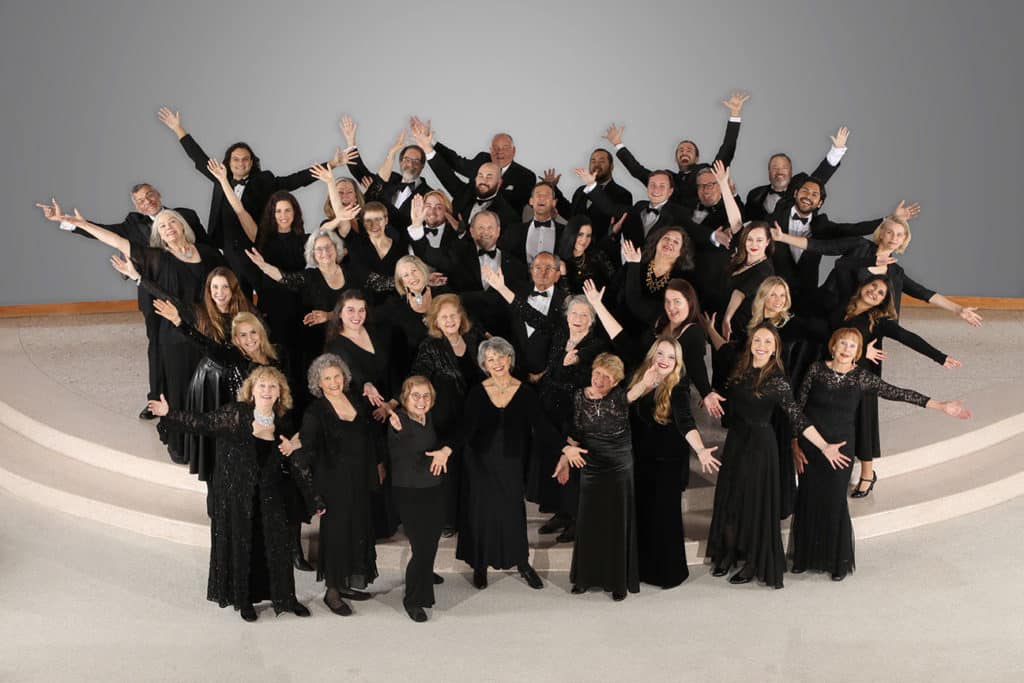
This Saturday and Sunday, The Verdi Chorus will be culminating their 39th season with their Fall Concert, “A Verdi Puccini Fest” in Santa Monica.

“This program includes some of the most exciting moments from two of the greatest operatic composers who ever lived,” said Music Director and Founding Artistic Director Anne Marie Ketchum, conductor of the Verdi Chorus since its beginning in 1983. Ketchum continued in a press release, “The program I’ve created for this concert is a smorgasbord of the many operas from these two prolific composers, and it has been such great fun to choose from the many dramatic works they both offer.”

One of the chorus members, Dr. Franklin Strauss, spoke with the Journal about the importance that music has played in his life, as a doctor and as a part of the Los Angeles Jewish Community. Strauss retired eight years ago after about 45 years practicing nephrology out of Cedar Sinai Medical Center with a teaching affiliation with UCLA Medical School. But even in retirement from medicine, Strauss is still quite active in performing his other love: opera.

“I retired from medicine in about 2014, and so I’m now living the life, living the dream as the young folks say,” Strauss told the Journal.

Strauss first got into opera while in college at Columbia University in New York. It was the 1950s, and he was working a part-time mail-sorting and office assistant job for a finance professional out of his apartment on Park Avenue. While there, Strauss’s employer would be playing opera records from his floor-to-ceiling collection. Strauss got hooked.

Back at school, Strauss met his wife, a violinist and then a fellow member of the Columbia University Orchestra.

They married and moved from New York to California where their family became members of University Synagogue in Los Angeles.

“And as the years went by, the area of music that I really loved the most was the opera that started College years,” Strauss said. “And so opera was always a very, very important part of my life.”

As members of University Synagogue, they took an interest in possibly joining the volunteer chorus.

“Since we’re both musicians—amateur musicians—even though neither one of us had any singing training in our background, we thought we would volunteer for the chorus and see how that went,” Strauss said. “And of course it was a lot of fun. It was very, very rewarding learning music, learning how to further our Hebrew education somewhat, and then incorporating that as part of a family activity, a family Jewish activity. So I felt very comfortable doing that. We were very warmly welcomed.”

Strauss was still practicing medicine at Cedars Sinai and was also doing clinical investigations, achieving  the top faculty rank as Clinical Professor of Medicine at UCLA Medical School. But he still found time to sing in Shabbat services and the High Holidays. The two of them also were in the Palisade Symphony for several years. And sometimes they’d put together a string quartet and do concerts in their living room.

He credits University Synagogue Cantor Jay Frailich for feeding his thirst for music. Cantor Frailich retired after 40 years in 2014.

“And we were very much taken by the cantor at that time, who was a wonderful musician and a wonderful human being, of course, who was very interested in not doing the same old service every Friday or Saturday,” Strauss said. “And he wanted to change things up a little bit. He utilized more modern Jewish composers rather than just the standard old things that we used to hear for decades and decades. And so it really was a wonderful opportunity to work with a musician and a really good synagogue chorus. And it also helped us to involve ourselves more in the activities of the synagogue and in our Jewish life.”

And then one day in 2000, another member of the choir told Strauss about the Verdi Chorus and invited him to go to one of their concerts.

“That was a key event in my life because I loved opera all these years, and here I am going to a performance of a community chorus that is singing my favorite type of music,” Strauss said. “When I went to this concert   I heard this community chorus with a wonderful music director and wonderful professional soloists. I said, ‘How do I sign up? Where do I audition?’ I auditioned a month later and boom!”

Strauss would transfer from the synagogue to the Verdi Chorus, where he has been ever since.

“The Verdi Chorus Is probably unique in our part of the United States, if not certainly in California or a wider geographical area. We are trying to find other choruses that do what we do. We’re the only chorus that is a community as opposed to a professional chorus that just sings the music of opera. All the other choruses—and there are many choruses in Los Angeles, the many courses everywhere—but they all sing all kinds of different music. They may even include an operatic chorus every now and then. But there’s no chorus that just focuses on the music of the opera chorus.”

The concerts on November 12 and 13 will feature selections from four Verdi operas – “I Lombardi,” “Don Carlo,” “Rigoletto,” and “La Traviata.” It will also feature sequences from Puccini’s “Turandot, “La Bohème,” “Suor Angelica,” “Tosca,” “La Fanciulla del West” and “La rondine.”

Strauss is not only on the board of the Verdi Chorus, but his wife is also a member, having joined about eight or nine years ago.

“It’s a wonderful thing for us to do as individuals, it’s also a wonderful thing for us to do as a married couple,” Strauss said. “It’s a wonderful anti-aging remedy. What it does for me is it takes me completely outta my normal day to day life experience, and I go to a different planet while I’m making music. I literally do. It’s a different personal experience, you know, forget about all the stuff that’s going on, Family, job, work, pressure, money, cars, everything. Just forget about that stuff. You go to someplace completely different and you just completely open up into a different realm of being for me, me. So it’s a wonderful, I won’t say escape, but it’s a wonderful way to put things aside and get creative and have a form of enjoyment unlike any other.”

The Verdi Chorus Fall 2022 Concert “A Verdi Puccini Fest” will take place at the First Presbyterian Church in Santa Monica, 1220 2nd Street, Santa Monica, CA 90401 on Saturday, November 12 at 7:30 pm; Sunday, November 13 at 4:00 pm. For tickets, visit www.verdichorus.org

Retired Doctor/Opera Singer on Why Music Is Great for Anti-Aging Read More »

An Intriguing Take on History

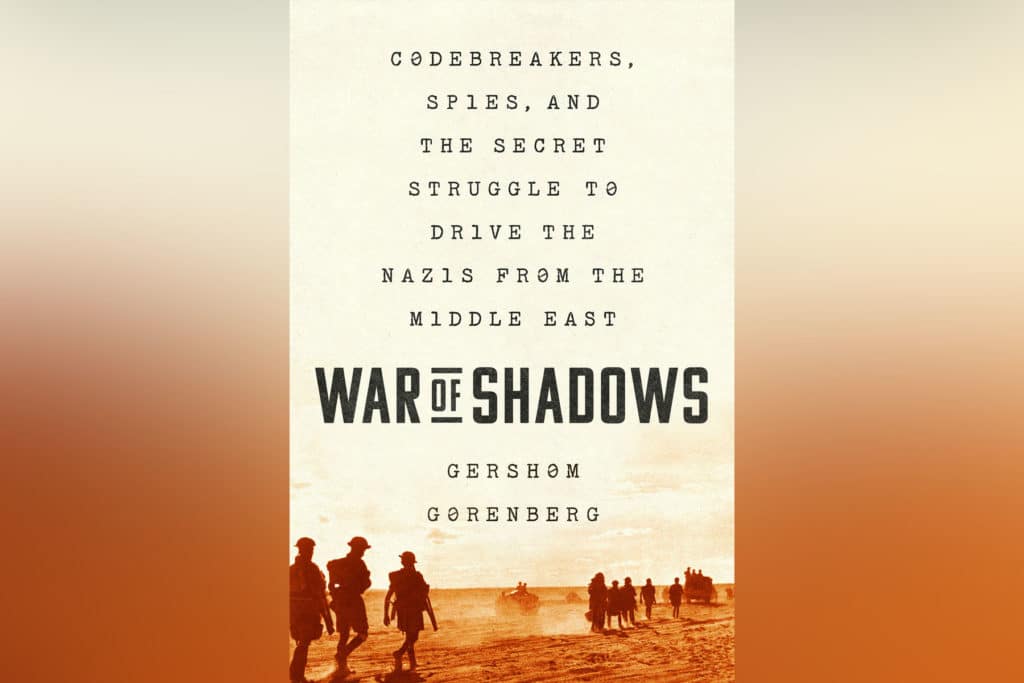
Historian and journalist Gershom Gorenberg’s dual vocations are manifest in his new fascinating work, “War of Shadows: Codebreakers, Spies and the Secret Struggle to Drive the Nazis from the Middle East” (New York: Public Affairs, 2022). Gorenberg writes history as a journalist: The story is personalized, the scenes are set, the personalities examined, their human frailties explored, the narrative is riveting and yet he has read all the relevant archives, document after often tedious document, and done his homework by interviewing all the key subjects available to him. And when they are no longer among the living, he has pursued their children, their nieces and nephews. He is steeped in the secondary literature. The result grips his readers.

Gorenberg tells multiple stories: Rommel’s battles in North Africa against the British army, American efforts to supply that army, and German efforts to keep Rommel’s army supplied—all the standard stuff of history. He takes us into the corridors of power in Cairo, describing those political figures around the king, those who would like to depose—and eventually succeed at doing so—the king including Gamal Abdul Nasser and Anwar Sadat, those supporting the British Empire and enjoying the privileges of colonial power and those bent on destroying the Empire during the war, or those more loyal who want to wait until after the war. He portrays the spies and the counterspies who frequent the palace, the plush hotels, and the pubs of Egypt. He depicts Nazi German efforts to lure the Egyptians to their side, including the promise of dire consequences for the Zionist project of creating a Jewish homeland, establishing a Jewish state.

But most interestingly and most unexpectedly, he explores in the declassified archives and countless interviews the successful British efforts to break the German Enigma code and thus gain access to Germany’s most secret communications.

Anyone who works in the field of Holocaust history know the importance of those efforts because the British had access to the reports of the Einsatzgruppen, their daily chronicle of going from town to town, village to village, city by city and murdering Jewish men, women and children, counting the bodies and reporting back to their superiors in great detail and without a shred of emotion, and certainly neither moral revulsion nor regret. These reports were forwarded to Winston Churchill directly—until such time as British intelligence determined that the systematic murders were occurring throughout the theater of the German occupation of the Soviet Union and the Prime Minister need not be distracted by the details.

British intelligence had an understandable and justifiable policy that it would not act on the information it learned this way, even to save British lives unless there was a second possible source for such information so as not to reveal to German counterintelligence that the code had been broken.

Breaking the code was a spectacular intellectual achievement requiring the collaboration of mathematicians, logicians, linguists and historians. And Gorenberg does a superb job of detailing how it was done and by whom. He reveals what personnel it took, what skills they had, what hurdles had to be overcome. He uses his journalist skills to depict the men and women involved and the urgency of their most important task. Sworn to silence, they could not speak of their work during the war and were not allowed to speak of it afterward when combat soldiers all returned from the front boasting of their accomplishments. These men and women were often asked with condescension: “And what did you do during the war?” Even their spouses did not know, could not know, what they did. I came to appreciate his understanding of how the process of breaking the code worked and his ability to communicate it in non-technical language. I even came to believe that I actually understood the process.

Breaking the code was a spectacular intellectual achievement requiring the collaboration of mathematicians, logicians, linguists and historians.

Logistics and intelligence are essential to an army’s success—witness the events in Ukraine—and Rommel, the Desert Fox as he was called, was extremely aggressive, pushing forward even against orders, often outrunning his supply lines. His secret weapon was that German intelligence had discovered that an American official in Cairo was forwarding to Washington accurate, insightful reports of British military positions, their strengths, and their vulnerabilities. Bravo for his vital intelligence efforts and ability to assess events and their military implications in real time. Unbeknownst to him, Rommel thus had a clear and immediate knowledge of enemy positions. He knew precisely what to expect and where and when to attack. A British intelligence agent, an unassuming, brilliant, quiet woman who never spoke even to her family of her wartime service to the nation, reasoned that if the British had cracked the German military code, then it was possible that the Germans had cracked the British military code and looked for evidence that would indicate that there was an intelligence leak. She found that, but even then, the ordinary RCA radiogram instructing the American to cease sending his data was not delivered and the American official continued to offer his insights giving the German General a vital actionable advantage.

Fortuitously, American cables were finally stopped when Rommel and his troops were at the peak of their vulnerability. Hence the British victory at El Aleman. The Desert Fox was stopped; his military career went downhill. Once Hitler’s favorite, he was now a loser, and after the 1944 assassination attempt on Hitler’s life and the subsequent purge of German military leadership, he was given the option of taking poison or facing execution. Rommel chose to die at his own hand, an innocent man not involved in the assassination plot.

If Rommel had triumphed at El Aleman, Cairo was next and then the Sinai and on to Tel Aviv and Jerusalem. Not only would the Jews of Palestine have been subject to the Final Solution, but also Jews who were then living in Syria, Lebanon, Iraq and Egypt as well. The Middle East would have become the scene of mass murder and/or sites of deportation, the hopes for a Jewish homeland dashed.

David Ben-Gurion articulated Jewish policy after the British White Paper of 1939: “We shall fight the White Paper as if there were no Hitler and fight Hitler as if there was no White Paper.” Gorenberg points out that the Arabs of the Middle East chose to sit out the war, remaining steadfastly neutral even when titling toward the Nazis against the British Colonial Empire. As a result, the Jews of Palestine serving either in the Jewish Brigade or in the British Army as ordinary soldiers as well as Jews throughout the Allied Armies gained invaluable tactical and practical military experience that proved essential during Israel’s War of Independence, while Arab armies remained untested and with limited military experience, which proved indispensable for the newly independent Jewish state.


Michael Berenbaum is a Distinguished Professor of Jewish Studies and Director of the Sigi Ziering Institute: Exploring the Ethical and Religious Implications of the Holocaust at American Jewish University. 

An Intriguing Take on History Read More »

Win or Lose, Rick Caruso is Happy to Have “Changed the Narrative of What’s Going on” in LA

With over half of the ballots left to be counted, there is still no winner in the race to be Mayor of Los Angeles.

The office of the Los Angeles County Registrar-Recorder/County Clerk announced that the next results drop will be on Friday morning.

Mayoral candidate Rick Caruso  said he didn’t get to bed until about 4:00 a.m. on Wednesday. It was the first day in quite a while that he had the opportunity to slow down from the six to ten events per day he had been doing.

So 17 hours after the polls closed, and another 46 before the next election data drop, Caruso had lunch at Langer’s Deli on South Alvarado Street.

The Journal caught up with Caruso and asked about his post-election message to the Los Angeles Jewish community.

“To the Jewish community who I love dearly and has been so good to me, I can’t wait to get into office and work with the Jewish community,” Caruso told the Journal. “A lot of it’s going to be around these hate incidents. We gotta protect the streets, we gotta protect people going to worship, and clean up the crime areas, and so I’m gonna be on it. And thank you for your support. The Jewish community came up big in support.”

While speaking with the press under the Langer’s awning, Caruso’s interviews were interrupted every few minutes by the sounds of police helicopters circling overhead and police sirens. Caruso quipped, “welcome to LA.”

On the corner of West 7th Street and South Alvarado the sidewalks are packed with street merchants and homeless people. But Caruso knows that the area around Langer’s is emblematic of what the work as mayor would entail if he emerges victorious.

“I love being down on this street, it’s the best deli in town, by far, the best rye bread, the best pastrami,” Caruso said. “But I walked this street about a week ago at night, and this is a good example which we gotta figure out. On how these streets work, how these merchants work, how the vendors work. Langer’s is impacted, they close at 4 o’clock now, they can’t stay open late because there’s crime problems, the homeless come in and disturb the help that works there—the people that are working behind the counters at night—the people that are eating there. We just can’t operate like that.

Caruso said he was not surprised at how close the election currently stands. With only 44% of the votes counted, Caruso (51.2%) leads Rep. Karen Bass (48.8%) by a slim margin. But besides sitting down for a lunch at his favorite deli, Caruso affirmed that he’s still hard at work while awaiting the results.

“We’re not at home waiting, we’re starting a whole transition, we gotta be prepared, I can win this, I can lose this,” Caruso said. “But it’s about a month, about four weeks before you take office. It’s sitting down and understanding the budget closely, the revenue that’s going to be coming into the city. I’m going to air the budget, we have to know how to work with that budget. Contacting the county, contacting the Governor’s office, putting together a transition team. A lot of work, we’re going to hit the ground running. We gotta be prepared.”

Although he said that neither he nor Rep. Bass had spoken on Election Night or Wednesday morning, both Bass and Caruso could find a fitting place for one another in each other’s respective mayoral administration—a role on a “Special Task Force on Homelessness” perhaps?

Part of Bass’s homelessness plan touts building more temporary housing. So it could make sense to have Caruso, a billionaire real estate mogul, in such a leadership role in a Bass Mayoral Administration.

Conversely, part of Caruso’s homelessness plan is to hire 500 additional caseworkers to coordinate special services to address mental health, job training and permanent housing. With a master’s degree in social work from USC and work history as a physician’s assistant and clinical instructor at the Keck School of Medicine, Bass would be an ideal candidate to lead a Special Task Force on Homelessness in a Caruso Mayoral Administration.

Regardless of the likelihood of either scenario, each candidate helping the other address homelessness with their unique set of skills could be a much-needed show of unity for the city of Los Angeles.

“I’m at peace that if I lose, I ran a great campaign from the standpoint that he had our heads up high, it was positive, I was proud of my family, I’m proud of and my team, I think it changed the narrative of what’s going on in the city and what we need to focus on, so I’m happy one way or the other, I really am,” said Caruso.

Win or Lose, Rick Caruso is Happy to Have “Changed the Narrative of What’s Going on” in LA Read More »

Visiting the Tehran of the Mid-Twentieth Century

On the strength of her earlier novels, including “Harem,” “Courtesan,” “The Last Romanovs” and “Scent of Butterflies,” Dora Levy Mossanen has been hailed by Amy Ephron as “an Isabel Allende of Persia.” Born in Israel, raised in Iran, and a prominent figure in literary Los Angeles, she uses her superb skills as a storyteller to introduce us to believable and compelling men and women who happen to live in exotic times and places.

Iran is not a combat zone, but it is still a place where travel permits for Palestine, then a British mandate, are the currency of life and death for refugees from Eastern Europe who have managed to reach Tehran. And, then as now, the Jewish population is always at risk.

Her latest novel is “Love and War in the Jewish Quarter” (Post Hill Press), which leaves behind Tehran as we see it every night on CNN and carries us back to the place as it existed during the Second World War. Iran is not a combat zone, but a place where travel permits for Palestine, then a British mandate, are the currency of life and death for refugees from Eastern Europe who have managed to reach Tehran. And, then as now, the Jewish population is always at risk.

Here we meet a Jewish dentist named Soleiman Yaran, who makes his way through the Alley of Seven Synagogues in order to make a house call on his latest and most privileged patient — Fawzia, the Queen of Persia, a daughter of King Fuad of Egypt and wife of Shah Mohammad Reza Pahlavi. They speak to each other in French, the preferred language of the Persian royal court, but Soleiman is aware that his Jewishness renders him najes, ritually impure, under Islamic law.  “May I have Your Majesty’s permission to check your teeth without gloves?” he asks.

Thus does the author allow us to glimpse the risks and stresses of a life lived between two worlds, the Jewish Quarter and the imperial palace. Propaganda leaflets, both Soviet and Nazi, and German radio broadcasts that call Hitler “the Shiite Messiah” are inescapable. The official residence of the governor general, where Soleiman makes another house call, includes two opium factories to process the harvest of his vast poppy fields and package it for export. Unlike the Queen, as Soleiman quickly discovers, the governor general is an uncompromising Jew-hater who seeks to convert him to Islam.

Indeed, the sheer abundance of observed detail, rich and strange, enlivens and enriches “Love and War in the Jewish Quarter.” Soleiman, for example, knows that an opium-user is at risk of death if treated with Novocaine and experiments on himself to come up with a safe alternative consisting of opium, lady slippers, oak bark, tea tree oil, wild indigo, extract of dates and molasses, “and the sweet stevia rebaudiana plant to eliminate the bitter taste.” And he uses the pain reliever in place of Novocaine to treat the governor general for a toothache.

His wife Ruby, by contrast, places her faith in Soleiman’s aunt, Shamsi the Midwife, who treats her for infertility with a concoction “made of a breed of half-fish, which cost its weight in gold, had to be dried in the sun, then pounded with a single pearl and two grams of pulverized turquoise to bribe Sheitan the devil into unlocking Ruby’s womb.” She rubs salt on Ruby’s belly to stave off the Angel of Death. And she expresses her own opinion of the hateful governor general in “a string of silent curses — black plagues, pus-filled boils and runny bowels.”

The heartbeat of Mossanen’s new novel is a deeply affecting tale of love and loss that cannot be neatly summarized in a book review without robbing the reader of the shocks and surprises to be found in the book. Suffice it to say that the story moves from Ruby to her ill-starred daughter, Neda, and then to a young woman named Velvet, whose misfortune it was to enter an arranged marriage with the governor general. Velvet regards her husband’s Jewish dentist as “a foreign dignitary from a mysterious world,” and Soleiman himself looks on Velvet as a “forbidden woman, the thought of whom has been stalking him.”

Perhaps the best way to hint at the feats of magic that Mossenen performs in “Love and War in the Jewish Quarter” is to pause on the remarkable character called Tulip, a eunuch on the household staff of the governor general. He is a figure out of a fairy tale, dressed in a turban, a red-and-gold kaftan, a bejeweled sash and a coat decorated with tiny bells, and yet Soleiman describes him as “the voice of reason in that dreary mansion.” 

For reasons and in ways that will amaze, it is Tulip who plays a crucial role in the many and vexing affairs of the heart that will keep the reader from putting down the book until the very last sentence, where all is finally revealed.

Dora Levy Mossanen will discuss and sign copies of “Love and War in the Jewish Quarter” at Diesel bookstore in the Brentwood Country Mart, 225 26th Street, Suite #33, Santa Monica, CA 90402, at 3:00 p.m. on Sunday, November 13, 2022.


Jonathan Kirsch is book editor of the Jewish Journal, and author of, among other books, “The Harlot by the Side of the Road: Forbidden Tales of the Bible.”

Visiting the Tehran of the Mid-Twentieth Century Read More »

Hen Mazzig: Fighter and Proud Mizrahi Jew

Take a look at Hen Mazzig’s Instagram bio and you’ll get a taste of who he is: “I love being Jewish 10x more than anyone hates me for it. Son of Amazigh+Iraqi refugees.”

The young influencer has more than 155,000 followers between Instagram and Facebook, and he spends his time posting his support for Israel and his defense of the Jewish people. Now, he’s released “The Wrong Kind of Jew: A Mizrahi Manifesto,” a book that’s part memoir, part proclamation about how Mizrahi Jews are often misunderstood and not included in the Ashkenazi-dominated conversations about our community.

“Because of my Mizrahi heritage, I don’t fit into what many people see as the secular, cultural tenets of Judaism,” he writes. “I like bagels, but I don’t consider them my cuisine. I don’t have opinions on Katz’s Deli or whether or not they are better than Langer’s … I’m bad at meeting expectations of what Jewish looks like, sounds like, thinks like, and means.”

Mazzig started writing his book four years ago. It started out as a memoir and then morphed into passionate advocacy for Jews of Mizrahi heritage. 

“I felt very strongly about my love for the Jewish people and Jews of Mizrahi identity, and I wanted people within our Jewish community and outside of it to see us,” he told the Journal. “I really think through seeing Mizrahi Jews and understanding our story, we become stronger as a Jewish community.” 

The author’s family lived in the Middle East for thousands of years in Muslim and Arab countries and faced discrimination and persecution, like the Jews in Eastern Europe. 

“They were living as second-class citizens,” Mazzig said. “You were protected until they didn’t want you to be protected.”

Mazzig’s grandparents were in Tunisia during World War II. There, the French Vichy government that controlled North Africa made them, and the other Jews there, work in forced labor camps. 

Other family members were in Iraq during The Farhud in 1941, a pogrom that resulted in the deaths of between 150 and 180 Jews. Rioters injured hundreds of others, raped women and looted around 1,500 homes and businesses. 

According to Mazzig, Mizrahi Jewish history, including what happened in Tunisia and Iraq, are often not included in the conversation about Jewish oppression and antisemitism in general.

“We hear a lot about the Holocaust and Soviet Jews,” he said. “One community that has been largely ignored is Mizrahi Jews. I struggle with it and, in the book, I dig deep into why we’re being ignored.”

In his book, Mazzig writes: “We’re not only unfamiliar, our culture shatters stereotypes and unspoken rules. Meanwhile, our story derails the narrative many want to propagate about Jews, antisemitism, and most controversially, Israel. We break the expectations many hold about Jews and race, the Middle East and religion, and even politics and oppression.”

Thankfully, the response from the Ashkenazi community has been positive. 

“So many Ashkenazi Jews who are my friends are interested in this story and want to discuss it,” Mazzig said. 

Currently, Mazzig splits his time between Tel Aviv, where he works at the organization he founded, The Tel Aviv Institute, and London, where his partner lives. 

Along with posting about Mizrahi Jews and Israel, the author, who is gay, also discusses LGBTQ+ issues. One thing that bothers him is when people accuse Israel of “pinkwashing,” or promoting the country’s LGBTQ+ rights and support while “covering up” other atrocities they are allegedly committing. 

“It’s really erasing the achievement of brave LGBTQ leaders in Israel to say we are pinkwashing,” said Mazzig. “It’s very hateful and sinister.”

Constantly, Mazzig receives threats online for being pro-Israel, Jewish, gay and Jewish, Mizrahi and a gay Israeli. 

“I feel like I’m becoming numb to it,” he said. “I have to remind myself that my grandparents went through far worse.”

Right now, being a Jew online is especially scary, considering the antisemitism coming from celebrities like Kanye West and Kyrie Irving, who have huge followings. While Mazzig is concerned, he doesn’t like the current approach we’re taking to the issue. 

“People looking from the sidelines don’t understand why what Kanye said was antisemitic,” he said. “We need to educate them and break it down as to why. In London, a Black British fashion blogger was engaging in hate speech and didn’t recognize it. She changed completely and said she was very pro-Jewish and was able to see us in a different light. My approach is to always lead in kindness and not to cancel people. We shouldn’t see people as antisemites. We should see them as people trying to unlearn antisemitism.”

Mazzig knows what it’s like to build bridges – when he served in the Israel Defense Forces, he helped Palestinians create infrastructures in Ramallah. 

Mazzig knows what it’s like to build bridges – when he served in the Israel Defense Forces, he helped Palestinians create infrastructures in Ramallah. Now, in addition to conversing with people on the “other side” to combat antisemitism, he hopes he can inspire others to speak up for what they believe in. 

“Everything I do is for the Jewish people,” he said. “My mission is greater than me as an individual. It’s to support one of the most marginalized groups in the history of mankind.”

On college campuses, where he encourages students to become activists, he tells them something that can be applied to anyone who is fighting for a cause. 

“We’re doing something massive here,” he said. “We’re doing something that is bigger than us, and it’s worth the discomfort we have to endure.”

“The Wrong Kind of Jew: A Mizrahi Manifesto” is available on Amazon.

Hen Mazzig: Fighter and Proud Mizrahi Jew Read More »

Should We Love God More Than Man?

Does Abraham love God more than his fellow human beings? He immediately jumps to follow God’s command to offer his son as a sacrifice; he does not question and does not bargain. God comes first. Abraham faithfully accepts God’s call, despite the great cost to himself and his family. This passage in the Bible, called the Akeidah, (the binding of Isaac), has a deep and abiding influence on Jewish thought.

Abraham’s response at the Akeidah is the polar opposite of how he responds to the punishment of Sodom. God tells Abraham he plans to destroy Sodom due to their great sins; Abraham objects, instantly and instinctively. He debates and negotiates, at one point rebuking God by saying: “Will the judge of the entire earth not do justice?” In this passage, Abraham clearly puts man before God.

The disparity between Abraham’s response at Sodom and at the Akeidah is puzzling. There are technical ways of resolving this question, noting distinctions, such as between when God approaches for a dialogue or with a command, or between making a personal sacrifice and pleading for the lives of others. But I find those resolutions unsatisfying. At its core, this contradiction forces us to choose one passage as paradigmatic, as the ultimate lesson of Abraham’s faith; and which one is chosen will depend a great deal on how one understands the lesson of the Akeidah.

Successive generations of commentaries have offered their own interpretations of the Akeidah. Already in the Book of the Maccabees, the Akeidah is seen as the inspiration to martyrdom (and rebellion). A this perspective of the Akeidah becomes very influential. Rabbi Meir in the Sifrei explains that the commandment to love God with one’s entire soul, which is found in the first paragraph of the Shema, means that a Jew is obligated to love God as much as “Isaac, who tied himself down on the altar (as a sacrifice to God).”

Indeed, martyrdom becomes so much a part of Jewish life, that several texts note how the martyrdom of later generations exceeds the Akeidah. The Talmud (Gittin 57b) tells the story of Hannah, a women whose seven sons were martyred by the Romans. Before her seventh son is executed for his faith, Hannah tells him “go and say to your father Abraham, you bound up one [son to the] altar, but my mother has bound seven sons to altars.” In a 13th-century poem, Rabbi Ephraim of Bonn writes:

Recall to our credit the many Akedahs,

The saints, men and women, slain for Thy sake.

In medieval Europe, many Jews saw the Akeidah as a reflection of their own unwavering faith. It was a heroic act, one that inspired the spiritual heroism of Abraham’s descendants.

Some authors are deeply attracted to this perspective as well, seeing it as more authentic than the sensible, dull and tepid religiosity of contemporary times. Isaiah Leibowitz argues that Judaism is uninterested in the ethical, and only recognizes mitzvot, divine commands. This he sees as a uniquely Jewish perspective, of the singular desire to fulfill the will of God. He notes that “Christianity’s highest symbol is the crucifixion and the sacrifice which God brings for man, whereas the highest symbol of faith in Judaism is the Akedah, where all man’s values are canceled and cast aside for the love and reverence for God.” The lesson of the Akeidah, he argues, is about putting God before man.

For this point of view, the Akeidah stands a corrective to the earlier passage about Sodom. In the Akeidah, Abraham changes direction, and instead of questioning God, learns to obediently follow His command.

Most modern commentaries offer a very different perspective. They are troubled by the Akeidah, and wonder how God could have issued an unethical command. Samuel David Luzzatto explains that the Akeidah is essentially a publicity stunt, a way of demonstrating the fullness of Abraham’s religious fervor. Unlike the surrounding pagan religions, Abraham’s ethical commitments prevent him from performing child sacrifice. An observer might mistake Abraham’s ethical refinement for a lack of faith; for this reason God stages the Akeidah, to publicly demonstrate Abraham’s faith, and to show that an ethical religion can still have profound religious passion. The purpose of the Akeidah is to undermine child sacrifice, and show that one can be passionately attached to God and meticulously ethical at the same time.

This approach can be taken a step further, in a manner suggested by Rabbi Abraham Isaac Kook and others. God commands Abraham, “Do not lay a hand on the boy,” because the very point of the Akeidah is to show that faith should never supersede ethics. The Akeidah is actually an example of what should not be done, the Torah’s way of making clear that God rejects the unethical.

The Akeidah is actually an example of what should not be done, the Torah’s way of making clear that God rejects the unethical.

Seen this way, the Akeidah confirms Abraham’s actions at Sodom; in the end, the ethical takes religious priority at the Akeidah as well.

Abraham in Sodom vs. Abraham at the Akeidah is not just the central riddle of the Parsha, it is also the central theological issue in Judaism. Does God come before man, or does man come before God?

At first glance, the perspective that puts God before man seems more credible. After all, religion is about God; compared to Him, man seems inconsequential. John Henry Newman, an influential 19th-century Catholic theologian wrote: “The Catholic Church holds it better for the sun and moon to drop from heaven, for the earth to fail, and for all the many millions on it to die of starvation in extremest agony, as far as temporal affliction goes, than that one soul, I will not say, should be lost, but should commit one single venial sin, should tell one wilful untruth, or should steal one poor farthing without excuse.” This may sound extreme; but if God is all that matters, then everything must be done to fulfill His will. Our interest in man is unimportant.

The challenge is to find religious arguments for putting man before God. Does humanism, which Rabbi Aharon Lichtenstein defines concisely as “a worldview which values humans highly,” have any place in Judaism?

The answer is yes, for the very reason that God created man. From a mystical perspective, as Rabbi Moshe Chaim Luzzatto explains, the purpose of creation was for God to extend his love and kindness towards man. If so, God cares deeply about man; we should as well. Man, who is created in the image of God, deserves our love and esteem.

Rabbi Joseph Ber Soloveitchik offers another idea that is critical to religious humanism. He explains that a foundation of Jewish ethics is that man is obligated to imitate God; and just as God is a creator, we too are meant to be creators. God left the world imperfect and incomplete, to allow man to complete creation, and be His partner in improving the world. Putting man before God is actually God’s desire; to care for humanity is to continue God’s work.

This idea is best illustrated by a passage at the beginning of the Torah reading. Abraham is speaking with God, but then abruptly turns away to welcome guests. The Talmud (Shabbat 127a) explains that this teaches us that “welcoming guests is more important than receiving the Divine Presence.”

Yet this idea is strange; even if there are guests arriving, why would Abraham disrespect God? Why can’t the guests wait a minute? The answer lies in recognizing the purpose of man’s partnership with God. Abraham is fulfilling God’s will by turning his attention to the guests; much like two partners, God is happy to be left aside, so that Abraham can take care of their newest “customers.” Man can come before God, because God Himself placed man at the center of His creation.

Man can come before God, because God Himself placed man at the center of His creation.

Many contemporary authors advocate religious humanism as a counterweight to religious fanaticism; they hope to end religious violence by reminding us of how ethics and kindness are the foundations of religion. But actually, religious humanism is critical for spiritual passion. At a time when it is difficult to perceive the divine presence, religious humanism becomes all the more important. Even in a profoundly secular world, we can truly experience the transcendent at special moments of human connection.

There is a Chassidic story, which was made famous by Y.L. Peretz, about a sainted Chassidic Rebbe. Rabbi Jonathan Sacks retells the story this way:

Every Friday morning before dawn, the Rebbe of Nemirov would disappear. He could be found in none of the town’s synagogues or houses of study….

Once a Lithuanian scholar came to Nemirov. Puzzled by the Rebbe’s disappearance he asked his followers, “Where is he?” “Where is the Rebbe?” they replied. “Where else but in heaven? The people of the town need peace, sustenance, health. The Rebbe is a holy man and therefore he is surely in heaven, pleading our cause.”

The Lithuanian, amused by their credulity, determined to find out for himself. One Thursday night he hid himself in the Rebbe’s house. The next morning before dawn he heard the Rebbe weep and sigh. Then he saw him go to the cupboard, take out a parcel of clothes and begin to put them on. They were the clothes, not of a holy man, but of a peasant. The Rebbe then reached into a drawer, pulled out an ax, and went out into the still dark night. Stealthily, the Lithuanian followed him as he walked through the town and beyond, into the forest. There he began chopping down a tree, hewing it into logs, and splitting it into firewood. These he gathered into a bundle and walked back into the town.

In one of the back streets, he stopped outside a run-down cottage and knocked on the door. An old woman, poor and ill, opened the door. “Who are you?” she said. “I am Vassily,” the Rebbe replied. “I have wood to sell, very cheap, next to nothing.” “I have no money,” replied the woman. “I will give it to you on credit,” he said. “How will I be able to pay you?” she said. “I trust you—and do you not trust God? He will find a way of seeing that I am repaid.” “But who will light the fire? I am too ill.” “I will light the fire,” the Rebbe replied, and he did so, reciting under his breath the morning prayers. Then he returned home.

The Lithuanian scholar, seeing this, stayed on in the town and became one of the Rebbe’s disciples. After that day, when he heard the people of the town tell visitors that the Rebbe ascended to heaven, he no longer laughed, but instead added: “And maybe even higher.”

We must be inspired by Abraham’s profound faith at the Akeidah. It reaches directly into heaven. However, even more inspiring is Abraham’s love for his fellow man. His enduring example teaches us how to ascend spiritually, and go even higher.


Rabbi Chaim Steinmetz is the Senior Rabbi of Congregation Kehilath Jeshurun in New York.

Should We Love God More Than Man? Read More »