fbpx

October 4, 2022

Help for Hurricane Ian Survivors Comes From Israel

For more articles from The Media Line, click here.

The aftermath of Hurricane Ian has left wreckage that has never before been seen in the southeast United States and areas in the Caribbean.

Various reports on the number of casualties caused by the hurricane indicate that the death toll is not yet final, as Ian is believed to be one of the most powerful storms to hit the region in the last century.

As part of the effort to help the victims, volunteers from Israel are bringing aid to the area.

The United Hatzalah (UH) organization has sent a delegation aimed at providing first psychological aid to those coping with the harrowing aftermath of the devastating hurricane.

The delegation of seven members, which is made up of five Israelis and two local volunteers, is also able to provide first aid medical care and other humanitarian assistance.
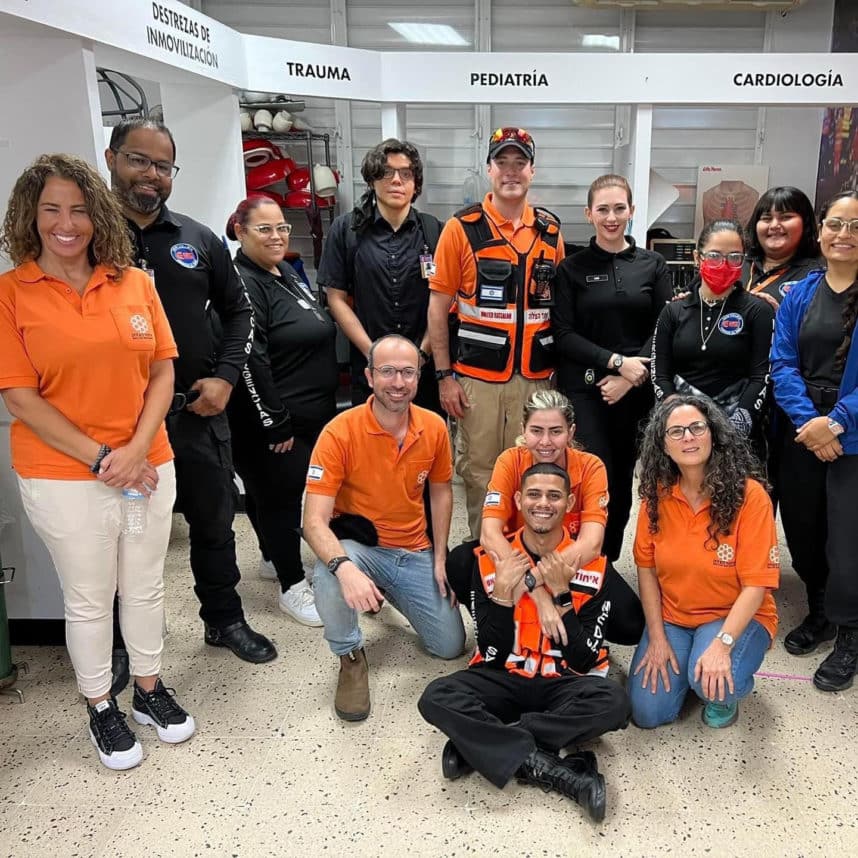
Volunteers for the United Hatzalah Mission to Puerto Rico worked with local first responders in Anasco in the wake of Hurricane Fiona. (Courtesy/United Hatzalah)

“We offer psychological first aid,” said Raphael Poch, a member of the Psychotrauma and Crisis Response Unit who is also the international media spokesperson for United Hatzalah. “We saw there is a need for psychological and emotional stabilization at the scenes of traumatic incidents,” he said.

Gavy Friedson, director of International Emergency Management for UH, arrived in Florida on Sunday and is part of the initial assessment team.

“It is a chaotic scene,” he described. “We are here to help people who lost their loved ones, their homes, but also to help the first responders who themselves are often traumatized.”

During the years in which the organization operated mainly in Israel, it developed a series of protocols and methods to deal with the immediate psychological trauma that comes with experiencing sudden upheaval, be it from natural causes or other causes.

The Psychotrauma and Crisis Response Unit is now in Florida. Established six years ago, it consists of volunteers who are psychiatrists, psychologists, social workers and other therapists. Its first mission to a hurricane disaster area was in 2017 during Hurricane Harvey, which hit Texas and Louisiana.

“If trauma is treated in time, the person can process the trauma in a healthy manner and move on; if it’s not treated in time it can develop in the end into post-traumatic stress disorder (PTSD),” Poch explained. “Those who receive treatment are much more able to function than those who don’t,” he added.

The first goal of the responders is to help victims realize that the immediate danger has passed.

“We find this extremely effective in the field,” said Friedson.

During their stay, the United Hatzalah team intends to guide local first responders on how to help people with psychological trauma with follow-up care.

Just before heading to Florida, the volunteers had finished a mission in Puerto Rico helping victims of Hurricane Fiona.

Volunteers for the United Hatzalah Mission to Puerto Rico meet with local residents in Anasco following Hurricane Fiona. (Courtesy/United Hatzalah)

On the first day of the Florida mission, they treated tens of people.

“The real answer to any human tragedy is acts of love and kindness. The fact that people come from different countries, to help people they do not know and will probably never meet again, that does a lot for the mental state of those suffering to know that people from all over the world care about what happens to them,” said Poch. “That already alleviates one of the big causes of emotional and psychological trauma, which is a sense of loneliness, and that makes a huge difference.”

Israel has extensive experience in treating PTSD sufferers, after decades of wars and terrorist attacks. This has resulted in the understanding that the mental care of survivors is no less important than their physical well-being.

“An ambulance comes and helps the physically wounded but what about all the bystanders and all the people who are emotionally affected and dealing with incident?” Friedson said.

“We provide tools to community leaders and local first responders. We are not coming to replace anyone, but as an add-on to local efforts going on,” Poch added.

Israel’s consulate in Miami also took part in relief efforts and dispatched supplies to people affected by the hurricane over the weekend.

“We as Israelis, out of appreciation and recognition of our special relations with the US, immediately stand by the people of Miami,” said Maor Elbaz-Starinsky, consul general of Israel in Miami.

“The thoughts and prayers of all Israelis are with the people of Florida, and all those who remain in the path of this devastating storm,” Israel’s Prime Minister Yair Lapid tweeted as the devastation wreaked by the hurricane became clearer.

“The impact of groups like UH … during times of need is great. I’ve seen it time and time again all over the world, of course also during the Champlain Towers tragedy in Surfside,” said Bal Harbour Mayor Gabriel Groisman. “Actions speak louder than words and the actions of these nonprofit groups demonstrate that the relationship between the United States and Israel runs deep. Their help is always appreciated.”

Elbaz-Starinsky and other staffers filled up cars with dry goods, water, fuel and flashlights and headed to the epicenter of the disaster zone.

“People immediately stood in line for supplies; it is difficult to imagine how much this aid is needed,” he told The Media Line.

According to Elbaz-Starinsky, the Israeli government has made an official offer of aid. There has been no response yet.

“We are examining in which ways we can be most beneficial,” he added.

Israel has a tradition of dispatching humanitarian aid after disasters. Through its military home front command or volunteer organizations such as United Hatzalah, Israelis are often seen in the epicenters of crises. For many victims, sometimes in countries who do not have warm or any relations with Israel, it is the first contact they have with Israelis.

“Our goal is to help where we can,” said Friedson. “An added bonus we constantly find is that the people we help have never met Israelis and are so grateful and appreciative for our response and are happy to see we aren’t what is portrayed in the news.”

Help for Hurricane Ian Survivors Comes From Israel Read More »

Competing Narratives of Jewish History and the Holocaust: Reflections on My Recent Journey to Poland

The relationship between Poles and Jews is complex and often contentious, historically when Poland was the home to the largest Jewish community in the world, ever more so when it was the site chosen by the Germans for the murder of Jews in death camps, and even today. We both remember a shared history, but often we remember it quite differently.

In 2018, Poland passed a law on Holocaust remembrance that the government believed would have benign implications on Polish-Jewish relations. The law sought to outlaw conflating the crimes committed by the Third Reich in occupied Poland with the Polish nation. While the Polish government may not be equally culpable for the crimes under German occupation, the law inhibited discourse on Polish complicity and accurate Holocaust memorialization.

The Israeli and American governments, along with the Jewish community, responded with strong condemnation. Accordingly, the Polish government recanted the possibility of criminal prosecution for violating the law; however, civil penalties remain. The second version of the law did not exclude creative and scholarly work in contrast to its predecessor. Israel, which initially agreed to the law, was slow to distinguish the differences, so much so that Yad Vashem, a government-sponsored memorial institution, admonished Israel’s complacency.

The issue of Holocaust remembrance is fraught in some cases, and there are competing narratives on how to accurately honor its victims. Three dominant narratives in the collection of Holocaust remembrance include: the Jews living in Poland, the Polish government, and Jews outside of Poland. Each narrative fails to incorporate a comprehensive overview of pre-Holocaust, the Holocaust and its aftermath.

Some neglect to include the complete arc of Jewish history in Poland, the background of Poland’s territorial sovereignty, or the resurgence of the Jewish community in Poland. However, a comprehensive narrative of the Holocaust in Poland under German occupation must account for 1,000 years of Jewish history in Poland, the context of previous conquests and annexation of Polish territory, and the current composition of Jewish life.

When studying the events of the Holocaust and World War II, specifically in Poland, many begin on September 1, 1939, with Germany’s invasion of Poland. Some posit that a more accurate starting point is the moments leading up to Germany’s invasion with the Anschluss of Austria, the takeover of the Sudetenland with the appeasement of Hitler by France and England, and the March 1939 conquest of Czechoslovakia.

While both of those dates align accurately with one objective of the Third Reich, to capture sufficient lebensraum,living space, for a more prosperous Germany unconstrained by territorial limitations, they neglect the second, more salient and consequential objective: the complete annihilation of the Jews, which was at the crux of Hitler’s nefarious intentions.

In 1939, there were 3.5 million Jews in Poland amounting to approximately ten percent of Poland’s population. Such a prevalent Jewish demographic could not exist without suitable conditions that could enable a minority group to survive and even thrive in segments. While the territory under the auspices of the Polish State expanded and retracted, Jews within its border, notwithstanding anti-Jewish riots and expulsions from certain cities, benefited from proclamations and statutes enumerating their rights. As a consequence of greater religious freedoms, synagogues, yeshivas, and other cornerstones of Jewish life sprouted throughout Poland. Hitler chose Poland to be the location for his death camps because Poland was the epicenter of Jewish life in Europe, far enough from Germany to provide a measure of secrecy, and some Poles supported the annihilation of Jews.

Although some overlook the integral role a thriving pre-World War II Polish Jewry plays on the narrative of the Holocaust, the contemporary Polish Jewish community and Poland’s government actively seek to highlight how it flourished before the Holocaust. And the rebirth of the Jewish community after communism, while modest in scope, is deeply symbolic in importance. Situated next to the Warsaw Ghetto Uprising Memorial, the POLIN Museum broke ground in 2007 and opened in 2013, filling a massive chasm in Polish museology. The POLIN Museum is not simply another Holocaust museum within the myriad Holocaust exhibits and memorials.

The POLIN Museum is a paradigm for what the rest of Polish Jewry seeks to achieve. The Holocaust and World War II, as destructive and unfathomable as the events were, dominated six years of Jewish history in Poland. The museum adequately and accurately depicts the events of the Holocaust within the greater context of the history of Jews in Poland. To some, the Holocaust is the beginning, middle and end of Polish Jewry. For the POLIN Museum, the Holocaust is one of many examples of how governments and people were both historically cordial or antagonistic to the Jewish people in Poland.

The Holocaust does not mark the end of Jewish history in Poland. Between the culmination of World War II and the fall of communism in 1989, the vast majority of Poland’s surviving Jewish community, more than 350,00 people, emigrated out of Poland. Figures vary on how many Jews stayed; however, the community that remained could not be rebuilt until the democratization of Poland.

As Poland’s Chief Rabbi Michael Schudrich expressed, “A Jewish community in Poland is the result of democracy.” The liberalization of Poland became a catalyst for those who hid their Jewish identity to share who they truly were. Second, it initiated uninfringed access to academic sources and the study of Jewish history in Poland. Lastly, democracy enabled open practice of the religious and cultural elements that are sacrosanct to Judaism.

The discovery by some Poles that they are Jewish or have Jewish ancestors has sparked considerable interest in learning more about Judaism. Access to academic sources spurred an influx of scholars, Jewish and non-Jewish, to study Jewish archives and Jewish history. Freedom of religion has ushered in a growing Jewish community in Warsaw led by Rabbi Schudrich, a JCC in Warsaw and a JCC Krakow that provide shabbat meals and teach Hebrew, a 34-year-old Krakow Jewish festival that is the largest Jewish festival in the diaspora (incidentally, organized by a non-Jew), shops and restaurants dedicated to Jewish culture, and other Jewish institutions.

To say that the Jewish community in Poland could see a resurgence to pre-Holocaust levels of Jewish life would be inaccurate, but to ignore the work accomplished since the post-Holocaust democratization of Poland in the revival of Jewish life in Poland is a great disservice to the overall narrative of Jewish history in Poland.

To say that the Jewish community in Poland could see a resurgence to pre-Holocaust levels of Jewish life would be inaccurate, but to ignore the work accomplished since the post-Holocaust democratization of Poland in the revival of Jewish life in Poland is a great disservice to the overall narrative of Jewish history in Poland.

While the American Jewish community tends to focus primarily on the six years of the Holocaust, the Polish government and many in the Polish Jewish community emphasize the periods of Jewish prosperity before World War II and in the last decades.

The Polish government and many Poles place the Holocaust and World War II within the structure of Polish sovereignty and the historical infringement of Polish self-determination by its neighbors. In addition to German occupation, Poland lost battles against Kievan Rus and the Holy Roman Empire; the third partition of the Polish-Lithuanian Commonwealth eliminated Polish sovereignty over its territory for 123 years; and political freedom and open markets crumbled under communist influence after World War II.

The larger Polish narrative differs from that of the Polish Jewish community. In this account, Nazi Germany’s occupation of Poland in 1939 is just another example of Poland as the victim of enemy aggression. While many of the most horrific atrocities committed during the Holocaust happened on Polish soil, the Germans occupied the country. Of course, there were Polish collaborators, Nazi sympathizers and Poles who turned in Jews to receive a reward. However, Poland’s government argues that the Polish government, then in exile in London, did not participate in the persecution of Jews, Roma and political prisoners.

Poland’s narrative depends on distinguishing aggressors and elucidating a degree of Polish victimhood. It agonizes over the difference between calling concentration camps “Nazi concentration camps in German-occupied Poland” as opposed to a less precise “Polish concentration camps,” often used within the Jewish community. To the native English speaker, the meaning of Polish concentration camps is clear. To Poles, the suggestion of Polish concentration camps obfuscates who was culpable for the crimes, who established and ran the camps, and who was in charge of the country. When applicable, Poland uses the German names of ghettos. For example, most Jews would be familiar with the Lodz Ghetto; however, the Poles will refer to it only as the Litzmannstadt Ghetto. In research conducted by institutes funded by the Polish government, a greater emphasis is placed on righteous Poles and crimes inflicted on ethnic Poles. Although the Polish government recognizes Jews as the main target of Nazi Germany, officials insist on including and stressing Polish suffering in the narrative.

A third storyline, the narrative of Jews outside of Poland, revolves around Jewish suffering, preserving faith, and the establishment of the State of Israel. To many Jews, Poland is nothing less and nothing more than a massive Jewish cemetery. Trips that take Jews to visit the cemeteries and killing centers at Lodz, Chelmno, Sobibor, Madjanek, Treblinka, Auschwitz and Birkenau corroborate the aforementioned claim. But these visits fail to capture the broader scope and context of Jewish history in Poland. As Helise Lieberman, the director of the Taube Center, stated, “Only going to concentration camps and ghettos is not education.”

Educating young Jews about the Holocaust cannot be confined to an equation: death and suffering plus preservation of faith equals the creation of Israel. The Holocaust is an example of the most malevolent actions within the spectrum of human capabilities. However, the presence of Jewish life in Poland should be celebrated alongside the recognition of these atrocities. It should be just as much an integral part of studying the Jewish experience in Poland. Likewise, Poland’s government must acknowledge and discern the roles of individual collaborators even while recognizing that the Polish nation was under German occupation.

The mechanisms by which governments and people reckon with their pasts are indicative of the future they are looking to build. If Jews focus solely on death and destruction, it will serve as a signal to the generations that follow that Jewish life is confined to moments of sorrow—hardly a reliable foundation on which to build. Similarly, should the Polish government disproportionately concentrate on Polish woes, it would catalyze a future where distorting history becomes an instrument for personal gain. For the Polish Jewish community, Poland’s government, and the Jewish community at-large, a comprehensive narrative is sacrosanct to preserving the memory of the Holocaust and ensuring a brighter future.


Ezra Hess is a Program Associate for NCSEJ, the National Coalition Supporting Eurasian Jewry, a nongovernmental organization dedicated to advocating for Jews in the former Soviet States and its historic sphere of influence. Recently, he participated in a trip funded by Poland’s Ministry of Foreign Affairs to bring members of American Jewish organizations to Poland.

Competing Narratives of Jewish History and the Holocaust: Reflections on My Recent Journey to Poland Read More »

Meet the Former Class President Who Keeps Aiming Higher

When I first learned that Judith Manouchehri (née Kermani) is running for a seat on the Board of Governors of the Beverly Hills Unified School District (BHUSD), otherwise known as the Board of Education, I smiled. And I thought about 1994.

That was the year that “Judy,” as we called her, served as eighth grade class president at our elementary and middle school, Horace Mann, in Beverly Hills. I was a fifth grader then, but Judy and my older sister were in the same grade, and they were close friends. When I read the election results and saw the words, “Judy Kermani, President,” I felt redemptive pride that an Iranian American Jew like myself was elected to such a high position. Yes, it was merely an eighth-grade class election, but at the time, it meant so much.

Four years later, as a senior, she was elected Associated Student Body (ASB) president at Beverly Hills High School. That too, was quite a feat. But by then, I wasn’t surprised that Judy had assumed so much responsibility.

In truth, before I met Judy, I didn’t believe that Iranian students, who were truly underdogs back then, were permitted to be assertive leaders. And whereas others (including myself) merely tried to survive among throngs of students, Judy seemed unabashedly invested in building relationships.

That probably explains why, after completing her undergraduate studies at UCLA and law school at USC, she became a real estate and construction attorney; she was still drawn to building, whether metaphorical or literal. I couldn’t have imagined her pursuing any other field.

Judy was only two years old when her family escaped post-revolutionary Iran. Back in Tehran, her father had served alcohol (forbidden in the nascent Islamic theocracy) at a home gathering and was arrested by the feared paramilitary police. Upon his release, the family, including Judy and her three-year-old brother, Jonathan, escaped the country in the middle of the night and traveled on horse-drawn carriage through Pakistan. They spent several weeks in Spain before arriving as protected refugees in the United States in 1982. A younger sister, Jasmine, was born in the U.S.

The family chose to join their relatives and resettled in Beverly Hills, home to what was then a new Iranian Jewish community. “We helped each other and created a community with shared values,” Judy told me. “We helped one another move forward and build new lives together.”

Growing up in Beverly Hills, community became ingrained in Judy, but there was something else. She quickly understood that community was a living, breathing organism; it needed to be nurtured and sometimes, even developed from the ground up. But Judy was different from most of her peers: She actually felt responsible for her community, which quickly grew to include her own friends and neighbors in Beverly Hills.  

Growing up in Beverly Hills, community became ingrained in Judy, but there was something else. She quickly understood that community was a living, breathing organism; it needed to be nurtured and sometimes, even developed from the ground up.

I asked Judy what was special about growing up in Beverly Hills in the 1990s: “It was the level of connection, support, trust and excellence,” she said. “At that time, we had 4,000-5,000 kids in the district, and we really excelled across the board: Academics, athletics…we were the apple of the city’s eye.”

Today, BHUSD’s student enrollment is roughly 3,300. “It’s a challenge to pinpoint exactly why enrollment has declined, because our district has endured many changes and challenges the last several years,” she said. That includes a middle school reconfiguration and a global pandemic that completely upended classrooms around the world. Currently, Judy’s three children, a preschooler, an elementary student and a middle school student, are enrolled in BHUSD.

The notion of a community can be vague and ever-changing; some associate it with geographically-close friends and neighbors; others with faith-based communities and houses of worship; and still others with virtual communities. Judy primarily associates community with schools, and good schools “are the foundation of a solid community,” she said. And she connects the dots between her Jewishness and desire to lead, describing her Jewish identity as three-dimensional: “You remember your past, and it very much relates to your present and future.” And that also seems to be her approach to the BHUSD: recognizing the past, present and future.

But running a campaign isn’t easy (the election is November 8). While campaigning, Judy’s heard from hundreds of parents, but the initial concerns were expressed by her own children, who conveyed a lack of enthusiasm over attending Beverly Hills High School (BHHS) in the future. Speaking from my own experience trying to visit the school in the last decade, the famous front end of the campus has turned into a seemingly never-ending construction site.

“One of the biggest challenges is that there’s been over $700 million in construction bond money since 2008,” said Judy. “The entire BHHS front lawn, where so many of us ate lunch, played sports and relaxed with friends, has been a construction staging area for years. We’re reaching a point where it’s been that way for so long that the students themselves don’t know anything different, and that’s sad.”

But ever the optimist (at Horace Mann, she was even a member of the elite Optimist International club), Judy sees a vibrantly bright future for BHUSD. And she recognizes that in running for a coveted seat on the school board nearly 30 years after assuming her first role as a student leader, she’s aiming to complete a circle of gratitude and service.  

“I attribute so much of who I am to this school system and this community,” she said, “which is why I want to have that full-circle moment.”

“I attribute so much of who I am to this school system and this community,” she said, “which is why I want to have that full-circle moment.”


Tabby Refael is an award-winning, LA-based writer, speaker and civic action activist. Follow her on Twitter @TabbyRefael

Meet the Former Class President Who Keeps Aiming Higher Read More »

Berkeley Law Dean, Profs Express Support for Jewish Students

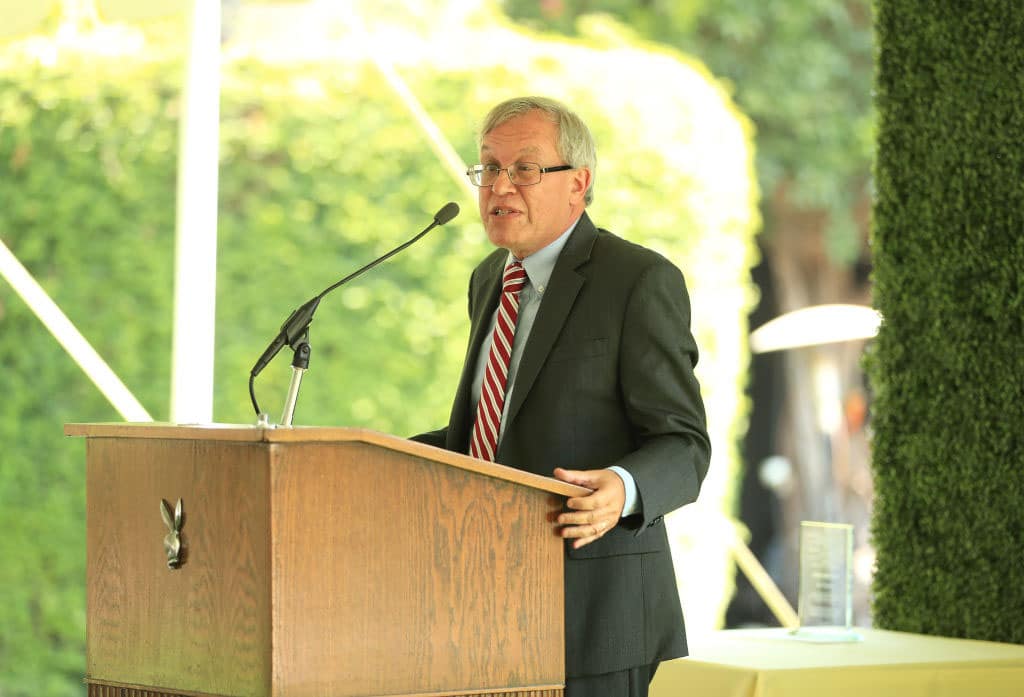
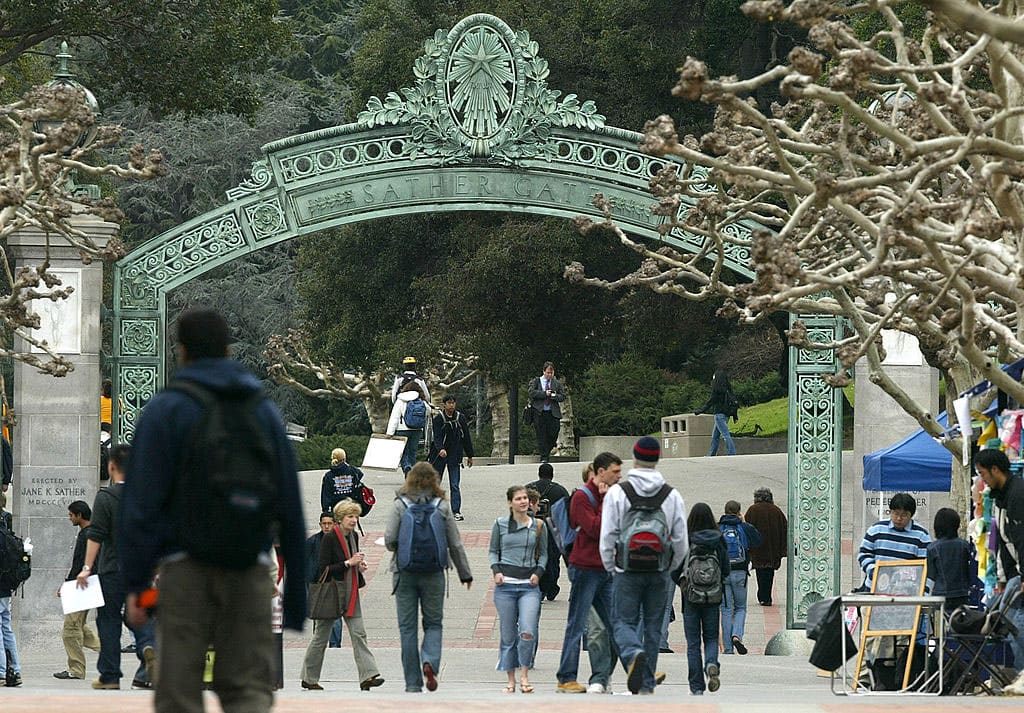
Several members of the Berkeley School of Law faculty, including Dean Erwin Cherminsky, have signed a statement expressing support for Jewish students after several student groups passed bylaws refusing to invite Zionist speakers to campus.

The statement, which was spearheaded by the Academic Engagement Network (AEN), says that the bylaws passed by these student groups are “antithetical to free speech and our community values.  These bylaws would also impermissibly exclude a large majority of our faculty from participating in the work of these organizations, including our Dean.” “Many Jews (including some of us signing below who are Jewish) also experience this statement as antisemitism because it denies the existence of the state of Israel, the historical home of the Jewish people,” the statement continued. “For many Jews, Zionism is a core component of their identity and ethnic and ancestral heritage. As an educational institution we hope that the student groups that have now endorsed a ‘No Zionist speakers’ pledge will engage in dialogue on these issues.”

The statement comes after Kenneth Marcus, who heads the Louis D. Brandeis Center for Human Rights Under Law and a Berkeley alum, wrote a September 28 Journal op-ed accusing the student groups of establishing “Jewish-free zones” with the bylaws. Cherminsky wrote in The Daily Beast that Marcus’ assertion that the bylaws amounted to “Jewish-free zones” on campus is “grossly misleading.” “A handful of student organizations—fewer than 10 out of over 100—initially adopted the by-law,” Cherminsky wrote. “But the rest rejected it or ignored it. Some that quickly accepted it are now reconsidering that. Most importantly, no group has violated the Law School’s policy and excluded a speaker on account of being Jewish or holding particular views about Israel. Such conduct, of course, would be subject to sanctions.”

Cherminsky’s statement about sanctions prompted Marcus to respond with an October 3 Journal op-ed stating that the “the tide is beginning to turn at Berkeley Law.”  “It is hardly enough, though, to tuck an important policy statement into a parenthetical comment in an internet publication. Chemerinsky must take the next step and make it formal,” Marcus wrote. “And he must convince all Berkeley law student groups to remove anti-Zionist provisions from their bylaws. He should remind these groups that their future application for bar membership is contingent upon a moral character determination. Adoption of discriminatory bylaws is hardly evidence of high moral character. He should remind them that exclusionary bylaws are inconsistent with their status as university-funded, registered student organizations.” Marcus also noted that more than 150 student groups worldwide signed onto an October 3 statement denouncing the bylaws “as a deliberate attempt to exclude Jewish students from the UC Berkeley campus community.”

Also on October 3, the Simon Wiesenthal Center issued a statement calling on California Governor Gavin Newsom, a Democrat, and the UC Regents to decertify the student groups at Berkeley Law that passed the bylaws against Zionist speakers. Wiesenthal Center Founder and Dean Rabbi Marvin Hier and Associate Dean and Director of Global Social Action Agenda Rabbi Abraham Cooper compared the student groups’ actions to “Stalin’s Soviet Union, Mao’s China, or Ayatollah Khamenei’s Iran” and that the groups are essentially “aiding and abetting Hamas and other groups seeking the destruction of the Jewish State of Israel.” “California taxpayers, Berkeley alumni, and university donors should not be contributing one penny to any Berkeley law school linked group that has signed on to such pernicious censorship,” Hier and Cooper said. “Those involved with this campaign should be sanctioned by the Law School and barred from any honors or law reviews.” They concluded with a call for Newsom and the UC Regents “to immediately act to de-certify Berkeley law school groups discriminating against ‘Zionists.’”

Berkeley Law Dean, Profs Express Support for Jewish Students Read More »

Is the Tide at Berkeley Beginning to Turn?

Last week, a Jewish Journal article I authored exposing Berkeley Law’s Jewish-free zones touched a nerve. Over the last few days, it has been discussed on countless platforms, widely praised, and retweeted by celebrities, elected officials, and others, for “exposing this appalling anti-Jewish discrimination” (as the ADL’s Jonathan Greenblatt put it). As is the way with such things, the article was also criticized, especially among Berkeley faculty displeased it made “major news.” But what is significant – more than the praise or the criticism – is that the tide is beginning to turn at Berkeley Law.

Understanding the change requires a recap. At the start of this academic semester nine Berkeley Law groups changed their bylaws to ban Zionists from speaking to their groups. Berkeley Law’s Jewish Student Association immediately expressed alarm about “the impact this by-law is having on our Jewish community.” They observed that these bylaws put many Jewish students “in a position all too familiar: deny or denigrate a part of their identity or be excluded from community groups.” Berkeley Law Dean Erwin Chemerinsky, a progressive Zionist, acknowledged that  he himself would be banned from speaking before the nine student groups, as would 90% of Berkeley’s Jewish law students. According to Pew, the vast majority of Jews view Israel as integral to their Jewish identity.

Chemerinsky’s initial criticism was qualified, however. He emphasized that only nine groups were banning Zionist speakers, as if this were good news. And he chastised one of the first newspapers to report on it calling it a “minor incident” that “hardly should be news” and claiming the media was using it to “paint a misleading picture.” He was troubled that a particular viewpoint was silenced but seemed unaware that it was also a particular community – his own – that was being harmed. He failed to grasp the ramifications of what these groups are doing, or he just wanted it to go away without any attention or fanfare. But make no mistake, this was no mere act of viewpoint discrimination. In barring Zionists, these nine groups were banning a people. And Berkeley’s administration failed to resolve this problem, leaving the discriminatory boycotts in place.

Several Jewish establishment figures decided to be quiet. Quietism has a long pedigree in Jewish communal history, but not necessarily a proud one. At all periods, Jewish establishment voices have urged community members to endure persecution in silence, assimilating to deteriorating conditions. The idea is that anything we say or do could provoke a backlash that makes things worse.

The problem is that things are already getting worse – and it doesn’t help to permit anti-Jewish forces to entrench their gains. The troubles in Berkeley follow efforts to exclude Zionists from various campus spaces around the country. The Brandeis Center has recently convinced the Biden administration to investigate such incidents at the University of Southern California and the University of Vermont. But we are seeing such problems nationwide. When we permit serious discrimination to persist at major institutions like the University of California’s flagship school, we should expect that it will recur elsewhere.

Since last week’s article, Berkeley’s Jewish apologists have circled their wagons. Chemerinsky criticized my article; I have refuted his criticisms. Two Berkeley professors, Ron Hassner and Ethan Katz, expressed indignation – not so much at what they call the “nakedly discriminatory” bylaws that they concede is “bound to make Jewish students feel excluded,” nor at Berkeley’s administration, for its feckless response – but at me, similar to how Chemerinsky initially blamed the media. They call my claims “outlandish” but not once do not deny that they are true. They call me inflammatory, because I rang the alarm when their house caught fire. Fortunately, the students are speaking back. On Tuesday evening, for example, over 150 student organizations, several at Berkeley, issued a joint statement urging the nine law student groups to rescind their discriminatory bylaws provisions. “As members of the global Jewish community,” they write, “we recognize these bylaws as a deliberate attempt to exclude Jewish students from the UC Berkeley campus community.”

Now, with the whole world talking about the outrage – the exclusion of Jews, not the fact that I’ve written about it – Chemerinsky has written yet again, this time in the Daily Beast. Chemerinsky complains again about my initial article without challenging any of its factual assertions. He falsely claims that “all some student groups have done is express their strong disagreement with Israel’s policies,” when the undisputed facts show that they changed their bylaws to bar Zionist speakers. But then he does something remarkable.

Chemerinsky announces that these nine groups will be punished if they follow through on their pledge to ban Zionist speakers. “Most importantly,” Chemerinsky writes, “no group has violated the Law School’s policy and excluded a speaker on account of being Jewish or holding particular views about Israel. Such conduct, of course, would be subject to sanctions.”

At long last, under pressure, Berkeley Law’s Dean is pledging to enforce Berkeley’s anti-discrimination rules against any of these nine organizations that act upon their new bylaw provisions. He must be held to it. This is a significant commitment, and it’s a far cry from his initial statement. Chemerinsky could not pledge to punish these groups if he believed that their actions were constitutionally protected. Implicit in his pledge is the understanding, delayed as it is, that neither our Constitution nor our laws protect actions that restrict equal protection. Implicit also is the awareness that anti-Zionist actions violate anti-discrimination rules. Anti-Zionism is racism, pure and simple.

It is hardly enough, though, to tuck an important policy statement into a parenthetical comment in an internet publication. Chemerinsky must take the next step and make it formal. And he must convince all Berkeley law student groups to remove anti-Zionist provisions from their bylaws. He should remind these groups that their future application for bar membership is contingent upon a moral character determination. Adoption of discriminatory bylaws is hardly evidence of high moral character. He should remind them that exclusionary bylaws are inconsistent with their status as university-funded, registered student organizations. As nearly 30 Jewish, civil rights, and pro-Israel organizations put it in a joint statement issued on Monday evening, “the nine student organizations should rescind the new, discriminatory provisions from their bylaws or face appropriate sanctions for their failure to do so.” The law, and basic standards of fairness and decency, demand nothing less.


Kenneth L. Marcus is founder and chairman of the Louis D. Brandeis Center for Human Rights Under Law. He served as the 11th Assistant U.S. Secretary of Education for Civil Rights.

Is the Tide at Berkeley Beginning to Turn? Read More »

you-dont-know-schiff

Carrot Top – Part 1

This week we are joined by Scott Thompson, known to the entire world as the hilarious and wildly entertaining comedian Carrot Top! A thirty year veteran of comedy, Carrot Top has become the iconic “King of Props” with an always-evolving, insightful act including keen observations of the world of pop culture. He has been delivering a powerhouse of a show headlining in Las Vegas for 25 years, including his ongoing residency at at the Luxor Hotel since 2005.

Scott was as nice as could be, and talked with Mark and Lowell for two hours. In this first installation, they cover many topics including Scott’s start in comedy at a college open mic night, working with his NASA engineer father on developing props, doing hundreds of TV shows and talk shows including “The Tonight Show” an incredible 31 times, and how he might have quit comedy early on if it weren’t for a few kind words from some fans while he was working at a restaurant.

Be sure to check out Carrot Top’s website for tickets, and follow him on his social media:
carrottop.com
Instagram @carrottoplive
Twitter @RealCarrotTop

Mark’s books are available for purchase!
Available November 8, 2022.”Why Not: Lessons on Comedy, Courage, and Chutzpah.”
Click on these links to buy:
Amazon
Barnes & Noble
Books-A-Million
Bookshop.org

Read road stories from some of the best comedians of our generation in Mark’s first book  “I Killed: True Stories of the Road from America’s Top Comics” available now!

Please follow “You Don’t Know Schiff” so you don’t miss out on any exciting episodes. Click here to subscribe on Apple Podcasts (and please leave us 5 stars and a positive review – your support means the world to us and it helps us get discovered by new listeners):

Your hosts:
markschiff.com
Twitter: @markschiff
Instagram: markschiff1
 

Lowell Benjamin
Twitter: @lowellcbenjamin
Instagram: @lowellcbenjamin


Carrot Top – Part 1 Read More »