
fbpx

September 16, 2022

Legislature Approves Bill to Protect Californians from Hate-Motivated, Antisemitic Violence

During a shabbat service this January at Congregation Beth Israel in Colleyville, Texas, a gunman stormed into the synagogue, taking the congregants hostage for more than 11 hours. As the gunman made threats and demands, Rabbi Charlie Cytron-Walker kept his congregation calm, waiting for the right moment to strike the perpetrator with a chair and usher the victims to safety. Thanks to Cytron-Walker’s expertise, everyone escaped safely.

In interviews following the incident, Cytron-Walker attributed his swift, decisive action to security training he had received from local nonprofit organizations.

More than a thousand miles away, California lawmakers took note.

The California State Legislature unanimously passed a measure in late August to strengthen protections for Californians facing hate-motivated violence. The bill, known as AB 1664, would expand the state’s Nonprofit Security Grant Program, which provides funding for security enhancements at institutions at risk of hate-motivated violence.

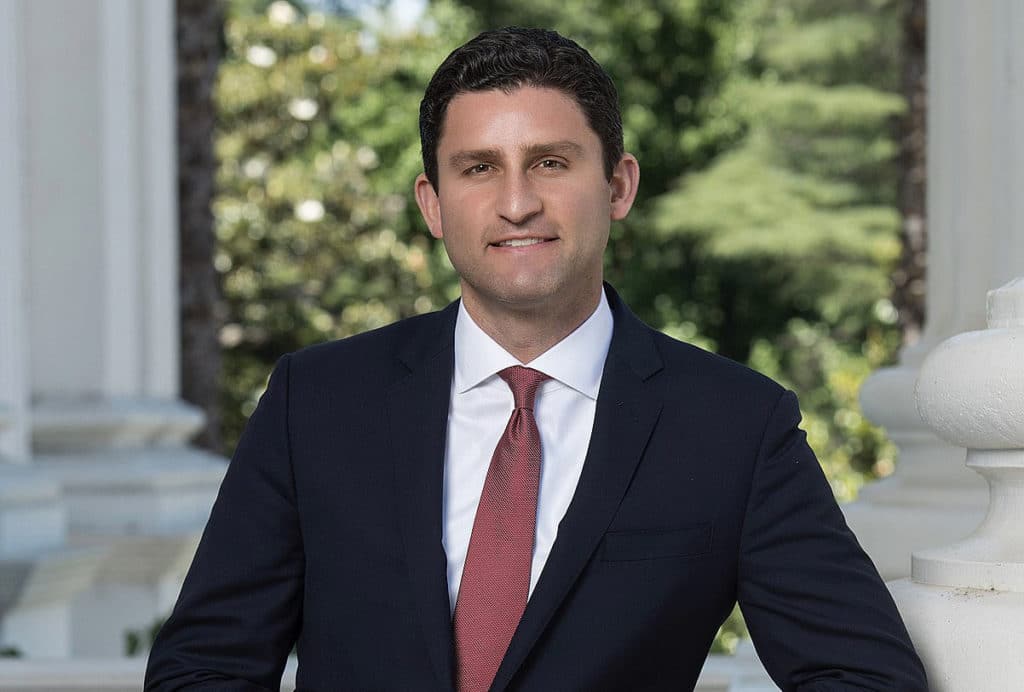
Assemblymember Jesse Gabriel (D-Woodland Hills), who authored the bill, said that it was introduced to the legislature in response to the standoff at Congregation Beth Israel. Gabriel cited a recent report from the California Attorney General that found a nearly 90 percent uptick in hate crimes in the state over the last decade as further reason to expand security protections at vulnerable community centers.

“In a world where hate crimes and antisemitism are on the rise, we need more than thoughts and prayers to keep us safe,” said Gabriel.  “This new law will provide critical resources to protect vulnerable communities and sends a powerful message that California stands firmly with those targeted by hate.”

Gabriel initially authored legislation to create California’s Nonprofit Security Grant Program in 2019, following a deadly shooting at Chabad of Poway. The program funds security enhancements at religious institutions, LGBTQ spaces, community centers, reproductive health facilities and other nonprofits deemed at risk of violence.

The Nonprofit Security Grant Program was originally slated to end in 2025. However, AB 1664 would extend the program’s lifespan and strengthen its ability to keep communities safe, giving recipient institutions greater flexibility to use grant funding for initiatives like security training. This year’s state budget included a $50 million allocation for the program, which was secured with the support of leaders and activists representing a broad coalition of vulnerable communities.

Jewish community leaders across the state have voiced their support for the bill—and for the continued funding of the Nonprofit Security Grant Program.

“In the midst of staggering levels of hate-motivated violence—targeting Jews and all vulnerable communities—we are fortunate to have the California State Nonprofit Security Grant Program to protect at-risk institutions from attacks,” said David Bocarsly, Executive Director of the Jewish Public Affairs Committee of California. “JPAC co-sponsored Assemblymember Gabriel’s bill to establish the program in 2019 because we knew first-hand the value it would provide. Given the overwhelming demand for this resource, we are proud to co-sponsor AB 1664 to extend this program and expand it to include security training.”

AB 1664 now heads to Gov. Gavin Newsom’s desk for signature, where it must be acted upon by Sept. 30.
Legislature Approves Bill to Protect Californians from Hate-Motivated, Antisemitic Violence Read More »

Kissinger Discusses Nixon, Leadership At Nixon Library

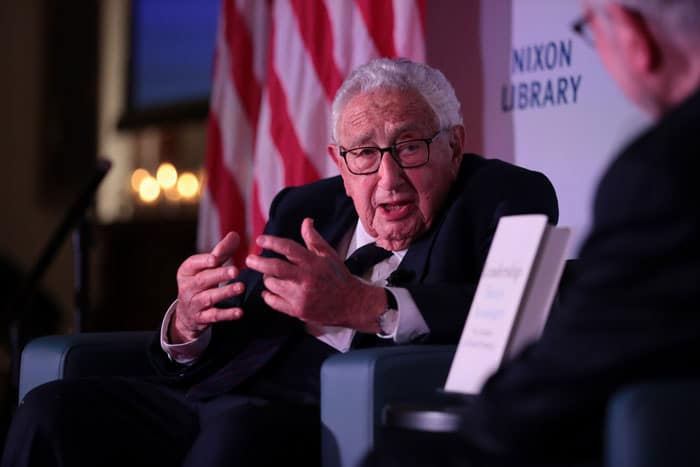
Former Secretary of State Dr. Henry Kissinger discussed what he thinks are the most important qualities in a leader in a September 14 appearance at the Nixon Library.

Kissinger, 99, was being interviewed by former Richard Nixon aide Frank Gannon about his new book, “Leadership: Six Studies in World Strategy,” which came out in July. Kissinger lauded Nixon for combining “vision and courage in an extraordinarily complex period in which the unity of the country was disintegrating and [in] which the international system was being attacked in so many places.” Kissinger went on to explain that he had never met Nixon before being tapped as his National Security Adviser (NSA); in fact, before Nixon was elected president, Kissinger was a close friend of Nelson Rockefeller, one of Nixon’s Republican presidential primary opponents.

“When President Nixon invited me to talk to him a few weeks after his election he didn’t do it to offer me anything,” Kissinger said. “We had a two-hour conversation as if we were college professors about the state of the world.” The meeting ended with Nixon requesting that one of his staffers and Kissinger establish a telephone line with each other. “As if Cambridge was a place that didn’t have adequate communication,” Kissinger quipped, prompting laughter from the audience. At the time, Kissinger was teaching at Harvard University.

During Nixon’s five-and-a-half years as president, Kissinger said that “peace in the Middle East was being advanced” and the “war in Vietnam ended on the terms that we set from the beginning: People who had relied on America should not be sacrificed.” And of course, the administration forged open relations with China. “People today often ask me what would Richard Nixon do today [with China] and I’m sure I know what he would do,” Kissinger said. “He would create a situation that makes it clear that threatening American security is too dangerous … but he would also simultaneously be in a dialogue to China.”

Kissinger explained that Nixon worked “within the framework of adult psychology” in his approach to leadership. “Nixon did not like enter a room and pound the table,” the former Secretary of State said, yet Nixon would still act “quickly and decisively” when a decision was made. As examples, Kissinger pointed to Nixon forging the Strategic Arms Limitation Talks (SALT) agreements with the Soviet Union in 1972, an election year in which Nixon was accused of not doing enough to achieve peace; at that time, the north Vietnamese was launching attacks against all of Vietnam with the help of the Soviets. The SALT agreements capped the United States and Soviets’ amount of antiballistic missile sites and put a freeze on each country developing intercontinental ballistic missiles. Kissinger also pointed to Nixon’s decision to send military supplies to Israel during the Yom Kippur War of 1973 as an example of the late president acting decisively, as a ceasefire was reached between Israel, Egypt and Syria a couple weeks later.

Photo courtesy of the Nixon Library

Kissinger said that the “key to Nixon’s thinking on these matters” was his viewpoint that “you pay the same price for doing something halfway as doing it completely.” “If you don’t know what to do tactically, ask yourself what you should want to be the end result of the process as a leader,” the former secretary of state said.

Kissinger proceeded to call Nixon’s resignation from the presidency during the Watergate scandal as being a “tragedy” because he and Nixon believed that the U.S. was growing “closer to either Russia or China than they were to each other” at that time. “The ultimate legacy of a leader is not the things he does himself but the process he starts and the thought that he leaves behind on which future societies can build,” Kissinger said.

The conversation then turned to Kissinger’s thoughts on the late Golda Meir, Israel’s prime minister during the Nixon administration. Kissinger called Meir “a spectacular person.” “She could make herself look like your favorite grandmother but she was very tough,” he said. He praised her for keeping “her country together in the early days [of the Yom Kippur War] where it looked as [if] things might turn badly.” 

Kissinger also recalled that Nixon had suggested that the administration publicize their viewpoint that the Soviets needed to be expelled from the Middle East. “All hell broke loose when I said it [publicly],” Kissinger said.

Kissinger then turned back to Nixon’s leadership philosophy, explaining that his debates with Nixon would focus on “how we could be both strong and vigilant.” “Too often our professional debate is conducted as a debate of people who want to do away [with weapons] and others who think you can do everything with weapons,” Kissinger said, adding that Nixon wanted “to bring the two [viewpoints] together.” He proceeded to mention Nixon’s “prescient” 1967 essay in Foreign Affairs that suggested that the U.S. could take advantage of China and the Soviet’s deteriorating relationship with each other as a way for the U.S. to develop better relationships with both countries. And when Soviet and Chinese forces broke out into a military conflict in Siberia early in the Nixon administration, Nixon looked into which one of the two was weaker. “When you have two adversaries and you’re concerned about both of them and they’re in conflict, you should support the weaker against the stronger,” Kissinger said.

The former secretary of state proceeded to say that when working through a crisis like the current Russian invasion of Ukraine, it’s important to determine “not only how you achieve victory but what you do after victory.” “When you talk about the Ukraine situation, do we want to create a situation in which a Russia that has been stopped in its tracks but in which Russia that becomes open to a new relationship with the west or that it looks to China for its support?” Kissinger said, adding that “the next three moves” after the war is over need to be determined.

Kissinger concluded the event by saying that leaders will drive themselves “crazy” if they care about public opinion and that in order to be a great leader, “you have to have a vision for your country because great leaders move people in their country from where they are to where they have never been.” He also recounted that during one of Nixon’s last nights in office, Kissinger told him that “history will treat you better than you can ever imagine,” to which Nixon replied: “That depends who writes history.” “Who writes history depends in large part on the memory that reflects society’s capacity for achievement,” Kissinger said, “and I think that remains to be true because if leaders are totally focused on themselves, they become overwhelmed by the communications of the moment and they expend so much of their effort trying to figure out the angle that they forget what the direction should be. I think that’s the overwhelming problem of our time.”

Kissinger Discusses Nixon, Leadership At Nixon Library Read More »

The Three Books of Judgment

In Masechet Rosh Hashanah, Rabbi Kruspedai says in the name of Rabbi Yochanan that three books are opened in heaven on Rosh Hashanah: one for the righteous, who are inscribed for life; one for the wicked, who are inscribed for death; and one for the beinonim, the middling ones, whose fate, as of Rosh Hashanah, is yet undecided (16b).

The image this teaching invokes—three books in heaven where our life or death is sealed—would be terrifying if it weren’t so implausible, but indeed it is implausible. We live in a world where the wicked often flourish and the righteous suffer.

There is a theological problem here, the technical term for which is theodicy: How do we maintain a belief in God’s goodness in a world where evil and misfortune exist? It is a problem that has kept theologians and philosophers awake at night for millennia, and which has inspired a number of creative readings of Rabbi Kruspedai’s teaching throughout Jewish history.

The Tosafot, medieval Talmud commentators in France and Germany, taught that “life” and “death” don’t refer to life and death on this plane of existence, but rather in the world to come.

Ramban, a medieval mystic and Torah commentator living in Spain, taught that Rabbi Kruspedai’s teaching is correct, but that only God knows who is considered a righteous person or a wicked person. It may be that a seemingly wicked person earns God’s favor in a single, unseen action. It may also be that a seemingly righteous person commits a grave offense when no one is watching.

The Raavad, a medieval philosopher, taught that each person is born with an arbitrarily predetermined lifespan. On Rosh Hashanah, a wicked person may have their life shortened by five years on account of their sins. If their predetermined lifespan was 120 years to begin with, however, this still leaves them with 115. This, then, would explain why the righteous sometimes have short lives and the wicked sometimes have long ones.

Our modern culture has produced its own responses to the problem of theodicy.

There is a psychological approach that maintains that the wicked, while they may flourish in life, will be plagued by guilt over their wicked deeds. The righteous, on the other hand, will sleep easy because of their clean conscience, even if their material circumstances are wanting.

There is a New Age approach that maintains that we “manifest” good and bad fortune with positive or negative thoughts, and thus have no one but ourselves to blame.

There is also the despairing response of the modern soul who does not believe in divine punishment or reward, but who sometimes wishes that he or she did on account of the great injustices and sufferings that are wrought upon innocent lives in this world.

The solutions offered by the Tosafot, Ramban and Raavad are successful in that they solve the central problem of Rabbi Kruspedai’s teaching, which is that it does not accord with observed reality. Nonetheless, each feels like a bit of a stretch.

The psychological solution, on the other hand, just feels like wishful thinking. We know that there are happy sinners and sorrowful saints.

The New Age solution is cruel and blames those who suffer for their own suffering.

The despairing response leaves us confounded.

Ultimately, there are no truly satisfying solutions to the problem of theodicy, for they all leave the problem intact when it would be better dismantled.

We are dealing with a faulty premise, which is the “goodness” of God. It’s not that God isn’t good—but I believe there is a bit of confusion around what we mean when we talk about God’s goodness.

Good and evil are both creations of God (Isaiah 45:7). Nonetheless, in the creation story, it is written that all of creation is “good,” as in, “and God saw all that had been made, and found it very good” (Genesis 1:31).

How can it be that God deems creation “very good” when creation contains both good and evil? The answer, it seems to me, is that the former (Genesis) deals with absolute goodness whereas the latter (Isaiah) deals with relative goodness.

By this I mean that the realities that humans experience as evil, painful, wrongheaded and destructive do not necessarily constitute a flaw in creation. Consider an example from nature: If a gazelle could be a theologian, surely it would ask why a good God would permit the existence of lions. We know, however, that this is merely the gazelle’s relative perspective. From an absolute point of view, both the gazelle and the lion are integral parts of a balanced natural order.

To take an example closer to home, consider death. Throughout the entire rabbinic discussion cited above, it is taken for granted that death is a punishment for evil. Indeed, death feels like a very evil thing to us mortals. We love each other, and thus we hate to say goodbye. We love living, and thus we hate to go. But is death really evil?

We love each other, and thus we hate to say goodbye. We love living, and thus we hate to go. But is death really evil?

If we attempt to leave behind our human subjectivity and imagine the earth as God sees it, we will come to understand that death is not a curse or a punishment but an integral part of life on earth.

The beloved spiritual teacher Ram Dass used to marvel at the fact that the world can be so full of trouble and yet so perfect just the way it is. These are not contradictory statements, but rather truths that exist on different planes of perception—one relative and one absolute.

On Rosh Hashanah, we are called to participate to different degrees in both planes of perception: the absolute, in that it is the anniversary of the creation of the world; and the relative, in that it is the day of judgment.

We are called to examine our actions and to consider how we can move forward and grow as individuals and communities, but we are also called upon to reflect on the first chapter of Genesis, which reminds us, as we tremble at the shofar’s blast, that everything is “very good” just the way it is.


Matthew Schultz is the author of the essay collection “What Came Before” (2020). He is a rabbinical student at Hebrew College in Newton, Massachusetts.

The Three Books of Judgment Read More »