fbpx

August 19, 2022

German Police to Investigate Abbas for Saying Israel Committed “50 Holocausts” Against the Palestinians

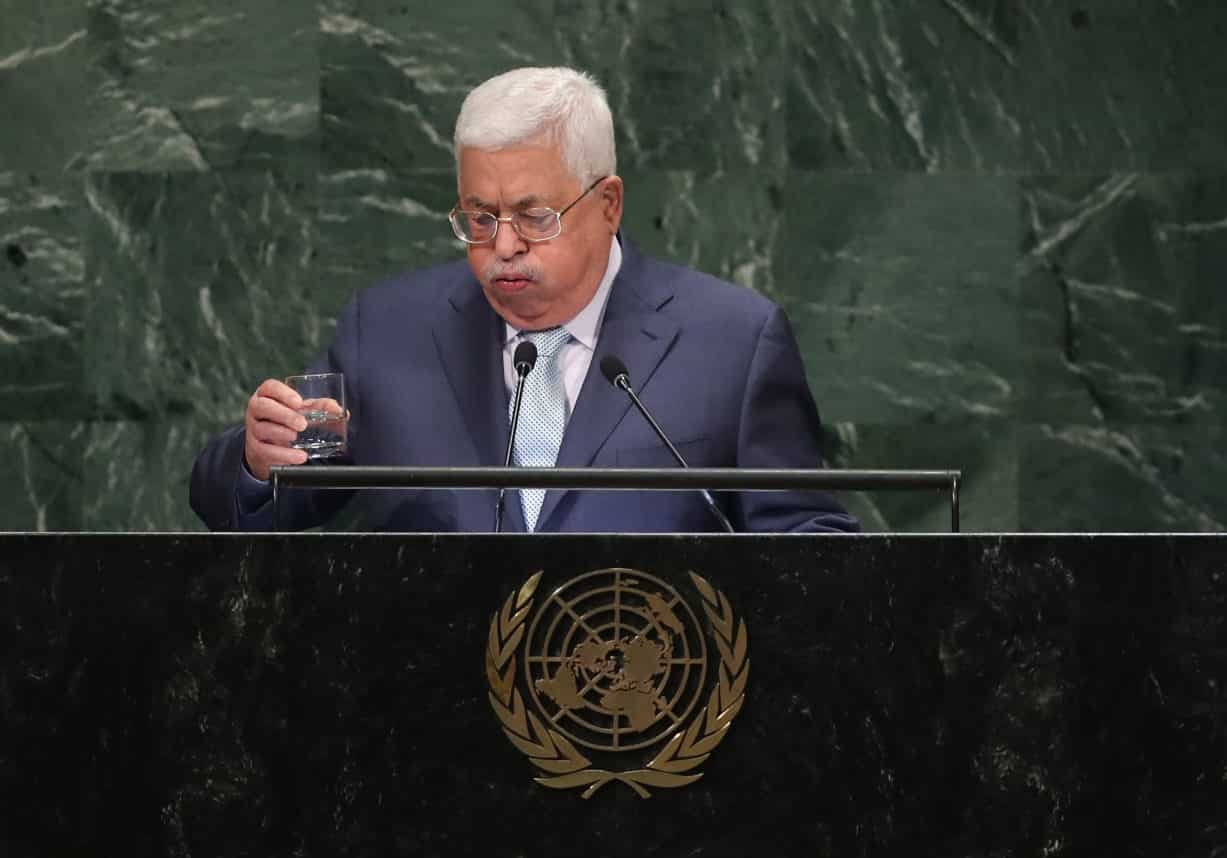
German police announced on August 19 that they are investigating Palestinian Authority President Mahmoud Abbas for saying earlier in the week that Israel has committed “50 Holocausts” against the Palestinians.

Abbas uttered his “50 Holocausts” remark during a joint press conference with German Chancellor Olaf Scholz in Berlin on August 16. The Jerusalem Post reported that Abbas was asked by a reporter if he would apologize for the 1972 Munich Olympic massacre, when Palestinians terrorists killed 11 Israeli Olympic athletes. “If you want to go over the past, go ahead,” Abbas replied. “I have 50 slaughters that Israel committed … 50 massacres, 50 slaughters … 50 holocausts.”

ABC News reported that Berlin police have started a preliminary investigation into Abbas’ comments, as Holocaust denial is barred under German law. However, the ABC News report noted that Germany’s Foreign Ministry has indicated that because Abbas was visiting Germany in his capacity as PA president, he will receive immunity.

Associate Dean and Director of Global Social Action Agenda at the Simon Wiesenthal Center Rabbi Abraham Cooper said in a statement to the Journal, “Diplomatic immunity isn’t the problem but diplomatic impunity that UN, EU, Germany, and many other nations bestow on the corrupt President Abbas and his pay-to-slay Jews policies underwritten by the largess of nations and NGOs.”

Abbas’ comments have been widely condemned. Israeli Prime Minister Yair Lapid tweeted that the “50 Holocausts” remark was “not only a moral disgrace, but a monstrous lie.” “Six million Jews were murdered in the Holocaust, including one and a half million Jewish children,” he wrote. “History will never forgive [Abbas].”

Scholz tweeted that he was “disgusted by the outrageous remarks made by Palestinian President Mahmoud #Abbas. For us Germans in particular, any relativization of the singularity of the Holocaust is intolerable and unacceptable. I condemn any attempt to deny the crimes of the Holocaust.” American Jewish Committee CEO David Harris and StandWithUs CEO and Co-Founder Roz Rothstein, herself the daughter of Holocaust survivors, praised Scholz for speaking out against Abbas.

But not everyone was satisfied with Scholz’s response. Human rights lawyer Arsen Ostrovsky, who heads the International Legal Forum, tweeted: “Not only did Chancellor Scholz wait 24 hours to issue ‘rebuke’ … but he also gave Abbas a parting gift of 340 million Euros!”

Abbas has since backtracked on his comments somewhat, telling WAFA, the official news agency of the PA, that “the Holocaust is the most heinous crime in modern human history” and that he didn’t mean “to deny the singularity of the Holocaust that occurred in the last century,” per the Post.

Judea Pearl, Chancellor Professor of Computer Science at UCLA, National Academy of Sciences member and Daniel Pearl Foundation President, highlighted a tweet from journalist Khaled Abu Toameh stating that Palestinians in the West Bank were supportive of Abbas’ “50 Holocaust” remarks. “The Western Press was so happy to dismiss President Abbas ‘Holocaust speech’ as a slip of the tongue. And here comes this massive parade and tells them: ‘No tongue and no slip, these are our deepest unshaken beliefs, our mother milk and our water supply. This is who we ARE!’”

German Police to Investigate Abbas for Saying Israel Committed “50 Holocausts” Against the Palestinians Read More »

Heroic Gratitude

Gratitude is good, and good for you. Researchers have found that recognizing life’s blessings can transform a person’s attitude. Martin Seligman, one of the pioneering researchers in the field of positive psychology, has found that practicing gratitude on a regular basis decreases the incidence of depression, and makes people happier; and there are many psychologists who practice “gratitude interventions” to improve the mental health of their patients. Gratitude is good for you.

Gratitude is also good, and one of Judaism’s moral foundations. The Torah tells us there is an obligation to recite Birkat Hamazon, grace after meals, and that “When you have eaten and are satisfied, praise the Lord your God.” After each meal, we thank God for the food we have eaten.

The Talmud and the Midrash take this obligation to recite Birkat Hamazon a step further, and add other blessings of gratitude. Another blessing is added before eating food as well; we thank God when we are hungry and needy, and we thank God again when we are comfortable and full. Hizkunni says that the redundant Hebrew word “et” in this verse teaches us that when eating at another’s table, the guest should offer a blessing for the host during Birkat Hamazon; the full text of the “guest’s blessing” is found in the Talmud. The obligation to offer gratitude has many applications.

There are those who argue that faith itself is based on gratitude. Rabbeinu Bachya cites a Midrash that says “anyone who fails to appreciate the gifts they receive from a friend, will in the end fail to appreciate the gifts given to him by God.” Authentic thankfulness leads us to appreciate everyone and everything around us. By reflecting on the goodness in this world we come to an appreciation of God. Gratitude is the gateway to godliness.

We teach lessons of gratitude at a very young age, and remind children to always say “thank you.” But because of this, we’re left with an immature understanding of what gratitude is, and think of it as a mere phrase, a quick string of words meant to be charming and sweet. This immature form of gratitude can become an exercise in public relations, more about the person saying “thank you” than the person being thanked. True gratitude is a lot more than an automatic response.

The word gratitude has two meanings: appreciation and thankfulness. Tony Manela, who has written extensively about the philosophy of gratitude, has labeled them “gratitude that” and “gratitude to.” “Gratitude that” is simply appreciating good fortune; one can be grateful that it’s a sunny day, or that they caught the subway just on time. “Gratitude to” is a specific sense of indebtedness, the need to thank someone who has done good for you. When someone provides you with an umbrella on a rainy day, or gives you directions on the subway, you owe “gratitude to” the person who helped you.

“Gratitude that” is important psychologically; people who are able to learn how to appreciate the world around them will be happier and more balanced. “Gratitude to” is the focus of philosophers and theologians, who discuss how to define the moral obligation of thanking another for a gift received.

In Rabbinic Hebrew, gratitude is called “hakarat hatov,” “recognizing that which is good.” This phrase underlines that “gratitude to” is actually a two-part process; it is both having a sense of appreciation of the good in our lives, as well as recognizing the benefactor and thanking them. “Gratitude to” almost always includes “gratitude that”; every time we thank someone, it is because we both appreciate the gift we have received and the kindness of the benefactor. (And in Judaism, “gratitude that” and “gratitude to” are never completely separate; the world is God’s handiwork, and that is why we thank God for every blessing we experience.)

But both appreciation and thankfulness can be very challenging.

True thankfulness is emotionally demanding. People take pride in being self-sufficient, and prefer being givers to being takers. “Gratitude to” is humbling. Included in every thank you is an admission that the recipient couldn’t do it themselves, that they are lacking, and need the help of others.

Rabbi Yitzchak Hutner notes that the same word in Hebrew, “hodaah,” is used both for the expression of thanks and conceding to another person in an argument. Rabbi Hutner writes that, “The explanation for this shared terminology is that within the human heart there is an aspiration to be independent and not to need the help of others. When a person expresses his gratitude to his friend and offers him thanks, at that time he is also offering an admission that he couldn’t do it himself, and that he needed the help of others.”

Gratitude is a confession that you can’t do it on your own. That is uncomfortable. We generally put the self-made man on a pedestal and aspire to be one ourselves. But once we take gratitude seriously, we realize the role parents, teachers, friends and even random chance have had in our achievements. How difficult is the admission that we are indebted to others for almost everything in our lives! Ultimately, the lesson of Rabbi Hutner is that the more we consider what we ought to be grateful for, the more we realize how much of our accomplishments belong to others. “Gratitude to” forces us to confront our egos.

“Gratitude that” can be even more challenging, and at times it is absurd. There are instances when life is too bitter to appreciate anything. Rabbi Yehuda Amital, who lost his family in the Holocaust, sharply criticized those who asserted that faith is based on gratitude; he found it shocking that people could make this argument after the Holocaust. Rabbi Amital says “the question is this: after the terrible destruction that occurred during Holocaust, can one still say that our service of God is built on gratitude for what God does? Is it possible that a Jew who lost his wife and children can serve God on the basis of gratitude? Is a Jew, whose job was to take the burnt bodies out of the ovens in Auschwitz, able to serve God out of gratitude? This is absolutely impossible.”

In this lecture, Rabbi Amital is focused on the structure of belief, and he finds gratitude to be a fickle foundation for faith, one that very much depends on a person’s circumstances. Coincidentally, Rabbi Amital also offers a challenge to our understanding of gratitude. What meaning does gratitude have in a world of misery? How can you be thankful for blessings when life has become a curse? Appreciation makes no sense in the midst of an overwhelming tragedy; it is absurd to offer praise for the goodness of life, when life is not at all good.

It is in situations of tragedy that gratitude moves from being an ordinary moral obligation to a heroic act of personal transformation. Usually, we see gratitude as a reflection of the world, a reaction to the goodness that we have experienced. But when there is little to offer thanks for, gratitude is not a reaction to a beautiful world; it is a vision of future goodness. By the sheer force of determination, this type of gratitude magnifies whatever good can be found, and expresses an aspiration to repair a broken world. This is heroic gratitude.

By the sheer force of determination, this type of gratitude magnifies whatever good can be found, and expresses an aspiration to repair a broken world. This is heroic gratitude.

Rabbi Yisrael Gustman was a brilliant Torah scholar who lost his six-year-old son during the Holocaust; he later managed to survive by hiding in the woods. He eventually moved to Israel, and started the Netzach Yisrael Yeshiva in Rechavia. Outside the Yeshiva was a small garden. Every day, Rabbi Gustman would go out to water the plants and tend to the garden. When new students would ask in astonishment why the dean of the Yeshiva was doing the gardening,  someone would explain to them that Rabbi Gustman insisted on caring for the garden himself because he felt he owed a debt of gratitude to the plants and trees for giving him a place to hide from the Nazis, and offering him sustenance during the war.

Instead of being a painful reminder of the worst moments in his life, Rabbi Gustman saw the plants and trees in his garden as a symbol of hope. It takes a great deal of optimism to see the good in a forest filled with lurking evil. Offering thanks for the small glimpses of goodness that appear during the worst of times is actually an expression of faith in the possibilities of life. And by thanking the plants and trees, Rabbi Gustman was cultivating a better world for the future.

This is precisely what heroic gratitude is.


Rabbi Chaim Steinmetz is the Senior Rabbi of Congregation Kehilath Jeshurun in New York.

Heroic Gratitude Read More »