fbpx

July 29, 2022

The Blueprint of the Ever Falling Temple
I believe the Divine, something beyond human will, places within us the potential to grasp love, justice, truth and beauty, the good and the holy, in their essence. We have the potential to be just and forgiving, to both live in the moment and rise above the petty.

One way we symbolize that metaphoric place within where the soul emanates these qualities is “the temple within,” in Hebrew, “HaMikdash Ha-Pnimi.” In moments of deep contemplation, we can feel these forces flowing through us.

* * * *

In our most clear moments, moments that shine like the firmament above, we aim to manifest those qualities that emerge from the soul. The light shines through the veils of personalities and character. We each give our own nuance to the Divine light felt within. God shines the Divine light upon us, and through us. We can shine our refraction of the Divine light into others, and they can shine their refraction of the Divine light into us. Our refractions build fleeting temples of light together – the architecture of harmony.

* * * *

The light within gives us a blueprint. In our lived lives we attempt to build our lives according to that blueprint. Or at least we ought to attempt to construct lives according to the blueprint of the temple within. We have an authentic drive to build. And we all have a hidden urge to destroy. That urge to destroy can burst out, or it can just gnaw away at our well-being. Dynamite or termites.

* * * *

That inner struggle, between the urge to build and the urge to destroy, is the theme of the Three Weeks between the 17th of Tammuz and the 9th of Av.

During this time, we recall with great sadness the tragedy of the destruction of the Temples. We call that the historical dimension. In the historical dimension, the Babylonians and the Romans destroyed the two Temples due to the sinfulness of the Israelites. At least, that is what we are told to believe.

I don’t believe that the sins of the Jews caused the Babylonians and the Romans to act with destructive fury, to murder, to raze to the foundations, to exile, to enslave. That was their sin. I stopped reciting the poetry of the 9th of Av for this reason. We are not to blame for what they did. God is not to blame. God is the source of love, justice, truth, beauty, the good, and the holy.

* * * *

I seek the inner life dimension of this commemoration day, the 9th of Av. I ask: how do we undermine the foundations of the temple we are trying to build into our lives? Every good person seeks to be loving, just and fair, a person of truth who creates beauty. Why do we, then, tend to make ourselves and others so miserable?  These are complaints, not really questions. We know why we tend to make ourselves miserable. We have an urge to destroy, the Yetzer Ha-Ra.

* * * *

To answer this question, the source of human destructiveness, I look to our holy texts. Every year I find a different focus. Or an old focus, but understood anew.

We are bidden to study two catastrophes in the Torah, in order to understand the metaphoric destruction of the temples. The Sin of the Molten Calf, and the Sin of Spies.

Each of these catastrophes was preceded by symptomizing events, unbelievably banal at their core. This banality burst into destructive force in the form of the Molten Calf, and in the form of the Rebellion of the Spies.

What happened before each catastrophe?  The people were pathologically hungry and thirsty. The food and water they desired were never far away. The God in these biblical stories always had some food and water nearby. They just had to be patient. Anybody can do without food and water for a day. We do it every Yom Kippur.

Maybe Yom Kippur is our penitence for not being able to withstand a bit of hunger and thirst without falling apart and wreaking havoc.

* * * *

Hunger and thirst, at the metaphoric level, are experiences of deficiency, of lack at a primal level.

At Mt. Sinai, it seems, we felt we lacked whatever it would take to live by the life-giving teaching. Whatever it would take to receive Torah, we assumed we didn’t have. We had enough of what it took to build a Molten Calf, but not enough to live lives of truth. People have not changed much.

* * * *

The Spies returned from Canaan with a deficiency of courage, of faith in themselves, and therefore a deficiency of faith in God. As is the human tendency, they could not stand to see the shame of deficiency within, so they blamed Moses, Aaron, and God. The rule seems to be: when you feel bad, blame someone else. Or, for some: when I feel bad, blame myself.

* * * *

The blueprint of the Temple within would tell you that when you feel bad, don’t blame others, or yourself, for very long. Shame and blame lock you into a destructive cycle that is hard to break. The blueprint of the temple within would have us build wisdom, compassion, perspective, resilience, accountability, and commitment to creating a better next moment. We can’t change the past and it is even hard to change the present. The future is another story.

* * * *

During these Three Weeks, we examine the deficiencies, the gnawing hunger and thirst, with great scrutiny. We prepare ourselves to tell a better story with our lives, lives built according to the holy blueprint. The ever-falling temple can be set aright.


The Blueprint of the Ever Falling Temple Read More »

Jewish Groups Criticize East Bay School Board for Approving Contract With Anti-Israel Ethnic Studies Group

Various Jewish groups are criticizing a school board in the San Francisco Bay Area for unanimously approving a contract with an ethnic studies group that they say promulgates antisemitism and “anti-Israel narratives.”

The pro-Israel education group StandWithUs first broke the news that the Hayward Unified School District Board of Education unanimously approved a $35,395 contract with the Liberated Ethnic Studies Model Curriculum Consortium (LESMCC) during the district’s July 27 board meeting. StandWithUs noted that the LESMCC was established by those who crafted and supported “the deeply problematic and widely criticized first draft of California’s Ethnic Studies Model Curriculum (ESMC).” The “deeply problematic” hyperlink goes to a July 19 letter from the California Legislative Jewish Caucus expressing concern over the first ESMC draft’s omission of antisemitism as well as the fact that it accused Israelis of manipulating the media and placed the Boycott, Divestment and Sanctions (BDS) movement “alongside domestically-focused civil rights movements.” The “widely criticized” hyperlink goes to an August 2019 Los Angeles Times editorial calling the first ESMC draft a “melange of academic jargon and politically correct pronouncements. It’s hard to wade through all the references to hxrstory and womxn and misogynoir and cisheteropatriarchy.” The editorial also called the curriculum draft “one-sided.” “There’s nothing wrong with students studying the Black Panther Party or the Third World Liberation Front or the Occupy Movement or the Palestinian-led BDS movement,” the Times editorial stated. “But what happened to studying a range of ideas, reflecting a variety of ideologies and perspectives, and having students take sides, dispute and debate those ideas, honing their research and thinking in the process, and ultimately deciding for themselves? This curriculum feels like it is more about imposing predigested political views on students than about widening their perspectives.”

StandWithUs noted that the leadership of the LESMCC “has smeared the ADL as a ‘white supremacist’ group and attacked California’s Legislative Jewish Caucus. Its website has targeted other mainstream Jewish organizations as well, and promoted the false narrative that Zionism is a ‘colonial ideology,’ erasing 3,000 years of the Jewish people’s history in their ancestral home.” Among the links that StandWithUs provided was a link to LESMCC’s website archived via Wayback Machine of the LESMCC’s website calling the ADL, Simon Wiesenthal Center and Jewish Community Relations Council as being part of the “Zionist backlash” against “the development of authentic anti-racist curriculum to ensure an Israel-friendly analysis. They want to prevent teachers and students from making connections between the US and Israel as white settler states, or apartheid-era South Africa and the current apartheid in Israel.”

StandWithUs also noted that the LESMCC partnered with several other “like-minded organizations” in January to establish the National Liberated Ethnic Studies Coalition; one of these organizations is the Arab Resource and Organizing Center (AROC), the head of which has said that “bringing down Israel really will benefit everyone in the world.” The LESMCC had also scored a contract with the Castro Valley Unified School District in January but lost their contract with Napa Valley Unified School District in May.

“Giving taxpayer funds to LESMCC sends a message that the district does not care about the well being of Jews, Israelis, or anyone who values critical thinking,” StandWithUs CEO and Co-Founder Roz Rothstein said in a statement. “Ethnic studies courses should help build understanding of marginalized communities, fight racism, and empower students to make our society better for everyone. Unfortunately, LESMCC has repeatedly taken the opposite approach, fueling hatred and division across California and beyond.”

Other Jewish groups echoed Rothstein’s criticism.

“The Hayward Unified School District apparently ignored guidance from California’s new Ethnic Studies law and adopted a contract with the drafters and supporters of a curriculum long ago rejected by the State Board of Education for being antisemitic and discriminatory,” ADL Central Pacific Regional Director Seth Brysk said in a statement to the Journal. “The leaders of the Liberated Ethnic Studies Model Curriculum Consortium produced a curriculum which contained antisemitic and extreme anti-Israel bias and excluded antisemitism from the glossary of different forms of oppression and prejudice. During a period when violence and hatred towards the Jewish community is at an all-time high, HUSD has opened the schoolhouse doors to antisemitism and bigotry.” He added that the contract “invites the drafters and supporters of a curriculum that includes the excised antisemitic and anti-Israel content that runs afoul of the Education Code into classrooms. It creates conditions that may expose students, including Jewish and Israeli students, to antisemitic and gratuitous anti-Israel content and likely violates district policy, the state Education Code and the new law.”

American Jewish Committee (AJC) Northern California Director Rabbi Serena Eisenberg told the Journal in a statement that the Hayward board’s decision was “risky and disappointing.” “The LESCC repeatedly promotes biased materials that were expressly rejected by the California State legislature and Department of Education,” she said in a statement. “AJC cautions the Hayward School District to ensure that ethnic studies courses will be taught in a balanced and inclusive manner, and not advance unlawful discrimination or a hostile environment for students of Jewish ethnic origins. Moreover, the issue was placed on a consent calendar designed for routine matters, and so the School Board’s approval did not benefit from public input.  We hope that the Hayward Unified trustees were simply unaware of the implications of their vote this week and will reach out to AJC and other community organizations for guidance.”

Progressive Zionists of California Executive Director Susan George urged the Hayward school board to rescind their contract with the LESMCC, telling the Journal that the LESMCC’s “leadership has a long track record of anti-Jewish bigotry that is unacceptable for California’s tax dollars to fund. It is imperative school district curricula does not reinforce bigotry of any kind. We urge them to reach out to Jewish community leaders in education, such as the Anti-Defamation League, JIMENA [Jews Indigenous to the Middle East and North Africa], or the San Francisco JCRC for guidance on ethnic studies education that fulfills the core mission of Assembly Bill 101: to educate and empower all California students.”

San Francisco JCRC CEO Tye Gregory said in a statement to the Journal: “We are deeply troubled that Hayward Unified has contracted with an organization that is hostile to the Jewish community. In response, we are calling on district leadership to ensure its ethnic studies curriculum is both free of bias and inclusive of the Jewish American experience.”

AMCHA Initiative Director Tammi Rossman-Benjamin told the Journal that “the danger of this development cannot be overstated.” “Liberated leaders were responsible for drafting the initial dangerous and grossly antisemitic ethnic studies curriculum roundly rejected by Governor Newsom, the State Board of Education, all Jewish communal organizations, and California’s Jewish Legislative Caucus, whose members warned that such a curriculum would ‘marginalize Jewish students and fuel hatred and discrimination against the Jewish community,’” she said in a statement. “And what Hayward just signed is a contract hiring Liberated to assist with teacher training and professional development, and in many ways that’s even more problematic than the specific Liberated curriculum because what’s being taught is a ‘Liberated’ approach, and that approach will actually train a teacher to be able to take any curriculum, even a benign multicultural one, and create an antisemitic Liberated ethnic studies course. Liberated’s approach will undoubtedly unleash dangerous bigotry and enmity — especially antisemitism — into California classrooms.

“And as if it wasn’t bad enough, Liberated is also pushing to make its ethnic studies curriculum a requirement for entering the UC school system — meaning all private school and Jewish day school students will also be required to take it — and many Liberated members and supporters are faculty on UC and CSU campuses involved with teaching the next generation of k-12 ethnic studies teachers,” Rossman-Benjamin added. “In addition, new legislative efforts are afoot that would require all K-12 ethnic studies teachers to be certified not just in social studies, as is the case now, but specifically in ethnic studies. Not surprisingly, Liberated’s executive director and other Liberated supporting ethnic studies faculty on CSU and UC campuses are behind this effort.  It is high time state elected officials intervene to prevent Liberated from hijacking our state’s high school and university classrooms.  They are gaining serious ground and even greater antisemitism will be directed at our children if they are not stopped.”

Associate Dean and Director of Global Social Action Agenda at the Simon Wiesenthal Center Rabbi Abraham Cooper also said in a statement to the Journal: “Jewish communities across California must take action with their local school boards to ensure that the ethnic studies program rejected by the State does not become the actual curriculum of local school boards. Action is needed from grassroots, such as been exhibited in San Diego and elsewhere where the pernicious ethnic studies program continues to be peddled.”

The LESMCC and members of the Hayward school board did not respond to the Journal’s requests for comment. The school district declined to comment to The Jewish News of Northern California about the matter.

UPDATE: Michael Bazeley, Director of Public Information and Government relations for the Hayward Unified School District, said in an August 1 statement to the Journal that the district “strongly and unequivocally condemns all forms of hate, including racism and antisemitism. The board policy on Ethnic Studies, adopted in June of last year, advocates for teaching Ethnic Studies with fidelity to the discipline. Jewish Studies and Israeli Studies are not part of the Ethnic Studies discipline. However, that will never preclude those topics from being included in other parts of our students’ curriculum, such as the teaching of U.S. history of immigration, World War II, the Holocaust, and post-World War II to present-day instances of antisemitism.”

Jewish Groups Criticize East Bay School Board for Approving Contract With Anti-Israel Ethnic Studies Group Read More »

Save the Whales! Save Yiddish! Save the Planet!: Everything is Connected and Needs Our Help

In England, where I live, temperatures shot up over 100 degrees last week—a record high. Fires raged across the country, roads and train tracks buckled in the heat, and even climate scientists were stunned. Perhaps it’s no surprise then that so much contemporary fiction is attempting to tackle climate change—whether it’s portrayed as a problem that needs solving or a problem that we failed to solve, dooming us to a postapocalyptic future (“cli-fi”). In the last two years alone, we’ve had Ali Smith’s novel “Summer,” Jenny Offill’s “Weather,” Jessie Greengrass’s “The High House” and Alexandra Kleeman’s “Something New Under the Sun,” among others, stressing the urgency of the situation.

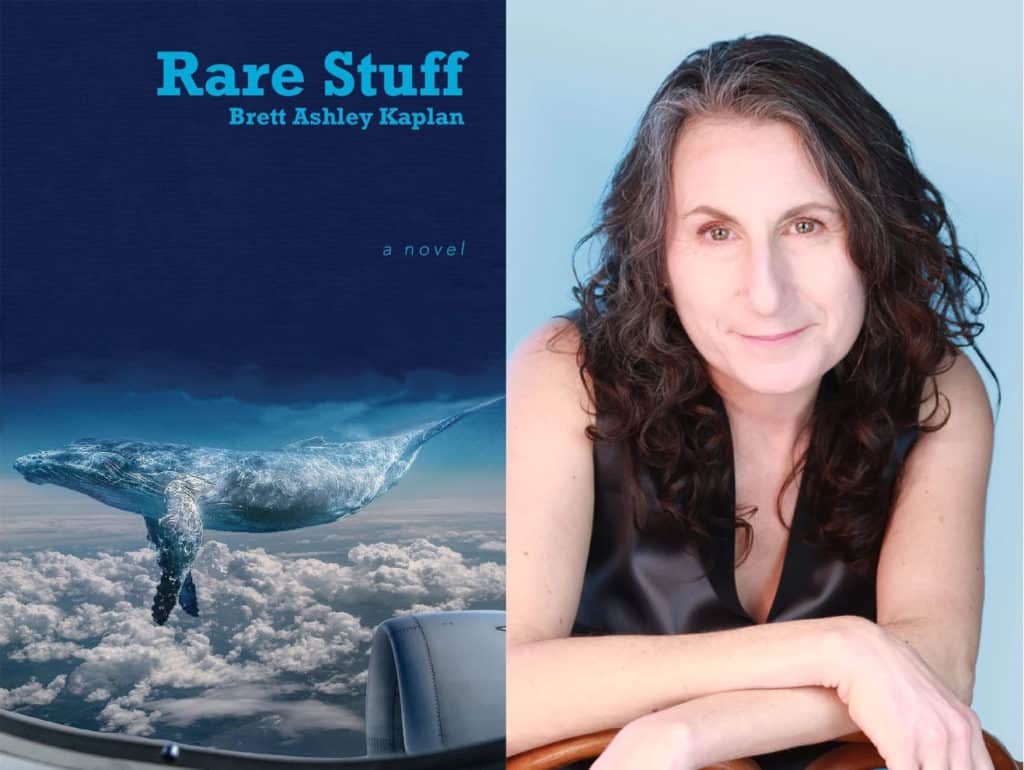
Brett Ashley Kaplan’s “Rare Stuff” inserts itself into this literary conversation about our ecological crisis, but to simply call the novel eco-fiction would not do it justice. This novel has a bit of everything, including, but not limited to, a plea for the planet: a mystery that takes readers, along with its protagonists, from Chicago to New York to Boston to Quebec City to the world at the bottom of the ocean; Yiddish-speaking whales (also at least one shark); evil buffoonish villains and wild, hairy escapes; an ode to interracial love; and connecting them together, a message that we can all do better.

The novel begins with the main character, Sid, a young female Jewish photographer in an on-and-off-again relationship with a mixed-race Jewish man from Guadeloupe, losing her father. To launch us into the adventure that the novel becomes, Kaplan has Sid discover a suitcase stuffed with clues that her deceased father left behind—a single red high-heeled shoe, a pair of blue kid gloves, a photograph of a man in a fedora, a small metal sculpture of a reclining woman, a glass paperweight, a wax paper bag and other items.

But where will these clues lead? Will they help Sid solve the mystery of her mother’s disappearance, decades earlier? Understand her father? Herself? Climate change?

Always keeping us on our toes, the first-person narrative moves around, allowing us to hear not only Sid’s voice, but also that of her boyfriend, André, an academic; her father, Aaron (we are privy to his unfinished book manuscript wherein the Yiddish-speaking whales reside); and her mother, Dorothy (also through her writing). There are also interviews, poems, book reviews and letters deftly weaved into this already colorful tapestry. Yet at no point is the novel confusing; on the contrary, the questions asked in one section might be answered in another, and the narrative pace is swift.

The characters of “Rare Stuff” are not deeply developed, but each one has their own rich history and collectively adds to a picture of interconnectedness. We get glimpses of aristocratic Austrian Jewish life before the war, as well as the crypto-Jews who fled the Spanish Inquisition and re-settled in the Caribbean. We meet couples who, like Sid and André, are interracial; they are the subject of Sid’s photography project. We read about Jewish whalers in 19th-century New England and Jack Johnson, a Black heavyweight champion who, in a novel within the novel, is given a happier ending than the historical figure was permitted. We read about dark times and places: Eagle’s Nest (Hitler’s refuge), the looting of Jewish art in the Holocaust, the killing of Eric Garner (though set in another time and place).

Implicitly, we are asked to think about the genocide of Jews alongside the extinction of species, and what the loss of these species could mean.

We even get to know some whales who, we are told, speak Yiddish since they decided to learn a human language at the turn of the 20th century when it was a transnational language spoken by millions and thus seemed a good option. Who could have known that Yiddish-speakers—and Yiddish itself—would be scarce by the end of the century? Implicitly, we are asked to think about the genocide of Jews alongside the extinction of species, and what the loss of these species could mean.

Yet these serious points are often cloaked in humor. “We sent messages that said things like ‘save the humans’ and ‘save the planet’,” explains one whale, “but then something got lost in translation and we heard reports back from the surface that bumper stickers popped up on your cars (thankfully no longer fueled by whale oil) that said ‘save the whales.’” Kaplan’s wise but misunderstood creatures call to mind the dolphins in Douglas Adams’s similarly picaresque classic comic series, “The Hitchhiker’s Guide to the Galaxy.” As indicated by the title of the fourth novel in Adams’s series—“So Long, and Thanks for All the Fish”—the dolphins were warning humans that they needed to flee a doomed planet; unfortunately, humans misinterpreted the message, thinking the dolphins were singing “The Star-Spangled Banner.” Kaplan’s whales, like Adams’s dolphins, know (and act on) what humans have continually failed to truly comprehend: The earth is in trouble.

If you look up Brett Ashley Kaplan, a literature professor for whom “Rare Stuff” is a fictional debut, you probably won’t be surprised to see she’s written a book on Philip Roth. After all, in addition to references to many other American novelists, poets and filmmakers (Herman Melville, Henry James, Ezra Pound, Toni Morrison, Woody Allen), we find many of Roth’s recurrent characters making cameos in Kaplan’s book. For instance, David Kepesh (of “The Dying Animal” among other Roth titles) makes an appearance here, interviewing Sid’s father, a novelist called Aaron Zimmerman, who resembles Roth’s novelist Nathan Zuckerman (who himself resembles Roth). But more importantly, Rothian playfulness abounds in this novel, making “Rare Stuff,” despite its dire warnings to humankind, a pleasure to read.


Karen E. H. Skinazi, Ph.D, is Associate Professor of Literature and Culture and the director of Liberal Arts at the University of Bristol (UK) and the author of Women of Valor: Orthodox Jewish Troll Fighters, Crime Writers, and Rock Stars in Contemporary Literature and Culture.

Save the Whales! Save Yiddish! Save the Planet!: Everything is Connected and Needs Our Help Read More »