fbpx

June 15, 2022

Antisemitic Brochures Found in Westwood

Several antisemitic brochures were found littered throughout the Westwood neighborhood on the morning of June 15.

Photos obtained by the Journal showed brochures with statements including:

  • “Every single aspect of the media is Jewish”
  • “Every single aspect of the Ukraine-Russia War is Jewish”
  • “Every single aspect of Disney child grooming is Jewish”
  • “Every single aspect of the COVID agenda is Jewish”
  • Jews are “the real slave bringers”

Also depicted was a faux New York Times page stating that there were Holocaust stories in “the Jew owned New York Times” before the end of World War II. The flyers were adorned with advertisements for GoyimTV, which is operated by the Goyim Defense League (GDL); the Anti-Defamation League (ADL) has described the GDL as “a small network of virulently antisemitic provocateurs.”

Rabbi Daniel Bouskila of the Westwood Village Synagogue told the Journal that the brochures were found “on every front lawn of Ashton Avenue” nearby the Wilshire Corridor. “The brochures were in plastic bags filled with small stones, and were most probably thrown from a car onto each lawn or front door,” he said. “There’s nothing else we know about them, except what they say. When I photographed them, there are those scan codes that lead to websites, which I did not open.”
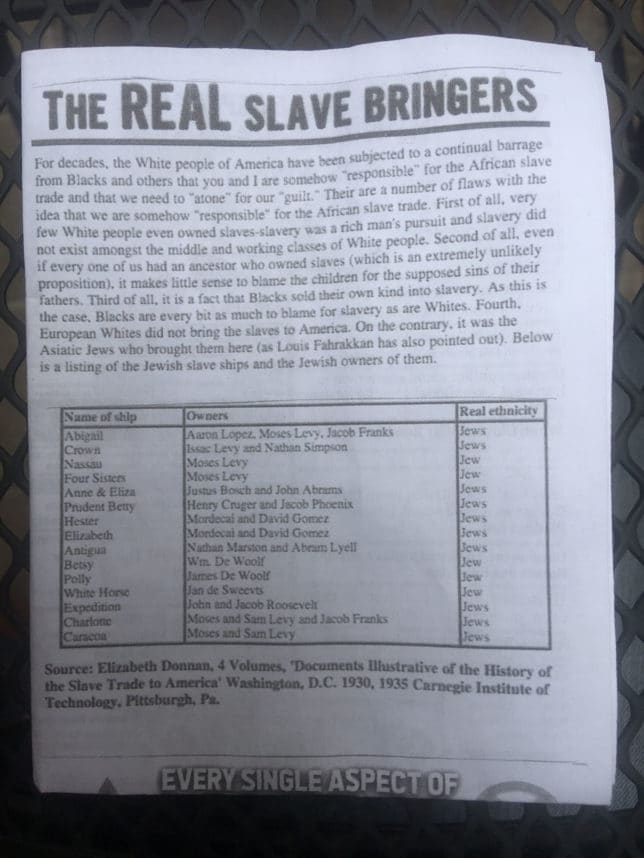
Photo courtesy of Rabbi Daniel Bouskila

Jewish groups condemned the flyers.

“We are appalled by the antisemitic flyers spread in Westwood today,” ADL Los Angeles Regional Director Jeffrey I. Abrams said in a statement to the Journal. “The subject matter differs from previous flyering incidents, but the dangerous messaging is the same, as is our response. This group seeks coverage to further spread their propogandist messages – and we refuse to give them the attention they crave. These hateful and antisemitic messages can and do inspire violence against Jews and other minority groups and it cannot be tolerated.”

He added that the “spate of flyers comes on the heels of a string similar incidents around Los Angeles County over the last eight months. Our county is witnessing an epidemic of antisemitic vitriol. ADL’s 2021 Audit of Antisemitic Incidents showed that vandalism, such as these hateful fliers, increased by 12% from 2020 to 2021. What’s more concerning is that we saw a 28% increase in harassment and a 367% increase in assaults in the same time period.”
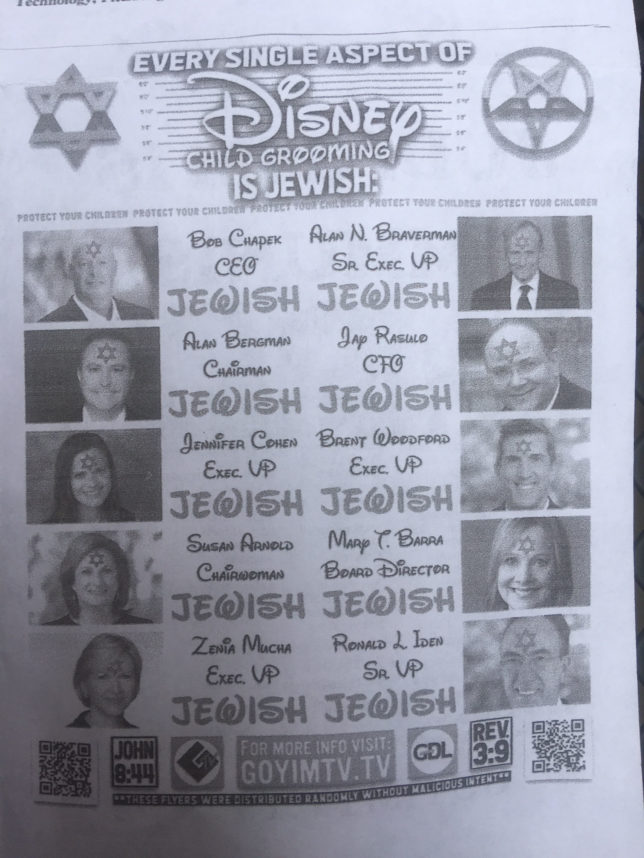
Photo courtesy of Rabbi Daniel Bouskila

American Jewish Committee Los Angeles Assistant Director Brian J. Hertz similarly said in a statement to the Journal, “Each time these sociopaths dump antisemitic, hate-filled leaflets in neighborhoods across our richly diverse city, we get a clearer picture of who they are – hateful pests with too much time on their hands. Nothing more. This most recent series of flyers illustrates just how far down the conspiracy-theory rabbit hole they’ve fallen. Their continued attempts to shock and rile up our community are a failure, as Angelenos are too smart to fall prey to such idiocy. Adherents of the ‘Goyim Defense League’ should focus on improving their own communities instead of scapegoating ours.”

Associate Dean and Director of Global Social Action Agenda at the Simon Wiesenthal Center Rabbi Abraham Cooper said in a statement to the Journal, “This is but the latest disgusting chapter by [an] anti-Semitic group who use low-tech delivery system to spread anti-Semitic tropes coast to coast, usually adding names of local political leaders who happen to be Jewish. It effectively garners them PR for these Jew haters.”

StandWithUs CEO and Co-Founder Roz Rothstein also said in a statement to the Journal, “Jews make up less than 2% of the U.S. population, but are the targets of nearly 60% of all religious-based hate crimes. In that context, the white supremacist conspiracy theories promoted by these flyers pose a real threat to both Jews and other communities. We have seen this anti-Jewish bigotry fuel deadly terrorist attacks against Jews in Pittsburgh, Poway, and elsewhere. Similar racism also motivated the murder of Latinos in El Paso, Muslims in New Zealand, and Black people in Buffalo just last month. We must all unite to fight back against the spread of this dangerous hatred and encourage anyone who is targeted with these antisemitic flyers to report this harassment to local law enforcement.”

Stop Antisemitism Executive Director Liora Rez said in a statement to the Journal, “Los Angeles Jews continue to be harassed by the distribution of flyers by the Goyim Defense League (GDL), this time throughout Westwood. The misinformation spread by these bigots is dangerous — how long will these antisemites be allowed to freely put the safety of Jews at risk?” Stop Antisemitism also sent the Journal a list of all of the GDL’s stunts since 2018, which showed a spike in incidents in 2021 and thus far in 2022.

Antisemitic Brochures Found in Westwood Read More »
Bass, Caruso, and the Search for the Elusive Middle

As the dust settles after the Los Angeles mayoral primary, it’s clear that voter concerns regarding crime and homelessness have fundamentally remade the campaign. But as much fun as armchair punditry and prognosticating can be, we won’t know exactly how the race for mayor has been impacted for several months. Until then, we will watch Rick Caruso and Karen Bass attempt to navigate between two seemingly contradictory sets of demands from LA voters.

There’s a certain number of Angelenos who just want our streets to be safe and clean again, no matter what it takes, and law enforcement excess and human rights violations are an acceptable price to pay to restore some semblance of order. There’s another group who resist any significant effort to confront either challenge and instead prioritize sweeping police reform and the preservation of existing homeless encampments even if such steps continue to threaten public safety.

Neither of these factions is large enough to elect a mayor, which leaves Bass and Caruso to search for an elusive and amorphous middle ground that can satisfy the majority of voters who are desperate for both safety and compassion. The challenge for both candidates is how to balance those two imperatives: the one who figures it out will be the next mayor.

Neither Caruso or Bass is embracing either of the extremes outlined above. The sentiments that drove the protests after the tragic deaths of George Floyd and Breonna Taylor have largely cooled and most mainstream Democrats (including Bass) are working hard to distance themselves from the “defund the police” rhetoric that was so prevalent at that time. And while Caruso has outlined a much more aggressive approach than is currently being used in Los Angeles and most other large cities, his strategy does not represent a return to the Three Strikes era of the late 20th century.

Caruso’s supporters want to be safe, but they still want to be compassionate. Bass’s voters want to be compassionate, but they still want to be safe. 

While it’s the goal of most campaigns to draw the starkest contrasts against their opponent, this particular election looks to be a matter of shades of gray. Caruso’s supporters want to be safe, but they still want to be compassionate. Bass’s voters want to be compassionate, but they still want to be safe. The difference between them will be largely one of emphasis.

But this debate does represent a decided shift to the right from the way criminal justice issues have been addressed in California for many years, which plays to the benefit of a centrist outsider candidate like Caruso. But the political newcomer could also overplay his hand, and if voters decide that his policies are too doctrinaire, Bass could look like a reasonable alternative.

Such nuance rarely survives the heat of a general election battle. Already, Bass’ supporters are sending mail that morphs Caruso into Donald Trump and the Caruso team has begun to link Bass to local criminal political activity. It’s not hard to imagine how much uglier those charges will become by early November. For low-information voters, the choice will come down to picking between the less repulsive of the two cartoon caricatures that are presented to them.

But underneath the nasty back-and-forth, an important political shift is taking place. Public safety issues had slipped far down the list of voter concerns over the last twenty years, to a point where even most Republican candidates had made them less of a focus on the campaign trail. The strongest advocates of defendant rights and police reform argue that the rates for many types of crime are much lower than in the 1990’s, but voter uneasiness about crime has been steadily rising and telling voters they are wrong is rarely the linchpin of an effective political strategy.

It’s important not to overstate this shift. Neither Los Angeles or California is likely to vote for conservatives for any office in the foreseeable future. Angelenos do not support a wall at the U.S.-Mexico border or tax cuts for CEO’s. They are still quite progressive. But they are progressives who are frightened of crime and exhausted by homelessness, and they are willing to at least consider atypical saviors to rescue them.


Dan Schnur is a Professor at the University of California – Berkeley, USC and Pepperdine. Join Dan for his weekly webinar “Politics in the Time of Coronavirus” (www/lawac.org) on Tuesdays at 5 PM.

Bass, Caruso, and the Search for the Elusive Middle Read More »

Academic Panel Promotes Bigotry as Knowledge

Dr. Rabab Abdulhadi’s tenure at San Francisco State University (SFSU) in the department for Arab and Muslim Ethnicities and Diasporas Studies (AMED) has been rife with antisemitism. She has attempted to connect students to terrorists, supported antisemitic activism, propagated antisemitic conspiracies about Jewish power, and unrepentantly compared the Jewish indigenous civil rights movement (Zionism) to white supremacy. Her recent department-hosted open classroom (still posted on the university’s official Facebook and YouTube pages) titled “Who Owns Jewishness” gave this writer a firsthand experience of Abdulhadi’s misuse of her academic position. The disingenuous question was posed to a panel of overtly biased and unqualified speakers to validate her anti-Israel ideology and justify hatred and discrimination against Jews.

Abdulhadi’s panel featured an English professor who has been active with notoriously antisemitic activist groups, including Jewish Voice for Peace (JVP); an undergraduate student; an author/activist known for young adult novels chronicling a fictional Palestinian policewoman who uncovers evil conspiracies perpetuated by the Israeli government; an NYU scholar focused on insinuating that the Anti-Defamation league has insincerely associated Zionism with the African American Civil Rights Movement in order to influence American society; another JVP member; a retired South African politician known for endorsing Hamas; and an ex-Israeli hack journalist who’s been a proud member of an extremist Palestinian political group for decades.

Abdulhadi’s overarching argument boils down to semantics: Though anti-Zionism denies Jews the universal human right to self-determination, this ideology is not antisemitic because here are some Jews who agree. However, it doesn’t matter how a person identifies; the bigotry motivating advocacy for a plan that would target all 6.8 million Israeli Jews for expulsion or murder is self-evident. Further, using her speakers’ Jewish backgrounds to show that not all Jews support Israel fails to disprove the truth that anti-Jewish bigotry is inherent to anti-Zionism. Moreover, none of the panelists are experts in any relevant fields and each specifiedtheir personal disconnections from Jewish religion, culture, or community—two speakers even rejected their Jewish identity altogether. Why should anyone listen to them instead of the overwhelming majority of Jews who disagree?

From Abdulhadi mentioning her love for the unabashedly antisemitic Marxist text, “On the Jewish Question,” to the undergraduate student panelist who, while wearing a t-shirt glorifying terrorism against Jews, outrageously asserted that Jewish traditional use of matrilineal descent is a white supremacist cultural value, there was no shortage of anti-Jewish bigotry in the content of the panel discussion.

Nearly every comment either callously disregarded Jewish life, such as lovingly referencing the convicted terrorist Leila Khalid; expressed an ignorant lack of context, such as blaming the IDF’s responses to terrorism for Israeli citizens’ lack of safety and psychological trauma rather than the terrorism that targets them; or blatant deception, such as referencing the “Deadly Exchange” libel that insinuates a relationship between American and Israeli law enforcement agencies who share “worst practicesin order to promote and extend discriminatory and repressive policing in both countries.” The justification for these claims are based on inaccurate historical assumptions: that a strong relationship to the land of Israel is not principally significant to Jewish culture, that Israel is an invading colonial entity, that Zionism is an anti-Palestinian ideology, and that Israel is ethnically cleansing Palestinians.

Only three points are needed to discredit this entire “class.” First, in the same way that the Cherokee nation is indigenous to the southeastern United States, so too are Jews to the land on which Israel was established. Historical records and extensive archaeology prove that Jewish culture has existed in the Levant since at least the 9th century BCE. Both the Torah and the Quran chronicle this ancient Jewish presence, and there are twenty-six Mitzvot that can only be exercised in Israel. Let’s not forget that Arab culture was introduced to the area over a thousand years later, and there has been continuous Jewish presence documented in the Land of Israel since before the Roman occupation. It is undeniably false to identify Jews as the foreign invaders to the land formerly known as Judea, while declaring that Arabs are indigenous.

It is undeniably false to identify Jews as the foreign invaders to the land formerly known as Judea, while declaring that Arabs are indigenous.

Second, the 1947 UN General Assembly Resolution 181 affirmed the right for Jews to establish a state in the British Mandate of Palestine based on an acknowledgment of the unique Jewish connection to the land. This is patently different from any other instance of settler colonialism, and there is ample evidence suggesting that many in the Jewish community wanted to coexist with their Arab neighbors rather than supplant them—a sentiment persevering through multiple Arab massacres of Jews, and the united Arab attempt to commit genocide of the Jews that became Israel’s 1948 War of Independence.

On the other hand, many regional Arab leaders had consistently rejected coexisting with their Jewish neighbors, a sentiment exacerbated by the Nazi-partnering Grand Mufti of Jerusalem who consolidated power and organized the Arabs into a discernible violent movement of anti-Jewish nationalism during the 1920s, which would be renamed as “Palestinian Nationalism” forty years later. This tradition of refusal is what forms the basis for Abdulhadi’s anti-Israel beliefs.

And third, Israel has never attempted to ethnically cleanse Arabs. The IDF’s use of house demolitions is either a response to terrorist activity, or the decades-long private civil housing cases that are still pending. Treating these instances as ethnic cleansing is dishonest, considering that the West Bank and Gaza have experienced a steady growth of the non-Israeli population and the Israeli Government demolished all Jewish communities in the Gaza strip in order to placate disingenuous Palestinian demands for the further advancement of peace in 2006. Since both Palestinian governments have enforced laws banning Jewish presence in land they control, it’s ironic for the panelists to demand that Israel relinquish more territory to rectify their fictitious history of Palestinian ethnic cleansing, while advocating for the actual ethnic cleansing of Jews.

By requiring this talk in her course syllabi, Abdulhadi is conditioning her students to justify antisemitism on an official university YouTube channel. How long will SFSU allow this inappropriate farce to continue?


Seth Mendel is a student at the University of Colorado at Colorado Springs, and the 2021-22 CAMERA on Campus Fellow for the Colorado region.

Academic Panel Promotes Bigotry as Knowledge Read More »

With Map of Jews in Boston, BDS Antisemitic Threat Now Clear and Present

BDS Boston, a local supporter of the international campaign to “de-normalize” Israel and end its existence through Boycott, Divestment, and Sanctions (BDS), recently shared a map linking Massachusetts-area Jewish institutions to government entities, the media and the police and connecting them to sinister activities.

The map, developed by the Mapping Project, includes tracking of the Synagogue Council of Massachusetts, teen and youth focused organizations like the Hillel Council of New England, the Jewish Teen Foundation of Greater Boston, and even a Jewish high school, Gann Academy. Included in their targeting of “institutions responsible for the colonization of Palestine or other harms” are Senator Elizabeth Warren, the Federal Bureau of Investigation’s Boston office, the Massachusetts General Hospital, Harvard University, and even Harpoon Brewery. Yet inescapably, the list’s focus is its inclusion of Jewish institutions, from cultural or press outlets like the Jewish Arts Collaborative and the Jewish Journal to major Jewish community organizations, like Hadassah, the Anti-Defamation League, and, ominously, Hillel and a Jewish day school. The mappers call them “highly militarized forces that share resources and information to enforce the intersecting systems of white supremacy and capitalism.”

Sound familiar? It should. It invokes age-old and frightening antisemitic tropes right out of the “Protocols for the Elders of Zion,” a fabricated document that described the Jewish plan for global domination and helped inspire brutal Russian pogroms and the Holocaust.

Now these same conspiracy theories are having a resurgence among anti-Israel activists who are increasingly bold when it comes to targeting Jewish organizations that are primarily religious- or community-focused (as opposed to Israel-focused). Nerdeen Kiswani of Within Our Lifetime claimed that Jewish community organizations “are Zionist organizations hiding behind Judaism. So every single organization on that list is a legitimate target.” Zahra Billoo, Executive Director of the Council on American-Islamic Relations San Francisco Chapter, said, “We need to pay attention to the Zionist synagogues. They are your enemies.” The New York group Decolonize This Place was even more explicit, posting online: “Find targets nearby, find where these Zionist fools live, and where there [sic] offices are, and act!”

Is it any surprise, then, that attacks on Jews—already by far the American demographic most targeted for religiously-motivated hate crimes—are skyrocketing? In New York City, anti-Jewish attacks increased by 409% in the one year period from February 2021 to February 2022. It is no wonder, then, that 88% of American Jews say they are concerned about Jew-hatred in the United States, and that 39% of American Jews changed their behavior over the past year due to antisemitism.

Jewish Americans are profoundly aware that there is an ongoing campaign by powerful forces, including state actors, to cause us harm. Notably, Iran has repeatedly targeted Jewish community organizations not associated with Israel for terrorist violence, including the truck bombing of the Jewish Community Center in Buenos Aires, Argentina, on July 18, 1994, which killed 85. France, with Europe’s largest Jewish community, has seen a rash of attacks on Jewish individuals and institutions, including at a kosher grocery store in Paris and a Jewish school in Toulouse.

Jewish Americans are profoundly aware that there is an ongoing campaign by powerful forces, including state actors, to cause us harm.

We can’t bury our heads in the sand any longer. The same people who are expressing an urge to “target” their “enemies” at Jewish institutions are also mapping out where Jewish individuals live and work. Surely, they won’t stop with Massachusetts, but will continue on to paint a national and worldwide map of Jewry. The goal is not merely to delegitimize Israel, but to render America’s Jewish community a pariah. More disturbingly, the intelligence represented by the map can be weaponized immediately by deranged individuals or more sophisticated ones, including state actors committed to doing harm to the Jewish community.

Make no mistake: What the Mapping Project has built is a plan for a pogrom. This is a code red—the incitement to harm and the intelligence are both being widely disseminated. We need immediate help from the U.S. government and all sectors of society to prevent a dramatic increase in anti-Jewish violence. Moreover, the world must recognize BDS for what it is—a front for the oldest hatred, antisemitism, in its purest and most virulent form. How cruel and telling that they who claim anti-Zionism is not antisemitism map not just pro-Israel but also Jewish institutions in New England.


Jacob Baime is Chief Executive Officer of the Israel on Campus Coalition (ICC), a leading organization in the fight against anti-Israel activity and antisemitism in the United States. He was also the Area Director of AIPAC’s New England Region and served as Campus Coalition Director for Massachusetts Lieutenant Governor Kerry Healey.

With Map of Jews in Boston, BDS Antisemitic Threat Now Clear and Present Read More »

Four LA Elections to Watch

The California primary elections on June 7 had a low voter turnout with only 21.6% of eligible voters statewide submitting ballots as of June 12. Even after every registered voter was mailed a vote-by-mail ballot, turnout is not expected to eclipse the 37.54% voter turnout in the 2018 state primary. Los Angeles County is reporting only 17% turnout so far. Official results will be certified by July 15.

While there were expected statewide primary victories by incumbents Governor Gavin Newsom, Attorney General Rob Bonta and Secretary of State Shirley Weber, Los Angeles has some major races that will be noteworthy to watch unfold between now and the general election on November 8th. 

The Journal spoke with several California-based political strategists who spoke on background for this story.  

Los Angeles Mayor 
Karen Bass 267,229 42.87%
Rick Caruso 226,454 36.33% 
*results as of June 17, 2022. 

The Los Angeles mayoral race’s two finalists are expected to have an expensive and bruising battle for the top spot in the country’s second most populated city. 

One strategist with over 15 years of experience running campaigns in California said that businessman Rick Caruso came into the race with some of the strongest momentum seen in decades. 

He is a former commissioner of the Los Angeles Police Commission (2001-2006) and has the endorsement of the Los Angeles Police Protective League. There could be a sensitivity to police support that might be a liability for Caruso in more progressive circles. One strategist speculated that voters who support Caruso specifically for his strong support from the police were not going to vote for any other candidate in the primary. Though he has been a registered democrat for only about six months, Caruso’s donations to both Democrats and Republicans over the years will make Caruso appealing for more moderate and conservative voters in Los Angeles. He was a registered Republican as recently as 2019.

Caruso is a billionaire and the son of the late Henry Caruso, founder of Dollar Rent-A-Car. He has already loaned almost $40 million of his own $4 billion net worth to the campaign and can be expected to spread as much or more for the general election. 

Financially, Caruso started his career well-positioned. He has spent decades at or near the top of the food chain of his real estate business, so he knows the day-to-day grind of running a major operation. He has been successful in a field where others have not been as successful: retail properties. His experience in real estate may be an asset in explaining to voters his plans to address Los Angeles’ homelessness crisis. Caruso’s entrepreneurial background might come off as a net positive against Bass as a “career politician.” 

Celebrity endorsements for Caruso such as Snoop Dogg and Gwyneth Paltrow are factors not to be ignored, as their impact will be difficult for pollsters to pick up in their surveys between now and November. 

U.S. Representative Karen Bass has been in Congress since 2011. Strategists expect Bass to “nationalize” the mayoral race by bringing in power hitters such as President Joe Biden and former President Barack Obama. Expect Bass to consolidate the political apparatus in Los Angeles:  labor groups, solid progressives and environmental advocates are expected to get behind her and do work on her behalf. 

One of Bass’s perceived liabilities can be that she comes in as an establishment candidate (which doesn’t take much when the opponent is in his first ever election for public office). Her years in Congress will be used against her to imply that she will bring “more of the same” to Los Angeles as mayor. Bass’ thousands of votes in Congress are a trove of opportunities to be spun against her by the Caruso campaign. Conversely, Bass’ voting record on both Capitol Hill and as Speaker of the California Legislature is filled with votes on laws that will be alluring to a large block of progressive Los Angeles voters.

Strategists caution that Bass can’t make any missteps when going toe-to-toe with Caruso on crime and public safety. She already has a strong ally with an endorsement by Steve Soboroff, a member of the Los Angeles Board of Police Commissioners. The New York Times reported that Soboroff said to Bass at a recent lunch meeting at Factor’s Deli, “You remind me of a combination between Golda Meier and Margaret Thatcher.” 

It is no surprise that Bass has the endorsement of many fellow Democrats from the U.S. House and Senate such as Speaker Nancy Pelosi and U.S. Representatives Ted Lieu and Adam Schiff. She also has endorsements from a significant number of state, city and county elected officials that she would no doubt have to collaborate with if elected Mayor. 

Five keys to consider:

Low turnout may have benefitted Caruso. Expect to see endless drives to get Los Angelenos to vote this fall in the form of television and social media advertisements.

Crime and homelessness didn’t bring people to the polls.

Crime, policing and public safety are concerns for voters, but it still wasn’t enough to drive pre-pandemic numbers of voters to the polls. Expect much sparring over this. 

Despite the high cost of the election, Los Angeles does not have a powerful mayoral system compared to other cities. Much of the power to get things done lies within the authority of the City Council. 

To the average voter, it’s hard not to look at the City Council through a lens of corruption because of indictments over the last few years.

Both candidates will have to simplify their plans for addressing Los Angeles’ homeless crisis. It’s a complex issue that touches on mental health, drug treatment, a rising cost of living and policing a disturbing scene of encampments. Expect both candidates to find ways to meld a compassionate solution with a stern set of provisions to ensure safety.  

Both candidates are making inroads in the Jewish community. This month, Caruso met with Chabad leaders and visited kosher businesses in the Pico-Robertson neighborhood. Bass has garnered the endorsement of several Rabbis and leaders of Jewish organizations, including Democrats for Israel Los Angeles.

Sheriff – Los Angeles County
Alex Villanueva 443,789 30.86%
Robert Luna 372,245 25.88%
*results as of June 17, 2022. 

It is a bad sign for any incumbent who does not get 50% of the vote in a primary. So despite his first place primary finish, Sheriff Alex Villanueva will have a lot of work to do to keep his post. His tenure has been riddled with scandals since being elected in 2018. He is expected to be in a runoff with Long Beach Police Department Chief Robert Luna. Luna was first elected Chief in 2014 and has over 30 years of service in the LBPD. Expect to hear much more about this race to oversee the fourth largest police department in the United States (after NYPD, Chicago PD and LAPD). 

Los Angeles County Board Of Supervisors – District 3
Robert Hertzberg 103,461 31.22%
Lindsey Horvath 91,572 27.63%
*results as of June 17, 2022.

The race to replace the retiring Sheila Kuehl in the Board of Supervisors District 3 will be an interesting one. The newly-drawn District 3 stretches from Agoura Hills to Malibu, across the San Fernando Valley to Burbank, the Hollywood Hills, Beverly Hills, Santa Monica and West Hollywood — consisting of approximately 2 million residents. 

Strategists expect a lot of outside money coming in to fund both candidates and it is shaping up to be a Valley versus Westside battle. 

State Senator Bob Hertzberg has been serving as the State Senate Majority Leader since 2018 and already represents a district that stretches from Northridge to Burbank. He has been in and out of public office since the 1990s, with a detour to private law practice in the early 2000s. 

Lindsey Horvath is a member of the West Hollywood City Council and former mayor of West Hollywood who owns a marketing business. 

Both Hertzberg and Horvath are respected by their current constituents and will have to make inroads in the other’s territory to win. The question is whether either candidate can resonate with the larger electorate further west of the 405. 

Los Angeles City Council District 5
Katy Young Yaroslavsky 27,235 48.99%
Sam Yebri 16,504  29.69%
*results as of June 17, 2022. 

The Los Angeles City Council District 5 open seat is a legacy candidate race for an open seat.

Sam Yebri, a public office newcomer comes with the endorsement of former longtime westside U.S. Representative Henry Waxman. He is a first-generation Angeleno whose family fled Iran as a refugee when he was just a year old. Yebri co-founded a non-profit called 30 Years After that “works to engage immigrants and first generation Americans in civic life.” In addition to being an attorney who advocated for workers, tenants and labor rights, he has also served on the board of several non-profits.

Katy Young Yaroslavsky represents a kind of establishment position in Los Angeles politics. Her mother worked for Sheila Kuehl in the state legislature. Yaroslavsky herself later worked for Kuehl when she was elected to the Los Angeles County Board of Supervisors, serving as the senior policy advisor on the environment and the arts. Yaroslavsky’s father-in-law Zev has a deep legacy in southern California, having served on the L.A. County Board of Supervisors for 20 years. 

While Yaroslavsky’s name recognition comes as an advantage, expect Yebri to go all in to connect with voters. The district that stretches from Bel Air to Palms to parts of Hancock Park has an approximate population of 260,000 residents — small enough to make any community outreach by either candidate go a long way. 

Four LA Elections to Watch Read More »