fbpx

May 25, 2022

A Bisl Torah – A Song of Lament

On Sunday, I spent the day at the baseball field, watching my sons enjoy their favorite sport. At my older son’s game, the opposing team used an application that called out each player’s name. And more entertaining, it played a specific song as that batter took their stance.

For one kid, “Take me out to the ballgame” blasted through the park. Another kid, “Fight Song.” And I couldn’t help but wonder which song we would choose…which song describes both who we are and what we want to convey at this particular moment?

There was a great show on television called, “Zoey’s Extraordinary Playlist.” Zoey’s superpower was looking past people’s blank facades and hearing their song. The song would reveal the person’s inner emotions, a true window, but only Zoey was privy to the lyrics.

We live in anguishing times. And we shake our heads, no words properly describing the torment. No words adequately expressing the outrage. Our anger.

Perhaps the events of the past week, the senseless murders have put you in a similar state of shock. How many more children need to die?

We must continue to speak out. We must continue to scream. We were not created to be complacent human beings. If your throat is dry, if you are choking back tears trying to explain how you are doing, how you are feeling…perhaps, a song’s lyrics will give way to the words you are meant to share.

In response to the destruction of Jerusalem, the prophet Jeremiah says, “Consider now! Call for the wailing women to come; send for the most skillful of them. Let them come quickly and wail over until our eyes overflow with tears and water streams from our eyelids.” Our tradition seemingly understands that grief should not be experienced alone and when faced with anguish, we might even need other lamenters to help us sing our song, to share our words that are locked within.

We are in pain. And we are angry. But we’re not alone. Let our songs join one by one…a river of tears singing, crying, protesting and mourning together.

Shabbat Shalom


Rabbi Nicole Guzik is a rabbi at Sinai Temple. She can be reached at her Facebook page at Rabbi Nicole Guzik or on Instagram @rabbiguzik. For more writings, visit Rabbi Guzik’s blog section from Sinai Temple’s website.

A Bisl Torah – A Song of Lament Read More »

A Moment in Time: “We Are” – We Are Not Standing Idly While our Neighbors Bleed

Dear all,

In 2018, following the shooting at Congregation Tree of Life in Pittsburg, I created this video with the words you see below.

Today, how tragic that we add yet another act of senseless hate to this list of violence. The school shooting in Uvalde, Texas leaves us grief-stricken.

But it can not relegate us to paralysis.

We live in one of the most educated times in history. And yet we continue to allow guns to get into the hands of people with nefarious intentions. Please, take a moment in time to hold close those you love. Hold them extra close.

And take an additional moment in time to write…. Write to your elected officials. Write to your newspapers. Let them know that enough is enough. “We will not stand by idly while our neighbors bleed” (Lev. 19:16).

”We Are”

by Rabbi Zachary R. Shapiro, 2018. Updated in 2022

We are Parkland.
We are Newtown.
We are Orlando.
We are Las Vegas.
We are Charlie Hedbo.
We are Virginia Tech
We are Charleston
We are San Bernadino
We are Laramee
We are Oklahoma City
We are Columbine
We are the Congregation Tree of Life in Pittsburgh
We are Thousand Oaks
We are Chistchurch
We are Sri Lanka
We are Poway
We are Atlanta
We are Boulder
We are Buffalo
We are Uvalde, Texas
We are
We are all these places where violence and hate crimes have inflicted terror on humanity.
And today WE are Culver City, and we bring a message of SHALOM
We are Jews
We are Christians
We are Muslims
We are Hindus, Shiks, and Bhuddists. We are Bahai
We are atheists and agnostics.
We pray to God, to Adonai, to Allah.
We love our children.
We are black, we are white, we are Latino. We are Asian. We are LGBTQ.
We are Democrats. We are Republicans.
We are immigrants. We are native.
We are survivors.
We are redeemers.
We are.
We are and we love and we dream and we hope.
We are.
We pray and we listen. We embrace and we care.
We are.
We march toward truth. We replace darkness with light.
We are.
We pursue justice. We march for peace. We gather with unity.
We fight the evils of antisemitism, a disease that has plagued Judaism – and all who care about humanity – for 3500 years.
We inherit the right to be safe in our schools, our houses of worship, and our places of recreation.
We inherit the responsibility to demand more of our community when that safety is compromised.
We are.
And we always will be.

As the prophet, Amos taught, “Let justice roll down like water, and righteousness like a mighty stream.”

With love and Shalom,
Rabbi Zach Shapiro

A Moment in Time: “We Are” – We Are Not Standing Idly While our Neighbors Bleed Read More »

Out of Exile, Jews Are Not a Color-Centric Binary

As a proud Black Jewish woman married to a Russian Jewish man with four Black Russian Jewish children, I am sometimes bewildered by the dialogue around race and racism in the Jewish community. The American Jewish community seems to have adopted the anti-racist discourse prevalent in the larger society, and in so doing we have failed to define and defend our own diversity. In an op-ed for The Forward, Ilana Kaufman discusses her concerns about diversity within the Jewish community, criticizing Jewish spaces for not being sufficiently “multiracial” and “antiracist.” Unfortunately, she relies on the same black-and-white thinking that has been used to divide people by their immutable characteristics. Kaufman’s insistence that “Many of our white leaders come from predominantly white communities” erases the very Jewish diversity she insists is being ignored. This example highlights the problem with accepting a racial binary that fails to include the complexity of Jewish peoplehood.   

Anyone who knows anything about Jewish peoplehood knows that Jews are among the most diverse peoples in modern times. Out of exile, the Jewish people came to live on every habitable continent on earth. There is thus no one way to look or be Jewish. However, that does not mean that the diversity of the Jewish people has been fully realized in Jewish institutions. It has not. We need to do a better job of acknowledging and celebrating the entirety of our people, eliminating perceived and real slights, and ceasing the erasure of specific groups of Jews. Organizations like JIMENA (Jews Indigenous to the Middle East and North Africa) and SHIN-DC (Sephardic Heritage International) hold a wealth of knowledge about Sephardic and Mizrahi Jews, for example, but are underutilized in Jewish learning spaces. Too many Jews in America are unaware of the experiences of their Sephardic and Mizrahi sisters and brothers. Further, the stories of Ethiopian Jews in refugee camps in Sudan, yearning to return to Zion and crossing scorching deserts, are underappreciated. We need to do better.   

The way to uphold our diversity is not to accept American-centric colorism, which racially categorizes and judges people based on their skin-color, but to embrace the full diversity of the Jewish people. Insisting on identifying fellow members of the tribe as “white Jews,” claiming that there are “affluent, cisgender, white men” chanting on the bimah, or stating that Jewish organizations hold legacies of “white supremacy” is insulting to all Jews and ignores the fact that we are all targeted by white supremacy. Being ashamed of Jewish success, using “affluent” as a slur, and accusing those who established Jewish institutions and places of learning and worship as holding privilege overlooks the obstacles Jews have overcome in order to build these organizations.     

The way to uphold our diversity is not to accept American-centric colorism, which racially categorizes and judges people based on their skin-color, but to embrace the full diversity of the Jewish people.

Too often, diaspora Jews have adopted views on race and ethnicity that are fundamentally at odds with what it means to be a Jew. The shrinking of Jewish identity to a color-based racial identity erases the majority of Jewish people. It ignores real diversity, including diversity of thought, of heritage, of language, of levels of observance and instead judges Jews based on the color of their skin. It is no surprise that adopting American-centric race-based colorism gives rise to a diversity approach based solely on skin color. Although I agree that issues regarding the embrace of Jewish diversity must be addressed, it’s a mistake to use the same color-based ideology that produced these tensions in the first place. Establishing color-based litmus tests for who gets to be part of Jewish organizational leadership is not a solution and only contributes to the problem. Inviting Jews to commit to color-based initiatives is a simplistic method of addressing a complex issue. Instead of establishing diversity committees, Jewish organizations and places of learning and worship should revisit ideas about what makes someone a Jew and reject race-based ideologies that fail to value the diversity of the Jewish people. 

Indeed, Diversity, Equity and Inclusion initiatives that institutionalize colorism are not what the American Jewish community needs. Kaufman suggests that it is wrong to “prioritize the rarefied, traditional training” of rabbis simply because the fact that there are not enough “clergy of color” who receive this training is racist. Hiring rabbis to lead congregations should be based on knowledge and skill, not on a watered-down scholarship or dogma designed to gain favor with political progressives. We don’t need to continue committing to programs that fail. We need to embrace a Jewish way of seeing ourselves in our splendid diversity, where “a Jew is a Jew is a Jew” regardless of skin color. We need to counter an ideology born in the diaspora that has divided us as a people. In the words of Menachem Begin z”l “We were all born in Jerusalem.”


Dr. Brandy Shufutinsky is the Director of Education and Community Engagement with the Jewish Institute for Liberal Values (JILV). Her focus is on developing intercultural opportunities that enhance liberal democratic ideals. 

Out of Exile, Jews Are Not a Color-Centric Binary Read More »

Four Words to Change the World

There are four words that have the potential to change the world. They form a well-known saying. They roll off the tongue, are easily understood and even seem obvious. And yet, they have proven to be almost impossible to implement. They are so simple and yet they have eluded us since the beginning of time.

The words are: Live and let live.

Virtually every conflict, in interpersonal relations and on the national and international stages, involves someone or some group attempting to impose their will on others. Merriam-Webster dictionary defines “live and let live” as a saying that “a person should live as he or she chooses and let other people do the same.”

Psychologist Leon Seltzer, writing in Psychology Today, notes that our history and our ego work against cooperation: “After all, it’s only natural that our most primitive ancestors would have been predisposed to confront one another in situations where natural resources vital to survival were in short supply.” Even though our more developed brain and different social conditions have made us more adaptable, we still act in “pre-ethical” ways.

Although recent studies show that we are primed at birth to be empathetic, human ego nurtures a need to see ourselves separate from and better than others, which undermines the ideal of “live and let live.” Add to this, suggests Seltzer, feelings of insecurity originating from when we were children, and you have a potent brew of emotions that make “live and let live” much more complex and difficult that it seems. 

The Marginalian’s Maria Popova adds a fascinating point of view. She examines love as the response to the quandary of living in a troubled world and facing the inevitability of death: “To become precious — that is the work of love, the task of love. The recompense of death. The human miracle that makes the transience of life not only bearable but beautiful.”

 She points out the heartbreak of “losing sight of just how precious we are to each other, squandering in less-than-love the chance-miracle of our time alive together, only to recover our vision when entropy has taken its toll, when it is too late.” For Popova, the Persian poet Rumi (1207-1273) expresses perfectly the tragedy of the human condition when hostility and conflict crowd out love:

Let’s cherish each other, my friend,

before we lose each other.

Why adore the dead but battle the living? 

These comments on the obstacles to “live and let live” make me understand better the Jewish emphasis on love. According to the Sefaria online resource, there are 16,334 references to love in Jewish source texts. In Leviticus, we are commanded to “love your fellow as yourself; I am Hashem.” Why does the verse end with the reminder that it issues from God? Perhaps because our internal, personal obstacles to love need to be overcome through an understanding that consideration for others is a divine imperative. 

To emphasize the point, God is described in the Torah as “the Lord, mighty, merciful and gracious, long-suffering and abundant in love and truth.” If God is the embodiment of all those qualities including love, then the message is clear: We are to transcend our grievances and be inspired to emulate the Creator. An exceptional comment in the Talmud draws attention to a profound psychological truth long before the invention of psychology: “Rabbi Akiva said: ‘This is a great principle of the Torah: You shall love your neighbor as yourself, meaning that one should not say, ‘Since I am scorned, I should scorn my fellow as well; since I have been cursed, I will curse my fellow as well.'” Rabbi Akiva understands that what drives most conflict is one’s keenly felt need for revenge for a perceived offence and he strongly discourages this all-too-human weakness. This is an attempt to promote harmony rather than discord, again pointing out that its source is divine.

If God is the embodiment of all those qualities including love, then the message is clear: We are to transcend our grievances and be inspired to emulate the Creator.

Jewish sources begin with the self, move to love of parents, and on to people who are different from us. Leviticus states that “the stranger who resides with you shall be to you as your citizens; you shall love each one as yourself, for you were strangers in the land of Egypt; I am Hashem your God.” This breadth starts with the individual and his or her own personal issues and progresses to love of others and even strangers. In fact, the prophet Micah universalizes the concept to include all: “What does God require of you? Only that you do justice and love goodness.” This statement is general and inclusive. It is astonishing and revolutionary in a society that was tribal and where fear of the other and constant wars were the norm. 

 Whether viewed psychologically, poetically or theologically, the problem of implementing the principle of “live and let live” is a matter of overcoming the desires of the self for the good of all, transcending ego for the benefit of everyone, making a conscious decision to seek peace and refuse conflict. The war in Ukraine has sparked a resolve in the free world to confront tyranny. That is a hopeful sign.  

Whether viewed psychologically, poetically or theologically, the problem of implementing the principle of “live and let live” is a matter of overcoming the desires of the self for the good of all, transcending ego for the benefit of everyone, making a conscious decision to seek peace and refuse conflict.  

If we learned from psychology that primal urges play a role in human behavior, if we were inspired by the aspirations and beauty of poetry and prose, and if we renewed our relationship with the concepts of dignity and love found in our religious traditions, perhaps we would progress toward a more humane world. The psychologists, the poets and religious teachings demonstrate that only love can drive out hatred, only light can defeat darkness and only hope can cure despair. This is not idealism. It is a genuine and urgent need to put an end finally to a world sick of suffering and despair. 

As Martin Luther King said: “Those who love peace must learn to organize as effectively as those who love war.” And it all starts with each one of us.


Dr. Paul Socken is Distinguished Professor Emeritus and founder of the Jewish Studies program at the University of Waterloo.

Four Words to Change the World Read More »

Go Take a Bath

In the 1800’s, cast iron pipes were invented.  Then in 1883, a loving God gave John Michael Kohler the foresight to invent the bathtub. Thank you, Mr. Kohler, for making the world a more enjoyable place. 

I love taking baths. I love everything about them. In just minutes, one can turn a rectangular-shaped object filled with water and heated to a nice toasty 95 to 105 degrees into Shangri-La. A good hot bath can turn the rattiest tenement apartment into a luxurious spa.  I know; I lived in one. 

There are many photos of me as a child sitting, smiling happily and splashing in an Alcove porcelain tub with my mother kneeling beside the outer wall. When my wife and I were newly married, my wife was deeply concerned that my mother was still giving me baths and getting me into my pajamas. This was way before we had children. I remember explaining to my wife that until we have children of our own, we should not judge a mother’s love.  

I like water. I like to drink it, gargle it, and walk in the rain getting drenched by it.  But first and foremost, I love sitting in it. Give me a wood backscratcher and a new bar of Olive Oil Oatmeal Soap and hello, happiness.  A bath to me is not a luxury but rather a necessity.  I can’t do without it. A bath can be so pleasurable, it’s hard for me to allow myself that much pleasure.   

Give me a wood backscratcher and a new bar of Olive Oil Oatmeal Soap and hello, happiness.  A bath to me is not a luxury but rather a necessity.  I can’t do without it.  

To prepare a proper bath, one must be part scientist. I add three ingredients. First, two caps of bubble bath are poured directly under the water spigot. Then a healthy squirt of aloe vera gel.  And of course, a handful of MgSO4 that is commonly known as Epson salts. Try the Lavender or Eucalyptus. I’m drooling just thinking about it. 

People have asked me if I equally enjoy dipping in the ocean or a lake. The answer is no. In the ocean, I’m aware that at any moment a shark might scoot by and saw me in half.  And in a lake, it’s the Electrophorus Electricus (better known as an electric eel) that I’m scared might take a bite out of my rump. 

Doctors will tell you a bath is good for depression, sore muscles, lowering blood pressure and relaxation. And of course, if they are not opposed to hopping in with you, it’s an opportunity to get to know your neighbors much better. But that’s for a different sort of newspaper. 

But here now is the difference between the professional and the amateur bathers.  It all comes down to taking a bath outside their bedchamber. There are people for whom the mere mention of taking a bath at a hotel repels them. Many people believe sitting in a hotel tub is akin to eating a piece of cheese found stuffed in a shoe that’s been sitting in a Times Square garbage can.    

Not me. I have been dipping my toes to test the water temperature in and out of hotel tubs for over 40 years and in over 28 countries that might have some of the worst hotels known to man.  When making hotel reservations I always phone the front desk and ask for a tub. Many newer hotels have very few, if any, tubs at all.  And some even charge extra for a tub.  

My opinion is that if you can sit on a toilet seat at Dodger stadium, you can take a bath anywhere in the world.  People react to hotel bathtubs as if you asked them to take a dip into the Yamuna River in India. The Yamuna receives 3.5 billion liters of sewage a day. 

As the rabbis tell us, God wants us to have pleasure. We were not born to just mope and grumble and quickly shower. We are here to enjoy ourselves and help others. So, grab a good book, your iPhone, Bluetooth speaker, a Coala Hola bath pillow and a new bar of scented soap. Then maybe phone a neighbor if that’s the way you roll.  Fill her up, get in, lie back and take a trip to heaven.


Mark Schiff is a comedian, actor and writer, and host of the ‘You Don’t Know Schiff’ podcast.

Go Take a Bath Read More »

Think What You Want, But Follow the Rules

As a long-time baal tshuva, or returnee to Jewish observance, I’ve often thought that what Orthodox Jews do is crazy. No cheeseburgers? But beef and cheese are both great protein sources. Observe Passover for eight days? I thought the holiday was over when the Seder dishes were cleared. Wave the lulav on Sukkot? Are you kidding? 

Early in my journey, I learned that when the Jewish people received the Torah, they said in unison, “Na’aseh v’nishma,” which means “We will do, and we will understand.” Action came first. As we approach Shavuot, the celebration of receiving the Torah, I am reminded that, as much as Jews love to argue and discuss, at its core Judaism is a religion of doing.

We’ve been building up to Shavuot for the seven weeks since Passover. As we welcome the holiday, what will our “na’aseh v’nishma” look like? How will we demonstrate our commitment to Judaism? I will take on one Jewish action, such as reading a chapter of Psalms twice a week. 

Many years ago, a convert explained to me why she chose Judaism over Christianity. She had been a Ph.D. student in Medieval European History. One of her professors told her, “In Christianity, you must think a certain way, but you can do mostly what you want to do. In Judaism, you can think what you want as long as you behave according to the laws. For her, mental freedom was key; she chose to become a Jew.

Different Jewish denominations have varying views on what it means to follow Jewish law. However, no matter how liberal someone’s interpretation, they abide by principles of Judaism as they understand them because they are Jewish. For me, that means looking longingly at the prepared salads at Trader Joe’s and not buying them. It means that no matter how curious I am about who’s calling me on Shabbat, I do not pick up the phone. For another person, it might mean foregoing the shrimp scampi at a fancy wedding reception. In a sense, the specific action is not relevant as long as we do it because we understand that it is what God wants from us.

I have a Jewish friend who has no religious practice and is about to intermarry. When I asked her if she would raise the children Jewish, she exclaimed, “I talk about Judaism all the time! There’s no way they won’t know they’re Jewish!” I realized when she said this that I rarely talk about being Jewish unless I’m asking someone whether they still have shmura matzah at Costco or sharing a Torah tidbit with one of my children. 

But I’m doing Jewish actions all day long – davening, saying blessings over food, making sure that my coffee with half and half goes into a dairy mug. As I’ve settled into living an observant life, doing Jewish deeds provides a deep sense of spirituality – even if my brain thinks they make no sense.  I am free to think it’s crazy – as long as I do the action.

We’ve been building up to Shavuot for the seven weeks since Passover. As we welcome the holiday, what will our “na’aseh v’nishma” look like? How will we demonstrate our commitment to Judaism? I am going to make mocha cheesecake, a recipe that I only prepare once a year. But in addition, I will take on one Jewish action, such as reading a chapter of Psalms twice a week. 

Because as much as Jews love to talk about Judaism, what matters in the end is what we do.


Elizabeth Danziger is the author of four books, including Get to the Point, 2nd edition, which was originally published by Random House. She lives in Venice, California.

Think What You Want, But Follow the Rules Read More »

Does Anybody Sleep Anymore?

More and more, I’ve noticed that people aren’t sleeping. I’ll text my friend on the east coast at 2 a.m. her time, and she’ll respond right away. Or, I’ll see people up late on Facebook Messenger or posting on Instagram. Everybody talks about how tired they are these days. 

According to one study, almost half of Americans say they feel tired between three and seven days per week, and 35.2% of all U.S. adults sleep less than seven hours per night. 

In one way, this is comforting, because I’m not alone anymore. I’ve been a night owl ever since I was a kid and stayed up until 1 a.m., dreading the early start to my school day. I’ve had a permanent coffee cup in my hand since I was 14, and I’ve tried Benadryl, melatonin and Unisom. Nothing makes me tired.  

I stay up late not only because it’s how my body is wired, but also because I love the silence. It’s when I can finally think clearly. It’s my “me” time. When I was younger, I’d be awake long after everyone else in my family had gone to sleep. Now, it’s the same with my husband and kids. 

While I’ve learned to accept my night owl status, on the other hand, it’s not the healthiest thing to stay up so late. It can cause weight gain, hurt your immune system and lead to forgetfulness. I often feel out of touch with the rest of the world. We live in a society where going to bed early and getting up early are the ideal, and being on a different kind of schedule means you’re out of the loop. 

The pandemic had a negative impact on my sleep, and I believe it hurt other people’s sleep habits as well. When we weren’t going to work, partaking in our favorite hobbies and gathering with our friends outside of our homes, time seemed amorphous. I stayed up late reading the news for updates about COVID, then the riots, then the election and the slew of other issues we’ve been hit with over the past few years. The anxiety and fearmongering have been relentless. I haven’t fully recovered – and I’m sure others haven’t either.  

The pandemic had a negative impact on my sleep … When we weren’t going to work, partaking in our favorite hobbies and gathering with our friends outside of our homes, time seemed amorphous. 

I have years of practice when it comes to staying up late, though. I’ve been functioning like this nearly my entire life. Going to bed at midnight would be a major win for me. 

We learn in Jewish law that we are commanded to take care of ourselves. If you aren’t sleeping enough or going to bed too late, it could take a toll on your mental and physical health. I’ve certainly had my fair share of struggles due to a lack of sleep. When I’m tired, for instance, I’m much more likely to gravitate towards sugar and caffeine just to stay awake throughout the day. I don’t feel good when I ultimately end up crashing. 

Going forward, I’m going to try my best to get to sleep at a more reasonable time. I want to switch off the screens and relax with a good book before bed instead. I’m hoping my new exercise routine will wear me out and help me feel at ease. Getting seven hours of sleep per night would, excuse the pun, be a dream. It’s a healthy way of taking back control over my life. 

If you’re staying up too late – especially if this is a new, pandemic-related habit – look at the reasons why. If you’re feeling anxious during the day or eating poorly or generally not functioning well, it could be tied to your sleep. From one night owl to another: it can be fun to stay up until the wee hours of the morning, but up to a certain point. 

I encourage you to turn off your screens at night; there will always be more news and social media notifications and email messages to keep you occupied. Don’t let the grind of everyday life make you unhealthy. Instead, give yourself a break … and get some sleep already.


Kylie Ora Lobell is the Community and Arts Editor for the Jewish Journal. 

Does Anybody Sleep Anymore? Read More »

Thoughts on the Horrific Killings in Texas

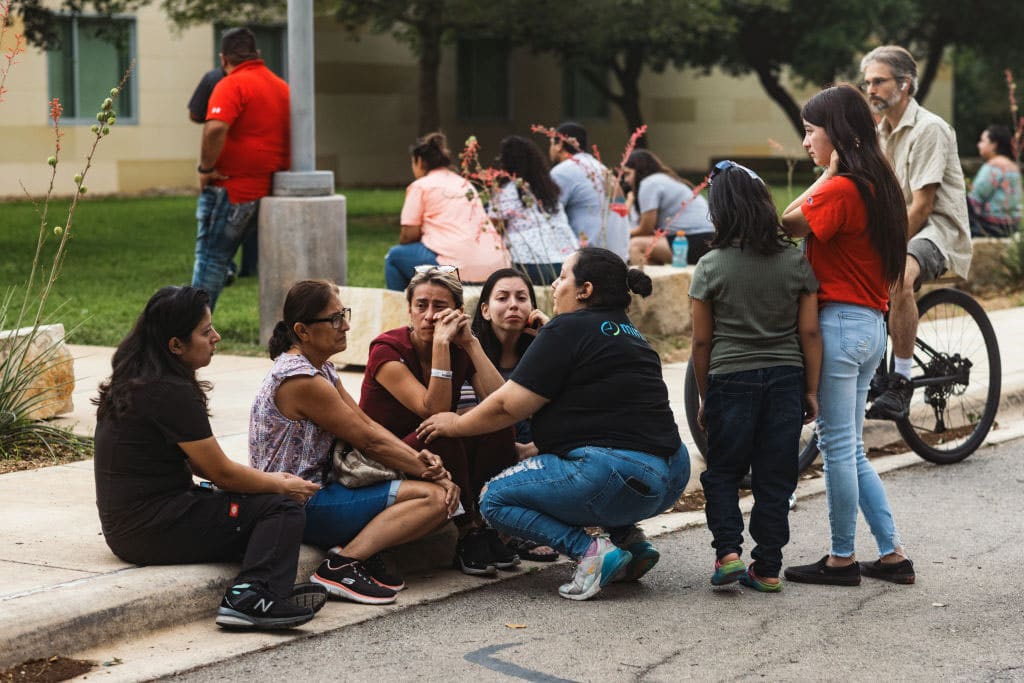
Having just heard the horrific news of 19 children and two adults killed in Texas, I am not only heartbroken but also furious. One school after another, churches, synagogues, stores, homes, countless places where people gather, live, study and pray have become places of danger. Safety feels ephemeral at best. Assaulted in every area of our lives, the pain becomes indescribable and often creates a form of numbness.

Many of us have begun to live with hypervigilance, that neuro-psychological response and self-defense to constant assault on the mind, body or spirit. We anticipate that at any moment the shoe will drop. The political, financial, tragic and health disasters we have all lived with in this country over these past years are bearing down on us. Many people have become more introverted, home-bound and even reclusive in the wake of COVID’s reign over our lives and the increasing frequency of humans who destroy the lives of the innocent.

What is also alarming is that many women and Jews are fighting for the freedom to make a critical choice with regard to their bodies. Meanwhile, those who oppose this freedom of choice but claim to care about life won’t do anything to save lives. So many people who are anti-abortion are the same ones fighting for the right to buy semi-automatic weapons without any common-sense restrictions to prevent those who are too young or too disturbed from having access to them. Many of these same people voted for a President who proudly said he could kill people on Fifth Ave and get away with it. This is the example we have set for our young adults. Murder is now a normal form of expression.

This is the message that is being sent when nothing is being done to seriously respond to these horrific events. How many children need to die before our leaders in Congress will act? What level of shame can we impose that will have an effect? We can’t even convince everyone in this country of the “truth” of the last presidential election. Some still feel cheated and will fight to the death to create their own reality. We watch power brokers in state after state set up new norms: If you lose you just change the facts.

People’s lives hang in the balance. We desperately need action. We need leaders who care about life, fight to protect it and work to sustain it. Talmud teaches when you save one life it is as if you saved the entire world. If you destroy a life, it is as if you destroyed the entire world.

People’s lives hang in the balance. We desperately need action.

Today 21 lives were destroyed. The world is reeling and many of us are weeping. But tears and grief are not enough, though necessary for healing. It is change in attitudes and in laws that we need more right now. Action and movement that reflects true love and concern for life are what we all need. I pray for that.

I pray for the families who are suffering, I pray our leaders will wake up and create a better day. I pray egos will recede while souls come forward and help to change misbegotten laws, so outdated from their original intent because the world is different.

In the memory of every lost soul to violence, please, let us create a more humane way to peace in this world.


Eva Robbins is a rabbi, cantor, artist and the author of “Spiritual Surgery: A Journey of Healing Mind, Body and Spirit.”

Thoughts on the Horrific Killings in Texas Read More »

Jewish Groups React to Texas Elementary School Shooting

Jewish groups have issued tweets expressing horror and outrage over the May 24 mass shooting at an elementary school in Texas that resulted in 19 students and two teachers dead.

The shooting occurred at Robb Elementary School in Uvalde, a city west of San Antonio. The alleged shooter, reportedly identified as 18-year-old Salvador Ramos, was also killed by police officers and is believed to have acted alone. Ramos also allegedly shot his grandmother, who is currently in critical condition. Two law enforcement officers were wounded, though their injuries are not believed to be serious. Thirteen students from the elementary school have been hospitalized. The suspect is also believed to have been from Uvalde and was a student at a nearby high school. The police have also been criticized for not stopping the shooter sooner, and the authorities have acknowledged the situation could have been handled better.

“We are absolutely devastated, outraged and heartbroken by reports of 14 children and 1 teacher killed at a school in Uvalde, TX,” the Anti-Defamation League tweeted. “As we investigate the shooter’s social media footprint, we send our deep condolences to the grieving families affected by this horrific, violent act.”

The American Jewish Committee (AJC) also tweeted, “Once again we feel despair, rage, and shock at another senseless act of violence. No words can heal these wounds. Our thoughts are with the grieving families.” AJC CEO David Harris wrote in his own separate tweet that the shooting was “another occasion for national shock, mourning &, yes, anger. Will the pandemic of violence in our nation ever end?”

The Simon Wiesenthal Center tweeted that they join “with all Americans in shedding tears for the families of the 19 innocent school children and 2 adults who were shot to death by a deranged murderer. We urge Democrats and Republicans alike to set aside their differences and work together to assure the safety of every child in every school in America, and to help put an end to the endless scourge of mass murders besetting the world’s greatest democracy.”

https://twitter.com/simonwiesenthal/status/1529298398980870146?s=20&t=Z1Ujp6vnS0heZ6we46odBg

B’nai Brith International President Seth J. Riklin and CEO Daniel S. Mariaschin called for “sensible gun reform measures” in response to the shooting. “We would like to think we can never become numb to this madness,” they said in a statement. “Yet it seems our country is paralyzed by an irrational fear of taking action to stop this plague. But what about the fear now growing in more and more of our citizens: fear of going to school, of attending services at a house of worship, fear of stepping into a grocery store or a movie theater.

“Our hearts ache for the victims and the families of this massacre. And for all of those who have been touched by gun violence.”

The American Jewish Congress urged Congress to “take immediate action to ensure that our children’s education institutions are adequately equipped to ensure their safety” as well as “measures to afford law enforcement the resources and reach to prevent these heinous crimes are critical” in a statement. They added that “Social Media must bear accountability for the power it holds.” “While we don’t know that Social Media played a role in today’s event as of yet – we do know that it has been a large source of inspiration in the past,” the statement read. “With the horrific events in Buffalo having just transpired, we have seen the damning effect that harmful content can bring to like-minded users. Dangerous media wields power to inspire those who go on to perpetrate terrorist acts of their own, and the need for moderation has never been higher.”

The Coalition for Jewish Values (CJV)––an Orthodox rabbinical group that, according to their website, lobbies “for classical Jewish ideas and standards in matters of American public policy”––argued in a Twitter thread that the shooting is symptomatic “of a far deeper societal problem.” “Long before he reached the point of deadly violence, Salvador Ramos was ‘bullied hard’ for his speech impediment, and no one stood for him,” the CJV wrote. “His one good friend moved away and he had no one. And then he cut himself ‘for fun’ all over his own face. People used to reach out to each other, care, and listen. People didn’t need to pay therapists to listen to them, because they had friends, and family. Today kids are bullied into suicide and no one responds.” They added that “faith and family” are also important toward helping those facing “great challenges and acknowledged that there are no easy answers to this societal problem. However, the CJV argued that “if we lift up those who are sad, give them friendship & hope, we might save their lives. And might even save many more. And we will surely, together, bring American society back from a sad state where this sort of tragedy is all too common.”

StandWithUs CEO and Co-Founder Roz Rothstein tweeted that the shooting was “beyond tragic.” “Sending love and prayers for strength and comfort– to the families, friends and communities of the 19 children and two teachers who were murdered in this horrific shooting,” she wrote.

Jewish Groups React to Texas Elementary School Shooting Read More »

What a Difference a War Makes

Throughout the Cold War, a succession of U.S. presidents were criticized for the alliances they formed with countries notorious for their abuses of basic human rights. Leaders in both parties usually defended these partnerships by arguing that the global challenges created by our country’s adversarial relationship with the Soviet Union necessitated friendships with some very bad actors. 

After the Berlin Wall fell and the international landscape became less balkanized, human rights became a higher priority in U.S. foreign policy. Tensions with China, Iran and North Korea, to name a few of America’s most menacing geopolitical irritants, still pressure American decisionmakers to team up with noted abusers, but these considerations have not been as major a determinant in our country’s diplomacy as was the case for the second half of the twentieth century. 

But when Vladimir Putin invaded Ukraine, the world began to look a lot like it did during the heyday of the USSR. When it was reported last week that President Joe Biden is considering a meeting with Saudi Arabia’s de facto leader Crown Prince Mohammed bin Salman (MBS) sometime this summer, it became clear that Biden’s own concerns about MBS’ human rights record were taking a back seat to other more pressing matters stemming from the Russia-Ukraine conflict.

During his presidential campaign, Biden vowed to turn Saudi Arabia into a “pariah” on the world stage. Shortly after taking office, Biden’s administration released a previously classified document blaming the crown prince for the gruesome murder of columnist Jamal Khashoggi. Since then, Biden has refused to communicate with MBS, speaking only with his father, King Salman bin Abdulaziz, the country’s ailing and titular head of state. The Saudis are also angry at the U.S. for reducing involvement in Yemen, where Saudi forces are facing increased attacks from Iranian-backed rebels and for Biden’s State Department’s ongoing pursuit of a new nuclear agreement with Iran.

It’s not clear if the U.S. still has the luxury of basing its foreign policy on high-minded considerations. There’s a war to win now, not to mention a midterm election just around the corner.

These extremely tense relationships between U.S. and Saudi leaders were a relatively low-level concern until the Russian invasion of Ukraine. Given Europe’s dependence on Russian oil, and the skyrocketing cost of gasoline in this country, Saudi Arabia’s massive energy resources have suddenly become much more important to Biden. But when he reached out to Saudi Arabia and the United Arab Emirates earlier this spring to request that the two countries increase the amount of oil they would sell on world markets to decrease the impact of the potential loss of Russian energy exports, he was not only rejected but ignored altogether. As successful as Biden has been at uniting NATO behind Ukraine, the leader of the free world could not even get his calls returned.

As the midterm elections draw closer, it’s become clear that Biden’s greatest domestic political obstacle is voter concern about ongoing inflation. While prices for food, rent and other goods are extremely high as well, the cost of gasoline is advertised very prominently on street corners throughout the country. So the psychological impact of gas prices on the American consumer is disproportionately harsh. Biden needs the price of gasoline to come down as quickly as possible, and the person best positioned to make that happen is Mohammed bin Salman.

In addition to Khashoggi’s murder, Biden has harshly criticized the Saudi record on other human rights issues such as their treatment of domestic dissidents. He had promised a more confrontational approach with that country than the amicable relations that his predecessor maintained. So White House leaks that Biden and MBS might be meeting in person in the near future suggest that the U.S. president has decided that a helping of humble pie might be on the White House menu before too long.

Saudi Arabia’s human rights shortcomings have not improved over the last few months, nor are they any more excusable. But just as was the case when Putin’s Soviet ancestors were in power, it’s not clear if the U.S. still has the luxury of basing its foreign policy on such high-minded considerations. There’s a war to win now, not to mention a midterm election just around the corner.


Dan Schnur is a Professor at the University of California – Berkeley, USC and Pepperdine. Join Dan for his weekly webinar “Politics in the Time of Coronavirus” (www/lawac.org) on Tuesdays at 5 PM.

What a Difference a War Makes Read More »