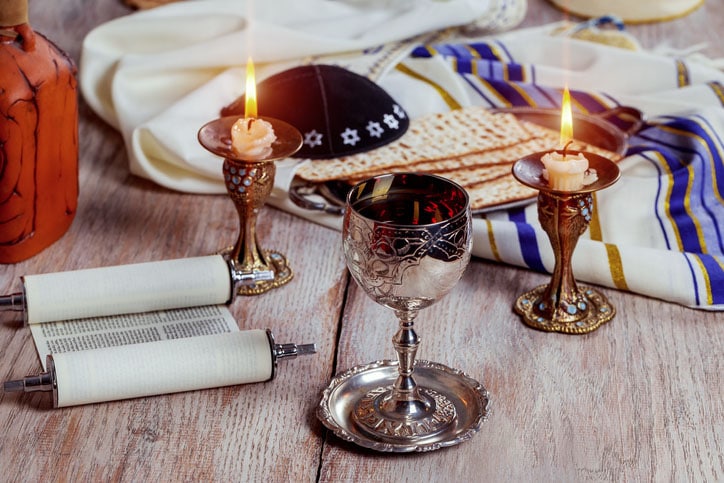
Tonight marks the beginning of the Jewish holiday of Passover. The centerpiece of this festival is the Seder: a festive meal designed to tell a narrative of God helping remove an oppressed people from the hand of the oppressors and making them a vibrant nation. The Seder meal often takes hours, involves special food and wine, and includes various songs and traditions.
These practices are done with the explicit intention of teaching Jewish children, as well as both the Jewish and secular communities, about the story of the Exodus, the core Jewish values of peace, liberation, self-determination and the Jewish imperative to work to make the world a better place for all. The Seder and the holiday of Passover itself are about sharing stories with family and community. And while Jews have long passed values and traditions down through stories in countless books like the Talmud, the familial and communal storytelling of the Seder is sadly no longer a norm today.
Jews in America are undeniably a people of the book in terms of their strong and continued focus on higher education, but the same cannot be said in terms of their reading of religious texts or sharing religious stories with family. Education has been a top priority in the Jewish community for centuries. In contemporary Jewish life, American Jews overwhelmingly report in numbers notably higher than other faiths and cultures that it is generally expected that one will attend an institution of higher education.
However, Jews are far less likely to report engaging with religious and philosophical texts or sharing religious stories with family. Data from the Survey Center on American Life’s new American National Family Life Survey reveal that a little more than a quarter (28 percent) of all Americans say they shared religious stories with their families at least a few times a month while growing up. But just 12 percent of Jews say they read scripture with their families this regularly while growing up, compared to 41 percent of Protestants.
With barely one in 10 Jews reporting that they regularly read scripture or religious stories with their families, this is hardly strong evidence that religious books and stories are central to their lives whatsoever. Instead, the Pew Research Center has found that Seders and food are much more central to Jewish life today. In fact, when members of the Jewish community were presented with a list of various Jewish practices and activities in a large national survey, sizable majorities of Jews note that they have held or attended Seder in the last year (62 percent) or cooked traditional Jewish foods (72 percent). But rates for other traditional activities, like attending religious services on at least a monthly basis (20 percent) or observing dietary laws at home (17 percent), are much lower. Jewish religious services are, incidentally, where books like the Torah are publicly read, scrutinized, analyzed and interpreted, and few Jews regularly engage in those domains as well.
These data should be troubling for leaders and thinkers both within the Jewish community and outside the Jewish world. Reading and engaging with texts and stories are far more than just religious acts; they are acts of communal identification and means by which to promote continuity of values and traditions. As sociologist Samuel Heilman observed in The People of the Book (1983), families and individuals study and learn stories to become part of the Jewish people itself. In turn, these actions provide a “sentimental education” in which Jews gain a deep understanding of the values of their tradition.
Reading and engaging with texts and stories are far more than just religious acts; they are acts of communal identification and means by which to promote continuity of values and traditions.
The Passover Seder—in which communities sit around the table, explicitly ask four questions, and try to make sense of history and philosophy with a special book, the Haggadah—is the epitome of how values are transmitted and better understood when they are shared aloud with family and community. By asking questions such as “Why is this night different from all other nights?” and “On all other nights, we eat chametz (leavened foods) and matzah. Why on this night, only matzah?” participants in the Seder have the chance to speak to others and struggle to answer questions about life and history. They also study, debate, and ponder religious texts aloud which in turn teach lessons and contextualize the present from lessons in the past.
Sadly, at present, books and texts are not regularly read in family settings nor are they central in the lives of most Jews. The benefits of these practices to Jewish continuity are significant but will be lost if only small numbers of Jews are actually trying to share religious stories in family settings. The efforts of the Grinspoon Foundation and its PJ Library—which sends more than 220,000 books that transmit varied cultural values and religious ideas to families raising Jewish children each month—could not come at a more important time, but it may not be enough, especially when older Jews have simply stopped the critical process of storytelling and debating in recent times. So, when many Jews sit down on Friday, perhaps when they arrive at the question of why this night differs from all other nights, those at the table should ponder why they do not read and discuss scripture, historic texts and religious stories on a more regular basis.
Samuel J. Abrams is a professor of politics at Sarah Lawrence College and a nonresident senior fellow at the American Enterprise Institute.
In the 2020-2021 academic year, Boycott Divestment and Sanctions (BDS) resolutions were proposed to student governments at 17 college campuses across the U.S. Eleven of them passed. On March 27, 2022, Princeton University hopped on the bandwagon, when Princeton’s Undergraduate Student Government (USG) voted to approve a BDS-aligned referendum brought forth by Eric Periman, a current sophomore and president of the Princeton Committee on Palestine (PCP).
After gaining USG approval, Periman collected the 500 signatures necessary for his referendum to appear on the campus-wide ballot. Voting began on Monday, April 11, and closed on Wednesday, April 13.
PCP has been mired in numerous antisemitic controversies in recent years, most notably for hosting one of the most notorious anti-Jewish, anti-Israel academics, Norman Finkelstein in 2019. Just two weeks ago, PCP members–Periman included–protested outside of the Center for Jewish Life during its “Israel Summer Program Fair,” holding up signs with slogans like “From the River to the Sea,” recalling a refrain commonly used by designated terrorist organizations like the Popular Front for the Liberation of Palestine (PFLP) and Hamas to call for the violent erasure of the Jewish State.
The referendum calls on Princeton to immediately halt the use of Caterpillar equipment in all ongoing campus construction projects,” claiming that Caterpillar has played a “violent role” in “atrocities” against Palestinians.
Periman disclaims any connection to BDS though the organization is clearly referenced in the explanation section of the referendum, which states that “Caterpillar is listed as one of the only targeted construction companies in the national Boycott Divestment and Sanctions (BDS) movement.”
“There is something nefarious about the fact that they don’t say that it is BDS outright,” expressed Rabbi Julie Roth, Princeton University’s Jewish Chaplain.
This is not the first BDS referendum to come across the desk of Princeton USG. In 2015, the Princeton Divests Coalition called for the university “to divest from all multinational corporations that contribute to or profit” from what they deemed “the illegal military occupation of the Palestinian territories,” citing Caterpillar as one of them. The 2015 referendum led to a rise in antisemitism on campus, with antisemitic messages proliferating on social media and swastikas appearing on campus. The 2015 vote failed, but only by a narrow margin of 5 percentage points.
In the week leading up to last week’s campus-wide vote, student activists on both sides mobilized to try and swing the student body vote. PCP hosted and co-sponsored a slew of events, one of which was a “Caterpillar Referendum Teach-In” with the parents of Rachel Corrie, an activist whose 2003 death in a restricted Gaza border zone–ruled accidental by the Israeli courts–occurred when she physically blocked a Caterpillar bulldozer out of sight of the operator. Rutgers Theatre Professor David Letwin, a faculty participant at the event, called Israel an “apartheid” regime, accused it of “ethnically cleansing hundreds of thousands,” and deemed it an irredeemable “colonial state.” In addition, the progressive lobby group J Street hosted “Occupied Palestinian Territories 101,” and PCP, the Alliance of Jewish Progressives (AJP), and the Pride Alliance hosted a discussion about Masafer Yatta, a contentious region in the West Bank adjoining Hebron used by the Israeli military for exercises.
In the week leading up to last week’s campus-wide vote, student activists on both sides mobilized to try and swing the student body vote.
Meanwhile, Tigers For Israel hosted a panel discussion titled “The Case Against BDS” with former U.S. Ambassador to Israel and Egypt, Daniel Kurtzer, public intellectual and activist, Michael Walzer, Palestinian peace activist Bassam Eid, and Ashager Araro, an Ethiopian-Israeli Jewish activist. At the event, Eid highlighted the fact that the Palestinian Authority itself uses Caterpillar earthmoving equipment, meaning that the referendum passing will harm the very people it claims to help.
Students on both sides also sent out mass emails to the residential college listservs, trying to persuade their fellow students to “VOTE YES” or “VOTE NO” on the referendum. In addition, campus publications like The Daily Princetonian and The Princeton Tory have published news and opinion pieces on the referendum and the events surrounding it.
There is currently a petition on Change.org titled “Princeton President Eisgruber: Remove Racist Referendum Targeting Jewish Students” that has garnered over 2,000 signatures. It calls on readers “to contact President Eisgruber to demand he protect Jewish students by removing the referendum question from the ballot and publicly condemning the referendum as antisemitic” and urges “[Eisgruber] to adopt the IHRA Definition of Antisemitism – the only internationally-accepted definition of Jew-hatred.” As of this writing, there is no internal petition put forth by members of the student body nor has there been a public statement by the University administration.
The election numbers were leaked on Wednesday, April 13, and USG officially released the results on Friday, April 15. Although BDS received a plurality of the votes, it did not receive a majority. 44% of students voted yes, 40% voted no, and 16% of students abstained. The referendum opposition initially believed that the vote had failed, because at the start of the campaign period, Brian Li ’24, the Chief Elections Manager of Student Government informed Tigers for Israel president Jared Stone ‘24 that the “abstain” votes would be counted as among the total number of votes cast. By this metric, the referendum fails.
Despite his clear written correspondence with Stone, Li asserted hours after the voting closed that “abstain” votes do not count as votes cast. Opposition campaigners responded with outrage, believing that the outcome of the referendum could very well have been different had they not constructed their campaign strategy based on the information provided to us by the USG Chief Elections Manager.
Per an email from Myles McKnight ’23:
Brian [Li] claims that “it was and remains [the case] that abstentions are not to be construed as votes.” But given his clearly-communicated prior decision that the abstentions would be counted, the claim that the decision not to count them has always stood is at best an absurdity, at worst a face-saving lie.
Here’s what’s happened: the ultimate and authoritative decider on the relevant constitutional questions informed campaigners of his interpretation of the Constitution. The campaigners built an entire campaign on that interpretation. As though it were a magic trick, he’s concocted the exact opposite interpretation after the results have come in, thereby reversing the result.
Is this the precedent you want to set?
This election was close. It came down to only about 100 votes. This whole thing could have come out differently with just the slightest alteration of campaign strategy. There are two ways USG can save face now: count the abstain votes, or void the referendum and hold a revote. I hope you realize how much damage you are doing to the trust you once held with the Jewish community––students, alumni, and family.
In addition to complaints submitted by McKnight and others, USG treasurer Adam Hoffman ‘23 filed a formal appeal of the election co-signed by USG Sustainability Chair, Audrey Zhang ‘25 and USG Senate Members Carlisle Imperial ‘25 and Ned Dockery ‘25. “It is our judgment that the conduct and decision of the CEM are unfair and incorrect,” they wrote. The four senate members recommended one of three solutions: “either a) abide by the representations made by the CEM during the course of the campaign and on the basis of which the campaign was conducted, b) void the referendum, or c) hold a revote with clearly communicated rules and guidelines.”
On April 15, USG released election results for the other two submitted referendums, but wrote that “results for Referendum Question 3 have not been certified at this time due to appeals pending before the Senate.”
Alexandra Orbuch is a Freshman at Princeton University from Los Angeles, California hoping to study Politics. On campus, she writes for The Princeton Tory, the university’s journal for conservative thought, and the Princeton Legal Journal, the university’s undergraduate Law review.
One of the challenges of living in chaotic and uncertain times is that we’re constantly bombarded by bad news. And then, seemingly out of nowhere, some good news will sneak in. It could be an inspirational sermon, a feel-good story, a spiritual insight, anything designed to uplift us.
Human nature, however, likes to settle in one place. It’s less confusing if we just pick a side. In a sense, the bad news and the good news compete for our minds and hearts. That’s why I often meet people who fall squarely on either side: those who see everything as a blessing, others who can’t stop railing about the darkness of our times.
Of course, they’re both right.
For me, the deepest value of Passover is that it doesn’t let us pick a side. We’re forced to confront the darkness of slavery, just as we are forced to contemplate the immeasurable value of freedom. This dual confrontation—the ability to hold two very opposite thoughts at the same time—is the essence of a healthy mind.
We can confront the unspeakable darkness of the massacres in Ukraine, while not ignoring the incredible outpouring of humanitarian aid to rescue millions of refugees.
We can rail against the rise of terrorism in Israel, while not ignoring that the Abraham Accords have begun to transform the relationship between Jews and Arabs in the Middle East.
We can bemoan the terrible rise in violence in Los Angeles, while also watching a sunset on Santa Monica beach and reminding ourselves that this is still one of the great cities of the world.
We can commiserate that technology is owning our lives, while remembering that we have the free will and agency to take back control.
We can express outrage at societal sins like racism, while not ignoring the significant progress that this country’s system of laws has enabled.
In other words, no matter what human nature says, life is not either/or. We confront darkness, but we don’t ignore the light. We embrace the light, but we don’t ignore the darkness.
The Passover seder can be seen as a great dance between darkness and light. We don’t read our story like a Hollywood movie. Slavery is not a set up for the big ending of liberation. Nothing is resolved. The whole point of the Jewish story is that we’re a work in progress, a messy one. We aim for progress, yes, but we never lose sight of the darkness. If anything, the darkness is there to fuel the drive for progress.
If we have a personal tendency to look at the glass as half-empty or as half-full, the Passover seder compels us to look at the whole glass. Why? Because our lives, our realities, are in that whole glass.
If we have a personal tendency to look at the glass as half-empty or as half-full, the Passover seder compels us to look at the whole glass. Why? Because our lives, our realities, are in that whole glass.
May our recognition of the full glass lead to the creation of more good news, in our lives and in the world.
For more articles from The Media Line, click here.
The United Arab Emirates’ senior-most rabbi has revealed plans to develop the Gulf Cooperation Council’s first dedicated Jewish neighborhood, containing faculties and institutions for the thousands of Jews who have made the Emirates their home.
Dr. Elie Abadie, the senior rabbi of the Jewish Council of the Emirates in the UAE, currently leads the Association of Gulf Jewish Communities (AGJC), established in 2021 to provide the Jewish populations in the UAE, Bahrain, Kuwait, Qatar, Oman, and Saudi Arabia with the Beth Din of Arabia rabbinical court.
Abadie says there are some 2,000 Jewish residents in the UAE, with about 500 “active Jewish” people practicing their religion.
This number has doubled since the historic Abraham Accords, which normalized relations between the UAE, Bahrain, and Israel, were signed in 2020, he says.
The UAE alone has welcomed more than 200,000 Jewish tourists since the peace deal, with many exploring the idea of moving to the Emirates and establishing businesses. Abadie predicts this number will quadruple over the next five years.
It means, the rabbi said, that it is time for the UAE to have its own dedicated Jewish neighborhood, home to hotels, shopping centers, schools, a synagogue, and a community center.
“We will be seeing more houses of worship, schools − from nurseries to higher education – a dedicated place for the mikveh, a ritual bath designed for the Jewish rite of purification, more kosher food establishments, a community center,” Abadie said. “What we need is a Jewish neighborhood, and I have been speaking with a few real estate developers about this.”
Having a dedicated fully functioning neighborhood will be particularly important on Shabbat, when Orthodox Jews do not drive except in life-threatening emergencies, the rabbi said. “So we would like a neighborhood with a synagogue, private homes, condominiums, hotels, shopping centers. That is something I am looking toward and talks are ongoing,” he continued.
The AGJC is headed by its president, Bahrain’s Ebrahim Dawood Nonoo, and led by the Beirut-born Abadie.
The rabbi said, “Since the Abraham Accords and the establishment of the AGJC, we have been really able to help the Jewish communities in the Gulf and many individual Jews in other countries that don’t have a formal Jewish community with their pastoral, religious and spiritual needs.”
Elsewhere in the GCC, Abadie estimates that Saudi Arabia has about 1,000 Jews, with smaller numbers across Bahrain, Kuwait, Qatar, and Oman.
He predicts that every GCC country will have recognized Jewish communities in the next five years, building on the Abraham Accords peace treaties between the UAE, Bahrain, and Israel.
He said he firmly believes that Saudi Arabia, Kuwait, Qatar, and Oman will follow suit and join the process of normalization with Israel, paving the way for Jews to openly practice their faith across the Gulf.
“I do hope the rest of the GCC opens up more and gives recognition to their Jewish communities, or allows their individuals to form a community,” Abadie said. “I am hoping for that and I’m positive that all the GCC will follow suit. Some countries will take longer than others, but I am sure that over the next five years all the [GCC] countries will make that change.”
Congratulations to my University of Pennsylvania classmate, Melissa Rivers, on her new book, Lies My Mother Told Me: Tall Tales from a Short Woman! Enjoy the excerpt below about celebrating the holidays with the Rivers. Hag Sameach! Happy Passover!
Happy Holidays!
My mother loved holidays. I’m not sure if it was the giving or the receiving, but any time a major holiday was coming up, my mom would get so happy and sweet and excited, she practically became another person. Instead of worrying about work and becoming resentful of those people who were getting the jobs she felt she should have gotten, she’d think about buying those people gi!s—like nooses or cyanide pills or cars with faulty brakes.
According to her, holidays are the main reason we’re Jewish. “Melissa, there are like a gazillion religions in the world—Christianity, Islam, B’hai, Shintoism, Hinduism, Buddhism, Sikhism, Jainism, Animism—and they all have something good to o”er.
“Take the Sikhs, for example. They wear turbans. Perfect religion if you’re having a bad hair day. You should speak to one of them about how to wrap your hair if you’re between colorings or your stylist is out of town at a pride parade. I realize there are not many people of that faith in our neigh- borhood, but my advice is Sikh and ye shall find.”
“Mom, really?”
“Same as the Muslims. They’re very big with the head coverings too. Like the Sikhs, they mostly live in hot, arid deserts where it’s very hard to hold a perm or a curl, and split-ends are the norm. Those hijabs come in very handy in July and August.”
“What about the burkas? They cover everything.”
“Again, Melissa, it’s about the hair. I heard that Muslim women are extremely hairy. Their legs get five o’clock shadow. But throw on a burka and, BOOM, just like that, smooth as a pageant winner.
“You know, all of this hair talk makes me realize that a lot of religions are very hat-oriented. And it’s trending.”
“Is that why our neighbor, Mr. Jones, started wearing a cap? Is he going B’hai?”
“No, B’hald. Mr. Jones is getting hair plugs, but they haven’t grown in yet. He looks like that Barbie doll you had when you were six. Remember? You got mad at me for making you cut your bangs, so you shaved Barbie’s head in protest. It was so embarrassing. I didn’t want to tell people you were being bratty, so I said that Barbie had alopecia, like Mike Nichols, and we were going to bring her to a doll hospi- tal for experimental treatments. Actually, it turned out very well. Rather than have them think I must be a lousy mother to have driven you to disfigure your doll, they’d say, ‘Mike Nichols has alopecia? Does his wife, Diane Sawyer, know?’
“I’d say, ‘Does she know? She loves it!’ Mike has no body hair whatsoever. When Mike gets out of the bathtub, he looks like a giant toddler or Baby Huey.
“One time I was at a girls’ lunch with Barbara Walters, Joy Behar, Whoopi Goldberg, and Diane. The food comes and Diane yells out, ‘Omigod, there’s a hair in my soup! Where did it come from?’
“I said, ‘Not Mike Nichols.’ Everyone laughed and laughed. Except Diane.”
“Is that why Diane hasn’t spoken to you in years?”
“Who knows? I’m sure she has plenty of other reasons. You know who really loves hats? The pope. The man is obsessed; he’s the Imelda Marcos of millinery. He has an entire floor of the Vatican devoted entirely to his hat collec- tion. Just like Elton John has for his wiglets.”
“Elton John has a floor at The Vatican?”
“Of course not, Melissa, I’m making an analogy. This explains your SAT verbal scores. Elton’s not Catholic. I’ve heard that Elton refers to his wigs as ‘the girls.’ How fabulous is that? They all have names. One is Maxine, one is Jenni- fer, one is Michaela, and so on. He wears a di”erent girl for each concert. Except for Fridays; he always wears Miriam on Fridays, you know, to honor the Sabbath.”
My mother must have noticed my look of incredulity (I was rolling my eyes so much I made myself dizzy), so she shi!ed gears.
“Oh…the pope. Remind me to come back to the Sabbath. So, the pope is quite the hat aficionado. You know, if he wasn’t the pope, I’d think he was just a very pious hoarder. Most o!en we see him with a beanie, but every now and again, depending on his mood, he’ll throw on a ni!y fez or a sassy little cloche. He says they’re fun to accessorize.”
“Really, Mom? When did he say that?”
“A few years ago. He told me. We wound up sitting together at the theater.”
“Theater?”
“On Broadway. We were seeing Agnes of God. Do you know he knew all the words and sang along to every song?”
“Mom! Agnes of God is not a musical.”
“Well, he was moving his lips during the entire show. Maybe he was praying, or maybe he was just muttering to himself about the woman sitting in front of us with the huge bou”ant that was blocking our view. She must have been from Jersey.”
“And in the middle of the play, you just leaned over and said, ‘Excuse me, Pope, what’s your favorite hat?’”
“Of course not. What’s that matter with you? First o”, I called him Your Eminence, and second, it was during inter- mission. He was in line for the men’s room. Apparently, that Blood of Christ really runs through ya. I o”ered him a Kit Kat and said, ‘I love your Beanie. It’s like a yarmulke with a nipple.’
“He laughed and said, ‘I hear that all the time. Mostly from the Jews. You’ll never guess what my favorite hat is. G’head; try.’
“‘Porkpie?’
“He laughed and said, ‘Pork, ha-ha; again, the Jews! No, the miter. I love my miter.’
“‘I love it too, Your Eminence. It’s like a dunce cap with rubies!’
“‘Oh my God, Joan, you kill me! I love it because it sits high and elongates my face. Gives me length and makes me look less stocky and stooped. So much cheaper than having work done.’
“‘Now, you tell me. Where were you twenty years ago when I was having my chin done?’”
We went back to our seats and exchanged numbers. I was going to ask him if he wanted to go backstage and say “hi” to the cast with me, but he had to leave before the bows. Something about blessing orphans or bringing relief to famine victims, who the fuck knows? Anyway, he was quite lovely.”
For what seemed like forever, I sat there and stared at her. Finally, my jaw unfroze, and I said, “Mom, do you expect me to believe that? That not only did you meet the pope in a Broadway theater, but that you remembered your entire conversation with him, verbatim?”
“Well of course I did, Melissa. I’m pretty sure if you were ever lucky enough to meet a pope, you’d remember every word too. He’d probably say, ‘So nice to meet you, Melissa. What’s up with the bangs?’”
“Really? You think the pope would take time out of his busy day to comment on my bangs?”
“If he has time to go hat shopping, he has time for your bangs.”
“Fine. Here’s your reminder: Sabbath.”
“Ooohhh, thank you sweetheart. I love you. Even with your bangs. You know, it’s not really about the Sabbath; it’s about why we’re Jewish.”
“I’m guessing because Grandma and Grandpa were Jewish?”
“No, but good guess. It’s because the Jewish religion has lots of holidays, that’s why. Think about it—everyone gets o” from work or school on Christian holidays, like Christmas or Easter, so it’s no big deal. It’s the same as national holidays, like the Fourth of July or Presidents’ Day or Columbus Day. Everyone is o”. But Jews get a lot of extra days o” because we have so many holidays: Rosh Hashanah, Yom Kippur, Purim, Tisha B’Av, Chanukah, and Passover. Put all those holidays together and we’ve got at least a month’s free paid vacation! And because nobody ever questions the validity of a religious holiday, we can make even the flimsiest of hol- idays into a ‘day of remembrance,’ or some other bullshit.
“Don’t scowl at me, Melissa…”
“I’m not scowling at you.”
“But you were going to. I know you; I’m your mother. I
gave birth to you. Or so I’m told.
“I wasn’t finished what I was saying when you began
scowling. And if you don’t stop scowling, I’m not going to finish. I think most Jewish holidays are really, really good, especially if I can celebrate them without having to go to synagogue. Anytime a major holiday rolls around, and I already have important plans for that day, like washing the feet of the poor, or curing cancer, or shopping, I always tell the rabbi I can’t make it because I have a sinus infection and he never quibbles, because a) name one Jew who doesn’t have a sinus infection and b) I’ve had so many nose jobs, he’s happy I still have sinuses.”
For those of you reading this who are not Jewish, not familiar with our holidays, or live in Iowa, most of our holi- days are similar to yours: Rosh Hashanah is the Jewish New Year, and we celebrate it like a regular New Year with lots of food and lots of fun. The only di”erence is, we don’t hang around Times Square getting drunk or flashing our tits while waiting for a ball to drop.
Purim is the story of Mordecai, Haman, Queen Esther, and evil King Ahasuerus. I know what you’re thinking: sounds more like a reality show on BET than a Bible story. I concur.
A week or so a!er Rosh Hashanah is Yom Kippur, our annual day of atonement. We observe this holiday by fasting for twenty-four hours to atone for our sins. We break the fast with lots of food, most of it very high in fats, carbohy- drates, and starch. Which explains why it took us forty years to cross the desert. Jewish food is so heavy, we had to stop every half mile to rest or look for a bathroom or buy some ex-lax.
Which brings me to Passover, which was my mother’s favorite Jewish holiday (mostly because it lasts for a week and she could milk extra days o” from whatever it was she was being paid to do). Passover is the story of the Jews’ exodus from Egypt, which is chronicled in Book 1 of the Bible, “Exodus.”
At our last Passover together, my mother thought we could make a new cable TV movie of the story and change the title from Exodus to Fi!y Shades of Schlepping.
The main part of Passover is the Seder, in which family and friends from all over gather and have a huge dinner that includes songs and prayers and the telling of the story of the exodus. It’s like a Christmas dinner without presents, ham, or Jesus. My mother hosted Passover Seders every year, and it became an annual tradition, like the Running of the Bulls in Pamplona.
One of the highlights of the Seder is the Four Questions, which is the Cli”sNotes version of the history of Passover (not to be confused with the self-help book, The Four Agree- ments, because Jews don’t do self-help; we do expensive therapists, who not only walk us through our anxieties and problems, but also serve as ni!y tax write-o”s). The Four Questions are always asked by the youngest child at the table, and answered by one of the wisest, most sage adults. One memorable year, with about thirty people at the Seder, I was the youngest one there, so I asked the Four Questions. And my mother, who liked to be referred to as The Oracle of Bel Air, answered them. Not truthfully, of course.
“Okay, question one: Why is this night di”erent than all other nights? And why do we dip twice?”
“Well, Melissa, it’s di”erent because your Aunt Barbara isn’t here, and she usually is—I think she hurt her back pow- er-shopping at Neiman Marcus. That’s what you get from doing cardio. And we dip twice because it makes dancing more fun. Okay, next question.”
“Why on this night do we eat only unleavened bread?”
“According to the Haggadah, it’s because the Pharaoh’s soldiers were coming to kill all the Jews, so we had to take our breads out of the oven before they were done. We wound up with matzah, which is, quite frankly, tasteless, unless it has caviar on it. That story is such BS. When is the last time you saw a Jewish woman hunched over an oven, baking? Never, that’s when. That’s why God invented Saltines.”
“I know this isn’t one of the questions, but why did the Pharaoh want to kill the Jews? What did we do?”
“We didn’t do anything, Melissa; your great-great-great- great-great-great-uncle Elliott, did. There was no one specific thing Elliott did, he was just unbelievably annoying. All the time. He was whiny, he was twitchy, he chewed with his mouth open, and he had BO and dandru”. Even the other Jews wanted to kill him. Next!”
“Okay, question number three: Why on this night do we eat bitter herbs?”
“Melissa, I work in Hollywood. Bitter is my middle name. Time for question four; go!”
“Okay, why on this night do we eat while reclining instead of sitting up?”
“Melissa, have you ever had post-partum depression?” “Mom, I’m eleven.”
“When a woman gets depressed, particularly a!er she
gives birth…to a baby she loves, even though the baby has ruined her figure and stretched her vagina so wide Chilean miners could get stranded in it, she o!en gets depressed. And she lies down in bed, flat on her back, and eats nothing but Fritos, ice cream, and Klonopin until she feels better. Six months later, when she finally gets up and looks in the mirror, she is so repulsed by what she sees, she gets back in bed.
“As for the men, they eat while reclining because the food is so binding, they can’t get up. Did you know that one year, your Uncle Allan ate so much matzah he didn’t shit until October? True story. I hope that answers all the questions!” The other twenty-eight people at the table sat there aghast, with their mouths open, like that scene from The Producers where the audience is horrified watching the musical number, “Springtime for Hitler.”
My mother didn’t notice. She put down her Haggadah and said, “Dessert, anyone?”
In hindsight, I think another reason my mother loved Passover is that since she was hosting—it was her house, her food, her Seder—she could lie with impunity and never get called out on it.
L’chaim!PS: One year my mother had a Passover Seder for all of her gay friends. It was so much fun. Two of the Four Ques- tions involved Liza Minnelli.PPS: If you want the real answers to the Four Questions, Google “Passover.”PPPS: Imagine my surprise when the pope showed up at our house that year for Thanksgiving.
Loved being on @TheView and was great to be able to discuss my new book “Lies My Mother Told Me: Tall Tales From A Short Woman” available now for pre-order. https://t.co/1y9ompucTL
Why is this Coachella different from all other Coachellas? This year’s Coachella begins on the first night of Passover. If you’re choosing to attend the Coachella Valley Music and Arts Festival instead of going to a Passover Seder this weekend, you can actually do both.
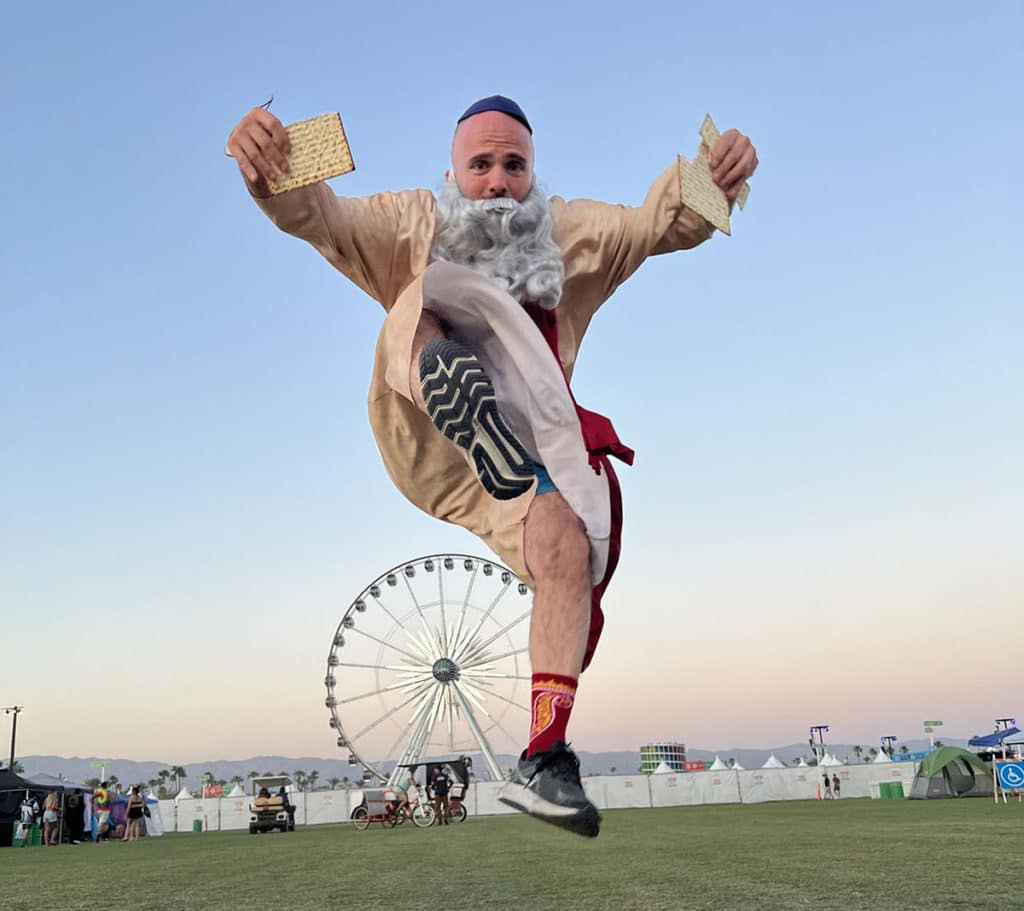
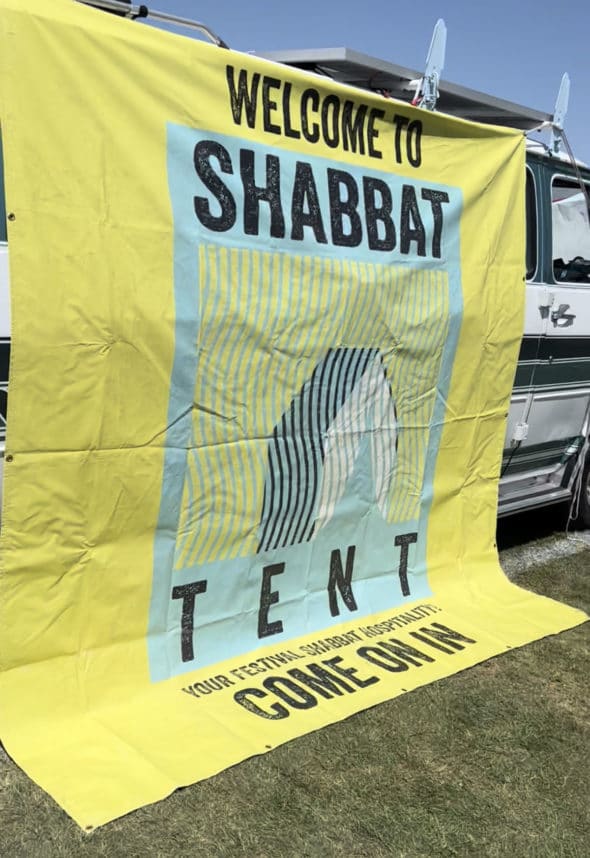
Rapper Kosha Dillz (real name Rami Matan) will be leading free Passover and Shabbat activities for concertgoers as part of the Shabbat Tent, dubbed “Matzachella,” on the Coachella campgrounds.
“Anyone who’s here is gonna be skipping Seders, so it’s a free Seder for the campers,” Kosha Dillz said. “It’s a good time to make people happy about Jews in general. Passover’s a pretty positive, miracle holiday. I’m rapping. We’ll have matzah, wine, grape juice; there’s cold drinks, there’s a place to charge your phone—sort of like a safe haven amongst all the chaoticness of a festival, especially Coachella.”
Coachella annually generates crowds of at least 100,000. Among them are Jewish music fans who will have the opportunity to do a Passover Seder outdoors and in the desert just like their ancestors, with the town of Indio substituting for the Promised Land. Many of them will be taking residence overnight at the Coachella campgrounds, and that is exactly where to find Kosha Dillz and the Shabbat Tent.
The mission of the Shabbat Tent is to be welcoming and open and bring Shabbat hospitality to Jewish concertgoers.
“We practice hospitality based on the Abraham and Sarah model,” said Rabbi Yonah Bookstein of Pico Shul, who took over the Shabbat Tent operations in 2010. “So it’s just an open tent and everybody comes.”
Bookstein said that one attendee pointed out at a previous festival, “You’re the only group here that’s not selling something!” The Tent relies solely on fundraising and donations from generous contributors who believe in its cause.
Shabbat Tents at music festivals began in 1999 at the jam band Phish’s Millenium concerts. While the founders are still on the advisory board, Bookstein helped build an enthusiastic team of volunteers and donors to continue spreading Shabbat Tents to some of the largest-attended weekend music festivals across the country. In the past, they have appeared at mega-festivals such as Bonnaroo and the Sundance Film Festival, among many others. Later this year, there will be Shabbat Tents at the Summer Camp Festival in Illinois and the High Sierra Music Festival in Quincy, California.
Since Coachella falls on Passover every few years, Matzachella spawned as a Shabbat Tent derivative. Kosha Dillz came up with the name after collaborating with Bookstein at the 2012 Paid Dues Festival in San Bernardino. They held their first Matzachella in 2016.
“I wrote this Haggadah for Kosha called ‘The Ten Minute Seder’ to do at the festival,” Bookstein said. “Now there’s a whole website for the ‘The Ten Minute Seder’ and it’s used all over the world. And it all started because Kosha and I had this crazy idea to do Passover at festivals.”
The festival spans two consecutive weekends from Friday through Sunday. This year is also the first Coachella festival since 2019—the 2020 and 2021 editions were canceled due to COVID.
“Thousands of Jews go to Coachella,” Bookstein said. “So people would come by [the Shabbat Tent] and say things like, ‘My mom was really mad that I was going to a festival over Passover, but now I can show her that I did do a Seder.’”
Another reason this Matzachella is different from all other Matzachellas is that Bookstein is unable to attend, but for a good reason: he is currently in Poland to lead 70 refugees from Ukraine in a Passover Seder, which he explained to the Journal earlier this month.
So that leaves Kosha Dillz and rapper Groovy Jew (Brad Cohen) of Santa Monica to take the lead at Matzachella.
Kosha Dillz is a first-generation American born to an Israeli family. He grew up in New Jersey and currently resides in New York City. Over the past year, he has experienced an explosion of popularity. He went viral last fall while was performing with a microphone and amplifier in the rain outside of Madison Square Garden after a Knicks basketball game.
Then, one of Kosha Dillz’s heroes, rapper Fat Joe, walked by and rapped a few lines alongside Kosha Dillz, much to the delight of the crowd. The video generated millions of views and was covered by news outlets worldwie. Four days later, Fat Joe invited Kosha Dillz to perform with him at a concert in Denver.
Throughout the past few months, Kosha Dillz traveled the world performing songs from his latest album, “Nobody Cares Except You.” In addition to performing all over the U.S., he also performed in Portugal, Paris and Jerusalem. Along the way, he found the time and stamina to run the L.A. Marathon.
At his core, he’s a freestyle rapper. Those improvisational skills earned him a spot this summer on the 18th season of the VH1 sketch comedy and improv game show series “Wild ‘N Out” with Nick Cannon.
At the time of the interview, Kosha Dillz was already dressed as Moses, making Matzachella hype videos for his 57,000 Instagram followers.
For those coming by the Shabbat Tent for some Matzachella, there will be free 10-minute Seders every 30 minutes starting Friday night at 6:00 p.m., and again on Saturday at 6:00 p.m. every 30 minutes until 9:00 pm. Kosha Dillz and Groovy Jew will be there for “chillin’ vibes” between Passover and Shabbat activities events—which will be needed, as the temperatures are forecasted to be around 90 degrees.
The crowd at Coachella skews towards a young adult demographic.
“We can’t expect young adults to be coming to us, [so] we sometimes have to bring Shabbat to them,” Bookstein said. “It shows that you don’t stop being a Jew at a festival. You can do Shabbat there [and] you know you can bring your friends. A lot of people reflect back and they say, ‘Shabbat Tent was one of my favorite parts of the festival. It was such a great chill zone.’”
Kosha Dillz also wants to remind people that the Shabbat Tent is for both Jew and non-Jews, and encourages anyone walking by to ask questions—even if it’s not the Four Questions.
“People like culture. I just took a [non-Jewish] friend to a Shabbat in Atlanta and they were like, ‘I’ve never done that before. Am I allowed to do that?’” Kosha Dillz said. “My whole aura is introducing stuff to people that they’ve never seen. I bring what I’m proud of whether that’s rapping or Passover. And I love Passover.”
The Shabbat Tent at Coachella is located at 811th Street and Main in lot 8 at the Coachella camping grounds. For those wandering/having difficulty locating Shabbat Tent, you can contact @KoshaDillz, @groovy_jew or @shabbattent on Instagram for updates. More information on Shabbat Tent can be found on their website: https://www.shabbattent.org/coachella