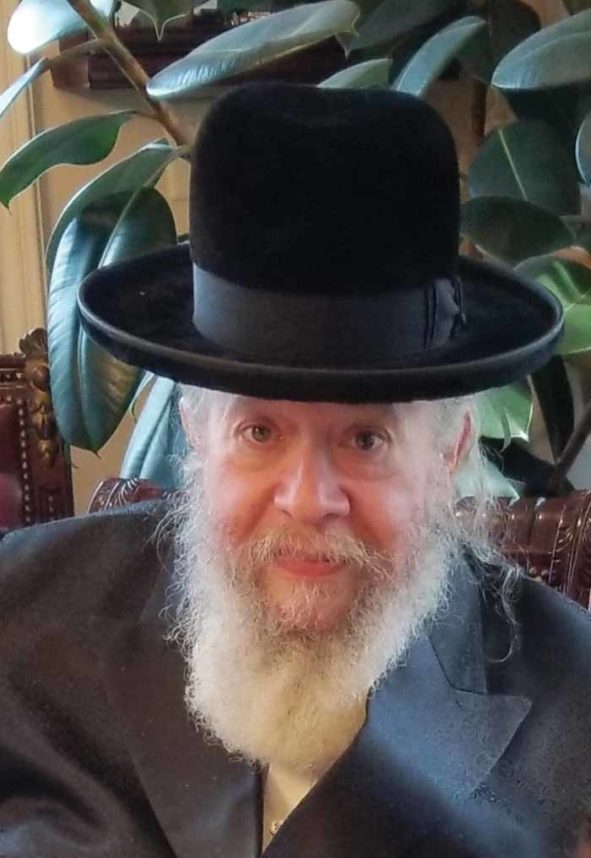
When Rabbi Yaakov Horowitz, now of Lawrence, New York, was growing up in West Hollywood, he was struck by a memorable oddity in congregations where he prayed.
“I met Jews from all kinds of little towns across the United States,” said Horowitz. “Their families had been religious for many years, while they lived in unlikely places such as Montana and the Southwest. Many were Sabbath observant and kosher observant.They had lived through tough, colorful eras, like the Gold Rush, like the Revolutionary War. They told astounding stories.”
Enter Horowitz.
Embracing the religious commitments of his own family, Horowitz became a Hasidic rabbi with broad interests.
Rich in historic photos, sketches and ample text across 106 colorfully packed pages, Horowitz has created one of this year’s most original Haggadahs.
For decades, he has been drawn to American history, focusing on the little-known roles played by what he calls American Traditional (practicing) Jews. And now he has organized and published his findings, culled from 350 years of American history, in a new Haggadah: “The American Jewish Legacy Passover Haggadah.”Rich in historic photos, sketches and ample text across 106 colorfully packed pages, it’s a unique Haggadah.
In addition to an essay called “How Matzo Became Square,” Horowitz asks Haggadah readers if they know interesting facts, such as how soldiers from the Confederate and Union armies celebrated Passover Seders with matzo and Haggadahs on the battlefield. He tells how Jewish homesteaders on the prairie in the 1800s made their kitchens kosher in preparation for the Passover holiday and that during the California Gold Rush, San Francisco had a number of matzo bakeries.
The Horowitz Haggadah relates a story from the San Francisco-based Daily Alta California newspaper about Steamer Day and Yom Kippur.
When, after a long, torturous journey, ships bearing goods from the East Coast arrived in the Bay Area, it was called Steamer Day, and sparked community-wide celebrations. In September 1866, when Steamer Day coincided with Yom Kippur, the Daily Alta headline read: “Steamer Day Postponed on Day of Atonement.”
According to the Alta story, “The remnants of God’s chosen people, the children of Israel, bow their heads to the ground to-day, in sorrow and humiliation, for it is with them the most solemn of holidays ordained in the Pentateuch … The Jewish portion of the citizens of California constitutes a very important element of our inhabitants, more than would be generally believed.”
“I put a question to a prominent historian,” Horowitz told the Journal. Why is so little known (or so little published) about the presence and roles played by practicing U.S. Jews in American History?
“Nobody has gathered information specifically on what it meant to be kosher in the Gold Rush, and there is a reason for this,” Horowitz said. “Among the overwhelming majority of well-known historians, their knowledge of a lot of Traditional Judaism was incomplete.”
“The whole premise of it is the Festival of Freedom in the Land of the Free. Passover is referred to biblically as the time when we became free, and the United States was and is proud to be known as the Land of the Free.”– Rabbi Yaakov Horowitz
Horowitz said his Haggadah is unique because “the whole premise of it is the Festival of Freedom in the Land of the Free. Passover is referred to biblically as the time when we became free, and the United States was and is proud to be known as the Land of the Free.”
Horowitz has led a Hasidic congregation in Lawrence for 30 years, but this has not kept him from other undertakings.
In 1998, in the midst of a 27-year run as the Orthodox Union’s lead kashrut overseer at the gigantic B. Manischewitz Food Co., he launched a national organization, the American Jewish Legacy (AJL). This Haggadah is one of its major accomplishments.
Horowitz’s driving purpose was to document participation of American Traditional Jews, meaning practicing Jews, since 1653.“I feel strongly that this is a great vehicle to combat antisemitism,” he said. “The majority of non-Jews in the United States are unaware of the critical role that Traditional Jews played. All Jews helped, but the fact that this has been going on for hundreds of years in the United States, and it was critical to the evolution of American commerce and culture, make it a story that needs to be told.”
GEICO canceled their upcoming event with former Women’s March Inc. leader Linda Sarsour and issued an apology following backlash to the scheduled event.
Stop Antisemitism tweeted out a screenshot they had received of an email sent to GEICO employees on April 5 touting the company’s Diversity and Inclusion event titled “GEICO’s Middle Eastern and North African Heritage Month Celebration Featuring Linda Sarsour.” Anti-Defamation League (ADL) CEO Jonathan Greenblatt had tweeted that he was “shocked” that GEICO would hold an event with “Sarsour, a person who peddles in antisemitic tropes while slandering and delegitimizing Israel.” As evidence, he pointed to prior reporting from the Journal on how Sarsour said in 2019 that Israel “is built on the idea that Jews are supreme to everyone else.”
We are horrified a respectable company like @GEICO would choose to feature antisemitic bigot @lsarsour to represent the MENA region.
Sarsour had to step down from the Women's March due to her open Jew hatred!
Shocked a company like @GEICO is reportedly partnering with Linda Sarsour, a person who peddles in antisemitic tropes while slandering and delegitimizing Israel. If true, GEICO must act fast and reverse course.
— Jonathan Greenblatt (@JGreenblattADL) April 7, 2022
GEICO proceeded to share a statement to Twitter on April 7 announcing that they had canceled the Sarsour event. “We apologize to our employees, customers, and others for our initial plan to invite Linda Sarsour to speak at our internal event celebrating Middle East and North African (MENA) Heritage Month. On Tuesday, we quickly canceled the event.
“GEICO does not condone hatred of any kind, and we do not stand for or with anyone who does. We are not aligned with any form of exclusion,” they added. “We will continue to celebrate MENA Heritage Month in a way that aligns our values.”
Jewish groups celebrated GEICO’s decision to reverse course.
“Glad @Geico heard our concerns and quickly reversed course,” Greenblatt tweeted. “Major companies should not partner with individuals who repeatedly espouse #antisemitic tropes. @ADL welcomes this development.”
Glad @Geico heard our concerns and quickly reversed course. Major companies should not partner with individuals who repeatedly espouse #antisemitic tropes. @ADL welcomes this development. https://t.co/ABQzyDi6py
— Jonathan Greenblatt (@JGreenblattADL) April 7, 2022
The American Jewish Committee tweeted, “Arab American heritage is something all Americans can celebrate. Thank you @Geico for recognizing that you need an appropriate representative to do so.”
Arab American heritage is something all Americans can celebrate.
— American Jewish Committee (@AJCGlobal) April 7, 2022
Democratic Majority for Israel also tweeted, “Thank you, @GEICO, for reversing your decision. Linda Sarsour has made a series of antisemitic statements and has trafficked in dangerous language. There should be no place for her hateful views.”
Thank you, @GEICO, for reversing your decision. Linda Sarsour has made a series of antisemitic statements and has trafficked in dangerous language. There should be no place for her hateful views. https://t.co/l1YJBJLL4i
— Democratic Majority for Israel (@DemMaj4Israel) April 7, 2022
StandWithUs Israel Executive Director Michael Dickson tweeted, “Many corporations or brands would have doubled-down but you considered the feelings of your customers, reviewed [the] evidence and made the right decision.”
Many corporations or brands would have doubled-down but you considered the feelings of your customers, reviewed them evidence and made the right decision. Well-handled, @GEICO.
Ellie Cohanim, former Deputy Special Envoy to Monitor and Combat Antisemitism, tweeted, “Congratulations to @GEICO! Wonderful to see corporations act like responsible citizens & reject #antisemitism!” Before GEICO announced the cancelation, Cohanim had told the Journal that if GEICO had moved forward with the event it would have signaled “to the world that Jew-hatred doesn’t matter and Jews don’t count.”
Former New York Democratic Assemblyman Dov Hikind, who heads Americans Against Antisemitism, praised GEICO for “doing the right thing.” “Let this be a lasting lesson: Linda Sarsour is a shameless racist, antisemite who cannot be cleansed of her hatred without fully repenting,” he tweeted. “Until then, good riddance!”
.@GEICO did the right thing and wasted no time in getting rid of Sarsour’s toxicity.
Let this be a lasting lesson: Linda Sarsour is a shameless racist, antisemite who cannot be cleansed of her hatred without fully repenting.
Stop Antisemitism Executive Director Liora Rez said in a statement to the Journal, “While we appreciate GEICO’s quick response we must ask how this happened in the first place and what can be done to prevent it from happening again. As covered in our 2021 ‘Antisemitism in Corporate America’ report Jews are often erased from [Diversity, Equity and Inclusion] initiatives; this incident is amongst many that shows it is imperative Jews have a seat at the equity table.”
Jewish groups have condemned the latest terror attack in Israel, which took place in Tel Aviv on the evening of April 7. Two Israelis are dead and eight others are wounded.
The attack occurred on Dizengoff Street in the heart of Tel Aviv’s nightlife. There were reportedly two shooters; some unconfirmed reports have stated that one of the shooters has been killed. The other is still believed to be at large. Authorities are encouraging those in Tel Aviv to stay home for the time being. Of those wounded, four are in serious condition.
Witnesses to the shootings told Israeli media that they saw “fallen tables and broken glass” as hordes of people were fleeing the area, per The Times of Israel live blog. Palestinians are reportedly handing out sweets in downtown Ramallah in response to the terror attack and Hamas praised the terror attack.
Palestinians are handing out sweets in downtown Ramallah in celebration of tonight's terror attack in central Tel Aviv in which at least two people were killed and more than a dozen were wounded. pic.twitter.com/dfqEdQ4ZGE
Hamas has issued a statement praising tonight's terrorist attack as a "heroic operation" that resulted in the death and injuries of civilians. #Gaza#Israelpic.twitter.com/uvxc3ZTWbj
Jewish groups issued statements denouncing the attack.
“We are horrified by reports from the unfolding #terrorist attack in the heart of Tel Aviv, including reports of significant injuries,” the Anti-Defamation League tweeted. “This spate of deadly #hate targeting Israelis going about their daily lives is intolerable.”
We are horrified by reports from the unfolding #terrorist attack in the heart of Tel Aviv, including reports of significant injuries. This spate of deadly #hate targeting Israelis going about their daily lives is intolerable.
The American Jewish Committee similarly tweeted, “We are horrified by reports of a terrorist attack in central Tel Aviv. At least two people have been killed and multiple others injured. Our thoughts and prayers are with the people of Israel at this time.” In a subsequent tweet, they urged “Congress to condemn this vile hatred and express support for the Jewish state.”
We are horrified by reports of a terrorist attack in central Tel Aviv. At least two people have been killed and multiple others injured.
Our thoughts and prayers are with the people of Israel at this time.
We will continue to monitor the situation as it develops.
— American Jewish Committee (@AJCGlobal) April 7, 2022
🚨 Israel is once again under attack. 🚨
At least two people have been murdered and multiple others injured in today's terrorist attack in Tel Aviv.
The time to act is now.
Urge Congress to condemn this vile hatred and express support for the Jewish state.
— American Jewish Committee (@AJCGlobal) April 7, 2022
Rabbi Abraham Cooper, Associate Dean and Director of Global Social Action Agenda at the Simon Wiesenthal Center, said in a statement: “More innocents killed by Arab terrorist in Tel Aviv. Israel must do whatever and wherever it takes to root out terrorists. US must back its ally. During Ramadan we await response from Muslim faith leaders to butchery of Jews.”
World Jewish Congress President Ronald S. Lauder also said in a statement, “Terror has struck at the heart of Israeli society for the third consecutive week, targeting people going about their evening on the bustling streets of Tel Aviv. These violent acts, which only serve those who seek to make peace unattainable, are a serious wake-up call for people around the globe. We call on Palestinian and Arab leaders to unequivocally condemn the reprehensible violence being directed at civilians.”
Diplomats also condemned the terror attack.
“Horrified to see another cowardly terror attack on innocent civilians, this time in Tel Aviv,” United States Ambassador to Israel Tom Nides tweeted. “Praying for peace, and sending condolences to the victims and their families. This has to stop!”
Horrified to see another cowardly terror attack on innocent civilians, this time in Tel Aviv. Praying for peace, and sending condolences to the victims and their families. This has to stop!
Dimiter Tzantchev, the European Union’s Ambassador to Israel, tweeted: “Deeply worried about reports about another terror attack against Israeli civilians, this time in the heart of Tel Aviv. Appalling. Our thoughts and prayers are with the victims and their families. The EU stands with Israel.”
Deeply worried about reports about another terror attack against Israeli civilians, this time in the heart of Tel Aviv. Appalling. Our thoughts and prayers are with the victims and their families. The EU stands with Israel 🇮🇱
Rabbi David Wolpe, senior rabbi of Sinai Temple, will step down and assume the position of Emeritus Rabbi starting June 30, 2023, Wolpe announced in a written statement.
Wolpe has held the position since 1997. Rabbis Nicole Guzik and Erez Sherman, currently rabbis at the Temple, will jointly assume the position of senior rabbis after confirmation by the congregation’s board.
For the 2023-2024 year, Wolpe will serve as visiting scholar at Harvard Divinity School in Boston, Mass., according to the statement. His plans call for him to fly back at times to Los Angeles and then return to the city as his permanent home.
“It is impossible to put into words how much Sinai Temple means to me,” Wolpe said in the statement. “This shul has been a home, a community, a source of warmth, enlightenment and growth for my entire adult life. I am grateful to each and every one of you who have given me the enormous zechut, privilege, of being your rabbi and given me the even greater gift of being my friend.”
“This shul has been a home, a community, a source of warmth, enlightenment and growth for my entire adult life.”
In a phone interview with the Journal, Wolpe said that although his contract runs through the end of 2024, he told the Sinai board that with the next generation of leadership in place, there is no need for him to remain for another two years while his successors are ready to take over.
“They are incredibly capable, and I believe it will be good for them and good for the synagogue for me to leave (one year) sooner,” he said. “As Rabbi Emeritus, I plan to remain involved with Sinai for years to come. But at this point, I really do feel like I have done what I could do in the pulpit and I’d like to try some other challenges. It just feels like it’s the right time.”
When Wolpe came to Sinai, it had a membership of approximately 1,000 families. Over the course of his leadership, synagogue membership almost doubled to its peak four or five years ago. Then, Covid-19 struck, which cost the synagogue a few hundred members.
Looking back at how the Los Angeles Jewish community has evolved and changed over his quarter century at Sinai, Wolpe said it “has grown both larger and more diverse and the same strains that are visible in America in general are visible in the Jewish community. But that’s just something we have to learn to live with and deal with and overcome. There certainly is a lot more political polarization than there was 10 years ago.”
As the rabbinic leader of one of the largest synagogues on the West Coast, Wolpe was generous with his advice for anyone considering entering the rabbinate.
“The best advice, which I got from an older rabbi before I started, is if you’re going to take a pulpit in a congregation, the single most important quality is to love Jews. And I do. And that’s why it’s been such a wonderful ride over these past 25 years.”
He continued, “It’s not about loving people in general. You have to love them (Jews) in all their individual particularities, gifts and problems – everything. I don’t know that everybody is built that way. But if you are, it’s a really wonderful life. I don’t regret a single minute of having been a rabbi at Sinai. It enriched me far beyond anything I gave to the synagogue.
“I feel very lucky and very blessed. Even from the challenges over the years, I’ve learned and grown. I can’t imagine that I could have done something with my life that would prove to be more rewarding.”
(JTA) — At least one gunman shot people at different locations along a downtown Tel Aviv street on Thursday night, leaving what Israeli emergency responders said were at least six people injured in serious condition.
Two were said to be in critical condition, according to the Magen David Adom, Israel’s main first responder.
Police said they were in pursuit of two gunmen, and called on people to stay indoors and stay away from windows. Witnesses described policemen running through the city streets, guns drawn.
Media reports claim the attack occurred on a busy section of Dizengoff Street, where bars and restaurants are concentrated.
Terrorists, some identified with the Islamic State group, killed 11 people within Israel’s 1967 lines over the course of a week last month.
The attacks come at the beginning of Ramadan, the Muslim holiday when tensions are often heightened around prayer spaces in Jerusalem. Israeli police and Muslim worshippers clashed for weeks around the same time last year.
I ordered a DNA test because they were on sale and it was a great deal, two for one, but also because I long for home. For years a feeling of rootlessness has been gnawing quietly at me, until one day I realize: I am homeless. Los Angeles does not feel like home despite having been raised here, despite having had my own children here. I am only the second generation born in America on my dad’s side, third on my mom’s, but when I ask my parents where our family was from they offer vague answers that land more like questions. Russia? Ukraine? Somewhere in Eastern Europe? They tell me that the borders changed so many times it’s hard to say for sure, and I imagine my ancestors’ place on the map like the blurred smudge left behind by an eraser.
Where is home? If I booked a ticket and made the journey to Eastern Europe, would it feel like coming home? I long for a sense of culture, a place-based identity with more history than the Hollywood sign or the Santa Monica Pier. So, I spit into the vial twenty times, spit until it’s full. I send my spit through the mail in the hopes that someone in a white coat and gloves in a faraway fluorescent-lit lab will tell me where home is.
Where is home? If I booked a ticket and made the journey to Eastern Europe, would it feel like coming home? I long for a sense of culture, a place-based identity with more history than the Hollywood sign or the Santa Monica Pier.
I get an email when my spit is received. It says it will be six weeks or more before my DNA results are ready.
The space of waiting fills with questions, some of which I ask my mother.
“What was your grandmother’s name?”
“Rose,” she tells me.
“What was Rose’s mother’s name?” I ask.
She doesn’t know.
How does a name get lost? Will my daughter’s daughter be able to name me? How many women had to give birth for me to be here?
Some of the questions I keep to myself: How does a name get lost? Will my daughter’s daughter be able to name me? How many women had to give birth for me to be here?
How many of them can I name?
Isign up for a genealogy site and begin to search through petitions for naturalization, marriage, birth, and death certificates, and photos of headstones, filling in the puzzle of my family tree. I react to each discovery with the excitement of a child completing a dot-to-dot puzzle. The picture grows in size, things clarify. The sense of rediscovery fuels me. I find names and dates and sometimes even black-and-white photographs: portraits of stern looking matriarchs, wedding parties frozen in time. There are moments of transformation embedded in those sepia documents, the instant at which a Yiddish name becomes Americanized, a Machala becomes, as if by magic, a Mollie.
I find Rose’s mother.
She was Machala. She was Mollie.
Each name I add to my trove seems to bolster me, as if they all carry their own unique energy. I line my small but powerful list of names up in my mind, and then recite them like an incantation.
I include myself: “I am Helen, daughter of Jill, granddaughter of Betty, great-granddaughter of Rose, great-great-granddaughter of Mollie.” I wait; I don’t breathe. I am alone, but feel weirdly exposed. The air suddenly seems strangely still; the hair on my arms stands up, and all sounds seem to cease. I feel as if I’m in a vacuum, as if I’ve placed myself in some sacred order.
Then a dog barks, a truck rumbles by. The outside world rushes back in, and the spell is broken.
Philosophy, religion, mysticism, folklore, and literature have held the power of names in deep regard since antiquity. Rumplestiltskin is undone by his own name. Jacob is transformed into Israel. It’s why we Jews say adonai and hashem – placeholders for the true name of God. And, in a way, it’s also why we changed our Machalas to Mollies.
When I was six months pregnant with my own daughter, I dreamed she’d been born and that her name was Gwendolyn. It wasn’t a name on our lengthy list, nor was it a family name, but when I told my husband about the dream, he felt strongly that that was our daughter’s name. The list we’d been joyfully cultivating fell by the wayside. She was Gwen.
I want more names.
Mollie’s mother and grandmother and great-grandmother. I grasp for names as if they might pull me back through time, back to the point where the thing I can’t name but feel I’ve lost might be regained.
Weeks pass, and still no DNA results. I have a mid-morning dentist appointment near my son’s school that leaves me with two hours to myself. It’s far enough from home that I decide to spend the time writing in a cafe near the office. I park at a meter out front, order breakfast and coffee and set to work. I write about DNA tests, diasporic homelessness, and the lost names of my ancestors.
A memory surfaces as I write: matryoshka dolls from my childhood. They were there, on a shelf in the living room amongst my father’s collection of netsuke and my mother’s Madame Alexander dolls. But the smooth wooden dolls were my favorite. As a child I would play with those dolls, opening each from biggest to smallest, standing them in height order, then putting them all back together, out of one many, out of many, one. I remember opening the largest doll, the bright red kerchief painted over her rounded head, the flowers on her apron. I remember her rosy cheeks and the smell of her insides, a softly welcoming smell, calming as the pages of an old book. I realize that I haven’t seen those dolls since my parents divorced — twenty years at least. They must have been lost in the upheaval brought by decades of shared belongings being divided and relocated. It’s as if they disappeared into the same cracks in time that swallowed my ancestor’s names.
Andreas Wagner / EyeEm/Getty Images
“I want a set of my own,” I think. I feel a strong desire to get my hands on those dolls again, and to put them into my children’s hands.
I do a quick search on my phone, but it’s getting late and I have to head to the dentist, so I scribble a reminder to myself in my notebook: “Find a set of Matryoshka dolls.”
I wave the waitress over, pay the check, pack up my things.
Outside, I put more money in the parking meter and then walk north to the corner and cross the street to the dentist. X-Rays and exam. The dentist assures me that my roots look healthy and strong. I set my next appointment, then walk south back to my car.
I think about my lost matryoshka dolls as I walk. Solid symbols of the generations, each containing multitudes and opening to reveal the next in line, to send them forward into the future. For so many years I was that tiny solid doll at the center, the one that hadn’t opened yet. Now my daughter fills that space. I’m deep in thought when I look up, glancing at the window display of a florist, and nearly jump out of my skin. There in the window, staring intently up at me, is a full set of Matryoshka dolls. I shout a curse word or two and look around self-consciously, half imagining that I’ve been set up. I take a few breaths and collect myself, then I enter the shop.
“I’ll take those,” I tell the lady.
“Aren’t they cool?” She replies. “We just put them out this morning.”
I pay $30 for the set of twelve and walk the rest of the way back to my car, my dolls wrapped in tissue and tucked into a paper bag.
I can’t help thinking of that Rumi quote, “What you seek is seeking you.”
My DNA results finally arrive. I click the link hoping it will lead me to missing parts of myself. I am advised that I am 99.9% Ashkenazi Jewish – not exactly a revelation.
My DNA results finally arrive. I click the link hoping it will lead me to missing parts of myself. I am advised that I am 99.9% Ashkenazi Jewish — not exactly a revelation. There are three pins on the map that show my distant ancestors’ migrations: the first is in East Africa, the second in the middle east, and the third in Eastern Europe. The results don’t tell me any more than my parents could. Russia? Ukraine? Somewhere in Eastern Europe? Yes, yes, and yes. I am exactly who I thought I was, and I still don’t know what that means. Worse yet, the trail goes cold when I try to find Mollie’s mother’s name. I peer into the darkness, I reach out for her. Nothing.
Included in the explanation of my DNA results is the note that all women alive today share a common, direct maternal ancestor who was born in East Africa around 180,000 years ago. We’ll never know what her true name was, but she’s been nicknamed Mitochondrial Eve.
I wonder if this is one of the reasons we Jews name the patriarchs and matriarchs when we say the Amidah. Did the authors and editors of the prayer know that we wouldn’t be able to name many of our own ancestors, and hope that mentioning Abraham, Isaac, Jacob, Sarah, Rebecca, Leah, and Rachel would fill that need?
Can I have my ancestors, even without their names?
Iflip through Askenazi Jewish cookbooks, looking for a connection, a bridge. I listen for my ancestors, hoping they’ll whisper to me through the recipes. I make a pot of soup, then send a group-text to three other moms on my block, inviting them to bring bowls.
I write: “I made a pot of cabbage and potato soup. This is shtetl food at its most basic. Who wants some?”
The women bring bowls, and I ladle soup out until there’s none left. We marvel at the deliciousness of such a simple recipe.
“Peak shtetl,” one of the women remarks with a laugh.
“Peak shtetl,” one of the women remarks with a laugh.
Peak shtetl.
Warsaw, Lodz, Odessa, Galicia.
Malacha, Mollie, Matryoshka.
East Africa, the Middle East, Eastern Europe.
Abraham, Isaac, Sarah, Rebecca.
Los Angeles.
Time expands and contracts like the dolls…I can’t go back, and maybe I’ll never really know what it’s like for a place on the map to feel like home.
Time expands and contracts like the dolls. The many matryoshka dolls become one. I am all of them and more.
I can’t go back, and maybe I’ll never really know what it’s like for a place on the map to feel like home.
But here I have the friendship of women, and their laughter, and soup to share.
Helen Jupiter lives in Irvine, California with her husband and two children.
From that which our minds
can no longer grasp
our silent gazes
recoil –
we turn to look away,
failing to understand
and yet, somehow must
turn again
to look …
to perhaps one day
speak the unspoken
our eyes have seen,
the unbearable
none seem
to comprehend –
to bear witness
to the evils of war
the sound of rage
the futility of words
the color of pain
the silence of tears –
to forever
remember,
Remember.
Our hearts flinch
these darkened hours
when, suddenly
from history’s
playbook emerged
that we thought abolished –
burrowing
through some dark unsealed
passage,
some distorted time
warp,
came howling again
the vengeful winds of War,
riding the wings of
hatred’s dark victory
eager, rapacious and
unyielding
as they once more sink
their craven
bloodied claws
in the very heart of
freedom and
liberty
Humanity weeps
as we watch,
the terror stricken
hearts
the myriad torn
bodies
the mutilated
souls
a fragile reality now
fragmented
perhaps even soon
dissolved
as fearful masses flee –
young bodies
just this morning
cuddly and warm
this evening, on grey
cement rubble
lay, lifeless and cold –
Cold.
precious life ebbs
away
towards another realm,
another place –
blissful innocence
joy and laughter
forever
obliterated –
by a tyrant’s
hate.
Images of misery and desolation
eternal testament –
stand
to man’s tyranny,
when nothing and no one
is spared
for bombs and bullet but
one single aim
know –
the young mothers pain
the little child cry
frail and elderly
their eyes of blue,
vacant and bewildered
within, a burning question
almost
a supplication –
when all around
the bullets fly,
when reason and madness
as one are fused
the tyrant’s will
the people’s plight –
one cannot see
where one begins –
or where
the other
ends
Words of strength and
hope spoken by
few at first
in a thousand hearts
now thrive,
COURAGE – extraordinary,
raw and unadorned
of a people and their leader –
the darkest nights
illuminates
and now, in multitudes
the world over,
it echoes and resonates
like a glorious chant,
a resounding hymn
at times also – like
a silent,
fervent
prayer
Please God,
as in Egypt of old
we beseech you
let these people
be free
show this Pharaoh’s
hardened heart
the road to choose,
to right his wrongs
to clearly see
which path to take
to end this war –
so once again
when spring
returns
and life begins
anew –
violins can play
friends can hug
children can laugh
mothers can love
lovers can kiss
soldiers can live.
One verse, five voices. Edited by Salvador Litvak, the Accidental Talmudist
This shall be the law of the metzora (the person afflicted with tzara’at), on the day of his cleansing: He shall be brought to the kohen (the priest).
– Lev. 14:2
Rabbi Rebecca Schatz Assistant Rabbi, Temple Beth Am
Some translations of this verse explain v’huva el hakohen as, “when it has been reported to the priest.” However, the Hebrew is painfully clear regarding the isolation of a leper: “And he will be brought to the priest,” which implies that in isolation he has to wait for someone to bring him before the priest. The Da’at Zkeinim shares that it is written as if “he had come” to the priest, since people were told to keep away from the leper. We could read this as sad and distant or empowering and a display of independence. The leper needs to see the priest to move from tzara’at to purity, but how they come together depends on support or allowances from community involvement. How hard do we try to bring the afflicted person back amongst us?
I’m reminded of a sugiya on Brachot 5b that shares of a time when Rabbi Hiyya bar Abba fell ill and Rabbi Yochanan asks for his hand to lift him up out of his illness and into health. Then in turn when Rabbi Yochanan falls ill Rabbi Hanina comes and asks for his hand to lift him up to health. So the rabbis of the Talmud ask, why could Rabbi Yochanan not just bring himself to health if he was able to heal others, and his response was, “a prisoner cannot free themself from prison.”
After years and many moments of isolation, we need to remember that like the leper we need help coming back into community. We might have the initial instinct to come back, but we need others to return us to the reasons, the feelings and the holiness of being together.
Rabbi Chaim Singer-Frankes Multi-faith Chaplain, Kaiser Permamente Medical Center, Panorama City
Our Torah embraces matters private and public; personal concerns and those shared among many. In this era, it is a familiar tension which we navigate both intimately and consequentially across these same congested boundaries. Classically, Moshe’s headaches as a leader involve the failings of the People Israel: our derelictions of faith and our yearning to correct through wisdom and holy counsel.
Therefore, it is curious that Metozrah’s passage personifies the leader (priest) as immunologist, in management of diseases intractable and ungovernable. With the former we journey back to God and community through deeds and sacrifice. Tza’arat by contrast, is in a category of blight ostensibly beyond our control. It almost feels like an admission by The Holy One as if to say, ‘I can’t help you with this one, so here’s the best way to deal with it.’
Accordingly, I am moved by the weight placed upon the priest in surveying and determining the ritual/social “cleanliness” of the Israelites.
Consider the social responsibility inherent to a thumbs up or down declaring a person’s fitness, closing doors or opening them. Inevitably, the public health officers of today come to mind, with their reams of data as reflections of the Torah’s words enumerating degree of spread, indicia of transmissibility, connoting danger of contagion. Let us then be mindful of the burdens heaped upon those with studied knowledge, endowed by God and people with the freight of momentous decisions, often unpopular and suffering scorn regardless which judgments they reach.
Marcus J Freed Actor, author and Jewish educator, marcusjfreed.com
There was a man called Rachel who sold drugs. The Rabbis tell the story of a merchant (Midrash Vayikra Rabbah, 16:2), and how he went from town to town proclaiming “who wants the drug of life?” Rabbi Yannai was interested. The man produced a book of Psalms, quoting “who is the man who desires life? …guard your tongue from evil” (Psalms 34:14-15).
The Ishbitzer Rebbe explained why the man was called Rachel – which in Hebrew is Rochel, spelled quite differently from the female name Rachel – because it comes from the word rechilut, meaning talebearing, or gossip. If not guarding our tongue leads to death, then we know which path to take.
The Biblical metzorah is one who has an illness that is a result of slandering others. We live in an age where people are harshly punished for their words, whether it is a 10-year-old tweet, a badly-timed joke in poor taste, or an offhand comment. We’ve seen people lose jobs, television series get cancelled, and lives ruined. Whilst this isn’t quite tzaras (the Biblical illness) it does cause tsuris (the Yiddish word for worries, stress, woe or grief).
Have you had that moment when you’ve spoken negatively about someone, later see them, and feel a bit guilty? At that moment the relationship has lost a tiny bit of its vitality. We all have access to this life force, by choosing carefully how to use our words. This is available to everybody, and you don’t even need to be named Rachel.
Rabbanit Alissa Thomas-Newborn
The first step of reintegration into society is for the metzora to meet with the kohen. The kohen goes outside of the camp and affects the ritual process of purification and return. The Gemara famously teaches that the imprisoned cannot free himself from jail, that the afflicted cannot heal himself alone. Jews need community, we need one another in order to get through life’s ups and downs. Sometimes to hold each other’s hand as we cross the threshold into the next chapter.
In the extreme context of the metzora’s spiritual reentry, the kohen embodies and models this ethic for us, and it is a role that holds tremendous responsibility. The kohen wasn’t merely the facilitator of ritual. He was the gatekeeper, the face that would greet and guide the person living on the outside.
What does it mean for us to be the gatekeeper? To facilitate space for another? To meet in the midst of vulnerability and support recovery? Who has been in that role for us? Often everything that comes after such an encounter is influenced by the tenor and heart evident in that first most liminal of moments.
Whether in a passing exchange or in a profound circumstance, we each have this power. And using it with empathy, vision, and wisdom is central in serving the Divine as mamlechet kohanim, a kingdom of priests.
The procedure for purifying a metzora from his punishing skin disorder involves slaughtering a bird, then tying together cedar and hyssop with red thread and dipping the cedar/hyssop stick and a live bird into the dead bird’s blood. Cedar represents strength; unlike most wood, it stays solid during extreme changes in weather and does not shrink, swell, or decay. Hyssop, on the other hand, represents humility. It is a soft and small herb, easy to crush or overlook. Since the metzora’s sin – evil speech – was caused by his own arrogance, the humble hyssop imparts an important lesson. But what about the tall and proud cedar? The metzora has already been brought down from the heights of arrogance and pride. What does he need to learn from the cedar wood?
The Hassidic master known as the Chidushei Harim (Poland, 19th century) explained that humility and conceit are both integral parts of being a virtuous person. In living a Torah life we must be strong and proud, but in matters pertaining to our own ego and comfort, we must be soft and humble. To be a Jew is to constantly balance competing forces: chesed (lovingkindness) and gevurah (judgement); yetzer tov (good inclination) and yetzer hara (evil inclination). We are adjured by God through Moses not to stray from the path of Torah, neither to the right or the left. How can we achieve this delicate balance? To paraphrase Rebbe Nachman, the key to staying balanced is first to banish fear.
Yesterday was a hard day. We had a swim lesson scheduled for the kids. Because it was to be their first class, we spent time psyching them up. When we arrived, they could barely contain their excitement.
But the venue had a scheduling mix-up, and they could not accommodate us.
On the car ride home, there was screaming, tears, and tantrums.
Oh – and then there was the reaction of the kids! (In truth, we did what we could to redirect their disappointment. It was a very difficult car ride).
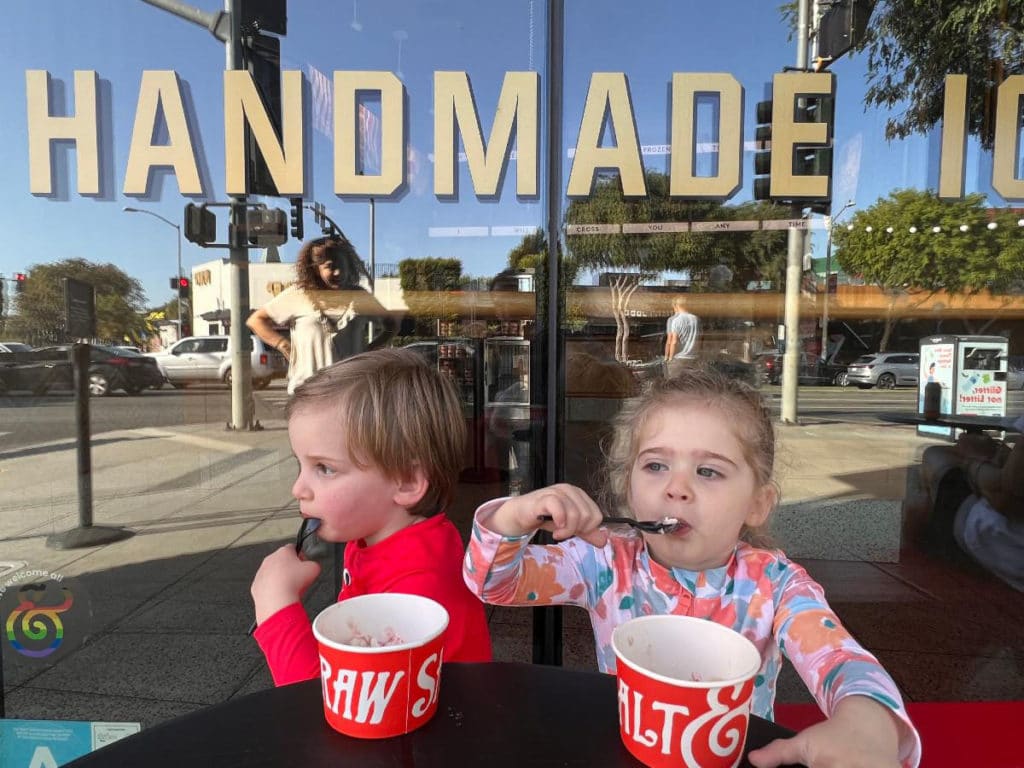
We then realized how a little ice cream always makes things better. So we stopped, indulged, and went home happy.
No, the treat did not erase the problem. But in that moment in time, we were able to transform “I scream” to “ice cream.” Sometimes, just a small shift, can make all the difference!


 In addition to an essay called “How Matzo Became Square,” Horowitz asks Haggadah readers if they know interesting facts, such as how soldiers from the Confederate and Union armies celebrated Passover Seders with matzo and Haggadahs on the battlefield. He tells how Jewish homesteaders on the prairie in the 1800s made their kitchens kosher in preparation for the Passover holiday and that during the California Gold Rush, San Francisco had a number of matzo bakeries.
 Los Angeles poet Rick Lupert created the