Jonathan Feiner: Mindfulness
Follow Shmuel Rosner on Twitter.
Jonathan Feiner: Mindfulness Read More »
Follow Shmuel Rosner on Twitter.
Jonathan Feiner: Mindfulness Read More »
Can a Super Bowl end racism? Read More »
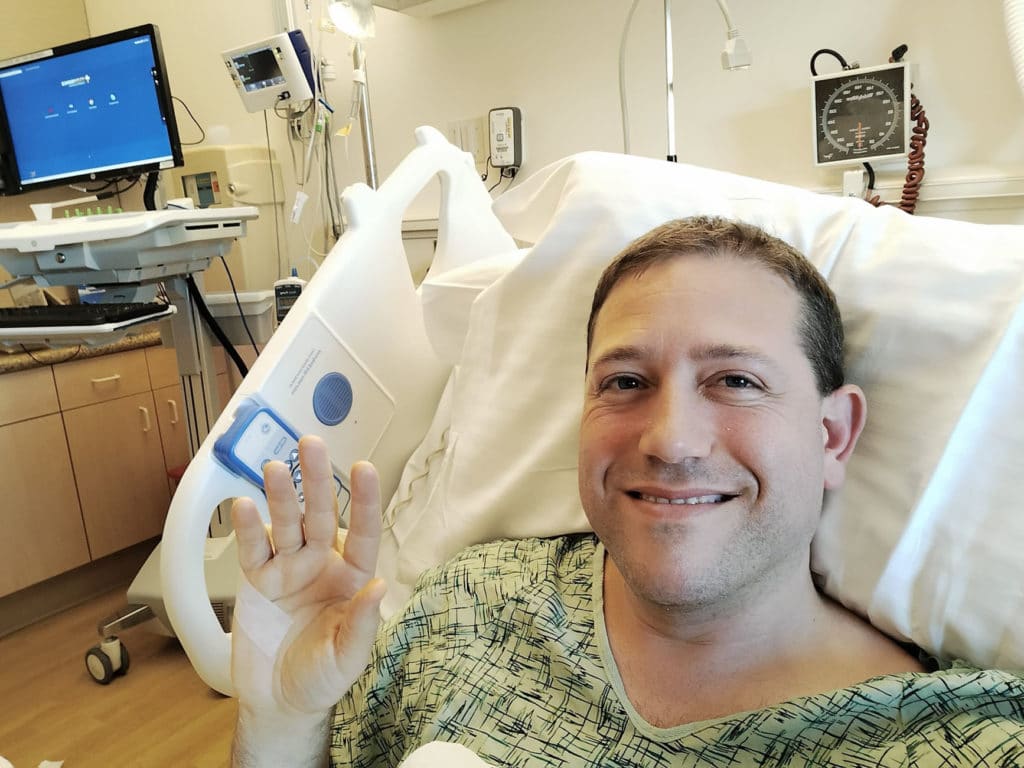
Who’s ready for the update from the TMI Health Educator nurse, who gets to play the role of patient? Let’s go!
The Good:
I had the pleasure of arriving and finding my pre-op nurse was my friend Savannah Arroyo, my surgical nurse was my friend Amber Ferguson, my dayshift nurse on the Orthopedic unit was (and still is) my friend Amy Berkin-Chavez, and my doctor is my friend Schehrezade Khan. Even the IV was inserted by my friend who runs the PICC team, Susan McCann. So friends abound in my care which is great.
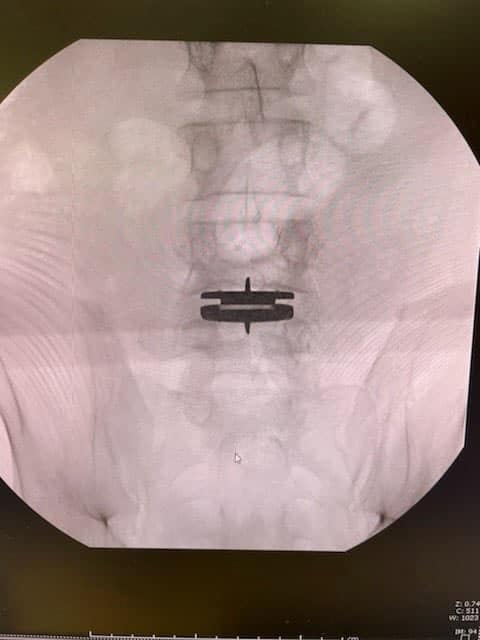
And that’s not to mention the most important of all, my friend who actually did the SURGERY, Brian R Gantwerker. He and his great vascular surgeon colleague Dr. Rao were successfully able to enter from the front, remove my damaged disc, and put in a new one made of titanium and plastic.

The Bad:
Well, pain. Pain is expected but pain still obviously sucks. Where’s the pain? Well, in the front where the incision was made (not laparoscopic, so as Adi says, we will share c-section scars), the pain in the back, and the pain in the hips which I suppose are compensating for everything. But again, this is expected, and will improve with time.
The Ugly:
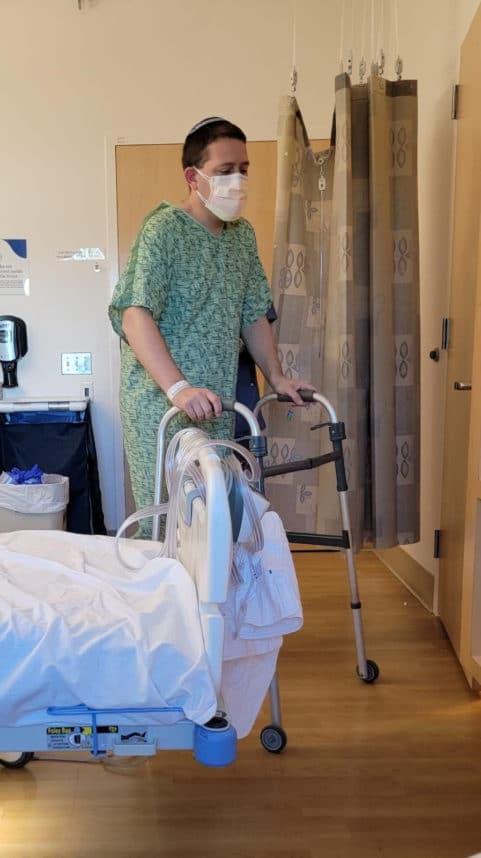
Here’s the TMI part so feel free to stop reading if you’re medical/organ squeamish. But it SUCKED waking up without a catheter and needing to pee! It took hours to get one inserted where 600ml immediately came out, and then when I finally took my first walk this morning with PT and OT, all I could focus on what how painful the catheter was. Yes, every movement was burning my urethra. OUCH. Got it removed, and such relief. BUT… over 5 hours later still no pee, no flatus (aka haven’t passed gas) and my stomach is so distended I look like the exploding fat man in Monty Python’s The Meaning of Life. So now a urologist has been called to help, thankfully another trusted friend, Jennifer Linehan. Avoiding narcotics as much as possible because they slow down your motility and make it harder to move gas/bowel/pee, and by not taking narcotics there goes the pain relief…you see the seesaw fun I’m in for. Yay.

But…focusing on the big picture: My back has been damaged at my L4/L5 for 15 years. No idea why but it always was. I’ve managed it for ten years very well without inhibiting me much, but for the past 5 years I’ve stopped all sports, I’ve worked in mild to moderate to severe pain depending on the week, and for the past year I haven’t lifted my own daughter. This is going to change. All of it. I will get through this hospitalization one way or another. I will get through about 6 months of intense physical therapy. And I will get back to work better/stronger than ever, be able to hold my daughter, and start playing softball and tennis again like the old days. These things will and must happen. And that’s great.
In the meantime, thank you for the Whatsapp messages, the social media comments I need to look at, the visit from Jared Rubin today bringing me BBQ Beef sandwiches from Jeff’s, the cool photos of my disc from my awesome Dr. Gantwerker, the meal train that I think is getting nicely filled up, and whoever has opted to watch my educational lecture. All of it, thank you. And wish me luck and continue to keep me in your prayers please, it can’t hurt.
TMI Health Educator Nurse Gets to Play the Role of Patient Read More »
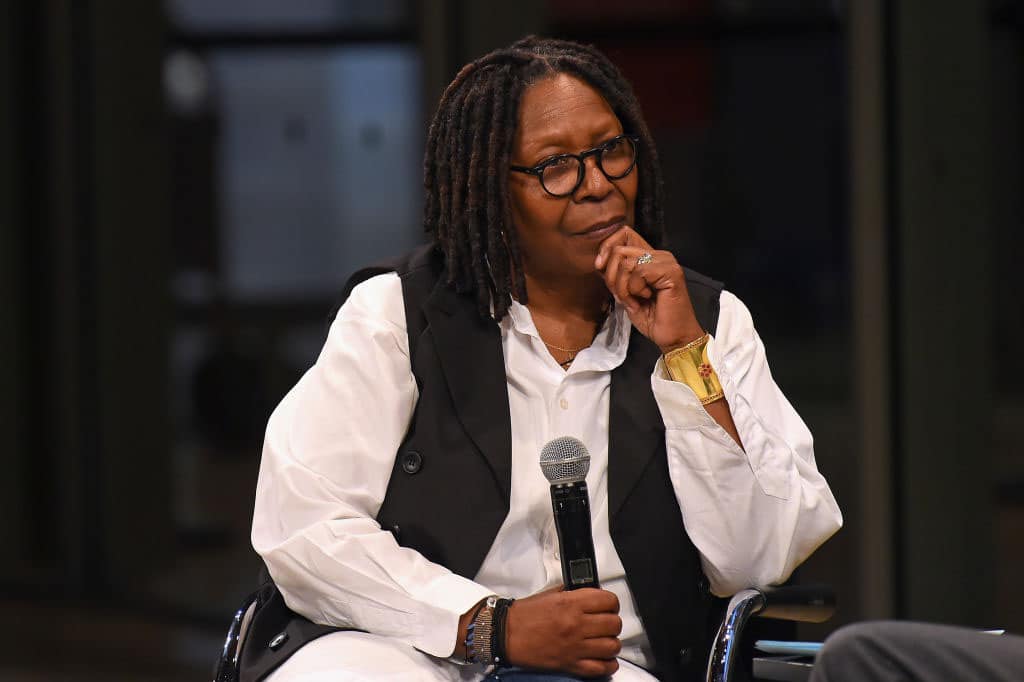
Whoopi Goldberg made an understandable slip in her comment on the Holocaust, given the ambiguity of the word “racism” in common American parlance. Her quick apology, though welcome, inadvertently made the usage murkier.
Ms. Goldberg’s recantation was based on the idea that the Nazis called Jews a separate race explicitly, so their hatred should therefore be considered racism. But should we really leave the determination of racism to the linguistic choices of the racists?
In the U.S. we commonly think of racism as the treatment of people without “white” skin as if they were a separate race, less deserving of respect and opportunity. But which end of that sentence is the essential element? The skin color or the treatment?
For Black Americans, skin color is the determinant physical feature marking difference, but that is not true for all people of color. People of Asian heritage have complexions as diverse as any other group of Americans; eye-shape is more frequently the recognized mark of difference. For Latino/as, language is probably the most significant identifier. What all of these groups have in common is mistreatment as a group distinct from those whose families claim descent solely from Europe.
Anthropologists tell us only one human race remains. Our homo sapien ancestors wiped out or absorbed their Neanderthal competitors, the last truly different race. “Racism” survives as a construct for relegating to that empty set a group of people who seem different from us in any way.
When people are treated abusively—as if they were lesser humans—because of their membership in any group, we ought to consider that racist. The slaughter of Tutsis by Hutus in Rwanda was a racist act, though both tribes shared the same color skin. So was the genocide in Armenia, or any genocide anywhere, and the impersonal murder of any religious group by members of another.
Islamophobia is racist not because of the colors of any particular believers’ skin, which varies across the globe, but because Muslims have been treated as a separate race of people, responsible for the violence committed against them. The treatment of Uighurs in China is racist because those people are treated as a separate race, a despised group, distinguished by some perceived difference from those in the majority.
In this usage, antisemitism is racist by definition, not because the Nazis labeled Jews a separate race but because they have been treated as one throughout history by many groups who did not use that term. If a gunman can walk into a synagogue and murder whoever happens to be near, if the largest hate group in American, QAnon, targets Jews for particular hatred, they are victims of racism.
The question should not really be whether Jews are people of color, since many of the latter are not primarily distinguished by skin color either. There are Jews of every color around the world. The question should be whether Jews as a group have been treated as a different race, and there is no question of that.
The question should be whether Jews as a group have been treated as a different race, and there is no question of that.
This is not to diminish the harshness of treatment of Black people in the U.S., who have irrefutably suffered for a difference that has nothing to do with their character or any other personal qualities that might be welcome in people considered the same race. It is only to recognize, as Goldberg seems to have done, that triggers of racism can range beyond labels of black and white.
In Europe, the groups facing the worst racism vary according to their numbers and local history. Pakistanis in Great Britain, Turks in Germany, Syrians and poor immigrants anywhere—the hatred they face should be recognized as racism, whatever their tokens of difference.
The common “other” of all later arrivals were victims of racism from every other group.
No group in the U.S. has been treated more harshly than Native Americans, who were targeted for genocide and then forced to settle on unwanted land. For these most abused people, the color of their skin was hardly determinative. Their tribal identity, language and culture marked them as different from the people who came from Europe, Asia and Africa. The common “other” of all later arrivals were victims of racism from every other group.
What is essential to racism is not the particularity of difference but the relegation of an entire group to sub-human status. Any group treated as a lower race of anthropoids suffer as the objects of racism. In the Holocaust it wasn’t what the Nazis called the Jews but how they treated them that made their hatred racist.
Richard Fliegel is a writer living in Los Angeles. He holds a Ph.D. in rhetoric from USC Dornsife College, where he serves as an associate dean.
What is Essential to Racism? Read More »
The Orthodox Union’s OU Women’s Initiative has introduced a new challenge grant for women’s programming. The organization will be providing 10 organizations/programs with up to $3,600 each to create inventive women’s programming this year.
Rebbetzin Dr. Adina Shmidman, director of the OU Women’s Initiative, said, “As we continue to embrace a new, ever-changing reality, the OU seeks to encourage thought and imagination to involve women in areas of chesed, learning and engagement at all stages of their lives.”
The OU Women’s Initiative collaborates with Orthodox communities around the world to address the spiritual, communal and educational needs of women, starting from when they are teenagers. It offers opportunities for women to learn Torah, become scholars-in-residence at synagogues, participate in mother/daughter weekly learning programs and be more actively involved in all aspects of synagogue life.
Programs include video series, where women can tune in to learn about different subjects like the Jewish holidays, courses and forums on women’s health and Nach Yomi, which features shiurim from women scholars. More than 1,000 women have completed the full Nach Yomi series, which held its first siyum to celebrate the end of the two-year learning cycle this past January. Events were held in Israel, New York and across the United States.
“As we continue to embrace a new, ever-changing reality, the OU seeks to encourage thought and imagination to involve women in areas of chesed, learning and engagement at all stages of their lives.” – Rebbetzin Dr. Adina Shmidman
According to Adeena Mayerfeld, program and operations manager for the OU Women’s Initiative, during the application process, applicants from synagogues and communities need to reflect on the effect the pandemic had on women’s engagement in Jewish communal life. They also need to reimagine women’s programming as well as community engagement and reconnect and reengage women through creative projects.
“By encouraging women to think creatively about how to reenergize their communities, the OU Women’s Initiative continues to support and engage women and communities across North America,” said Executive Vice President of the OU, Rabbi Moshe Hauer.
Applications for the grant are being accepted until February 25, and winners will be announced on March 31.
“The Challenge Grant is a vital next step in creating communal cohesiveness and shared vision in our ever-changing world,” said Moishe Bane, president of the OU. “With much faith and confidence, we are asking women to actively search for and create programs that foster spiritual growth and enthusiastic community involvement.”
To apply to the OU Women’s Initiative challenge grant, visit the website at ou.org/women/grant22-application.
OU Women’s Initiative Announces Grant for Innovative Women’s Programming Read More »
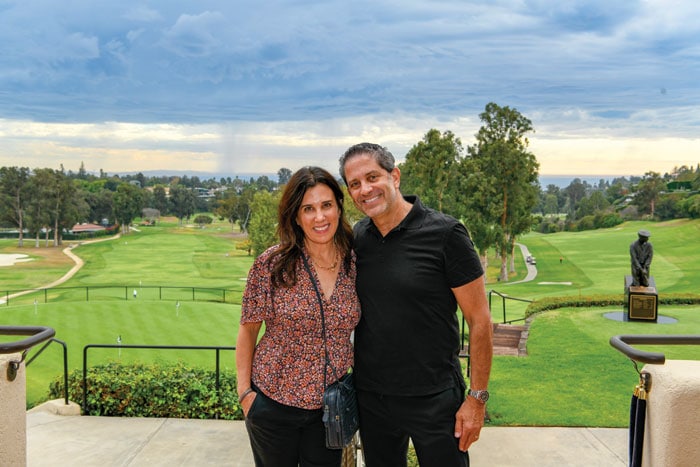
The Jewish National Fund-USA (JNF-USA) in Los Angeles has two new Board Co-Presidents: “Attorney to the stars” Fred Toczek of Felker Toczek Suddleson Abramson LLP, and his wife, psychotherapist Susie Satzman-Toczek.
“We hope to help spread the magic,” the Toczeks said in a joint statement. “We want to represent JNF-USA at communal events, introduce our vision to as many people as possible and inspire as many people as we can to get involved.”
In his work, Fred represents clients like Daniel Radcliffe, Seth Rogen and Bill Hader. He is already a member of the Arts & Entertainment Task Force, and he said he hopes “to engage people in the entertainment industry to lend us their voices and help us develop recognition of the meaningful work we do.”
Along with serving on the Task Force, Fred said he and his wife chair monthly board meetings, and they hope to lead a mission to Israel. Some of the JNF-USA initiatives that are closest to their hearts include the investment in the growing community of Halutza in the Negev and programs to inform high school students about Israel.
“We have also proudly beautified bomb shelters, which makes them just a little less intimidating for young children,” said Susie, who will be co-chairing the Women for Israel luncheon on May 11 at the Beverly Hilton with Laura Stein and Dr. Marcia Seltz. “We hope we can expand our network of committed women who are passionate about Israel.”
“We want to represent JNF-USA at communal events and introduce our vision to as many people as possible.”
– Fred and Susan Toczek
According to Fred, he and Susie first got involved with JNF-USA after his family had a chance encounter with Tiran Attia, the director of a JNF-USA program called Special in Uniform. It gives young Israelis with disabilities the chance to serve and volunteer in the Israel Defense Forces.
“When Tiran shared his deeply moving story of how he came to create this innovative program, which works to fully integrate young adults with disabilities into the IDF and in turn, Israeli society, our youngest daughter was inspired and immediately wanted to raise money for them in honor of her bat mitzvah,” said Fred.
The Toczeks did their research, finding out more and more about the meaningful work JNF-USA was doing.
“[We] came to realize how JNF-USA operates from a core value of ensuring that each and every Israeli enjoys a life of purpose, dignity and belonging in all sectors of society both now and in the future,” said Susie. “We were so impressed by the compassion and inclusivity of this notion, and we had to be part of it.”
As co-presidents, Fred and Susie plan to be involved in JNF-USA initiatives in LA and Israel, as well as encourage others to do the same.
“People give to JNF-USA because they want their philanthropic dollars to have maximum impact,” Fred said. “One only needs to look at our track record to see that from day one, and even before the re-establishment of the State of Israel, we have been there supporting the needs of our Jewish homeland. When you give to JNF-USA, you know that your contribution will continue to have an impact not just for today, but for tomorrow, the day after that and for generations to come.”
JNF-USA Names New Board Co-Presidents in LA Read More »
A few years ago, I was watching “House of Cards” when my husband Daniel walked by the TV.
“What’s this show about?” he asked me.
“Oh, you know, just politics, cheating, lying, murder, all that fun stuff,” I said.
“Wow. That’s depressing,” he said. “Why are you watching such dark television? Doesn’t it put you in a bad mood?”
“Well…” I said, pondering his question. “I guess it doesn’t put me in a good mood.”
“Then can I make a suggestion? Maybe you should turn it off.”
Daniel brought up a solid point. So with that, I finished the episode and never watched “House of Cards” again.
I had a realization: I was watching a lot of dark TV. It served no purpose in my life. Many times, it gave me nightmares. It made me view the world from a more negative perspective and kept me feeling down.
From then on, I only watched lighthearted comedies like “Friends” and “Jane The Virgin” that made me laugh and gave me a break from real life. Over time, I noticed myself not only becoming more and more sensitive to dark content, but also recognizing how much of it was out there.
I’m going to turn on my TV, have a laugh at something stupid Joey said on “Friends” and go to sleep with a smile on my face.
Just scrolling through Netflix’s original content, I saw documentary after documentary about murderers like Ted Bundy or the Night Stalker. When Netflix isn’t producing true-crime television, they’re putting out deeply creepy shows like “You,” about a psychopathic couple that kills people, “Black Mirror,” which highlights a sad, dystopian future and “Squid Game,” which is about people dying in gruesome ways. I could go on and on.
Even new comedies these days aren’t funny – they’re also dark and disturbing. I tuned into “The Righteous Gemstones” thinking it was a silly show about a group of religious leaders. By the end of the first episode, I had witnessed cheating, stealing, drug use and attempted murder, set to dark lighting and ominous music playing in the background. The biggest sin of all? It wasn’t remotely funny.
People may think I’m being an uptight religious person. I’ve heard this argument: We read about disturbing things that happened in the Torah, so why can’t we watch dark TV? Isn’t it the same?
I believe that there are lessons we can learn from the Torah and deeper meanings that can be revealed from these stories. In the Torah, evil people’s actions are by no means condoned. Just for one example, when Cain kills Abel, he is punished. When characters do bad things on TV, they sometimes get away with it. We may even be encouraged to root for them (Walter White in “Breaking Bad,” anyone?). I’ve never learned meaningful values by tuning into my streaming services.
I do understand why people like to watch dark TV. It may give them better insight into human nature, and having evil characters and gloomy plotlines adds to the drama of TV shows. Horror gives people an adrenaline rush, which can make them feel more alive.
When I was going through a traumatic time, I started binging on horror movies to try to distract myself. What was happening in these movies was much darker than my trauma, so I thought it could help me feel better. While it entertained me for a little bit, I wound up feeling worse afterwards. And now, I had all these sick images in my head to boot. It was like eating junk food when I already felt bad about my body.
These days, if anything negative happens in the first few moments of a show, I turn it off. Some stringent people may advise me to cut out television altogether to avoid these situations. But I love television. I always have. For now, I don’t want to give it up.
I just have to be vigilant about what I watch, and I advise other people to do the same. After all, the world is scary enough right now. Television should be a positive outlet. It should be a place where we can find shows that lift us up, not drag us down.
Now, I’m going to turn on my TV, have a laugh at something stupid Joey said on “Friends” and go to sleep with a smile on my face.
Kylie Ora Lobell is the Community and Arts Editor of the Jewish Journal.

Staying Away From Dark TV Read More »
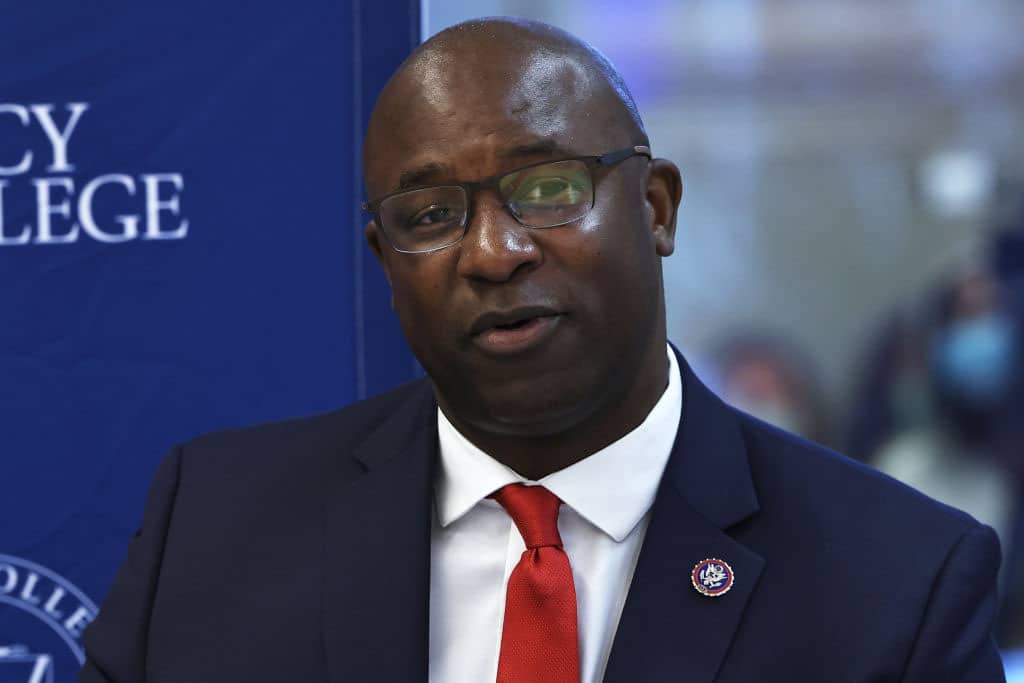
Representative Jamaal Bowman (D-NY) announced in a letter to his constituents on February 15 that he will be withdrawing his co-sponsorship of a bill that would enhance the Abraham Accord agreements forged between Israel and various Middle East countries in 2020, as first reported by Jewish Currents and Jewish Insider (JI).
The bill, titled “Israel Relations Normalization Act,” would require the State Department to submit annual reports to Congress on how the United States can further the goals of the agreements, according to Jewish Insider. The bill currently has 328 co-sponsors in the House of Representatives with a nearly 50-50 split of Republicans and Democrats.
In his letter, Bowman wrote that his J Street-led trip to Israel and the Palestinian territories in November as well as “further conversation” made him realize that the bill was not the best step forward for peace. “I became aware that the deals that this bill supports and seeks to pursue, have included deals at odds with human rights and safety for everyday people in the region, including the recognition of Morocco’s control over Western Sahara, and conversations about arms sales with the United Arab Emirates,” he wrote. “In the end, it is my estimation that these actions will only escalate violence in the Middle East and make already vulnerable communities less safe. This agreement to normalize relations unhelpfully isolates Palestine and Western Sahara when what we need is a process that engages them.”
The political advocacy arm of Jewish Voice for Peace, a Jewish group that supports the Boycott, Divestment and Sanctions movement, tweeted: “This is a critically important move from @JamaalBowmanNY that sends a clear message: Trump-era weapons deals with authoritarian regimes are not about a just peace and they’re at odds with everything progressives are fighting for. Every progressive should join in this ‘no’ vote.”
This is a critically important move from @JamaalBowmanNY that sends a clear message: Trump-era weapons deals with authoritarian regimes are not about a just peace and they're at odds with everything progressives are fighting for. Every progressive should join in this 'no' vote. https://t.co/mQ4xVGTPih
— Jewish Voice for Peace Action (@JvpAction) February 16, 2022
Justin Charles, a member of the Democratic Socialists of America’s (DSA) National Political Committee (NPC), told Jewish Currents that they view it as a step in the “right direction” for Bowman. DSA had said in December that they would not yet endorse Bowman’s re-election after he went on the J Street trip and voted to provide Iron Dome funding, but stopped short of expelling him altogether.
Sydney Ghazarian, who is also a member of DSA’s NPC, tweeted that DSA had listed withdrawal from co-sponsoring the bill as one of their “conditions.” “I’m glad that we worked with @JamaalBowmanNY and that he is following through,” she wrote. Bowman’s office did not respond to the Journal’s request for comment on whether DSA influenced Bowman’s reversal on the matter. However, a source familiar with Bowman’s thinking told the Journal that the congressman had weighed the decision since October after discussions with various constituents and groups. Some of the groups that Bowman had met with on the matter included Jews for Racial and Economic Justice, Just Foreign Policy, U.S. Campaign for Palestinian Rights, Code Pink, IfNotNow, Jewish Vote, J Street as well as various local rabbis.
This was one of the conditions the @DemSocialists NPC set during our discussion with Bowman— a critical move for Palestinian liberation. I’m glad that we worked with @JamaalBowmanNY and that he is following through. https://t.co/NlxqwKV4NA
— Syd (@SydneyAzari) February 16, 2022
A group of New York rabbis wrote a letter expressing disappointment in Bowman’s decision. The letter, obtained by JI, lauded the Abraham Accords as “a breakthrough in Middle East diplomacy” for “strengthening ties between Israel and other Middle Eastern countries that had long sought to isolate and delegitimize a nation recognized by the international community since 1948. The Accords will provide economic and strategic opportunities for the advancement of all its member nations, and will most importantly, strengthen efforts to defend states against Iran’s regional aggression.” They called Bowman’s decision to withdraw his sponsorship of the bill “especially surprising and disappointing.” “His withdrawal of support for this important piece of legislation, which is poised to improve Mideast stability, economic opportunity, and which will disincentivize some of the region’s most egregious sponsors of terror, is lamentable, and will surely be received with bewilderment and disapproval by many voters in Rep. Bowman’s district,” the letter stated.
Representative Ritchie Torres (D-NY) tweeted, “One cannot claim to oppose the economic and diplomatic isolation of Israel yet oppose the Abraham Accords because it fails to economically and diplomatically isolate Israel. That makes no sense even by the distorted logic of the [Boycott, Divestment and Sanctions] movement. One can and should advocate for Palestinian dignity and sovereignty without delegitimizing Israel as a Jewish state or delegitimizing the Abraham Accords as a [bona fide] breakthrough for peace.”
He added: “The Abraham Accords PREVENTED the annexation of the West Bank, which, had it not been prevented, would have foreclosed even the possibility of a two-state solution. Thank God cooler heads prevailed.”
One cannot claim to oppose the economic and diplomatic isolation of Israel yet oppose the Abraham Accords because it fails to economically and diplomatically isolate Israel. That makes no sense even by the distorted logic of the BDS movement.
— Ritchie Torres (@RitchieTorres) February 16, 2022
One can and should advocate for Palestinian dignity and sovereignty without delegitimizing Israel as a Jewish state or delegitimizing the Abraham Accords as a bonafide breakthrough for peace.
— Ritchie Torres (@RitchieTorres) February 16, 2022
The Abraham Accords PREVENTED the annexation of the West Bank, which, had it not been prevented, would have foreclosed even the possibility of a two-state solution. Thank God cooler heads prevailed.
— Ritchie Torres (@RitchieTorres) February 16, 2022
The Simon Wiesenthal Center also tweeted, “Shame @JamaalBowmanNY caved to extremists. Peace begets peace. Israelis and Arabs from Gulf to Morocco to Sudan expanding peace, mutual respect, and cooperation. Nightmare for terrorist Hamas, corrupt pay-to-slay-Jews Palestinian Authority.”
Shame @JamaalBowmanNY caved to extremists. Peace begets peace. Israelis and Arabs from Gulf to Morocco to Sudan expanding peace, mutual respect, and cooperation. Nightmare for terrorist Hamas, corrupt pay-to-slay-Jews Palestinian Authority. https://t.co/LUV41TUfk5
— SimonWiesenthalCntr (@simonwiesenthal) February 16, 2022
Marcus Frias, a spokesperson for Bowman, said in a statement to the Journal: “The Congressman values and welcomes the community’s engagement with the legislative process and takes their thoughts and suggestions seriously. Last night, following many thoughtful and educational conversations with his community, the Congressman sent the letter to constituents to inform them of his decision.”
Rep. Bowman Ends Co-Sponsorship of Bill Strengthening Abraham Accords Read More »
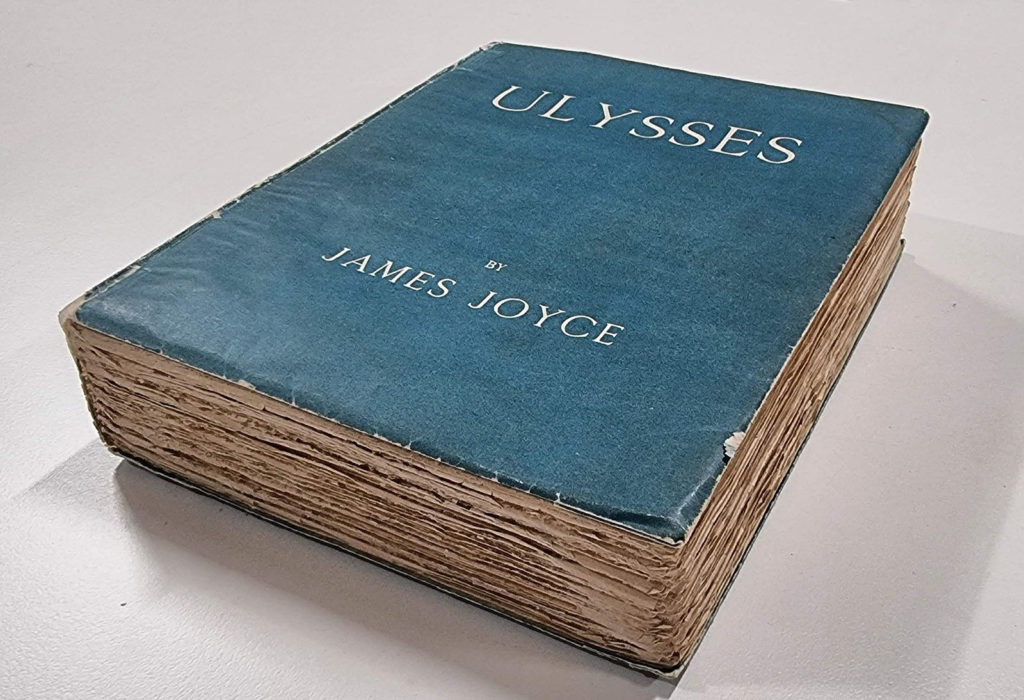
James Joyce presciently said he hoped his Ulysses would keep
picky professors
busy for centuries while arguing over what he meant. They reap
like Macki Messers
repartees, with papered comments sharper than sharks’ teeth
in tenured aisles,
creating with their published words an intellectual wreath,
uncourteous Weills.
Ulysses interpretations that are far more sensible,
Maureen Dowd
is surely making than of D.C.’s far less comprehensible
creepy crowd,
and of course a lot more tacky
than Bertolt’s Mr, Messer, Mackie.
In “A New Look for ‘Ulysses’: Eduardo Arroyo, a Spanish artist who died in 2018, provided drawings, watercolors and collages for an illustrated edition of the James Joyce novel,” NYT, 2/10/22. Raphael Minder writes:
James Joyce once said that he hoped his groundbreaking and famously challenging novel “Ulysses” would “keep the professors busy for centuries arguing over what I meant.”
In “D.C. and Joyce — Both Incomprehensible,” NYT, 2/12/22, Maureen Dowd writes:
On this centenary of James Joyce’s colossus, we can borrow a thought from W.B. Yeats’s poem “The Fascination of What’s Difficult”: Is “Ulysses” hard because it’s great, or do people assume it’s great because it’s hard?
“It’s hard because Joyce put a lot in there,” Dan Mulhall, the Irish ambassador, told me. “A lot of people are drawn to the novel because of its complexity and derive a lifelong satisfaction from delving into it more deeply. It’s like Wordle for serious readers.”
Gershon Hepner is a poet who has written over 25,000 poems on subjects ranging from music to literature, politics to Torah. He grew up in England and moved to Los Angeles in 1976. Using his varied interests and experiences, he has authored dozens of papers in medical and academic journals, and authored “Legal Friction: Law, Narrative, and Identity Politics in Biblical Israel.” He can be reached at gershonhepner@gmail.com.
Ulysses and DC’s Far Less Comprehensible Crowd Read More »
A few months ago, Gallup reported that Americans’ trust in the media to report the news “fully, accurately and fairly” had edged down four percentage points from the previous year to 36%. That’s another way of saying that two thirds of Americans don’t trust the media.
How did things get so bad?
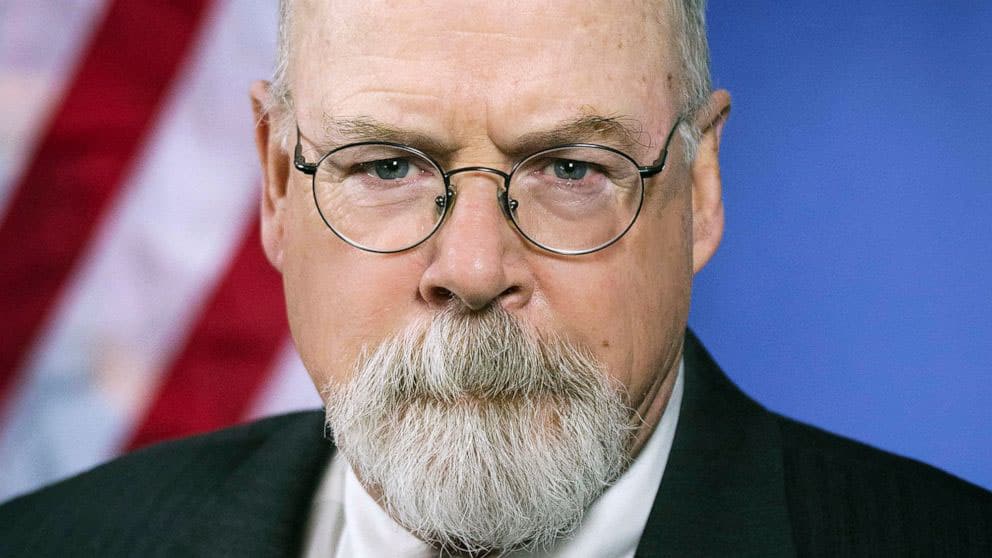
The legacy media’s reaction to the latest revelation from the Durham investigation helps answer that question. Day after day, I looked on the home pages of the Washington Post, CNN and the New York Times to see how they would cover what National Review Online (NRO) called a “jaw-dropping revelation.” Nothing.
What revelation were they ignoring, or at least downplaying?
As NRO reported:
“In a court submission last week, Durham alleged that a tech executive, who was supposed to be helping the government combat cyber threats, used his privileged access to Internet data — specifically, domain name system (DNS) traffic between servers — to mine contacts between Russia and facilities connected to Donald Trump. The information, Durham says, was taken out of context and distorted to suggest that Trump might be a clandestine agent of Vladimir Putin’s regime.
“Alarmingly, some of the Internet traffic mined in early 2017 was generated by the Executive Office of the President — the White House. That is, the tech executive, who has been identified as Rodney Joffe, was monitoring then-President Trump, trying to portray him as Putin’s mole.”
We already know that “the Clinton campaign played a huge role in generating the suspicions that spawned the government’s investigation.” Now we have Rodney Joffe, a Clinton supporter, deepening a sordid story.
Can you imagine how the media would have responded if this Durham revelation was about a Republican rather than a Democrat?
Actually, we know the answer. For three years, the mainstream media breathlessly reported leaks, rumors and unsubstantiated allegations in pursuit of a “Russiagate” story against a Republican president that went nowhere. They still haven’t apologized for getting it so wrong.
Meanwhile, a new report suggests there was “spying on the president of the United States with the aim of harming his ability to govern the country,” as NRO describes it, and the mainstream media yawns. When they’ve addressed it, they either tried to rebut it or dismissed it as “GOP propaganda machine in action.”
Do they really care that two thirds of Americans no longer trust them?
Maybe not so much. Maybe we’ve reached a point where loyalty to an ideological position takes precedence over loyalty to the full, accurate and fair truth.
Maybe we’ve reached a point where loyalty to an ideological position takes precedence over loyalty to the full, accurate and fair truth.
In reviewing Batya Ungar-Sargon’s book, Bad News: How Woke Media is Undermining Democracy, Mark Hemingway notes the key insight that “the media’s problems stem largely from issues of class, even if the problems are outwardly manifested as political and cultural extremism.”
Whereas journalism used to be written primarily by the working class for the working class, Hemingway writes that “as the industry shrinks, it has become ensconced in an elitist bubble that serves the interests of its corporate owners and distribution channels controlled by Big Tech.”
You can’t get a better descriptor to explain loss of media credibility than an “elitist bubble.”
Outside of that bubble, any enterprising journalist would have feasted on Durham’s latest revelation about possible spying on a president, where the stakes couldn’t be higher. Today, elitist ideology seems to trump even personal ambition.
The masthead on The Washington Post says “Democracy Dies in Darkness.” But journalism, the lifeblood of democracy, also dies in darkness.
Journalism Dies in Darkness: How Mainstream Media Dismissed Durham Revelation Read More »