fbpx

January 3, 2022

Coughing and Limping Into 2022

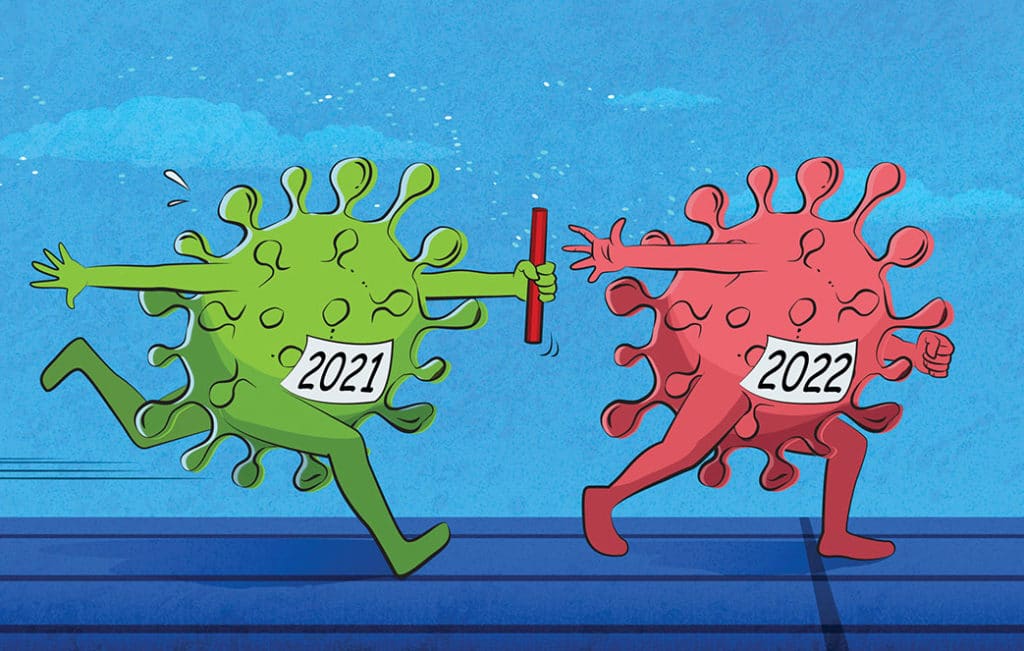
Just when we thought, foolishly, that it was safe to go outside—our lives slowly restored to normal, masks discarded, arms boosted, Broadway lights ablaze, children back in classrooms, nursing home patients breathing, and anti-vaxxers livid from all those mandates and restrictions—corona humbled us once again.

There will be no V-Day against this virus—at least not yet, and possibly never.

COVID-19’s viral load has already spread into 2022 and brought with it another wave of grim tidings. Joe Biden declared the first year of his presidency a success. It is a boast not widely shared.

America’s lack of preparedness for the Omicron variant alone was a colossal failure. Home-testing kits are either unavailable or unaffordable. In New York City it can take a full week to receive the results from mobile sites testing for either the virus or its antibodies. The operative word is “mobile.” Finding the vans is a scavenger hunt all its own, causing respiratory failure unrelated to the virus.

What started in Wuhan strayed from Wuhan and, in time, germinated into a dizzying array of variants. We’re still wearing masks, and, apparently, so, too, is the coronavirus—camouflaged within our bodies with its spikey crown, like a rogue despot. Positivity rates are soaring. Yet, many are asymptomatic. Corona turns otherwise healthy people into unsuspecting couriers.

We’re still wearing masks, and, apparently, so, too, is the coronavirus—camouflaged within our bodies with its spikey crown, like a rogue despot.

And then there’s the mutations. Alpha. Delta. Omicron. Are there enough letters in the Greek alphabet to account for these overlapping organisms? Soon, when we run out of names, we’ll dust off Sanskrit, an appropriately symbolic dead language.

Surging infection rates are everywhere. Over the past month, nearly 6 million Americans tested positive for the virus, a massive spike from a year ago, with over 400,000 new cases reported daily. Hospitals are overwhelmed with intake, and children are no longer regarded as low-risk. Globally, over the past month, 24 million people have been infected, with the overall death rate now up to 5.5 million. The monstrous morbidity levels we heard at the outset of this disease might one day become a reality. Epidemiologists are now projecting January to be the worst month of all.

Some of the presumptions about the vaccine are plummeting in tandem with Dr. Fauci’s approval rating. It turns out, two doses of any of the vaccines offers no panacea and only qualified protection. Omicron is making a fool of pharmaceutical companies. Many of those hospitalized are fully vaccinated. Break-through infections are now as porous as our southern border. Unvaccinated migrants may be illegal, but are no more contagious than the rest of us.

We’re all equal in the eyes of Omicron. Once more we find ourselves desperate to “flatten the curve,” a turn of phrase we believed we had retired. Omicron, tragically, pitched us a new curve.

There is solace in knowing that Omicron presents a lower chance of severe sickness. Of course, that, too, comes with a catch: With transmissibility so infectious, just leaving your home is a risky venture. Social distancing is yesterday’s prophylactic. Vitamin D3 and N95 masks are no longer impenetrable shields. Pfizer’s new COVID-19 treatment pill, along with fourth vaccine shots and second boosters, might end up useless against Omicron’s feistiness or corona’s next looming surprise.

There is solace in knowing that Omicron presents a lower chance of severe sickness. Of course, that, too, comes with a catch: With transmissibility so infectious, just leaving your home is a risky venture.

And so, we survived another year living cautiously. Another New Year under siege, helpless against aerosol droplets, confusing advisories, conflicting regulations, and the mismanagement of a public health crisis. Vaccine mandates are now being challenged under the law. The Supreme Court, over 100 years ago, deemed mandatory vaccines the province of states. That was with smallpox. With COVID, it’s the states, mostly the red ones, fighting to protect its citizens from the vaccine.

The coronavirus might literally take your breath away, but it’s far more likely to drive you crazy first.

The politics of the virus has not abated either, neither has it inspired much confidence in our leaders. The upcoming midterm elections are bound to feature COVID-19 campaign platforms. America’s obsession with personal autonomy is behind all this national infighting over masks, booster shots, vaccine passports, school closings and lockdowns. It’s a game of political football where the goal posts keep moving while the players shelter at home.

Next up: COVID-19, the video game.

It’s beginning to sink in that this menace might never leave us. A pandemic purloined our lives, rendering us uncertain about our future and even questioning the meaning of existence. Without face-to-face social engagement, along with theaters, restaurants, and museums, why live in New York or Los Angeles—why live anywhere?

A pandemic for the ages has given birth to an entirely new age, one with its own rituals, verities, even vocabulary. Our best laid plans thwarted, the last two years lost, will this ever come to an end?

The true fever of this pandemic is one of fear, the collective anxiety that we will never be able to return to the life we once knew. Back in early 2020, many believed it would be just a matter of months before normality resumed. But the new normal—with its viral mutations, social isolation, and self-sacrifices—has proven to be too abnormal.

No longer do these life changes seem temporary. The adjustment period is over and entirely new ways of living, working, and loving have been revealed to us. We’ve adapted to the virtual offices, home gyms, Zoom meetings, and Amazon delivery trucks. They’re all now part of the scenery, the green screen that has totally re-landscaped our lives.

But the costs have been immeasurable—the disconnection from friends and families; the paralyzing loneliness, the risk assessments associated with every encounter; the mindboggling misinformation.

One doesn’t have to be a believer to have the uneasy feeling that something biblical is going on. We keep waiting for the seas to part with a virus-free Garden of Eden awaiting us. A pandemic for the ages has given birth to an entirely new age, one with its own rituals, verities, even vocabulary. Our best laid plans thwarted, the last two years lost. Will this all ever come to an end?

Coughing and Limping Into 2022 Read More »

One God, Two Names, One Tent: Sermon on Parshat Va’era

Sometimes adulthood, and leadership, is about making decisions that you wish you didn’t have to make, but which you are rather convinced are right. We are often faced with a situation we wish were different.  But we do not script the canvas upon which we paint the landscape of our lives, or influence. We inherit reality, confront it, and try to make decisions informed as much as possible by our values, even if our values most point to a desired reality far different than the one we face.

COVID has been all about that: Decision-makers around this institution, and city and nation and globe, faced with a situation they rued, having to make the best possible decisions given the circumstances. Such decisions emerge from a less than perfect situation, and as such the decisions themselves are vulnerable to second-guessing, ridicule and even contempt. Certainly, they are vulnerable to not being understood.

I, and members of the Temple Beth Am (TBA) leadership, made such a decision recently. It was to permit a group of TBA members to self-organize, under the informal imprimatur of the TBA communal banner, but not as a formal TBA group with direct oversight from staff, but as a cohort of conservative political thinkers.  A subset of them came to us with this request. In recent months and years, they, many of them decades-long devoted members of the community, testified to feeling on the outs, judged a priori for anything they might say or do in the community as a result of their identifying as conservatives. They felt they were losing their sense of feeling at home within what had been their spiritual home.

In an era in which many conservatives decry “safe spaces” as arenas full of liberal snowflakes, this group of conservatives ached for a safe space within TBA, which would be free from recrimination. And in an era in which many liberals tout safe spaces and properly insist on our listening to and believing those who say they feel uncomfortable, targeted, othered and treated unfairly, some on the more liberal side in our community contested whether this group of conservatives’ experiences were real, legit, worthy, and whether creating a safe space for them to gather, share ideas and be a community within a community was proper.

Welcome to synagogue life in 2022.

The decision weighed on us. Mostly not because we were that split on what the decision ought to be.  That decision seemed rather obvious to us.  But it was weighty because we rued having to make it in the first place. Bucking a growing, and to me troubling, trend within Jewish communal life, TBA proudly exists as multichrome, eschewing the notion that what one believes about God charts in only one direction regarding what one must believe about country, about America, about poverty, about racial injustice, or about how to vote in an election.

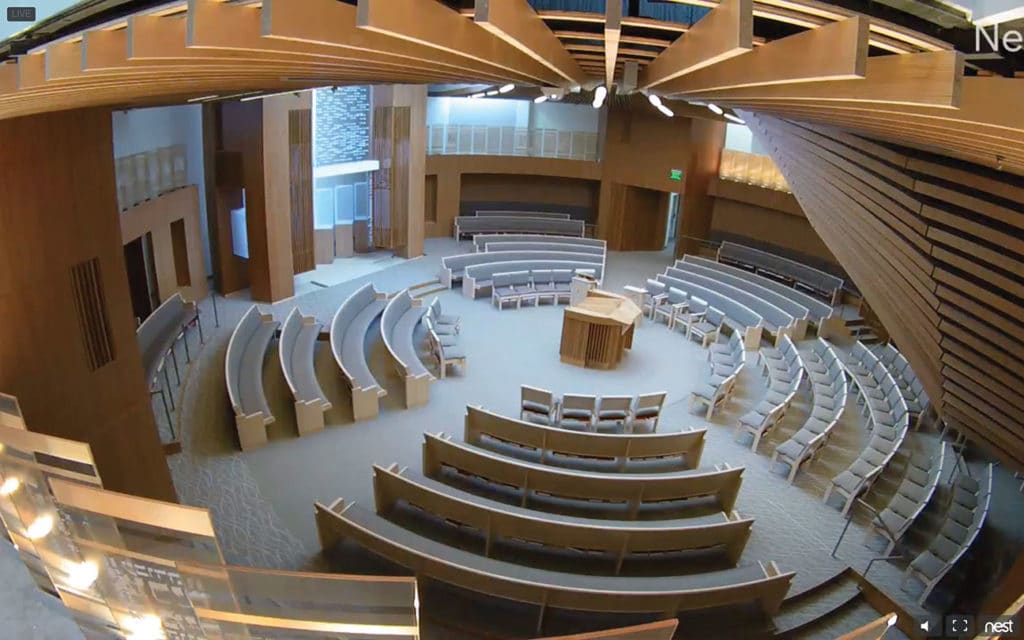
Decades ago we pioneered a multiple minyan model, suggesting that there is more than one way to pray to God.  And within the community, and within each minyan in this community, we have AIPAC donors, J-Street devotees, nearly avowed anti-Zionists and those who might support the ZOA, but might do it surreptitiously lest they be reprimanded. We are wonderfully kaleidoscopic. I am proud of that, even and especially during these times of riven national identities.  A civil war may be raging, burgeoning out there. But we have found a way to be one community, one tent, at 1039 S. La Cienega. For as long as I am the rabbi here, that will be a stated, clear aspiration.

And so, the decision we made sat well with us. But the circumstances that pushed us to have to make it did not. All of us wished that there were no need for individual subgroups within our community to have to self-organize as such, especially if that self-organization was not just to offer niche programming, which we do all the time, but because the self-organization stemmed from their feeling unwelcome, lacking an embracing space to be who they really are.

As a political being who, myself, rejects over-labeling, and straddles a wide center, and answers the question about whether I am right-wing or left-wing by saying: tell me what issue we are talking about, and I will tell you where I stand, for now, and why, and I am open to reconsidering…I witnessed first-hand some of the pain this group of TBA conservatives spoke of.  

It cannot be forbidden, or unsafe, to be conservative at a Conservative synagogue.

One memorable example for me was at one of our Hanukkah Monologues within the last few years. These powerful, curated evenings of self-revelation are stirring gatherings. People share from the depths of their soul, and it is nearly impossible not to feel pulled in to their narrative. One year one of the presentations veered from personal and vulnerable sharing into political grandstanding. And it did so in a way that at least seemed to suggest that the presenter just assumed that such a stance would resonate with every person present. And if not, too bad. That was the tone.

As someone not personally so at odds with what this person presented, I did not feel wounded and othered. But I knew that any person present who tended more towards the conservative side of American political thinking would not have experienced it as if they had been invited to consider a different approach, but rather that they had been bludgeoned by the presenter’s certainty and certain expectation that every person present agreed. One long-time member of our community, a beloved, gentle, generous and utterly humane person who self-identifies as conservative, gently wept that night, and then emailed me the next week, wondering if TBA could still be a home.

Such moments dig at me. Profoundly. They dig at me in the same way they would if the person feeling that way, that outed, that unmoored were feeling it because they were part of the LGBTQ community, or the black/brown/Asian community, or indigent community, or, yes, liberal/leftist community and felt patently unsafe or unwelcome in our midst.

Small tents help define what we believe, and what we don’t; what is right and what is wrong. If someone wanted to start a Messianic Judaism minyan in our building, we’d say “no.” But our tent must be big enough to include those on all parts of the political, sexual, gender, racial and financial spectrum.  It cannot be forbidden, or unsafe, to be conservative at a Conservative synagogue. Particularly because we are knowingly varied when it comes to what we believe about God and Torah and religion, how can we be less varied when it comes to what we believe God and Torah and religion say about being an Angeleno, a Californian?  We can share space with one who disagrees with us about what God says about Judaism, but not about what God says about America?

We can share space with one who disagrees with us about what God says about Judaism, but not about what God says about America?

So to come full circle, we agreed to have this group meet, and since they started their soft-advertising, more people than they expected or knew about identified themselves as being interested.  A few said that they wondered whether they could still call TBA their home, or whether others had left their previous shul, as a result of their political leanings.

How did we get here? And in what way is this topic, this sermon, a d’var torah rather than a “state of the union”?  One of my most treasured teachers, the great Micha Goodman who teaches at Hartman and elsewhere, has a wonderful notion about the inverse relationship between one’s sense of one’s God and one’s certainty about one’s own decisions and stances.  Common thought in the Jewish world is that the more frum you are, the more you believe in God.  Look at how long my skirt is! Look how punctiliously I make my tea on Shabbat! Look at the long list of hekhshers I don’t accept. It must be that I am incredibly God-fearing.  My God is great, because my halakha, my personal practice, my convictions are precise and unyielding. That’s how I show my devotion.

Micha says it is the opposite. How small must your God be such that that God cares about such micro-moments in the cosmos?  How pusillanimous, and borderline narcissistic, your theology is if you are convinced that God must love and hate the same people you do, the same religious acts and, yes, the same American political positions and politicians? Micha, himself a devoted observant Jew, argues that the greater import and certainty you impute to any act, mitzvah, ritual or thought position, the smaller your God must be. And the greater your God is, the lesser the significance and rectitude is of anything you say, or do.  In 2022, however, we are living in perpetual Purim. Nahafokhu, topsy-turvy, where the pious get to hang their piety on their pettiness. Gone is the notion of a God who is truly grand.

This way of thinking dovetails with a fascinating sermon I heard recently. It was delivered by someone I first came to know of as a dear friend of Rabbi Abraham Skorka, who is the rector of the Seminario Rabbinico, the Masorti Rabbinical School in Buenos Aires. This colleague of Rabbi Skorka’s gave a sermon about littleness.  Here is one fetching line from the sermon: “God does not rise up in grandeur, but lowers Godself into littleness. Littleness is the path that God chose to draw near to us, to touch our hearts, to save us and to bring us back to what really matters.”

While one could erroneously understand this message to mean, or only mean, that God is found in the miniature particulars of what we do, and what we think, I am pretty sure this message means that God is found in the miniaturized way in which we present who we are. Humble. Curious. Uncertain as a religious value. Now, this may be the first time that a drash given at TBA quoted a Christmas homily. For the friend of Rabbi Skorka’s who gave this homily was the Pope. And I am inspired by his message. Both Pope Francis and Micha Goodman are in good company.

On a flight recently I got happily lost in a not-great but not-awful Hollywood take on the Civil War called Cold Mountain. Nicole Kidman. Jude Law.  Renee Zellweger. Lots of death.  But in the middle of it was a line that pierced this rabbinic soul. The general context was futility of war, even a righteous war such as the Civil War which propelled our great country out of the scourge and the scar of slavery. On the ugly, brutal battlefield, away from the generals and leaders whose lives were not in danger, brothers against brothers were in a merciless battle to the death, that seemed far removed from true rights and wrongs. One weary soldier says, “I imagine god is weary being called down on both sides of an argument.”

How pithy. Can we not believe in and worship a God who can be genuinely and earnestly called upon by those with whom we strongly disagree?  Can we not sit together and assume that the person in front and in back has a different conception of what God might have to say about being alive, being a Jew, being a citizen, being an American? And can we not celebrate that admixture, choose it, aspire to it…rather than balkanize ad infinitum?  What’s the next subgroup who will ask for TBA’s imprimatur? Democrats of TBA? Republicans?  Carnivores of Beth Am? Vegans?

While niche programming has its merit, I hope that is not the general direction we go in. I am, after all, the one-kiddush guy.  Even if we daven in different spaces, and in slightly different ways, we can’t eat a bowl of cholent together every week? But if we cannot figure out, individually and communally, how to act in a way in which our political or religious or conceptual adversaries feel safe and welcome, being their full selves, in our presence…if we cannot hold back from projecting that our sense of God excludes their sense of self, their amalgamation of thoughts and principles, then we are destined to subdivide such that we are only a myriad of tents, who just happen to be pitched at the same address on La Cienega.

Oh right…it’s Parshat Va’era. What insight might it have? From the opening lines, a lot.  Its first verse lays bare the indivisible God’s utter divisibility.  Many of you know the general rabbinic notion that reads the two main names of God as representing different attributes of that God.  Elohimis justice, harsh decree and unyielding punishment. Adonaiis tender intimacy, forgiveness and mercy.  Both of those names, and divine aspec launch us into Va’era, and thus out of slavery. Elohim spoke to Moshe. And said to him, I am Adonai.  Perhaps we have the bulk of the meaning and import of Torah right in those schizophrenic 8 words.

The God who invites Moshe into a relationship, and will battle Pharaoh, and who will redeem Israel and thus create our nation, is multichrome, kaleidoscopic, at times manifest as seemingly merciless fury, at times the most gentle force in reality. A midrash in Shemot Rabbah on this verse says that this divided aspect of God is not just present in reality at large, but can evolve and change one second to another. Such a metamorphosis happens in the verse itself. God begins as elohim, chastising Moshe for seemingly losing faith a few verses earlier.  But then, mid-thought, God becomes adonai, recognizing that a different tone, a different view of the same set of facts, was what this moment required.  Surely such a God, who tolerates God’s own shimmering, shifting, transposing realities, can bless, and be present, and be worshiped by all at Temple Beth Am. Without fear of being harnessed as the defender of just one approach to thought and life, and America.

I always keep a book in my tallis bag, to read a few pages at a time here and there during services.  Much easier to do when I am on vacation!  Right now, that book is Yossi Klein Halevi’s “Letters to a Palestinian Neighbor.” It is a series of short essays, written as letters to a conjured Palestinian living just over the valley from Yossi’s home in French Hill.  The book attempts to describe, with clarity and without contempt, the truest and most compelling rationale for the Jewish claim to the land of Israel, and thus the State of Israel.  While part of me thinks I should remove the book and put it on my night stand so I can finish it in the next day or two, a larger part of me is reveling in reading it slowly, as one does Torah commentary, so that my experience within the book lingers and marinates.

It’s a masterpiece. Both in its erudition and knowledge of history, culture and geography, but also in its humility, which does not eviscerate its passion. And also in its curiosity about the counter-narrative, which takes nothing away from Yossi’s convictions about his own. I have never come across such a generous read and attempt at articulation of the narrative of an enemy sworn to one’s annihilation.  But Yossi does it without self-abnegation. And not to curry favor. He does it to model, maybe, to any Palestinians or Arabs who may read it, but mostly to us, his more devoted readers, what it means to believe in one’s story, one’s God, with no apology, but also to make capacious room for the story, the God, of the other. Even if the other wishes you did not exist, and militates so that you do not.  Yossi is a Jew and Zionist who would davven in any shul.  And would share services and kiddush and frank conversation with any member, any American, any Israeli, neither sacrificing his principles, nor making whatever other who may share that space with him feel anything but embraced, welcome, whole, accepted, a child of God.

We should be thrilled to share space with those who offer us the gift of pushing our certainties, and thus expanding our humanity.

How Yossi writes his book about existential realities facing the nation and state of Israel is how I desire us, here, to live our Jewish, Beth Am lives as we face one another in the midst of a tumultuous era.  We, too, face existential issues as Americans and Jews and Californians and Angelenos. And we dare not assume that our God is so picayune such that the divine spirit can be aligned with our, and nearly only our, views on all of the above.

We should be thrilled to share space with those who offer us the gift of pushing our certainties, and thus expanding our humanity.  We should, to paraphrase a witticism I have used before, which I originally heard from Professor Alex Kaye of Brandeis University, assume that those with whom we disagree are neither moron nor monster, but rather have much to teach us, which is different than saying that they are poised to convince us. And we should plant pegs in a tent narrow enough such that its boundaries mean something, so that there is a coherence to being a traditional, progressive, egalitarian, modern Conservative Jew in this city, but also wide enough such that we are not the ones who are partially responsible for the next splinter, the next individual or group who wonders, “at TBA, do I have a home?”

This is our one God, with two names, representing endless divinities, invoked with reverence and variety, under a singular protective tent.

Shabbat Shalom.


Rabbi Adam Kligfeld is the senior rabbi at Temple Beth Am. 

One God, Two Names, One Tent: Sermon on Parshat Va’era Read More »

USC Denounces Antisemitism After Making Wiesenthal Center’s Top 10 Global Antisemitism List

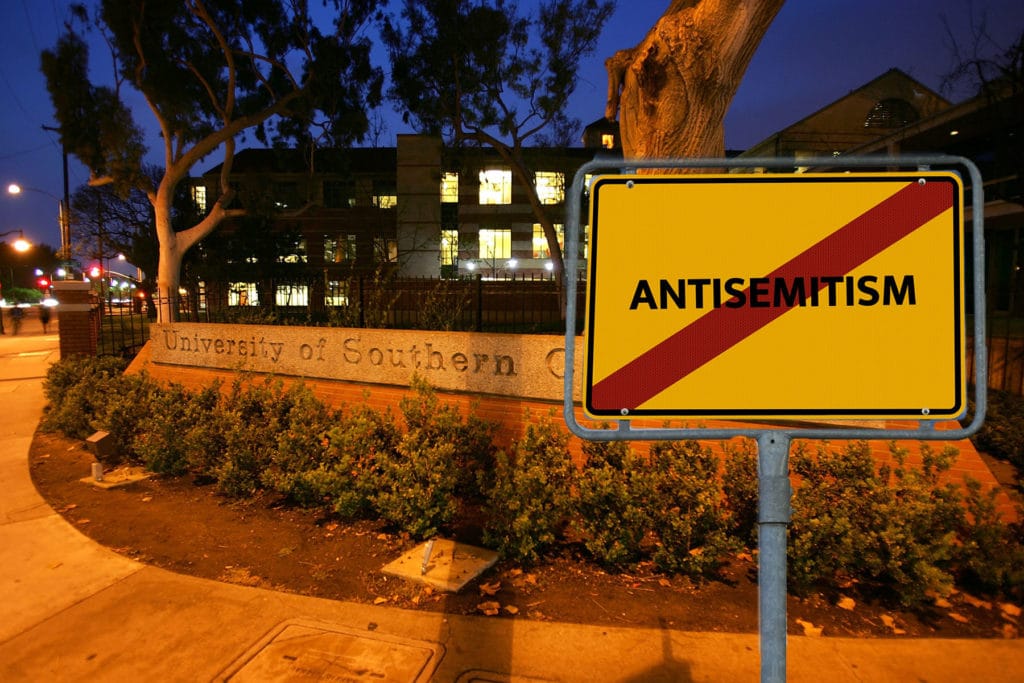
USC issued a statement on December 28 denouncing antisemitism after the university made the Simon Wiesenthal Center’s annual Global Antisemitism Top Ten list.

The Wiesenthal Center ranked USC ninth on the list over their handling of student Yasmeen Mashayekh, a student Diversity, Equity and Inclusion senator at the Viterbi School of Engineering who has tweeted about wanting “to kill every motherf—ing Zionist,” “Death to Israel,” among other tweets. “Not even the fact that over 60 faculty members at USC recently signed an open letter … urging officials to rebuke Mashayekh has moved USC to take real action to remove her,” the Wiesenthal Center list stated. “At a time when special efforts are being made to protect and encourage minorities, USC President Carol [Folt] gets an ‘F’ for allowing this travesty to continue.”

In response, the university said in a statement sent to reporters: “President Folt and the USC Board of Trustees have publicly and unequivocally denounced antisemitism in all its forms and are committed to creating an environment which is safe for our Jewish community.

“The university understands why students, faculty and staff have felt unsafe following a series of hateful tweets that called for violence against both Jews and Zionism, which is an important part of the identity of many Jewish people. The tweets in question violated USC’s community values and we have addressed that with the student, consistent with California law.” They added that they “are committed to strengthening the Jewish community at USC and ensuring that our campus is free of hate speech.”

USC Board of Trustees President Rick J. Caruso also said in a statement, “As I said earlier this month, the Board of Trustees together with President Folt unequivocally rejects antisemitism. We explicitly condemn and denounce tweets calling for the killing of Jews. This kind of hateful speech has no place at USC or anywhere in society.”

Associate Dean and Director of Global Social Action Agenda at the Simon Wiesenthal Center Rabbi Abraham Cooper acknowledged in a phone interview with the Journal that USC’s statement was “a strong statement against antisemitism” but “we’re looking for action against antisemites, and that’s totally lacking.” He also criticized the university for having “trouble uttering the word ‘Zionist.’” “They’re worried what the woke folks are gonna be saying … if they [the university] say, ‘No no, Zionism is the national liberation of the Jewish people and people have every right to pursue it,’” Cooper said.

USC’s statement was “a strong statement against antisemitism” but “we’re looking for action against antisemites, and that’s totally lacking.”

If USC can’t figure out a way to hold Mashayekh accountable, Cooper added, they “should get a team in there that can, because we do not accept the status quo.”

USC Chemistry Anna Krylov, one of the faculty members who signed the letter calling for the university to rebuke Mashayekh, told Jewish New Syndicate (JNS) that while the university’s statement did say that Zionism is integral to Jewish identity, it needed to be on a public platform.

“We are still waiting to hear whether Israeli and Zionist students and those who support the right of the State of Israel to exist are welcome on campus,” she said.  “It is also not clear what concrete actions to improve the campus climate will be taken. So far we have heard a lot about various task forces but not much about actions.”

Judea Pearl, Chancellor Professor of Computer Science at UCLA, National Academy of Sciences member and Daniel Pearl Foundation President, also told JNS that Folt at first “couldn’t spell Zionism. Then she finally spelled it but not on an official letter.” He added that Folt might simply be trying to avoid “political controversy.” “She may be afraid of CAIR’s (Council on American-Islamic Relations) lawyers or maybe some other source of criticism, but that’s why she is hesitating and this is what we need here. Zionism is not taking sides. It’s just moral imperative—and I say it very clearly—people who believe in the right of Jews to have a homeland.”

In a December 14 article, The Los Angeles Times quoted Mashayekh as saying that she doesn’t “feel safe on campus,” claiming that she is being subjected to “targeted harassment” and that the university has not adequately responded to her concerns. She also said she was removed from Virterbi’s website and is concerned about future employment opportunities and her loan payments. “I just really wish I didn’t have to think about what I would change. I wish people didn’t expect Palestinians to be the perfect victims.”

USC Denounces Antisemitism After Making Wiesenthal Center’s Top 10 Global Antisemitism List Read More »

What Made Sheldon Adelson Tick?

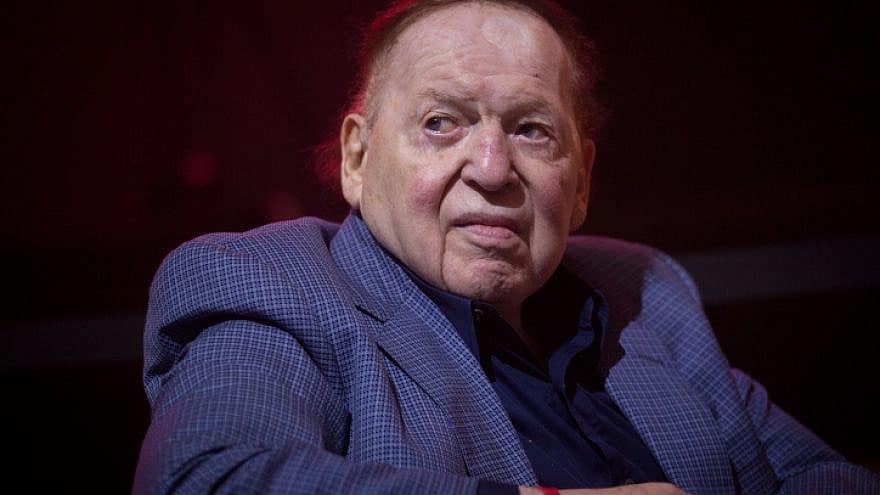
The secular new year coincided with the very first Yahrzeit of that giant of Jewish vision and philanthropy, Sheldon Adelson.

As Sheldon was a dear friend whom I mourn and miss, and as I have written much about him since his passing, I wanted to pen this particular column as a stream-of-consciousness exercise that focuses on his absence.

What has the world Jewish community and the State of Israel been missing since Sheldon was lost to us a year ago? How is his absence felt?

I would say this.

More than anything Sheldon represented unapologetic Jewish pride. Sheldon Adelson was Jewish identity personified.

More than anything Sheldon represented unapologetic Jewish pride. Sheldon Adelson was Jewish identity personified. He made zero compromises with those who believed that Jews should keep their heads down and not make waves. He believed that to be a Jew was a privilege, an honor, a responsibility, something to be fought for and defended at all times.

Sheldon was, in his core, a fighter for the Jewish people, the ferocity of which our people have rarely encountered in modern times.

As America’s foremost political contributor, along with his wife Miri, he received significant criticism from people on the left who said that using political muscle on Israel’s behalf—say to pressure a president to move the American Embassy to Jerusalem—could only excite antisemitism.

Sheldon scoffed at such notions, dismissing them out of hand. What was the point of wealth or influence if it were not deployed in the service of a great cause? And what greater cause could there be that the survival and flourishing of the nation that gave the world God, the Ten Commandments, the Bible, the belief that all humans are created equal in the image of God, and the modern State of Israel, the only democracy in the Middle East?

He found those who would not stand up for Israel and their Jewishness weak and pathetic. The Jewish people had every right to exercise their influence for noble causes and righteous interests. And as America’s most reliable ally in the world, Israel’s security was directly related to America’s.

Sheldon was not an orthodox or halakhically-practicing Jew, in the strict sense of the words.

Yet, in other ways he was ultra-orthodox.

If being an observant Jew means believing in the destiny of the Jewish people and safeguarding a vulnerable nation from harm and valuing the infinite worth of every member of our nation, then Sheldon was off-the-charts religious.

He was a fanatic when it came to a proud Jewish identity and had little respect for any Jewish men and women—especially those who are accomplished and high-profile—who denied it. He and Miri became the single biggest supporters of Birthright Israel not only because it exposed young Jews to the Jewish state—although that was their primary reason—but also because demographic studies showed that those who attended Birthright were more committed to finding a Jewish spouse and establishing a Jewish home.

Jewish continuity was Sheldon’s lifeblood. Politicians of every party knew that support from Sheldon Adelson came down to two things. Do you want America to flourish economically, socially, and militarily as never before? And do you care about the security and survival of America’s foremost ally, Israel? Do you recognize the genocidal government of Iran, with its stated purpose of bringing about a second holocaust, as evil and will you resist that evil or will you surrender to it?

I have met few men who could care less than Sheldon for constant press attacks against him for using his influence to protect Israel. He wore the criticism as a badge of honor.

There was a mystical attachment between Sheldon and his Jewishness that belied any rational attempt at explanation.

In his introduction to the Hebrew Edition of “Moses and Monotheism,” Sigmund Freud wrote of his Jewish identity as consisting of deep dark mystical feelings, “the more powerful the less they could be expressed in words.”

When thinking of Sheldon that sentiment often comes back to me.

How do we explain how a man who did not go to a Yeshiva, or visit Israel until much later in life, developed an attachment to Judaism and Israel that would transform both? How do we explain how a man whose immediate family was protected from the Holocaust in Boston would nevertheless go on to become, along with his wife Miri, the single biggest supporter of Holocaust memory in the world? And how do we explain how a man who served as a soldier in the United States Army could have the vision of understanding that a strong IDF in Israel could directly protect American interests from Iran and other terrorist foes?

I submit that having known Sheldon and having tried, on countless occasions, to fathom the depths of his commitment to the Jewish people and Israel, that it remains a powerful mystery, “the more powerful the less they could be expressed in words.”

But there is one ingredient above all that explains it. His wife Miri was a game-changer. Miriam Adelson shares one pivotal virtue with her late husband that is positively historic: She is quite simply the proudest Jew you will ever meet. That Sheldon and Miri found each other was providential and would change the landscape of Jewish life as we know it. It was not until he met Miri that Sheldon became, with his wife, the world’s foremost Jewish philanthropist.

To be sure, Sheldon was already drawn to Israel. He wanted to marry an Israeli wife. Little did he realize that he’d marry the living personification of the Israeli woman—brilliant, tough, totally committed, and nearly invincible.

On one of his birthdays I asked Sheldon if his father, Arthur, and his mother, Sarah were the principal influences in his life to become a Zionist before he met Miri. On that day I had given Sheldon a beautiful tzedakah box to keep on his desk and he told me the story of how his father, a taxi driver, had taught him to put a few pennies in the “pushky” every day. “And why should we give charity to the poor, Dad, when we’re so poor ourselves?” “Because,” his father said, “there is always someone poorer.”

There can be no question that having a father who gives his paltry few pennies to the Jewish national fund, and oozes Jewish pride, is going to impact his children, and Sheldon always cherished and spoke fondly of his parents’ legacy.

But most of all, Sheldon spoke of Miri.

He never stopped talking about Miri and how she was the perfect partner and wife. Indeed, I witnessed Sheldon singing to Miri over the phone on many occasions about his love for her.

A marriage like that, where you transcend just being spouses and instead become soul-mates can take the marital union to heights scarcely imaginable.

Those heights of marriage to Miri—their shared commitment to enlivening the Jewish nation politically, religiously, and culturally—electrified the world. Together, Sheldon and Miriam Adelson became living paragons of how wealth can be translated into commitment and how one marriage can breathe new life into a nation that experienced a genocide just 75 years ago.

The Talmud says that “our forefather Jacob never died. Since his children are alive [continuing his legacy], he too is alive.”

We miss you Sheldon. I miss you every day. It’s the reason that on January 20 at Carnegie Hall we are awarding your memory with the “Light of the Jewish People Award,” which you personally presented to Elie Wiesel at our gala in Times Square in 2015, a year before the great man died. You will be only the second person to ever receive it and it will be presented by Elisha Wiesel, Elie’s son.

But we see you Sheldon in everything Miri does for America, the Jewish people, and Israel.

We will never forget you.


Rabbi Shmuley Boteach, whom the Washington Post calls “the most famous Rabbi in America,” is the international best-selling author of 36 books including his most recent, “Kosher Hate: How to Fight Antisemitism, Racism, and Bigotry.”

What Made Sheldon Adelson Tick? Read More »

Israeli Ambassador Criticizes Emma Watson’s Palestinian Solidarity Instagram Post

Israeli Ambassador to the United Nations Gilad Erdan criticized actress Emma Watson’s Instagram post expressing Palestinian solidarity.

Watson’s January 2 post featured various pro-Palestinian protesters holding “Free Palestine” signs and the words “Solidarity is a verb.” Her caption included a lengthy quote from feminist scholar Sara Ahmed stating in part that solidarity “involves commitment, and work, as well as the recognition that even if we do not have the same feelings, or the same lives, or the same bodies, we do live on common ground.” 

Erdan tweeted out a screenshot of Watson’s post and wrote: “Fiction may work in Harry Potter but it does not work in reality. If it did, the magic used in the wizarding world could eliminate the evils of Hamas (which oppresses women & seeks the annihilation of Israel) and the PA [Palestinian Authority] (which supports terror). I would be in favor of that!” Erdan was referencing the fact that Watson starred in the Harry Potter movies as the character Hermione Granger.

Stop Antisemitism responded to Watson’s post by quoting an Amnesty International report stating that females in the Gaza Strip have been discriminated against “in law and practice and were inadequately protected against sexual and other gender-based violence, including so-called honour killings throughout Gaza and the Palestinian territories.” “We would think a feminist collective would help bring attention to these horrific situations vs. sharing silly slogans,” Stop Antisemitism added.

Scottish journalist and Zionist activist Eve Barlow tweeted, “Emma Watson posting a Free Palestine solidarity Instagram message hours after Hamas fire rockets into Israel is pretty much as tone deaf and braindead as dancing on a fresh grave, but I guess if you support terrorist regimes you like celebrating death and destruction.” On January 1, two rockets were fired from Gaza and landed in a coast nearby Tel Aviv.

New Zionist Congress Co-Founder and Journal columnist Blake Flayton tweeted, “Just in case you need an example of how disproportionate a hatred anti-Zionism is, Emma Watson just shared a Solidarity with Palestine post on Instagram, where she has 64 million followers. Four times the amount of Jews on planet earth. But sure, their state is the problem.”

This article has been updated.

Israeli Ambassador Criticizes Emma Watson’s Palestinian Solidarity Instagram Post Read More »