The Israeli tech company Doral Energy broke ground for their solar energy project known as Mammoth Solar Project in Indiana on October 14.
The project is going to be a 13,000-acre farm that will span across the Starke and Pulaski counties in northern Indiana. The project is expected to be operational by 2024 and will have the capability of powering 75,000 homes, according to the Associated Press.
Israeli Ambassador to the United States Gilad Erdan hailed the project as a “milestone in the Israel-U.S. relationship” and “a shining example of the tremendous mutual benefits of our cooperation, not only for the people of Israel and the United States but for the entire world,” The Jerusalem Post reported.
“Mammoth Solar will create hundreds of jobs, and produce enough clean energy to power over one hundred and seventy thousand households annually,” he said, adding that “we stand together when our economies are attached.”
Erdan also praised Indiana Governor Eric Holcomb, a Republican, for launching an investigation to see if Unilever, the parent company of Ben & Jerry’s, violated the state’s anti-Boycott, Divestment and Sanctions (BDS) laws for Ben & Jerry’s decision to withdraw from the “Occupied Palestinian Territory.” “We must never stay silent when anti-Semitic double standards are applied against the world’s only Jewish state,” he said, according to WKVI.
Holcomb had visited Israel during the May conflict between the Jewish state and Hamas; Erdan called Holcomb a “true friend of Israel.”
WKVI reported that there has been a “mixed” reaction from local landowners regarding the solar project; Holcomb said that the community would benefit from the “jobs and tax revenues” that the project would bring. He also said he would be open to living next to a solar farm.
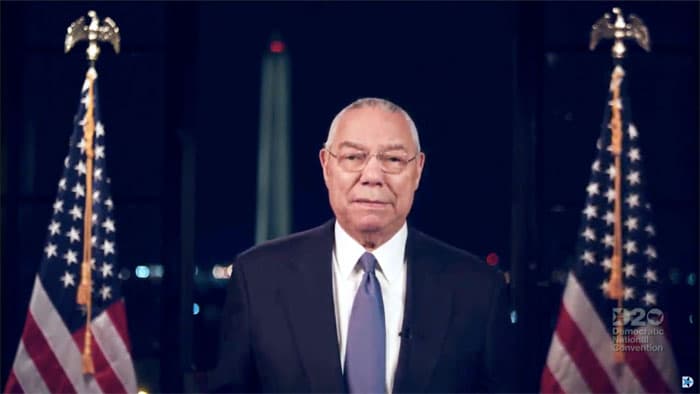
Various Jewish groups have released statements mourning the loss of former Secretary of State Colin Powell, who died on October 18 at the age of 84.
Powell’s family announced that he had died from COVID-19-related complications while battling multiple myeloma (plasma cell cancer) and Parkinson’s Disease. He was fully vaccinated against COVID-19.
Powell had served as a national security adviser in the Reagan administration, chairman of the Joint Chiefs of Staff under President George H.W. Bush and became the first Black Secretary of State under President George W. Bush. According to Jewish Telegraphic Agency, Powell “brokered the ‘road map’ to a two-state peace deal that still informs much of U.S. policy in the region” and spoke Yiddish as a second language.
“We have lost a remarkable and loving husband, father, grandfather and a great American,” Powell’s family said.
Jewish groups tweeted out their condolences.
“Our thoughts are with the loved ones of Colin Powell, who we lost earlier today,” the Anti-Defamation League (ADL) tweeted. “The first African American Secretary of State and recipient of ADL’s highest honor, the America’s Democratic Legacy Award, Gen. Powell served his country with honor, integrity & will truly be missed.”
Our thoughts are with the loved ones of Colin Powell, who we lost earlier today. The first African American Secretary of State and recipient of ADL’s highest honor, the America’s Democratic Legacy Award, Gen. Powell served his country with honor, integrity & will truly be missed. pic.twitter.com/y5vCdLcsfr
The American Jewish Committee (AJC) tweeted, “AJC mourns the passing of Colin Powell, a soldier-statesman who served as the first African American Secretary of State and was a friend of Israel, of the Jewish community, and of AJC. We extend condolences to his wife, Alma, and his entire family. May his memory be a blessing.”
AJC mourns the passing of Colin Powell, a soldier-statesman who served as the first African American Secretary of State and was a friend of Israel, of the Jewish community, and of AJC. We extend condolences to his wife, Alma, and his entire family. May his memory be a blessing. pic.twitter.com/PyEUJUdiE5
StandWithUs CEO and Co-Founder Roz Rothstein tweeted, “The elegant, brilliant Colin Powell, first Black US secretary of state, will be missed. He left his mark on the world, and was a true friend to Israel.”
The elegant, brilliant Colin Powell, first Black US secretary of state, will be missed. He left his mark on the world, and was a true friend to Israel. https://t.co/Pk06mB5ead
Democratic Majority for Israel tweeted, “Today, our thoughts are with the family & loved ones of Gen. Colin Powell as we mourn his loss. Powell was a historic leader, a statesman and a dedicated supporter of the U.S.-Israel relationship. May his memory be a blessing.”
Today, our thoughts are with the family & loved ones of Gen. Colin Powell as we mourn his loss. Powell was a historic leader, a statesman and a dedicated supporter of the U.S.-Israel relationship. May his memory be a blessing.https://t.co/fld92lNUYM
— Democratic Majority for Israel (@DemMaj4Israel) October 18, 2021
The Jewish Democratic Council of America tweeted, “Colin Powell was a dedicated public servant who broke barriers in our military and government. We’re deeply saddened to hear of his passing, and our thoughts are with his family. May his memory be a blessing.”
Colin Powell was a dedicated public servant who broke barriers in our military and government. We're deeply saddened to hear of his passing, and our thoughts are with his family. May his memory be a blessing. https://t.co/gXIB42PXLW
The American Jewish Congress said in a statement that they were “deeply saddened” by Powell’s death. “Throughout his life, he was a close ally of the Jewish community and a true friend of Israel. An American Army leader, politician, and diplomat, Powell epitomized public service, dedicating his life to both our country and the American people.”
They added: “He was a towering presence for America on the world stage, and for both his achievements and contributions, he will always be remembered as an American trailblazer and pioneer. We express our sincerest condolences to his family. May he rest in peace.”
WASHINGTON (JTA) — Colin Powell will be remembered in history as the first Black U.S. national security advisor, the first Black military chief of staff and the first Black secretary of state.
He was also the first military chief to speak Yiddish as a second language, and he loved surprising Jews with his skill.
Powell, the former U.S. secretary of state who brokered the “road map” to a two-state peace deal that still informs much of U.S. policy in the region, died Monday aged 84. He died of COVID-19, his family said on Facebook. He was fully vaccinated and, according to news reports, had been undergoing treatments for blood cancer.
Powell made history three times as the first Black man in a senior security position: As President Ronald Reagan’s last national security adviser from 1987 to 1989; as the chairman of the Joint Chiefs of Staff from 1989 to 1993 under President George H.W. Bush, who commanded the successful first Gulf War; and as secretary of state from 2001 to 2005 under Bush’s son, President George W. Bush.
Powell, the child of Jamaican immigrants who grew up in the Bronx, was a hero in Vietnam who upon his return stayed in the military and rapidly rose through the ranks.
From when he was 13 until his sophomore year at the City College of New York, Powell worked for Sickser’s, a Jewish-owned shop in the Bronx that sold goods to new parents — many of them Jewish who spoke Yiddish as a first language. He also worked as a “Shabbes goy,” turning on the electricity for Orthodox families on the Sabbath, and picked up the language.
Shamir and Powell shared more than a language: In Powell, Shamir found the only senior national security official who was sympathetic to Israel’s reluctance to hold fire in the face of Iraqi Scud missile attacks on the country. The senior Bush and Brent Scowcroft, his national security adviser, were baffled that Israel did not want to rely on American protection.
Powell, as a military officer, understood Shamir’s concern that staying out would lower Israel’s deterrence, and his sympathetic ear helped bring Shamir around toward complying with the Bush administration’s demand that Israel lay low throughout the conflict.
Powell was consistently concerned about Jewish sensibilities; heading a volunteerism initiative under President Bill Clinton, he formally apologized to the Jewish community after the commission’s first summit was held on Passover.
The pro-Israel community, mindful of his history, welcomed his ascension to secretary of state under the younger Bush, a development that accelerated talk that Powell would eventually run for president as a Republican.
Powell was the first Bush administration official — indeed the first U.S. official — to say, in 2001, that the likely outcome of peace talks would be a Palestinian state. The development stunned the pro-Israel community, which had expected the second Bush administration to step back from the intensive Middle East peace brokering that had characterized the Clinton and first Bush administrations.
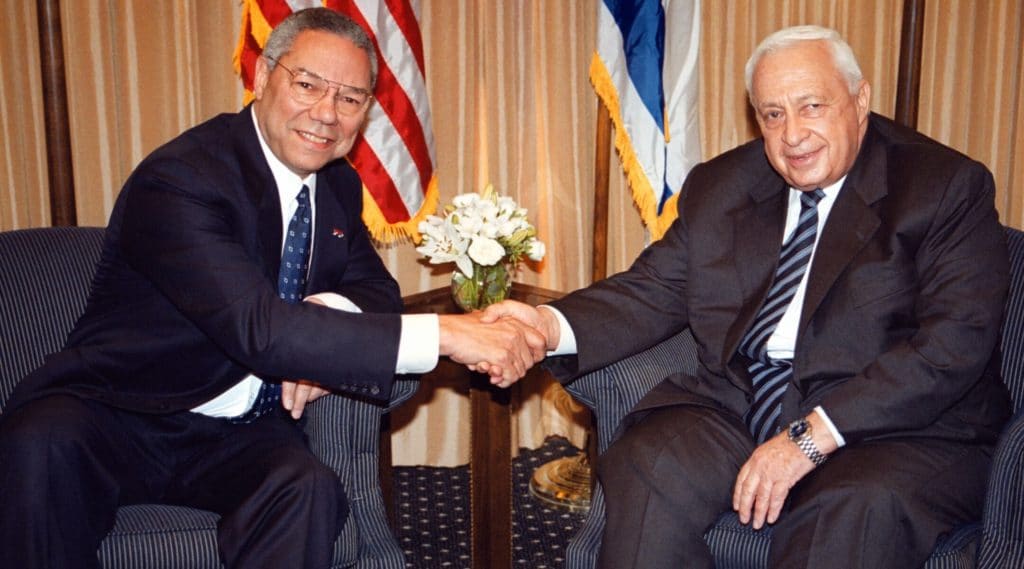
Powell had the ear of his boss; by the summer of 2002, Bush was speaking of Palestinian statehood, and by 2003, Powell had dragged a reluctant Sharon into endorsing — with caveats — the roadmap, which envisioned a process culminating in Palestinian statehood.
Sharon was signing onto the very thing he had accused his Labor Party opponents of rushing toward barely a decade earlier, when the Oslo Process, which did not explicitly envision Palestinian statehood, was launched under Clinton. Powell worked hard to bring the U.S. pro-Jewish community on board with the road map, mindful of how opposition among U.S. pro-Israel groups had helped frustrate the Oslo process.
The Trump administration suspended some provisions of the road map, deemphasizing statehood as an outcome for Palestinians. The Biden administration has reinstated its parameters.
Powell wanted a second term as secretary of state; he forever regretted becoming the leading pitch man for the Iraq War ahead of its 2003 launch, notably with a speech to the United Nations that was later revealed to have included distortions, and wanted to stick around to clean up the mess. Powell clashed with Vice President Dick Cheney over how the war developed.
Bush, however, chose in his second term to let Powell go and elevated his national security adviser, Condoleezza Rice, to the job, making her the first Black woman to be secretary of state. Once again the pro-Israel community, noting Rice’s reputation for hawkishness, rejoiced; once again, it was disappointed when she spearheaded pressure on Israel to enter the Annapolis peace process in 2007.
Powell, meantime, disillusioned with the course of the Bush presidency and resigned to the fact that his own presidential hopes were dashed in Iraq, endorsed Barack Obama for president in 2008. He remained a critic of the rightward drift of his party, endorsing Obama again in 2012, and Hillary Clinton in 2016, although he disliked her; Donald Trump, he said then, was a “national disgrace.”
The last few weeks have brought with them several teachable moments, not just about Jews and antisemitism, but also ones relevant to our society as a whole. In her book, “How to Fight Antisemitism,” journalist and author Bari Weiss claims that the rise of antisemitism is a clear indicator of societal rot. “When a society begins to become unhealthy and tearing itself apart, as we see here and throughout Europe, antisemitism begins to show its face,” Weiss argued, appearing on “Real Time with Bill Maher” in 2019.
Signs of the rot have been all too visible recently, and they carry with them a great warning. U.S. Vice President Kamala Harris addressed students at George Mason University to mark National Voter Registration Day at the end of September. Following her talk, the Vice President called on students for questions. One of those students accused Israel, and America, of committing “ethnic genocide.” Instead of using this as a teachable moment and focusing on the importance of truth in dealing with crucial issues within our society, Harris chose to avoid the mendacious claim and stated, “Your truth should not be suppressed.” Truth became a matter of perception. A few days later, in the pages of this esteemed publication, Gil Troy responded: “Genocide is the mass murder of a people, yet the Palestinian population has quintupled since 1967 … Millennia of Jew-hatred have provided the road map for such perversions. Decades of anti-Zionism paved the way.” When we don’t defend the truth and instead allow moral relativism on what is a clear-cut matter of fact, we open the door for antisemitism and ignorance to creep in, eat away at the foundations of our society and pave the way for nefarious outcomes to come.
Signs of the rot have been all too visible recently, and they carry with them a great warning.
At the beginning of 2021, Congresswoman Marjorie Taylor Greene’s 2018 Facebook post came to light. In it, she claimed the California wildfires were started by PG&E, with the help of a “space laser” belonging to the Jewish Rothschild family, the focal point of many antisemitic tropes. This abominable accusation became the subject of much ridicule, exposing Greene’s antisemitism and ignorance, both of which are all too common, but not limited to, the far right.
Just last week, Jews and Space made a comeback, this time by prolific comedian Dave Chappelle on his latest Netflix standup comedy special. There, he shared a “movie idea” about “aliens, originally from earth, who left thousands of years ago.” When things go terribly for those aliens, they come back to earth and claim it for their own. He labeled his plotline “Space Jews.” To make matters worse, the same plotline included also the story of an African American slave who gained his freedom, became a successful slave-owner himself, and ended up treating his slaves worse than the way he’d been treated. Whether Chappelle’s not-funny joke was related to the ancient accusation of Jewish world dominion or to Jews’ returning home to Israel, it reeks of antisemitism. So, too, does his insinuation that Jews have been treating Palestinians worse than the Nazis treated Jews.
Humor is an essential key to societal communication and human interaction. Comedy is a tool often used to say the things we all know to be true but refrain from saying out loud. It is a universal language, which is why we must be careful in how we use its power to send a message. Jewish communities in the U.S. and across the world are under verbal and physical threats of classic antisemitism and anti-Zionism. In New York’s Times Square, for example, a Jew was beaten senselessly a few months ago, just for wearing a skullcap. Netflix was quick to defend Chappelle’s “creative freedom,” ignoring the fact that the special allows antisemitic tropes to be moved from Greene’s fringes to the mainstream consciousness through its mass distribution channel of hundreds of millions of viewers.
A few months ago, in an interview on CNN, Pakistan’s Foreign Minister, Shah Mahmood Qureshi, said knowingly that Israel is losing the media war despite “their connections and deep pockets.” “They are very influential people,” he said, while laughing. “I mean, they control the media.”
When we don’t defend the truth and instead allow moral relativism on what is a clear-cut matter of fact, we open the door for antisemitism and ignorance to creep in, eat away at the foundations of our society and pave the way for nefarious outcomes to come.
Another great example of willful ignorance was on full display in an Axios interview with the founders of Ben and Jerry’s. The two are no longer actively managing the company but were pulled out of retirement to defend the company’s decision to divest from parts of Israel due to supposed discomfort with some Israeli policies. “You guys are big proponents of voting rights. Why do you still sell ice cream in Georgia? Texas abortion bans. Why are you still selling there?” asked the astute reporter. A few moments of puzzled looks on the screen are followed by a shrug and a poignantly telling “I don’t know,” accompanied by nervous laughter. They know it’s OK to act against Israel just because, but they can’t explain why the same supposed moral principle doesn’t apply in other cases, where Jews and the Jewish state are not involved. Assumption is the mother of all mistakes, and ignorant assumptions are the worst of all.
One line passes between Ben and Jerry’s and Kamala Harris, Marjory Taylor Greene and Dave Chappelle. It’s a red one, indicating that something has gone wrong with our societal discourse. Acts of hatred and antisemitism are born out of ignorance, all “just because it’s true.” Words have meaning and consequences. When we let ignorance rule the dome, when we accept it willingly instead of standing up for the truth, when we do not demand accountability, we allow dangerous notions into our public square.
When we “know” Jews to be malevolent, we “understand” acts of violence against “them” and may even perpetrate them. We are on a slippery slope; those red bulbs are flickering all around us. We should all be warned and take action before it’s too late.
Shahar Azani is a former Israeli diplomat and Senior Vice President at JBS.
Once upon a time a teacher could walk into a classroom, begin to speak, write on the board and hold the students in the palm of his hand.
Those days are past.
Instead, there is a downward spiral of students’ attention spans, paralleled by the upward spiral of teachers desperately seeking tools to keep young people engaged.
In 2010, Rabbi Dan Roth walked into a classroom of American students in Israel who had dropped out of their families’ Orthodox lifestyles. The students ignored him; some even left the classroom. He walked out knowing he had crashed and burned.
Rather than look for another profession, he returned to the classroom, with the same material, in the form of a multimedia slideshow, and the students reacted with enthusiasm.
His goal was not just to reach his students, but also to reach the world, and the seeds of Torah Live were sown.
Torah Live’s graphics, animation and film level are highly professional and their team of men and women includes over thirty scriptwriters, animators, video editors, and sound and special effects artists.
Fast forward to the autumn of 2021. Torah Live’s graphics, animation and film level are highly professional and their team of men and women includes over thirty scriptwriters, animators, video editors, and sound and special effects artists.
While the world was in lockdown, Torah Live kicked in big time. Since the beginning of COVID, over 1.5 million videos have been viewed, and the website has been accessed by 168,000 active users. It has hundreds of thousands of viewers from around North America and the world, including Moscow, Paris, London, Australia and South Africa.
Hadassah Levy, a Torah Live blogger, writes, “An unexpected, and particularly meaningful new user base of Torah Live, has begun among the B’nei Menashe community in India, a group of Jews who claim descent from one of the Lost Tribes of Israel (a claim confirmed in 2005 by the Sephardi Chief Rabbi Shlomo Amar).”
Photo courtesy of Torah Live
A new gaming website was recently added to their rich reservoir. The gaming program is advised by Rabbi Yaakov Deyo. A graduate of Harvard Business School, he was the educational director for Aish L.A. for four years (1998-2002), director of Partners in Torah in New Jersey for seven years, and was involved in many other Jewish educational projects. “We’re basically looking to create something between Fortnite and Kahn Academy, a platform that will not only engage players, but draw them into a world of Torah … by learning via film, performing mitzvot and submitting pics of their work, creating positive impacts in the world around them.”
Students are given the tools to create their own written content and animated shorts, and can also upload their own photos and short videos. Parents or teachers can create their own program to incentivize their children. The kids choose their picture from an avatar and can send their photos to Torah Live, who will “cartoonify” them. Each player has his own dashboard that goes up to 36 levels, alluding to the “thirty-six full-fledged righteous individuals in each generation” (Talmud, Succa 45b, translation by Sefaria). Points in the gaming element are based on creativity, quality and effort. As they participate, they also earn badges.
Rabbi Roth says, “The child earns virtual coins, called ‘dinars.’ They can decide how to spend them,” like sending food to a poor family for Shabbat or sending flowers to an elderly person in a retirement home. “We hope through partnerships to help fulfill the child’s wish … Our hope is that when the child grows up, he’ll give real money to charity, not virtual money.”
Among the more than 30 rabbis who offer video approbations on the site are Rabbi Asher Weiss, Rabbi Hershel Schachter and Rabbi Meir Goldwicht, and Rabbi Yisroel Reisman. The late Rabbi Dr. Abraham Twerski says, in a clip, “Man was intended to be not just an intellectual animal, but a spiritual animal, and in Torah language, this means the acquisition and the development of midot.” He calls the work of Torah Live “unprecedented educationally” and something that can help both young people and adults achieve tzelem Elokim—be in the image of God.
Torah Live materials are used by all ages, by all denominations of Judaism and even by some non-Jews who are learning for conversion or who are simply seeking knowledge.
Torah Live materials are used by all ages, by all denominations of Judaism and even by some non-Jews who are learning for conversion or who are simply seeking knowledge.
Jacob Scheer, who teaches in a Conservative school in N.Y., used Torah Live videos to teach about the issue of ribis (interest). Zita Weinstein, a home-schooling parent, said that her children, ”know it’s coming from the right source … I often hear my kids laugh as they’re watching … and they just want more and more.” Rabbi Binyamin Plotzker of Monsey, director of teaching and learning at Yeshiva Ketana Ohr Reuben, said that, “The Tefillah and Emunah series … is saturated with hashkafa, Emunah … and is dealt with so clearly and humorously.” They have also been used by Aish, NCSY and Chabad. Some of their films have even appeared on El Al.
Photo courtesy of Torah Live
In addition to their programs on Jewish ritual and mitzvot are those that relate to one’s behavior, such as judging one favorably, the quality of patience, the value of a smile, the importance of humility in leadership, and a magnificent 18-part unit on “The Power of Speech.” Everything is filmed among the magnificent vistas of Israel, including the ocean (to explore the snails from which the blue dye for tzitziot comes).
The Process
Elchanan Schnurr, the scriptwriter and showrunner, is originally from Los Angeles, went to a variety of public, private and Jewish day schools, worked in Hollywood, and learned in various yeshivot. He considers the direction that Rabbi Roth wants to take a project and researches the content. The process is a dialogue with Rabbi Roth, and Ben Katz (who writes, shoots and edits) and Ronen Zhurat (their main animator) are very influential on the creative side.
Ben Katz, originally from New York, told this writer, “It is challenging to create productions that have many locations, or many different characters or a combination of graphics, live action and animation. ‘The Lost Light,’ which had all of the above, was actually approached as two separate productions that were filmed almost a year apart. It also had many logistical nightmares, and many ’recurring characters’ that needed to be tracked down and scheduled a year later.”
On the other hand, the stunning “Weapon of War” segment from “The Power of Words” was scripted, prepared and filmed in a day.
Validation from the Rambam and a Harvard Professor
The Rambam, in Sefer Hamada (the Book of Knowledge), Hilchot Talmud Torah 4:5, explains that the sages said that one who is shy cannot learn [because they are embarrassed], referring to a subject [the students] don’t understand due to its depth, or “mipnei da’atan k’tzara.” This last phrase is usually translated “because his comprehension is weak” but one Torah scholar told me it can also be interpreted as referring to a student’s short concentration span. Today, a student using Torah Live will feel more confident, as he navigates at his own pace.
More than 800 years later, Professor Howard Gardner’s ground breaking 1983 book, “Frames of Mind: The Theory of Multiple Intelligences,”noted that in addition to language and logic/math, a person can have an intelligence that is spatial, or musical, or bodily-kinesthetic, or interpersonal or intrapersonal. He later added naturalistic intelligence, and new “candidates” are “Existential Intelligence—The Intelligence of Big Questions” and “Pedological Intelligence—The Intelligence of Teaching.”
Whether Rabbi Roth and his crew realize it or not, they are implementing Professor Gardner’s theory of multiple intelligences through their multifaceted Torah Live programs, enabling children, parents and their teachers to find their own pathway to Torah.
Toby Klein Greenwald is an award-winning journalist, director of Raise Your Spirits Theatre, an educator and the editor-in-chief of WholeFamily.com. She was thrilled to discover many of her actresses in the Torah Live films.