fbpx

July 30, 2021

Comedian Matt McCarthy Is Not the CEO of Ben & Jerry’s … Or Is He?

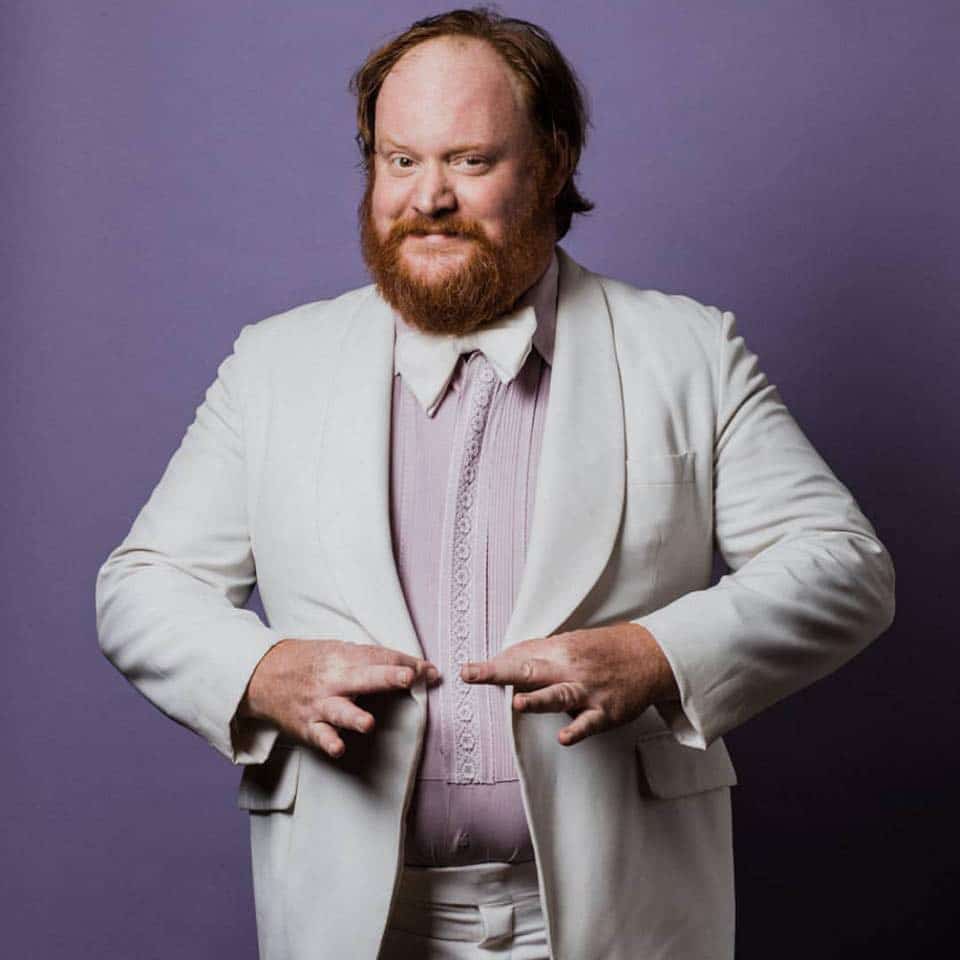
Everybody is weighing in on Ben & Jerry’s decision to end sales of ice cream in the West Bank and east Jerusalem. People are very angry on one side and proud of the company on the other. Either way, they’re speaking their minds to comedian Matt McCarthy on Twitter. Why? Because they’ve mistaken him for the CEO of Ben & Jerry’s, Matthew McCarthy.

“It’s happened before but the recent Ben & Jerry’s news completely revved it out of control,” said McCarthy, who goes by @mccarthyredhead on Twitter, in an interview with the Journal. “[I receive] at least one [tweet] a day. Since I’ve started leaning into the nonsense recently it’s been more tweets from people in on the joke.”

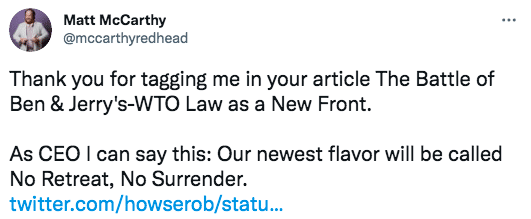
McCarthy doesn’t mind; even when people are attacking him, he has fun with it. After someone tagged him in a post about the situation, McCarthy thanked the man and told him,  “Our newest flavor will be called No Retreat, No Surrender.” The man then posted, “Love that spirit,” and McCarthy responded by posting, “This guy’s bio says he is an NYU Law School professor.” The man later deleted his tweet, perhaps realizing his mistake. But a reply from him still lingers on McCarthy’s page: “Thank you for your bold and principled move!”
Here’s one where McCarthy cut straight to the point. When a customer asked him, “Hi gentlemen, Please, could you bring back the most fantastic Ice Cream of B&J, New York Chocolate Crunch please. We can not anymore buy it in France? A problem of a range too wide? Please it’s one of your best perfume,” McCarthy replied, “Thank you for reaching out. No.”

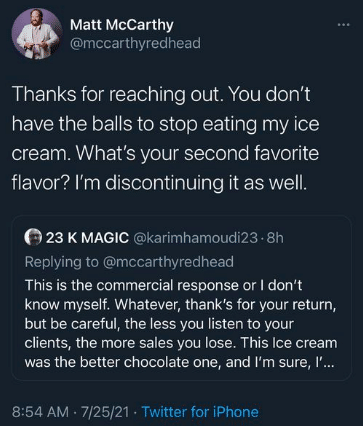
That same person said to McCarthy, “Be careful, the less you listen to your clients, the more sales you lose. This Ice cream was the better chocolate one, and I’m sure, I’m not the only one thinking that.” McCarthy responded, “Thanks for reaching out. You don’t have the balls to stop eating my ice cream. What’s your second favorite flavor? I’m discontinuing it as well.”
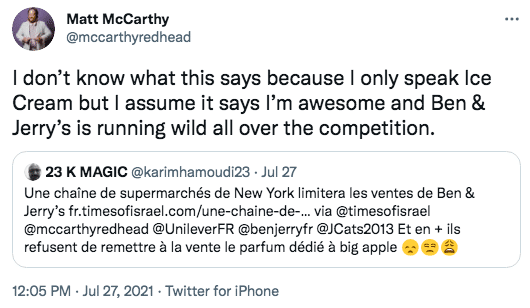
Still, the original poster didn’t catch on. He also tweeted something completely in French to McCarthy. McCarthy replied, “I don’t know what this says because I only speak Ice Cream but I assume it says I’m awesome and Ben & Jerry’s is running wild all over the competition.”
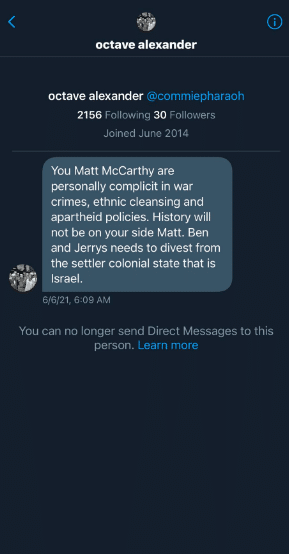
The comedian, who has over 10,000 followers, posts pictures of himself “checking in” on “his products” in grocery stores and tweets at other ice cream companies that he’s coming for them, along with funny GIFs. He also tweets pictures of direct messages, like one from a user who told him he is “personally complicit in war crimes, ethnic cleansing and apartheid policies” and that “history will not be on your side Matt.” Someone replied to that, “I love you CEO of ben and Jerry’s you stand with humanity now I’m buying Ben and Jerry’s anytime I need Ice cream. Thank you for standing up for injustice!!!”

When asked whether or not people are catching on that he’s not really the CEO, McCarthy said, “It’s hard to say. Mostly I’ve been replying back like the CEO of Ben & Jerry’s is an action hero from a bad ‘80s movie. And still they don’t notice.”

While McCarthy does have a favorite Ben & Jerry’s flavor (“Cherry Garcia, maaaaan”), what he doesn’t actually have an opinion on is what’s going on with the Israel situation.

“I watch pro wrestling VHS tapes and collect comic books,” he said. “I’m the last person you want discussing world affairs.”


Comedian Matt McCarthy Is Not the CEO of Ben & Jerry’s … Or Is He? Read More »

Unscrolled Eikev: Why God Isn’t Nice

Growing up, I always heard the so-called “Old Testament God” (characterized as wrathful, vengeful and mean) contrasted with the so-called “New Testament God” (characterized as loving, forgiving and nice).

When I was older, I clocked this trope as antisemitic, but I never questioned the central premise of the idea, which is that God ought to be nice.

And yet it comes up again and again as we read the Torah week from week. My father, taken aback by God’s fiery temperament, shakes his head and says, “So this is what they mean when they talk about an Old Testament God.

Indeed, throughout the Torah, God smites, condemns, knocks down buildings, floods the earth, and destroys entire cities. Considering all that, my father’s concerns aren’t so terribly hard to understand.

And yet I wonder, is niceness really what we’re looking for from our holy scriptures?

In Parashat Eikev, as the Israelites stand poised to inherit the promised land, God reiterates his love for them again and again.

“It was to your fathers that the LORD was drawn in His love for them, so that He chose you” (Deuteronomy 10:15).

Reading these beautiful passages, I could see the relief on my father’s face, wondering if perhaps the “angry Old Testament God” had given way to something softer in the book of Deuteronomy.

But these chapters also contain words of dire warning. Moses scolds the Israelites harshly for their past sins and stresses to them that if they stray from God in the promised land, they will be utterly destroyed—cast out and scattered or even obliterated by the anger of God as it blazes forth against them.

My father’s face fell—because no, it isn’t nice. And Moses doesn’t mince words.

If the Torah were merely a bedtime story, perhaps a nicer God would be more fitting—one more serene and simple, docile and domesticated. But it isn’t just a story. There’s a message being sent and the stakes of mishearing it are perilously high.

This isn’t a time or a place for niceness. What’s happening is real and it’s serious and the Israelites need to wake up to the profundity of the moment. God is giving them an opportunity to build a society of Torah, of holiness, of equality, of justice, of accord with nature, of accord between citizen and stranger.

And yes, there are consequences to failing in this mission. Those consequences sound harsh, but they are not the fanciful invention of Moses or the Biblical author. We can see what those consequences are when we look out our windows and when we read the paper: war and death, injustice and disease, a planet on fire.

So, no, the “Old Testament God” is not nice. But nor is He the violent banshee conjured up by problematic antisemitic comparisons with the so-called “New Testament God.”

So, no, the “Old Testament God” is not nice. But nor is He the violent banshee conjured up by problematic antisemitic comparisons with the so-called “New Testament God.” Indeed, the great revelation of Deuteronomy is that everything God does, God does in love. Even the actions for which the “Old Testament God” has received His reputation are acts of love.

We are told that God disciplines the Israelites “as a man disciplines his son” (Ibid 8:5). We learn that the hardships of the years in the wilderness were not harsh diktats from a cruel deity, but rather sober expressions of love from the living God in order to “learn what was in [the Israelites’] hearts” and ultimately to “benefit them in the end.”

So yes, God is loving, but He is not nice. I doubt we would want Him to be.

Nice is cheap. It is the smile of a salesman. It is the polite nod of someone who long ago stopped listening. It is the gracious gesture of one who doesn’t care.

By this point in the Torah, we should surely expect more of God than that.


Matthew Schultz is the author of the essay collection “What Came Before” (2020). He is a rabbinical student at Hebrew College in Newton, Massachusetts.

Unscrolled Eikev: Why God Isn’t Nice Read More »

Illinois to Ben & Jerry’s: Reverse Israel Stance, Or We Will Divest From You

The Illinois Investment Policy Board reportedly plans to warn Ben & Jerry’s to reverse their recent stance on Israel or else the board will divest from the ice cream company.

The Associated Press (AP) reported that the board’s Israeli Boycott Restrictions Committee will provide Unilever, Ben & Jerry’s parent company, with 90-day deadline to either “confirm or deny” Ben & Jerry’s stance. “In this case, it was a blatantly open statement made by the chairman of Ben & Jerry’s and we need to determine if Unilever deems it appropriate to walk the statement back.”

Should Unilever not reverse the statement, then Illinois’ state pension funds will need to divest from Unilever under state law.

Other states are taking similar actions. The New York State Comptroller’s Office sent a letter to Unilever on July 23 telling them they have 90 days to prove they aren’t partaking in the Boycott, Divestment and Sanctions (BDS) activities or else face divestment. The Texas Comptroller is considering taking similar actions. Florida Governor Ron DeSantis, a Republican, wrote a letter to the State Board of Administration urging them to take action against Ben & Jerry’s and Unilever.

In a July 27 letter to the Anti-Defamation League, Unilever CEO Alan Jope wrote: “Unilever rejects completely and repudiates unequivocally any form of discrimination or intolerance. Anti-Semitism has no place in any society. We have never expressed any support for the Boycott Divestment and Sanctions (BDS) movement and have no intention of changing that position.” Jope also wrote that Ben & Jerry’s independent board has the jurisdiction to issue such a stance and that they “emphatically” welcome Ben & Jerry’s to remain in Israel, although the board has issued a statement saying that they did not approve the part of the July 19 statement saying they would be remaining in Israel.

Joel Gasman, the owner of a Ben & Jerry’s shop in the Upper West Side of New York City, told the New York Post that Ben & Jerry’s July 19 decision to leave the “Occupied Palestinian Territory” “has definitely hurt our bottom line.” They have also “lost some foot traffic as well as bigger catering jobs that usually help us during the summer. We’re getting bad reviews online that have nothing to do with the store, only in regards to corporate’s views.” Gasman said that his shop is going to donate 10% of their profits to Israel in response.

“We are proud Jews, Americans, and active supporters of the New York Jewish community and State of Israel,” Gasman wrote in a Facebook post.

Illinois to Ben & Jerry’s: Reverse Israel Stance, Or We Will Divest From You Read More »

Ruth Pearl’s Life Story in Her Own Words

In 2003, when my wife Ruth and I were editing the book “I Am Jewish: Personal Reflections Inspired by the Last Words of Daniel Pearl,” we were extremely careful to include only essays that reflected direct and honest answers to the question asked: “What does being Jewish mean to you?” Ruth’s own essay in the book is a model of honesty and directness. It encapsulates in fact her entire life story, and the very essence of what being Jewish meant to her and to so many of us.

Ruth Pearl, who left us last week, was a graduate of the Technion-Israel Institute of Technology and held a Master’s degree in electrical engineering. She worked as a software developer and computer consultant, and served as CFO and secretary of the Daniel Pearl Foundation.

The following is an excerpt from the book “I Am Jewish” (Jewish Light, 2004), edited by Judea and Ruth Pearl, and winner of the National Jewish Book Award for 2004.

***

“I absorbed many of the attitudes and values from my Jewish heritage, such as empowerment to question, zeal for honesty, reverence for learning, and deep commitment to create a better world for the next generation.”—Ruth Pearl

Growing up as a Jewish child in Baghdad left me with recurring nightmares of being chased by a knife-wielding Arab in the school’s stairway while 2,000 schoolmates screamed hysterically. The screaming was a real and frequent occurrence triggered by sudden noise or a minor accident in a chemistry lab, a consequence of the trauma from the June 1941 looting and massacre of 180 Jews in Baghdad.  I also remember my parents’ night vigils waiting for my two brothers to come home after their outings. Indeed, one time my father had to bail them out of jail with a bribe after they were arrested not far from home, just for being Jewish.

All that changed when we left for Israel in 1951. My acclimation to Israel was amazingly easy and natural, though my nightmares continued for many years. In Israel, one does not have to be an observant Jew to feel Jewish, an atmosphere that suited me perfectly. By the time my husband and I arrived in the United States in 1960 for postgraduate studies, I was a proud and secure Jew and did not expect anti-Semitism to ever touch my life.

I tried to pass along to my children my ethical Judaism: a guilt-free, pragmatic religion with open-mindedness at its core.

I was raised in a moderately religious home and community, and I absorbed many of the attitudes and values from my Jewish heritage, such as empowerment to question, zeal for honesty, reverence for learning, and deep commitment to create a better world for the next generation. I tried to pass along to my children my ethical Judaism: a guilt-free, pragmatic
religion with open-mindedness at its core.

My security and sense of justice were shattered with the murder of my son, Daniel.

Like many generations before us, we are now embarking on a new war against anti-Semitism and fanaticism. More than ever before, I am conscious of my Jewishness and my obligation to contribute to its preservation, for I feel bonded to people who share my values and my commitments. Driven by the vision of Danny—a proud Jew who continues to inspire people with his values and dignity—we will win this war, as did our ancestors for many generations.


Judea Pearl is a Chancellor professor at UCLA, co-author of “The Book of Why,”
and president of the Daniel Pearl Foundation (www.danielpearl.org), named after his son. 

Ruth Pearl’s Life Story in Her Own Words Read More »

For the First Time, CSUN Jewish Studies Has Two Permanent Faculty Members

For the first time in its 52-year history, the Jewish Studies Program in the College of Humanities at California State University, Northridge has two permanent faculty members, with the hiring of Dr. Melissa Weininger. She will serve alongside Program Director and Associate Professor Dr. Jennifer A. Thompson.

Established in 1969, the Jewish Studies program offers interdisciplinary courses in many different departments as well as unique classes like Applied Jewish Ethics and a Natural Environment and Judaism and Wilderness Survival course. CSUN students have the opportunity to both major and minor in Jewish Studies, and they can intern at local Jewish nonprofit organizations. The program also offers $1,000 scholarships just for taking Jewish Studies courses and caters to both Jewish and non-Jewish students.

“It’s really great to have people in full-time and tenured positions because it makes the program so much more stable going forward,” said Thompson, in an interview with the Journal. “We can create new programs and lasting relationships because we can count on having the same faculty in place.”

Weininger is coming to CSUN Jewish Studies from Rice University’s Jewish Studies program, where she was the Anna Smith Fine senior lecturer in Jewish Studies and the former associate program director.

“She has fantastic teaching experience across a lot of different courses that we don’t currently offer but would love to,” said Thompson. “She has taught on the Jewish graphic novel. She is an expert at teaching courses that we offer, like our course on Israel’s history and peoples. She did a teaching demonstration for us as part of the hiring process that was just phenomenal. She does everything the way we’d like to see in terms of engaging students and really capturing their attention and interest, and this was over Zoom with students she’d never met before. You can imagine how much better it’ll be when she is here.”

Weininger’s research focuses on Hebrew and Yiddish literature, and she’s currently working on a book about the relationship between Israel and the diaspora communities. She will also be teaching classes on Jewish literature, Israel, gender studies, the American Jewish experience and women in the Jewish experience.

“My skills and experience are very well-suited to this position,” she said. “The program is also growing and developing and I have a lot of experience at Rice starting in a very small program and enhancing and shaping it to fit the needs of the student body and the community. This program is considering deeply the needs of the student body and the community and looking at ways they can adapt their curriculum offerings and programs to serve their needs.”

CSUN Jewish Studies is dedicated to providing programming to the Jewish community in the San Fernando Valley, which is home to half of LA’s Jewish population. “We’ve become a kind of anchor for sharing scholarship and research through public lectures and programs,” said Weininger.

Additionally, at a time when antisemitism is on the rise, Weininger said that the CSUN Jewish Studies program could educate non-Jewish students about what Jewish culture really means.

There are elements of our courses that teach antisemitism but the best way to combat that kind of negative response is for people to learn about it and be exposed to it and appreciate it and fall in love with it.”

“Obviously like everything else, when you’re exposed to something and its particulars and you gain an appreciation of it, it always complicates simplistic understandings that lead to antisemitism,” she said. “Jewish Studies exposes people to Jewish history and culture. That’s the kind of thing we want to be exposing students to to combat antisemitism. There are elements of our courses that teach antisemitism but the best way to combat that kind of negative response is for people to learn about it and be exposed to it and appreciate it and fall in love with it. You can’t help doing that when you take a class.”

Moving forward into this school year and beyond, CSUN will continue to be dedicated to the student body and community and offer them distinctive courses and programming.

“I’m hoping that as we expand especially post-pandemic and start trying new things that the community will be interested in what we are doing and want to connect with us,” Thompson said. “We are eager to make those connections.”

For the First Time, CSUN Jewish Studies Has Two Permanent Faculty Members Read More »

Verified on Twitter and on IMDb: Niver’s News: July 2021

July News 2021 with Lisa Niver & We Said Go Travel:

I am now VERIFIED on Twitter!

During the 1,001 years of COVID, something happened! YAY!

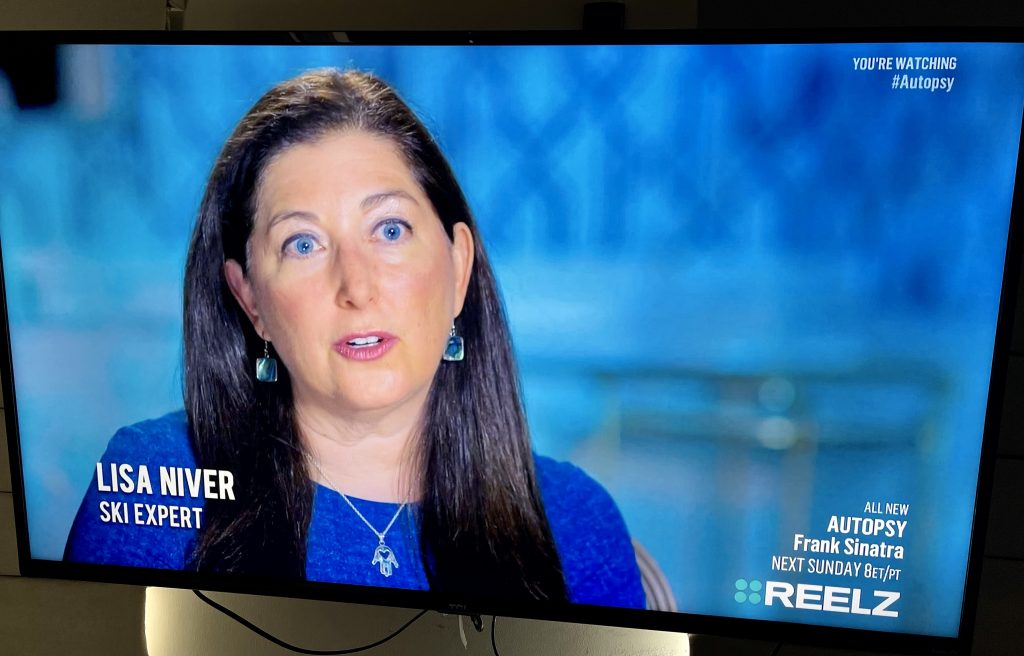
Also during COVID, I filmed as a ski expert with Autopsy: The Last Hours of…Sonny Bono!

Now I am on IMDb!

Thank you to AAA EXPLORER Magazine! I loved sharing about NEW MEXICO in PRINT! TWO ARTICLES!!

Do you want to help in Bali and in India? Please support these projects of my friends. If you have a project to help during COVID, please let me know and I will help get the word out.

Thank you to THE LA GIRL, Erika De La Cruz for including me in her launch event at NUA BEVERLY HILLS.


Embed from Getty Images

Embed from Getty Images

I was the moderator of the media panel at the Women in Travel Conference with AFAR, NATGEO and KOSTUCH.

It was a virtual conference BUT I stayed at Chamberlain Hotel with Jen Faust and then at Le Parc Suites Hotel for the event. I have TWO new videos about WeHo! Enjoy…

WHERE CAN YOU FIND MY TRAVEL VIDEOS?

Here is the link to my video channel on YouTube where I have over 1.35 million views on YouTube! (Exact count: 1,355,779 views) Thank you for your support! Are you one of my 3,167 subscribers? I hope you will join me and subscribe! For more We Said Go Travel articles, TV segments, videos and social media: CLICK HERE Find me on social media with over 150,000 followers. Please follow  on Twitter at @LisaNiver, Instagram @LisaNiver and on FacebookPinterestYouTube, and at LisaNiver.com.

My fortune cookies said:

 “Your talents will bring you the highest status and prestige”

“There is Always time for you to try a new path in life”

Happy Summer! Lisa

Verified on Twitter and on IMDb: Niver’s News: July 2021 Read More »

Proposed Parking Restrictions Pose Threat to Daily Activities at Beth Jacob Congregation

The email didn’t mince words:  “the enactment of such a resolution will be devastating to Beth Jacob.”

The issue? What else? Parking.

Since 1954 Beth Jacob Congregation in Beverly Hills has had a cordial relationship with the residents of adjacent Wetherly Dr., the street that borders the synagogue. For a synagogue with no dedicated parking facilities, members and visitors have come to rely on Wetherly as their parking haven. Even with its two-hour parking limit, the street has allowed members and guests to have convenient parking so they can attend Beth Jacob’s robust schedule of weekday prayer services, programs and communal events.

However, if some Wetherly residents have their way, that may all change.

A petition to institute a street permit from 8 a.m. to 6 p.m. has been circulated. Such a permit would essentially prevent all non-resident parking during the day. The petition was signed by the slimmest majority needed to bring the issue before the Beverly Hills Traffic and Parking Commission, although according to Beverly Hills, some who signed the petition have already withdrawn their support. The Commission will meet on August 5 and, after hearing comments via telephone from interested parties, will make a recommendation to the full Beverly Hills City Council.

Wetherly Drive

To say the Beth Jacob leadership and membership are concerned is a vast understatement. More than 150 emails have been sent to the City of Beverly Hills voicing opinions on the new regulations under consideration.  “We don’t know if the emails are pro or con,” Shana Epstein, Director of Public Works for Beverly Hills said. “However, we can only guess that the vast majority are from synagogue members.”

“This regulation will make our shul the least accessible synagogue in the entire Pico-Robertson community when it comes to weekday attendance at davening (prayer services) and shiurim (classes),” the email from Senior Rabbi Kalman Topp and synagogue President Jonathan Stern, which was also sent to the entire congregation, read. In an interview, Stern added: “Without a doubt, these restrictions threaten to create an insurmountable parking hurdle for those who regularly attend our myriad of services and programs, not to mention important lifecycle milestones, many of which must be scheduled at the last minute.

“And, of equal importance, it would place an extreme burden on elderly members who do not have handicap placards and our many doctors who are on call and must leave the shul on short notice,” the email continued.

The synagogue is bordered by Doheny Dr. on the west, Olympic Blvd. on the north, Robertson Blvd. on the east and Whitworth Dr. on the south. All these streets, and those in between, have restricted parking already, leaving Wetherly as the last location for Beth Jacob member and visitor parking.

On Wednesday, July 28 Beth Jacob distributed a letter to each of the 30 homes on Wetherly inviting residents to engage in an open dialogue. “We believe it is important that our neighbors fully understand the dire implications of this proposal,” Stern said. “All we want is to continue to serve the many needs of the Beverly Hills community like we’ve done for the past almost seven decades.”

This is a developing story.

Proposed Parking Restrictions Pose Threat to Daily Activities at Beth Jacob Congregation Read More »

Jackie Mason and my Bubby’s America

As I was writing my reflections on the six-month mark of my beloved Bubby’s passing, I received a news alert that Jackie Mason had just passed away at the age of 93—just one year younger than my grandmother. This marks the end of an era for so many people who have come to associate him with the daily challenges of reconciling the old versus the new world, nostalgia for a world now forgotten from war and migration, and the comfort of the famously visual imagery of our mamaloshen while navigating the increasing complexity of the post-war Jewish immigrant experience in America.

Jackie Mason was Bubby’s favorite performer, and it is easy to understand the connection she felt to all that he represented, for she too experienced the physical and psychological trauma of moving to America in the early 1950s after surviving deportation from her native Poland and a five-year internment in Auschwitz. As the sole survivor of her entire family, she found kinship in Mason’s references of life in her native village before Hitler annihilated all that she knew and understood in the world.  

As the sole survivor of her entire family, she found kinship in Mason’s references of life in her native village before Hitler annihilated all that she knew and understood in the world.

For Bubby, listening to the “Borscht Belt” performers reminisce in jest of the flavors of gedempte chicken, gefilte fish and pickled herring grounded her with a sense of identity in a place where she felt invisible. Further, Mason would recall the enchanting melodies of “By Meir Bist Du Shein” in a place where American pop culture was foreign to her native Yiddish ears. To Bubby, Mason was a holistic experience of what was left behind and the challenges to understand the world she now inhabited. In her own way, Bubby tried to replicate the kinship and camaraderie of her world by rooting herself at Roxbury Park along with a group of survivors who would become her devoted friends for decades.

Spending so much time with Bubby at the park among her friends was indeed a beautiful sight to witness. The ladies (who I affectionately called the “Oy Luck Club”) played cards at one table, alongside the men at the other table, all kibbitzing in Yiddish about their children, grandchildren, and when they went to Israel for the first time after being liberated from the concentration camps.

Bubby could be challenging at times—as anyone who lived through the experiences she did would naturally be—but she was also incredibly wise and unwaveringly loyal to her family. Having lived next to her and cared for her for close to half of my life, I spent countless hours in her living room, just listening to whatever she chose to speak of that day—be it the meshugana politicians or the geshmacte cholent or even the fakakte pipes in the building, she was such a prominent figure in my life that it is hard to imagine a space that she did not occupy in my consciousness.

It is in the little things where I feel her absence most prominently. I instinctively think to buy her smoked fish at the kosher market, I still expect to see her outside of the building sitting on the chair, I reminisce about all of the shabbat evenings when we lighted candles and I listened to her daven in Yiddish with her hands over her eyes. I miss her profoundly, and somewhere in my heart, I feel her energy infusing her living space, which I now occupy, with her life force and layers of memory. At this stage, memory is what we hold on to as we, her surviving family members, try to imagine the next chapter without her physical being—without hearing her voice, which remains etched on our souls.

In the words of Jackie Mason, “A person who speaks good English in New York sounds like a foreigner,” and the exquisite tapestry of the nostalgia of what once was fused with the reality of the present will always conjure up images of my beloved Bubby. She was indeed a gift to us all—her survival and thus the survival of the vanished world she brought with her.

In loving memory of Hilda Zelmanovitz, Z”L


Lisa Ansell is the associate director of the USC Casden Institute.


Jackie Mason and my Bubby’s America Read More »

A Bridge Between Generations

Every June, my synagogue reminds me of the upcoming anniversary of my mother’s passing. “We would like to remind you that the yahrzeit of your mother, Liebe Leah bat Dov Ber, is this month,” the email reads. I make a donation to the shul in honor of my mother’s memory, and the rabbi recites a special memorial prayer for her during services.

Twenty years ago, my mother passed away only two weeks before our eldest son’s bar mitzvah. When the shiva week was over, I tried to focus on floral arrangements and wrote out place cards for the luncheon. Mourning and celebration collided during the surreal event, but my mother’s presence in the room was palpable. Some might say she had one of the best seats in the house.

Six years ago, that bar mitzvah boy, Avi, was a married man whose wife had just given birth to their second daughter. When Avi was called to the Torah during the shacharis service to name her, I stood with bated breath, listening eagerly for the name. When I heard him announce “Liebe Leah,” my heart and tears overflowed. I had become a bridge between my mother Liebe Leah and her great-granddaughter Liebe Leah. And my mother had been named in memory of her own great-grandmother. I cannot describe how richly I felt a sense of connectivity and continuity being passed down from generation to generation.

Each of our eight grandchildren carries a first name, a middle name, or sometimes both, in remembrance of their great-grandparents, great-great grandparents, great-great aunts or uncles. Several were Holocaust survivors: Shlomo, born in Salonika who was hidden in a Greek church during the war; Miriam, who spent her infancy in Siberia and whose family remained on the run; Yitzhak, who sailed at age six with his parents from Germany in 1938—a late date to escape from the Nazis—and lived a lonely, poor childhood in Washington Heights, New York.

Since the arrival of our grandchildren, the yahrtzeits of my mother, father and maternal grandfather have lost some of the sting of loss. Now in my mind’s eye I see not only the face of my beautiful mother, but also of beautiful six-year-old Liebe, an exuberant child, natural gymnast, tireless reader, and sneaker of sweets. I see two delightful boys who share the name Yaakov, after my father—one a skinny redhead who is fascinated with all things related to fire trucks and construction workers, and a sixteen-month-old with wild dark curls, huge eyes and an equally huge smile. My grandfather Dov Ber has a namesake in twenty-one-month-old Dovi, a sweet-natured toddler.

Since the arrival of our grandchildren, the yahrtzeits of my mother, father and maternal grandfather have lost some of the sting of loss.

That sense of connectivity and continuity between my past and my future is a deeply satisfying reward of having grandchildren. But it is one that a majority of my relatives and acquaintances who are not religiously observant do not share. Our married children’s decisions to begin their families when they are still young is typical among Orthodox Jews but a real outlier in the secular society.

The U.S. fertility rate has been dropping precipitously for years and is now the lowest it’s been in 40 years, according to the Centers for Disease Control—far below replacement rates. Marriage rates have fallen also: the average age for brides in the U.S. is now 28; for men, over 30.

While young adults are in no hurry to start families, some of their parents are getting impatient. “I can’t wait to have a grandchild!” a neighbor in her mid-60s exclaimed to me one day when she saw me pushing a stroller. I wished that for her, too. When her 40-something son and his wife finally had a child, she rushed over to tell me the news, glowing with happiness.

Grandchildren are a blessing in every way. They are a vote of confidence in the future, made by our grown children who have chosen to maintain a commitment to the integrated Jewish living that we tried to model for them. My job as a Nana is time-consuming but great fun: I get to rock babies, read stories, build towers, and spoil them with simple pleasures—a new jump rope, puzzle, or trip for ice cream. I have more patience and certainly greater perspective now as a grandparent than I had as the harried mom of four kids all close in age.

I enjoy this role immensely, but I also hope I am building a foundation for the future. When they are teens or young adults, whether eager to share good news or struggling with problems or questions, I hope they’ll see me as a trusted confidant and friend. I had this type of relationship with one of my own grandmothers and it was a precious gift.

While I would be thrilled to have grandchildren regardless of their names, calling out the names of my late parents and grandparents and having bright little faces turn to me deepens my sense of feeling blessed by my role as a bridge between generations. I hope and pray that God will grant me many years to continue building my active-Nana relationship with them.


Judy Gruen is a writer and editor. Her books include “The Skeptic and the Rabbi: Falling in Love with Faith.”

A Bridge Between Generations Read More »