
fbpx

July 25, 2021

A 76-Year-Old Jewish Philanthropist From Los Angeles Is One of the World’s Most Prolific Olympic Pin Traders

(JTA) — Sid Marantz loves tradition so much that he spent 20 years as a board member of his family’s Los Angeles synagogue.

So it’s a big deal that he isn’t in Tokyo this week for the start of the Olympics, the first Summer Games he’s missed since 1984. Marantz usually attends for three weeks: the 16 days of the games — with a few more days tacked onto the beginning and end to trade Olympic pins.

The 76-year-old retired businessman and Jewish philanthropist is one of the world’s most committed pin traders, structuring his life around a subculture immortalized in “Boy Meets Curl,” a 2010 episode of “The Simpsons” in which Lisa Simpson becomes obsessed with collecting the year’s commemorative tchotkes.

“I’m in it basically just for the fun,” said Marantz, who is vice president of the board of directors of Olympin, which bills itself as “the world’s largest Olympic collectors club.”

A Los Angeles native, Marantz became an Olympics enthusiast — with a special interest in Jewish and Israeli athletes — at an early age. He was a teen when his family traveled to Europe for a vacation that ended at the 1960 Rome Olympics. “I just got blown away by the whole thing,” he said. “I loved it.”

The next time Marantz attended an Olympics was in 1976, when he traveled with his family — his wife, his parents and his toddler daughter — to the Montreal Games. It was there, he said, that pin trading first caught his attention.

“We bought a few and we traded and they were gone and we bought more and we bought more,” he said. “That was my introduction to Olympic pin trading and collecting.”

Olympic pins are the small commemorative lapel pins, made and distributed at each Games, by national Olympic committees, host countries, and sponsors, which are meant to be traded among spectators from different countries. At about $7 a pop, the tiny, colorful artifacts make ideal souvenirs, meaning that aficionados like Marantz and rank-and-file attendees tend to engage with each other, often in the official pin trading facilities that Coca-Cola has operated at each Olympics since 1988.

Marantz said that he “forgot about” the habit for a time, but the Olympics came back into his life in a big way in 1984, when the Games were held in his hometown. His wife, who worked at the time for the U.S. Olympic Committee, wrote to all of the games’ sponsors asking for pins as a birthday present for her husband.

The resulting haul brought him into contact with the founders of the Olympin club, launched around the 1980 Lake Placid, New York, Winter Olympics. His decades-long involvement has included an appearance in a 2008 documentary called “Pindemonium” about the pin-trading subculture. Attendees of the 2010 Vancouver Games frequently recognized him because Air Canada showed the movie on flights to the Games.

Pins from the 2008 Beijing Games. (Courtesy of Sidney Marantz)

Marantz said he’s traded pins with everyone from Olympians themselves to heads of state to celebrities. The biggest names among his trading partners include Prince Albert of Monaco, former Secretary of State Hillary Clinton, and gymnast Mary Lou Retton — but he said the vast majority have been locals who have dabbled in the hobby when their hometowns have hosted the global sports gathering.

“It’s an activity without class distinction,” Marantz said. “For me, it’s not a money-making thing. Some people, they actually do generate money from it. Whether or not they net out a profit, I don’t know.”

Marantz estimates that he’s spent more than $10,000 amassing a collection of more than 12,000 pins. (That doesn’t include the considerate costs of Olympics attendance.) In one notable acquisition, he told the New York Times last year, he and some pin friends paid $35,000 for 750,000 unsold pins after the 1996 Atlanta games. They each kept 40,000 pins and sold the rest to collectors.

Pins from the Torino Olympics in 2006. (Courtesy of Sidney Marantz)

Marantz specializes in collecting pins produced by countries seeking to host the Olympics, pins made by official host committees and pins made by media organizations covering the games. But he tries to cast a wide net, even engaging in what’s called “churning” by trading for pins he already has.

“The interaction with the people, the chasing of that next pin you want to get… I enjoy the hunt as much as I do having the collection,” he said. “It’s more about the people and the experiences.”

Among Marantz’s favorite pins is one he got in a trade with Gal Fridman, the first Israeli to win an Olympic gold medal (in windsurfing in 2004).

“I love to see Israeli athletes win,” Marantz said. “I got to trade an Israeli team pin with him. It’s in my collection, and it’s meaningful to me.”

Marantz was not at the Olympics in Munich in 1972, the year the Israeli Olympic team was massacred by the terrorist group Black September. But he boasts a connection to that year’s games: Mark Spitz, the Jewish American swimmer who won seven gold medals and set seven world records at that Games, is a member of Marantz’s synagogue, the Reform Stephen Wise Temple.

Marantz recounted other Jewish Olympics moments that he did witness in person. He was in the arena ahen Lenny Krayzelburg, a Jewish American swimmer, medaled in 2000 and 2004. When American gymnast Ali Raisman won the floor exercise to “Hava Nagila,” Marantz was watching.

This year, Jewish and Israeli athletes could again make history, as Team Israel’s baseball team is considered a medal contender in its first Olympics outing. Marantz is paying close attention to the team, which he notes has “a couple of sabras,” or native Israelis, rather than just Jewish American ballplayers.

But he won’t be in Tokyo to see their games. That’s because fans are banned from attending because of the global COVID-19 pandemic, which delayed competition from last year and has threatened to derail this year’s contest.
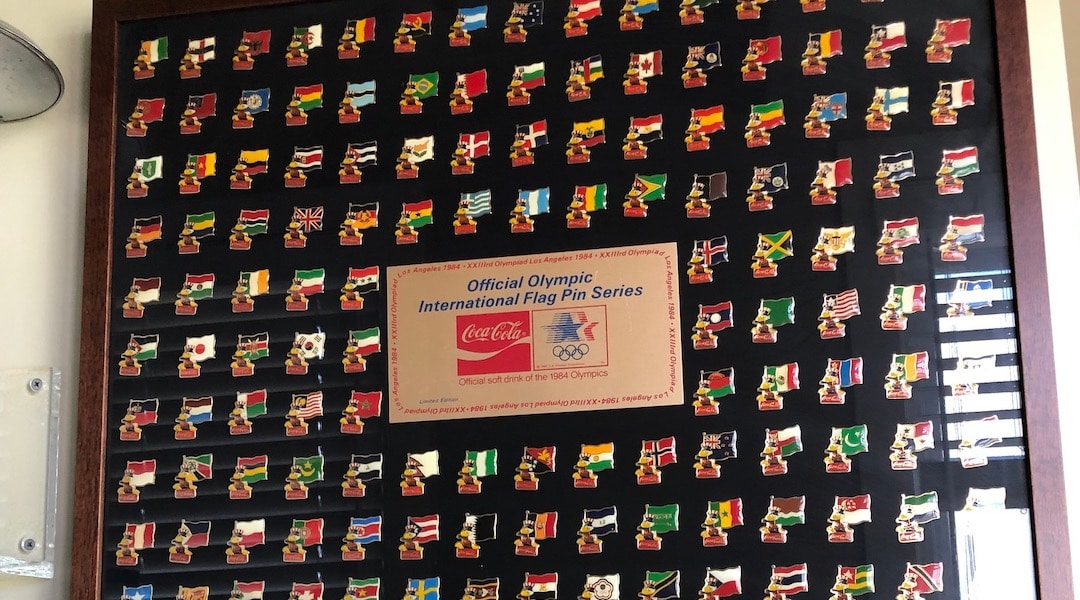
(Courtesy of Sidney Marantz)

Marantz said he’ll be tuning in from home — and looking for ways to collect pins without being on site. Because some of the roughly 200 “hard core of international collectors and traders … who go from Games to Games” work for the Olympics or for individual teams, including as doctors, they’ll be able to purchase pins in person. Marantz expects to be able to trade for them or buy them on eBay.

The next Olympics is the Winter Games in Beijing in early 2022, and Marantz said he’s hoping to go if he’s allowed. (He’s also been to every Winter Games since Nagano in 1998, the last time the Olympics were held in Japan.) But he’s really looking ahead to 2028, when the Games will once again be held in Los Angeles.

“Hopefully I’m alive and well and able to attend that one as well,” he said.

Marantz’s Olympics enthusiasm has not gone unnoticed. When the Olympics were held in Atlanta in 1996, Marantz’s daughter had a job with the Olympic Committee, working on the opening and closing ceremonies. Marantz was tapped to serve, during a dress rehearsal, as a stand-in first for President Bill Clinton, and later for Juan Antonio Samaranch, then the International Olympic Committee head.

But even as his profile in the Olympics community has grown, Marantz said one of his favorite Olympic memories took place back in 1984 in Los Angeles, when he donned the suit of the Games’ mascot, Sam the Olympic Eagle.

“Here’s the thing: I wasn’t blessed with athletic ability,” Marantz said of his time in costume. “Certainly not enough to be an Olympian. So if you’re going to be more than just a spectator, you’ve got to jump in with both feet, doing as much as you can to wring out from your experience as much as you can.”

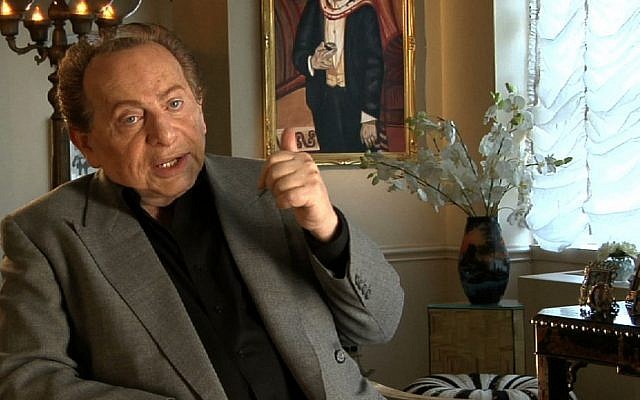
A 76-Year-Old Jewish Philanthropist From Los Angeles Is One of the World’s Most Prolific Olympic Pin Traders Read More »

In Memory of Jackie Mason, Fearless Borscht Belt Comedian

Long before “political correctness” had any meaning, legendary comedian Jackie Mason turned ethnic and racial humor into art—without the culture threatening him with cancellation.

Today, he is dead at 93.

Thank God this former rabbi left the pulpit and took his Yiddish accent, Jewish wit, jabbing finger and graceful stage movements on the road to comedy clubs, TV variety shows, movies and Broadway theaters in a truly mercurial career that lasted for well over half a century.

Unlike the three filmic iterations of “The Jazz Singer,” this clergyman turned entertainer didn’t entirely give up the tools of his rabbinic trade. Mason was a one-man Purim spiel, with sermonizing shtick that was rapturously gut busting. His observational humor had both Talmudic wisdom and a taste of the shtetl. Of course, there were Jewish standup comedians before him, but compared to Jack Benny, George Burns, Milton Berle, Rodney Dangerfield, and Don Rickles, Jackie Mason was absolutely and avowedly, “too Jewish.”

And his mostly mixed audiences absolutely loved him for it. (Mason’s act sold-out London’s West End nightly with a show entitled, “Fearless.”) Mason delivered rimshots as if blowing a shofar. Sometimes he dazzled with a cantorial riff. He was all borscht-belt gone mainstream, a trifle traif comedy act that spared no one and had them all laughing.

It’s difficult to overstate how influential Mason was to American and Jewish culture.

It’s difficult to overstate how influential Mason was to American and Jewish culture. For Middle America watching The Ed Sullivan Show or The Tonight Show in 1964, Jackie Mason was like “Fiddler on the Roof” (which opened on Broadway that year) on steroids. Woody Allen, whose standup career coincided with Mason’s, was all Freud and Marx (Groucho, not Karl), the kind of Jewish-American cultural imprint that depended on anxiety and perversion, which came to define Jewish comedy and even literature (see Philip Roth).

Mason, however, showcased a funnier, ballsier and more topical Sholom Aleichem—an otherworldly tummler who conjured a Chelm wit, with a dash of Delancey Street, dissecting human foibles and contradictions like a Yiddish Mark Twain.

Stout like a boxer, he delivered his punchlines with knockout precision. He impaled Jews (husbands and wives, the big talkers and the self-haters), poked away at Protestants, Blacks, Puerto Ricans, and Indians (not the native kind, but immigrants from India who competed with Jewish doctors), United States Presidents, pretentious aesthetes who ate sushi and drank Perrier. He spared no one: Jewish dining and Gentile drinking habits; Jews who couldn’t program a VCR or fix a car and non-Jews who never saw a line they wouldn’t stand in uncomplainingly for an eternity; and slavishly obedient Jewish husbands and their domineering wives who couldn’t find the kitchen.

He was a terrific mimic of political figures, from the Kennedys to Ronald Reagan, Henry Kissinger and Jesse Jackson.

His impersonation of Ed Sullivan was comedic ballet, and it was laden with meaning. Mason was a Sullivan show mainstay until he wasn’t, having once jabbed his finger in a way that Sullivan interpreted as being flipped. It ruined Mason’s career. Exiled from wholesome commercial TV, he was suddenly unkosher. For nearly two decades he disappeared from American households, consigned to the condominium circuit of Collins Avenue in South Florida.

And then a miracle happened to this former rabbi, a Job out of a job, suddenly materializing Lazarus-like in a one-man Broadway show.

And then a miracle happened to this former rabbi, a Job out of a job, suddenly materializing Lazarus-like in a one-man Broadway show. Mason was given a second chance, and he was too shrewd not make his comeback part of the act—reminding audiences each night of the Sullivan debacle, and thanking them for his resuscitation.

Mason would go on to win both a Tony and Emmy for “The World According to Me.”

The show began with a tryout in Los Angeles in 1986. It became a hot ticket, mostly among star-studded fans rooting for Mason’s revival. (I sat behind Mel Brooks.) Three more Broadway shows would follow.

Mason’s improbable show-biz comeback was itself a feel-good Hollywood movie. (Executives at Warner Brothers, Netflix, and Disney: get ready for incoming pitches this week.)

Ultimately, Mason faced a foreshadowing of the cancellation culture—decades before the humorless and grievance-obsessed of today exerted their social media powers like network censors.

It wasn’t the “N-word” that did Mason in, but the “S-word”: Once for Mayor David Dinkins, and then years later with President Barack Obama. Yes, it’s Yiddish for “black person,” but as Woody Allen once came to his defense: context should matter. Mason was, after all, a Catskills comedian. That word was once the cornerstone of hundreds of jokes—not Klan rallies, but comedic bits. Jews never spoke that word in a hatefully derogatory way. After all, they identified with the cause of civil rights. They were founders of the NAACP and its Legal Defense Fund. A Jewish lawyer, acting pro bono, defended the Scottsboro Boys all the way to the Supreme Court. Jews comprised the single largest white contingent of the Freedom Riders.

Of course, none of those exculpations matter anymore. There are no alibis or acquittals in the cancel culture.

Mason’s career was a case study in the rise and fall of assimilation. His experience was an object lesson in what was to come. It would get even worse, given the many A-list comics who nowadays refuse to play colleges, knowing that any booking is bound to get either cancelled or the entire act shouted down.

Mason lived a long life, but his death, mercifully, came at the right time. The gift of laughter today is a high-risk venture. God didn’t need another rabbi, but during his prime, Mason appeared at the right time and left an enduring legacy.

After rendering a withering satirical takedown of an ethnic group, including his own, he was known to quip: “I shouldn’t have just joked like that. After all, it’s not my nature to insult anyone.”

We know, Jackie.

In Memory of Jackie Mason, Fearless Borscht Belt Comedian Read More »

Comedian Jackie Mason Dies at 93

Legendary comedian Jackie Mason died Saturday evening at Mount Sinai Hospital in Manhattan at the age of 93.
He was born Yaacov Moshe Maza, the son of a rabbi, and he himself and his three brothers all became rabbis.
After serving congregations in Pennsylvania and North Carolina, he decided to switch professions.
As often in his career, Mason gave a brazen and seemingly contradictory reason for switching his career goal.
In 1987, he told the Associated Press “you have to be emotionally barren or empty or frustrated in order to become a comedian. I don’t think someone who feels comfortable or happy is motivated to become a comedian. You’re searching for something and you’re willing to pay a high price to get that attention.”

His close friend and lawyer, Raoul Felder, told the Associated Press that Mason had a Talmudic outlook on life, “that whatever you would say to him he would start an argument with you.”

His close friend and lawyer, Raoul Felder, told the Associated Press that Mason had a Talmudic outlook on life, “that whatever you would say to him he would start an argument with you.”
Like a stereotypical Jew, Mason had his psychological fixations. “I was so self-conscious,” he is quoted as saying, “that every time football players went into a huddle, I thought they were talking about me.”
This reporter saw Mason perform in person only once while covering a testimonial dinner for a Los Angeles community leader.
Mason opened with one of his barbed comparisons between Jews and gentiles.
“The toilet seat was invented by the Italians,” he proclaimed, “but it was the Jews who thought of putting a hole in it.”
Among the thousands of Jewish jokes bounced off me during a long lifetime, this one has always stuck in my mind.
Politically, Mason supported right-wing personalities and causes in both the United States and Israel.
He was one of the few major show biz figures to support Donald Trump’s run for the presidency and he co-founded the organisation “One Jerusalem,” which opposed the Oslo Peace Accord between Israel and its Arab foes.
Mason is survived by his wife, producer Jill Rosenfeld, and a daughter, Sheba.

Comedian Jackie Mason Dies at 93 Read More »