fbpx

July 14, 2021

Three Israelis Arrested in Nigeria While Working on Jewish Documentary

Three Israelis, including prominent activist Rudy Rochman, were arrested in Nigeria on July 9 while working on a documentary about various Jewish communities that aren’t well-known.

The two other filmmakers who were arrested are Andrew (Noam) Leibman and Edouard David Benayim. According to a July 14 statement from their families, the three filmmakers have been working on a documentary series called “We Were Never Lost” for more than a year and plan to interview Jewish communities in China and Afghanistan, among other countries.

“The documentary is not intended to make any political statements about the countries in which the filming will take place, nor does the filmmaking team endorse any political movements,” the statement read. “The team is simply there to observe the communities, learn about their experiences with Judaism, and explain some of the documentary filmmaking process with those in production.” They added that the filmmakers had brought “gifts with cultural symbolism” to these Jewish communities, including a Torah for the Nigerian Jewish community.

“Unfortunately, members of non-state political groups have hijacked for their own purposes images of the filmmakers gifting a Torah to the local community,” the filmmakers’ families said. “These individuals are distorting the intentions of the filmmakers in an effort to manufacture a connection to local political matters when no such connection exists. These politically-motivated actors have taken a simple gesture of kindness and twisted it in an attempt to create an alternate meaning.” The “non-state political groups” appear to be a reference to separatist groups, as an Israeli source told The Jerusalem Post that the filmmakers “were not involved in any separatist activities, but that separatists had posted photos of them making claims that drew the Nigerian authorities’ ire.”

Rochman, Leibman and Benayim are currently being held by Nigeria’s Department of State Services; their families are working the United States, Israeli and French embassies in order to secure their release.

The Times of Israel reported that the filmmakers had been visiting the Igbo community––who views themselves as “one of the lost tribes of Israel”––in Nigeria prior to being arrested. According to the New York Post, “Some of the Igbo people have been in conflict with the Nigerian government since 1967, when they declared independence from the nation, sparking a 30-month civil war that left over a million dead. The conflict never completely ended and last November, six Igbo synagogues were demolished by Nigerian soldiers.”

On July 8, the following statement was posted on the documentary series’ Facebook page: “We do not take any position on political movements as we are not here as politicians nor as a part of any governmental delegations.”

Various Jewish and pro-Israel Twitter users issued tweets praying for the filmmakers to be released as soon as possible.

“Rudy Rochman is a friend, colleague and a devoted leader of the Jewish people,” activist Hen Mazzig tweeted. “He went to Nigeria and delivered a Torah – an apolitical act. Please pray with me that he and his friends will be freed.”

StandWithUs Israel Executive Director Michael Dickson also tweeted that Rochman is “a fearless Jew who works to bring Arabs and Jews together and to bring light to issues surrounding Israel” and that he is “praying for their quick return.”

https://twitter.com/michaeldickson/status/1415291560783192064?s=20


Three Israelis Arrested in Nigeria While Working on Jewish Documentary Read More »

LAUSD School Board Unanimously Passes Resolution Condemning Antisemitism

The Los Angeles Unified School District (LAUSD) school board unanimously passed a resolution on July 13 condemning antisemitism, the Los Angeles Daily News reported.

The resolution, which was introduced by School Board Member Scott Mark Schmerelson, stated that “there has been a significant rise in hate crimes here in Los Angeles and across the country over the last four years against many racial, ethnic, religious, and other minority groups” and acknowledged that “reports of white supremacist, anti-Semitic, anti-Jewish, and anti-Israeli graffiti, bullying, harassment, and violence on LAUSD campuses has been on the rise for the past four years, and administrators, teachers, and student leaders need updated and readily available training and resources to prevent and address anti-Semitism in all its forms.” The resolution also noted that there has been a recent spike in antisemitic attacks and vandalism following the recent escalation between Israel and Hamas.

“The Board of Education denounces the rise in anti-Semitic, anti-Jewish, and anti-Israeli rhetoric and hate-motivated crimes and incidents that denigrate Jewish students and staff LAUSD schools and in the communities served by LAUSD in order for every LAUSD campus and office to be a safe and welcoming environment for all students, staff, and families,” the resolution stated, adding that there need to be “updated bulletins, curricular and instructional resources, and training for teachers, staff, administrators, students, and parents to address and prevent anti-Semitism and respond when anti-Semitic vandalism, bullying, harassment, or violence occurs either on campus or in the community, including specific reference to anti-Semitism in the mandated bulletins training at the start of each school year.”

The resolution concluded with a directive for the LAUSD superintendent to “direct all schools and offices to affirm the rights of Jewish students, staff, and families and to report acts of anti-Semitism in schools and the workplace” and to have their curriculum updated “in the areas of Jewish history and culture and the Holocaust” with input from the Anti-Defamation League (ADL), Simon Wiesenthal Center, and other organizations and experts.

Jewish groups praised the LAUSD school board for the resolution.

“We commend the LAUSD Board of Education for denouncing antisemitism and anti-Israel rhetoric and calling for updates to its curriculum and resources to help create a productive and safe environment for Jewish students and all students and families,” ADL Los Angeles Regional Director Jeffrey Abrams said in a statement to the Journal. “At ADL we have tracked a significant increase in antisemitic incidents in Los Angeles and across the country during the recent conflict between Israel and the terrorist group Hamas. In this context, it is important to note that rhetoric that demonizes Israel, holds it to a double standard, or rejects its right to exist as a Jewish and democratic state crosses the line into antisemitism and should be firmly condemned by our communities and leaders.”

American Jewish Committee Los Angeles Regional Director Richard S. Hirschhaut similarly said in a statement to the Journal, “We welcome LAUSD’s adoption of this resolution and applaud School Board Member Schmerelson’s leadership in spearheading this initiative. It could not come at a better time. Amid an alarming spike in acts of antisemitic violence and anti-Jewish animus in the public square, including anti-Israel vitriol, this reassures Jewish students, staff, and families that antisemitism will not be ignored or excused in the classroom. And that appropriate training and reporting will give this measure teeth. It is also a clear and preemptive ‘shot across the bow’ ahead of the UTLA [United Teachers Los Angeles] vote in September.”  Hirschhaut was referencing the UTLA’s scheduled vote on a motion supporting the Boycott, Divestment and Sanctions movement.

StandWithUs CEO and Co-Founder Roz Rothstein also said in a statement to the Journal, “StandWithUs applauds the LAUSD Board of Education for unanimously passing this resolution of solidarity with the Jewish community and for firmly standing against antisemitism and anti-Israel rhetoric in our schools. As an organization that works directly with high school students, parents, teachers and community members across the district, we hear the growing concerns of antisemitism in our city and we echo the call for updated educational resources that represent the Jewish community’s history and experiences. Including education about the diverse Jewish community in our classrooms, is a crucial step in combating antisemitism.”

Associate Dean and Director of Global Social Action Agenda at the Simon Wiesenthal Center Rabbi Abraham Cooper said in a statement to the Journal that the passage of the resolution is “a resounding vote with profound implications for our city, state, and nation. Americans and their children, including Jews, deserve a counsel culture not cancel culture.”

In a Facebook post, the Progressive Zionists of California hailed the resolution as “an achievement in standing against bigotry and hatred of Jews.” “The district has one of the largest populations of Jewish students in the country, and these young folks deserve to feel safe and supported in their places of learning. Mazel tov to everyone who got this resolution passed!”

LAUSD School Board Unanimously Passes Resolution Condemning Antisemitism Read More »

LAUSD Does Not Go Far Enough in Calling Out Antisemitism

The past year and a half have unearthed some unfortunate truths in America. In addition to the catastrophic pandemic, we have seen a rise of hate speech and crimes against many communities, including African Americans, Asian Americans, transgender individuals, immigrants—and the Jewish community. According to the Los Angeles Police Department, antisemitic attacks in L.A. are up by more than 60 percent so far in 2021.

There’s a special role that educators can play in teaching young people to reject xenophobia and racism. The L.A. Unified School District (LAUSD) and the teachers’ union, United Teachers of Los Angeles (UTLA), have historically been at the forefront in doing just that. However, recently activists within the union expressed support for a resolution backing the boycott, divestment and sanctions movement against the State of Israel, calling on an end to all U.S. aid to Israel, and urging the organization to endorse a cultural, economic and academic embargo of the country.

This week, the LAUSD School Board recognized this problem and unanimously passed a resolution affirming the value of Jewish students, staff and families—a welcome measure, but one that does not go far enough in calling out antisemitism. Instead, the UTLA resolution must be withdrawn.

I don’t believe that criticism of Israel or its policies is necessarily a manifestation of antisemitism. Nor do I always agree with every policy of the Israeli government. But for an organization that represents the very people tasked with educating our region’s youth to single out only one country and people in the world for condemnation smacks of antisemitism and is a danger to the safety of Jewish teachers and children within LAUSD and beyond.

During the latest conflict between Israel and Gaza, individuals drove up and down the streets of Los Angeles, yelling anti-Jewish slogans and assaulting groups of people who are Jewish or who they perceived to be Jewish. These attacks were mirrored in cities across the country and the world. We can’t allow our schools to be manipulated by those who would use events taking place in and around Israel as an excuse to target Jewish Americans here in our city.

Instead of seeking to divide students and their parents across the southland, our schools and teachers should help people find common ground. After all, we can both support Israel’s right to exist as a nation and advocate for a region in which all peoples can live in dignity with peace and self-determination. We must try to live up to these ideals—which are American ideals—in our institutions here, including our schools.

Instead of seeking to divide students and their parents across the southland, our schools and teachers should help people find common ground.

I recognize the pain of the Palestinians and empathize with their desire for a truly independent state. And I understand on a personal level the critical importance of Israel to all Jews. I would not be here today as an elected leader if not for the state of Israel. My mother was born in Haifa to parents who escaped the pogroms in Russia. My father lived to start a family because he escaped Romania to find refuge in what became Israel. I would not be alive today if not for the welcoming home they found in Israel. My children would not be alive if not for Israel.

No matter what is happening in the Middle East, we cannot be silent when bigotry rears its ugly head. In a democracy, people are free to disagree, but our most sacred institutions should not join a call for the end of a nation or people. That is what is at stake with the UTLA resolution. It is an issue that transcends politics as it calls into question the safety and security of our children.

I believe this is a teachable moment. UTLA is not the enemy here—the teachers they represent are heroic, selfless and integral to the fabric of local communities. My hope is that their leadership and membership meet the challenge at hand effectively and intelligently by rescinding this resolution immediately. Taking swift action on this misguided resolution will send a message to all students and parents that building a more just and tolerant world starts right here in our schools.


Ron Galperin is the son and grandson of Holocaust survivors and currently serves as the elected Controller of the City of Los Angeles. 

LAUSD Does Not Go Far Enough in Calling Out Antisemitism Read More »

Yes, Anti-Zionism is Antisemitism

During the 11-day barrage of rocket attacks by Hamas on Israel in May 2021, there were dozens of orchestrated attacks against Jews in the United States and around the world by supporters of the Palestinian cause. These attacks included college students in Naperville, Illinois, Iranian American Jews and their Christian friends in Los Angeles, Orthodox Jews in New York City, and a rabbi in Boston among others. In response, on July 11 three thousand American Jews and their allies attended the “No Fear” Rally, intended to build solidarity between Jews around the principle that antisemitism in the United States is a growing concern that must be forcefully rejected. But the rally’s significance is as complicated as the politics of polarization surrounding Israel and Zionism.

The rally was initially conceived of by educator and activist Dr. Melissa Landa, Executive Director of Alliance for Israel. She had spearheaded an earlier rally in front of the Israeli embassy in Washington, D.C. At that first rally, Landa realized that many attendees needed and wanted American Jews and their allies to resist the atmosphere of fear created by anti-Zionists and antisemites. That realization was reinforced when members of the Alliance for Israel contacted her from across the country and asked her to take action.

To promote solidarity among Jewish groups and to urge Jews to stand up and be vocal against antisemitism, Landa decided another, larger rally must be held, and a grassroots movement was created. Landa was eventually contacted by Elisha Wiesel, a philanthropist and son of the beloved Holocaust survivor Elie Wiesel. Together they expanded the number of Jewish groups that sponsored the rally to more than one hundred. Some of these included the American Jewish Committee—Washington, the Anti-Defamation League—Washington, the Louis D. Brandeis Center for Human Rights Under Law, Combat Antisemitism, End Jew Hatred, B’nai Brith International, Zioness, the member organizations of the Reform and Conservative movements, the Jewish Democratic Council of America and the National Council of Jewish Women, the Jewish Council for Public Affairs, Jewish Community Relations Councils of Greater Washington, Jewish Federations of North America, StandWithUs, Jewish National Fund, American Zionist Movement, The Jewish Agency for Israel, Alums for Campus Fairness, Birthright Israel, and the Israel Forever Foundation.

One of the criteria both Landa and Wiesel agreed upon for co-sponsorship of the rally was that groups signing on could not hold a position that denied Israel the right to exist as a Jewish state. In other words, anti-Zionists could not co-sponsor the rally. In their view, much of the antisemitism that has recently emerged is directly related to Israel, and the “No Fear” concept includes the right of Jews to demonstrate their love and support for Israel without condemnation or fear. As such, the message during the rally included addressing anti-Zionism, or the denial of collective self-determination for the Jewish people, as a new form of antisemitism.

Groups such as Americans for Peace Now and J Street objected vehemently to the rally and denounced it publicly. Hadar Susskind, President of Americans for Peace Now, stated, “This rally looks like it will conflate criticism of the occupation and criticism of Israeli actions with anti-Zionism, and will say anti-Zionism is antisemitic, and we want no part of that.”

The rally was conceived to impart the message that anti-Zionism—not criticism of Israeli policies—is in fact antisemitism. As actor and writer Noa Tishby stated at the rally, “Today’s Jew haters simply attribute all the evil tropes, lies and libels used for centuries to justify the worse horrors against the Jewish people, to the Jewish state.” No longer will the denial of the collective rights of Jews to exist in their ancestral homeland be acceptable. No longer will supporters of Israel (or, Zionists) be demonized by academics, congresspersons or people on the streets. No longer will it be acceptable to hold Israel to a standard to which no other country in the world is ever held.

The rally was conceived to impart the message that anti-Zionism—not criticism of Israeli policies—is in fact antisemitism.

Daniel Raab, a university student from Naperville Illinois, stated that he and his sister received dozens of death threats and were ultimately attacked in a pro-Israel rally they had organized in their hometown. Their flags were burned and their cars were damaged as their assailants shouted, “Kill the Jews!” Raab stated, “Our persecutors wish to pry us from supporting our homeland, and fear is their weapon of choice, but now is the time for courage.” Dr. Andrew Pessin mentioned the hundreds of academics—the ones who are educating our children—who signed vehemently ant-Zionist petitions. Meghan McCain, daughter of the late Sen. John McCain remarked, “Anyone who’s trying to pollute and distort Zionism as some kind of dirty word, is antisemitic.” Arizona State Representative Alma Hernandez (D) said, “I am damn proud to be a Zionist. I am a Democrat, and I will not allow anyone to ever make me choose one of my identities!” Ron Halber, Executive Director of the Jewish Community Relations Council of Greater Washington, an organization with over 300,000 members, stated, “It doesn’t matter whether you cloak your hatred against Jews in white supremacy or in double standards against Israel … we will unapologetically support the state of Israel.”

There was no clearer example of the relationship between anti-Zionism and antisemitism, however, than that of first-generation Iranian American Jew Matthew Haverim, the victim of the antisemitic attack in Los Angeles, California on May 18, 2021. That evening, his assailants were marching with keffiyah masks and Palestinian flags to show support for Palestine as the conflict between Hamas and Israel raged. They were angered when their demands to cheer for Palestine were ignored by Haverim and his friends. They then asked, “Are you Jewish?”—to which Haverim immediately said, “Yes, we are.” One of their assailants then taunted, “You should be ashamed of yourself,” and then beat the men to the point that they required urgent medical care. Haverim closed his speech with a poignant statement about his parents fleeing Iran in 1979 to escape the Ayatollah Khomeini’s anti-Zionist antisemitism: “Within a generation, the shameful poison of antisemitism that corrupted the soil they left has now crept up on our doorposts here in the United States.” Haverim reminded listeners that the antisemitism his parents experienced came in the form of anti-Zionism.

Another recurrent theme was the insistence that antisemitism in the U.S. comes from both sides of the political spectrum, a fact finally realized by the many centrists cosponsoring the rally. In Congress, members on both sides of the aisle have made antisemitic remarks. To their credit, both Democrat and Republican Jewish organizations attended the rally to drive home this point.

Many references were made about public servants on both sides of the aisle who have trafficked in antisemitism. Landa opened the rally with an exhortation to the crowd that the antisemitic statements of politicians such as Ilhan Omar, Rashida Tlaib and Marjorie Taylor Green desecrate their oaths of office and erode public trust. McCain stated, “It’s important to call out white supremacists on the far right as it is people on the far left … people like Ilhan Omar who think they are the only voices in this space are damn sure wrong.” McCain urged members of Congress to call out antisemitism in their own parties. Rep. Hernandez (D-Az) stated, “We need to call out hate and bigotry regardless of what side of the aisle it is on … it happens on both.” JCRCGW’s Halber said, “We will hold both of our political parties and their elected officials responsible and accountable.”

Finally, Haverim ended his speech with a statement about politicians in both parties: “We are gathered here because we now face persecution from our fellow Americans on our streets, on our campuses, on social media, and from some right here in D.C. If our leaders can’t call out antisemitism in Congress, how can we expect them to keep us safe on the street?”


Jessica Emami, PhD, is an Iranian American sociologist and Middle East expert living in Washington, D.C.


Yes, Anti-Zionism is Antisemitism Read More »

Abraham Accords Fulfilled as UAE Opens Embassy in Tel Aviv

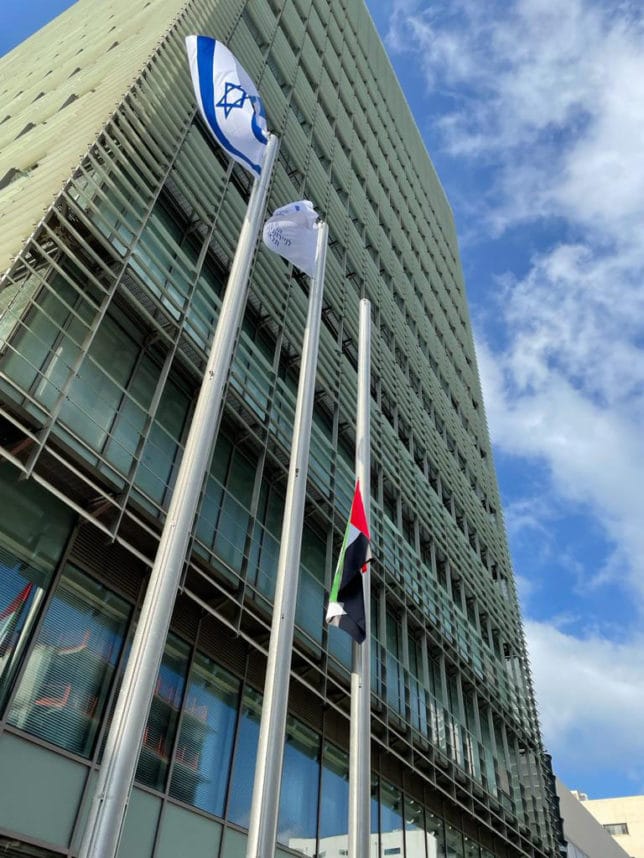
(The Media Line) The United Arab Emirates formally dedicated its embassy in Tel Aviv.

“This embassy will serve not just as a home for diplomats but a base for our task to continue to build on our new partnership, to seek dialogue, not dispute, to build a new paradigm of peace, and to provide a model for a new collaborative approach to conflict resolution in the Middle East,” UAE Ambassador Mohamed Al Khaja said on Wednesday morning in front of the new embassy, located in the Tel Aviv Stock Exchange building.

“Since the normalization of ties between Israel and the UAE, we have seen – for the first time – discussions on trade and investment opportunities, collaboration between hospitals, universities and research centers, cultural and people-to-people exchanges, cooperation in combating COVID-19, countering cyberthreats, and protecting our environment. We signed major agreements across various fields, including economy, air travel, technology and culture,” Khaja said.

“And this is just the beginning. In our post-COVID world, those who innovate will lead,” he also said, adding: “The UAE and Israel are both innovative nations.”

“The people in this region are eager for a stable, functioning, and prosperous Middle East. It is time for new approaches and thinking to set a new and better path for the future of the region,” Khaja said.

Khaja opened the day’s trading on the TASE at the end of the ceremony.

The flag of the UAE is raised for the first time in front of its embassy in Tel Aviv. (The Media Line)

Israel’s President Isaac Herzog, who joined Khaja in cutting a ribbon to open the embassy, said that: “While seeing the Emirati flag flying proudly in Tel Aviv might have seemed like a far-fetched dream just about a year ago, in many ways, nothing could be more natural and normal. So many Israelis and Emiratis have discovered our countries and people share a great deal.”

“We are both nations that cherish our history and traditions while pushing the very boundaries of innovation and science. We are deeply rooted in our land while having our eyes on the stars, while we both build our modern states out of the desert sands. We made the impossible possible. And we have both created vibrant, multicultural societies through an unwavering commitment to religious freedom and human dignity,” he said.

The peace agreement between Israel and the UAE, Herzog said, “will save lives, will help humanity, will help the region, will develop food, water and medicine for the benefit of humankind, all through people-to-people dialogue. Both of our cultures will be enriched.”

Herzog praised the leadership of the Emirates for the “courageous decision to open the door to a warm friendship between our peoples. It is not only an important step for Israel and the United Arab Emirates, but for the entire Middle East. The Abraham Accords will promote stability, security throughout our region, and will demonstrate to all the tremendous promise and potential of peace.”

He called for the extension of the agreement to other countries and nations. “We are a nation of peace and those who are interested in peace with us will be welcomed with open arms,” he said.

Last month, Israeli Foreign Minister Yair Lapid, who missed Wednesday’s ceremony after being required to quarantine due to an aide testing positive for the coronavirus, opened the Israeli Embassy in Abu Dhabi and a consulate in Dubai.

Also on Wednesday, UAE Minister for Food and Water Security Mariam Al-Muhairi met with representatives of Hebrew University of Jerusalem to promote a research and innovation partnership based on FoodTech and Agtech. The meeting is the first official visit of a senior UAE government official to an Israeli academic institution since the two countries agreed to normalize relations.

Professor Benny Chefetz, dean of The Robert H. Smith Faculty of Agriculture, Food and Environment, called the minister’s visit “prescient and historic,” adding: “We look forward to sharing our know-how with our neighbors in the Middle East so that we may meet the challenges of climate change together and better prepared.”

Israel and the UAE agreed to the peace deal in August 2020, and signed the Abraham Accords normalizing relations between the two countries in a ceremony in Washington on Sept. 15, 2020. Israel also signed a normalization agreement with Bahrain the same day.

(Marcy Oster contributed to this report)


Abraham Accords Fulfilled as UAE Opens Embassy in Tel Aviv Read More »

Table for Five: Tisha b’Av Special Edition

One verse, five voices. Edited by Salvador Litvak, the Accidental Talmudist

O how has the city that was once so populous remained lonely! She has become like a widow! She that was great among the nations, a princess among the provinces, has become tributary.

-Lamentations 1:1


David Sacks
Torah Podcaster LivingwithGod.org

The Kotzker Rebbe says, if a person can’t cry over the destruction of the Holy Temple… they should cry over the fact… that they can’t cry.

If I’m going to be honest, I’m not even sure what the Holy Temple is, other than a building from a long time ago. And if I’m going to cry over any Jewish event, it should be the Holocaust. Why don’t we fast over that?

The answer is, Tisha B’Av is the fast day for the Holocaust and every tragedy we experience. Not because we lump all the sad times together and check them off on Tisha B’Av. Rather because all sadness is rooted in the destruction of the Holy Temple.

That’s because the Holy Temple wasn’t just a beautiful building… It’s the connection between heaven and earth. Without it, brokenness fills the world. With it, we can fly to the highest heights.

The Holy Temple is a vessel created to hold the highest light from heaven. But the vessel isn’t the building itself. The vessel is the love Jewish people have for each other. When that love went away, because we were hating each other for no reason, the Holy Temple went away with it.

How do we get it back? By rebuilding the love in our hearts. That will create the vessel that will hold the highest light once again. And we can begin right now, with our very next encounter.


Rabbanit Alissa Thomas-Newborn
BCC – B’nai David-Judea Congregation

When our streets were empty and we were on lockdown, we saw a city dwelling alone and lonely. Loneliness has proven to be a psychological and spiritual threat that we continue to process. And yet that same loneliness is a thread that connects us all.

The world, once populous and vibrant, stood still– our streets yearning in the absence, like a widow. Rashi famously teaches on our verse that God does not leave us truly as a widow. Rather, the city is like a person whose spouse has gone away with the intention to return.

Few generations know what it is to viscerally move from isolation to reunion in the way we do. The result is that our prayers for return– to each other and to God– have a messianic poignancy, rawness, and potency to them. Tisha B’Av is a day when we sit in the ashes and encounter the sorrow, pain, illness, and loneliness that still exist. And it’s a day when we are honest about our sins and responsibility along the way.

This Tisha B’Av, let’s remind ourselves and God that our Beloved left only momentarily, with the intention to return. Realizing that promise requires that we respond to the loneliness in each other, such that our cities, hearts, and minds begin to feel whole and held. This moment has the power to be redemptive because we understand the pain of our verse more than ever before. May we merit to step up to the task.


Rabbi David Stein
Director of Judaic Studies, Shalhevet High School

I often hear from people who tell me that they have trouble connecting with Tish’a B’av. “How can I mourn for an event that happened so long ago?,” they ask. “Why should I be sad for Jerusalem – I’ve visited, and it’s a thriving, bustling city!” They report that the heroism of Chanukah, the freedom of Passover, and even the introspection of Yom Kippur each carry much more meaning than the difficult and depressing rituals of Tish’a B’av.

To be honest, I understand the challenge. What are we even commemorating on this day – other than an ancient tragedy that feels far less immediate than the Holocaust and increasingly anachronistic to those who recognize the miraculous triumphs of the State of Israel? In a word, though, I would argue that on this day – more than any other – we connect to Jewish peoplehood.

On Tish’a B’av, I’m often drawn to what Rabbi Joseph B. Soloveitchik once wrote about being part of the Jewish people: “A Jew who believes in the Jewish people is the Jew who lives as part of it…feels its pain, rejoices in its triumphs, fights its battles, mourns its defeats, and celebrates its victories.” In other words, connecting with Jewish peoplehood requires feeling the ups and downs of our shared history – the “princely” highs and the lonely and “widowed” lows alluded to in our verse. Ultimately, then, Tish’a B’av demands that we translate our past into a commitment to face the challenges and partake in the triumphs of our present.


Tova Leibovic-Douglas
rabbitova.com, @rabbi_tova

I remember the first time I experienced Tisha B’Av. I was nine years old and attending Camp Ramah when our counselor told us to wear black and bring a flashlight. I sat on the grass next to my confused bunkmates and listened to the most gorgeous and tragic trope for Eicha (Lamentations). At that point in my life, Judaism was the opposite of this experience; it was beautiful, hopeful, and joyful. That night, there was a solitude present, an undercurrent of loss that left me in tears.

This year seems to be calling us to honor Tisha B’av in a way that we may not have in prior years. It is the day to mourn what once was and what will never be again; a day to understand our loneliness and pain, to hold our grief and our tears. This year, we need to hear the chant of Eicha and channel the sadness of our ancestors, as we too exist in our personal trauma.

We mourn the loss of our Temple, both the one that was destroyed and our metaphorical Temple: our sense of self, body, and spirit. In this year of tremendous loss, as we re-enter a world that is the same and different, the wisdom of our Hebrew calendar invites us to ritualize and embody our feelings. We begin with O, and we let out our sighs and wails as our ancestors did and we are part of the rhythm of our heart and soul, perhaps ready to heal.


Ilana Wilner
Judaic Studies Teacher & Director of Student Activities

There’s nothing that makes me feel more present and connected to Tisha b’Av than hearing the haunting first verse sung in the sad yet stunning tune.

אֵיכָ֣ה  יָשְׁבָ֣ה בָדָ֗ד

How could a city once booming with life and happiness now be in mourning and alone? The Rabbis in Eicha Rabbah note that the opening word of Eicha, “how could it be” comes up three times in the Bible. The rabbis suggest that in order to understand the experience of Tisha b’Av you need to understand the eicha that precedes the Eicha of our megillah.

The word first appears in Exodus when Moshe uses the word eicha to ask how he can carry the people by himself. The second is when Isaiah foresees the sins of the Jewish people leading to the destruction of the Holy Temple. The last, from Lamentations describing the despair over the destruction. Each of these represents a phase in the process of destruction. From peace and unity to Isaiah seeing the seeds of the Jewish people starting to fall to the final lamentation.

To fully understand this we must also ask what precedes this process. This word from Genesis, ayeka, where are you? gives us some insight. After Adam and Eve sinned with the Tree of Knowledge God asked, “ayeka?, where are you?” God asking Adam this question shows a strain in the relationship. This word is spelled with the exact same letters as our word eicha and reminds us that our destruction and sins stemmed from the foundational question of ayeka? Where are you? Why aren’t you here? When we hear Eicha and think of the mourning of the destruction of the temple, we should also be thinking about the destruction of Ayeka, the destruction of the relationship with God.

Table for Five: Tisha b’Av Special Edition Read More »

Producers Receive Film Rights to Make a Film About Hannah Senesh

The Legacy of Hannah Senesh. 

We are looking for supporters, donors, investors and film studios to make an extraordinary film about this true Jewish hero!

Hannah Senesh sacrificed herself for not only the Jewish people but for mankind as well. She was and is a true hero; a true Jewish hero.

We are Maurice and Attila who, after 3.5 years of not giving up, were able to obtain the film rights to make a film about Hannah Senesh. Attila, representing both of us, actually traveled to Israel to try the impossible. There, he met one of the nephews of Hannah. 

Earlier this year, we secured the film rights with three phases with an additonal option to extend.  

The screenplay has been written and is solely based on Hannah’s diaries, letters and witness’ testimonies. But what more intriguing is that one of the nephews of Hannah assured us that he would share some additional details with us whatever he finds appropriate. The other great news is that he wishes to be fully involved in the project. We think that it is absolutely amazing!

Some say Hannah was a British parachuter, others say she was a radio officer.  First, she was not British; she was Hungarian. Her first name in Hungarian is Aniko. She was born on July 17, 1921, in Budapest, Hungary. And she had a brother, George. 

After we read her entire diaries, letters and poems, we quickly found out that she was an extrordinary person with extraordinary qualities. One of them was that she always finished her classes as a top student, and she did everything with perfection. 

Hannah at The Nahalal Agricultural school.

In 1939, after graduating from highschool in Budapest, she was accepted at the Nahalal Agricultural School in Palestine. Her life goal at that time was to continue to build a Land for future generations. So, she was among the first ones who put down the fundamentals of a country we know today as Israel.

She graduated from that school, but the horrors of the WWII made her realize that her life had an ultimate mission.  And that mission was completely different from why she went to study in Palestine.

During those times, her brother, George (Gyuri) was studying in France, and her mother, Katalin remained in Budapest.  Seeing the Nazi regim overthrowing the Hungarian government and having the Hungarian Jews being rounded up, she decided to make every effort in the world to do something about it.

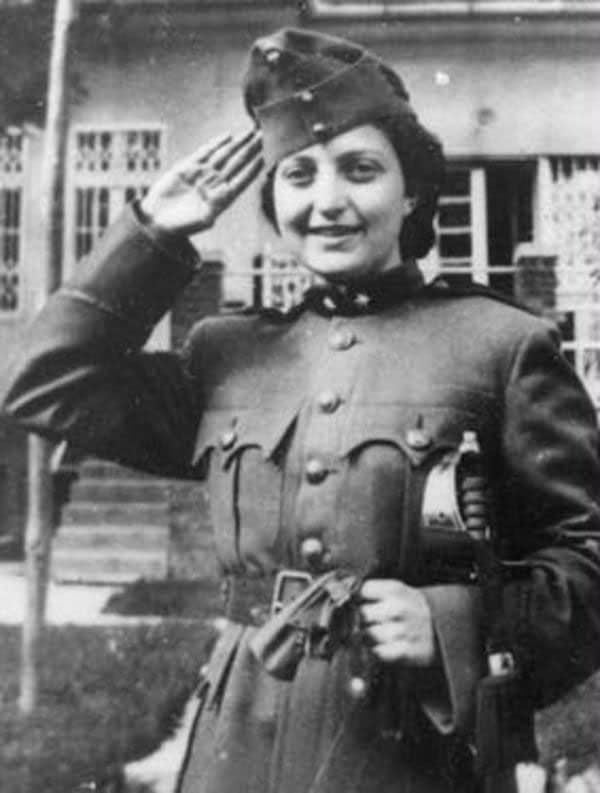
It wasn’t easy for her first to get accepted into the Palmach, but she pulled it off.  From there, she was able to get signed by the British Army to act as a spy to gather information on the British captives in Hungary.  When the crossing from Yugoslavia to Hungary was postponed, she decided to take on her own mission. (Later her friend, Yoel Palgi crossed over to Hungary, too).

Hannah in the British Army.

It was then when she handed a piece of paper to her commander, the Yugoslavian Rueven Daphne who almost threw that paper away. When he opened it, he saw a writing.  That was Hannah’s most famous poem: Blessed is the Match (and she wrote it in Hebrew).

Hannah’s way of viewing life was that if one can give one’s life to save thousands, it’s worth the sacrifice.  She tried and went for it because she wanted to save the last Jewish people of Europe.

But before she left Palestine, she arranged everything for her brother’s arrival.  Just one day before leaving for training in Cairo, Yoel helped Hannah to meet her brother in Haifa who arrived from France.  Hannah and her brother George were able to see each other only for a brief time… 

After she was captured, she was imprisoned, and the Nazis beat her up to give up her radio code; but they didn’t succeed.  Later, her interrogater, the Gestapo leader Seifert  completely gave up on getting the radio code.

In the prison, where her mother was placed, too, she was making paper dolls for all the matrons.

Then there was a trial.  She had a lawyer who was thrown out of the court room, so temporarily she faced the panel of judges alone.  Her defense turned into a heated debate.

The court could not come to a resolution, so her case was postponed – with the Soviets coming closer to Budapest, it was the most logical thing to do.  All the prisons were evacuated with only very limited staff remaining.  But in the panel of judges was a judge advocate who also happened to be the commander of the prison Hannah was transfered to.  His name was captain Simon… 

In the meantime, Hannah’s mother tried to find out in which prison Hannah was when she finally found Captain Simon.  Captain Simon told her nothing but lies.  Finally, Katalin found some of Hannah’s clothing.  From one of the pockets, she pulled out her daughter’s last letter addressed to her… 

After the war, captain Simon was brought to justice and was convicted of judicial murder.

On November 7, 1944, Hannah was only 23.

In 1951, her body was transfered from Budapest to Haifa where she was reburied with full military honor, and where she rests today…

We truly hope that Hannah’s story is not going to be overlooked as she was and remains one of the greatest heroes of all time, and the hero of Israel and all the Jewish people around the world.  She did something remarkable not many of us would be brave enough to even just think about. 

Let’s pay her a tribute with this film for her life, for her cause, for her sacrifice, for what she did for the Jewish people and for mankind.  And it wouldn’t be a better time than the 80th anniversary of the moment she left the world: on November 7, 2024.

Please help us make a remarkable film about this remarkable person.  But we should say instead: let’s make this film together!

We are trying to shoot this film in Israel and Hungary with an American A listed director and cinematographer. 

If you would like to get more information, or if you wish to get involved, please contact Maurice 310-880-4610 or Attila at 323-534-9749, or at film4hannah@gmail.com.

We thank you very much for spending time and reading!  We thank you for your generous support!

Producers Receive Film Rights to Make a Film About Hannah Senesh Read More »