fbpx

July 4, 2021

I’ve Waited 15 Years for This Wedding

In 2006, a 19-year-old IDF soldier named Gilad Shalit was abducted by Hamas in southern Israel and held in captivity in Gaza for five long years. In that time, he became “Israel’s son”; not a day went by that the Israeli public didn’t remind its leaders to bring Shalit home safely. In 2011, his family members even chained themselves in protest outside the Jerusalem residence of then-Prime Minister Bibi Netanyahu, and thousands of Jews around the world rallied for his release. As for me, I did what I always do when a life is in peril: I prayed.

My prayers on Shalit’s behalf were both short and long term: I entreated God to release him back into the arms of his mother, Aviva, and his father, Noam, as soon as possible. And, for some reason, I asked that he be able to live to see his wedding day. Perhaps I figured that his wedding day, which would undoubtedly be the happiest day of his life, offered the starkest contrast between the suffering he was enduring in the clutches of Hamas.

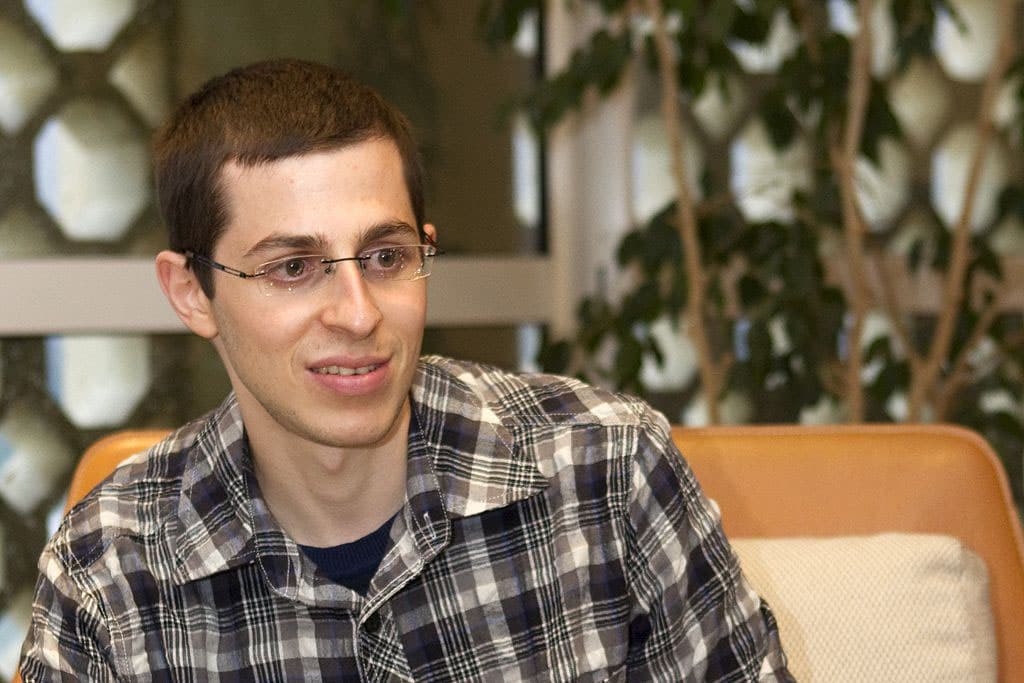
Two weeks ago, on June 23, Shalit married his fiancé, Nitzan Shabbat, in a small ceremony in central Israel. As I watched a short video of a beaming Shalit standing beneath the chuppah, I couldn’t help but think about the unforgettable image of a frail, pale, and seemingly broken young man on the day he returned home ten years ago on October 18, 2021. Humble and humbled, appearing ever so small, he saluted Netanyahu in a way that left no doubt that he had served his country.

Two weeks ago, on June 23, Shalit married his fiancé, Nitzan Shabbat, in a small ceremony in central Israel.

To the naked eye, Shalit looked like any happy groom on his wedding day, but if you look closely at the pictures, you’ll see that his doe-like, gentle eyes betray a secret: his family, close friends, and his bride might be privy to his pain, but only he knows how much he suffered during those five years in Gaza.

And if you survived five years in Hamas captivity, your wedding doesn’t merely celebrate love; it builds an altar to life, survival and, ultimately, continuity.

But not all abducted IDF soldiers receive a second chance. Ehud “Udi” Goldwasser, z’l, was never able to return home to his wife of just ten months, Karnit, after he was captured by Hezbollah in July 2006. His family endured the torment of the unknown for what seemed like an eternity, until finally, two years after he was abducted, they learned he had been killed.

His family endured the torment of the unknown for what seemed like an eternity, until finally, two years after he was abducted, they learned he had been killed.

Eldad Regev, z’l, never even had a chance to stand beneath the chuppah. He was captured along with Goldwasser, sparking the Second Lebanon War between Israel and Hezbollah. Both their bodies were returned to Israel during a prisoner exchange with Hezbollah in 2008.

As for Shalit, his freedom came at an enormous cost: Israel released 1,027 Palestinian prisoners, many of them serving life sentences (Hamas leader Ahmed Jabari told the Saudi Arabian newspaper Al-Hayat that the prisoners collectively killed 569 Israelis). Shalit became the first IDF soldier to return home alive in 26 years. It was the highest price the Jewish state had ever paid for one soldier.

A few days after Shalit’s release, Daniel Bar Tal, a political psychology professor at Tel Aviv University, told The Jerusalem Post:

“Here we see the basic dilemmas between the individual and the collective, and we see victim pitted against victim. Gilad Shalit is a victim who was violently kidnapped, in a way that Israelis do not consider to be a normative means of struggle. Therefore, one side says, he should be returned at any price. But the families of those killed in terrorist attacks and the people who were wounded in those attacks are victims, too, and they say that no price should be paid to the murderers. And it is truly a dilemma, because no side is right, and no side is wrong.”

In the coming years, there will hopefully be other happy stories about Gilad Shalit: news of Gilad and Nitzan’s first child (and subsequent children); the release of his book (if he ever writes one); and, one day, perhaps in about 19 or 20 years, news that his first born, whether male or female, has reported for duty to the IDF.

Judaism teaches that the moments during which a bride and groom stand beneath a chuppah constitute a particularly auspicious time for prayer, and that on their wedding day, a couple possesses the power to offer brachot, or blessings, to others.

There are many in Israel whose loved ones were savagely murdered by those now-released prisoners. Perhaps they were understandably not celebrating as enthusiastically as other Israelis the day Shalit was released ten years ago. I’ll never know what was going through Shalit’s mind as he stood under the chuppah, but I can only hope that he whispered a prayer of healing and protection for all Israelis, whether those whose hearts are full … or still broken.


Tabby Refael is a Los Angeles-based writer, speaker and civic action activist. Follow her on Twitter @RefaelTabby. 

I’ve Waited 15 Years for This Wedding Read More »

Conservatives Must Reject Nick Fuentes

If you thought that all of the white nationalist House Republicans were gone after Steve King was ousted from Congress in 2020, then think again.

Earlier this week, it was revealed that Representative Paul Gosar (R-AZ) will be doing a fundraising event with Nick Fuentes, host of the “America First with Nicholas J. Fuentes” episodic livestream, who has notoriously made antisemitic, racist, and sexist comments. Fuentes has been designated as a white nationalist by the Department of Justice. Lest one believes that my description of him is an exaggeration—and that Fuentes is merely a controversial, yet ultimately reasonable, figure—all they must do is watch the video of him denying the Holocaust or calling Matt Walsh, a conservative commentator who works for Ben Shapiro, a “shabbos goy race traitor.” Fuentes has also expressed the belief that racial segregation in the U.S. was a good thing and that women should not be allowed to vote.

That Rep. Gosar, a sitting member of the U.S. House of Representatives—who has subsequently denied having any knowledge of the upcoming fundraising event—has decided to associate with Fuentes and his bigotry is extraordinarily concerning. It should be condemned not only by elected Republicans, but also by anyone who identifies as a conservative, for one critical reason: a conservative embrace of Nick Fuentes would discredit and doom the movement. That Fuentes should be condemned simply on the basis of his bigoted language and views goes without saying. But in the context of what it means for conservatives to embrace someone who holds such despicable views, the stakes are even higher.

If conservatives want to fight for a better country—one where we champion limited government, free markets, strong communities, and equal opportunity—then it is thoroughly counterproductive to allow Fuentes and his followers a seat at the table.

No rational person should take seriously a movement that makes room for people who long for the days of racial segregation. If Republicans and conservatives want any chance at regaining the support of moderate and suburban voters—the exact people who have been recently shifting ever-more to the left—then alienating them by embracing the fringes is not helpful in any way.

If Republicans and conservatives want any chance at regaining the support of moderate and suburban voters—the exact people who have been recently shifting ever-more to the left—then alienating them by embracing the fringes is not helpful in any way.

While some populist conservatives say that we do not need those voters to succeed electorally—they envision a new multiracial coalition that is united against “the elites”—accommodating legitimate and obvious racism could also stand to drive away those voters as well. After all, it is pretty hard to have a “multiracial coalition” when white nationalists are not unequivocally condemned.

This is not to say that conservatives should not be bold in our rhetoric and policy prescriptions—we should. Rather, it is simply to argue that overt racists and antisemites are neither a part of the conservative vision nor helpful to our success.

Some people who are critical of this idea (the president of the New York Young Republicans Club, Gavin Wax, for example) will contend that stigmatizing Fuentes and Rep. Gosar would mean playing the left’s game for them. They argue that conservatives should not be the business of canceling people with whom we disagree, and it is not necessary to agree entirely with someone in order to allow them into our movement.

However, it is important to note that keeping Fuentes and his supporters out of the conservative movement is not an enactment of “cancel culture.” In fact, to believe that this is a prime example of cancel culture in action would be to have a fundamental misunderstanding about what cancel culture actually is.

Every movement and society has certain limits to what speech we consider socially acceptable. The real question is about where those lines should be drawn. Conservative critics of cancel culture are correct that the window of acceptable speech—the Overton Window—has become far too narrow in our political culture and national institutions, to the point that it is excluding mainstream conservative voices and even left-leaning heterodox voices. But the answer to an overly restricted Overton Window is not to get rid of it completely. The truth is that in the same way that it is dangerous to compress the window of acceptable speech too far, it would be equally foolish to believe that there should be no limit whatsoever.

In today’s society, it should not be supremely controversial to suggest that white nationalism should fall outside of our limits of socially acceptable ideas. U.S. history since the 1960s has been, in part, characterized by a country-wide reckoning with our discriminatory and racist past. To believe that voices who advocate a retrogression to those backward times should be given just as much legitimacy as any other view is absurd.

Moreover, those views are an affront to our most deeply held beliefs as Americans. In our Declaration of Independence, Jefferson writes that “We hold these truths to be self-evident, that all men are created equal, that they are endowed by their Creator with certain unalienable Rights.” Nothing being pushed by Fuentes or his “groypers” lives up to this founding ideal.

Conservatives have the ability to shape a bright future for our country. But if we discredit ourselves with outdated and immoral ideologies and people, then nobody should be surprised when we find ourselves on the losing side of the battle for America’s soul.


Jack Elbaum is a rising sophomore at The George Washington University. His writing has been featured in the Wall Street Journal, The New York Post, and Newsweek. You can contact him at jackelbaum16@gmail.com and follow him on Twitter @Jack_Elbaum.


Conservatives Must Reject Nick Fuentes Read More »

A Period of Transition

“Transitioning isn’t pretty, but stagnation is hideous.”—Nikki Rowe

“Nothing is permanent in this world—not even our troubles.”—Charlie Chaplin from “Monsieur Verdoux”

People love throwing sayings at you when you are going through life’s trials and tribulations. For instance, “When life hands you lemons, make lemonade.” Okay. Suppose, like me, you don’t like lemonade. I’ve been handed lemons and done nothing with them. Most of my lemons turn mushy with white and green mold on their bottoms.

Here’s another: “You made your bed, now lie in it.” Worst advice for someone depressed or out of work. “Get out of bed and do something with your life” should be the advice.

And that’s where I am at. For the last year, I have basically been out of paying work. I’ve written a book and pitched some ideas, but so far, not much dough has been coming in. When people ask me if my work has returned, if I tell them the truth, they don’t have much to say.

Sometimes there is nothing to say. Sometimes the person just needs to hang tight and see what will be revealed. We’ve heard, “When God closes one door, he opens another.” True. But the waiting in the hallway for that other door to open can be painful. So, while waiting for that door to open, don’t forget that it’s important to keep knocking.

Just recently, as I was walking slowly to get my mail (there is no need to walk fast if you are out of work), I bumped into a neighbor who told me that his business of many years is now on life support. I asked him what he might do. He said he thinks he might enjoy flipping houses. “Good idea, but start small,” I said. “First try flipping pancakes.” Generally, injecting a little humor never hurts. He mumbled something about being in transition, then quickly walked off without the usual smile and a “see you later.”

So, like him, I thought, hey, I’m in a period of transition. In fact, isn’t all of life transitioning from one thing to another thing. Breakfast to lunch. House to car. Emotion to emotion. Until eventually the ultimate transition. “Transition” is a nice word if you believe you’re transitioning to somewhere better. If not, the “T” word could be scary.

An extremely uncomfortable conversation is when my wife asks me what I am going to do about work if things dry up. I hate the sound of “dry up.” Dry up sounds so fatalistic. When I think hard, what comes to me is that I am not really cut out to do most other things especially now that I have aged like a good porterhouse, slightly marbleized on both the inside and outside. I have been a comedian for almost 40 years. My B plan was my A plan.

My friend George Stanley is 96 years old. I speak with him maybe three times a week. George is also out of work. I tell him for his sanity and the sake of his marriage, he should go back to school and get a new career.  He agrees. He and his wife Sandra, who is only in her 80s (a mere spring chicken compared to him), sing together each day. And occasionally they will sing “You Are My Sunshine” to me on the phone. When I am down, hearing those two belting it out can really cheer me up.

George is a warehouse of aphorisms. Somehow words coming from George make me feel like they’re coming straight from above. He always reminds me of three things.

First, each day, just put one foot in front of the other and make sure you do something to move yourself forward. That will make you feel better.

Second, don’t take yourself too damn seriously. Getting too serious can depress and immobilize you.

Third, let go or be dragged. The more you hold on, the more you might get hurt. Those things have made a big difference.

These three reminders have pulled me out of many a pit that I had begun to dig for myself and even started to furnish.

These three reminders have pulled me out of many a pit that I had begun to dig for myself and even started to furnish. George continually reminds me that I have always landed on my feet. (My question is what do you tell someone with no feet that they will land on? Just asking.)

So, daily I am left with two choices: plow on or buckle under. I choose to plow on. And I try not to worry more than a little. I bet doctors tell patients not to worry more than almost anything else. Someone told me to let God do the worrying and that I should just do the work.

But if I ever show up at your office and you see me floating around and you are wondering what I might be doing there, two things could be true. I might be stopping by to say hello, or I just might be in a period of transition.


Mark Schiff is a comedian, actor and writer.

A Period of Transition Read More »