fbpx

June 28, 2021

Book Review: “Is Superman Circumcised?”

The title of Roy Schwartz’s “Is Superman Circumcised?” (McFarland) is funny, to be sure, but the book is no joke.  Rather, it is a fascinating, illuminating and highly accomplished study of a comic book character as the crucial key to understanding both the mysteries of Jewish history and destiny and the makings of modern American civilization.

“From Krypton’s destruction echoing the biblical flood of Genesis, to his origin as a baby rocketed to safety paralleling that of Moses in Exodus, to the Clark Kent persona as a metaphor for the Jewish immigrant assimilation, to Kryptonite symbolizing remnants of the Jewish civilization destroyed in the Holocaust, to his role as a modern golem advocating the New deal, open immigration and interventionism in World War II, Superman’s legend is consistent as Jewish allegory,” he proposes.

Superman was the invention of two Jewish guys from Cleveland, Jerry Siegel and Joe Shuster, the sons of immigrants from the Old Country.  Superman, too, is an immigrant from a far-off place – the planet Krypton – and they bestowed upon their readers a pop culture icon that fully embodies the aspirations of new arrivals in America.  And yet, as Schwartz insists, the key to understanding Superman is to think of him as Jewish.

“It was like I had found the decryption key to a nearly century-old secret code,” he explains. “His colorful mythology suddenly revealed obvious threads of Jewish culture and folklore, tracing all the way back to the Bible.”

Schwartz himself was born in 1980 and raised in Israel.  “Comics are actually how I learned English,” he notes, “which is why I’m comfortable in using words like ‘swell.’” The comics that he encountered in America “were often sophisticated, pithy, avant-garde and sometimes filled with gravitas,” he explains. “Like the rest of my generation I was an avid consumer of all things pop culture, but my parents also instilled in me a love of fine arts and literature. In comics I found the perfect mix of both.” His book, in fact, is based on the master’s thesis that he wrote as a graduate student at the New School in Manhattan.

Schwartz has written a lively and often funny book, but he also offers a short course in the makings of popular culture in all ages and places. Along the way for example, we encounter topics as various as the ancient form of Japanese street performance called “paper theater,” the argument that Adam must be seen as the first Golem, the Jewish psychiatrist who crusaded against comic books on the grounds that they turned “susceptible youths into lecherous, murderous hooligans,” and the reason why “the Star of David, Cross, Old Glory, Swastika and even the Nike Swoosh” perform the same function in their impact on human perception and action.

Yet Superman remains the focus. “He is the Adam of superheroes,” he concludes, “the avant-coureur  who heralded the tidal wave of costumed crimefighters that would come to monopolize the comic book medium.”  Superman even caught the attention of Nazi Germany, where an SS newspaper singled out Jerry Siegel for attack, calling him “an intellectually and physically circumcised chap” who saw how “the manly virtues of Rome and Greece”’ were now being revived by the Axis and pilfered them for his own comic strips. “As you can see,” the Nazi propagandists insisted, “there is nothing the Sadducees won’t do for money,”

Nor does he overlook the saga of Superman’s creators, who signed away ownership of the money-making machine that was Superman in 1938 for $130.  “Perhaps they were strapped for cash, willing to sell their firstborn to Rumpelstiltskin if that’s what it took to turn the beat back on at home,” the author muses. “Or they truly were tricked by rapacious farbrechers into signing away ownership without realizing it.”  The truth cannot be ascertained with certainty – “There are as many versions to the story as there are to Superman’s” – but one fact is beyond debate: “They lived to regret it.”

I promise that you will never look at Superman in quite the same way after reading “Is Superman Circumcised?”  Schwartz credits Siegel and Shuster with an achievement that he compares to “the transformation that turned ‘The Odyssey’ into ‘Ulysses’ and ‘Romeo and Juliet’ into ‘West Side Story,’” and he places their comic strips in “the canon of modern Jewish literature, alongside the works of Philip Roth, Saul Bellow, Primo Levi and Sholem Aleichem.”

When I was reading Superman comics as a child growing up in the 50s, the Man of Steel was the subject of ongoing speculation and debate that arose from the proposition that he acquired his superpowers only after landing on earth.  One questioner asked: How does Superman cut his hair on earth where each strand is as strong as steel?  The answer: He flies out of our solar system, whose sun gives him his superpowers, to get a haircut.

So Schwartz has given us an entirely new question to ponder. Superman couldn’t have been circumcised after his arrival on earth because his flesh (like his hair) was now impervious to any cutting implement.  So we are left to wonder where his parents found a mohel on Krypton.


Jonathan Kirsch, author and publishing attorney, is the book editor of the Jewish Journal.

Book Review: “Is Superman Circumcised?” Read More »

SDSU Chabad House Vandalized for Second Time in Two Months

The San Diego State University (SDSU) Chabad House was vandalized for the second time in two months on June 25.

CBS 8 and San Diego Jewish World reported that security footage shows two women tearing a banner and attempting to pull down the Chabad menorah. The Chabad Rabbi, Chalom Boudjnah told CBS 8, “They just came by the Chabad House and started tearing out the banner behind us. They went from one side, grabbed a piece of it, went to the other side and started tearing the banner. If that wasn’t enough, they decided to go and destroy part of the menorah.” He added that it was “very, very upsetting” and “frustrating.” In April, the Chabad House was burglarized.

Jewish students at SDSU set up a GoFundMe page to help the Chabad house repair the vandalism. Rabbi Boudjnah wrote on the GoFundMe page that the Chabad is looking into “a few things we could do in the short term to improve security” and that “in the long term we will be applying for the federal security grant to address more substantial security concerns.”

The university released a statement calling the recent vandalism “appalling.” “We want all members of our Jewish community to know: We are with you in anger, but urge you not to allow this incident to make you question your place at SDSU. We are committed to you and fostering a welcome and inclusive environment.” The statement added that they are convening a task force to address antisemitism on campus.

Anti-Defamation League CEO Jonathan Greenblatt tweeted, “Thank you to the university for this statement of support and we look forward to seeing further action to make campus a welcoming place for Jewish students.”


Combat Antisemitism also tweeted that the vandalism was “abhorrent” and they “stand in solidarity with the local Jewish community experiencing this hatred.”


Anti-Defamation League San Diego Regional Director Tammy Gillies said in a statement to the Journal, “We are once again saddened and angered to hear about this latest incident of vandalism at Chabad at San Diego State University.  San Diego State University has seen too many incidents of antisemitism on its campus.  We look forward to working with the Presidential Task Force on Antisemitism to ensure that SDSU is a safe and welcoming place for Jewish students.  With antisemitism on the rise across the country, this Task Force is more important than ever before and must take action to protect our Jewish students.”

SDSU Chabad House Vandalized for Second Time in Two Months Read More »

Lapid to Blinken: We Can Repair Bipartisan Ties Together

Israeli Foreign Minister Yair Lapid told U.S. Secretary of State Antony Blinken in Rome on Sunday that “mistakes were made” in recent years that damaged bipartisan support for Israel, and that the two would “fix those mistakes together.”

Lapid’s remarks echoed statements he made shortly after taking office, when he claimed that the administration of former Prime Minister Benjamin Netanyahu had become too close to U.S. Republicans, risking turning Israel into a partisan issue. He called Netanyahu’s policies towards Democrats “shameful and dangerous.”

While expressing Israel’s “serious reservations” about the Iran nuclear deal during his meeting with Blinken, Lapid again made an oblique reference to Netanyahu’s approach, saying, “We believe the way to discuss those disagreements is through direct and professional conversation, not in press conferences.”

Referring to his upcoming “historic” trip to the United Arab Emirates, which normalized relations with Israel in September of last year, Lapid thanked the U.S. for helping Israel’s regional normalization efforts. “I look forward to working with you to widen the circle of peace in our region,” he told Blinken.

Blinken said that the Biden administration strongly supports the Abraham Accords normalization agreements. However, he added, “as vital as they are, they are not a substitute for engaging on the issues between Israelis and Palestinians that need to be resolved.”

Blinken stressed the importance of reconstructing the Gaza Strip following “Operation Guardian of the Walls,” the 11-days of fightingbetween Israel and terrorist groups in Gaza sparked by Hamas launching rockets at Jerusalem on May 10.

During his two-day trip to the region last month, Blinken vowed to “rally international support” to rebuild Gaza.

Both leaders stressed the “deep, enduring” relations between their countries “based on shared values and interests,” but said that disagreements were to be expected.

“We want the same things. We sometimes disagree about how to achieve them,” said Lapid.

“We have the same objectives; sometimes we differ on the tactics,” Blinken agreed. “And we, I think, are very clear and direct with each other when that’s the case. And that’s exactly the way it’s supposed to be.”

Lapid to Blinken: We Can Repair Bipartisan Ties Together Read More »

IHRA Definition of Antisemitism: An Important Tool to Combat Surge in Jew-Hatred

If there is anything we have learned in the last few weeks, it is that, unlike Las Vegas, what happens in Israel, doesn’t stay in Israel.

Last month’s conflict between Israel and Hamas unleashed a torrent of attacks on Jews around the world, as well as on Jewish institutions and places of business associated with Jews. A kosher pizza restaurant in the Upper East Side of Manhattan, a place where my grandchildren like to go for a snack after school, had a brick thrown through its window, as did the Jewish-owned hardware store next door. By now, many of us have seen and heard about the terrifying rampage of keffiyeh-wearing ruffians who attacked patrons in a Los Angeles sushi restaurant as they asked who among them was Jewish. Similar violent attacks on Jews are taking place not just here in America, but in Europe and around the world, as antisemites seem emboldened in their brazenness and lack of fear of repercussions for blatant attacks on Jews.

In addition to the physical attacks, social media has become a platform for amplifying and multiplying hateful, vicious invective against Jews and Israel. People who express support for Israel are bullied, intimidated and silenced—all because Israel had the chutzpah to defend itself against the 4,300 rockets hurled at it from Gaza. That Israel was acting in self-defense and chose to act in a way that sought to minimize loss of life on both sides, and that it worked with precision to destroy Hamas targets while striving to avoid civilian casualties, was irrelevant.

Synagogues throughout the country have been targets of antisemitic acts of desecration, necessitating increased security in light of the threats and vandalism.

The only way to understand the convergence of the hostility directed at Jews and the animosity toward Israel is to understand that in the mind of many, there is no distinction between the Jewish state and Jews. To prove this point, consider that when Russia attacks or invades Ukraine, there are no calls for violence or need for increased security at Russian Orthodox churches.

The sad truth and logical conclusion is that hatred of Israel and the Jewish people are one and the same. This is why as long ago as 1975, Israel’s late Foreign Minister, the brilliant Abba Eban, wrote in The New York Times, “There is no difference whatever between anti-Semitism and the denial of Israel’s statehood. Classical anti-Semitism denies the equal right of Jews as citizens within society. Anti-Zionism denies the equal rights of the Jewish people its lawful sovereignty within the community of nations. The common principle in the two cases is discrimination.”

To put it in other terms, trying to make a distinction between anti-Zionism or hatred of Israel and antisemitism is like trying to explain the difference between lox and nova. Indeed, one bleeds into the other, sometimes literally.

All of this points to the need for all nations and their leaders, all universities, all government bodies, including the UN, and all NGOs to fully and formally embrace the 500-word International Holocaust Remembrance Alliance (IHRA) definition of antisemitism. It is the gold standard for understanding how anti-Zionism is a form of modern-day antisemitism. The surge in antisemitism over the past month in the wake of the conflict in Gaza illustrates the undeniable necessity of adopting this definition. Understanding and recognizing antisemitism, through the adoption and use of a definition, is key to combating it.

This definition has already been adopted by more than 30 countries, including the U.S., a majority of EU member states and many Muslim-majority nations; numerous universities, including Oxford, Cambridge, New York University and Florida State University; leading corporations such as Daimler AG and Volkswagen; and the international Muslim clerics’ leading organization, known as the Global Imams Council. Even the English Premier League, the most widely watched soccer division in the world, embraces and uses IHRA.

The global momentum is there, but some are still slow to act, and others remain hesitant.

Some have claimed they object to its adoption out of concern that it may curtail free speech or legitimize criticism of Israel, as if Israel is not already subjected to microscopic critique. Yet the definition clearly states that “criticism of Israel similar to that leveled against any other country cannot be regarded as anti-Semitic.” The key here is legitimate criticism—the kind of criticism to which all nations are and should be subjected. There is a place for legitimate criticism of Israel, but the concerted campaign to delegitimize the rights of the Jewish people to their homeland or to defend itself is little more than a convenient way to dodge the charge of antisemitism. Applying a double standard that subjects Israel to standards not applied to other nations is an attempt to camouflage hostility toward Jews. And others just don’t see it as a priority.

There is a place for legitimate criticism of Israel, but the concerted campaign to delegitimize the rights of the Jewish people to their homeland or to defend itself is little more than a convenient way to dodge the charge of antisemitism.

At a time when antisemitism is raging from all quarters, left and right, IHRA is a powerful and necessary tool for those in positions of authority, and for all of us, to understand what constitutes “the world’s oldest hatred.”

In his famous letter to the Jewish community of Rhode Island in 1790, the first President of the United States pledged that, “the Government of the United States, which gives to bigotry no sanction, to persecution no assistance requires only that they who live under its protection should demean themselves as good citizens in giving it on all occasions their effectual support.”

Adopting the IHRA definition of antisemitism is a fulfillment of Washington’s pledge, and it is critical to stemming the alarming resurgence of antisemitism.


Rabbi Stuart Weinblatt is rabbi of Congregation B’nai Tzedek of Potomac, Maryland and the chairman of the Zionist Rabbinic Coalition.


IHRA Definition of Antisemitism: An Important Tool to Combat Surge in Jew-Hatred Read More »

Former Kuwaiti Minister Calls for “Palestinian Spring” to “Oust” Palestinian Leaders

A former Kuwaiti Minister of Information called for a “Palestinian spring” to “oust” the Palestinian leaders that control the West Bank in a June 11 appearance on Saudi Arabia’s Al-Arabiya Network.

The Middle East Media Research Institute (MEMRI) reported that the former minister, Sami Al-Nesf, said that the current issues that Palestinians face stem from Haj Amin al-Husseini, the Grand Mufti of Jerusalem, “placing a losing bet on Hitler” during World War II. “The more mistakes he made, the more they clung to him. It became a kind of model followed by those who came after him.” Al-Nesf argued that Yasser Arafat similarly clung to power despite wronging Jordan, destroying Lebanon “to the point where Lebanon renounced the actions of the Palestinians” and siding with the late Iraqi dictator Saddam Hussein over Kuwait in 1990.

The host then asked Al-Nesf about “the current Palestinian leadership in the West Bank.”

“I think that they all should be replaced, in order to put an end to the repression of Palestinians,” Al-Nesf replied. “Today, in the Gulf, we cannot afford to deal with the issues of others. We face security problems, some of which have taken down countries much larger than us. Some are threatening to create an Arab Spring here, or a Gulf Spring. I say why not create a Palestinian Spring that will oust those leaders?”

The Simon Wiesenthal Center tweeted that Al-Nesf’s remarks were “clear, honest advice for Palestinians from [a] fellow Arab leader.”

The Jewish Policy Center also tweeted that Al-Nesf “gets it.”

Al-Nesf has previously criticized Palestinians leaders for repeatedly turning down peace agreements with Israel, including the most recent proposal from former President Donald Trump, arguing that the Palestinians have lost every time their leaders have rebuffed such peace deals.

Former Kuwaiti Minister Calls for “Palestinian Spring” to “Oust” Palestinian Leaders Read More »

Trying to Regain Paradise in Lalaland


All paradises seem doomed sadly to be lost,
but LA may be of this rule a great exception.
once based on single dwellings whose steep climbing cost
is largely caused by deconstructive contraception
of buildings where a lot of people co-exist,
its urban rules insisted every home be built
for single families with private gardens and
a pool, and not become a multicolored quilt.

Such regulations were the law in Lalaland,
whose single-dwelling structures separated all
its population from each other. Very soon
this paradise will be replaced by urban sprawl
just as the sun is after sunset by the moon,
and it is doomed at freeway speed to fade away.

Accessory dwelling units, known as ADUs,
will supplement the single ones now in LA;
white genteel gentiles will live not just next to Jews
but people of all races,  which is surely how
God planned His paradise in Eden. Though a fall
brought it to a most tragic end, in LA now
we’re hoping to create another one for all
its citizens, whatever color, race or in-
come group.  Though still connected by its famous freeways,
this paradise won’t suffer from the primal sin
that it committed with its former he- and she-ways,
architecturally correct, as PC hit
a paradise regained, with a far larger crowd,
than Eden in which our two parents did not fit,
because, un-PC, they did what was not allowed.

Bravely willing in the New World now to grapple
with urban problems that its ancestors ignored,
Big Orange is now finding ways to ensure its apple
is one that all good citizens can then afford.

Michael Kimmelman writes in “Los Angeles Has a Housing Crisis,”” NYT, 6/23/21:
https://www.nytimes.com/2021/06/22/arts/design/los-angeles-housing-crisis.html
Can California’s biggest city — and possibly America’s least affordable one — redesign its way out of the housing crisis?…. In 2017 California legislators took a step in the right direction, streamlining the approval process for the construction of accessory dwelling units — ADUs or granny flats, as they’re also called: garage apartments, backyard cottages and studios added to existing houses. ADUs are less expensive to build and to rent than most other housing types, so they’re an obvious and relatively simple way to increase housing stock. They have come to account for more than 20 percent of new housing in Los Angeles.


Gershon Hepner is a poet who has written over 25,000 poems on subjects ranging from music to literature, politics to Torah. He grew up in England and moved to Los Angeles in 1976.  Using his varied interests and experiences, he has authored dozens of papers in medical and academic journals, and authored “Legal Friction: Law, Narrative, and Identity Politics in Biblical Israel.” He can be reached at gershonhepner@gmail.com.

Trying to Regain Paradise in Lalaland Read More »

Oh, No, an Article on Israeli ‘Apartheid’

(The Media Line) Writing about Israel and apartheid is a losing proposition. It comes out defensive, gives credibility to the specious charges against Israel, and starts a fight that can’t be won because the other side doesn’t care about the facts.

So I really should stop writing. But I won’t.

The latest iteration of the “apartheid” saga is a tragedy. Israel made a deal with the Palestinian Authority to send 1.4 million doses of Pfizer COVID-19 vaccines now, in exchange for a similar number of vaccines the Palestinians are due to receive next year.

But the Palestinians called off the deal and sent back the first 90,000 doses, charging that they were too close to the expiration date. That set off a wave of criticism of Israel for giving the Palestinians out-of-date doses. Except they weren’t. Israel immediately used those very doses for its own 12-to-15-year-olds.

Then the Palestinians let it be known that they would like to reopen the negotiations.

Exasperated, I concluded that once again, as with Israel’s offers of a Palestinian state in the West Bank, Gaza, and parts of Jerusalem that the Palestinians turned down in 2000 and 2008, their leaders were once again prioritizing the politically rewarding suffering of their people over their welfare, and using the whole saga to bash Israel. I suggested that Israel should resume the negotiations, and then negotiate for a very, very long, long time, and in the meantime give the doses to someone who would actually use them instead of playing politics with them.

All that is accurate, as far as it goes, but there’s more. It turns out the prospect of receiving vaccination doses from Israel enraged Palestinians on social media, and the uproar “forced” the leadership to cancel the deal. That’s even worse than my scenario.

So how does this fit into the apartheid story? Like this: Under the Israeli-Palestinian interim peace accords, the Palestinian leadership controls about 40% of the West Bank, where more than 90% of the territory’s Palestinians live. Israel rules the rest with a mixture of military and civil law. That appears to be apartheid by definition – two unequal governments for two peoples in the same land.

But no. Apartheid comes when separate rules are forced upon a powerless minority. And despite their best efforts to appear as powerless victims, the Palestinians agreed to the arrangements, signed on to them, and have had their self-governing authority in place for 25 years. Evidence is the PA’s independent decision to call off the vaccine deal. Add to that the fact that Israel pulled its settlers and soldiers out of Gaza in 2005, and it’s under total Palestinian control.

Please spare me the meritless argument that, in spite of all that, Israel still “occupies” Gaza because it controls its borders with the Hamas-ruled territory (as does Egypt). If that’s occupation, does Germany occupy France? Does Belgium occupy Holland? Nations control their own borders. That’s what the borders are for. Oh, but the Palestinians don’t have a state? Please refer to the abovementioned two proposals they rejected.

Now how about Israel itself, where it’s common knowledge that Arab citizens suffer under the yoke of the oppressive Jewish regime? Not.

For the first time, there’s an Arab party in the coalition government. There have been Arab ministers in the government before as members of predominantly Jewish parties, but this is a big deal: the representatives of an entirely Arab, Islamic party have a direct say in policy – and more importantly, are taking responsibility for it.

Meanwhile the society has moved far past the government when it comes to opportunities for Arab Israelis.

I recently had the chance to spend quite of bit of time at Sheba Medical Center near Tel Aviv. It prides itself on being named among the top 10 on Newsweek’s “World’s Best Hospitals 2021” list.

At some point, I wondered if anybody there spoke Hebrew. Many of the nurses and orderlies were from the Arab Israeli community or were immigrants from Russia or Ethiopia. Also among the Arab Israelis on staff: many doctors, including one of the three surgeons I dealt with.

Yes, folks, there are Arab doctors in Israeli hospitals. And at my local pharmacy, almost all the pharmacists are Arabs. Overall, about 17% of Israel’s doctors are Arabs, as are 25% of the nurses and about 40% of the pharmacists.

That’s not to say there are no problems. The Arab community suffers from income and education gaps, inadequate infrastructure and housing issues.

But one thing there isn’t: apartheid. Just as no one notices who’s Arab and who’s Jewish at my favorite open-air market, no one pays much attention to ethnicity at the hospital, either. We’re so far past that.

So I went and wrote about Israel and apartheid. I just couldn’t help it.


Mark Lavie has been covering the Middle East for major news outlets since 1972. His second book – Why Are We Still Afraid? – is available on Amazon.

The author of this blog or other opinion piece is a third-party contributor who is independent of The Media Line Ltd and its partners or supporters. All assertions, opinions, facts, and information presented in this article are the sole responsibility of the author and are not necessarily those of The Media Line and/or all parties related thereto, none of whom assumes any responsibility for its content.

Oh, No, an Article on Israeli ‘Apartheid’ Read More »

Why the Pro-Israel Community Must Oppose the Appointment of Jason Wingard as Temple’s President

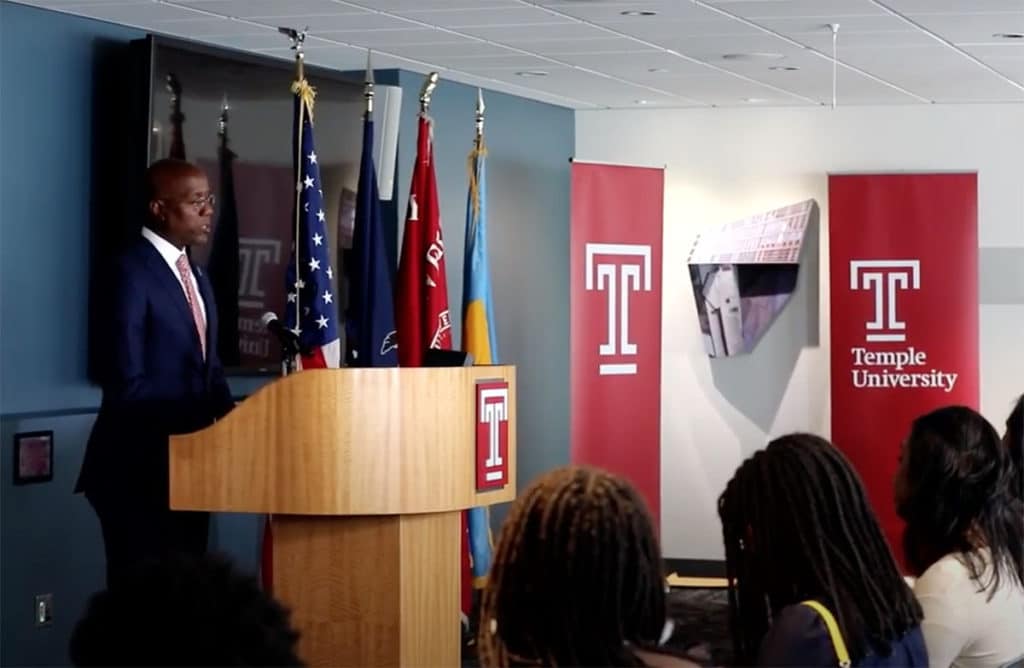
As a two-degree alumnus of Temple University in Philadelphia, and as president of the Zionist Organization of America, I cannot remain silent regarding the recent appointment of Dr. Jason Wingard—the Chair of the anti-Israel, antisemitic Tides Foundation—to be Temple University’s next president.

Under Jason Wingard’s leadership as Chair of the Tides Foundation, Tides has been funding and elevating organizations and individuals who demonize Israel, support terrorists, lead anti-Israel boycott campaigns, lead lawfare attacks on Israel and Jews, and oppose the Jewish State’s very existence. Pro-Israel groups must urge Temple University to rescind this appointment so that Wingard can’t bring Tides’ hateful ideology to Temple University’s 37,000 students, potentially via appointing anti-Israel, Jew-hating deans, faculty and programming, and other means at the disposal of someone given the powerful position of heading a major university. Wingard is still listed as a Tides Center board member.

Under Jason Wingard’s leadership as Chair of the Tides Foundation, Tides has been funding and elevating organizations and individuals who demonize Israel, support terrorists, lead anti-Israel boycott campaigns, lead lawfare attacks on Israel and Jews, and oppose the Jewish State’s very existence.

Under Dr. Wingard’s chairmanship, Tides has been funding the following groups:

AROC (Arab Resource & Organizing Center): AROC is an anti-Israel Boycott, Divestment and Sanctions (BDS) organization. AROC’s ongoing BDS campaigns include violently and unlawfully blocking numerous U.S. ports, and harassing and attacking American dockworkers to prevent cargo ships operated by an Israel-based company (ZIM) from unloading medical supplies and other items needed by Americans.

Adalah Justice Project USAAJP is another leading anti-Israel BDS organization, intertwined with Adalah in Israel, which defends terrorists. Adalah USA also lobbies for sanctions against Israel; falsely claims that Israel is mistreating Palestinian “children” when Israel arrests 17-year-old Arabs who murder innocent Israelis; falsely likens Israelis to police who murder Black Americans; and falsely accuses Israel of “indiscriminate war crimes” and similar demonization. Adalah and Tides collaborator, Dream Defenders co-authored the Movement for Black Lives (M4BL, the parent of Black Lives Matter BLM) platform, which falsely states Israel is a genocidal, apartheid State and promotes anti-Israel BDS.

Palestine Legal:  Palestine Legal promotes “mock eviction” campaigns to frighten Jewish students on college campuses; mounts numerous anti-Israel “lawfare” campaigns; defends hate groups such as Students for Justice in Palestine (SJP); advocates against anti-BDS laws; and participates in anti-Israel “days of rage” in U.S. cities.

In addition to funding these antisemitic organizations, Tides boasts that it also “provide[s] the organizational and operational support and the network to help [such groups] grow [their] impact.”

Dream Defenders:  Tides also boasts that it has a “radical collaboration” with and works closely with Dream Defenders (DD).  DD is intertwined with the PFLP (Popular Front for the Liberation of Palestine), which is a U.S.-designated foreign terrorist organization. DD promotes the PFLP in educational materials, and sponsors anti-Israel trips to “Palestine” to demonstrate and work with PFLP operatives.

Tides’ website, moreover, prominently features in multiple places articles such as one entitled “Meet These Extraordinary Palestinian Leaders.” In this article, Tides promotes anti-Israel leaders such as AROC Executive Director Lisa Kiswani and AJP Executive Director Sandra Tamari.

AROC Executive Director Lisa Kiswani’s documented long list of activities include demonizing Israel and America; promoting BDS; co-founding hate group SJP, and stating at a BDS conference, displayed on a YouTube video, that “bringing down Israel really will benefit everyone in the world, everyone in society.”

Adalah Justice Project Executive Director Sandra Tamari likewise has a long documented record of antisemitic activity, including glorifying PFLP terrorist Rasmea Odeh (convicted for murdering two Jewish students in a Jerusalem supermarket); agitating against Israel; leading BDS activities, including co-chairing the steering committee of the leading U.S. BDS group.

It defies belief that Wingard, Chairman of Tides’ Board of Directors, was unaware of Tides’ prominently-featured support for these antisemitic, anti-Israel hate groups and leaders.

I understand that Temple’s Chair, Mitchell Morgan, never questioned Dr. Wingard about his leadership of Tides before offering Dr. Winograd Temple’s presidency—a surprising lack of due diligence for the Chair of a major university. The ongoing controversy over Temple Professor Marc Lamont Hill—who calls for ending Israel’s existence and has attempted to justify murdering Jews—should have made Chairman Morgan especially sensitive and careful to avoid giving Temple’s top post to someone likely to magnify the harm Lamont Hill has done to the university’s students and reputation.

I thus call on the pro-Israel community to urge Morgan to rescind the offer to Dr. Jason Wingard of the Temple presidency.


Morton Klein is President of the Zionist Organization of America (ZOA), the oldest pro-Israel group in the US, founded in 1897.

Why the Pro-Israel Community Must Oppose the Appointment of Jason Wingard as Temple’s President Read More »

Israel and Jewish Rights Advocacy Need Help

I am a daughter of Iran and a child of Israel. As a product of my parents, Iranian-born immigrants who escaped religious persecution in the 1970s, and as the guardian of my religious and cultural beliefs, I understand that I am blessed to live in a country that gives me the great freedoms of religion, speech and existence. For the past year, as Co-President of the Trojans for Israel organization on the USC campus, I fought every day, alongside organization members, so that those who cherish their Judaism and commitment to Israel could express their beliefs without fear, distress, or dread.

Zionism and Judaism run deep in my blood. I cherish and protect my religion even as our opponents attack it. I commit myself to passion-driven works of Zionism because I know, we know, that the most important thing keeping Judaism and its people together is Israel. But I have seen how living in a secular society has taken many in the Jewish and Zionist populations farther away from their religious identity, and therefore, farther away from their attachment to the land of Israel and the movement of Zionism.

So I come from a place of honesty and write this with compassion: the Jewish and Zionist communities in our country no longer know how to advocate for Israel—or for themselves. The debate over Israel’s safety and security has become dangerously polarized and anyone who dares stand up on Israel’s behalf in public faces the risk of harsh criticism. But advocating for a religious homeland in a secular country is even more difficult when so many in our community’s ties to the Jewish faith, and therefore, the movement of Zionism, have gradually weakened.

So I come from a place of honesty and write this with compassion: the Jewish and Zionist communities in our country no longer know how to advocate for Israel—or for themselves.

That means that many of us will need to find our inspiration and motivation from some source other than Jewish religious practices in order to be effective advocates for Israel. In a time of increasing anti-Zionism and antisemitism in the United States—especially on college campuses—those of us who stand with Israel in the face of hate are pleading for help.

The challenge is only getting harder as the recent violence in Israel has led to an increase in antisemitism in this country to all-time highs. We’ve been trained to make our case on social media, where propaganda and misinformation from our opponents run rampant. But online advocacy is most useful for organizing and motivating our own supporters: the truth is that limiting ourselves to online involvement does little to persuade those who have yet to choose a side.

The most effective way of advocating for Israel and the Jewish people requires us to move away from our computer screens and move out into the real world. It’s scary. It’s risky. But it is also necessary for us if we intend to raise awareness that Jews and other supporters of Israel are being attacked—for their birthright religion and/or their belief in the birthright land of the Jewish people. Our student leaders have been left on the front lines of the public Zionist movement: they are carrying the weight for all of us, and they need more of us to step in to help share that burden.

The determination of the Jewish and Zionist communities and our potential to build support for our cause is greater than most of us think. But we will become much more likely to achieve those goals if we learn how to more effectively stand up for ourselves—in public and in person. Social media holds sizable power, and it is an effective tool, but in addition to communicating with each other, we must extend our advocacy beyond our screens and into our communities. I’ve learned from my work on campus that in-person activism can create stronger connections, more reasoned discourse, and often greater levels of trust among those in the discussion. That gets us closer to peace.

But we will become much more likely to achieve those goals if we learn how to more effectively stand up for ourselves—in public and in person.

Inspiration, passion, and education are the keys to the most important advocacy in the world: the advocacy for Israel as the Jewish state that is the embodiment of safety and security for its people. But it requires courage and confidence too, qualities that we will need for our Jewish and Zionist populations to thrive.


Chloe Rad is a Milken School alum and will be graduating from USC with a degree from the Marshall School of Business in 2022. She is a student leader on the USC campus serving as a former Co-President of Trojans for Israel and is currently the Chair of College Outreach for the Women’s International Zionist Organization (WIZO) of Los Angeles. 

Israel and Jewish Rights Advocacy Need Help Read More »

Or Worse? Climate Catastrophe and Dark Hope

It might be easier to understand and react if this were last year’s carbon footprint. If the giant sucking hole of fire and flood we’re spiraling into were the immediate consequence of more recent choices. That would make the contingency, as psychologists sometimes put it, clearer. Action, consequence; cause, effect. Release more carbon into the atmosphere, create more unbearable climate extremes.

Perhaps that sounds dramatic. The reality is that there aren’t words dramatic enough to get at the scope of our disaster.

As NASA has put it, “Even if we stopped emitting greenhouse gases today, global warming would continue to happen for at least several more decades, if not centuries.”

We’re on the steep part of the carbon emissions-global heating curve. It gets steeper every minute. And we’re thinking about it all wrong.

This year’s fires, the current superheating and megadrought and hypertornadoes and all the rest: they’re the consequences of our lousy choices five, fifteen, even twenty, thirty, and forty years ago. We’re living with the carbon consequences of old decisions. For younger people, those are decisions they had no part in. Our decisions now, for people of all ages, will have far worse outcomes than what we’re beginning to deal with today. Probably much sooner than expected.

(Small wonder so many young people are opting out of an American “normal” entirely, concluding that it’s “bulls–t.”)

If you want to think about the consequences of last year’s actions, take whatever happens this summer—and, though barely summer at all, it is filled to overflowing with dread and despair on the climate front, ringed by raging fires—and remember that it’s the outcome of much older actions. Then times it by eleventyhundred. That’s the consequence, a few years from now, of this year’s carbon emissions.

In other words, if you don’t like what you’re getting now, act immediately. Not to get something better, but to avoid something far, far worse.

In other words, if you don’t like what you’re getting now, act immediately. Not to get something better, but to avoid something far, far worse.

For climate catastrophe, “act” means act politically, at scale. Large-scale problems can’t be solved by small-scale individual gestures. As indicated in a draft of an upcoming report from the UN’s climate science advisors, “simply swapping a gas guzzler for a Tesla or planting billions of trees to offset business-as-usual isn’t going to cut it.”

In politics, we still talk about “inaction” on the climate catastrophe, but that’s profoundly misguided. We’re acting in concert plenty already. Lots and lots and lots, even during COVID.  Unfortunately, nearly all our action is oriented toward ever more hellish consequences in an ever nearer future.

It’s easy to forget that preventing global warming was once a bipartisan winner in the United States. Republican George H.W. Bush ran for, and won, the presidency in 1988 in part on a climate platform. High on having solved the hole in the ozone layer, a confident nation was ready to establish a global treaty on carbon emissions. Even the oil giants were on board, at least somewhat. John Sununu scuppered the deal. Personally, he just couldn’t see it. How could human carbon emissions possibly change the climate of the whole earth? It didn’t seem right to him.

Sununu’s the scapegoat, but one supposes plenty of other people in the energy industry saw upsides to a warmer world, too. After all, why wasn’t the U.S. climate delegation led by a capable negotiator like Richard Benedick, who had brokered the world-historical Montreal Protocol (to protect the ozone layer) in 1987 and wanted to lead the charge to control carbon emissions under Bush?

Today, immodestly modest climate proposals from the Biden presidency are treated as partisan maneuvers. Major newspapers offer silly headlines like “Democrats spar over advancing Biden’s climate agenda”—as though addressing our catastrophe were a Joe Biden thing and not, say, a universal human responsibility to one another and the world. (Indeed, the “Biden climate agenda” is woefully inadequate in its own right, and the U.S. is only one actor upon a large stage, albeit an outsized one. China’s carbon emissions are a canard waved by those hoping to forestall transformative change at home, but they’re also a real contributor to the general disaster.)

The reality is that it is simply too late to solve the climate crisis. But, it’s probably not too late to avoid the worst. And that’ll take an awful lot more than anything yet coming out of the Biden White House.

It’ll take more than partisanship and bipartisanship alike.

A couple years back, I wrote, from my home in Kachina Village, near Flagstaff, Arizona:

“Our house will probably burn. As heat-driven wildfires sweep America’s vast mountain west, the almost unthinkably devastating Paradise Fire in CA will be a regular occurrence from WA to TX. Situated as Kachina Village is along Pumphouse Wash, the seasonal stream that drops down to Oak Creek and, through that raggedly beautiful red-and-silver-white canyon, 3,000 ft to Sedona and beyond, it is only a matter of time. Kachina will most likely burn, and with it our house: 3,000 books or so, keepsakes and furnishings from around the world, G-d forbid our nonhuman companions and we ourselves, too.”

This year, in Arizona, the Rafael Fire had our house on “set,” the pre-evacuation notice. Sheriffs and volunteers went door to door. Shooting across Sycamore Canyon to the west, driven through drought-ravaged junipers by high winds, fire rushed toward our neighborhood, rained ash and the burned black leaves of live oak across all of Flagstaff. We were away from home, though, in Steamboat Springs, Colorado—where smoke from the Muddy Slide Fire also blanketed the town, obscuring entirely the runs of the ski resort. As I began writing this piece, in California the Willow Fire in Big Sur blossomed into a promise of death.

This is the fire threat, less threat than already partially achieved promise. Elsewhere the promise-threat is inundation, pandemic, dust bowls and globalized crop failures, outright heat-death, water wars (already heating up along antisemitic lines for U.S. extremists), refugee crises of unthinkable proportions.

It is hard to look at all this squarely, to accept the evidence of our senses and our scientists. There are many creative dodges, from the billionaire fantasy of bunkers and mountain-island getaways to the smaller, seemingly reasonable questions. Should we move into the city, then? Is it time to start looking at Maine or Manitoba?

We will not avoid the ravages of the climate change we have wrought. Quite the contrary: We need to confront even the possibility of widespread social breakdowns.

We can—if we become sufficiently pragmatic, honest enough to live with that shimmer of horror at our horizons that Jews have already so long endured—diminish the extent to which coming consequences threaten our very species-survival. We can increase the likelihood of sustaining our most cherished values and ways of being, can make futures together where we are, almost wherever we are.

We can—if we become sufficiently pragmatic, honest enough to live with that shimmer of horror at our horizons that Jews have already so long endured—diminish the extent to which coming consequences threaten our very species-survival.

To do that, we’ll need to change everything.

As the draft IPCC Climate Report for 2022 (reported out exclusively by AFP) has it, “We need transformational change operating on processes and behaviours at all levels: individual, communities, business, institutions, and government. We must redefine our way of life and consumption.”

And even if we do will it all still burn, house and yard and neighborhood alike? Probably, and we should not be dispassionate about that probability. As I write, the Rafael Fire is around 65,000 acres and pointed at Camp Navajo, a significant military installation near to home. Ash continues to fall in both Flagstaff and Steamboat.

These are times, then, for dark hope. Start with cold-eyed realism, yes, but then wager on our own possibilities not alone but all together and also with something like the transcendent, something like HaShem. Bet like the Marranos—the medieval Jews of the Iberian peninsula who outwardly converted to Christianity to survive the Inquisition, but held fast to Judaism within—on making a future that, though worse, will not be the worst.

That may be a long shot, but wouldn’t we be fools and scoundrels both, to bet any other way?


Ira Allen is Associate Professor of Rhetoric at Northern Arizona University and author of The Ethical Fantasy of Rhetorical Theory. His current work focuses on witnessing and constitution writing in the face of climate change.

Or Worse? Climate Catastrophe and Dark Hope Read More »