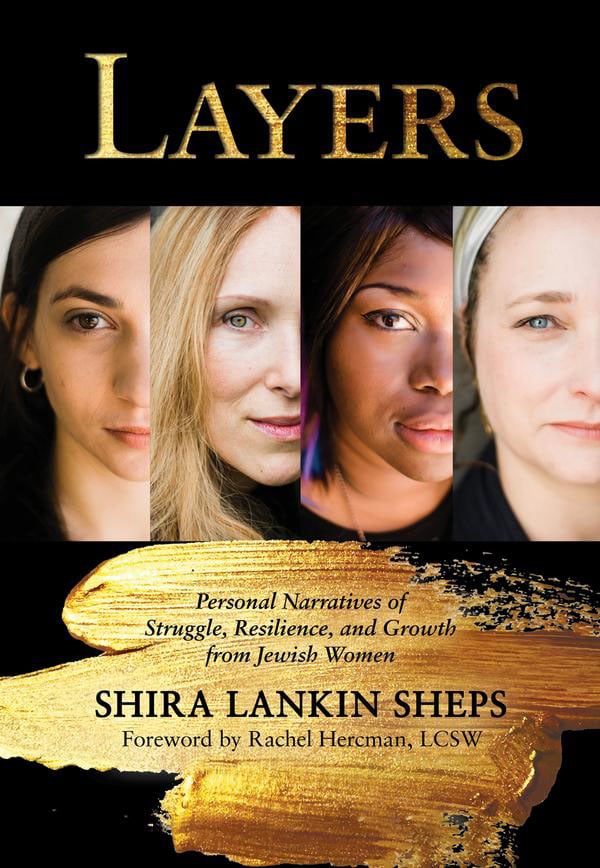
When Shira Lankin Sheps was working as a photographer back in 2017, she came up with an idea: She wanted to start a photo project where she would interview Jewish women about stigmatized and taboo topics. She posted a status on Facebook pitching the project and asked if anyone wanted to participate.
“Within the first hour, there were 20 women that reached out to me, asking to share their stories,” she said, in an interview with the Journal. “That’s how I knew this was work that I needed to do.”
The book features over 30 personal narratives from Jewish women from diverse backgrounds living in Israel, where Lankin Sheps, a Modern Orthodox Jew, lives. She decided to put the stories into print to bring them to life in a different way.
“The internet is ephemeral. Thank God, there is a vibrant social media space where Orthodox women get to share their lives, images, businesses and art,” she said. “In the right-wing Jewish media spaces, women’s images are blurred and removed for reasons they claim to be about modesty, but really it’s about advertising and placating extremist politics. The Layers Project Magazine lives online. We feature full-length, three-dimensional personal narratives of Jewish women with powerful images. I wanted to concretize the work and bring it into hardcopy.”
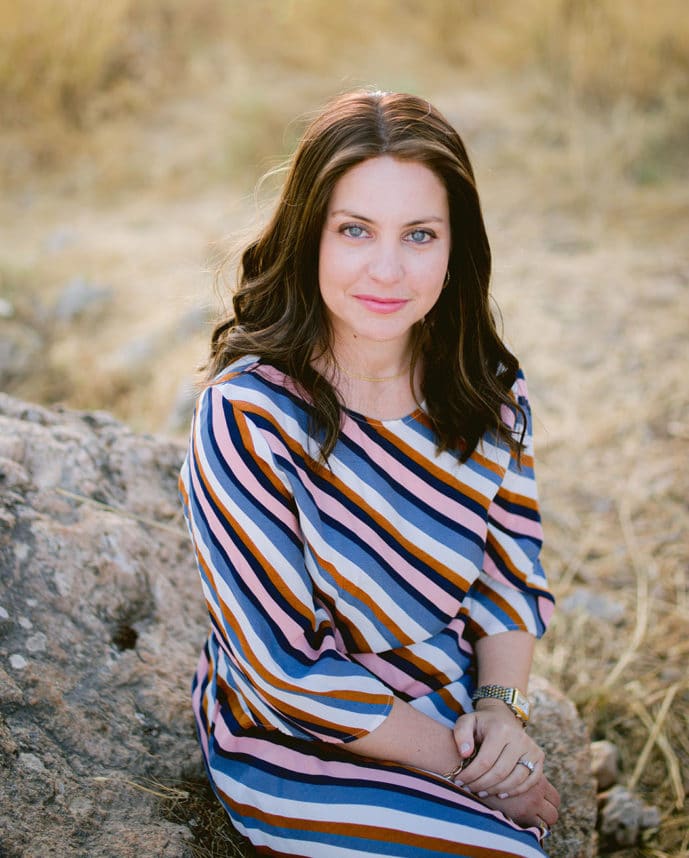
Shira Lankin Sheps: (Credit: Tzipora Lifchitz)
Though every story is touching, there are two that stand out to the author. One is from Ahava Emunah Lange, a blogger who wrote about her battle with ovarian cancer; and the other is told by Leah Klein, a Holocaust survivor and powerhouse matriarch of a large family. Both passed away before the book was published.
“[Ahava and I] formed a friendship and we wrote her chapter together,” said Lankin Sheps. “Her chapter in the book ends with her promise to fight for every last breath that she could take in this world. At her funeral, her family shared the very last lines of the chapter we wrote together. They validated that she lived every last moment, fighting to stay in this world. I can’t describe what it is like to participate even in a small way in recording a small part of her powerful legacy.”
Klein talked about her painful and loving memories of family members she lost in the Holocaust and how she rebuilt her life first in America as a post-war refugee, and then again in her 80s in Israel.
“Only a few months after we met and recorded it all, she suffered a serious illness and lost her ability to communicate,” said Lankin Sheps. “Several days before the book went to print, she left this world. We had just enough time to write a tribute of gratitude to her for her sharing her story with all of us.”
Other stories from The Layers Project focus on miscarriage, infertility, disability, antisemitism, issues with physical and mental health, and terrorism.
“I hope that readers will see that ordinary women can live extraordinary lives through their ability to live through pain and love through heartbreak,” said Lankin Sheps. “That everyone wrestles with something challenging in their life because we are put on this earth to grow, and growth often begins with struggle.”
“I hope that readers will see that ordinary women can live extraordinary lives through their ability to live through pain and love through heartbreak,” said Lankin Sheps.
Lankin Sheps is from the United States; she made aliyah in 2018. The electronic version of Layers Project Magazine shows women from all around the world, but the book is focused on women in Israel because she’s a new immigrant.
“I was commissioned to start writing the book the month after I made aliyah, three years ago,” she said. “It was a really beautiful opportunity to meet the immigrant women of this land.”
While all types of readers will be able to connect with these autobiographical stories, Lankin Sheps emphasized that women in particular can truly benefit from them.
“When Jewish women tell their personal stories of challenge and triumph, they build a community of healing,” she said. “As Jewish women navigate our many roles at home, work and even our roles in our own societies we can lean on the support of connecting with other women. Traditionally and even biblically, Jewish women create strong communities to be there for each other, to advocate for each other. We are simply re-engaging in communal growth through the prism of the pillars of our community: our women.”
Kylie Ora Lobell is a writer for the Jewish Journal of Los Angeles, The Forward, Tablet Magazine, Aish, and Chabad.org and the author of the first children’s book for the children of Jewish converts, “Jewish Just Like You.”
We’re used to clashes between ideologies in Israel—left versus right, religious versus secular, Jews versus Arabs, and so on. Underlying these clashes, however, is a more human schism: Who is acting with decency and who isn’t?
We saw extreme examples of this divide in recent days, as sore losers from one side clashed with gracious winners from the other. It started with Charedi parties, who couldn’t stomach the prospect of losing power.
“The name of the evil shall rot,” UTJ party leader Moshe Gafni said last week, referring to the incoming prime minister Naftali Bennett.
“The Jewish state is in danger,” said Shas leader Arye Deri, and “the government headed by Bennett will destroy and ruin everything that we have preserved of the Jewish character and identity of the country, which enables life together over the last 73 years.”
No insult was too harsh.
Charedi minister Ya’acov Litzman called the incoming coalition “an extremist, left-wing government without values or a moral compass,” and repeated the ridiculous notion that “everything Jewish is being wiped out.”
Likud MK’s like David Amsalem called the new coalition “a government of hate,” while MK Galit Distal Atbaryan said that Bennett and New Hope leader Gideon Sa’ar are like “parasites on an organism.”
This ugliness was merely a continuation of the corrosive and divisive politics that have plagued Israeli society under the leadership of Benjamin Netanyahu. While Bibi should be commended for his many accomplishments on the world stage, his ruthless “divide and conquer” style will not be missed by Israelis who crave unity and decency.
Bibi demonstrated that divisiveness until the bitter end, when he littered his final speech in the Knesset with nasty attacks on those who will follow him.
As my friend Yossi Klein Halevi wrote in Times of Israel, there were “two Israels” on display at the swearing-in for the new government:
“There was the Israel of desecration, MKs shouting, faces contorted with hate, trampling on the dignity of the state as they refused to allow the prime minister-designate to speak at his own inauguration. And there was the Israel of Naftali Bennett and Yair Lapid, speaking with passion and reason and self-control as they presented their coalition of healing.”
It’s hard to overstate how difficult it must have been to cobble together this new coalition of healing. The ideological differences between the many parties are so great that the mere existence of the coalition boggles the mind.
The conventional wisdom is that the intense desire to replace Netanyahu was what unified them. Yes, but there’s more. This coalition would never have happened without the decent human beings who persevered to make it happen.
It starts with Yair Lapid and Naftali Bennett. They set the tone. No matter how many ugly insults they got from the other side, no matter how difficult it became to bring together so many disparate parties, they maintained their decency while seeking unity.
The very optics of unity is an extraordinary development. When Bennett says “I assure you it is a government that will work for the sake of all the people,” he’s playing a whole new instrument.
The very optics of unity is an extraordinary development. When Bennett says “I assure you it is a government that will work for the sake of all the people,” he’s playing a whole new instrument. When he says “we’re here in the name of good” and “not to dance on the pain of others” and “we are not enemies, we are one people,” he sounds radically new.
I can’t remember the last time I heard an Israeli leader even utter such words. Maybe they figured words of unity were for suckers, or “freiers.” But it’s precisely their innocence and lack of cynicism that has made them cut through.
When Yair Lapid says, “The Israeli public deserves a functioning and responsible government that places the good of the country at the top of its agenda … All the partners in this government are committed, first and foremost, to the people of Israel,” he captures the hopes and dreams of a people exhausted by ugliness.
It is those human bonds that help us transcend our ideological differences for the sake of a higher ideal.
You can’t get to such a place of unity without a sense of decency that nurtures loyalty and friendship. It is those human bonds that help us transcend our ideological differences for the sake of a higher ideal.
The fragile new Israeli government will be shaped and tested, in many ways, by the human bonds between its two leaders—Bennett and Lapid. They will be the human face of a new Israel.
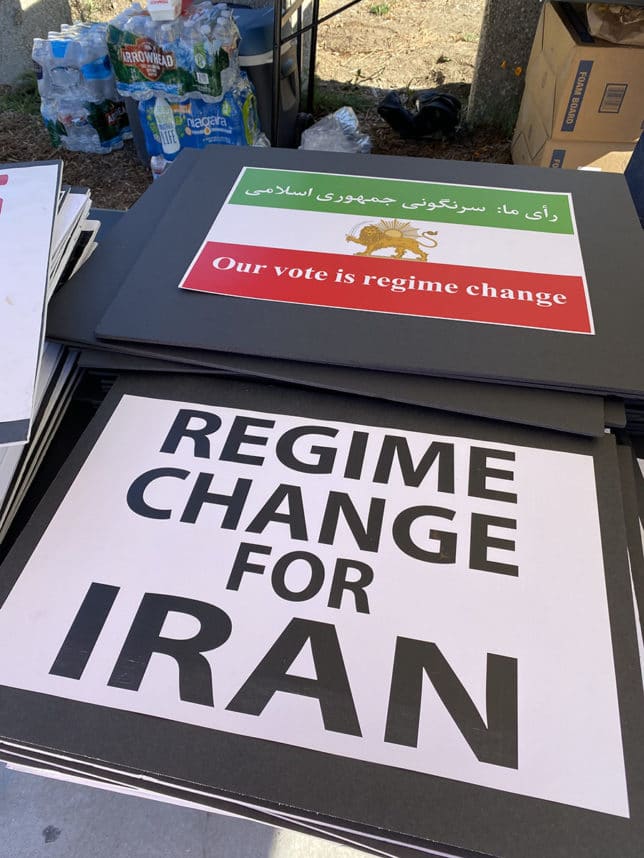
Around 200 people protested against the Iranian government on June 13 in front of the Federal Building on Wilshire Boulevard.
The demonstration, officially titled “No to the Islamic Republic of Iran Demonstration,” featured protesters chanting “Freedom for Iran,” “Down with Islamic Republic” and “President Biden, Do Not Deal with Mullahs,” among other slogans.
Photo by Aaron Bandler
“We have all different groups that are here,” Arezo Rashidian, one of the organizers of the protest, told the Journal. “We have the Jewish community, the Baha’i community, the Muslim community standing against the Islamic Republic of Iran. We’re here today to boycott the sham elections of Iran and say no to the Islamic Republic of Iran.” The elections will be held on June 19.
She added that the opposition to the Iranian government has been working to “expose the regime for its unjust human rights abuses, unjust political prisoners.”
Rashidian echoed these sentiments in her speech to the protesters and urged people to look for different ways to spread their message. “We know what’s happening in Iran in Farsi. We need to do it in other languages. If you know French, if you know Russian, if you know Armenian, spread the word what this terrorist regime is doing inside of Iran.”
Rashidian also spoke out against the Biden administration rejoining the 2015 Iran nuclear deal from which the Trump administration exited in 2018, calling the Iranian government a “terrorist organization.” “We are telling President Biden, ‘Please listen to us. It is our turn to be a voice.’”
Other speakers included Iranian singer Morteza Barjesteh, Foad Pashai, who heads the Constitutionalist Party of Iran, and Ardavan Mofid, all of whom spoke in Farsi. Rashidian was the only speaker to communicate in English. Bobby Afrooz, who came to the United States from Iran when he was 16, told the Journal that the speakers were talking about how the Iranian government is perpetuating a “fake dichotomy of reformists vs hardliners.” “People are here to say, ‘Hey, they’re all the same.’ It’s the Islamic Republic, there is no dichotomy; it’s all the Supreme Leader [Ayatollah Ali Khamenei].”
He added that the opposition to the Iranian government has been divided for the past 40 years, but now they’re united. “I guess they figured it wasn’t working; they need to unite.”
Zohreh Mizrahi, president of Persian-American Civic Action Network, told the Journal that she said during her speech it’s “about time for Iranians to be united” against the Islamic Republic. “In the past 42 years, we have experienced nothing but femicide, honor killing[s] and we cannot wait for other nations to come to our rescue. It has to come from us, and we have to stand tall, we have to stand strong against the Islamic Republic.”
She echoed the calls to boycott the upcoming elections in Iran. “In every democracy, not voting has consequences, but when there is no democracy, when you don’t vote, you are sending a strong message: that there is nothing for me to vote for.”
Golnar Djahanbani, another attendee at the protest, told the Journal that she came to the U.S. from Iran at the age of 18; her father, who was a general in the Iranian Air Force, was executed during the 1979 Iranian revolution. “What I’m witnessing for the first time after 42 years is a unity amongst a people outside and inside of Iran all over the world that is saying no to the Islamic Republic of Iran. 42 years of murdering, 42 years of terrorism against Iran and the countries around us, including Israel…enough is enough, as they say, and we want to save our young generation, which is being tortured, murdered and imprisoned every day.”
She added that “not one vote should go in that box” for the upcoming Iranian elections. “Unfortunately, what we’re hearing is that the Iranian government has paid Iraqis and given them special permission…to come into Iran and pose as Iranians and vote.” The number of Iraqis posing as Iranians to vote in the elections are already “in the thousands,” Djahanbani said.
Mofid told the Journal that the protesters are calling for a “regime change” in Iran and for the United States and other Western countries to “support people of Iran, back them up” in order to bring freedom to the country. He also urged the United Nations and Western countries to not deal with the mullahs. “Don’t pay them monies because…they’re actually just going to spread the terrorism.”
Photo by Aaron Bandler
Pashai similarly told the Journal that he disagrees with the Biden administration’s policies toward the Iranian government, arguing that the Biden administration believes that “giving a hand to” the Iranian government will be enough for them to change their behavior in the Middle East. But Pashai believes that this approach won’t work because of the Iranian government’s ideology. “If you show them the nice face, they’ll attack you. You have to show them a strong punch and a strong power.” He added that he agreed with the Trump administration’s “maximum pressure” approach against the Iranian government.
Mizrahi pointed out that it has always been against U.S. foreign policy to negotiate with terrorists and Biden is “representative of human rights for every other nation,” so why is he “not taking into consideration the human rights of Iranians” and wanting “to negotiate with the financier of all the terrorist organizations?” “This is against our public policy. It is against what America stands for and it’s going to harm Americans and the national security of this country.”
She added that regime change can happen in Iran if Western countries stop meddling “into [the Iranian people’s] affairs.” “If they stay away and if they don’t intervene or support the Islamic Republic of Iran, believe you me, Iranians are resilient enough to overthrow these mullahs.”
A typical day at Extreme Adventure Summer Camp in Spokane, Washington could involve learning Torah, riding in a helicopter, going scuba diving, and interacting with a kangaroo, monkey or tiger. Eitan Staples, a third-generation zoologist who founded the camp, wanted to start a summer camp where he could live out his childhood dreams, without turning anyone away because of finances.
“It’s all the stuff I wanted to do as a kid but couldn’t afford,” he said, in an interview with the Journal. “I thought I needed to create an environment where nobody is turned away for any reason.”
A religious Jew who comes from a Sephardic background, Staples began his career as a magician in Los Angeles and performed at The Magic Castle. When he met Siegfried and Roy, he realized he wanted to incorporate animals into his act.
A religious Jew who comes from a Sephardic background, Staples began his career as a magician in Los Angeles and performed at The Magic Castle.
“That didn’t last long,” he said. “The animals were my friends and I wanted them to be happy, so I changed my performance to be more educational. I really fell in love with the whole educational value of it.”
Staples took in abandoned animals and traveled around giving presentations and teaching about these creatures. He made it onto “The Tonight Show” and “The Today Show” and eventually decided that his animals needed to go into retirement. That’s when he opened Staples Safari Zoo and Extreme Adventure Summer Camp, which is for boys ages 13 to 18 and runs in two-week sessions throughout the summer.
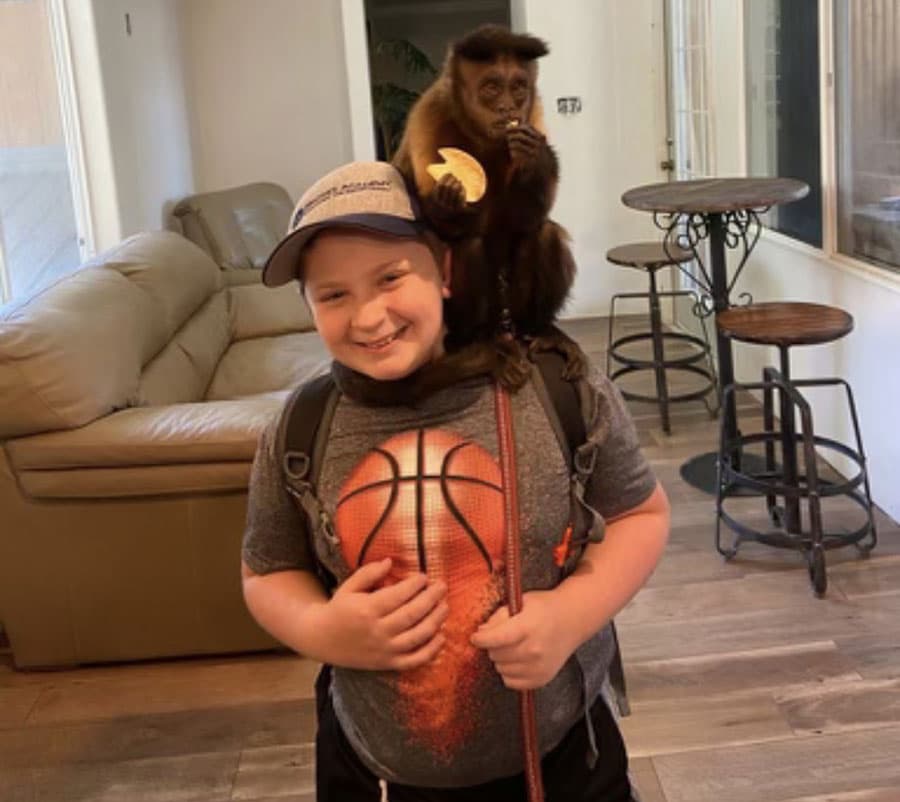
Along with hanging out with animals like dogs, cockatoos, Katahdin sheep from Maine, a Scottish Highland bull, pot-bellied pigs, Capuchin monkeys from South America, African baboons, a black leopard and a tiger, the campers learn about the halachot relating to animals, from how to obtain chalav Yisrael milk to why it’s important to chase a chicken away from her nest before taking her eggs.
“All these kids recognize the passuk but now we get to do it in real life,” said Staples. “If we can take that extra step to be compassionate and kind to animals, how much does that make you more compassionate to humans?”
While some of the kids are initially scared of the animals at the beginning of camp, by the end of the session they’ve completely changed their tune.
“I want the kids to not be afraid of the animals but to find respect and joy in them,” said Staples.
Even though camper Elan Goldberg, 13, from LA likes animals, he did wonder about the tiger before he arrived at the camp last year. “I had a small fear of the tiger, but I knew it was not a roaming tiger and that if I kept my distance I would be safe,” he said. “It was quite cool to see the tiger up close like that. I’m going back this year.”
Elan Goldberg (Photo courtesy of Elan Goldberg)
Along with the zoo, the camp has a synagogue, Spokane Sephardic Center, which hosts services every day and serves the Spokane community as well. There are also yeshiva learning rooms where the kids can study Torah.
The campers earn CPR and PADI scuba certification, hike in Mount Rainier National Park, identify local wildlife and birds and participate in activities like kayaking, water-tubing, horseback riding and ziplining.
“The whole focus is getting connected to HaShem through nature and really expressing kindness,” said Staples. “I want the kids to connect with animals and Torah where we aren’t wagging a finger at them or forcing them to sit in a yeshiva setting that they may not be familiar with. Rather, [I want] to get them engaged in activities they will become passionate about.”
“The whole focus is getting connected to HaShem through nature and really expressing kindness,” said Staples.
At Extreme Adventure Summer Camp, Staples emphasized just how easy it is to connect to the Almighty.
“You walk outside, look at the clouds, see the wildlife, reexamine your surroundings and recognize the hand of G-d you might have missed previously. We get back to nature and recognize everything comes from HaShem.”
Kylie Ora Lobell is a writer for the Jewish Journal of Los Angeles, The Forward, Tablet Magazine, Aish, and Chabad.org and the author of the first children’s book for the children of Jewish converts, “Jewish Just Like You.”
As Israelis take their first tentative and raucous steps into a post-Netanyahu era, the most frequently asked question is how long a jury-rigged governing coalition led by Naftali Bennett and Yair Lapid can survive with no discernable unifying ideology beyond an antipathy toward their controversial predecessor. While no one can predict such an uncertain future, the best person to answer that question might be Joe Biden, who is attempting to navigate a similar path.
If we think back to the strategy that Biden employed last spring to secure the Democratic presidential nomination, the parallels between the partnership that Biden assembled with various factions within his political party and the alliance that Lapid and Bennett cobbled together with a half dozen equally incompatible smaller parties become more noticeable.
The obvious structural differences between Israel’s parliamentary democracy and the presidential system used in the United States create two very different logistical challenges. Biden has been forced to build bridges within the Democratic Party, and the Bennett-Lapid team (I wonder how long Lapid will still be referenced in these discussions now that Bennett has taken office) has relied on a multi-party outreach strategy. But the philosophical difference between conservative parties such as Yisrael Beiteinu and Yamina and left-leaning parties like Labor and Meretz are similar to the distance between Alexandria Ocasio-Cortez and Joe Manchin. The governing configuration might be different, but the concept is the same.
So Biden’s successes—and his unmet challenges—when it comes to convincing unlikely ideological bedfellows to set aside their differences toward a common good might be a helpful roadmap for Israel’s new governing coalition to emulate as they prepare to move forward.
In his campaign, Biden’s first step was to convince the progressives in his own party that defeating Trump should be more important to them than maintaining their ideological purity. After using that argument successfully to persuade supporters of Bernie Sanders and Elizabeth Warren to join him in the primary, he regularly employed that same message to motivate young, progressive and minority voters to turn out for him in the general election. Lapid and Bennett used similar techniques during their own campaigns and the post-election bargaining period.
In his campaign, Biden’s first step was to convince the progressives in his own party that defeating Trump should be more important to them than maintaining their ideological purity.
But as Biden can tell them, assembling that coalition may not be easy, but maintaining it in order to govern is an even greater challenge. Biden’s first weeks in office were shaped by unpleasant memories of the January 6 violence at the U.S. Capitol and of Trump’s ongoing efforts to overturn the results of the election. Because those memories were so fresh, and because Trump’s mishandling of the coronavirus pandemic was so apparent, Biden was able to accomplished his first policy goal of a COVID-19 relief package with minimal difficulty.
But he has struggled since then to convince the two wings of his party to come together on his next legislative priorities. Trump’s absence from social media has largely kept him out of the public eye, and his focus on retribution against fellow Republicans rather than on national policy debate has lowered his profile even further. The result is that the former president no longer seems like as much of a threat to his opponents, and as a result, they have begun to turn on each other. Strange as it may seem, Biden needs Trump, if only to keep his own troops focused on their common goals.
In contrast, Bennett does not have to worry about Netanyahu going anywhere.
“If we have to be in opposition, we will do this standing tall—until we bring down this dangerous government and return to lead the state,” Netanyahu said to his supporters in closing remarks before Sunday’s vote. “I will lead you in a daily battle against this bad and dangerous left-wing government, and bring it down.”
The new coalition may face a great challenge in maintaining its unity once Netanyahu has left the stage. But it seems like that departure is not going to happen anytime soon.
The new coalition may face a great challenge in maintaining its unity once Netanyahu has left the stage. But it seems like that departure is not going to happen anytime soon.
Regardless of any differences, Biden and Bennett have plenty to learn from one another as they try to keep their ambitious and fragile coalitions together.
Dan Schnur teaches political communications at UC Berkeley, USC and Pepperdine. He hosts the weekly webinar “Politics in the Time of Coronavirus” for the Los Angeles World Affairs Council & Town Hall.
As Father’s Day approaches, I realize this year will be a unique celebration. Now that everyone in our family will be vaccinated, including our 15-year-old grandson, we can sit together around the table, something we haven’t done since 2019. The sheer joy of seeing everyone’s faces, unmasked, relishing delicious morsels, fills me with enormous gratitude.
Yet I’m also aware of those whose lives were extinguished way too early. George Floyd, a father murdered before our eyes, and fathers who passed away during this last year will not see their children grow up. They will not share in peak moments of accomplishment or celebratory occasions of Bar/Bat Mitzvah, graduation, marriage, or any other life cycle or holiday gathering where they would have reaped great joy, or “shlep naches,” as my Eastern European parents used to proudly express. Many of these lost fathers were men who dedicated their energy to supporting their families through jobs that often demanded many more hours than they cared to give.
My own father, Benny, had a full-time job and spent his weekends adding supplemental work in order to care for his own young family along with his mother, his youngest brother and his brother’s family. Together, they were a family of survivors who came to Canada, the promise of a new world after the trauma of the Shoah. After brutal abuse and tremendous loss, my survivor father traveled to Toronto with my mother and me, their miraculous new baby born in Sweden, to begin again, to create a new life and find a way to make a living among foreigners, all without knowing a word of English.
Together, they were a family of survivors who came to Canada, the promise of a new world after the trauma of the Shoah.
How many men, fathers like my own, dug deep into their vast expanse of courage, despite physical weakness and emotional chaos, to take the next step so they could begin again and be “fruitful and multiply”? In the wake of unspeakable tragedy, countless men, who in most cultures were expected not to cry or express fear, lifted themselves up and like Avraham, who was mandated to “Lech L’cha,” journeyed into the unknown, traveling to the promised land to bring new life into the world. They did all this so that “L’dor vador”—“from generation to generation”—could become a reality.
Av, the Hebrew word for father, is a central principle in Judaism. Until recently, perhaps 30-40 years ago, our central prayer in the three daily services was called “Avot,” fathers. For nearly 2000 years our intimate conversations with G-d began by recognizing our ancestral fathers, Avraham, Isaac, and Jacob—men, mavericks, who are the foundation of our tradition despite their foibles. In the biblical narrative, the importance of being a male who fathered sons is apparent. Even as egalitarian Judaism recognizes the importance of women in our tradition, we must also see Judaism through the eyes of the ancient world, where the role of men was to fight and protect, often to their own peril, to keep their families safe and provide a future.
Ancient and classical Judaism expanded the role of men as fighters and protectors to include the expectation that they will study and teach Torah so that the wisdom of our texts will not be lost. The Torah reminds us “teach your children….” It is an imperative that cannot be ignored. In Judaism, a father’s relationship with his child is grounded in his commitment to fulfill this duty. There are those who believe that Moshe is left out of the Haggadah because he failed as a father, abandoning his sons (and his wife) to become G-d’s partner and denying them the possibility of priesthood. The figure of the father is central in the Jewish tradition. Even in our most sacred days, the High Holy Days, we say, “Avinu…Our Father…please show us compassion and forgive our sins.”
Yes, fatherhood is central to our tradition. As one who honors the feminine and the imminent presence of the Holy One as Shechinah, it is also important to acknowledge the fathers, ancient and present, who have dedicated their lives to loving and treasuring their children—their hope for the future. Let us remember and honor the men who are both seed and harvesters of our lives, the men who passed on the values of hard work, protection, loyalty, teaching, sacrifice, and dedication to family.
As one who honors the feminine and the imminent presence of the Holy One as Shechinah, it is also important to acknowledge the fathers, ancient and present, who have dedicated their lives to loving and treasuring their children—their hope for the future.
Here’s to you, dad, beloved father, who bequeathed a plethora of skills and values that sustain me. Here’s to my husband Steve, who dedicated countless hours not only to sustain a congregation and be father to many, but also to find the time to remain available to his own children in moments of need. Here’s to all fathers for your dedication to lead, teach, act as a role model, and exemplify the love (whether spoken or not) you have and will always have for your children.
Bless you all!
Eva Robbins is a rabbi, cantor, artist and the author of “Spiritual Surgery: A Journey of Healing Mind, Body and Spirit.”
Re: June 14 Council meeting; item A-1, exclusionary resolution 2021-R
Dear Members of the Culver City City Council,
Please read my remarks into the record, which I’m writing as an individual member of the Council of the City of Beverly Hills, one of the only Jewish-majority cities outside of Israel, and a city which itself has a past history of exclusion and restrictive covenants towards Blacks, Jews and other groups.
Jew-hatred is a form of racism. Jew-hatred, also sometimes pseudo-scientifically called antisemitism, is likely the oldest, most atavistic and most pathological form of racism, not unlike a virus which has been constantly mutating for over two millennia.
While undoubtedly well-intentioned, item A-1, the proposed resolution 2021-R acknowledging the racial history of Culver City unfortunately excludes any history of racism towards Jews, who are not even mentioned in the draft resolution by name.
Talking about exclusionary covenants and systemic racism towards “people of non-Christian religious faiths” is a kind of whitewashing and, quite frankly, a trivialization of the institutional and systemic antisemitism which has impacted Jews for centuries in this country and for millennia in this world. Covenants did not specifically exclude Muslims or Hindus or Shintoists or people of any other “non-Christian religious faith”; they specifically excluded Jews. The KKK, which, as the resolution discussed, operated with impunity in Culver City, echoed (and still echoes) Nazi hatred towards Jews, not towards all “people of non-Christian religious faiths” and reserved (and still reserves) some of its worst venom for Jews.
Of all the groups they could have chosen to call out, white supremacists routinely chant “Jews will not replace us.” They don’t chant “people of non-Christian religious faiths won’t replace us.” Even today the KKK and other white supremacist groups use Israel as an excuse to unleash their Jew-hatred.
Furthermore, lumping Jews in with “people of non-Christian religious backgrounds” not only erases Jewish history, it also ignores the fact that Jews are not just members of a religious faith, but are a People, connected by their common history, group memory, shared aspirations and DNA. Some Jews are not religious at all.
By ignoring the impact of policies of exclusion towards Jews, the resolution latently denies Jews our Peoplehood and trivializes our unique history of persecution and persistence, ongoing for millennia. Such a trivialization could itself easily be seen as discriminatory and bigoted towards Jews, perpetuating the virus of antisemitism, which mutates into any number of forms of hatred, denial, erasure, and apathy.
How effective can a “truth and reconciliation process” really be that attempts to ignore, rewrite and literally whitewash a part of history?
Attempts to paint Jews as “white” ignore Jewish history and trivialize the unique Jewish experience of suffering and survival. As mentioned, white supremacists clearly don’t consider Jews white, while antisemites on the other side often paint Jews as colonizers and beneficiaries of “white privilege.” Again, the virus of Jew-hatred has mutated in ways that demonize Jews while attempting to define them, with outside groups denying Jews their Peoplehood and sacred right of self-definition.
Perhaps it’s time that we started speaking seriously of Gentile privilege, in addition to other forms of privilege. Because the fact remains that Jews – Ashkenazi, Sephardic and Mizrahi Jews – are all linked by DNA to each other and to the Middle East, and if other Middle Easterners are to be considered “people of color,” so must Jews, who are native to the Middle East and whose indigenous status is often called into question in continual antisemitic microaggressions and outright anti-Jewish attacks.
Culver City is not only a city with a history of cross burnings on the front lawns of the homes of Jewish residents, it’s also a city where just last month, in May of 2021, a street advertisement was vandalized with a swastika and the words, “Jews fund BLM.”
A swastika. The symbol of fascism and Nazi crimes against the Jewish People and humanity. A reference to BLM, a leftwing group which itself has engaged in antisemitic and dehumanizing rhetoric towards Jews. The mutating virus of Jew-hatred – for which there is no Pfizer, Moderna or J&J vaccine – so concisely captured in one jarring instance of vandalism in Culver City less than a month ago.
In a time in which anti-Jewish hate crimes and violence are once again spiking worldwide, in addition to correcting this exclusionary resolution meant to acknowledge the racial history of Culver City, which has been unceremoniously whitewashed and scrubbed of antisemitism, it would make sense for the Culver City City Council also to enact a resolution adopting the IHRA definition of antisemitism, as Beverly Hills did last year when I was mayor.
We would be happy to assist you in taking this important measure against ongoing Jew-hatred, along with helping you craft a resolution in condemnation of anti-Jewish racism. Thank you for your efforts to come to a reckoning with racism in Culver City and I hope you are able to fix the elements of that reckoning which erase the lived experience of your Jewish neighbors.
Sincerely,
John Mirisch
Beverly Hills City Council
I am once again astonished by how some people can turn personal tragedy into a fulcrum to move and improve the world.
Our journey begins this year on June 3, by driving along Highway Six to the Negev. It flows by open fields and hills, and birds, sometimes in evocative flocks, glide above the cars. Everyone thinks of the Negev as being a hot place, but in the evening, it cools and we can feel the beginning of a breeze.
And there, among the summer dust and the cool winds, we come upon an oasis of humanity. We have arrived at the beautiful ADI Negev-Nahalat Eran therapeutic and residential village to attend a concert by the world-renowned Israel Philharmonic Orchestra, conducted by Yoel Levi, whose usual venues are elegant halls in Israel and Europe.
Tonight, however, following more than a year under pandemic protocol, and several intense days in the direct line of fire from Gazan rockets, they will be playing in the accessible amphitheater of this ground-breaking venture on the outskirts of the desert town of Ofakim.
But something is happening here that is much more important than a concert.
ADI (formerly ALEH Jerusalem and ALEH Negev-Nahalat Eran) is legendary as Israel’s most comprehensive provider of residential and rehabilitative care. The village that sits on 25 acres is home to 165 individuals with severe disabilities whom it serves in that capacity. There are over 500 professional staff members, including doctors, nurses, therapists and special educators, and more than 800 annual volunteers. It has a hydrotherapy pool, special education school, integrated nursery, green care farm, and a therapeutic horse farm and petting zoo.
This concert is to celebrate the opening of ADI’s Neuro-Orthopedic Rehabilitative Hospital in the Negev, the first of its kind in Israel’s south, scheduled to be completed later this year. ADI spokesperson Elie Klein (no relation to this writer) says, “There are other rehabilitative hospitals in Israel, but we will be among the largest. It will include 108 rehabilitative hospital beds and will also create more housing and jobs in the Negev. Residences for the medical professionals who will work at the hospital are also being built adjacent to the village.”
This concert is to celebrate the opening of ADI’s Neuro-Orthopedic Rehabilitative Hospital in the Negev, the first of its kind in Israel’s south, scheduled to be completed later this year.
But there’s more. The start-up nation that created the flash drive, Waze, the rooftop solar hot-water system, the flexible stent, and scores of other technological and medical inventions, will not only change the face of rehabilitative care in Israel, but also go far beyond through state-of-the-art translational research that can be used globally. Klein explains that translational research is research that can be immediately implemented effectively in the field. “Through partnerships with Ben-Gurion University of the Negev, Johns Hopkins University, the Sheba Medical Center, the Weizmann Institute and Irbid National University in Jordan, researchers at the hospital will study the trauma and recovery of everything from car accidents to COVID-19, which will be shared with hospitals across the country and around the world to improve global best practices.”
So the whole world will benefit from this project.
Musicians connect directly with the children.
The orchestra’s musicians had traveled to the village two weeks earlier and played music for and with the children of ADI. How could they play “with” the youngsters, most of whom could not speak and some of whom did not usually make eye contact? By putting percussion instruments into their hands and showing them what to do.
While the musicians performed their repertoire of delightful light classics at the concert, we saw, on large screen behind them, ADI children “playing” drums, triangles, wind chimes, cymbals and more. A girl puts her hand on a trombone, connecting with the music. A boy lays his hand on a violin while the musician plucks its strings. This film, which was shown on an occasional loop throughout the concert was, for me, the most moving part of the evening. At one point it was accompanied by an original composition by the Israel Philharmonic called “Every Person is a Symphony.”
I wondered about some of the children I saw in the video, who appeared to be “typical” children. Klein explains, “We have an integrated preschool—one class of children with disabilities and a second with their non-disabled peers. The classes are mixed throughout their daily activities to teach empathy and inclusion from a very young age. The very young children seen in the video are a mixture of both classes.”
It was heart-warming to see them together in the video, and to know that the children in these mixed pre-schools will grow up with understanding for those with disabilities, and a different attitude in general toward people in our society who are different.
Who is behind this initiative?
Major General (Reserves) Doron Almog, Founder and Chairman of ADI Negev-Nahalat Eran, is the centrifugal force advancing this mammoth project. An emulated former commander of the Paratroopers Brigade who also held other prestigious army positions, he was awarded the Israel Prize for lifetime achievement in 2016.
He petitioned for the founding of the village due to his experience with his son, Eran, named for Almog’s brother who fell in the Yom Kippur War. Eran was born with brain damage, and suffered from severe autism and cognitive disabilities. He died at age 23 in 2007. Almog also had a daughter who died when she was one month old. His remaining child, Dr. Nitzan Almog, was 10 when Eran was born. Today she is a senior clinical research associate at IQVIA (The Human Data Science Company).
Doron Almog is an IDF hero. He has participated in three of Israel’s wars and many military operations. Since the evening was also in honor of his 70th birthday, it was no wonder that among the guests were IDF Chief of Staff Major General Aviv Kochavi, former Chief of Staff and former Defense Minister Moshe “Boogie” Ayalon, Minister of Culture and Sport Hili Tropper, former U.S. Ambassador to Israel David Friedman, and former Israel Ambassador to the UN Dore Gold. Almog described emotionally, to the crowd, how painful it was when he used to take his son Eran with him to swim at the Nes Tziona Country Club, and some of the people there looked askance. Almog related, “A man said to me recently, ‘We remember how you used to come here with your son, and some people used to ask, ‘Why is he bringing his retarded son here?’ and you said to one of them, ‘I think you are the one who belongs in a closed institution.’” It was then that he realized that individuals with disabilities need a place that will treat them with respect, and that will give them the treatments and care that they need. He described how he and his wife Didi went from school to school, from institution to institution, and their hearts were broken when they found nothing appropriate, and many in appalling condition. “I thought, it is not right that we know how to go to Entebbe and Ethiopia and won’t have mutual societal caring and intervention here in Israel.” Almog had command of the first task force in Operation Entebbe in 1976, and he was the first paratrooper on the ground. He commanded the Shaldag Unit (similar to Navy Seals) in Operation Moses, the airlift of 7,000 Jews from Ethiopia, in 1984-5. I wondered if there was an age limitation for the ADI residents. Klein replied, “No…It is a home and a family providing a continuum of loving care from infancy and childhood through adulthood. Some of our residents are in their 60s.”
It was then that he realized that individuals with disabilities need a place that will treat them with respect, and that will give them the treatments and care that they need.
Almog said, “The strength of the human chain is only as strong as its weakest link–our ability to become better people and an exemplary society is dependent upon our commitment and our efforts to advancing the most vulnerable among us…While it is often said that every person is a world unto himself, we believe that every person is actually a symphony–unique, complex and beautiful–and we can appreciate the wonders of each individual if only we take the time to listen to the music of their souls.”
From a caravan to a state-of-the-art hospital
It had been David Ben Gurion’s vision to develop the Negev, and in more recent decades this dream has been implemented exponentially, with the increased advancement of Ben Gurion University, the Soroka Medical Center and more. “The residents of Israel’s south deserve the same care as those in every other part of the country, and we believe that we can set the bar higher for rehabilitative care,” added Almog.
Almog called the musicians’ earlier visit to the village, “Incredibly powerful…But you couldn’t help but notice the striking contrast between the beautiful music, which no doubt reaches the heavens, and our residents who are always silent.” This concert, he said, gave the ADI residents a voice.
ADI has gathered about it a cadre of supporters who are dedicated to helping it continue to grow and succeed. The building of the hospital is being implemented, Klein says, thanks to the support of JNF-USA, multiple government ministries and international donors, with one of whom I spoke at length.
Alicia Kaylie Yacoby, of the Harvey and Gloria Kaylie foundation (created by her parents), who says she is “a born and bred New Yorker, from Brooklyn,” has lived in Israel for more than 30 years. “My favorite part of the evening was watching the children with the percussion; I was thinking about how ADI Negev was doing it right, bringing the top of the top to these residents because that’s their standard.” She said the Kaylie Foundation has an interest in ADI Negev because, “We strive for higher standards and for excellence and for innovation. ADI Negev meets all those requirements and does it all very well professionally, aside from the fact that we’re committed to the issue of supporting special needs.”
But I knew there must be more to the story, because that’s the way it is with supporters of causes—there is usually a personal reason. “Why does this speak so much to your heart?” I asked.
“My uncle—my father’s brother—was born healthy and the medicine that they gave him saved his life but made him mentally challenged—high functioning—so we see it up close,” says Yacoby. “He’s living in a residence in Ohel with nine other men like him [in New York] …They also have very high standards. So we appreciate when people see special needs people as no different from any of us, and they just need more help.
“My father met with Doron Almog and when he first visited the place there was only a caravan and Doron’s vision. And it’s not as if it was always easy… there were many challenges and maybe one of the biggest ones was finding and maintaining staff. “[For example] when my father visited the village, he thought it could be a happier, more positive environment, and then my husband Danny suggested that National Service girls volunteer there; he was also involved in the implementation of it.
“In the beginning it was hard to get the girls to go there but now there’s a long waiting list and there are about 50 National Service; they bring such life to the village…We visited recently on chol hamoed Pesach and met some girls from previous years who came to visit because they missed the residents and the ADI Negev ‘vibe.’ “
She shares a story about one of these National Service volunteers. “Once there was a very large resident who suffered from rages of anger and, unfortunately, he broke the finger of one of the staff members, so they thought ADI wasn’t a good fit for him. Then this petite National Service girl said, ‘Give me a week,’ and he was putty in her hands, he became the most relaxed person. She was 18 years old. Maybe it’s a combination of being naïve and hopeful that conquers, and they do conquer; they are extraordinary.”
Their foundation has been on this trajectory for years. “Camp Kaylie in NY was the first completely integrated camp between special needs children and typical children and now there are others because it’s so successful. It’s run by Ohel, named after my parents. There is a long waiting list. My husband is also involved.”
A Shoah Connection and Project
“I participated in the ADI Negev Yom Hashoah ceremony, this year,” says Yacoby, “because of the candles, our six million.” She is referring to a project she created called “A Candle for Every Name,” in which people light candles for specific individuals on Yom Hashoah, their goal being to reach 6 million lighted. So far 4,532,122 candles have been lighted. “They just blew us away, those German volunteers.”
Almog told the audience about the group to which she referred—young German volunteers who have been coming to ADI Negev since 2007, four of whom came this year for six months to volunteer with Israelis with disabilities, to atone for the sins of their Nazi grandparents. Klein elaborates, “They are members of the organization ‘March of Life,’ and they believe that every German family was complicit in the Holocaust, and are thus responsible for speaking the truth, raising their voices against antisemitism and standing in friendship with Israel. They see volunteering with ADI as the ultimate challenge of true acceptance of all individuals, and thus the ultimate redemption.”
“They see volunteering with ADI as the ultimate challenge of true acceptance of all individuals, and thus the ultimate redemption.”
I found this both chilling and moving since the Nazis murdered people with disabilities. One of the German volunteers, Shayna Isabell Wither, 19, recently discovered that her grandfather was the one who planned Auschwitz. “On Yom Hashoah this year, these four young people spoke with Israeli Holocaust survivors—asking for forgiveness and gaining much needed closure,” says Klein.
Almog told the audience, “About the Germans: We have one day of kapara—redeeming ourselves—Yom Kippur. But these young people see every day as a day that they must work for kapara for what their grandparents did. They are preparing a March of Nations for May 14 of next year, the day of Israel’s independence. And they want to begin the march here, in ADI Negev.” He said that they want there to be no more “race theory,” but the acceptance that we are all equal people. “Eran is no longer with us, but he continues to kick and to build this place,” said Almog. “It is not enough to give them a place to live. We want them to be part of the State of Israel, and have the highest quality of life possible. Being a better person, creating a better society, that is what creates a better world.” Yakoby: “To sum it up, the whole atmosphere of ADI Negev is, ‘We can.’ It’s just a big hug to everyone. It’s kind of magical.” On Sunday, June 20, an enhanced program, including the full Israel Philharmonic concert and a behind-the-scenes look at ADI Negev’s new rehabilitative hospital, will be broadcast to ADI’s friends and supporters around the globe. Free tickets for the International Broadcast can be secured by registering at http://bit.ly/adinegevconcert. If you want to warm your heart, I suggest you tune in to that broadcast, to remind yourself that every person is a symphony.
Toby Klein Greenwald is an award-winning journalist, theatre director and the editor of WholeFamily.com, who is blessed to have children and grandchildren settling the Negev.
When it comes to genetic screening, it’s usually the prospective mothers who take the initiative on it. But what about the dads? Doesn’t it take two people to have a baby? Just in time for Father’s Day, we’ve asked genetic counselor Daniella Kamara to address some of the most common questions men have about screening for genetic diseases.
1. My wife has already had genetic screening. Why do men need to be screened as well?
Even if your wife had carrier screening and her results are normal, it can be important for you (the male partner) to still be screened, although the chance of having a child with a genetic condition is very low. The reason it is important is because carrier screening can provide information for you personally as well as for your family members and future children. For example, if you find out you are a carrier for a certain genetic condition there is a 50% chance that your children will also be carriers (they will not have the disease but be carriers like you). This will be important information for them to have when they start to have children in the future. Additionally, you can inform your siblings or cousins because there is also a chance that they are carriers for the same condition and this is essential information for them to know.
2. Aren’t many genetic conditions passed down from the woman’s line?
Some genetic conditions are sex-linked, meaning the way they are inherited depends on which parent is a carrier. However most genetic conditions are not sex-linked and can be passed down from mother or father. The most common sex-linked condition is Fragile X syndrome, which can be passed from mother to son. Typically in Fragile X syndrome the mothers are unaffected and then they have a son born with Fragile X. Carrier screening will test for sex-linked conditions as well as non-sex-linked conditions.
3. We’re an interfaith couple. Doesn’t that mean we’re not at risk for genetic conditions?
Unfortunately, no couple is at 0% risk for genetic conditions. Couples of different ethinic backgrounds have a lower risk of being carriers for the same genetic conditions, however it is still possible. For that reason, it is essential that all couples, even those of different ethnicities, undergo carrier screening prior to conceiving.
4. I got screened for genetic diseases several years ago before we had our first child. Do I really need to be screened again?
Technology and science have come a long way in the last decade. The type of testing that is done now is very different from what was done even 6 years ago! For those that were tested many years ago, there are more comprehensive tests available that provide much more detailed and accurate information for individuals and couples. So, yes! It’s time to think about getting an updated test.
5. I did the 23andMe test. Isn’t that all the genetic screening I need?
No! 23andMe and other Direct To Consumer genetic testing options are not medical grade tests and do not provide the same information carrier screening done through a healthcare professional would provide. Although it may provide some information about conditions you are a carrier for, it does not provide the same level of analysis or accuracy as a medical grade test. Speak to a healthcare professional about carrier screening.
An exclusive offer from Gene Test Now for Jewish Journal readers. Save $36 on an in-home genetic screening kit from JScreen. Click here to learn more about getting screened. JScreen tests for more than 200 genetic conditions, including those that are more common in individuals of Jewish ancestry, as well as diseases that are common across ethnic groups.
GeneTestNow.com is a nonprofit initiative of the Doris Factor Endowment Fund of the Jewish Community Foundation of Los Angeles.